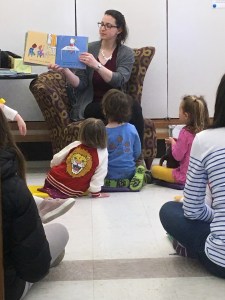
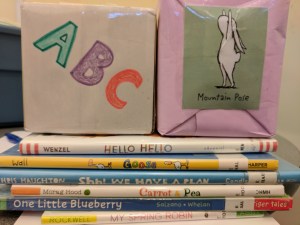
It was a beautiful day and a BIG group in our little storytime room today – about 18 kids plus a baby or two and accompanying grownups. It was a correspondingly loud storytime, so when possible, I used techniques to harness and direct the noise: CAW-ing like a crow in Harold and His Woolly Hat, HONK-ing with Goose Goes to School, lots of songs from the song cube.
- Welcome and announcements
- “Hello Friends” song with ASL from Jbrary
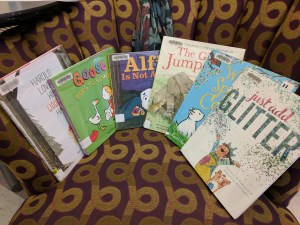
- Harold Loves His Woolly Hat by Vern Kousky: I got a little brown bear out of our stuffed animal/puppet closet and let the kids pet it after the story. Hat tip to Lauren at the Robbins Library for reading Harold at her storytime a few months ago.
- Yoga: forward fold to touch toes, stretch to touch ceiling
- Goose Goes to School by Laura Wall: Again, Goose was a hit. I don’t know if it’s the bright colors or the text-to-illustration ratio or what, but it’s magic.
- Song cube: Itsy-bitsy Spider, I Had A Little Turtle
- Alfie Is Not Afraid by Patricia Carlin: Nearly all of the humor in this book comes from the juxtaposition between the pictures and the text, so I mentioned that upfront as something to look out for.
- Yoga: Seated forward fold, stretch toward the ceiling, stretch to either side
- When Spring Comes by Kevin Henkes: An informal poll shows that EVERYONE likes jumping in puddles.
- “Shake Your Sillies Out” with shaker eggs (and scarves, because I ran out of eggs)
- The Giant Jumperee by Julia Donaldson
- Song cube: Zoom Zoom Zoom, We’re Going to the Moon; I’m A Little Teapot; Where Is Thumbkin?
- Just Add Glitter by Angela DiTerlizzi and Samantha Cotterill: This has textured pages, which I let the kids feel after the story.
- “Goodbye Friends” song with ASL from Jbrary
- Clean up mats, get coloring sheets (I drew two different types of hat and made copies), color with crayons, come choose a colored pom pom and get a dot of glue.


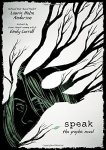 The past few months have also brought us graphic novel adaptations of Laurie Halse Anderson’s Speak and Lois Lowry’s The Giver. The former is YA rather than middle grade, and the art is quite different from the books above; Emily Carroll did an absolutely haunting job translating Speak into a new format. Melissa’s silence, the claustrophobic atmosphere of menace, and the slow healing and emerging that takes place are rendered in a way that honors and enhances the original.
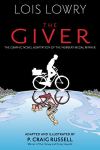 The Giver is often read in late grade school, though it’s one of those books that is thought-provoking no matter when in life you encounter it. Unlike the rest of the books here, it is set in a different reality than our own, a futuristic place of Sameness. P. Craig Russell produced the graphic novel version; cool blues and grays prevail, until Jonas’ moments of “seeing beyond” introduce flashes of color, and The Giver’s memories do the same. The Giver himself looks less Kindly and more ominous than I had pictured him, and the whole community has a 1950s vibe (on purpose). It’s very hard to improve on the original, and as one of the first utopia/dystopia novels that young readers encounter, it’s not in danger of falling by the wayside, but if this version of The Giver finds a new audience, all the better.
 Jenny Arch