This year’s Massachusetts Library Association (MLS) Annual Meeting was at Fort Devens, where I have been many times – but only to play in ultimate frisbee tournaments. The meeting involved no cleats, frostbite, or heatstroke, which was an altogether different experience!
After a brief welcome from MLS Executive Director Sarah Sogigian and MLS Executive Board President Anna Bognolo (also the director of the Greenfield Public Library, which has a beautiful new building!), reporter Matt Shearer delivered a morning keynote full of short, funny videos of hyper-local news stories, such as the famous (in internet circles) story of one of the three Market Baskets on Boston Road closing in Billerica, and the sad tale of the Dunkin Donuts-less town of Stow, MA. Matt’s approach to reporting is, “I show up in small towns and try to find something cool.” After much exploring, he has concluded, “It is the people who make these towns special.” He says, “I’m trying to find the things that aren’t getting covered, the people whose voices aren’t getting heard.” And he recommended, when creating content, to have fun with it, and people will find it engaging.
The way that people respond to Matt’s videos – locally and more broadly, as many of his videos have gone viral – makes me think of the decrease in local news coverage over the past few decades, as local and regional papers fold, and people are left to rely on social media (e.g. Facebook, NextDoor) or national papers like The New York Times. This has contributed to a lack of trust in the print media, as there can be such a great distance between the issues that have a real impact on peoples’ day-to-day lives and the issues that national papers cover. Matt’s use of humor helps, too, and his genuine curiosity about people’s lives.
The business meeting was short and sweet, followed by an update from MBLC Director James Lonergan. He urged everyone to continue contacting state representatives to support library budget lines, all of which have seen increases recently. The focus next year will be on continued support for State Aid to libraries, and a bigger increase for the Massachusetts Center for the Book. Lonergan also mentioned MLS’ partnership with Unite Against Book Bans (MLS, MLA, and MSLA are all partners).
 Uniting against book bans tied in nicely to William Adamczyk’s update from the MLA Legislative Committee. There was a hearing on Monday, October 30 that was relevant to several different library interests (you can watch it here), including library access to e-books and digital audiobooks, freedom to read, and protection against book bans. MLA has been working closely with MSLA and with EveryLibrary to have a funded, effective school library program and a licensed school librarian in every school in the commonwealth (see “The Top 5 Reasons for having a Licensed School Library Teacher in Every School“). The Massachusetts Teachers Association (MTA) is in full support of this effort. Another goal is for the MA Department of Elementary and Secondary Education (DESE) to designate a school library point person – someone who understands the importance and value of librarians in schools.
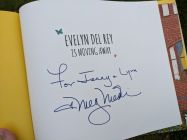 After lunch, it was time for MEG MEDINA! Yes, she’s caps-lock-worthy: she’s the National Ambassador for Young People’s Literature, a faculty member of the Hamline MFA program, and the author of Merci Suárez Changes Gears, which won the Newbery Medal in 2019. She has written two sequels to Merci, as well as picture books Mango, Abuela, and Me; Tía Isa Wants A Car; and Evelyn Del Rey Is Moving Away. Most recently she has contributed to Chelsea Clinton’s She Persisted series of biographies, with entries on Sonia Sotomayor and Pura Belpré.
Medina graciously answered questions from Christi Showman Farrar and Kristi Chadwick from MLS. Some excerpts from their conversation:
- When did storytelling start for you? When did you decide to become a writer? Medina’s family moved to the U.S. in the 1960s, due to political turmoil in Cuba; she believes that her family “used story to deal with the trauma of loss of homeland.” She did not begin writing fiction until she turned 40.
- How do you decide whether the story is a novel, a picture book…does the story tell you what it’s going to be or do you make that decision? A little of both. Tía Isa would have made a funny middle grade novel. “When you sit with a story for a second, your heart sort of tells you the piece of it that matters most, and that helps you navigate” what age to write it for. What matters to you the most in that moment about telling that story?
- When books are published simultaneously (or nearly) in English and Spanish, what is the translation process like? “We have all points of language” in Latino families, with some fluent in English, some in Spanish, some in both. Availability of books in both languages allow the family to experience the story together, in the language they’re most comfortable with. “More language is more people you can talk to.”
- What was your involvement in the graphic novel adaptation of Yaqui Delgado Wants to Kick Your Ass? Medina said it takes her a while when she sees visual representations of her work, even book covers, because the artist’s representation is always different from what she sees in her head. “I feel about graphic novels the way I feel about movies….This is a new generation and it’s a different art form….[I’m] glad it’s coming to a new generation of readers.”
- What was the research process like for Burn Baby Burn? “You think you remember everything accurately…you don’t!” It was fascinating to dig into the research, including the NOW archives at NYU, which covered the Women’s March in much more detail than The New York Times. She asked, “Who’s telling the story? And what was omitted?” and added, “That idea of not being erased is vitally important right now.”
- Question from a school librarian: How do you help teachers who are attached to classics understand that there is so much new talent? You’re not throwing away the classics, but nothing can become a classic if no one reads it. Medina suggested shelf talkers that pair the classic with the new, like Little House on the Prairie with Linda Sue Park’s Prairie Lotus. “Give people a way to think about those books. Give them a way to preserve both, if they must.”
Other questions and answers covered what it was like to get “the call” (from the Newbery committee), what she does in her role as the National Ambassador (“Book friend to America’s children”), outreach to Latino populations, how to get kids passionate about stories, and challenges to youth materials (she spoke to both the Senate and the House).
Thank you, Meg, for coming to our meeting, and for everything you do for children’s literature!
 Jenny Arch