The Morgan Library in New York recently hosted a conversation between Maria Popova and Sophie Blackall, “Children’s Books as Philosophy for Living,” and the recording is available on their website. (The Morgan Library, incidentally, is where I learned that E.B. White, author of The Trumpet of the Swan and Charlotte’s Web, is the same E.B. White as The Elements of Style by Strunk & White. I cannot now find a listing for that exhibit on the Morgan website, but I am 99% sure that’s where I saw his manuscripts, journals, and letters and made the connection. Anyway…)
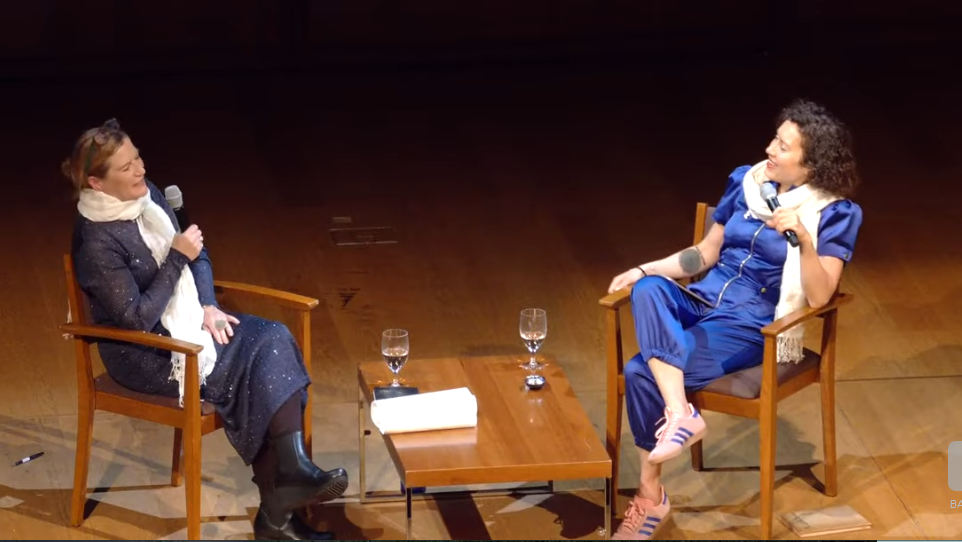
Popova and Blackall discussed, among other things, A.A. Milne’s Winnie-the-Pooh, Antoine de Saint-Exupery’s The Little Prince, and Beatrix Potter’s Peter Rabbit, as well as her scientific drawings. In the photo above, they’re wearing scarves, like the little prince’s iconic scarf, which resembles Piglet’s ears. (Sophie: “It was Piglet’s ears that made me want to be an illustrator….how to convey emotion in a couple of lines…” Maria: “Isn’t it amazing how these influences and ideas permeate the psyche, often without our awareness, and kind of lodge themselves in there and become these quiet building blocks of what we create, often without us knowing that we’re creating out of these borrowed pieces?”)
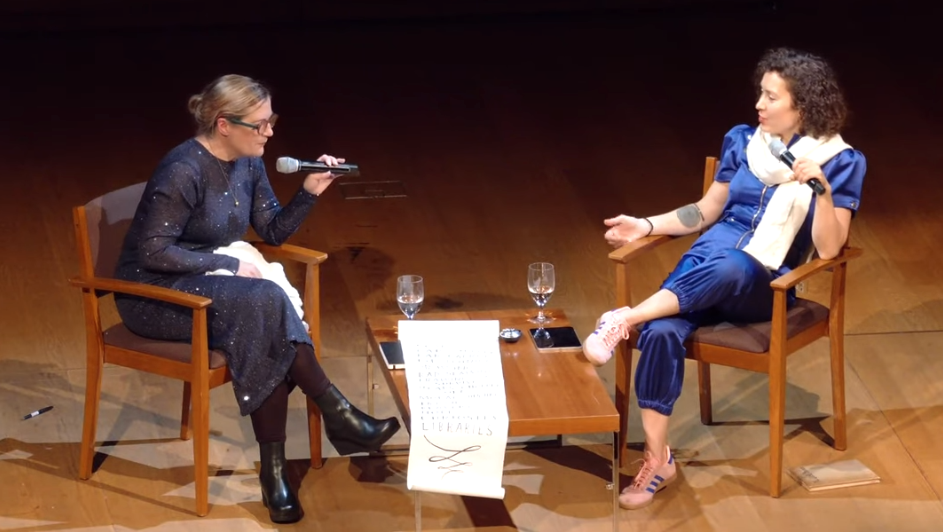
Here are a few more quotes from the talk, but if you are interested in children and children’s literature, it’s worth an hour of your time to watch the whole thing. Sophie brought a list (see photo below) to keep their conversation on track.
“I don’t believe in moralizing children, but I do believe that morality is a branch of the imagination, just like creativity and curiosity, and if the imagination is rooted in kindness, then morality stands a pretty good chance.” -Maria Popova
“Children’s books to me, the ones that endure, can be read both when you’re a child and when you’re a grownup. And as a reader of any book you bring so much of yourself to it.” -Maria Popova
“Fantasy mystifies in order to reveal some deeper truth, and fundamentalism mystifies in order to conceal.” -Maria Popova
“And that’s what story gives children, that agency to imagine themselves as characters in a different story, of telling different stories, of unbelieving the main story, the mainstream story.” -Maria Popova
“I want to foster a curiosity in children, so that they will feel confident that they can read any book that they might want to pick up….If a child is encouraged to be curious, I believe that they will continue to read and they will become a more empathetic human being and I think we need that more than ever.” -Sophie Blackall
“We are trying to arm [children] with everything we know to be true, and that is what we are trying to put into the books that we give to children.” -Sophie Blackall
Toward the end of the conversation, they mention author Katherine Rundell’s work, Why You Should Read Children’s Books, Even Though You Are So Old and Wise. You can read an excerpt here: Why Adults Should Read Children’s Books. Rundell quotes Marina Warner: “Fairy tales…evoke every kind of violence, injustice and mischance, but in order to declare it need not continue.” [emphasis added] Rundell continues, “Fairy tales conjure fear in order to tell us that we need not be so afraid. Angela Carter saw the godmother as shorthand for what she calls “heroic optimism”. Hope, in fairy tales, is sharper than teeth.” Children’s books satisfy the desire for justice and foster a sense of wonder and awe. And don’t we all, no matter how old, want justice and wonder?
 Jenny Arch
Thanks for this Jenny! I loved the quotes you pulled. I’ve become fascinated by the distances, nuances and semantics between the concepts of “teaching students to read” and “teaching students to become readers”. Your post scratched that itch.
Thanks Luke! There’s “learning to read” and then there’s “reading to learn.” Phonics education and the science of reading is definitely necessary, but we need to make sure that kids still have access to whole books, not just excerpts, as they make that transition. I think Sophie is right when she says that fostering and encouraging curiosity is the most important thing – curious kids (and grown-ups) will seek out books to learn more about whatever they’re interested in.
“Unbelieving the main story” is lovely.