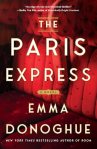
 On St. Patrick’s Day, author Emma Donoghue was interviewed at the Odyssey Bookshop in South Hadley, and I was able to squeeze in a visit in the middle of my library shift (and be back in time for Pajama Storytime). I’ve been reading Emma Donoghue’s books my whole adult life: since 2007, I’ve read fourteen of her books, and I’m looking forward to reading her newest, The Paris Express, as soon as my library copy comes in. It was a treat to hear her speak about her new book, research, adapting novels into other forms, being Irish and Canadian, and more. Here are a few snippets from the interview:
- On being an Irish writer, even though she’s lived in Canada since 1998: “The first twenty years are the years that mark you and shape you.”
- On the topic of the train crash: “I’ve always wanted to write about a disaster of some kind.” They bring a cross-section of people together. The train journey gives shape to the novel.
- On anarchists and explosions: “They were never that clear how blowing things up would help.”
- On pacing: “Speed is the heart of the novel.” (One entitled rider demanded an unscheduled stop, adding ten minutes to the trip, which the transit employees tried to make up later in the journey: “So basically one rich arsehole ruined it for everyone.”)
- On characters being cut from the novel: All of the characters were interesting people, but they “had to be having an interesting day,” even if the conflict they faced was mostly internal. “What I love about novels is that you can jump into the head of each character in turn.”
- On writing a novel with a large cast: “It was like planning an amazing dinner party,” bringing people together and seeing how they interacted.
- On novels being made into films: “I don’t think about film when I’m writing a novel…each form has its own strengths…I love doing adaptations” [of her own work and others’, such as the upcoming H Is for Hawk]. Writing the story as a novel first, then adapting to film, is the right sequence; a novel allows for “rich imagining.”
- On adapting someone else’s work: “I felt like a tiny figure climbing inside a machine made by someone else.”
- On the writing process: “It never feels as if you’re alone…” I feel as though I’ve been with people all morning on a moving train.
- On writing about disaster: “My interest was in the tension. I didn’t want it to be a bloodbath.” But each character wonders, “Am I going to die?” And all of them have been “derailed” from the “predictable path” of their day.
- On living in a diverse, multicultural society: “The train is a more interesting train if it has a wide variety of people on it.” (The train itself is a POV character in The Paris Express.)
- On adapting one form to another: It’s “spinning the same yarn again.” She likes all forms, from novel to film to play to musical: “Whatever gets my story into your head.”
- On her new project: A musical with traditional Irish music about people who emigrated from Antrim to Canada during the Famine.
- On thinking about whether a book will sell: “I write books, then sell them….If you write a lot of things, one of them will pay the rent.”
Thank you, Emma, for your many books, and for visiting us in Western Massachusetts!
Quotations are from my notes, accurate to the best of my ability.

 Jenny Arch