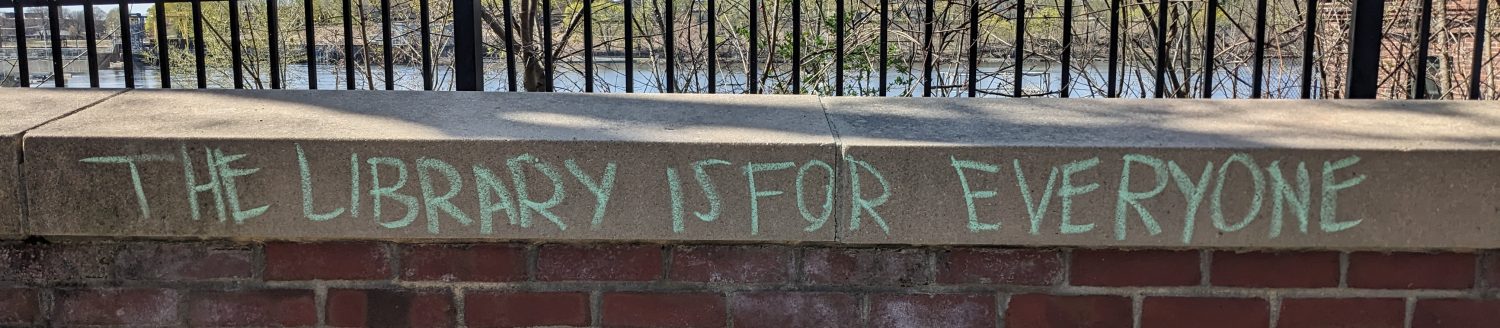
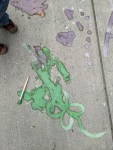
 I cannot bear waste, so I’m always seeking ways to use up the last little bits of things – for example, little nubs of sidewalk chalk too small to draw with. Over school vacation week, my handy 9yo assistant happily picked all the small bits of chalk out of the bin and bashed them up (carefully) with a hammer. (She separated the chalk by color into different bags and crushed them on a piece of cardboard outside.) I funneled the colored chalk into separate containers, and waited for good weather…which arrived today! After story time, I mixed the powdered chalk with water in bowls, and we went outside to the library patio for some chalk painting. It was great fun! There’s still plenty of chalk left, so we may do this at STEAM as well later this summer.
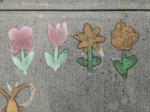 Now that I’ve reduced STEAM time for kids ages 5-11 to a manageable frequency (twice a month instead of every week), it’s been going great. Here are some of the activities we’ve done since the program began in January:
- Robot Turtles board game
- Spot It! card game
- Creating and decoding messages with Caesar ciphers
- Penny boats (supplies: aluminum foil, watertight bins, water, about $5 in pennies)
- Jigsaw puzzles
- Word scrambles
- Building block challenges with big and regular-size Jenga blocks
- Primary color painting
- 3D paper snowflakes (supplies: paper, stapler/tape, scissors, yarn or ribbon)
- Make Your Own Board Game
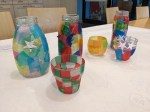
- “Stained glass” luminaria (supplies: old honey or jam jars, tealights, colored tissue paper, mod-podge, brushes)
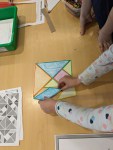
- Make Your Own Tangrams (supplies: cereal boxes, Tangram template, markers/crayons, scissors, glue). This is one of my favorites, because of the way it combines art and math; I’m looking forward to doing tessellations later.
- Scattergories Jr.
- Origami bookmark corners
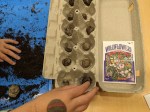
- Wildflower seed bombs (supplies: clay, compost, seeds; egg cartons to transport them home)
Sometimes, we start STEAM with a book to introduce the topic, or to use as a reference during our activity. For example:
- Mix It Up! by Herve Tullet (for primary color painting)
- The Science of Seafaring by Anne Rooney, Big Book of Science Experiments (2011), Alpha Bravo Charlie by Sara Gillingham (for penny boats)
- Maker Comics: Design A Game! by Bree Wolf (for make your own board game)
- Math Lab for Kids by Rebecca Rapoport and Highlights Tangrams (for Tangrams)
- Yoko’s Paper Cranes by Rosemary Wells (for origami bookmarks)
- Wintergarden by Janet Fox and Up in the Garden and Down in the Dirt by Kate Messner (for seed bombs)
In general, this has been a fairly easy, low-budget program to run. I keep a running list of ideas, books, and materials in a google doc, and use a lot of recyclable materials (like cereal boxes or honey jars) or ones we already have (like paint and paint brushes), or share new supplies with teen programs (teens made seed bombs too).
Guest presenters occasionally lend their expertise: in early spring, an author from Northeast Wildlife visited to teach about animal tracks, scat, and food sources (lots of animals each acorns!). This summer, our regional health nurse is bringing UV bead bracelets to emphasize the importance of sun protection, and one of our library trustees, who is also a master quilter, is going to lead a session on hand-sewing and help us make a small quilt we can hang in the library. So, we’re STEAMing along!
 Jenny Arch