Quotes from books, part VI

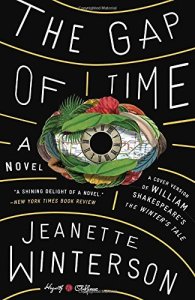
This batch of quotes is from books I read between April and August 2016. The tenth quote was hard to choose because nearly every sentence in The Gap of Time was so knockout beautiful.

  1.  “Mostly I’m just trying to get it right, whatever that means.”The Truth About Forever, Sarah Dessen
  2.  But, of course, the hardest shells hid the most fragile selves. The Expatriates, Janice Y.K. Lee
  3.  He made a whole city full of windows. -Harold and the Purple Crayon, Crockett Johnson
  4.  “You can’t compare one person’s coping capacity to another, hon.”The Raven King, Maggie Stiefvater
  5.  He considered how memories hold our lives in place but weigh nothing and cannot be seen or touched.Father’s Day, Simon Van Booy
  6.  “And fiction gives us empathy: it puts us inside the minds of other people, gives us the gift of seeing the world through their eyes. Fiction is a lie that tells us true things, over and over.”The View From the Cheap Seats: Selected Nonfiction, Neil Gaiman
  7.  There are pockets of time, she thinks, where every sense rings like a bell, where the world brims with fleeting grace.The Last Painting of Sara De Vos, Dominic Smith
  8.  Unlike the world of technology, where rapid innovation produces improvements, innovation in fashion just produces arbitrary stylistic changes. Overdressed: The Shockingly High Cost of Cheap Fashion, Elizabeth Cline
  9.  It’s impossible, what I’m trying to do. To say good-bye without telling them I’m leaving.Imagine Me Gone, Adam HaslettCover image of The Gap of Time
  10.  Forgiveness is a word like tiger – there’s footage of it and verifiably it exists but few of us have seen it close and wild or known it for what it is. The Gap of Time, Jeanette Winterson

Quotes from books, Part V

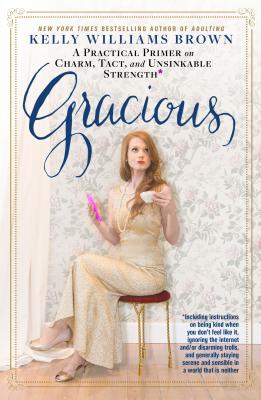
Continuing my series of quotes from books I’ve read semi-recently (this batch is November 2015-April 2016), originally inspired by The Broke and the Bookish and Three Good Rats. Here are quotes from three YA novels, three nonfiction books, one etiquette book, one book of essays, and two adult novels.

  1.  “When it comes to controlling human beings there is no better instrument than lies.” 
    1. b. “Oh, the world is full of things you don’t see.”The Neverending Story, Michael Ende
  2.  “Peace is joy at rest, and joy is peace on its feet.” –Small Victories, Anne Lamott
  3.  “It is surely a premise of democracy that the rules apply equally to everyone.” –Common Courtesy, Judith Martin
  4.  “The big problem doesn’t lie in differences between what men and women want out of life and love. The big problem is how hard it is to achieve equal relationships in a society whose work policies, school schedules, and social programs were constructed on the assumption that male breadwinner families would always be the norm.” –Marriage, a History, Stephanie Coontz
  5. “When you don’t know what made someone leave once, you also don’t know what might make him do it again.” –Conviction, Kelly Loy Gilbert
  6.   “The biggest difference between boys and girls is how people treat them.”None of the Above, I.W. Gregorio
  7.  “What redemption there is in being loved: we are always our best selves when loved by another. Nothing can replace this.” –This Must Be the Place, Maggie O’Farrell
  8.  “God is a human invention.”Gretel and the Dark, Eliza Granville
  9.  “We can stretch our personalities, but only up to a point….We might call this the “rubber band theory” of personality….We are elastic and can stretch ourselves, but only so much.” –Quiet, Susan Cain
  10.  “The first rule of a successful getaway is not to look as if you’re trying to get away.” –A Burglar’s Guide to the City, Geoff Manaugh

Previously:

Part I (August-November 2015)

Part II (June-September 2015)

Part III (January-June 2015)

Part IV (some all-time favorites, no particular order)

Quotes from books, IV

After more than a year, I’m picking this up again (see Part III here, with links to Parts I & II). The quotes below are some of my longtime favorites.

Clipart quotation marks

It occurs to her that there is one thing about people you can never understand well enough: how entirely inside themselves they are.Pigs in Heaven, Barbara Kingsolver

She’ll be okay without me, I think as I watch her, but I know that she will not. –The Time Traveler’s Wife, Audrey Niffenegger

“I love my children. No one will tell you otherwise, but just between the two of us I have to say I admire you for not having any. The ways they break your heart, Jesus, and it never stops. I mean it, it simply does not stop.” –The Magician’s Assistant, Ann Patchett

People had their natural habitats, after all, demarcated not in ecologies but in ages. He’d been perfectly adapted to being nineteen, and she was better at being thirty-two. –Gold, Chris Cleave

The shelves were supposed to be loaded with books – but they were, of course, really doors….A library in the middle of a community is a cross between an emergency exit, a life raft and a festival. They are cathedrals of the mind; hospitals of the soul; theme parks of the imagination….They are the only sheltered public spaces where you are not a consumer, but a citizen instead. -“Alma Mater,” Caitlin Moran (anthologized in The Library Book)

Clipart quotation marks

Arlington Reads Together: Becoming Nicole

Last fall, I was on the selection committee that chose Becoming Nicole: The Transformation of an American Family by Amy Ellis Nutt as the 2017 Arlington Reads Together book. Last Saturday, I got to be in the audience to hear Nicole herself, and her father Wayne, speak to the Arlington community for the A.R.T. kickoff event in our beautiful old Town Hall building.

In the weeks leading up to this event, as we have had library displays announcing the book and the related programs this month, I have been pleasantly surprised how many people have shown so much enthusiasm for the book and for the topic. (Transgender issues, unfortunately, have been in the news again lately as the federal government has just revoked protections for transgender students in public schools to use the bathroom that corresponds to their gender identity.)

I encourage everyone to read Becoming Nicole, if you haven’t already. My brief review and quotes from the book from when I read it last year are on LibraryThing; I’ll use this space to recap the event.

Nicole’s talk emphasized the need to educate people on transgender issues. When kids know what “transgender” means, they are less likely to bully other trans students; when adults know, they are more likely to support trans people’s rights. She called the recent rollback of federal protections for trans students an “unnecessary backward step” because “people don’t put a face to the trans movement. Who actually is this affecting?” In the Q&A after the talk, Nicole said, “It’s harder to marginalize a human being than a foreign idea.”

Nicole also emphasized the importance of education because “kids know their gender identity early….Parents need to get on board early so kids can get medical treatment.” She spoke about “the importance of having adults support you”; her mother Kelly supported her from the beginning, and her father Wayne eventually got on board as well. Her elementary school supported her at first, but later things deteriorated to the point where the Maines family had to move. Nicole also mentioned Camp Aranu’tiq as a wonderful, inclusive summer camp experience for trans kids.

Though Nicole and Wayne appreciated the supportive Arlington audience, Nicole said, “We can’t keep preaching to the choir”; we have to have conversations with people who don’t understand. “The people in power don’t get it, and they need to.”

During the Q&A, one preschool teacher and one middle school teacher asked for advice. For the preschool teacher, Nicole suggested specific books (including I Am Jazz; there is also Being Jazz: My Life as a (Transgender) Teen), and suggested not enforcing a gender binary (e.g. allowing children to play with any toys in the classroom, not identifying some as “girls’ toys” and some as “boys’ toys”). She mentioned the need to educate parents as well, though she acknowledged the balancing act that might take. For the high school teacher, she said that being available for students to come talk to is important.

This was a wonderful event, and we were so lucky to hear directly from Wayne and Nicole, who were both well-prepared, entertaining, sympathetic, and humorous speakers. You can see photos of the event (taken by librarian/photographer Rob Lorino) on the library blog.

“What is fake news?” informational pamphlet

People from several libraries have asked if they can use the “What is fake news?” pamphlet that I created to go with my library’s January display on this topic. The answer is yes, please feel free to use and share it! I made a new version with a Creative Commons license instead of my library’s logo: 2017-01-fakenewsbrochure-update-2017-03

Indiana University created a helpful LibGuide about fake news as well. If you have similar materials to share, please do. Information literacy and news literacy are more important now than ever.

HIGHLY anticipating

Cover of Northern LightsAt the end of my 2016 wrap-up I started to look ahead into 2017 for books to look forward to, but didn’t have any specific titles at the time. This morning (I went to bed even earlier than usual last night) I woke up to the good news that Philip Pullman is publishing another trilogy, The Book of Dust, and that the first one comes out this fall – specifically, on my daughter’s birthday. (She will be thrilled about being dragged to a bookstore first thing in the morning and then being ignored all day while her mama reads. Best birthday ever!)(Kidding, of course. She will be in daycare that day and I will probably take a vacation day. Or just read during her naps and after she goes to sleep, like a normal person.)

So anyway, I’m definitely looking forward to that one. Sometimes when an author of a beloved book or series announces a new book or series, I am a little nervous that it won’t measure up, but I have faith that this one will.

Cover image (not yet final) of All the Crooked SaintsAnd because October is always a big month for publishing, Maggie Stiefvater’s novel All the Crooked Saints comes out then too, another one I’m looking forward to, but not with quite the insane devotion, because I haven’t been reading and re-reading her since I was twelve.
Still waiting on Audrey Niffenegger for Alba, Continued.

Libraries in a Post-Truth World, Part III: Afternoon Discussion

See Part I and Part II of Libraries in a Post-Truth World.

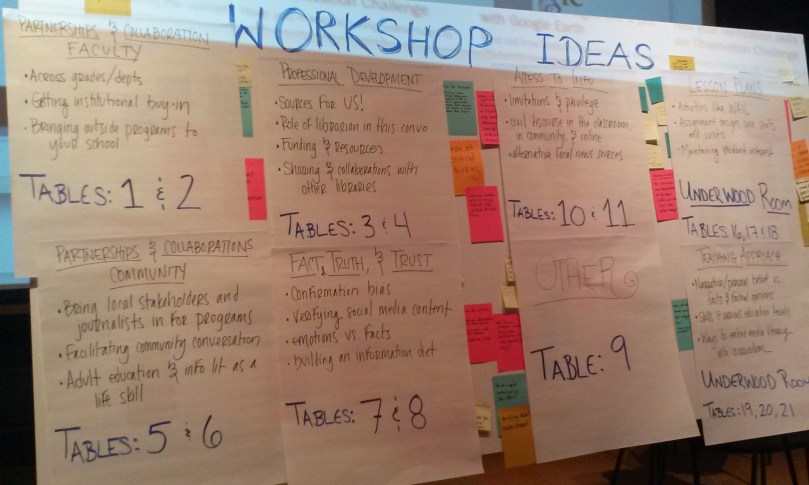
Workshop Ideas posterboard with post-its

In the Fact, Truth, and Trust group of academic and public librarians and researchers, we discussed confirmation bias, verifying social media content, emotions vs. facts, and building an information diet. We started with introductions and why we had chosen this group. People expressed interest in:

  • How to separate fact from opinion (“Where does truth lie in a society that’s all about opinion and rhetoric?”)
  • How to have programs in libraries and schools without political slant or agenda
  • Advocacy for funding for librarians in schools
  • Teaching/encouraging critical thinking skills
  • Information-seeking behavior and narrative theory, how people construct narratives
  • Trust in/use of data (what people talk about when they talk about data; presentation of data)

One participant commented that “Uncovering bias is one of the highest-order thinking skills we have…it can be almost invisible.” As one of the panelists had pointed out earlier, confirmation bias affects people on both/all political sides. Two people mentioned the site allsides.com (“Don’t be fooled by bias. Think for yourself”), which offers left, right, and central perspectives for real news stories. 

Eventually we came to the idea of “building an information diet” and spent most of our time discussing how we might use that idea to offer library programs on information literacy. The diet analogy will be immediately familiar to most people: a healthy information diet, like a healthy food diet, should be varied and mostly wholesome. There are many ways to approach this:

  • Read/watch/listen to a news source that has the opposite perspective from your usual source(s). Expand/broaden your news-universe; whether or not you agree with it, know where the other side is coming from. Begin to build a bridge from your emotional comfort areas to increase empathy. You may not change your mind, but understand where others are coming from.
  • Debate whose responsibility it is to curb “fake news”/ propaganda/misinformation/disinformation. Social media platforms? The government? Individuals?
  • Incorporate international media sources: look at international coverage of world news and U.S. news. If teaching a class or workshop, international examples are less political, as are sports and entertainment/cultural coverage.
  • Affirm belief in truth and facts: encourage people to be skeptical, but convince them that verification is possible.

As for specific program ideas:

  • Include it in existing summer reading programs.
  • Use the “Whole 30” model, or modify it to a day- or week-long challenge. Those who want to participate can meet at the beginning and end to discuss their strategies and results.
  • Create a game aspect with competition and prizes. Tracking down original sources can be like a mystery or a treasure hunt.
  • Try a version of the Human Library to encourage discussions across political differences. A conversation with a real live person is more likely to change someone’s mind (or create that empathy bridge) than reading an article.
  • Checkology from the News Literacy Project can be used in public libraries. It’s designed for students in grades 6-12 but some parts are appropriate for adults as well.

It’s important to maintain the trust that people already have in libraries, and strike a balance between advocacy and alienation. Be aware that the term “fake news” itself is very polarizing. (But “propaganda” is even more so.) Frame information literacy programs as helpful for “brushing up your skills” instead of teaching something entirely new. 

The information diet idea isn’t original to the Libraries in a Post-Truth World conference; a NYT article has been published since the conference on the same topic (“Fatigued by the News? Experts Suggest How to Adjust Your Information Diet,” Christopher Mele, The New York Times, February 1, 2017). This article was somewhat short on actual suggestions, however, beyond (1) seeking out positive news as an antidote to the barrage of negativity, (2) reading a print newspaper instead of Internet sources, and (3) not reading or watching the news before bed. It also links to an article that cites Dan Gillmor, who popularized the “slow news” movement, partly as a reaction to the 24-hour news cycle.

I used to read Dan Gillmor’s blog regularly, and actually did an activity he assigns to the students in his media literacy class at ASU: to track your own media consumption for one day. It was interesting to do, and could easily be adapted into a library program if patrons were interested in sharing their experience.

I’m grateful for the experience of attending this conference, and hope to put some of the ideas to work here in my library.

“Truth will ultimately prevail where there is pains taken to bring it to light” –George Washington

Libraries in a Post-Truth World, Part II: Morning Panel

See the first Libraries in a Post-Truth World conference post here.

The panelists:

John Palfrey, Head of School, Phillips Academy, and author
Mary Robb, Teacher, Media Literacy and Democracy, Andover High School
Adam Schrader, Former Facebook editor and news fact checker
Damaso Reyes, Program Coordinator, The News Literacy Project
Melissa Zimdars, PhD, Assistant Professor of Communication at Merrimack College
Catherine Tousignant, English Instructor, Phillips Academy
Alison Head, PhD, Project Information Literacy
John Wihbey, Assistant Professor of Journalism and New Media at Northeastern University
Claire Wardle, First Draft News
Ben Sobel, Fellow, Berkman Klein Center for Internet and Society, Harvard University

Right away, many of the panelists took issue with the term “post-truth”:

  • Not post-truth but post-accountability; the responsibility is on all of us to call out inaccuracies. It is important to teach students the skills to tell fact from fiction. (Mary Robb)
  • “Post-truth” is a useful way to think about how information and politics are converging. Immediacy sacrifices deep digging. When people only read headlines, what kind of information are they taking from that and what does that mean? Variety of the internet includes misinformation and disinformation (and “bullshit”). (Melissa Zimdars)
  • “There is a world of truth and a world of facts and it doesn’t go away. But there’s also a world of words that occupies its own space…the words have their own power.” Who has authority? Whose authorship is valuable and meaningful? Perspective does matter. Words have power even if they’re untrue. (Catherine Tousignant)
  • Students look for consensus, not answers/truth….Untruth works well when it confirms how you feel. (Alison Head)

They also discussed “fake news” and its synonyms:

  • There is a difference between untruth and bias. (Adam Schrader)
  • “Fake news” is a new term for an old thing – PROPAGANDA. It is important to call these things by their actual names. (Damaso Reyes)
  • A lot of the fake news propagated during the election were fueled by economic motives, not political ones (clicks = money). Antidotes/possible correctives are complicated. (John Wihbey)
  • “I don’t want to take us down the rabbit hole of darkness, but…we have to think about this” ability to create and disseminate. Trust shifts. Trust bubbles/filter bubbles increase peer-to-peer influence in the absence of gatekeepers. (Claire Wardle)
  • The best way to combat fake news is to understand how it is created and disseminated. (Adam Schrader)

Information literacy, media literacy, news literacy:

  • “Information is coming towards [students], they don’t have to seek it out….Reach has become a proxy for authority. There are more sources of information” being seen as valid. (Damaso Reyes)
  • There has been a slippage in authority – we’ve moved from scarcity to abundance [of information], moving target. (Alison Head)
  • Confirmation bias is a bipartisan challenge (Damaso Reyes)
  • “We’re surrounded by editorial speech” (e.g. Google search autocomplete). “[People think] the way we obtain our news…are neutral conduits for information, when in fact they are not.” What does it mean to hold Google and Facebook accountable? (Ben Sobel)

What can librarians do?

  • Librarians are the “intellectual beating heart of our institutions.” (John Palfrey)
  • Different types of libraries can take different actions. Read Pew reports, PIL reports, etc. Libraries are a trusted institution. (Whereas newspapers are less so now.) Librarians are good at ferreting out what exists and good at making partnerships. Librarians are in the right position to make an impact. (Alison Head)
  • Academic libraries trying to prepare students to be successful may be using the ACRL Framework for Information Literacy for Higher Education, though this framework mentions quality but not truth. Evaluation is the one skill students tend to take and build on. What kind of tools [for evaluation of information] already exist? What partnerships are formed around those tools?  Twitter Trails is one example of a tool to determine where information came from and how it spread.  (Alison Head)
  • Public libraries are going through a shift not unlike the shift newspapers and media have gone through….It’s not about directing a student to a book…it’s about teaching them how to find information. The best thing librarians can do is give students/patrons the tools to find, sort, prioritize information. “It’s about having the tools to interrogate the information that you find.” (Damaso Reyes)
  • Teach students to look for WAIL in news stories: Word choice, Adjectives/adverbs, facts Included, Left out. Sometimes you don’t know what’s left out until you consult another source. Students used to come to school for information, now they have information but don’t know its quality. Teach critical analysis. (Mary Robb)
  • Have programs with journalists. What libraries could do is bring in different journalists who covered the same event and have them “unpack” how they covered that story: what goes into news creation, how stories can be reported in two different ways. (Damaso Reyes)
  • Students love to talk to journalists. It’s a great way to get students to understand how news is created. (Melissa Zimdars)
  • Improve (or help explain) the presentation of information, e.g. from government websites. Improve library websites – they could be much more user-friendly. (John Wihbey)

Q&A

Question for the journalists on the panel: What process do you use for fact-checking?

Panel response: It depends on the type of fact. For a quote, try to find video or audio recording of the person saying it (video is better, so you can carefully examine whether the sound and the lips moving sync up – both audio and video can be faked). For a statistic, go to the organization that issued it. Obtain multiple, credible sources. Cross-verify independently. Use government sources (but be skeptical about these too). Sometimes it’s better to “wait for the debris to clear,” then accurately report the truth. For verification of unofficial sources (e.g. social media content), try to determine the providence, source, state, location.

Question/comment: How to evaluate validity and quality is a complicated problem. Librarians are best-trained to deal with this problem, even better than journalists (who are often trying to be first to break the news). Provide evidence of incorrect information/lies. As humans we just cannot process all of this information. Tech people can create plug-ins to create alerts for lies, satire. Companies must cut off advertising to fake news purveyors. Schools need to teach media literacy and critical thinking. People should understand the scientific method and apply it to your everyday thinking and decisions. Understand the difference between fact and opinion. Understand who you are – know your biases.

Panel response: Silicon Valley needs to hire a nation of librarians! There are some programs and browser plugins that can help (e.g. Hoaxy). Re: Citizen journalism and breaking news: encourage students to keep off of social media (either viewing or sharing) during breaking news situations.

Question: Those of us who teach information literacy classes traditionally direct our students to government websites….

Panel response: During the government shutdown, many pages were inaccessible. Approach with skepticism. Each president has a different agenda; what have they said on a topic? Look elsewhere for information. Figure out which information source is most appropriate for each task. There are more ways to get information, there are ways to evaluate it. Someone introduced an idea about different versions (algorithms) of Facebook, as alternate versions of their usual (secret) algorithm; users could choose the MIT version, LOC version, etc.

All that discussion and Q&A filled an hour and a half and gave participants plenty to think about. In my next post, I’ll write about the afternoon discussion session on “fact, truth, and trust,” where we came up with ideas to use in academic and public libraries.

Libraries in a Post-Truth World

On Thursday, January 26, I attended a one-day conference hosted by Phillips Academy in Andover called “Libraries in a Post-Truth World.” There was some helpful pre-conference reading about fake news and hoaxes, information overload, and media literacy:

Why America is Self-Segregating” and “Did Media Literacy Backfire?” by danah boyd, January 9 & 10, 2017

Many Americans Believe Fake News Is Sowing Confusion,” Pew Research Center, December 15, 2016

The Real History of Fake News,” Columbia Journalism Review, December 15, 2016

At Sea in a Deluge of Data,” Alison J. Head and John Wihbey, The Chronicle of Higher Education, July 7, 2014

Mike Barker, Director of Academy Research and Library Services at Phillips Academy, introduced the morning’s panelists:

John Palfrey, Head of School, Phillips Academy, and author
Mary Robb, Teacher, Media Literacy and Democracy, Andover High School
Adam Schrader, Former Facebook editor and news fact checker
Damaso Reyes, Program Coordinator, The News Literacy Project
Melissa Zimdars, PhD, Assistant Professor of Communication at Merrimack College
Catherine Tousignant, English Instructor, Phillips Academy
Alison Head, PhD, Project Information Literacy
John Wihbey, Assistant Professor of Journalism and New Media at Northeastern University
Claire Wardle, First Draft News
Ben Sobel, Fellow, Berkman Klein Center for Internet and Society, Harvard University

The panelists were all informed and articulate, experts in their fields; they could have spoken for much longer, but we used the rest of the day for two presentation sessions (Damaso Reyes on The News Literacy Project and Checkology, Alison J. Head on Project Information Literacy), identifying areas of focus for the afternoon discussion, reforming into discussion topic groups, and reporting our results to the other participants.

“Librarians are good at ferreting out what exists and good at making partnerships. Librarians are in the right position to make an impact.” -Alison Head

I attended Damaso Reyes’ presentation on Checkology (“how to know what to believe”), a news literacy program designed for 6th-12th grade students. Reyes showed us videos created for the program (Peter Sagal was in one!) and guided us briefly through the four modules: (1) Filtering news and information; (2) exercising civic freedoms; (3) navigating today’s information landscape; and (4) how to know what to believe. Some key takeaways:

  • “Information literacy is not what it should be in our society, and that’s a threat to our democracy.”
  • When reading/listening to/watching news, ask: What is the primary purpose of this information? (To inform, to entertain, to convince, to provoke, etc.)
  • Consider the role of algorithms and personalization. The information you’re getting is filtered – think about how and why.
  • Trying to teach students to be skeptical, not cynical.
  • Critical thinking & skepticism is an important skill, and should not be outsourced to technology even if it could be (e.g. plugins). “We shouldn’t depend too much on technology to save us.”
  • What you share online has your credibility attached to it.
  • We are all susceptible to confirmation bias.
  • Society stops functioning if we can’t agree on some things (i.e. facts). A fact is something we can all agree on but it is also something we can independently verify.

After the presentation, we talked in small groups to come up with discussion topics for the afternoon. Two of the Phillips Academy librarians sorted our ideas into loose categories:

Partnerships & Collaboration with Faculty
Partnerships & Collaboration with Community
Professional Development
Fact, Truth, & Trust (I was in this group)
Access to Information
Lesson Plans
Teaching Approach
“Other”

I will be writing another blog post (or two) soon about the morning panel and the afternoon discussion. In the meantime, I’d like to share a handout I made for my library to accompany our display on media literacy. Here is the PDF of the tri-fold pamphlet: updated 2/16/17, 3/1/2017 – I have made a new version without the Robbins Library logo, with a Creative Commons license. Please feel free to use and share: 2017-01-fakenewsbrochure-update-2017-03

Advice for 21st Century Libraries

Recently, a trustee from another library in Massachusetts contacted me to ask for some thoughts on the future of libraries, and how best to design for that future. She said her library was “at a crossroads,” but may soon have the opportunity to renovate their current building or build in a new location. She was taking the wise step of seeking information and opinions from a variety of perspectives before launching any action. Here, then, is some of my advice for libraries looking to the future:

  • If you’re lucky enough to get a building grant (or another source of funding to make changes to a current building or build a new one):
    • Consider the way that patrons are using your library now, but also consider other ways people might use the space. Make it as flexible as possible, with modular furniture and movable stacks.
    • Get as much natural light as you can. This includes basement levels (children’s and teen departments are often downstairs, as are meeting rooms, and staff work space).
    • When choosing an architect, make sure they have designed libraries before. Talk to staff – not just directors, but all staff, from circ to reference to children’s – to see what they like and dislike, what works and what could be improved. Staff on the “front lines” have a lot of valuable knowledge that an architect should consider: the importance of sight lines between desks, the location of bathrooms, the varying temperature zones in different areas of the library.
  • Have places for people to meet: large meeting and program rooms, smaller study rooms, open areas with tables for group work. Study rooms are in demand at most public libraries, and larger rooms can be used (for free or for a fee, depending on library policy) by community groups, which may lead to partnerships between those groups and the library.
  • Make the space welcoming. Natural light, comfortable furniture, perhaps some bright colors or a particular visual element – like a mural in the children’s area – encourage people to come in and stay for a while.
    • And if you give a mouse a place to stay for a while…he’s probably going to ask for milk and cookies. Do you have (or can you add) a coffee shop or cafe? At the very least, consider scrapping policies against food and drink in the library, at least in some areas.
  • Who uses the library? Are you missing certain demographics (age, income, race)? How do you encourage those people to use the library?
  • Where are the teenagers? Talk to teen librarians. In my experience, they are some of the most enthusiastic and creative librarians in the profession, bubbling over with outside-the-box ideas, and they have incredible problem-solving skills. How can you support them to make the teen space inviting, either in terms of furniture, materials, technology, or programming? Teen space in the library should be distinct from children’s space and adult space.
    • Is there a good library in the middle school and high school? Support your teen librarian’s efforts to connect to teachers and school librarians. Consider offering programs that are more fun than educational – games, arts and crafts, movies.

The two most important things I hope that library directors and boards will take into account when planning for the future are the following:

Get buy-in from library staff, library users, and people in the community who don’t use the library. (Why don’t they come in? What could you offer that would attract them?) Not everyone will be excited about change, but if you can get a few “early adopters” on board, they will bring others with them. Bottom-up change is usually more successful than top-down change, so get input from every level.

Design for flexibility. We can’t see the future, but we can safely assume it will be different from the present. Make your space as flexible as possible so that you can make changes to meet unforeseen needs and wants: renovations and new furniture are expensive, so make them count. And remember to prioritize accessibility, not simply to fulfill ADA compliance, but because the library should be welcoming and easy to use for everyone.

Do you work in a library? Are you a library user? What do you think are the most important things to keep in mind when planning for the future of a library?