Tango with censorship

Ray Bradbury can go ahead and start rolling over in his grave pretty much right away: a committee of parents, teachers, and administrators in the Davis County district in Utah have voted to restrict access to the book In Our Mothers’ House (yes, that apostrophe is correct, it’s about a family with two mothers). This in itself is not unusual; books are challenged all the time, and sometimes moved (from the children’s section to young adult, or from YA to adult, or behind the counter, as in this case).

However, the district has taken the additional step of asking librarians to pull other titles that may cause controversy. (And Tango Makes Three, a picture book based on a true story of two male penguins at the Central Park Zoo who hatched a chick from an egg and raised it together, is likely next.) McCarthyism, anyone?

It’s easy to get outraged against censorship; there are hundreds, if not thousands, of eloquent examples in print and on the web. (Here’s a defense of In Our Mothers’ House in The Salt Lake Tribune.) But let us take a step back and consider the purpose and mission of the library. How do these “controversial” books appear on library shelves in the first place, and why should they stay there despite strenuous objection from community members?

Most libraries have a collection development policy: guidelines for what kinds of materials the library ought to have in order to serve its community. Different libraries may choose to allocate their resources in different ways, but most public libraries aim to provide a broad range of materials – educational, recreational, and cultural – for people of every age, socioeconomic status, race, religion, political affiliation, and sexual orientation.

Our collection development policy states, “The…community includes people from diverse educational, cultural and economic backgrounds displaying a wide variety of interests, needs, values, viewpoints and occupations.” It continues, “The library has the obligation not only to serve its current users but also to search for materials and methods that will meet the needs of new members of the community and those who have not been traditional library users.”

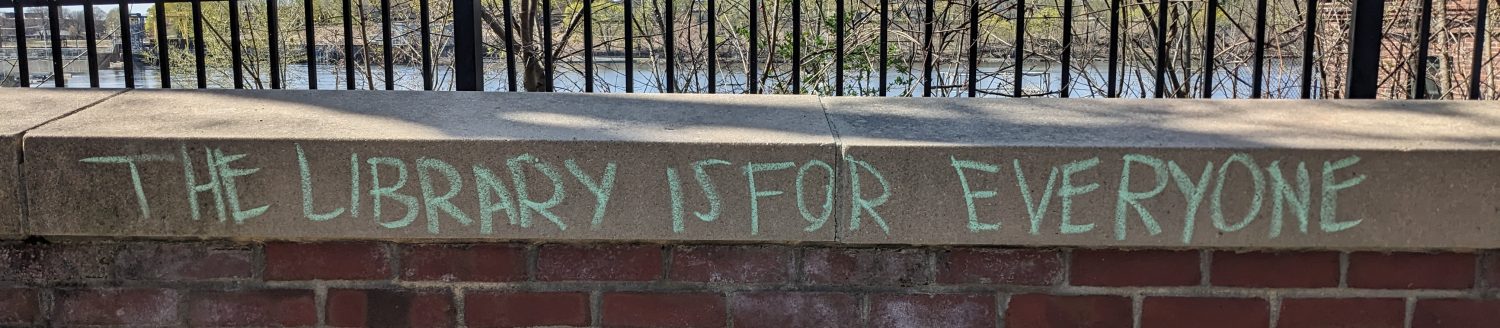
The library is, or should be, an inclusive place. It should be a safe space. If parents want control over what their children are reading, that is perfectly within their rights – but exercising control over what everyone else’s children are reading is most definitely not.

Librarians are advocates for everyone in their communities. We are advocates for equal access to information. It is our responsibility to make sure that there are materials for everyone. (The Utah librarians who added In Our Mothers’ House to the school library collection did so in part because a child in the elementary school has two mothers.) As one librarian said, at a panel at MLA, “If you have to come up with a reason not to buy something, that’s when you should add it to your collection.” We are in the business of selection, not censorship.

If a library had plenty of books for adults but none for children, someone would object. If a library had a hundred books about Christianity but none about Buddhism, someone would object. If a library collected books by and about Republicans but not Democrats, someone would object. A balanced collection includes materials for and from many points of view – an increasingly rare thing in a world where most news sources are slanted, and only offer one viewpoint.

If history is any indication, there will always be people who want to censor books. There will also always be people who defend them.

Library Q&A

Stack Exchange, “a network of free, community-driven Q&A sites,” now has a Library and Information Science site in beta. Most of the library Q&A I have seen has been through LinkedIn groups’ discussions (mostly ALA), so this seems like a great forum for detailed, professional questions.

Because librarians are all about sharing knowledge, I’m optimistic that this site will be successful if enough library professionals know about it. So, librarian-friends, check it out! Read the FAQ before jumping in and asking/answering.

The science of working together

At the launch event for Interop: The Promise and Perils of Highly Interconnected Systems, the authors John Palfrey and Urs Gasser gave an overview of interop and provided several relevant examples. Though they began years ago on a theoretical level (does increased interop lead to increased innovation?), interop is a deeply practical topic.

“Interop” here is short for interoperability, defined as “the ability to transfer or render useful data and other information across systems (including organizations), applications, or components.” The authors decided that this initial definition, however, could be broadened into “the science of working together” on many layers: institutional, human, data, and technological.

Though it may sound abstract, there are many good examples of how interoperability is important in daily life. Solutions to big societal problems depend on interop, said Palfrey and Gasser. They talked first about “smart cities,” which depend on sharing information: between police, firefighters, and ambulances, for example, and between various forms of transit (does your bus pass also work for the subway and the commuter rail systems?).

Next they talked about open platforms, such as Facebook, which made its API available so that anyone could build an app. However, this interconnectedness has a down side: many points of connection means more vulnerability to privacy and security breaches. (This is also true of credit cards – another example of interop – which are vulnerable to identity theft.)

Facebook is an example from the private sector, but the public sector can drive interop as well, by regulation and legislation, as Europe has done for standardized cell phone chargers.

Naturally, one of the areas in which I am most interested is that of libraries. Libraries, said Palfrey, are facing two large interop problems: preservation of knowledge over time, and the lack of an open standard for e-lending.

The first issue has to do with reformatting; over the past decade or two, data has been stored not just in print, but in a whole variety of other ways, including floppy disks, microfilm, microfiche, CDs, and on computers in a variety of formats, some of which are no longer readable because the software necessary is no longer in use. Libraries must be vigilant to make sure that the information they have is preserved in an accessible form.

The second problem is one that has been in the news more or less constantly for a few years: there is no open standard for e-lending. Instead, there are a lot of proprietary formats that are not interoperable at all (e.g. you can’t read a kindle book on a nook device). “This is crazy,” Palfrey said. “Why is this [print book] still better technology?”

I hope and trust that, in the next few years, an open standard for e-lending will develop. In an ideal world, both libraries and individuals would be able to buy and lend any e-book, which could be read on any device.

Fingers crossed.

Upcoming local events

There are two local events coming up that I’m looking forward to; the first is tonight in the Harvard Law School building, where authors John Palfrey and Urs Gasser will be discussing their new book, Interop: The Promise and Perils of Highly Interconnected Systems. Palfrey and Gasser also co-authored Born Digital, and I’ve seen Palfrey speak before on the subject of the Digital Public Library of America (DPLA); he is intelligent and articulate.

The second event, at the Brookline Booksmith on June 8, is an author talk of a different sort. Jenny Lawson, a.k.a. The Bloggess, will be appearing for her new book, Let’s Pretend This Never Happened: (A Mostly True Memoir). As a fan of both blog and book, I am really excited to see her in person. If you haven’t heard of her before, I recommend reading her posts about Copernicus and Beyonce as an introduction.

Massachusetts Library Association Conference

I was lucky to be able to attend MLA today. I heard some great speakers and panels and met some inspiring (and friendly!) people. “The Future of Libraries: The Next Generation,” featuring six panelists who have only been librarians for five years, was excellent, and skillfully moderated by Maureen Sullivan. One of my favorite audience questions to this panel was “What is your hope for your profession that will keep you in it?”

The next panel, “The Future of Library Leadership,” featured participants in the 2011 New England Library Leadership Symposium (NELLS). All had insightful things to say and great examples of their leadership skills in action; all demonstrated the value of close relationships with professional peers. Though many NELLS participants were in management positions, some were not, proving that leadership is not just for managers.

I’ll go into both these panels in more depth in future posts; I’ll also touch on the “Reading Women” talk, Random House Book Buzz, and the closing keynote (Maureen Sullivan, Keith Fiels, and Molly Raphael). More to come!

“I can’t imagine not wanting to learn.”
-Jeremy Shaw-Munderback, “Next Generation” panelist

Real Good for Free

I’ve read a lot of articles and blog posts over the past few years about e-readers, e-books, and the resulting tension between publishers and libraries. In the “Sparring Over E-Books” section of her article “Changing Policies on Digital Books Wreak Havoc on Libraries,” Jenny Shank repeats the publishers’ argument about “friction.” Essentially, publishers are fine with libraries lending books to patrons for free, as long as it is slightly more difficult for people to use the library than to buy books in a store or online. However, if it’s just as easy to borrow a book from the library as it is to buy it, then (the argument goes), sales will plummet.

Let’s backtrack to the days before online ordering, when buying a book meant going to a bookstore, and borrowing one meant going to the library. If you got a book from the library, you had to return it, meaning you had to make one extra trip; if you bought the book, you didn’t have to go back to the bookstore until you wanted to. An extra trip is a little extra friction, a little added inconvenience (assuming you aren’t the kind of person who goes to the library every week whether your books are due or not).

With online sales of both e-books and print books, it became much easier to buy books and have them shipped to you; frictionless, one might say (except for the friction of the money leaving your account). Now that libraries are also offering e-books – or at least trying to – some publishers are objecting that there ought to be some inconvenience introduced to the process, that it should be harder to borrow an e-book than to buy one. To these publishers I say: have you ever tried to borrow an e-book from a library? For most systems, “one-click” doesn’t enter into it.

But for argument’s sake, let’s pretend borrowing an e-book from a library is as easy as buying and downloading one from Amazon or Barnes & Noble (or one of the independent bookstores that offers e-books). People have been able to get books from the library for free for years. And has that caused the collapse of the publishing industry? No, it has not. (Remember: libraries buy their books from publishers! Libraries are customers, too. And libraries buy a lot of books.)

One book borrowed does not equal one lost sale. In fact, people who borrow are also people who buy; this is true of music as well as books, as Christopher Harris points out in American Libraries (“Giving Away Music Increases Sales…Just Like For Books”).

The title of this post comes from a Joni Mitchell song. “Real Good for Free” is on the album Miles of Aisles.

Happy birthday, Mom! via Google+

I live in Massachusetts; my brother and mom live in northern and southern California, respectively. And yet, all three of us were able to “hang out” together for Mom’s birthday, thanks to the group video chat that is Google Hangouts. Thank you, technology, for enabling the off-key singing of “Happy Birthday”!

In all seriousness, though, there is much talk about whether technology in general and social media in particular bring people together and foster closeness, or whether, conversely, they increase isolation and only foster shallow ties. I won’t speak about Facebook or Twitter (or Pinterest, or Instagram, or Tumblr, or…), but video chat – through Google Hangouts, Skype, or another service – is truly amazing. When you can’t be face-to-face, it’s the next best thing.

Inventing the Future

Following links from this week’s issue of American Libraries Direct, I found two excellent, thoughtful articles about the current (and probably future) state of the publishing business, including background on Amazon and the ongoing Department of Justice case against Apple and the major publishers. The articles are so well-written and clear that I don’t have much to add, but I highly recommend reading them if you’re at all interested in ebooks – as a consumer, author, publisher, or librarian.

The first piece, “Why everyone is probably wrong about the DoJ ebooks case” by librarian Hugh Rundle, outlines both sides of the conversation taking place about ebooks: the confusion over what the DoJ case is actually about (investigating collusion to keep consumer prices high), and the short- and long-term implications of Amazon’s pricing (and effective monopoly) of ebooks. Rundle argues that the major publishers handed Amazon its current de facto monopoly on ebooks by insisting on DRM (Digital Rights Management). He concludes that “the future of books is not the present of books,” and that “the best way to predict the future is to invent it.”

Rundle linked to Charlie Stross’s piece, “What Amazon’s ebook strategy means.” Here is a fantastic article that includes Amazon’s history from its founding in 1994, as well as some important definitions (disintermediation, monopoly, and monopsony). Stross, too, argues that DRM is dead, or should be: “By foolishly insisting on DRM, and then selling to Amazon on a wholesale basis, the publishers handed Amazon a monopoly on their customers—and thereby empowered a predatory monopsony.”

Rundle also linked to a post on David Pakman’s blog, “Why should ebooks cost $15?” In this piece, Pakman writes, “Absent from most of this [ebook] coverage are two main questions: a) what is the right price for eBooks and who gets to set it, and b) why are eBooks not interoperable on different devices?” Leaving aside the first question for the moment, his second question is one of the main reasons I still don’t have – or want – an ereader. Imagine how much more appealing buying and reading ebooks would be if all ebooks were DRM-free and could be read on all devices – Kindles, nooks, iPads, Sony eReaders. As it is, however, if you buy a Kindle and some Kindle books, but then decide you want to switch to a nook…well, too bad, you can’t take your books with you, because you can’t read Kindle books on a nook.

Given all this, we can hope that ebooks will be DRM-free sooner rather than later. Increased interoperability would certainly be good for consumers, and maybe for publishers and retailers too.

Recommended Recommenders

A recent blog post on the Boston Globe site highlights seven “book recommendation websites” people can turn to for reading suggestions. I was already familiar with four of the seven, but decided to explore the rest for comparison’s sake. If I’ve made a mistake, feel free to correct me in the comments; conversely, if you are a devoted member of one of these sites and want to sing its praises, please feel free to do that as well!

Goodreads
This is a site I use every day; I’ve been a member since 2007, and have over a thousand books on my “shelves.” Goodreads offers a great way to keep track of what you’ve read (including when you read it, what you thought about it, your rating – out of five stars – and who recommended it to you), what you’re currently reading, and what’s on your to-read list for the future. You can create more shelves in addition to these three – historical fiction, for example, or biography – and you can see what your friends have read. Goodreads will recommend books for you based on your shelves, and you can see others’ lists, take quizzes, and sign up for giveaways. There are also many “Goodreads authors,” published authors who participate as members. One of my favorite features of the site is that it combines personal recommendations with crowd-sourced ones, so I can see what my friends thought of a book as well as what everyone else of Goodreads thought of it. Great usability, too – the interface is pleasant and intuitive, you can sort your lists by author, title, date read, date added, rating, etc., and you can get some nice descriptive statistics too.

LibraryThing
LT is similar to Goodreads in many ways: you can create your own shelves and tags, see your friends’ books, create a profile, get recommendations, and participate in giveaways. LT offers richer metadata, including Dewey Decimal Classification and Library of Congress Classification (DDC and LCC). The interface isn’t quite as user-friendly, but it’s a robust site, and if Goodreads didn’t exist, I’d happily use LT as my primary books-and-reading website.

Shelfari
Shelfari is powered by Amazon, which means two things: (1) it is designed to get you to buy books, preferably from Amazon, and (2) the design is beautiful and the user experience (UX) is fantastic. I remember an earlier version of the site, which was kind of clunky – maybe why I chose Goodreads instead of Shelfari five years ago – but it’s clean and colorful now. Shelfari rates high on content and interactivity; like Goodreads and LibraryThing, it’s a social networking site for readers (or in their words, “a community-powered encyclopedia for book lovers”). The front page pushes books that are already popular, including New York Times bestsellers and Amazon bestsellers, but if you dig deeper into the site, you can narrow by category or subject. One of the most useful features I discovered was the Series tab, where you can see all the books in an author’s series, in the correct order – definitely helpful at the reference desk.

Whichbook
I’ve already written about Whichbook; I like it very much. It isn’t nearly as robust as Goodreads, LT, or Shelfari, but it isn’t meant to be; it’s less a social networking site for bookworms and more of a reader’s advisory site. It’s whimsical, with its sliding scales (optimistic to bleak, funny to serious, safe to disturbing) instead of a traditional search box, and it does a good job suggesting off-the-beaten-path books rather than the most popular books. There are lists as well, in categories such as “Bad Luck and Trouble” and “Weird and Wonderful,” and you can also create your own lists. Whichbook promotes libraries over Amazon: the “borrow” button is ahead of the “buy” button.

What Should I Read Next?
WSIRN, as it’s called, is one of the most basic sites in this collection. You can create two lists: like and dislike. You can get recommendations based on any title on your list; however, these recommendations are based “purely on collective taste.” That is, books on the same list become associated with each other. This might work fine if everyone liked only one genre, so all mysteries were associated with each other, all romances associated with each other, etc., or if users were able to create and name multiple lists (e.g. “favorite biographies”), but that’s not the case. I have read and loved many books that were wildly different from each other, and the only thing they had in common was that I liked them; I wouldn’t necessarily recommend them both to the same person. That said, WSIRN is a simple, quick tool, and the developers may add functionalities in the future.

The Staff Recommends
The Staff Recommends is, as far as I can tell, McSweeney’s editor-at-large John Warner. (Supposedly also his “team of readers,” but all the reviews I read on the site were written by John.) TSR calls itself “an advertorial publication,” meaning they do get paid for recommending books, but they only recommend books they like; furthermore, proceeds are donated to a nonprofit, so I feel confident that the recommendations are honest. So, if you happen to have the same taste as John and his “team of readers,” you’re in luck! Whether you agree with him or not, the reviews are thoughtful and well-written. As of today, there are eight current selections and a few lists (e.g. crime novels) consisting of shorter reviews of more titles. TSR offers fewer points of view and less content than most of the other sites in the article, but it’s worth bookmarking nonetheless.

Gnooks
The main appeal of this site is the “literature map” that it creates when you type in the name of an author. However, there’s no information as to how the relationships between authors are determined. I want to know why Author A and Author B are considered similar: is it the subjects they write about? Their writing style? Hard to say. You can also get recommendations based on authors you like (I tried it; results were pretty accurate, but there were only three). I probably won’t use this regularly, but I do like that it’s author-centric rather than book-centric.

Treasure Hunt

Professor Greg Downey at the University of Wisconsin-Madison created an amazing assignment for his digital native students: find information that’s not online. And where did most of them turn for help? Libraries!

In the User Instruction course I took last fall, we spent a lot of time discussing “one-shot” instruction: those 45-minute or hour-long sessions an instruction librarian might get with a freshman class to teach them everything they need to know about the library (hint: impossible. Remember, some people get Master’s degrees for this). Usually, librarians concentrate on the online catalog and one or two major databases, and that’s all they have time for.

Downey, however, clearly recognizes the importance of research, online and off, as well as all that libraries have to offer, in terms of physical materials as well as online databases and additional software and technology. This assignment reflects that recognition and respect for libraries and research; it’s also a great reminder that not everything is available on the Internet.

I’ve heard that “librarians like to seek; everyone else likes to find.” Finding is certainly satisfying, but it seems like Downey’s students got into the seeking aspect as well, and that’s what good research is about. Great assignment!