Decisions, Making

Two seemingly unrelated bits of news/opinion in this post, but both have to do with decision-making on some level. To start, one of the first articles I read this morning was Ann Patchett’s op-ed in the New York Times about the Pulitzer Prize Board’s failure to select a fiction winner from the three finalists. As Patchett points out, this is not only disappointing for the authors (“It’s fine to lose to someone, and galling to lose to no one”), it’s also a letdown for readers and for booksellers. Here are the past winners.

Another article I read today is from ASIS&T: Thom Haller wrote on the topic “What happens when architectural questions are not asked?” (architecture, here, is information architecture, or IA). He used Facebook as an example, and it’s a good one: who hasn’t been confused by Facebook’s changing structure, or its hierarchy and organizing principles (or lack thereof), not to mention its always-in-flux privacy policies? The problem Haller discussed was that of labels (or lack of labels) for “content clusters,” and it’s something that would probably come up in a basic usability test; right now, it’s not really clear what the difference between “public” and “all” is, unless there is a label for each group of options (there isn’t).

For such a huge site, there are some surprising difficulties in terms of navigation and settings. I almost have to assume that these difficulties are planned, or at least unresolved, on purpose; it seems like Facebook wants certain actions (privacy settings, unfriending) to be difficult.

So as not to end on a negative note, please enjoy this list of fake Massachusetts town names from McSweeney’s. And may I also recommend Jenny Lawson’s (a.k.a. The Bloggess) just-published memoir, Let’s Pretend This Never Happened? Read a snippet here. (Unless you’re at work, because most people’s work doesn’t usually provoke hysterical laughter, and this might. You’ve been warned.)
YA for Grown-ups

You know that xkcd comic, “Someone is WRONG on the internet”? I actually don’t feel that way too often. Not because there isn’t plenty of misinformation on the internet, or a lack of opinions out there with which I disagree, but because I don’t spend most of my time looking around for things to argue with and get all bent out of shape about.

However, I followed a link from this new “Y.A. for Grownups” column, and wouldn’t you know it, SOMEONE IS WRONG ON THE INTERNET. Joel Stein, columnist for Time magazine, believes that “Adults Should Read Adult Books.” And ONLY adult books. And here is something that gets me bent out of all recognizable shape: someone telling me what I can’t (or shouldn’t) read. (Remember “no one ever told me no”? Or the simple fact that telling a kid – or anyone, really – s/he can’t read/do/have something is a surefire way to get them to want to read/do/have that thing with every fiber of their being?)

Maybe I’m just contrary. However, I believe there is value in YA literature for adults as well as teens. First of all, remember, most adults reading fiction are reading fiction for pleasure and entertainment, so who’s to tell them (us!) what to read or not read? Second, Stein admits he hasn’t read any of the major YA books out there now: not The Hunger Games, not Twilight, not Harry Potter. So right off the bat there’s the issue of passing judgment on something he isn’t familiar with, and only citing the biggest blockbuster names out there. Yeah, okay, he happens to be right that Twilight is not literary, but neither is Nicholas Sparks (yes, it’s pick-on-Nicholas-Sparks week here), and Stein isn’t bashing adults who read The Notebook.

But Joel Stein, I dare you, I dare you, to read Jennifer Donnelly’s A Northern Light and write it off in the same fashion. Read it and say it has no value and that adults should only read “adult” books. That we should read only the books – literary or not – aimed at our age group. (Speaking of age groups, “YA” is just the publishers’ designation for marketing purposes. There’s no strict definition, but usually the main character is a child or teenager, the book is from their point of view – first person or third limited – and it takes place in the present or recent past.)

You know what? Whatever Joel Stein thinks, I’m not embarrassed to read YA books in public. Maybe I feel like re-reading The Giver or Bridge to Terabithia or The Boggart or The Golden Compass, or maybe I feel like keeping abreast with newer YA books, like The Hunger Games or Uglies or A Fault in Our Stars – wait, how did I even get to this point in this tirade without mentioning John Green? Joel Stein, I dare you to read A Fault in Our Stars as soon as you’re done with A Northern Light.

Anyway, the point is, look: I was in middle school once, so while I won’t say I’m 100% immune to embarrassment, I am most emphatically NOT embarrassed to read YA books in public, and I’m years beyond caring what anyone else on the train thinks about it. What books make me cringe? None.*

*Fine, one: I had to read Pretty Little Liars for a YA Lit class and it was awful. I did not want to read it in public. You can have that one, Joel.

In the Beginning

What makes you decide to read a certain book? Is it the cover (whether or not you should judge a book by its cover, many do), the flap copy, a friend’s recommendation, familiarity with the author? Something else?

Friends’ recommendations are important to me, and sometimes I’ll look at reviews as well. I always read the flap copy (on the back of a paperback or the inside front flap of a hardcover), but often what clinches it is the first sentence. Am I hooked after the first sentence? After the first page? I figure the author must put as much or equal thought and effort into the first sentence as any other in the book, the first sentence being the equivalent of a first impression.

Here are a few memorable first sentences:

“Leon Trotsky is trying to kill me.” –The Autobiography of Joseph Stalin: A Novel, Richard Lourie

“I had this friend, you see, that everyone loved.
(My name is Sid Halley.)
I had this friend that everyone loved, and I put him on trial.” –Come to Grief, Dick Francis

“It was a dark and stormy night.” –A Wrinkle in Time, Madeleine L’Engle

“Lyra and her daemon moved through the darkening hall, taking care to keep to one side, out of sight of the kitchen.” –The Golden Compass, Philip Pullman

“If you are not here, then why are you everywhere?” –Love Begins in Winter, Simon Van Booy (epigraph)

What are your favorite beginnings, most memorable first sentences?

What You Read When You Don’t Have To

Someone I know is leaving soon to take a job in a foreign country. He will be away for a long time, and wanted to stock up on books (ebooks, actually, on his Kindle) before leaving. I did a little reader’s advisory interview, and he said he had read and enjoyed fantasy and sci-fi in the past but wasn’t much of a reader otherwise and was looking to expand. Here’s what I recommended, with occasional genre/subject/additional works notes in parentheses (forgive me for not putting each title into italics):

Classic dystopia
1984, George Orwell
Brave New World, Aldous Huxley
Fahrenheit 451, Ray Bradbury
Anthem, Ayn Rand
The Giver, Lois Lowry (and sequels Gathering Blue and Messenger; YA)
The Handmaid’s Tale, Margaret Atwood
Oryx and Crake, Margaret Atwood

Classic fantasy/sci-fi
The Hitchhiker’s Guide to the Galaxy, Douglas Adams
His Dark Materials (trilogy: The Golden Compass, The Subtle Knife, The Amber Spyglass), Philip Pullman (YA)
A Wrinkle in Time, Madeleine L’Engle (also: A Wind in the Door, A Swiftly Tilting Planet, Many Waters; YA)
Neverwhere, Neil Gaiman (fantasy)

Contemporary Literary Fiction
The Amazing Adventures of Kavalier & Clay, Michael Chabon (comic books, history; Pulitzer Prize)
High Fidelity, Nick Hornby (music)
The Prince of Tides (and/or The Lords of Discipline), Pat Conroy (the South, violence, families)
The Story of Edgar Sawtelle, David Wroblewski (dogs)
The Poisonwood Bible, Barbara Kingsolver (missionary family in Africa)
The Brothers K, David James Duncan (brothers, baseball)
Faithful Place, Tana French (mystery/suspense)
This Is Where I Leave You, Jonathan Tropper (crazy families, funny)
A Thousand Splendid Suns, Khaled Hosseini (Afghanistan)
Edited to add (4/13/12): Life of Pi, Yann Martel
Edited to add (4/13/12): The Septembers of Shiraz, Dalia Sofer (Iran)

Classic American Literature
East of Eden, John Steinbeck
Lolita, Vladimir Nabokov (though English was the author’s third language)
The Great Gatsby, F. Scott Fitzgerald
For Whom the Bell Tolls, Ernest Hemingway
Ordinary People, Judith Guest

Nonfiction
Science/Environment
The Ghost Map, Steven Johnson
The World Without Us, Alan Weisman
A Short History of Nearly Everything, Bill Bryson
The Immortal Life of Henrietta Lacks, Rebecca Skloot
In Defense of Food, Michael Pollan

History
The Professor and the Madman, Simon Winchester
Under the Banner of Heaven, Jon Krakauer (also Into the Wild and Into Thin Air)
Unbroken, Laura Hillenbrand (also Seabiscuit)
In Cold Blood, Truman Capote (true crime)
How the Irish Saved Civilization, Thomas Cahill
The Wordy Shipmates, Sarah Vowell (Massachusetts Bay Colony)
In the Garden of Beasts, Erik Larson (American family in Germany, pre-WWII)

Popular Psychology
The Tipping Point, Malcolm Gladwell
How We Decide, Jonah Lehrer

Biography/Memoir
The Happiness Project, Gretchen Rubin
What I Talk About When I Talk About Running, Haruki Murakami
On Writing, Stephen King
Charles & Emma, Deborah Heiligman (YA)

Essays
Manhood for Amateurs, Michael Chabon
How To Be Alone, Jonathan Franzen
The Polysyllabic Spree, Nick Hornby (books/music)
-anything you can find by Ann Patchett, including The Getaway Car and This is the Story of a Happy Marriage

The title of this post borrows from an Oscar Wilde quote, “It is what you read when you don’t have to that determines what you will be when you can’t help it.” Feel free to add additional recommendations in the comments.

Sticklers Unite!

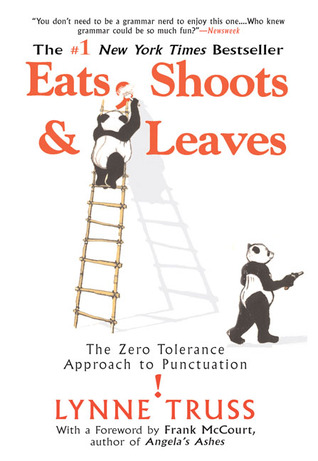
I just finished reading Lynn Truss’ excellent book, Eats, Shoots & Leaves. “Bestselling grammar book” is not a phrase you hear often, but this one is, and for a reason: in an impassioned, intellectual, and often quite humorous way, Truss makes her case for the importance of grammar and punctuation. The title comes from a joke whose punchline highlights the difference between “eats, shoots and leaves” (not a dinner guest you want in your house) and “eats shoots and leaves” (a panda).

Lynn Truss is probably at the forefront of the small subset of society that cares deeply and perhaps disproportionately about correct grammar, punctuation, and spelling. I too am part of this subset, and nodded along in complete agreement when I read, “To those who care about punctuation, a sentence such as “Thank God its Friday” (without the apostrophe) rouses feelings not only of despair but of violence.”

Perhaps the best argument Truss makes for punctuation is that its function in written communication and in literature is crucial; see the above example about the panda. One comma changes the meaning of the sentence entirely. Likewise, “You’re home” and “Your home” also have completely different meanings (in the former, you are at home; in the latter, the home in question belongs to you).

Those who rely on spellcheck to catch these errors are sunk; as this Slate article points out, spellcheck software is great at catching “nonword” errors, like “hte” instead of “the”; however, it doesn’t understand context, so it won’t stop you from using “complement” when you mean “compliment.” Web browsers, for the moment, have surpassed some spellcheck software; in the past five years, according to the Slate article, “Web browsers have become better at spelling than most humans.” What a thought: maybe the next Are You Smarter Than a Fifth Grader? will be Are You Smarter Than Your Browser? Someone call Ken Jennings.

Happy National Library Week!

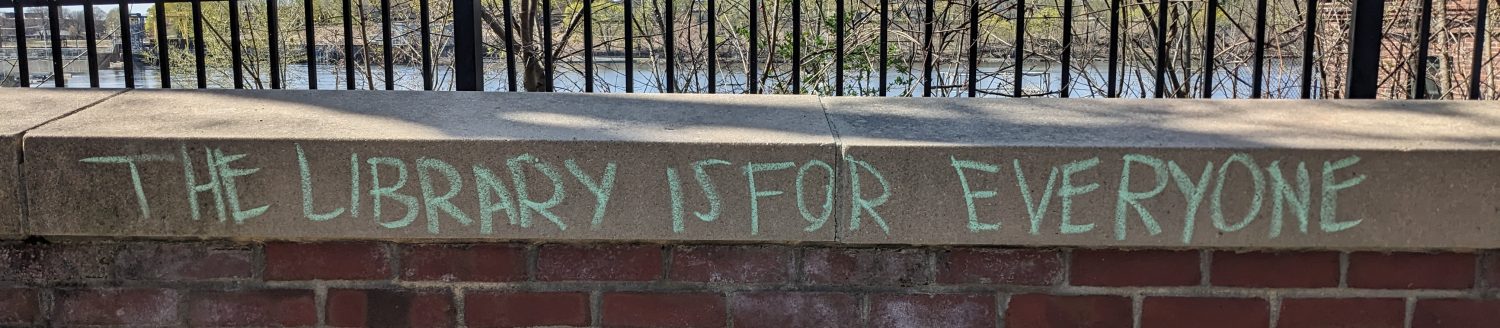
April 8-14 is National Library Week! Show your support for your library by visiting in person, commenting on or “liking” your library’s social media pages (Facebook, Twitter, etc.) if it has them, participating in Library Snapshot Day on Thursday, volunteering, writing to your library director, or calling or writing to your local government representatives to let them know what libraries mean to you.

One of my favorite library statistics is that on average, a person will pay about $40 per year in taxes to support the library. That is less than the cost of two hardcover books – and libraries aren’t just for books (though they do usually have plenty of hardcovers, paperbacks, ebooks, and audiobooks). They also offer DVDs, public internet access, and programs – from storytime and crafts for kids, to movie screenings, to computer and technology workshops, and much more. What do you love about libraries? Leave a comment!

Let Us Now Praise Libraries, Librarians

An article in the Boston Sunday Globe caught my eye this morning, with the headline “Let Us Now Praise Libraries, Librarians.” (A true librarian would have titled it “Let Us Now Praise Librar*”; hats off to you if you get the joke.) The article’s author, Anthony Doerr, writes about his childhood reading, “Here’s what I think about now: No one ever told me no. Not Mom, not the prim librarians stamping return dates onto slip after slip. No one ever said: This book is outside your age range; this book is too complicated.”

I had a similar childhood experience, reading far ahead of my “age appropriate reading level” and not coming to any harm. I’ve thought about this topic before (see the last three paragraphs of the post “Whose Common Sense?“), and I’m glad to see a similar attitude in print. Doerr writes, “…I worry that we are presenting reading to our kids as a labor to suffer through for which a reward can be earned at the end….The message to young people is obvious: Books are good for you. What’s missing, however, is the idea that sustained reading is magic, a kind of magic that can be wildly addictive, even dangerous.”

He then goes on to create a fantastic analogy, based on the fact that when the brain is stimulated (“when a person is thinking imaginatively and creatively”), it produces endorphins: “Great books are like drugs, readers [are] like junkies, and, yes, to stretch the analogy into absurdity, good librarians [are] like drug dealers.” He finishes, “So, to all you beautiful librarians out there, with National Library Week in the offing….Keep on putting books in the hands of readers, because as every good dealer knows, all it takes is one fix and your patrons are hooked.”

One of the most magical, engaging, imaginative, creative books I can think of is Nick Bantock’s Griffin & Sabine, which is the first of six books (all equally magical) detailing the correspondence between Griffin and Sabine. It’s not your typical epistolary novel (see The Guernsey Literary and Potato Peel Pie Society, also an excellent book), because each postcard and letter Griffin and Sabine exchange is rendered with “their” artwork and handwriting; the reader pulls actual letters out of actual envelopes. (For this reason, my first encounter with the books was in Special Collections at the Mount Holyoke College library.) If you can find these, I highly recommend them; you will find yourself immersed and filled with wonder. “Sustained reading is magic,” indeed.

Anne Fadiman: “Never Do That To A Book”

Anne Fadiman, author of Ex Libris: Confessions of a Common Reader (and other books), spoke at the Main Branch of the Cambridge Public Library on April 1 as part of Harvard University’s 375th Anniversary. In her talk she revisited the subject she addressed in one of the essays in Ex Libris, “Never Do That To A Book”: in short, she identified two different types of book lovers, the “courtly” and the “carnal.” Courtly lovers treat the book as a sacred object; carnal lovers have a more physical relationship with books – folding down pages, underlining, highlighting, and writing marginalia, and in the odd case, using bacon for bookmarks.

Though Fadiman was most likely correct to say that “Everyone in this room loves books, but not in the same way,” most of the audience identified themselves as somewhere in the middle of the courtly/carnal scale. Fadiman is, by her own admission, a carnal lover of books, believing that marginalia is “a way of turning a monologue into a dialogue.” Reading, she believes, “is a relationship like any other.”

Fadiman also said, early in her talk,”The story of our lives is the story of our books,” which reminded me of a fragment of a poem (“Improvisations of the Caprisian Winter”) by Rainer Maria Rilke (translated by Franz Wright):

So many things lie torn open
by rash hands that arrived too late,
in search of you: they wanted to know.

And sometimes in an old book
an incomprehensible passage is underlined.
You were there, once. What has become of you?

I am also somewhere in the middle of the courtly/carnal book lover scale; in books that I own, I have written and underlined (but only in pencil). I have folded down the corners of pages (but only until I finish the book – then I write down all the quotes I wanted from the dog-eared pages and un-dog-ear them). I do not splay books face-down; I do not highlight; I do not sleep with them under my pillow (though there is a stack on the nightstand and another stack on the floor).

And of course, whether the book was my own or belonged to the library, I would never use bacon for a bookmark.

Bring back the midlist!

There’s a great blog post on YARN (Young Adult Review Network) about the danger of the blockbuster mentality in the publishing world, and about the value of the fast-disappearing “midlist” – books that neither sold millions of copies nor flopped, by authors who had talent and the potential and promise to keep writing good quality books.

We can all identify the blockbusters – The Hunger Games, Twilight, Harry Potter are the obvious ones in YA, and all of those had crossover appeal, which helped them sell even more. There are adult blockbusters too – just look at The New York Times bestseller list. Again, nothing against reading popular books, but let’s brainstorm our favorite off-the-beaten path books – fiction or nonfiction, YA or adult. Here are a few of mine:

Overture by Yael Goldstein

All My Friends Are Superheroes by Andrew Kaufman

The China Garden by Liz Berry

The Good People of New York by Thisbe Nissen

The Stolen Child by Keith Donohue

A Pigeon and a Boy by Meir Shalev

The Various and Celandine by Steve Augarde

Lucky Girls: Stories by Nell Freudenberger

Love Begins in Winter: Stories, Simon Van Booy

What about you? Books that maybe haven’t hit the bestseller list or been heaped with literary awards or prizes, books that haven’t received much publicity buzz from publishers or reviewers, but good books nevertheless. Share your favorites in the comments!

Booktalk

A booktalk is exactly what it sounds like: a talk about books. Earlier this month, I gave a booktalk to the Wilmington Women’s Club at the library; it was a lot of fun picking the books, writing up a booklet ahead of time, and giving the talk.

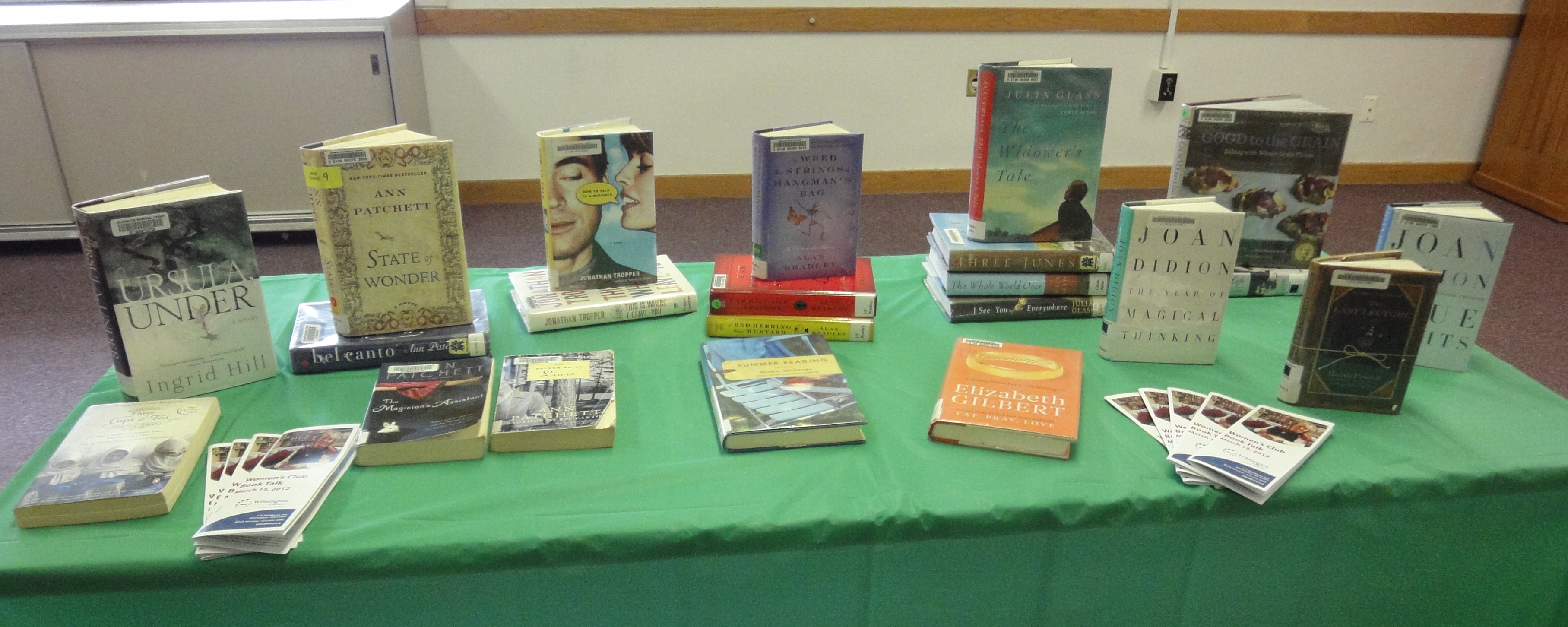
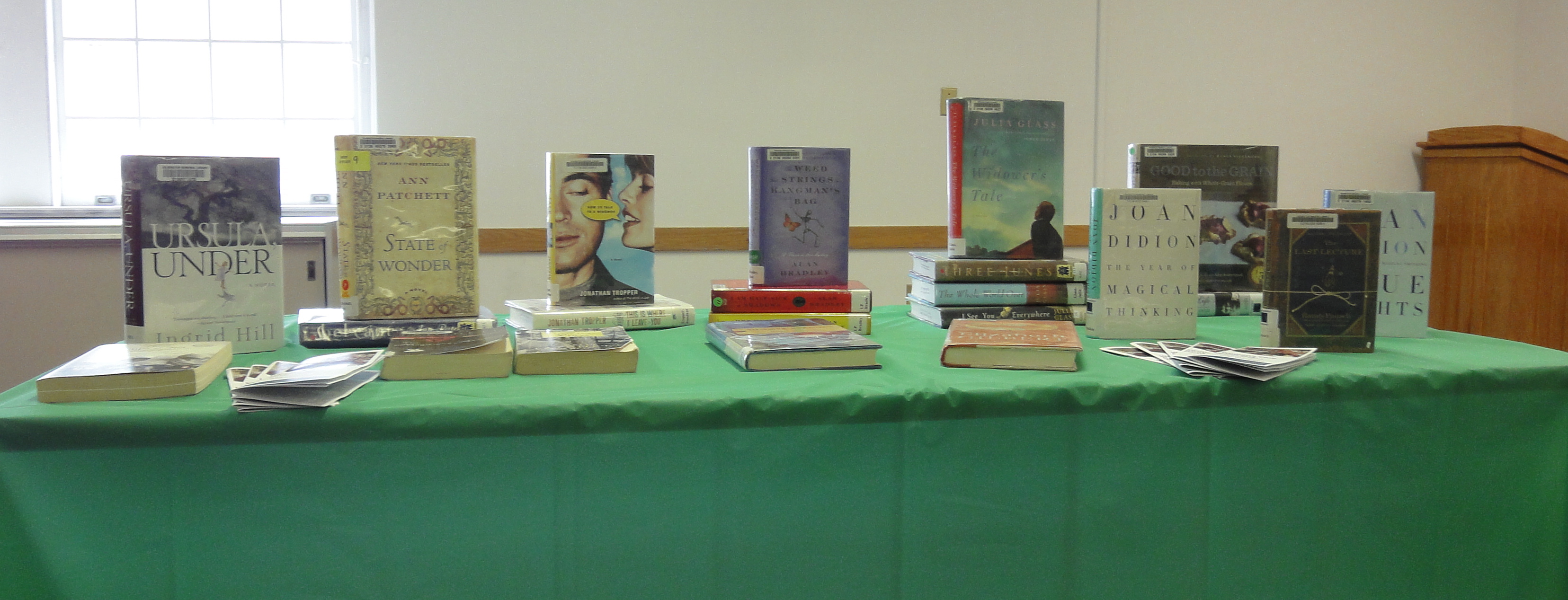
Right before the talk, I pulled all of the books I could find from the shelves and created this display. Some of the books were out, of course, but most are here, and in some cases I included the authors’ other books, if s/he had any.

From left to right: Ursula, Under by Ingrid Hill; State of Wonder, The Magician’s Assistant, The Patron Saint of Liars, and Bel Canto by Ann Patchett; How to Talk to A Widower and Then We Came to the End by Jonathan Tropper; Summer Reading by Hilma Wolitzer (An Available Man wasn’t available); Alan Bradley’s Flavia de Luce books (The Sweetness at the Bottom of the Pie is the first); Commitment by Elizabeth Gilbert; The Widower’s Tale, Three Junes, The Whole World Over, and I See You Everywhere by Julia Glass; The Year of Magical Thinking and Blue Nights by Joan Didion; Good to the Grain by Kim Boyce; and The Last Lecture by Randy Pausch and Jeffrey Zaslow (author of The Girls From Ames).

Not pictured (fiction): Her Fearful Symmetry and The Time Traveler’s Wife by Audrey Niffenegger; Wayward Saints by Suzzy Roche; The Flight of Gemma Hardy by Margot Livesey; The Tea Rose by Jennifer Donnelly; The Paris Wife by Paula McLain; I Married You for Happiness by Lily Tuck

Not pictured (YA): The Hunger Games by Suzanne Collins; The Fault in Our Stars by John Green

Not pictured (biography/memoir): Bossypants, Tina Fey; The Happiness Project, Gretchen Rubin; My Life in France, Julia Child and Alex Prudhomme; An Exact Replica of a Figment of My Imagination, Elizabeth McCracken

Not pictured (nonfiction): The Girls From Ames: A Story of Women and Friendship by Jeffrey Zaslow; The Spirit Catches You and You Fall Down by Anne Fadiman; The Girls Who Went Away by Ann Fessler; The Ghost Map by Steven Johnson

Hopefully, there’s something for everyone!