Best of 2011, Part the First: Young Adult

Saving the two major categories – adult fiction and nonfiction – for later, here are a few of the best young adult (YA) books that I read in 2011 (not necessarily published in 2011).

Looking for Alaska, by John Green
I was utterly blown away by this book. It is set at a boarding school in Alabama, where the main character Miles Halter (a.k.a. Pudge) comes seeking a “great perhaps.” What he finds is a teacher who makes him think, a friend who makes him laugh, and a girl who makes him dream – and breaks his heart. The structure of the book is unique: it is divided into two parts, Before and After, and instead of chapter headings there are countdowns (e.g. 121 days before; 29 days after). Looking for Alaska is a classic, tragic coming-of-age story, along the lines of Bridge to Terabithia and A Separate Peace. (I highly recommend John Green’s other books as well, including his newest, The Fault in Our Stars.)

Little Brother, by Cory Doctorow
Warning: This book will make you paranoid, for at least as long as it takes to read it and several days after. It features Marcus, a high school hacker who uses his intelligence primarily to evade the school’s efforts to invade his privacy. Marcus and his friends get drawn into a much bigger battle against a much more powerful enemy when the Department of Homeland Security picks them up after the Golden Gate Bridge is blown up. Part thought experiment, part meditation on privacy, security, and freedom (though meditation is too quiet a word to describe this book), Little Brother is thought-provoking, action-packed, and a little bit frightening – it’s our world, once-removed.

The Body of Christopher Creed, by Carol Plum-Ucci
Simply one of the best YA mysteries I have read in ages. Social outcast Christopher Creed goes missing after leaving an ambiguous note, and his classmate Torey Adams cannot let the disappearance rest – especially when rumors that Chris was murdered begin swirling, and fingers are pointed at people that Torey is sure are innocent. Torey is often introspective, musing on the nature of popularity and friendship, but this intensifies the suspense of the story rather than slowing it down. (There is also a sequel, Following Christopher Creed, which does not disappoint.)

Uglies, by Scott Westerfeld
A dystopian novel in a sea of dystopian novels, Uglies exceeded my expectations. In Tally Youngblood’s world, everyone is surgically transformed from an Ugly to a Pretty when they turn 16, and Tally can’t wait – but her transformation depends on betraying her friends, who ran away to escape being turned Pretty. When Tally goes after them, her journey and the people she meets open her eyes to what being Pretty really means. (This series continues through Pretties, Specials, and Extras. I read Pretties, and enjoyed it, but did not feel compelled to continue after that.)

A Northern Light, by Jennifer Donnelly
Fans of historical fiction: stop whatever you’re doing, go find this book, and read it. Set in the Adirondacks in 1906, A Northern Light is 16-year-old Mattie Gokey’s story. Mattie’s mother is dead, and Mattie has shouldered her duties on the farm, including taking care of her younger siblings. Mattie dreams of being a writer, and has a teacher who believes in her and encourages her; but a future as a writer is incompatible with the deathbed promise she made to her mother. Will Mattie put her family first, or her own dreams? Her decision hinges on a bundle of letters that a visitor leaves in her care, with instructions to destroy them – but Mattie reads them, and it changes the course of her life. (Inspired by the same case that inspired Theodore Dreiser’s An American Tragedy.)
Best of 2011: Prequel

[Yes, most people were more timely with their “best of 2011” lists. Better late than never, right?]

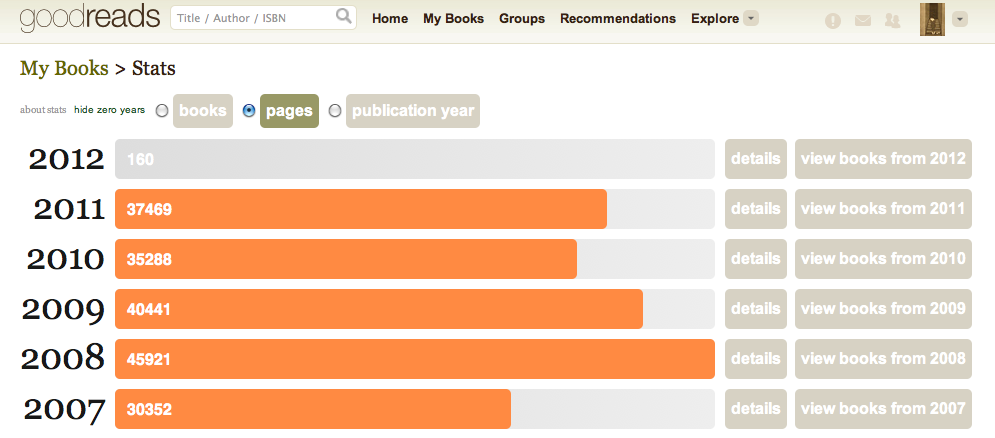
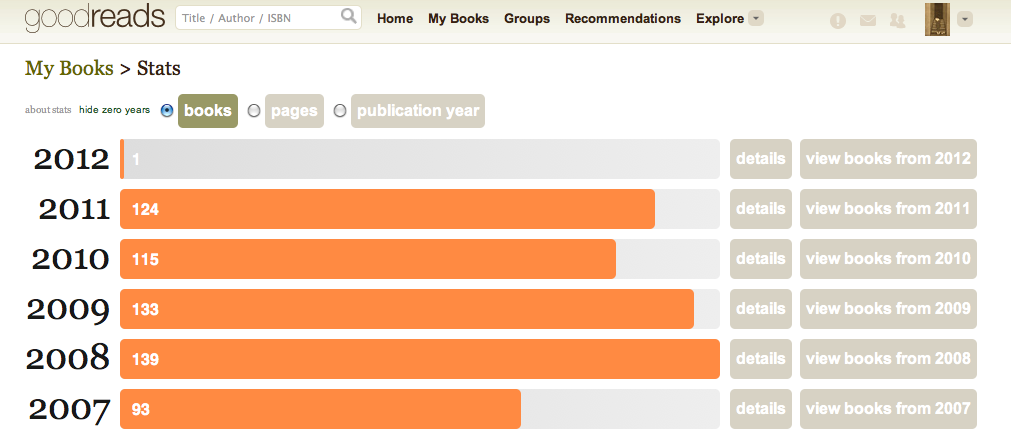
I’m not as statistics-happy as some, but I realized recently that Goodreads keeps some stats for you, and puts them into pretty little bar charts and scatter-plots. I’ve been using Goodreads pretty religiously since I discovered it mid-2007, and here’s what it had to tell me:

That’s 139 books in 2008 (the first full year I kept track), 133 books in 2009, 115 in 2010, and 124 last year, in 2011; it’s an average of 9.5-11.6 books per month.

Here’s another cool thing Goodreads calculates for you: page count! In 2008, I read 45,921 pages, or about 3,827 pages per month; last year, I read a total of 37,469 pages, an average of 3,122 pages per month. (This is just books, not articles online or for classes.)

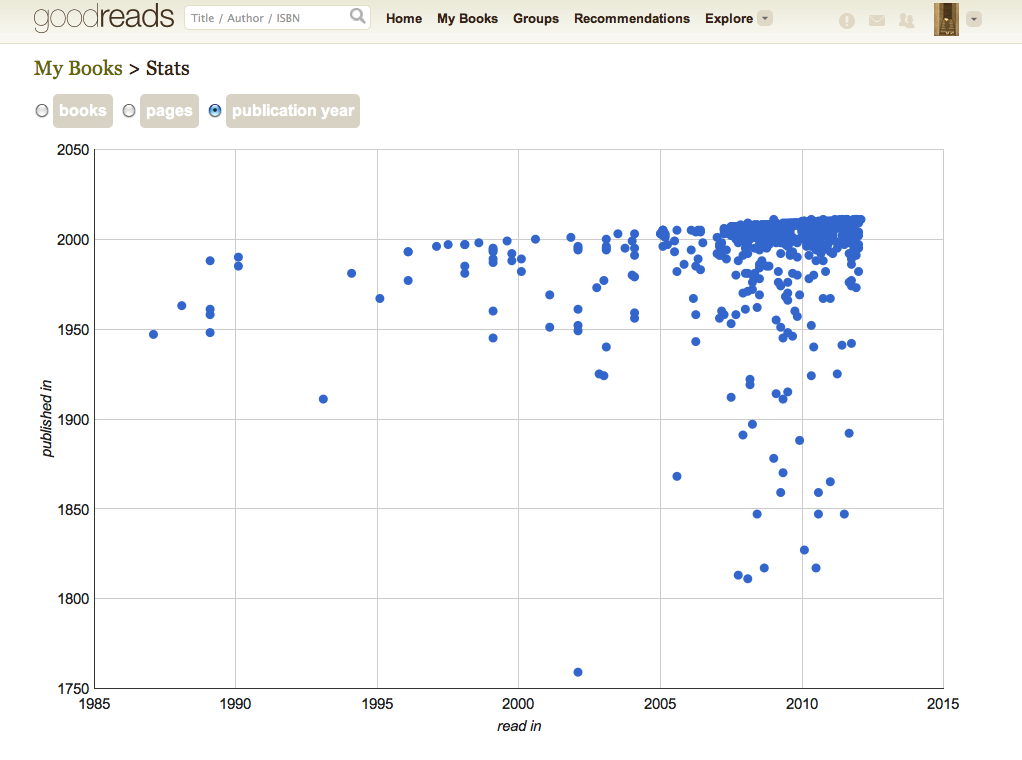
Finally, it creates a scatter plot of the publication dates of books you’ve read, with the pub date on the y-axis and the date you read the book on the x-axis. There’s a pretty dense cluster around the late ’90s and early 2000s, which makes sense as I read a lot of contemporary fiction, but there are some older books too, back as far as the early 1800s.

What statistics don’t tell you, of course, is anything about content. Which books did I love, which would I read again, which would I recommend? I’m glad you asked! I read a number of books I loved in 2011, and I’ll share those here soon. Meanwhile, here are some favorites from 2009 (I seem to have skipped a write-up for 2010): nonfiction, poetry, plays, and young adult fiction; short stories, classics, and “re-reads”; and fiction.


Rules for Writing Fiction

This two-part article from The Guardian (UK) isn’t new, but it’s worth another read even if you saw it when it was first published. Writers including Elmore Leonard, Margaret Atwood, Philip Pullman, Jonathan Franzen, Anne Enright, Hillary Mantel, Zadie Smith, and many more offer their personal rules for writing fiction. A few that are repeated throughout many lists include “take long walks,” “avoid adverbs,” and (seems obvious, but…) “write.” Many encourage habit and routine; many also admit it’s fine to break the rules sometimes. Whether you’re a writer or a reader, the lists are fascinating.

Read Part One

Read Part Two

Research and Publication

Two recent pieces in the New York Times – an article and an op-ed – address the issue of the publication of scientific research, and access to that research. The op-ed, “Research Bought, Then Paid For” by Michael Eisen, the founder of the non-profit, open-access Public Library of Science (PLoS), argues that research that was funded or subsidized by taxpayers ought to be available to those taxpayers free of charge. In a nutshell, “if taxpayers paid for it, they own it.” Eisen encourages scientists to publish their work in open-access journals instead of journals like Science, Nature, and Cell, which charge steep subscription fees – often to the same universities whose researchers submitted the papers and provided peer-review services for free.

The January 16 article “Cracking Open the Scientific Process” explains the issue in a slightly more balanced way (and reveals that some open-access journals, PLoS included, charge authors publication fees to authors). However, though of course the issue is more complicated than it appears at first glance, Eisen has a point about the principle of the thing: publicly funded research should be available to the public. Additionally, as the Jan. 16 article illustrates, many sites allow and encourage collaboration and networking, enhancing the scientific community and helping solve research questions more quickly.

I am reminded of the TED Talk on Open-source cancer research, wherein researcher Jay Bradner published and shared research instead of patenting it – the opposite, he pointed out, of what a pharmaceutical company would do – based on the principles of open-source and crowdsourcing.

A January 20 article in The Atlantic (“Locked in the Ivory Tower: Why JSTOR imprisons academic research”) also addresses the issue of the “broken economics of academic publishing.” The author summarizes, “Step back and think about this picture. Universities that created this academic content for free must pay to read it. Step back even further. The public – which has indirectly funded this research with federal and state taxes that support our higher education system – has virtually no access to this material, since neighborhood libraries cannot afford to pay those subscription costs.” She suggests circumventing the publishers, eliminating the print journal, and putting the content online.

Whether or not that’s the solution that enough people, organizations, and institutions eventually coalesce around, it’s clear that something must be done about the current state of academic research and publication – and it will probably happen sooner rather than later.

Edited to add (2/4/12): Some researchers, inspired by open-access champion Peter Suber and British mathematician and Fields medalist Tim Gowers, are boycotting the journal publisher Elsevier.

Technology as a means to an end

Earlier this month, there was an op-ed in the New York Times titled “Internet Access Is Not a Human Right.” One of the main points of the piece was that internet access is always a means to an end – the “end” being some kind of content or service or tool.

It’s not an exact parallel, but this reminded me of the difference between information literacy – the ability to recognize the need for information, and to locate, evaluate, and use that information effectively – and information technology skills. Likely, you’ll need certain technology skills in order to locate information, but just because you know how to use search engines, databases, or online catalogs does not mean you have all the other skills as well.

As the Association of College & Research Libraries (ACRL) states, “Information literacy, while showing significant overlap with information technology skills, is a distinct and broader area of competence. Increasingly, information technology skills are interwoven with, and support, information literacy.” However, they aren’t the same thing. The means to access information has changed, is changing, and will continue to change in the future; ensuring that everyone has the right to access and the skills to do so  is the important thing.

What is SOPA? Bring in the nerds!

I was reading Jessamyn West’s insightful wrap-up of the SOPA strike, which contained several excellent links, a few of which I’ll re-share here.

Jon Stewart, on SOPA’s likely effect, and on Congress’ lack of understanding of the internet: “‘Bring in the nerds’…Really? Nerds? You know I think actually the word you’re looking for is experts” at 4:21-4:45. (Also funny: at 6:50-7:00, when “Imagine” starts to play, “Wait, no no no no no no, even as a joke we don’t have John Lennon copyright money!”)

West also linked to ProPublica, which offers a tool to look up your current members of Congress’ stance on SOPA/PIPA. Here also is a graphic showing the difference between Jan. 18 and Jan. 19 (it went from 80 supporters and 31 opponents to 65 supporters and 101 opponents).

Lastly, here’s a slightly older (Jan. 6) article from Publishers Weekly, arguing that libraries are in fact the best counter to piracy. Author Peter Brantley cites Tim O’Reilly’s 2002 essay, “Piracy is Progressive Taxation,” wherein O’Reilly says that the incentive for piracy (of e-books, in this case) is “dramatically reduced” when demand is satisfied in as many places and as many ways as possible.

I don’t have a statistic for what percentage of people pirate books, movies, music, or other content as opposed to obtaining it legally, whether by purchasing it, borrowing it from the library, or licensing it through various services, but I think that many people would prefer to obtain their content legally, and are even willing to pay for it, as comedian Louis CK proved recently with his “Live at the Beacon Theater” production, which he sold for $5 online. The takeaway: when buying or borrowing is easier than pirating, people are likely to borrow or buy.

The Day After

Here are several links regarding SOPA, PIPA, and yesterday’s blackout:

Columbia Law School professor Tim Wu pointed out the Web’s strength in this New York Times article, in which he was quoted as saying, “This is the first real test of the political strength of the Web, and regardless of how things go, they are no longer a pushover. The Web taking a stand against one of the most powerful lobbyers and seeming to get somewhere is definitely a first.”

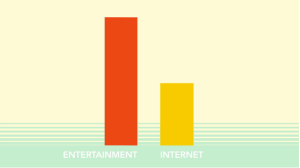
Political strength and economic strength are linked, and as the “Protect IP/SOPA Breaks the Internet” video notes, the “internet industry” now dwarfs the entertainment industry (most of Hollywood is for SOPA/PIPA, while most internet companies – including Google, Facebook, Wikipedia, and YouTube – oppose it). (See 2:48-2:57 – the yellow “internet” bar shoots skyward past the red “entertainment” bar.)

The American Library Association (ALA), which opposes SOPA/PIPA, put together this Quick Reference Guide (PDF), clearly delineating the basics and the structure of each bill. Read the District Dispatch in which ALA applauds the blackout.

Mashable offers a “read between the lines” deconstruction of the official White House response to two petitions (“Stop the E-PARASITE Act” and “Veto the SOPA bill”). The White House addresses legislative scope, non-legislative solutions, censorship and innovation, internet security and stability, and “demands of Congress a more intimate understanding of the Internet in general.”

Lastly, here’s a funny/poignant cover of Don McLean’s “American Pie” on TechCrunch.

SOPA/PIPA

As you may already be aware, today, January 18, a number of sites (including Wikipedia) are participating in a blackout to protest SOPA and PIPA – the Stop Online Piracy Act and the Protect IP Act. A few days ago I linked to a Digital Trends article with a good description of what both bills are and what they would do if passed.  The site sopastrike.com is also informative, though it’s a little overwhelmed with traffic today and may be slow. Here’s a video from Fight for the Future which is also clear and informative regarding what the bills are intended to do vs. the effect they are likely to have in reality.

It seems to be a case of “the road to hell is paved with good intentions.” Most can agree that online piracy is bad, and that intellectual property and copyright do and should entitle the creators of works to the proceeds from those works. “Stop online piracy” is a good goal, but SOPA will not be able to do this effectively. As is pointed out in the video, the government already has tools to regulate the internet: the Digital Millennium Copyright Act (DCMA, 1998), the Prioritizing Resources and Organization for Intellectual Property Act (PRO-IP, 2007), and the Anti-Counterfeiting Trade Agreement (2011).

What can you do? Read about SOPA and PIPA, educate yourself, and take action. There are a number of ways, from blacking out your own website if you have one, to contacting your representatives.


Education and Equality

I was going to call this “Nice Guys Finnish First,” but (a) it’s a bad pun, and (b) for those who don’t get the pun, it just looks like I’ve misspelled “finish.”

However, it seems to be true about nice guys, or at least nice countries: the Finnish education system (entirely public, by the way; there are no private schools in Finland) is overwhelmingly more successful than the U.S. one, primarily because it values cooperation over competition, responsibility rather than accountability, and equality over all. This excellent article in The Atlantic goes into detail: “What Americans Keep Ignoring About Finland’s School Success.”

By valuing equality in practice rather than just in speech, Finland has done what America says it wants to do: leave no child behind.

Searching for Context

Yesterday I attended Alison Head’s lecture “Searching for Context: Modeling the Information-Seeking Process of College Students” at the Berkman Center at Harvard. Head is affiliated with Project Information Literacy, and what she said about her research findings largely agreed with what I’d found through my User Instruction course last semester (though consulting the PIL reports would have been helpful at the time!).

Project Information Literacy (PIL) is an ongoing national study, including (so far) 11,000 students across 41 college campuses – community colleges as well as private and public four-year undergraduate institutions. Findings are not generalizable as the samples are voluntary, not random, but the methodology is sound (focus groups, surveys, content analysis, interviews) and the findings are certainly interesting.

Head’s presentation yesterday included four “takeaway points” from the PIL studies:

1. Students say research is more difficult for them now than ever before. Research – course-related and “everyday” – is a stressful process. Students must grasp the big picture, gather information, use appropriate language (search terms), and measure the information they find against their expectations. Unexpectedly, the PIL studies found that students were most likely to consult a librarian for help with search terms, rather than gathering information; also, the studies found that everyday, open-ended research questions were harder than research assignments.

2. Students turn to the same “tried and true” sources over and over again. Students use the same sources no matter what their contextual need is – whether it’s for an assignment or an everyday question, whether it’s for a science class or a literature class. Students reply on course readings first, then search engines, library databases, instructors, and Wikipedia; farther down the list is librarians. However, contrary to expectations, students use a hybrid model – they don’t search exclusively online, but also consult printed matter, teachers, and family and friends.

3. Students use a strategy of predictability and efficiency…as opposed to the librarian model of scholarly thoroughness. Students are risk-averse, preferring familiar resources, and placing a high value on currency (above other measures of quality, such as the publication, the author, etc.). Students say the most difficult step is getting started, then defining a topic, narrowing the topic, and sorting through irrelevant results. Seven out of ten students consulted Wikipedia, often as a “presearch” tool – to help with the big picture before really starting to research.

4. “Research and finding and using information is different than when you were in college.” Perhaps this was aimed at audience members who are no longer in their 20s; most everything Head described about PIL’s findings was relatively familiar to me. However, there has no doubt been rapid change: the amount of information available today is “staggering,” the level of connectivity is higher, there is a Web 2.0 culture of sharing, and expectations about information have changed. Group projects, for example, used to be objectionable to students because they did not want to share their work with others; today, group projects are still objectionable, but for different reasons – scheduling issues, personality conflicts, unequal contributions (not that these weren’t problems before as well).

To revisit takeaway #3 – this was much discussed in my User Instruction class last fall – librarians and faculty both can help alleviate student anxiety about research and improve their research strategies by providing clearer and more detailed guidelines in syllabi, assignment descriptions, and handouts. Head admitted that when she taught, she designed her syllabus largely based on that of her favorite professor at UC Berkeley; there is no class in a Ph.D. program where future professors learn how to craft syllabi and assignments.

On top of this, faculty tend to assume that students possess research skills already, when this is often not the case. High school research is different than college research, and students cannot learn all they need to know in one class session with a librarian during freshman year (some don’t even have the benefit of this). Ideally, professors’ assignment guidelines would include a description of what research means, how to do it, and what resources are available; they should point not just to library resources, but also to librarians. They should also discuss plagiarism – not just the standard warning that plagiarism is a punishable offense, but a description of what it is (it might seem obvious, but there are different levels – word-for-word copying, paraphrasing too closely, lack of attribution for others’ ideas).

Research does not have to be as stressful for students as it is. (Head gave an example of a professor who likened the research process to solving a mystery, complete with Sherlock Holmes analogy.) Librarians can reach out to both faculty and students; faculty can reevaluate their expectations of students’ research skills and craft their assignments accordingly; and of course, students can be more proactive in seeking help. But they’ll have to have a good reason to trade in their strategy of predictability and efficiency for a model of scholarly thoroughness.

Edited to add: There was an article on this topic in Inside Higher Ed in July 2010: “Assignments: Being Clear About What Matters,” by Barbara Fister.