Alba, Continued

For those who do not know, The Time Traveler’s Wife is my favorite book. This is not hyperbole. I first read it approximately nine years ago, and I’ve never really stopped reading it. We have at least four print copies in the house: two U.S. editions, a limited edition with a cover by the author, and a U.K. edition (purchased during a semester abroad in Spain; I lasted about two months without a copy, then went to London and bought a new one at Paddington Station. First agenda item, before museums or anything).

I have also followed Audrey Niffenegger’s other work: her novel Her Fearful Symmetryher artist’s books and graphic novels, and recently her exhibit at the National Museum of Women in the Arts, “Awake in the Dream World.” 

TTW_zolaFor a long time, The Time Traveler’s Wife was not available as an e-book*, but recently it has become available from Zola Books, which sells platform-agnostic DRM-free e-books that work on all devices. (That bears repeating: platform-agnostic DRM-free e-books that work on all devices. How marvelous.) So of course I bought the e-book. I probably would have anyway, but I was (am) especially excited because this version had a new author’s note, and – and – a snippet of the sequel. Tucked at the end, after the permissions, are 18 (Zola says 25, but I counted, it’s 18) beautiful, magical, perfect pages – “Alba, Continued.”

*Here is Audrey in an interview with UR Chicago on the subject of e-books:

“…E-book feels like a misnomer. There’s nothing booky about it. It’s like when Gutenberg invented the printing press….What he was doing was imitating, as best he could, the handwritten word. Every time you get a new technology, it tries to kind of impersonate the old technology until everybody calms down, and then it can go ahead and progress and be whatever it is going to be. That’s the stage I’m waiting for, because I’m getting kind of grumpy with this thing that is trying to impersonate a book.”

But back to “Alba, Continued.” This is very much like, if you happen to be a Narnia fan, someone casually opening the door to the wardrobe and inviting you to step on in. Or if you are a Harry Potter fan, receiving a letter from Hogwarts (never mind that you aren’t eleven years old anymore). Or if you are a Philip Pullman fan, and you come across a window into Lyra’s Oxford. If all three of those things happened to me simultaneously, I could not be more excited.

Part of the excitement comes from surprise; unlike Narnia, Hogwarts, and Lyra’s Oxford, Henry and Clare’s Chicago was never part of a series; I never expected there to be any more of it. For years after the publication of TTW, the author said she was done writing about Clare and Henry and Alba. In an interview with Dear Author, she said,

“I wasn’t planning to write a sequel so this is still new to me. Joe Regal of Zola Books asked me if I had any Time Traveler’s Wife material that hadn’t been published; he was looking for something to publish with the e-book of TTW as an extra. I had nothing that would have made any sense to a reader, just notes and revisions. So I promised to write something new.

It was a funny experience, writing about Alba. I have always made a point of not imagining the lives of Clare and Alba and the other characters beyond the scope of the book, but when I tried to think about them many things came flooding in, as though I knew them already. The imagination is a strange thing, it often works best when you don’t watch it too closely.”

And so the wardrobe, when you least expect it, opens.

The Queen of Dinner Parties: in which I discover The Yale Book of Quotations

yalebookquotationsThe Library Link of the Day for September 30…you know, I’m having trouble even putting into words how delighted I was to read it (“Who Really Said That?” by Corey Robin in The Chronicle of Higher Education) and to find, as a direct result, The Yale Book of Quotations on the library shelf. I have always collected quotes – from books, from songs, from anywhere really. I am a magpie, and quotes are my shiny objects.

How, then, did I not discover The Yale Book of Quotations previously? I do not know. But needless to say that when I did find it, browsing through it was a purely joyful experience. (Book nerd. Yes. That has been established.) At last, I could find out whether Oscar Wilde’s last words really were “Either that wallpaper goes, or I do.” (Close enough: “Decidedly one of us will have to go.”) I could verify the wording of Clarke’s Third Law (“Any sufficiently advanced technology is indistinguishable from magic”) and discover that he also said, “How inappropriate to call this planet Earth when it is clearly Ocean” (1990).

I could be indignant that the lyrics of Eminem’s “My Name Is” and “The Way I Am” were included nearly in full, but there was only one quote from The Princess Bride (“Life is pain…anybody that says different is selling something”). Incidentally, you’d have to know that William Goldman wrote the book (and the screenplay) to find the Princess Bride quote, because the contents are organized alphabetically by author last name. (Would anyone look under Morgenstern, I wonder?)

For anyone who believes, as I do, that correct wording is important, and correct attribution is equally important, The Yale Book of Quotations is a goldmine. (“Oh, you’re going to be the queen of dinner parties,” my husband said when I bombarded him with my new discovery. “You won’t be able to take me anywhere,” I agreed.) With over 12,000 quotes in 851 pages (plus a keyword index that brings the total page count to 1067), this is one of those times when a book might just be better than the internet. Here are a few of its many gems:

“Mother told me a couple of years ago, ‘Sweetheart, settle down and marry a rich man.’ I said, ‘Mom, I am a rich man.'” -Cher, 1995

“When Tolstoy wrote that all happy families are alike, what he meant was that there are no happy families.” -Susan Cheever, 1991

“What America does best is to understand itself. What it does worst is to understand others.” -Carlos Fuentes, 1986

“Diplomacy is to do and say / the nastiest thing in the nicest way.” -Isaac Goldberg, 1927

“Gentlemen, include me out.” -Samuel Goldwyn, 1933

“You lose more of yourself than you redeem
Doing the decent thing.” -Seamus Heaney, 1984

[J. Cheever Loophole, played by Groucho Marx, speaking:] “I bet your father spent the first year of your life throwing rocks at the stork.” –At the Circus (motion picture) (1939) Screenplay by Irving Brecher.

[Responding to a fan’s request that he autograph a school chemistry book:] “Sure thing, man. I used to be a laboratory myself once.” -Keith Richards, 1994

[On looting after the fall of Baghdad:] “Stuff happens!” -Donald Rumsfeld, 2003

“A rattlesnake that doesn’t bite teaches you nothing” -Jessamyn West, 1979

“I myself have never been able to find out precisely what Feminism is: I only know that people call me a Feminist whenever I express sentiments that differentiate me from a doormat or a prostitute.” -Rebecca West, 1913

“It was in dealing with the early feminist that the Government acquired the tact and skillfulness with which it is now handling Ireland.” -Rebecca West, 1916

[Mother:] It’s broccoli, dear.
[Child:] I say it’s spinach, and I say the hell with it.
-E.B. White, New Yorker cartoon caption, 1928

“Our deepest fear is not that we are inadequate. Our deepest fear is that we are powerful beyond measure. It is our light, not our darkness, that most frightens us.” -Marianne Williamson, 1992 (frequently misattributed to Nelson Mandela)

I also wrote about this article and book on the Robbins Library blog.

Fall Titles: The Signature of All Things, The Lowland

This fall should be a good one for publishers and readers alike. Many beloved authors are coming out with new titles in September, October, and November, including Margaret Atwood (MaddAddam), Stephen King (Doctor Sleep), Amy Tan (The Valley of Amazement), and several others. I was lucky enough to read advance copies of two of these anticipated titles: The Lowland by Jhumpa Lahiri, and The Signature of All Things by Elizabeth Gilbert.

lowland First, and most eagerly awaited, The Lowland: a friend of mine who attended ALA in Chicago snagged a galley and generously let me borrow it. Lahiri (Interpreter of Maladies, The Namesake, Unaccustomed Earth) treads familiar ground with a story of an Indian family, some of whom move to the American Northeast, and some of whom stay behind in India.

Those who read the fiction section of The New Yorker may recognize the first several pages of The Lowland, in slightly altered form; it was published as “Brotherly Love” in the June 10 issue earlier this year. The brothers are Subhash and Udayan: the elder is cautious, the younger is reckless (“[Subash’s] parents did not have to worry about him and yet they did not favor him. It became his mission to obey them, given that it wasn’t possible to surprise or impress them. That was what Udayan did”).

Though the brothers grow up side by side, their paths diverge, with Udayan becoming involved in a dangerous political movement – the drastic consequences of which echo for decades after Udayan’s death and Subhash’s marriage to his brother’s widow, Gauri.

The narration is a close third person, shifting perspectives every so often, from Subhash, to Gauri, to their daughter Bela, to the brothers’ mother Bijoli, and finally to Udayan. Lahiri creates intensely believable characters in the Mitra family, and she covers a significant time span with her spare, beautiful prose.

The Lowland has been shortlisted for both the National Book Award and the Man Booker Prize.

signatureofallthingsThe Signature of All Things by Elizabeth Gilbert (Stern Men; Eat, Pray, Love; Committed) covers an even greater span of time, at a much more leisurely pace. For once, I could not agree more with the Publishers Weekly review, which is a marvel of conciseness. This thoroughly researched story begins with Henry Whittaker, a scrappy young thief whose father works at Kew Gardens. Henry eventually becomes one of the wealthiest men in Philadelphia, and his daughter, Alma, grows up on the family estate, White Acre.

Alma is given all the advantages Henry did not have, especially education; but, because she is plain (especially compared to her beautiful adopted sister, Prudence), she must resign herself to spinsterhood while Prudence and their mutual friend, Retta, both marry.

Alma devotes her time to business – after her mother Beatrix’s death, she is Henry’s right hand – and the study of mosses. Her life continues in this quiet, circumscribed, but more or less satisfying manner until the arrival of Ambrose Pike, an orchid artist. For the second time in her life, Alma falls in love, and she and Ambrose marry, but the marriage is not what either of them expected, and Ambrose leaves White Acre.

Soon afterward, the inimitable Henry Whittaker dies, and Alma decides, finally, to leave White Acre and travel. She follows Ambrose’s path to Tahiti, and after a few years there, makes her way to her mother’s homeland of Holland.

Gilbert incorporates her research into the story in a way that is natural, not distracting – a harder task than it appears. From beginning to end, she maintains control over the story and the characters; I was aware of the narrator’s voice and presence throughout the time I was reading. Perhaps this slight distance was the reason I did not feel the full emotional impact of admittedly dramatic events throughout Alma’s life. Still, this is a unique book, and an especially great choice for those who are interested in botany, science, history, or travel.

The Design of Everyday Things by Donald A. Norman

“Good design is actually a lot harder to notice than poor design, in part because good designs fit our needs so well that the design is invisible, serving us without drawing attention to itself. Bad design, on the other hand, screams out its inadequacies, making itself very noticeable.”

designofeverydaythings
The above quote is from the preface to the new edition of The Design of Everyday Things, which will be published in November (the preface is already available). If I’d known a new edition was coming so soon, I might’ve waited a few months, but as it is, the 1988 edition holds up fairly well. The examples are outdated, but the principles remain sound, and Norman even predicted certain technological advances (the smartphone, for example).

Norman’s principles of design truly do apply to everything that people make and use, from the simple (doors) to the advanced (computers). Though technology has improved since 1988 (now, of course, computers are everyday things), some of the same design flaws persist, and Norman’s decades-old observation still holds true to some extent: “[D]esigners of computer systems seem particularly oblivious to the needs of users…” Designers, who know their products well, often fall into the trap of thinking that they are the typical user, when in fact, they usually cannot predict the type of errors that users will commit.

So, what are these principles?

Visibility: Is it clear from examining the object in question how it can be used, or what should be done with it? For example, is the on/off switch in the front, or hidden around the back? I thought of an example of poor visibility right away: at our library, we have a coin box where patrons pay for their print jobs. This box is designed so that coins go in a slot at the top. The machine also accepts $1 and $5 bills, but the slot for the dollar bills is placed on the front of the box but very far down, near the floor. Patrons frequently come to the desk to get change for a bill, and we show them that the machine does in fact accept bills. A lot of them apologize for bothering us and blame themselves for not seeing the bill slot, but really, it is a bad design: the bill and coin slots should be grouped together.

Natural mapping: Essentially, does the way a thing works make sense? A joystick or a mouse employs natural mapping: forward=up, backward=down, left=left, right=right. Likewise a steering wheel in a car: turn right to move right, and left to move left. The opposite would be counterintuitive, confusing, and frustrating, and would lead to frequent error.

Conceptual model: Norman writes about three aspects of mental models: the design model, the system image, and the user’s model. The design model is the designer’s mental map of how their product works; the system image is what the product shows to the user; and the user’s model is a mental map of how they think the product works. In the preface to the 2002 edition, Norman writes, “Design is really an act of communication, which means having a deep understanding of the person with whom the designer is communicating.” Because the designer and the user don’t communicate directly, the user’s only insight into the designer’s mind is through the system image. Therefore, the designer must “explain” through the system image how the product works, and guide the user to perform the correct actions for the task they want to complete – not an easy feat. However, Norman writes, as a rule of thumb, “When instructions have to be pasted on something…it is badly designed.” Things work best when the designer and the user have similar conceptual models.

Feedback: Once the user has completed an action, how does s/he know whether it has worked or not? Humans generally are not comfortable with uncertainty, so a good design provides feedback to explain what is happening or has happened. “Design should…make sure that (1) the user can figure out what to do, and (2) the user can tell what is going on.” Feedback includes everything from progress bars (“Your download is 58% complete”) to descriptive error messages with helpful next steps.

Swash_ornament_zeimusu

While reading The Design of Everyday Things, Clarke’s Third Law came to mind: “Any sufficiently advanced technology is indistinguishable from magic” (Arthur C. Clarke). When processes become invisible, they come to seem magical and mysterious. The flip side is that “magic” is hard to take apart, fix, and put back together; cellphones aren’t like old radios. With much of today’s technology, it is difficult for users to tell what is happening, and, if something is going wrong, how to fix it. The Design of Everyday Things doesn’t necessarily help users who are frustrated with a product (except by assuring them that it likely isn’t their fault, but rather the fault of the design), but it does help us recognize bad design, think about how it could be better, and appreciate good design.

More quotes from the book can be found in my Goodreads review.

Open Letter: Authors for Library E-Books

Naturally the subject of e-books in libraries arose during the week at NELLS. For those who are unfamiliar with the issue, Maureen Sullivan’s open letter to publishers (9/28/2012) is a good place to begin. In it, she explains how libraries support publishers by improving literacy, instilling a lifelong love of reading, and aiding discovery of new authors and genres. E-books in libraries will no more cannibalize e-book sales to consumers than print books in libraries have (i.e., they won’t; research shows that most people who borrow from the library also buy books).

A4LE_badge2

The Authors for Library E-Books campaign (@Authors4LE on Twitter; #A4LE) is an effort to encourage authors to speak out on this issue. Libraries and authors are natural allies, and we all need to speak up to bring this change about. To this end, I contacted a few authors that I have met over the years – through publishing or through author events at bookstores and at the library. I’ve included a template of my letter here; if you know an author (or two, or five, or twelve) who supports libraries, feel free to tweak this and send it along. I personalized each one by mentioning a recent reading of theirs that I’d attended, a program they’d done at a library, or a new book of theirs coming out soon.

An Open Letter to Authors for Library E-Books

Dear [Author],

I hope you are having a good summer so far. I know you are a strong supporter of libraries, and I thought you might like to join ALA’s “Authors for Library E-Books” effort.

I’m sure you’re aware of the ongoing discourse between publishers and libraries on this topic. As it stands, each publisher has come up with a different solution: HarperCollins, for example, licenses e-books to libraries at a reasonable cost, but those licenses expire after 26 uses. Other publishers, such as Random House, charge libraries more than three times the consumer price for e-books and digital audiobooks.

Author and library advocate Cory Doctorow has made a short (four minutes) video about why he supports the Authors for Library E-Books campaign. He says, “Libraries have been so important to the careers of writers, and librarians are such fabulous advocates for authors….Libraries should be able to buy books and they should be able to buy them on fair terms.”

Join Cory Doctorow, Jodi Picoult, Ursula Le Guin, and many other authors who stand with libraries on this issue. You can sign onspeak out, and learn more at the A4LE site, or of course feel free to contact me with any questions or feedback.

Sincerely,
Jenny

NELLS resources

st-exuperyOn the first day of NELLS, each participant and mentor received a binder full of resources, including a “selected list of readings on leadership” compiled by Maureen Sullivan, which I have reproduced below (she said it was okay to share):

Bennis, Warren et al. Transparency: How Leaders Create a Culture of Candor

Bennis, Warren and Joan Goldsmith. Learning to Lead: A Workbook on Becoming a Leader

Berger, Jennifer Garvey. Changing on the Job: Developing Leaders for a Complex World

Bridges, William. Managing Transitions.

Cohen, Allan and David Bradford. Influence without Authority.

Farrell, Robert and Kenneth Schlesinger. Managing in the Middle (an ALA Guide for the Busy Librarian)

Fisher, Roger and Daniel Shapiro. Beyond Reason: Using Emotions as You Negotiate

Heifetz, Ronald et al., The Practice of Adaptive Leadership: Tools and Tactics for Changing Your Organization and the World

Kinlaw, Dennis. Coaching for Commitment. Jossey-Bass, 1999.

Kouzes, James M. and Barry Z. Posner. A Leader’s Legacy and The Truth About Leadership

McKee, Annie et al. Becoming a Resonant Leader

Patterson, Kerry et al. Crucial Conversations and Crucial Confrontations

Sinek, Simon. Start with Why: How Great Leaders Inspire Everyone to Take Action

Stueart, Robert D. and Maureen Sullivan. Developing Library Leaders.

rollingridge_mazeOf course, many other books and articles were mentioned by Maureen and others during the week. I have listed as many of those as I could find here, but if other NELLS folks want to add more in the comments, that would be great. Links for books go to the Minuteman or OCLC catalog, links for articles go to various websites.

Alexie, Sherman. “Superman and Me.” The Story and Its Writer: an Introduction to Short Fiction.

Amabile, Teresa. Growing Up Creative: Nurturing a Lifetime of Creativity

Boyatzis, Richard. The Competent Manager: a Model for Effective Performance

Brazelton, T. Berry. Touchpoints Birth to Three: Your Child’s Emotional and Behavioral Development  (mentioned in the context of managing emotions)

Conger, Jay. “The Necessary Art of Persuasion.” Harvard Business Review, May 1998. (Article preview is available, the rest of the article is behind the HBR paywall.)

Conner, Daryl. Managing at the Speed of Change: How Resilient Managers Succeed and Prosper Where Others Fail

De Rosa, Cathy, et al. From Awareness to Funding: A Study of Library Support in America. OCLC, 2008. (Web | PDF)

Drucker, Peter. “Managing Oneself.” Harvard Business Review, January 2005. (Article preview.)

Gabarro, John and Kotter, John. “Managing Your Boss.” Harvard Business Review, January 2005. (Article preview.)

Gladwell, Malcolm. Blink: the Power of Thinking Without Thinking

Goleman, Daniel. “Leadership That Gets Results.” Harvard Business Review, March 2000. (Article preview.)

Gross, Valerie. Transforming Our Image, Building Our Brand: the Education Advantage

Hallowell, Edward. CrazyBusy: Overstretched, Overbooked, and About to Snap: Strategies for Handling Your Fast-Paced Life and The Childhood Roots of Adult Happiness: Five Steps to Help Kids Create and Sustain Lifelong Joy and Connect

Harwood, Richard. The Work of Hope: How Individuals & Organizations Can Authentically Do Good (free ebook from link)

Heath, Chip. Switch: How to Change Things When Change is Hard.

Heifetz, Ronald et al. “Leadership in a (Permanent) Crisis.” Harvard Business Review, July 2009. (Article preview.)

Hesselbein, Frances, et al. The Organization of the Future

Kegan, Robert. The Evolving Self: Problem and Process in Human Development (he has written other books as well, including Change Leadership: a Practical Guide to Transforming Our Schools, but I think The Evolving Self was the one Maureen mentioned)

Kotter, John. “Accelerate!” Harvard Business Review, November 2012. (Article preview.)

Kretzmann, Jody and Rans, Susan. The Engaged Library: Chicago Stories of Community Building. Urban Libraries Council, December 2005. (PDF)

Lankes, R. David. Expect More: Demanding Better Libraries for Today’s Complex World

MacKinnon, Rebecca. Consent of the Networked: the World-Wide Struggle for Internet Freedom

Margolis, Michael. Believe Me. GetStoried.com

Maurer, Rick. Beyond the Wall of Resistance: Unconventional Strategies that Build Support for Change

Moore, Mary. The Successful Library Trustee Handbook. ALA, 2005.

Neiburger, Eli. Libraries Are Screwed. September 2010. (YouTube video, approx. 20 min. altogether, part 1 | part 2)

Nelson, Sandra. The New Planning For Results: a streamlined approachALA, 2001.

O’Toole, James, and Bennis, Warren. “A Culture of Candor.” Harvard Business Review, June 2009. (Article preview.)

Updated to add: Perlinska, Agnieska and Chapados, Chip. The Conversation: Simple Truths to Make Life Work

Sandberg, Sheryl. Lean In: Women, Work, and the Will to Lead

Scholtes, Peter. The Leader’s Handbook: Making Things Happen, Getting Things Done

Shewhart, Walter A. “Plan Do Check Act (PDCA).” (Wikipedia article)

Quinn, Robert. Deep Change: Discovering the Leader Within

Underhill, Paco. Why We Buy: the Science of Shopping

Von Oech, Roger. A Whack on the Side of the Head: How You Can Be More Creative

Neil Gaiman: Myth, Magic, and Making Stuff Up

neil-gaimanThanks to Twitter (see, it IS good for something!), I found tickets to the sold-out Neil Gaiman talk at the Boston Museum of Fine Arts on Saturday, “Myth, Magic, and Making Stuff Up.” Gaiman is not only an excellent writer – of fiction for adults, teens, and children, of graphic novels, of nonfiction, of short stories – he is a great advocate for libraries, so I was doubly excited to see him speak.

His first words to the audience were, “Hello. So, the plan. And I have one.” He then said hello to those watching/listening from the overflow room, and consoled them, “You wouldn’t believe what it smells like in here.” For the rest of the hour, he gave a prepared talk, then read us a draft of a new story(!), then answered questions from the audience.

Gaiman likened myths to compost – an analogy he has used elsewhere – old, essential stories broken down into their rich, earthy components, ready and waiting for writers to plant their own seeds and harvest their own new plants from the old material. Myths evolve to suit – and help explain – a particular time and place. In one version, Sleeping Beauty might sleep for a hundred years, and in another version she might sleep for just a day; in many versions she is the protagonist, but in another it’s the queen who is the hero. “Too often myths are unexamined,” Gaiman said. “It is the function of imaginative literature to show is the world we know but from a different direction.”

After his prepared talk, Gaiman read us a story called “Freyja’s Unusual Wedding,” a retelling of an old Norse myth featuring Freyja, Thor, Loki, and the giant Thrym. I’m unfamiliar with the original, but in this version, Thrym steals Thor’s hammer, Mjolnir, and demands Freyja’s hand in marriage in exchange for its return. Freyja, naturally, declines to be married off to the giant, and Thor and Loki must come up with an alternative plan. “Freyja’s Unusual Wedding” is to be part of a collection of retellings of myths that Gaiman plans to spend 2014 working on (among other things, I’m sure), and the audience reaction was strongly positive.

oceanattheendofthelaneThe question and answer session was relatively brief. One person asked about the role of rules in myths, citing examples from Gaiman’s newest adult novel, The Ocean at the End of the Lane. Gaiman responded that myths once had a useful function as a teaching tool in society, but noted, “I have always been very fond of not telling what the rules are.” He pointed out that whenever he has met with people in Hollywood meetings about his projects, someone has inevitably said, “I don’t really understand what the rules are,” to which he replied, “No one understands what the rules are.” That’s what makes life – and stories – interesting (or scary).

Another person asked, “Do you ever create something that becomes part of your belief system?” Yes, Gaiman said; writing can be a way of learning what you believe, and at least, “I believe what I’m writing while I’m writing it.” But, he added, “It’s weirder for me when other people believe it.” (“I have a very weird kind of head.”)

The last question was from a teacher, who mentioned the recent change in the core curriculum, a shift toward more nonfiction. He asked if Gaiman could recommend some nonfiction he liked. Gaiman said that he hadn’t really started reading nonfiction until he started writing fiction and realized “It all had to come from somewhere.” He recommended two of his favorite nonfiction books: Extraordinary Popular Delusions and the Madness of Crowds by Charles MacKay (1841), London Labour and the London Poor by Henry Mayhew (1967).

A few additional quotes from the first part of the event:

On turning into a werewolf: “I dreamed I did once, so I know what it’s like.”

On writing: “We [authors] cannibalize ourselves.”

On stories: “Without our stories we are incomplete.”

On fairy tales: “Fairy tales are not true, they’re more than true.”

On the imagination: “It’s a strange place, the imagination…a dangerous place…you can always use a guide.”

For those who missed this event and are interested in what Gaiman has to say, I recommend his recent commencement speech (video). For those who are interested in reading some of his work, check out A Calendar of Tales for free – twelve short stories, one for each month of the year, inspired by prompts on Twitter.

Note: The above photo of Neil Gaiman is from the Boston MFA website. Photography during the event was “strictly prohibited.”

The Impossible Lives of Greta Wells by Andrew Sean Greer

gretawellsFrom the first sentence (“The impossible happens once to each of us”), I was completely drawn in, ready to be enchanted, and The Impossible Lives of Greta Wells delivered. I read it in one great gulp, and it’s already on my “to reread” list; because the time period changes, a slower (or second) read could help keep all the details and different storylines straight.

The book begins with Greta in late October of 1985. Due to her twin brother Felix’s death of AIDS and her longtime lover Nathan’s leaving, she is suffering from depression, and is undergoing a course of electroconvulsive therapy. And then: “That is how magic works. It takes the least likely of us, without foreshadowing, at the hour of its own choosing. It makes a thimblerig of time. And this is exactly how, one Thursday morning, I woke up in another world.” This “other world” is Greta’s own, but in 1918: she lives in the same apartment New York, her aunt Ruth nearby, her brother Felix still alive.

Eventually, it becomes apparent that there are three different Gretas, cycling through each other’s times and lives: 1918, 1941, and 1985. We follow only the original 1985 Greta, though the other Gretas leave traces of their activities behind, little things changed where they have left their own mark on each other’s lives. (“I was not borrowing these other Gretas; I was becoming them.”) In each time, the same characters appear: Felix, Ruth, and Nathan, as well as Felix’s love interest Alan and Greta’s love interest Leo.

Each of the Gretas is receiving her time period’s equivalent to electroconvulsive therapy, so that the three Gretas rotate times on a schedule (a day in 1918, a week in 1941, etc.). However, when one Greta misses a treatment, the other two switch places (instead of cycling through all three) until she returns. As the original 1985 Greta nears the end of her treatments, she must decide where she will be happiest, and where she is most needed – in the present, or in the past.

Greer’s writing is beautiful but not showy; without it, the story would be spare. When one pauses, there is so much to wonder about and untangle. Greer, however, seems less interested in the details of how a woman from 1985 would fit into a life in 1918 or 1941, and more concerned with the personal relationships in each era, and the different versions of Greta and everyone around her – of how people are shaped by their time. As Greta reflects, “A shift in weather, and we are a different person. The split of an atom, and we change….It takes so little to make us different people.”

Ultimately, Greta comes up with a question that is also her answer: “What is a perfect world except for one that needs you?”

Those who enjoy the writing style of Simon Van Booy (Love Begins in Winter, The Illusion of Separateness) and the mind-twisting intricacies of time travel literature will delight in Greta Wells.

Being Wrong: Adventures in the Margin of Error, by Kathryn Schulz

beingwrongI spent about a week reading Being Wrong: Adventures in the Margin of Error by Kathryn Schulz. It had been on my to-read list for some time, and I’m so glad I finally got around to it. It felt like I bookmarked something on nearly every page (and indeed, I ended up taking eight pages of notes), and my review stretched to three pages.

Full review on Goodreads

Full review including quotes (link to Google doc)

I first heard about the book in a New York Times Book Review interview with Drew Gilpin Faust (President of Harvard University), who recommended it as a book all incoming freshman should read. The book is in four parts: The Idea of Error, The Origins of Error, The Experience of Error, and Embracing Error.

Schulz is a gifted writer in the way she weaves together ideas from across several disciplines, provides illustrative examples from many sources, quotes experts from different fields, and builds a cohesive and powerful model – the “Optimistic Meta-Induction” (to counter the Pessimistic Meta-Induction*).

Although the ideas and theories in the book are substantial, the writing is accessible and personable, even funny at times. Though it’s awkward to recommend this book in person (“I just read this book called Being Wrong, I think you’d love it!”), it’s well worth reading; I found it to be an incredibly rewarding book that will, I hope, help me think and feel differently about the experiences of being right and wrong, and have more compassion and empathy for those who see things differently than I do.

*Schulz defines the Pessimistic Meta-Induction from the History of Science on page nine: “…because even the most seemingly bulletproof scientific theories of times past eventually proved wrong, we must assume that today’s theories will someday prove wrong as well.” She extrapolates from this and expands it: “No matter the domain of life, one generation’s verities so often become the next generation’s falsehoods that we might as well have a Pessimistic Meta-Induction from the History of Everything.”


Roundup: Reading and writing elsewhere

I haven’t posted here in a little while, but I have managed to write a few posts elsewhere. On the Robbins Library blog, I wrote about four WWII books that I’ve read recently: The Guernsey Literary and Potato Peel Pie Society by Annie Barrows and Mary Ann Shaffer, Life After Life by Kate Atkinson (which I wrote about here previously), All the Light There Was by Nancy Kricorian (who is coming to the Robbins Library this fall!), and Rose Under Fire by Elizabeth Wein, author of the fantastic Code Name Verity.

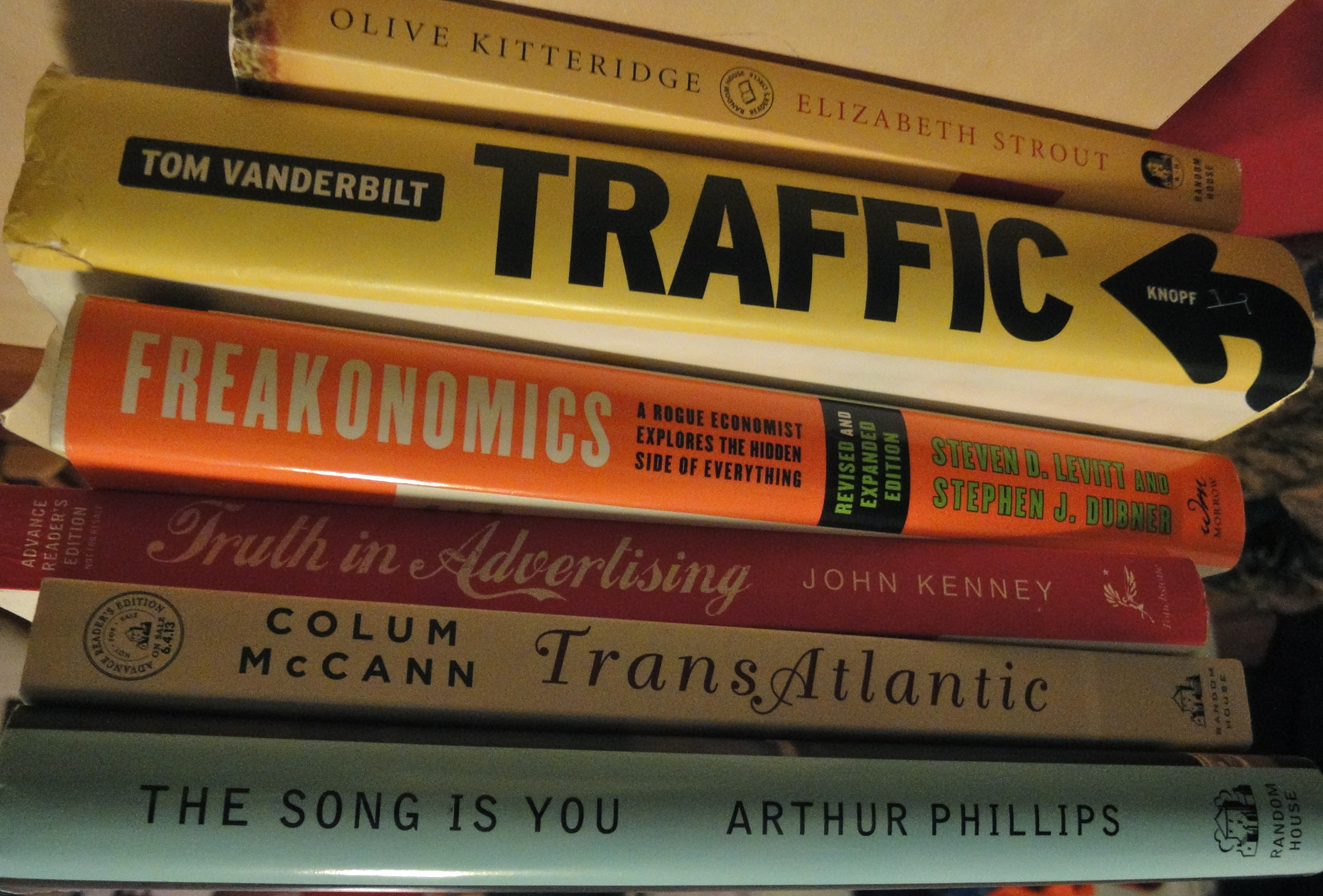
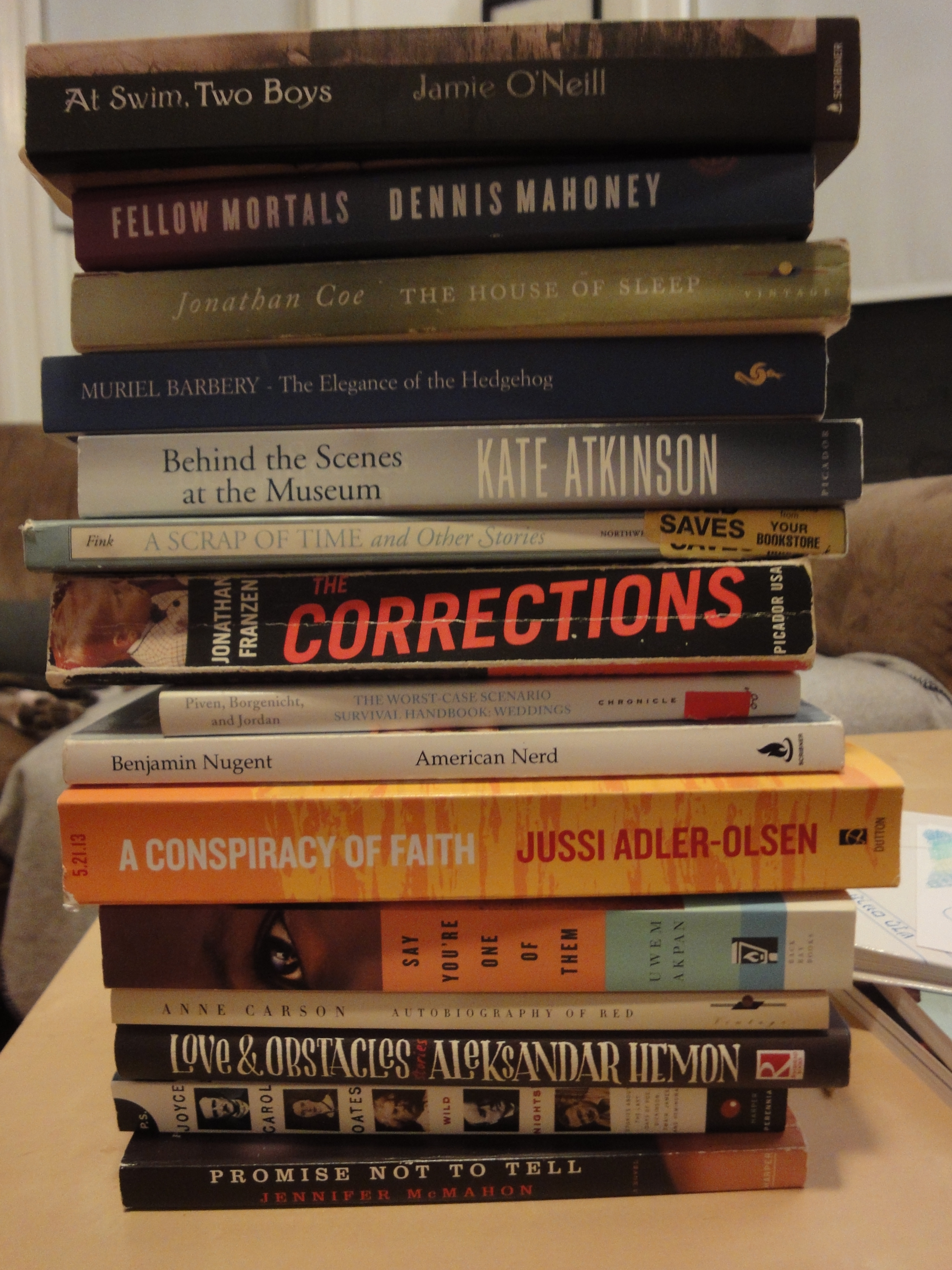
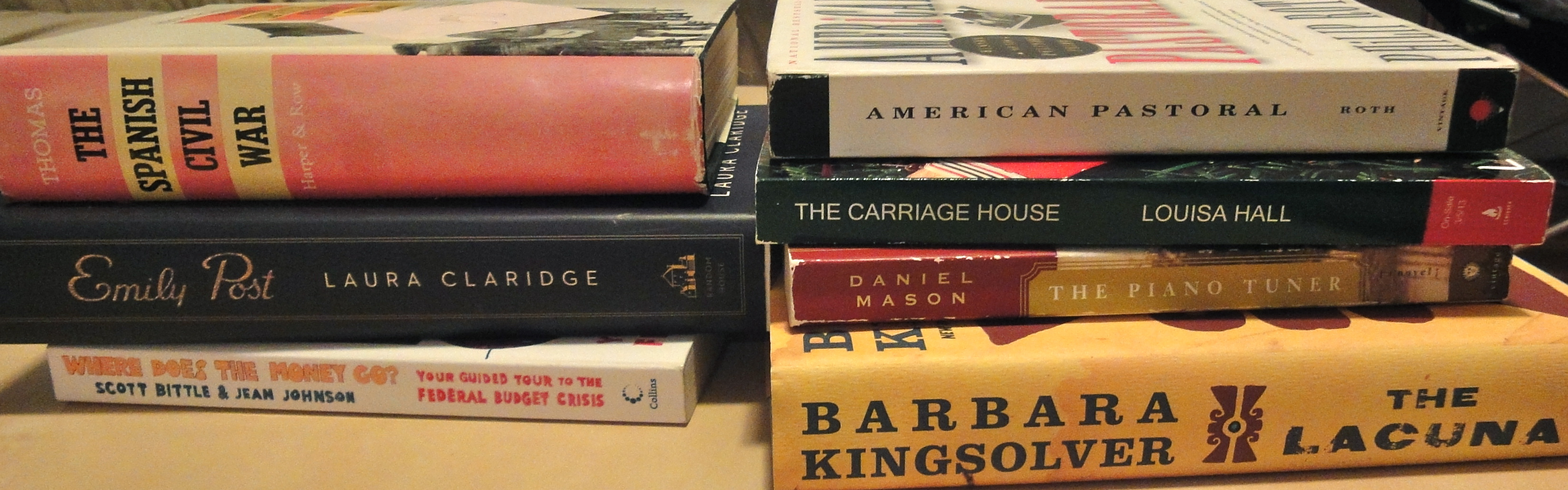
Over on my personal blog (mostly recipes and dog photos), I wrote about which thirteen (13) books I brought with me on a recent one (1) week vacation, and then which of those I actually read. Also, if you’re interested in seeing what The Casual Vacancy or Mockingjay look like in Icelandic, or what The Fault in Our Stars looks like in French, I took photos of those book covers in the Reykjavik City Library and a bookstore in the 11th arrondissement of Paris, respectively.

In other news, I found out I’ve been accepted to the New England Library Leadership Symposium (NELLS), along with my friend Anna, an awesome young adult librarian (read her blog! Unlike me, she actually sticks to a schedule). We’ll be there, along with 26 other participants, for a week later this summer, and I’m pretty excited to meet other librarians from around New England, exchange ideas, learn a lot…and maybe go canoeing.