Tango with censorship

Ray Bradbury can go ahead and start rolling over in his grave pretty much right away: a committee of parents, teachers, and administrators in the Davis County district in Utah have voted to restrict access to the book In Our Mothers’ House (yes, that apostrophe is correct, it’s about a family with two mothers). This in itself is not unusual; books are challenged all the time, and sometimes moved (from the children’s section to young adult, or from YA to adult, or behind the counter, as in this case).

However, the district has taken the additional step of asking librarians to pull other titles that may cause controversy. (And Tango Makes Three, a picture book based on a true story of two male penguins at the Central Park Zoo who hatched a chick from an egg and raised it together, is likely next.) McCarthyism, anyone?

It’s easy to get outraged against censorship; there are hundreds, if not thousands, of eloquent examples in print and on the web. (Here’s a defense of In Our Mothers’ House in The Salt Lake Tribune.) But let us take a step back and consider the purpose and mission of the library. How do these “controversial” books appear on library shelves in the first place, and why should they stay there despite strenuous objection from community members?

Most libraries have a collection development policy: guidelines for what kinds of materials the library ought to have in order to serve its community. Different libraries may choose to allocate their resources in different ways, but most public libraries aim to provide a broad range of materials – educational, recreational, and cultural – for people of every age, socioeconomic status, race, religion, political affiliation, and sexual orientation.

Our collection development policy states, “The…community includes people from diverse educational, cultural and economic backgrounds displaying a wide variety of interests, needs, values, viewpoints and occupations.” It continues, “The library has the obligation not only to serve its current users but also to search for materials and methods that will meet the needs of new members of the community and those who have not been traditional library users.”

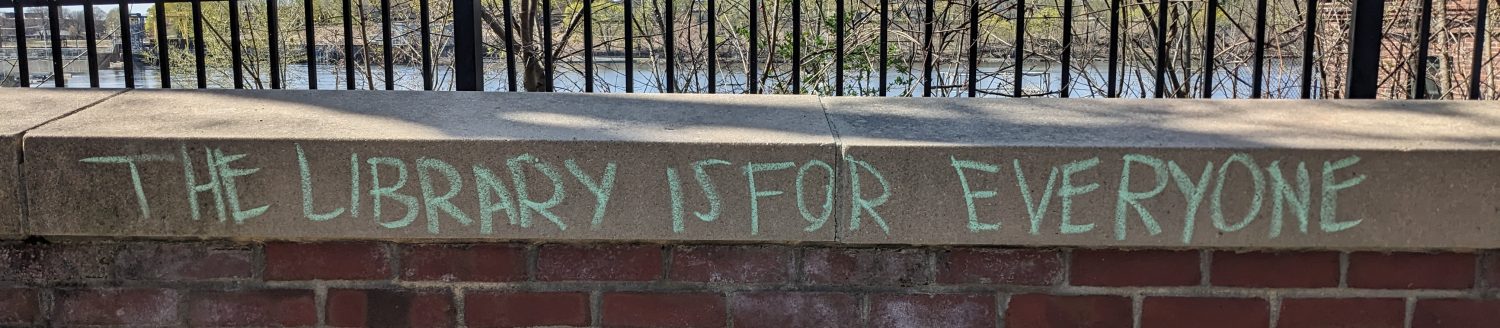
The library is, or should be, an inclusive place. It should be a safe space. If parents want control over what their children are reading, that is perfectly within their rights – but exercising control over what everyone else’s children are reading is most definitely not.

Librarians are advocates for everyone in their communities. We are advocates for equal access to information. It is our responsibility to make sure that there are materials for everyone. (The Utah librarians who added In Our Mothers’ House to the school library collection did so in part because a child in the elementary school has two mothers.) As one librarian said, at a panel at MLA, “If you have to come up with a reason not to buy something, that’s when you should add it to your collection.” We are in the business of selection, not censorship.

If a library had plenty of books for adults but none for children, someone would object. If a library had a hundred books about Christianity but none about Buddhism, someone would object. If a library collected books by and about Republicans but not Democrats, someone would object. A balanced collection includes materials for and from many points of view – an increasingly rare thing in a world where most news sources are slanted, and only offer one viewpoint.

If history is any indication, there will always be people who want to censor books. There will also always be people who defend them.

The science of working together

At the launch event for Interop: The Promise and Perils of Highly Interconnected Systems, the authors John Palfrey and Urs Gasser gave an overview of interop and provided several relevant examples. Though they began years ago on a theoretical level (does increased interop lead to increased innovation?), interop is a deeply practical topic.

“Interop” here is short for interoperability, defined as “the ability to transfer or render useful data and other information across systems (including organizations), applications, or components.” The authors decided that this initial definition, however, could be broadened into “the science of working together” on many layers: institutional, human, data, and technological.

Though it may sound abstract, there are many good examples of how interoperability is important in daily life. Solutions to big societal problems depend on interop, said Palfrey and Gasser. They talked first about “smart cities,” which depend on sharing information: between police, firefighters, and ambulances, for example, and between various forms of transit (does your bus pass also work for the subway and the commuter rail systems?).

Next they talked about open platforms, such as Facebook, which made its API available so that anyone could build an app. However, this interconnectedness has a down side: many points of connection means more vulnerability to privacy and security breaches. (This is also true of credit cards – another example of interop – which are vulnerable to identity theft.)

Facebook is an example from the private sector, but the public sector can drive interop as well, by regulation and legislation, as Europe has done for standardized cell phone chargers.

Naturally, one of the areas in which I am most interested is that of libraries. Libraries, said Palfrey, are facing two large interop problems: preservation of knowledge over time, and the lack of an open standard for e-lending.

The first issue has to do with reformatting; over the past decade or two, data has been stored not just in print, but in a whole variety of other ways, including floppy disks, microfilm, microfiche, CDs, and on computers in a variety of formats, some of which are no longer readable because the software necessary is no longer in use. Libraries must be vigilant to make sure that the information they have is preserved in an accessible form.

The second problem is one that has been in the news more or less constantly for a few years: there is no open standard for e-lending. Instead, there are a lot of proprietary formats that are not interoperable at all (e.g. you can’t read a kindle book on a nook device). “This is crazy,” Palfrey said. “Why is this [print book] still better technology?”

I hope and trust that, in the next few years, an open standard for e-lending will develop. In an ideal world, both libraries and individuals would be able to buy and lend any e-book, which could be read on any device.

Fingers crossed.

Upcoming local events

There are two local events coming up that I’m looking forward to; the first is tonight in the Harvard Law School building, where authors John Palfrey and Urs Gasser will be discussing their new book, Interop: The Promise and Perils of Highly Interconnected Systems. Palfrey and Gasser also co-authored Born Digital, and I’ve seen Palfrey speak before on the subject of the Digital Public Library of America (DPLA); he is intelligent and articulate.

The second event, at the Brookline Booksmith on June 8, is an author talk of a different sort. Jenny Lawson, a.k.a. The Bloggess, will be appearing for her new book, Let’s Pretend This Never Happened: (A Mostly True Memoir). As a fan of both blog and book, I am really excited to see her in person. If you haven’t heard of her before, I recommend reading her posts about Copernicus and Beyonce as an introduction.

Recommended Recommenders

A recent blog post on the Boston Globe site highlights seven “book recommendation websites” people can turn to for reading suggestions. I was already familiar with four of the seven, but decided to explore the rest for comparison’s sake. If I’ve made a mistake, feel free to correct me in the comments; conversely, if you are a devoted member of one of these sites and want to sing its praises, please feel free to do that as well!

Goodreads
This is a site I use every day; I’ve been a member since 2007, and have over a thousand books on my “shelves.” Goodreads offers a great way to keep track of what you’ve read (including when you read it, what you thought about it, your rating – out of five stars – and who recommended it to you), what you’re currently reading, and what’s on your to-read list for the future. You can create more shelves in addition to these three – historical fiction, for example, or biography – and you can see what your friends have read. Goodreads will recommend books for you based on your shelves, and you can see others’ lists, take quizzes, and sign up for giveaways. There are also many “Goodreads authors,” published authors who participate as members. One of my favorite features of the site is that it combines personal recommendations with crowd-sourced ones, so I can see what my friends thought of a book as well as what everyone else of Goodreads thought of it. Great usability, too – the interface is pleasant and intuitive, you can sort your lists by author, title, date read, date added, rating, etc., and you can get some nice descriptive statistics too.

LibraryThing
LT is similar to Goodreads in many ways: you can create your own shelves and tags, see your friends’ books, create a profile, get recommendations, and participate in giveaways. LT offers richer metadata, including Dewey Decimal Classification and Library of Congress Classification (DDC and LCC). The interface isn’t quite as user-friendly, but it’s a robust site, and if Goodreads didn’t exist, I’d happily use LT as my primary books-and-reading website.

Shelfari
Shelfari is powered by Amazon, which means two things: (1) it is designed to get you to buy books, preferably from Amazon, and (2) the design is beautiful and the user experience (UX) is fantastic. I remember an earlier version of the site, which was kind of clunky – maybe why I chose Goodreads instead of Shelfari five years ago – but it’s clean and colorful now. Shelfari rates high on content and interactivity; like Goodreads and LibraryThing, it’s a social networking site for readers (or in their words, “a community-powered encyclopedia for book lovers”). The front page pushes books that are already popular, including New York Times bestsellers and Amazon bestsellers, but if you dig deeper into the site, you can narrow by category or subject. One of the most useful features I discovered was the Series tab, where you can see all the books in an author’s series, in the correct order – definitely helpful at the reference desk.

Whichbook
I’ve already written about Whichbook; I like it very much. It isn’t nearly as robust as Goodreads, LT, or Shelfari, but it isn’t meant to be; it’s less a social networking site for bookworms and more of a reader’s advisory site. It’s whimsical, with its sliding scales (optimistic to bleak, funny to serious, safe to disturbing) instead of a traditional search box, and it does a good job suggesting off-the-beaten-path books rather than the most popular books. There are lists as well, in categories such as “Bad Luck and Trouble” and “Weird and Wonderful,” and you can also create your own lists. Whichbook promotes libraries over Amazon: the “borrow” button is ahead of the “buy” button.

What Should I Read Next?
WSIRN, as it’s called, is one of the most basic sites in this collection. You can create two lists: like and dislike. You can get recommendations based on any title on your list; however, these recommendations are based “purely on collective taste.” That is, books on the same list become associated with each other. This might work fine if everyone liked only one genre, so all mysteries were associated with each other, all romances associated with each other, etc., or if users were able to create and name multiple lists (e.g. “favorite biographies”), but that’s not the case. I have read and loved many books that were wildly different from each other, and the only thing they had in common was that I liked them; I wouldn’t necessarily recommend them both to the same person. That said, WSIRN is a simple, quick tool, and the developers may add functionalities in the future.

The Staff Recommends
The Staff Recommends is, as far as I can tell, McSweeney’s editor-at-large John Warner. (Supposedly also his “team of readers,” but all the reviews I read on the site were written by John.) TSR calls itself “an advertorial publication,” meaning they do get paid for recommending books, but they only recommend books they like; furthermore, proceeds are donated to a nonprofit, so I feel confident that the recommendations are honest. So, if you happen to have the same taste as John and his “team of readers,” you’re in luck! Whether you agree with him or not, the reviews are thoughtful and well-written. As of today, there are eight current selections and a few lists (e.g. crime novels) consisting of shorter reviews of more titles. TSR offers fewer points of view and less content than most of the other sites in the article, but it’s worth bookmarking nonetheless.

Gnooks
The main appeal of this site is the “literature map” that it creates when you type in the name of an author. However, there’s no information as to how the relationships between authors are determined. I want to know why Author A and Author B are considered similar: is it the subjects they write about? Their writing style? Hard to say. You can also get recommendations based on authors you like (I tried it; results were pretty accurate, but there were only three). I probably won’t use this regularly, but I do like that it’s author-centric rather than book-centric.

Decisions, Making

Two seemingly unrelated bits of news/opinion in this post, but both have to do with decision-making on some level. To start, one of the first articles I read this morning was Ann Patchett’s op-ed in the New York Times about the Pulitzer Prize Board’s failure to select a fiction winner from the three finalists. As Patchett points out, this is not only disappointing for the authors (“It’s fine to lose to someone, and galling to lose to no one”), it’s also a letdown for readers and for booksellers. Here are the past winners.

Another article I read today is from ASIS&T: Thom Haller wrote on the topic “What happens when architectural questions are not asked?” (architecture, here, is information architecture, or IA). He used Facebook as an example, and it’s a good one: who hasn’t been confused by Facebook’s changing structure, or its hierarchy and organizing principles (or lack thereof), not to mention its always-in-flux privacy policies? The problem Haller discussed was that of labels (or lack of labels) for “content clusters,” and it’s something that would probably come up in a basic usability test; right now, it’s not really clear what the difference between “public” and “all” is, unless there is a label for each group of options (there isn’t).

For such a huge site, there are some surprising difficulties in terms of navigation and settings. I almost have to assume that these difficulties are planned, or at least unresolved, on purpose; it seems like Facebook wants certain actions (privacy settings, unfriending) to be difficult.

So as not to end on a negative note, please enjoy this list of fake Massachusetts town names from McSweeney’s. And may I also recommend Jenny Lawson’s (a.k.a. The Bloggess) just-published memoir, Let’s Pretend This Never Happened? Read a snippet here. (Unless you’re at work, because most people’s work doesn’t usually provoke hysterical laughter, and this might. You’ve been warned.)

YA for Grown-ups

You know that xkcd comic, “Someone is WRONG on the internet”? I actually don’t feel that way too often. Not because there isn’t plenty of misinformation on the internet, or a lack of opinions out there with which I disagree, but because I don’t spend most of my time looking around for things to argue with and get all bent out of shape about.

However, I followed a link from this new “Y.A. for Grownups” column, and wouldn’t you know it, SOMEONE IS WRONG ON THE INTERNET. Joel Stein, columnist for Time magazine, believes that “Adults Should Read Adult Books.” And ONLY adult books. And here is something that gets me bent out of all recognizable shape: someone telling me what I can’t (or shouldn’t) read. (Remember “no one ever told me no”? Or the simple fact that telling a kid – or anyone, really – s/he can’t read/do/have something is a surefire way to get them to want to read/do/have that thing with every fiber of their being?)

Maybe I’m just contrary. However, I believe there is value in YA literature for adults as well as teens. First of all, remember, most adults reading fiction are reading fiction for pleasure and entertainment, so who’s to tell them (us!) what to read or not read? Second, Stein admits he hasn’t read any of the major YA books out there now: not The Hunger Games, not Twilight, not Harry Potter. So right off the bat there’s the issue of passing judgment on something he isn’t familiar with, and only citing the biggest blockbuster names out there. Yeah, okay, he happens to be right that Twilight is not literary, but neither is Nicholas Sparks (yes, it’s pick-on-Nicholas-Sparks week here), and Stein isn’t bashing adults who read The Notebook.

But Joel Stein, I dare you, I dare you, to read Jennifer Donnelly’s A Northern Light and write it off in the same fashion. Read it and say it has no value and that adults should only read “adult” books. That we should read only the books – literary or not – aimed at our age group. (Speaking of age groups, “YA” is just the publishers’ designation for marketing purposes. There’s no strict definition, but usually the main character is a child or teenager, the book is from their point of view – first person or third limited – and it takes place in the present or recent past.)

You know what? Whatever Joel Stein thinks, I’m not embarrassed to read YA books in public. Maybe I feel like re-reading The Giver or Bridge to Terabithia or The Boggart or The Golden Compass, or maybe I feel like keeping abreast with newer YA books, like The Hunger Games or Uglies or A Fault in Our Stars – wait, how did I even get to this point in this tirade without mentioning John Green? Joel Stein, I dare you to read A Fault in Our Stars as soon as you’re done with A Northern Light.

Anyway, the point is, look: I was in middle school once, so while I won’t say I’m 100% immune to embarrassment, I am most emphatically NOT embarrassed to read YA books in public, and I’m years beyond caring what anyone else on the train thinks about it. What books make me cringe? None.*

*Fine, one: I had to read Pretty Little Liars for a YA Lit class and it was awful. I did not want to read it in public. You can have that one, Joel.

In the Beginning

What makes you decide to read a certain book? Is it the cover (whether or not you should judge a book by its cover, many do), the flap copy, a friend’s recommendation, familiarity with the author? Something else?

Friends’ recommendations are important to me, and sometimes I’ll look at reviews as well. I always read the flap copy (on the back of a paperback or the inside front flap of a hardcover), but often what clinches it is the first sentence. Am I hooked after the first sentence? After the first page? I figure the author must put as much or equal thought and effort into the first sentence as any other in the book, the first sentence being the equivalent of a first impression.

Here are a few memorable first sentences:

“Leon Trotsky is trying to kill me.” –The Autobiography of Joseph Stalin: A Novel, Richard Lourie

“I had this friend, you see, that everyone loved.
(My name is Sid Halley.)
I had this friend that everyone loved, and I put him on trial.” –Come to Grief, Dick Francis

“It was a dark and stormy night.” –A Wrinkle in Time, Madeleine L’Engle

“Lyra and her daemon moved through the darkening hall, taking care to keep to one side, out of sight of the kitchen.” –The Golden Compass, Philip Pullman

“If you are not here, then why are you everywhere?” –Love Begins in Winter, Simon Van Booy (epigraph)

What are your favorite beginnings, most memorable first sentences?

What You Read When You Don’t Have To

Someone I know is leaving soon to take a job in a foreign country. He will be away for a long time, and wanted to stock up on books (ebooks, actually, on his Kindle) before leaving. I did a little reader’s advisory interview, and he said he had read and enjoyed fantasy and sci-fi in the past but wasn’t much of a reader otherwise and was looking to expand. Here’s what I recommended, with occasional genre/subject/additional works notes in parentheses (forgive me for not putting each title into italics):

Classic dystopia
1984, George Orwell
Brave New World, Aldous Huxley
Fahrenheit 451, Ray Bradbury
Anthem, Ayn Rand
The Giver, Lois Lowry (and sequels Gathering Blue and Messenger; YA)
The Handmaid’s Tale, Margaret Atwood
Oryx and Crake, Margaret Atwood

Classic fantasy/sci-fi
The Hitchhiker’s Guide to the Galaxy, Douglas Adams
His Dark Materials (trilogy: The Golden Compass, The Subtle Knife, The Amber Spyglass), Philip Pullman (YA)
A Wrinkle in Time, Madeleine L’Engle (also: A Wind in the Door, A Swiftly Tilting Planet, Many Waters; YA)
Neverwhere, Neil Gaiman (fantasy)

Contemporary Literary Fiction
The Amazing Adventures of Kavalier & Clay, Michael Chabon (comic books, history; Pulitzer Prize)
High Fidelity, Nick Hornby (music)
The Prince of Tides (and/or The Lords of Discipline), Pat Conroy (the South, violence, families)
The Story of Edgar Sawtelle, David Wroblewski (dogs)
The Poisonwood Bible, Barbara Kingsolver (missionary family in Africa)
The Brothers K, David James Duncan (brothers, baseball)
Faithful Place, Tana French (mystery/suspense)
This Is Where I Leave You, Jonathan Tropper (crazy families, funny)
A Thousand Splendid Suns, Khaled Hosseini (Afghanistan)
Edited to add (4/13/12): Life of Pi, Yann Martel
Edited to add (4/13/12): The Septembers of Shiraz, Dalia Sofer (Iran)

Classic American Literature
East of Eden, John Steinbeck
Lolita, Vladimir Nabokov (though English was the author’s third language)
The Great Gatsby, F. Scott Fitzgerald
For Whom the Bell Tolls, Ernest Hemingway
Ordinary People, Judith Guest

Nonfiction
Science/Environment
The Ghost Map, Steven Johnson
The World Without Us, Alan Weisman
A Short History of Nearly Everything, Bill Bryson
The Immortal Life of Henrietta Lacks, Rebecca Skloot
In Defense of Food, Michael Pollan

History
The Professor and the Madman, Simon Winchester
Under the Banner of Heaven, Jon Krakauer (also Into the Wild and Into Thin Air)
Unbroken, Laura Hillenbrand (also Seabiscuit)
In Cold Blood, Truman Capote (true crime)
How the Irish Saved Civilization, Thomas Cahill
The Wordy Shipmates, Sarah Vowell (Massachusetts Bay Colony)
In the Garden of Beasts, Erik Larson (American family in Germany, pre-WWII)

Popular Psychology
The Tipping Point, Malcolm Gladwell
How We Decide, Jonah Lehrer

Biography/Memoir
The Happiness Project, Gretchen Rubin
What I Talk About When I Talk About Running, Haruki Murakami
On Writing, Stephen King
Charles & Emma, Deborah Heiligman (YA)

Essays
Manhood for Amateurs, Michael Chabon
How To Be Alone, Jonathan Franzen
The Polysyllabic Spree, Nick Hornby (books/music)
-anything you can find by Ann Patchett, including The Getaway Car and This is the Story of a Happy Marriage

The title of this post borrows from an Oscar Wilde quote, “It is what you read when you don’t have to that determines what you will be when you can’t help it.” Feel free to add additional recommendations in the comments.

Sticklers Unite!

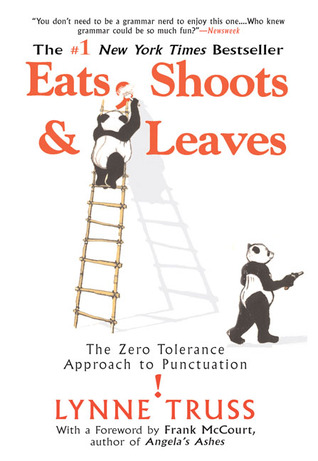
I just finished reading Lynn Truss’ excellent book, Eats, Shoots & Leaves. “Bestselling grammar book” is not a phrase you hear often, but this one is, and for a reason: in an impassioned, intellectual, and often quite humorous way, Truss makes her case for the importance of grammar and punctuation. The title comes from a joke whose punchline highlights the difference between “eats, shoots and leaves” (not a dinner guest you want in your house) and “eats shoots and leaves” (a panda).

Lynn Truss is probably at the forefront of the small subset of society that cares deeply and perhaps disproportionately about correct grammar, punctuation, and spelling. I too am part of this subset, and nodded along in complete agreement when I read, “To those who care about punctuation, a sentence such as “Thank God its Friday” (without the apostrophe) rouses feelings not only of despair but of violence.”

Perhaps the best argument Truss makes for punctuation is that its function in written communication and in literature is crucial; see the above example about the panda. One comma changes the meaning of the sentence entirely. Likewise, “You’re home” and “Your home” also have completely different meanings (in the former, you are at home; in the latter, the home in question belongs to you).

Those who rely on spellcheck to catch these errors are sunk; as this Slate article points out, spellcheck software is great at catching “nonword” errors, like “hte” instead of “the”; however, it doesn’t understand context, so it won’t stop you from using “complement” when you mean “compliment.” Web browsers, for the moment, have surpassed some spellcheck software; in the past five years, according to the Slate article, “Web browsers have become better at spelling than most humans.” What a thought: maybe the next Are You Smarter Than a Fifth Grader? will be Are You Smarter Than Your Browser? Someone call Ken Jennings.

Let Us Now Praise Libraries, Librarians

An article in the Boston Sunday Globe caught my eye this morning, with the headline “Let Us Now Praise Libraries, Librarians.” (A true librarian would have titled it “Let Us Now Praise Librar*”; hats off to you if you get the joke.) The article’s author, Anthony Doerr, writes about his childhood reading, “Here’s what I think about now: No one ever told me no. Not Mom, not the prim librarians stamping return dates onto slip after slip. No one ever said: This book is outside your age range; this book is too complicated.”

I had a similar childhood experience, reading far ahead of my “age appropriate reading level” and not coming to any harm. I’ve thought about this topic before (see the last three paragraphs of the post “Whose Common Sense?“), and I’m glad to see a similar attitude in print. Doerr writes, “…I worry that we are presenting reading to our kids as a labor to suffer through for which a reward can be earned at the end….The message to young people is obvious: Books are good for you. What’s missing, however, is the idea that sustained reading is magic, a kind of magic that can be wildly addictive, even dangerous.”

He then goes on to create a fantastic analogy, based on the fact that when the brain is stimulated (“when a person is thinking imaginatively and creatively”), it produces endorphins: “Great books are like drugs, readers [are] like junkies, and, yes, to stretch the analogy into absurdity, good librarians [are] like drug dealers.” He finishes, “So, to all you beautiful librarians out there, with National Library Week in the offing….Keep on putting books in the hands of readers, because as every good dealer knows, all it takes is one fix and your patrons are hooked.”

One of the most magical, engaging, imaginative, creative books I can think of is Nick Bantock’s Griffin & Sabine, which is the first of six books (all equally magical) detailing the correspondence between Griffin and Sabine. It’s not your typical epistolary novel (see The Guernsey Literary and Potato Peel Pie Society, also an excellent book), because each postcard and letter Griffin and Sabine exchange is rendered with “their” artwork and handwriting; the reader pulls actual letters out of actual envelopes. (For this reason, my first encounter with the books was in Special Collections at the Mount Holyoke College library.) If you can find these, I highly recommend them; you will find yourself immersed and filled with wonder. “Sustained reading is magic,” indeed.