People just don’t make sense anymore

A brief round-up of mostly unrelated pieces of news/commentary:

In a blog post for the Harvard Business Review, Dan Pallotta discusses the problems of “abstractionitis,” “acronymitis,” “Valley Girl 2.0,” and “meaningless expressions” – in other words, people don’t use real words with real meanings anymore.

It would be great if there was Netflix for books…oh wait, there is! It’s called the library.

Borders employees take one last jab at Amazon, reminding customers of one advantage physical stores have over online ones.

Amazon vs. Bricks-and-Mortar

It’s not even Amazon vs. the independent bookstores anymore; now it’s Amazon against any physical bricks-and-mortar bookstore that offers browsability, serendipity, and (hopefully) knowledgeable, informed, helpful staff who can make personalized suggestions tailored to your needs, likes, and dislikes.

Author Richard Russo wrote an op-ed in The New York Times on December 11 about Amazon’s competitive strategy of encouraging buyers to use its price check app in stores by offering credits to consumers, who then buy from Amazon instead of from stores. (It should be noted that while book prices can be checked with the app, they do not qualify for the promotion.)

Russo sent this news on to a number of other authors, including Scott Turow (president of the Authors Guild), Stephen King, and Ann Patchett. King called the strategy “invasive and unfair”; Turow suggested that it might not be “lawful” for Amazon to encourage consumers to go to a store solely to obtain pricing information without any intention of buying; and Patchett said, “I do think it’s worthwhile explaining to customers that the lowest price point does not always represent the best deal. If you like going to a bookstore then it’s up to you to support it. If you like seeing the people in your community employed, if you think your city needs a tax base, if you want to buy books from a person who reads, don’t use Amazon.”

Authors and bookstore owners and employees aren’t the only ones who object to Amazon’s price check promotion; Maine Senator Olympia Snowe said, “Amazon’s promotion – paying consumers to visit small businesses and leave empty-handed – is an attack on Main Street businesses that employ workers in our communities.”

Fortunately, it is not all bad news for bookstores. An “unusually vibrant selection” of books this season seems to have helped bookstore foot traffic and sales, which are up from this time last year. Former Borders customers are finding other bookstores, too. One bookstore owner in Seattle said, “What’s extraordinary about the books that are out there is that they’ve been so well written and such a pleasure to read. Maybe people have an appetite for nonfiction right now, just for some sort of grounding in reality.”

The book business is, as much as book lovers would like to deny it, a business, but Amazon’s price check app and promotion are “bare-knuckles” enough to leave a bad taste in one’s mouth. Before doing ordering all your holiday presents on Amazon, consider what you get for a few extra dollars at the bookstore: personal recommendations from people who read. Of course, the level of service stores offer varies, but if you’re in the Cambridge/Somerville area, I can recommend the excellent Porter Square Books in good faith.

And if you aren’t looking to buy, just looking to read, another great place to get a recommendation is your local library. 🙂

Two Approaches

The Authors Guild has spoken out against Amazon’s Lending Library, arguing that Amazon’s contracts with publishers cover only the sale of books, not lending or giveaways. For additional background on this issue, here’s my November 3 post with several links. The Guild may have a point here, and urges its authors to contact their agents and publishers.

In the “good news” category, however, we have Ann Patchett’s new independent bookstore, Parnassus Books, opening soon in Nashville, TN. The most recent NYT article notes that small, independent bookstores compete “where Amazon cannot: by being small and sleek, with personal service, intimate author events and a carefully chosen rotation of books” (including e-books). Best of luck to Ann, her business partner Karen Hayes, and Parnassus Books!

Open Library

If you aren’t already familiar with Open Library, a project of the non-profit Internet Archive, you now have one more reason to head over and check it out: all 50 state librarians have voted to build an alliance with IA. What does this mean? The Chief Officers of State Library Agencies (COSLA) and Open Library will be working together to ensure free access to e-books through all public libraries in the U.S.

Already, anyone can borrow e-books from Open Library‘s collection of 10,000 e-books, provided by the Internet Archive and its partner libraries. You can borrow up to 5 books for 2 weeks each, in a variety of formats (in-browser, e-Pub, or PDF). If your public library is a member, you may have access to even more.

Happy reading!

How to Cook Without a Book?

“But a Nook can’t read, so a Nook can’t cook. So…what good to a Nook is a hook cook book?”
One Fish Two Fish Red Fish Blue Fish, Dr. Seuss

I’m sure that’s not what Barnes & Noble had in mind when they named their e-reader.

A recent article in the New York Times asks if cookbooks are obsolete (leading question much?). It describes how a number of wonderful apps are sweeping traditional cookbooks and recipe cards off the kitchen counter and back onto their shelves to gather dust.

As usual, there is plenty of room for both sides. Certainly, some people will gravitate toward these apps and e-versions of cookbooks on tablets or e-reader devices, either replacing or enhancing their print cookbooks; others will ignore the new toys (audio, video, flowcharts, built-in timers and glossaries) and continue using their print books.

There’s also a middle ground: Eat Your Books offers a way to search through all the indexes of all your cookbooks for a particular recipe. The recipes themselves can’t be accessed through the site unless they are free online, but by searching the indexes of all the books you already own, you can find what you’re looking for much more easily; it’s a way of semi-digitizing your cookbooks. You can also add blogs such as Chocolate & Zucchini and Smitten Kitchen to your “shelves” and search those too.

Incidentally, the NYT article neglects to mention what would happen if one were to spill soup onto one’s iPad.

Bookmaking for Beginners

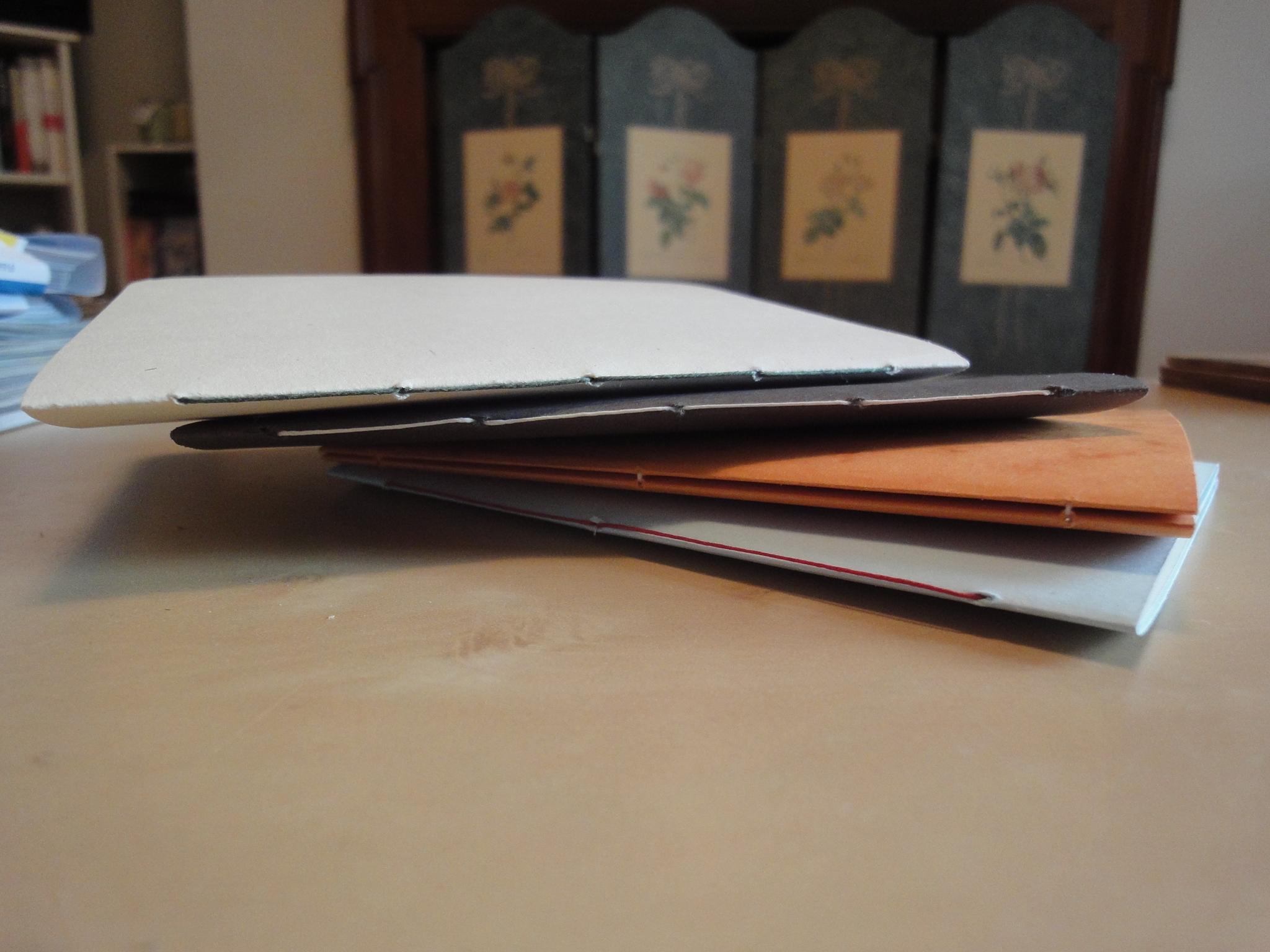
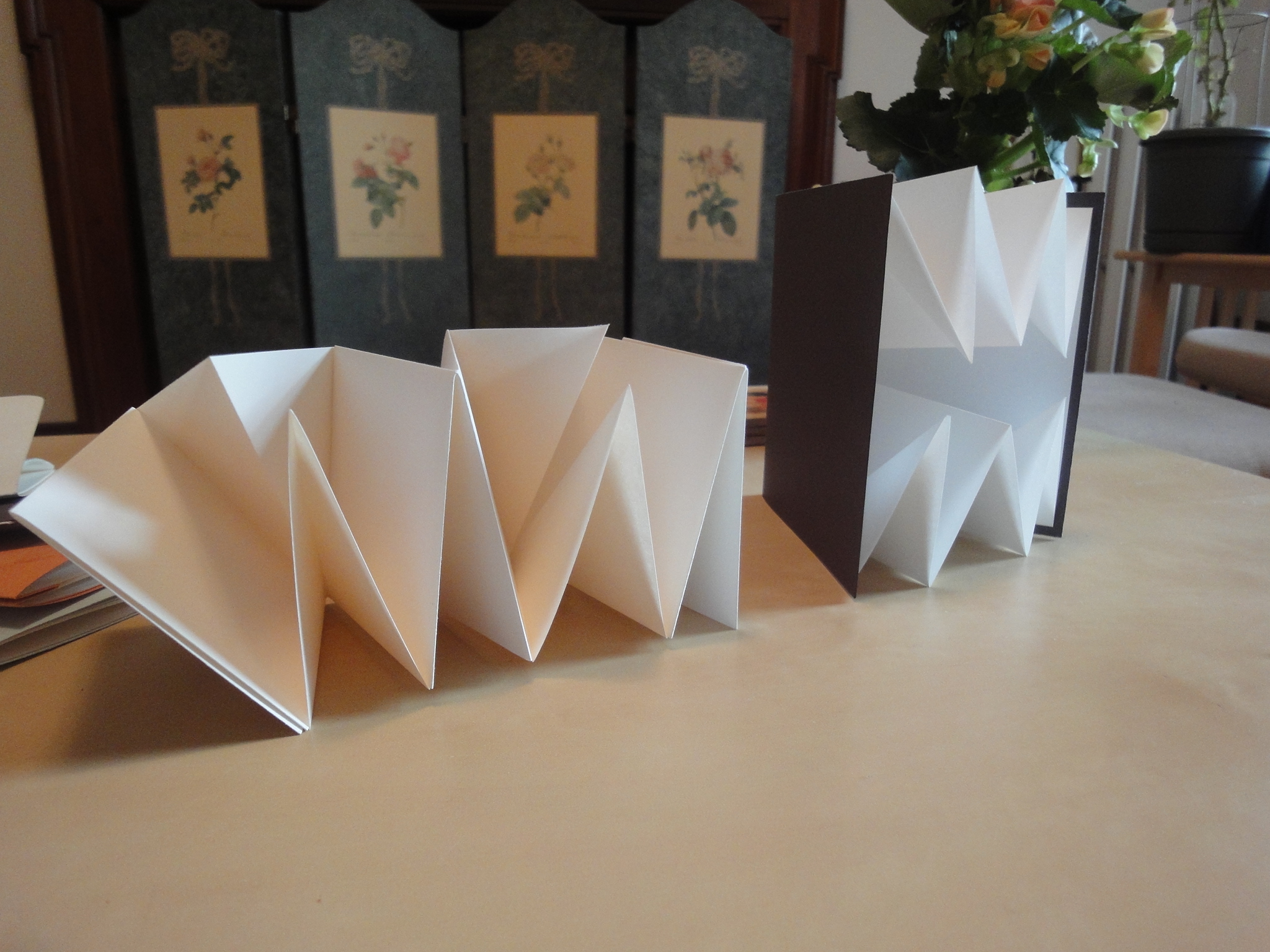
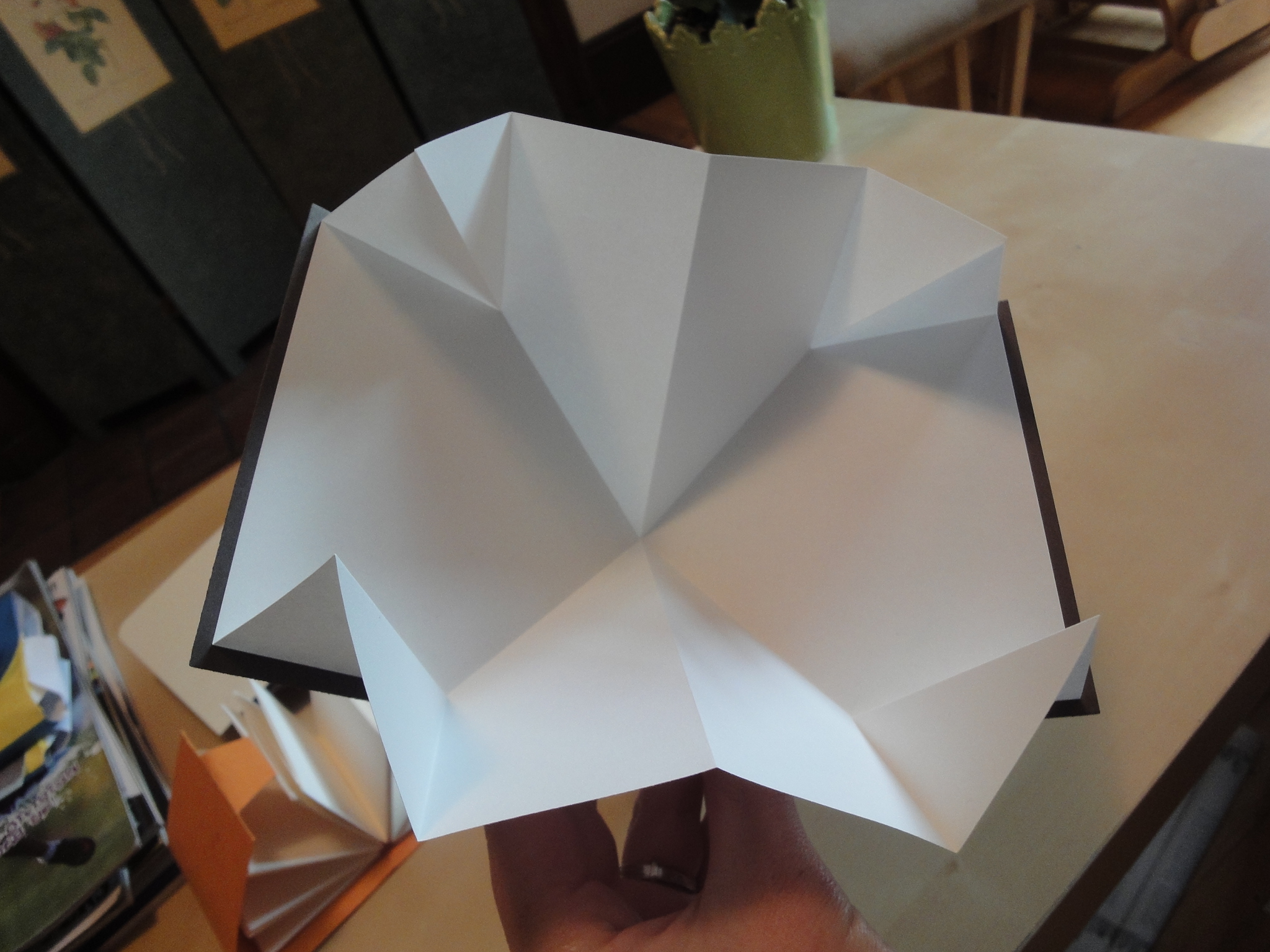
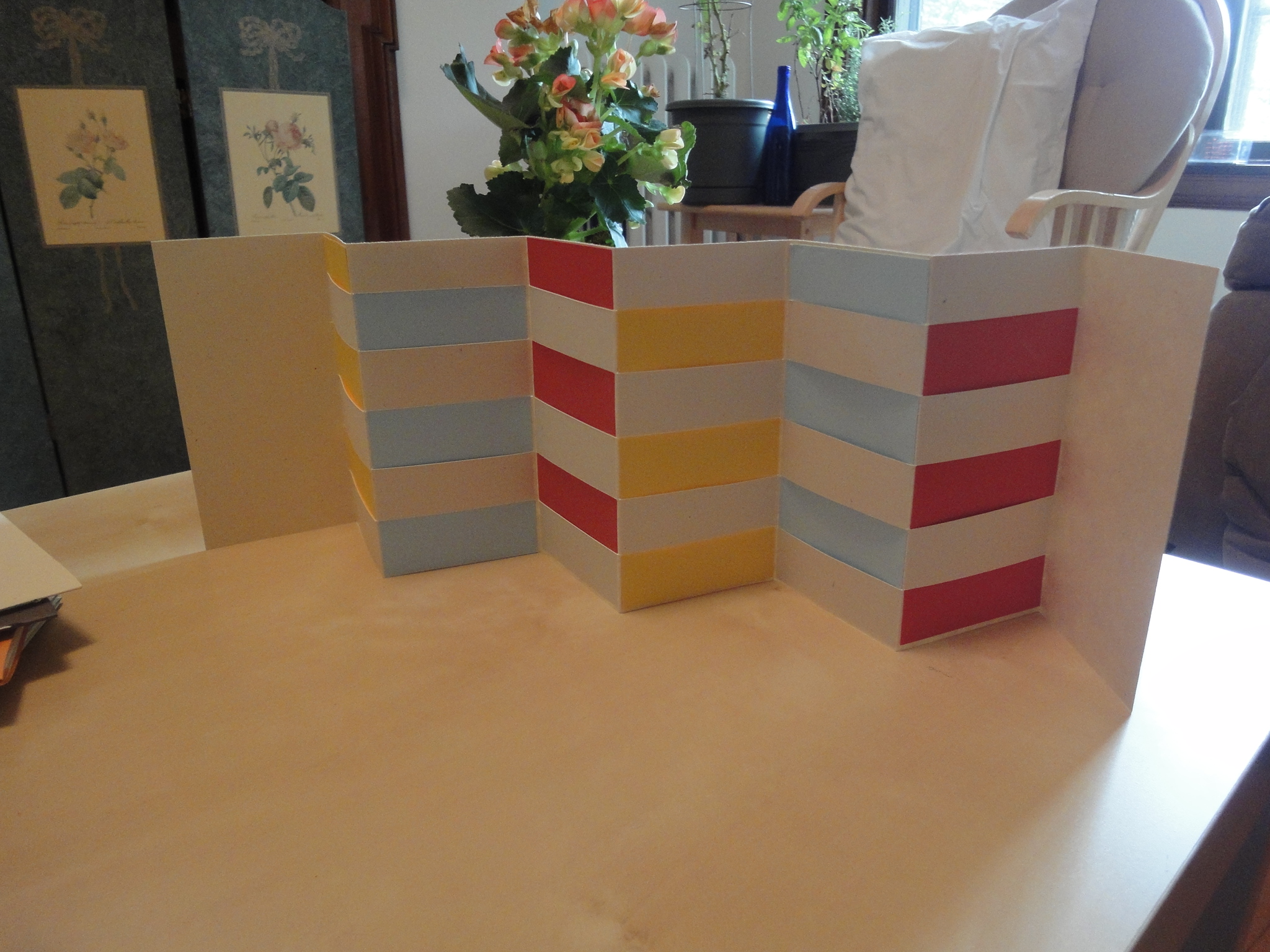
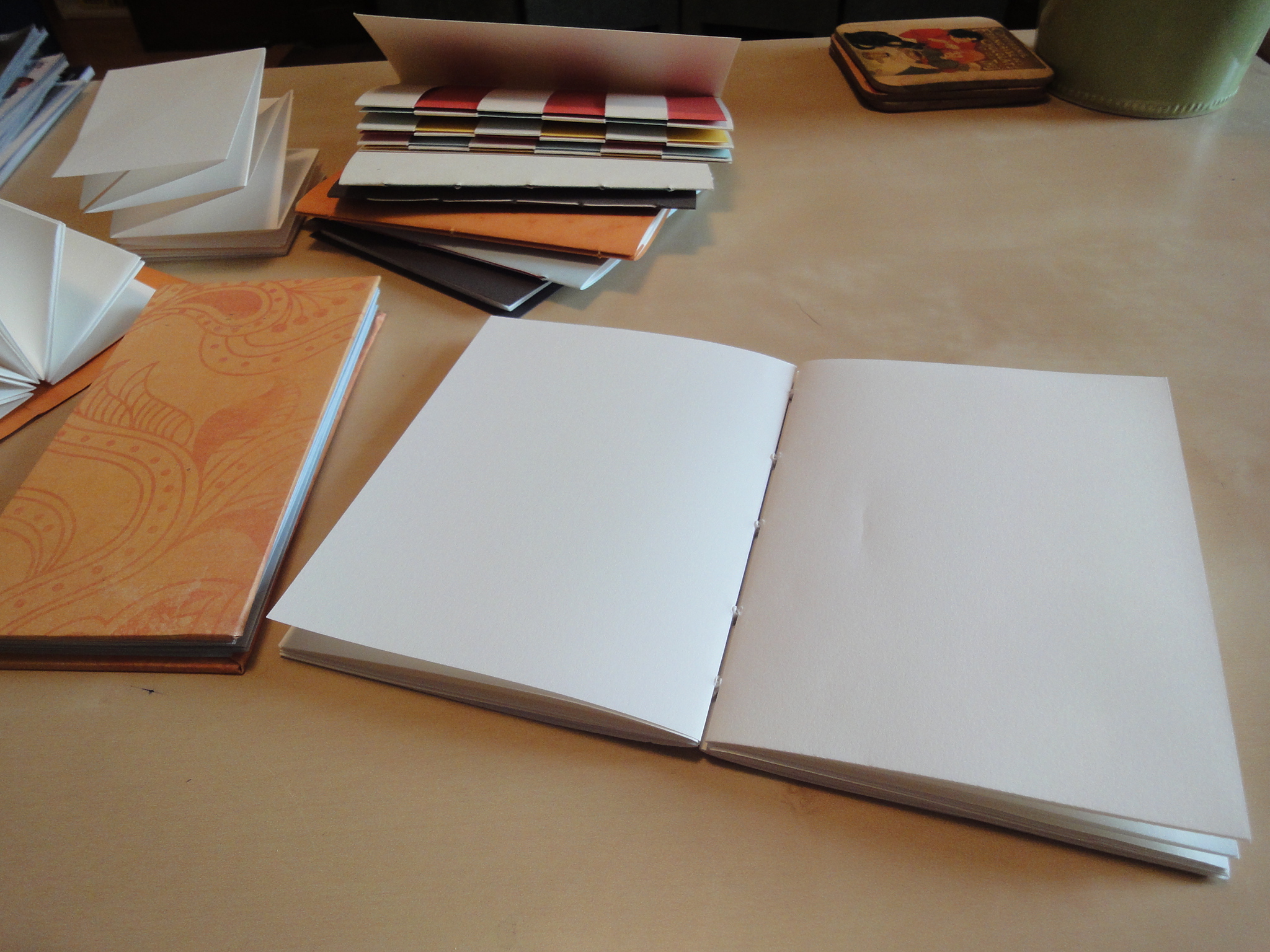
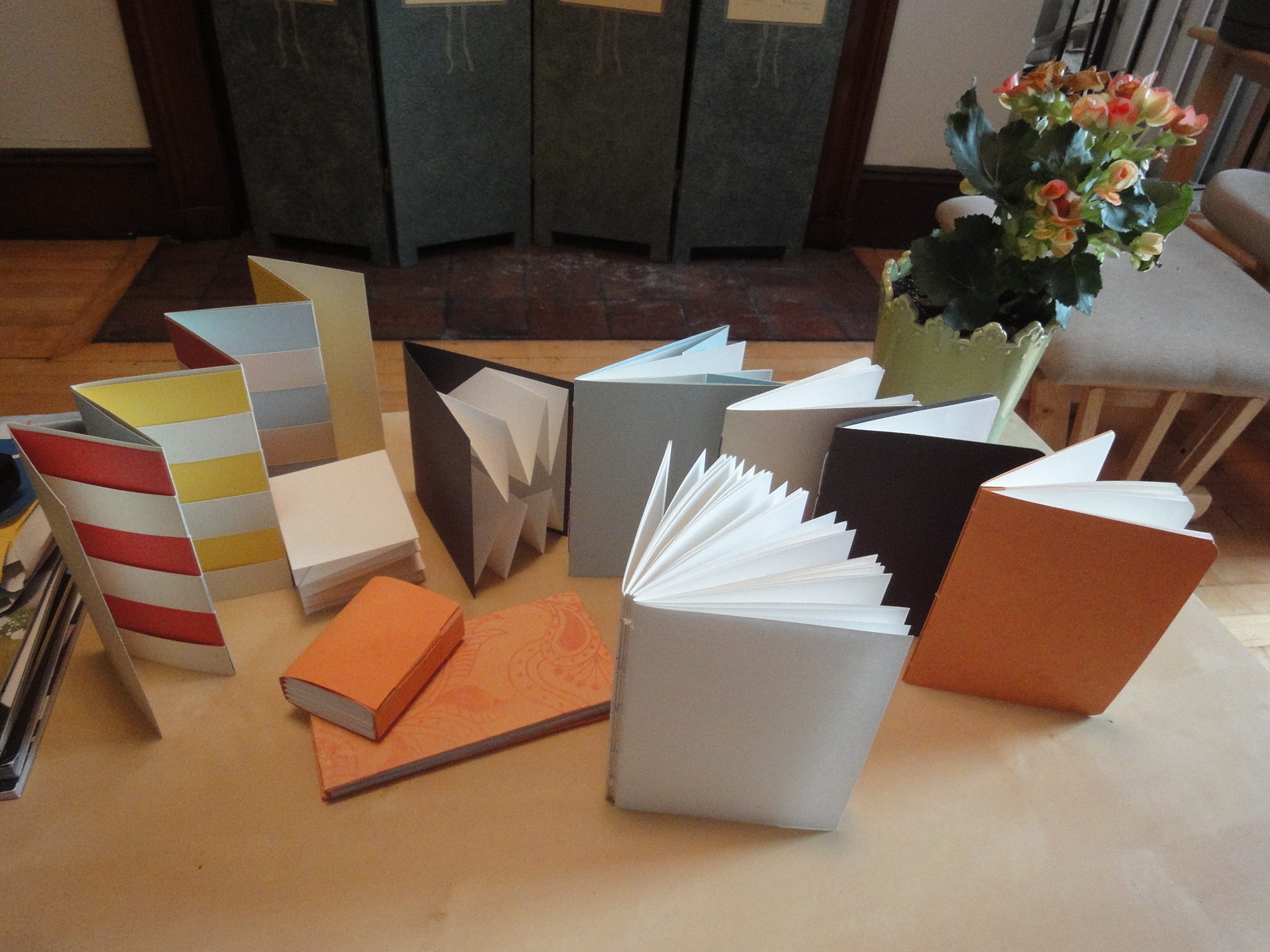
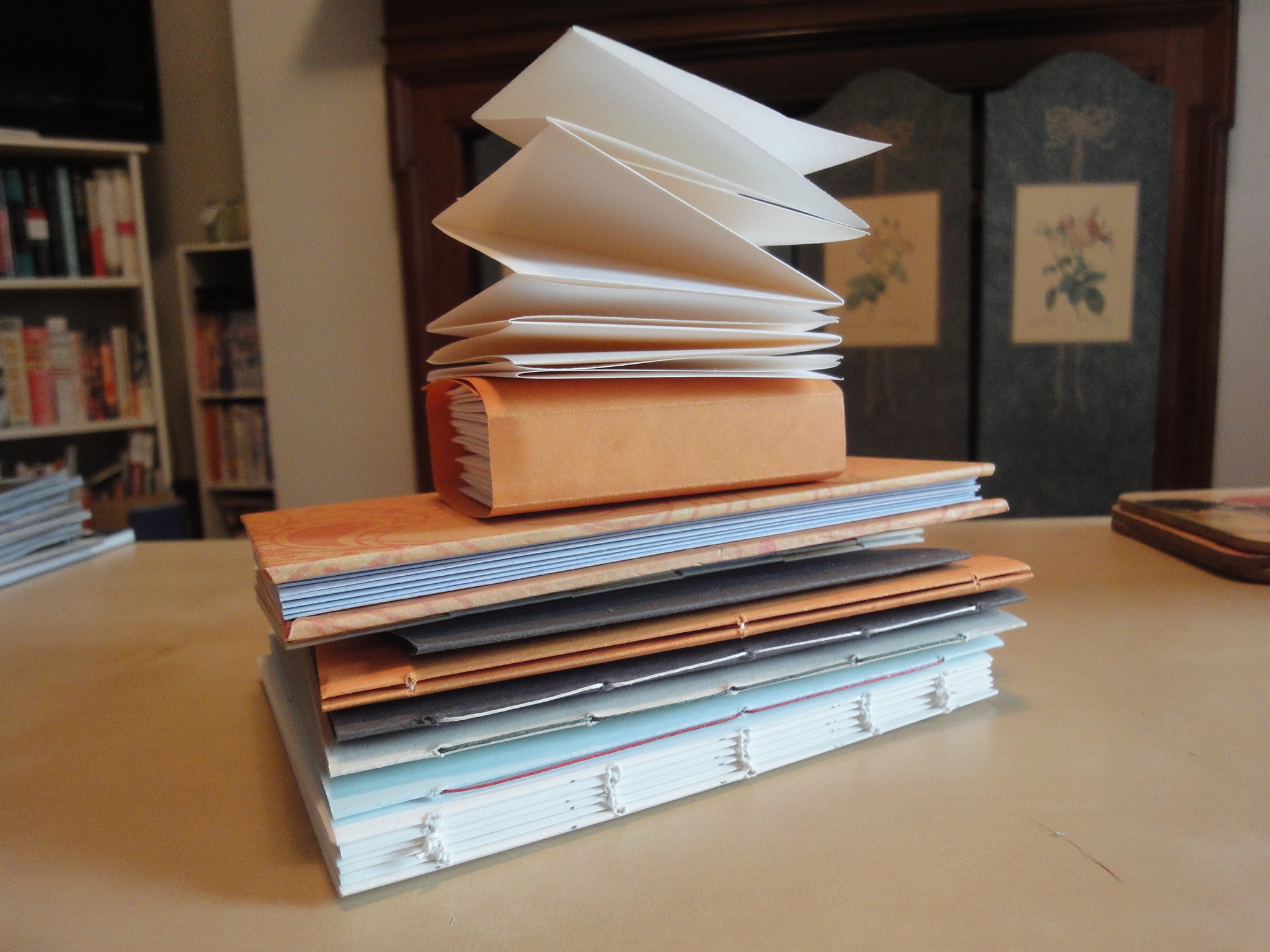
On Saturday, I took a Bookmaking for Beginners workshop taught by Sarah Smith through GSLIS Continuing Education. The workshop began with a short lecture about different kinds of bindings through history, and how contemporary artists are re-using and making books. The rest of the day was all hands-on: we started with the one-sheet fold-up and the accordion structure, then the blossom fold, Turkish map fold, and Korean map fold; then we learned how to make single-section and two-section pamphlets, and finally how to do chain-stitch.
All the books! From top to bottom: Blossom fold, Korean map fold, accordion fold (with covers), woven flexagon, Turkish map fold, two-section pamphlet, one-section pamphlets, chain-stitched binding.
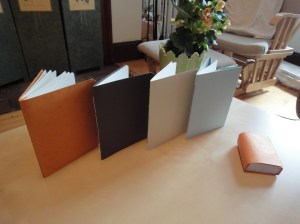
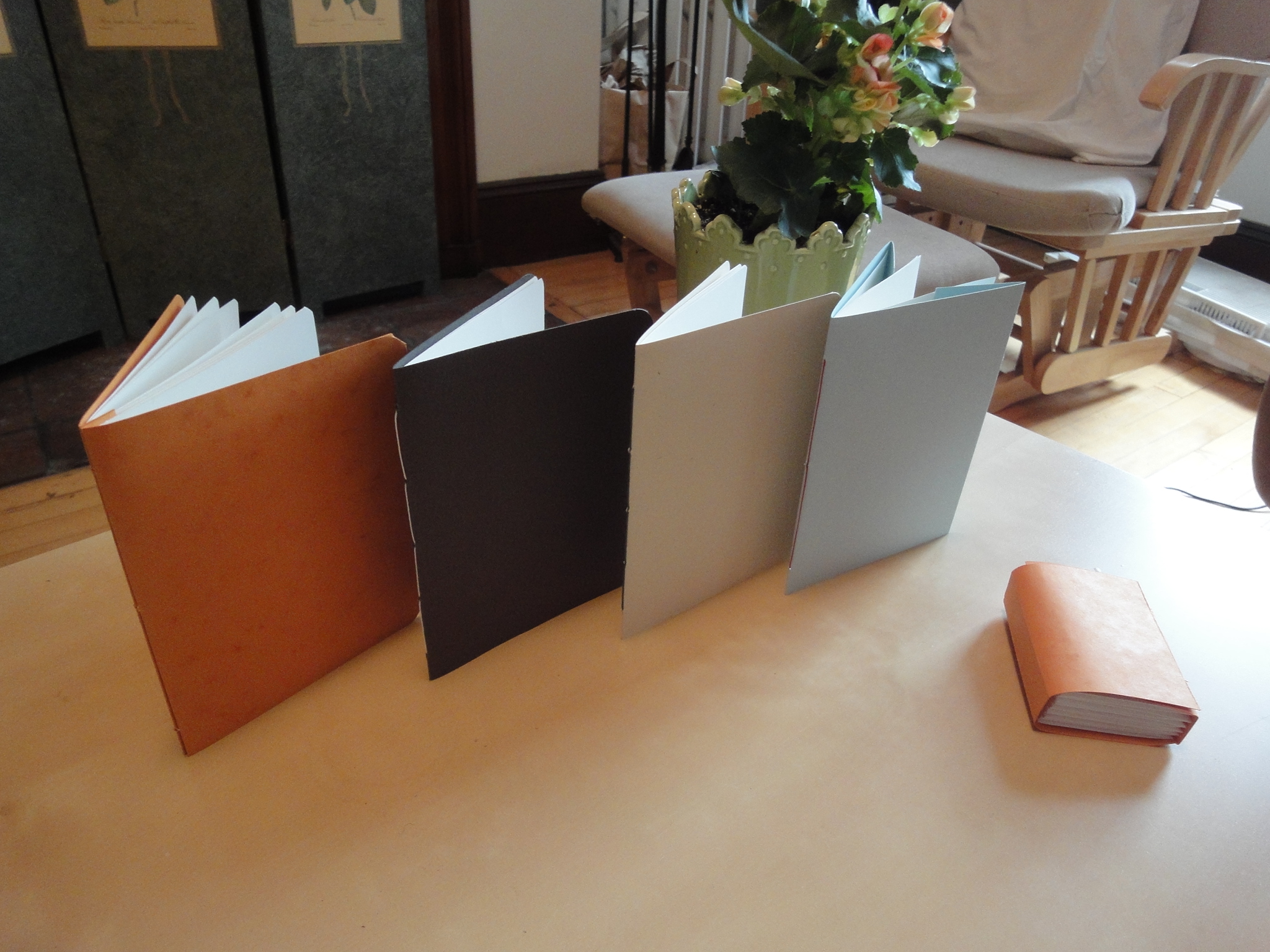
From left to right: two-section pamphlet, one-section pamphlets (3- and 5-station), and Korean map fold.
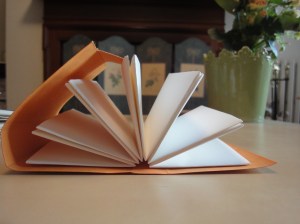
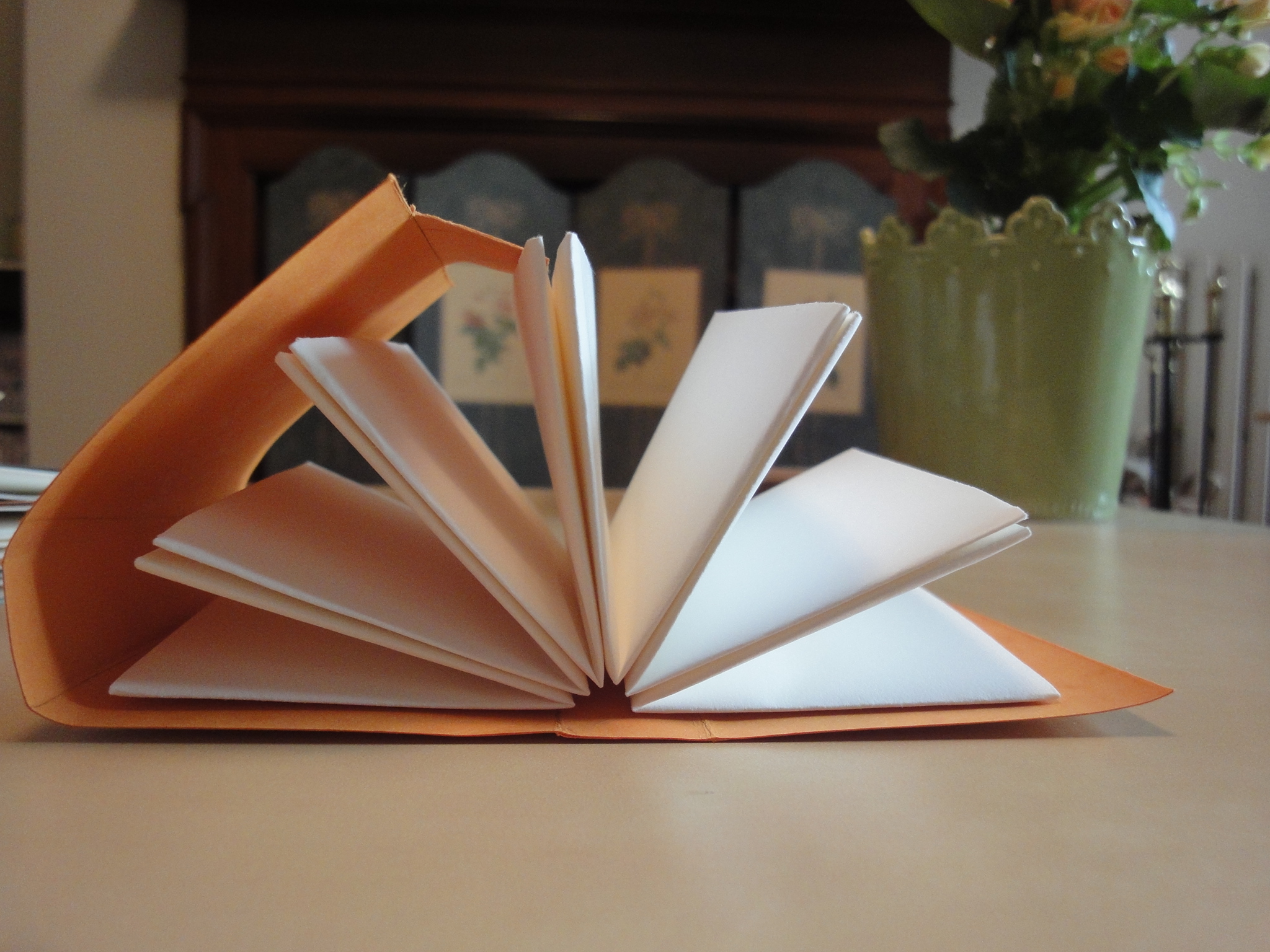
This is the Korean map fold book: it’s the same one that looks like a little cedar block in the previous picture. It’s bulky because it contains six pieces of 8.5″x11″ paper, folded into 8 sections each.
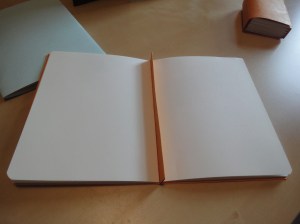
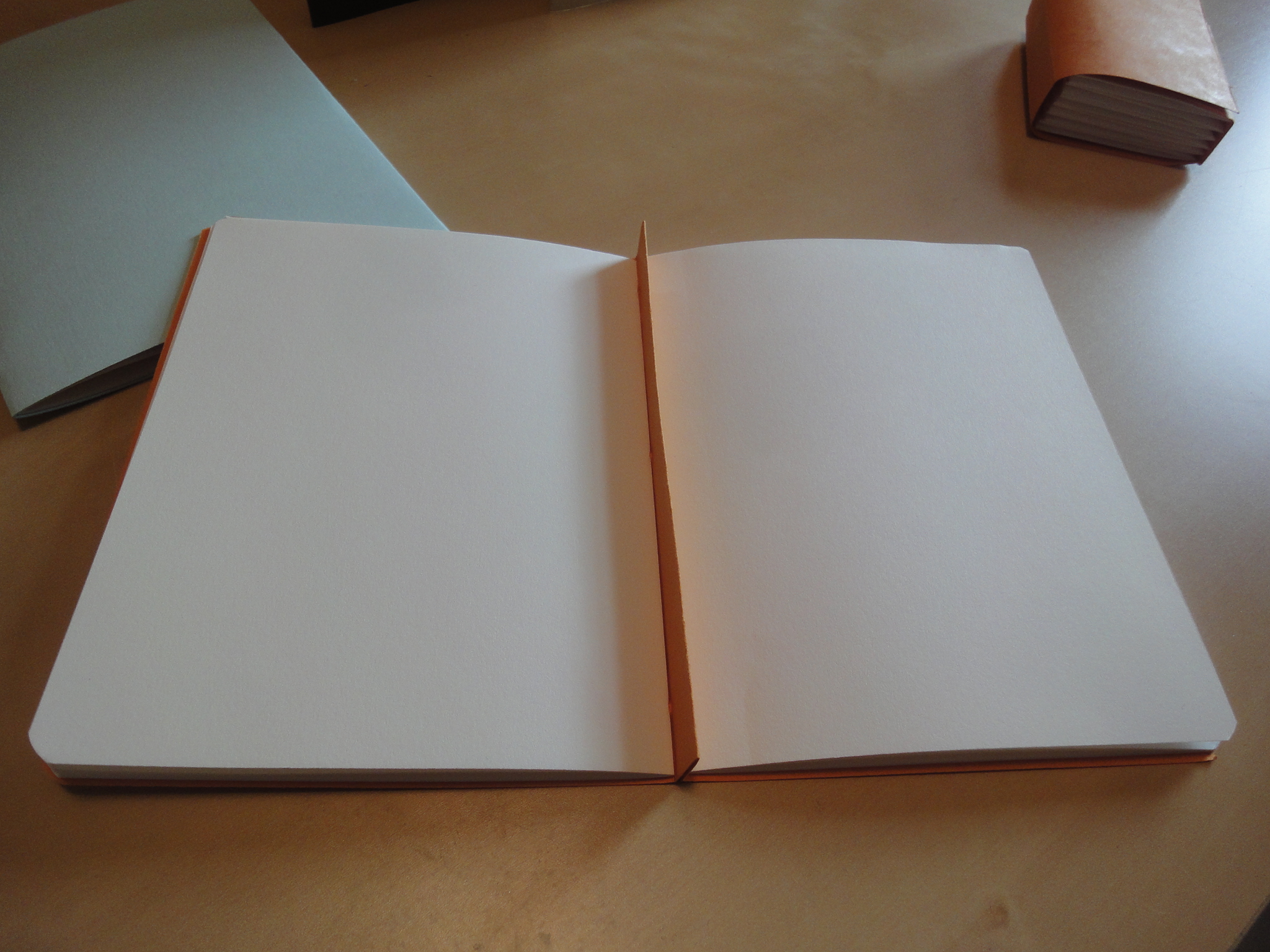
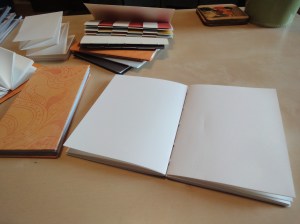
This is the two-section pamphlet; the sections are each made up of four sheets of paper, each folded in half once. The cover has a pleat in the middle, and there are three “stations” (holes) where the waxed thread goes through all the layers to hold it together.
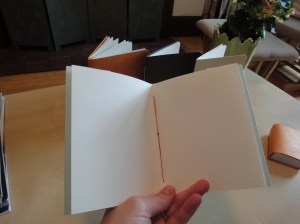
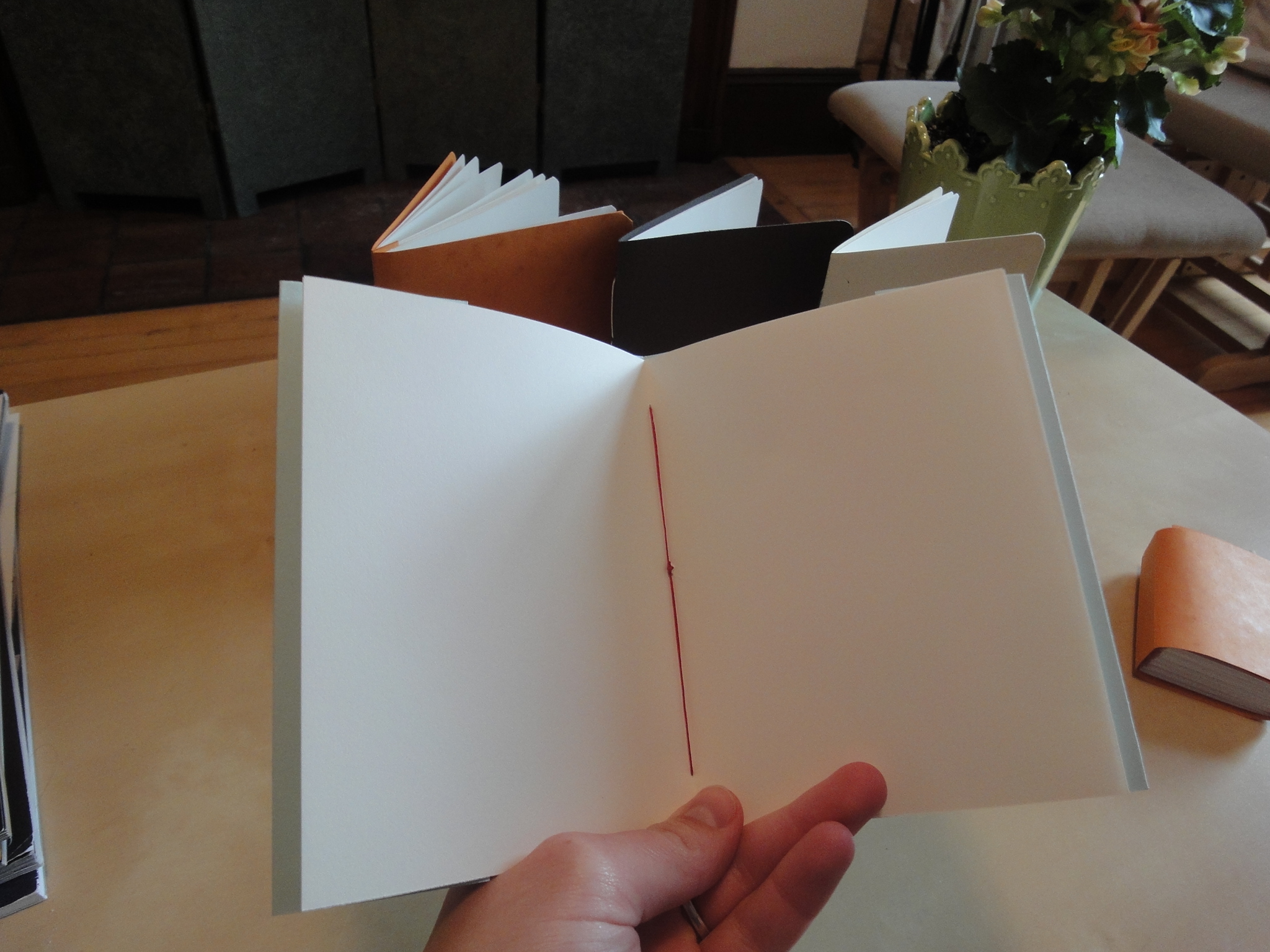
This is a one-section pamphlet, also with three stations. I gave the other pamphlets rounded corners, but I folded the edges of this cover in, so it has French flaps (like fancy trade paperback editions sometimes do).
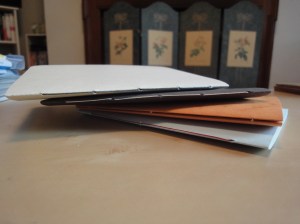
All four pamplets: the top two have five stations, the bottom two have three.
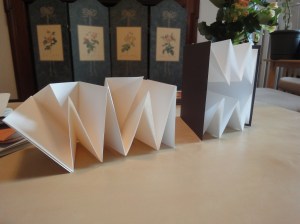
Standing up like this, these remind me of The Monster Book of Monsters from Harry Potter (when Hagrid teaches the Care of Magical Creatures). On the left is the blossom fold; on the right, the Turkish map fold.
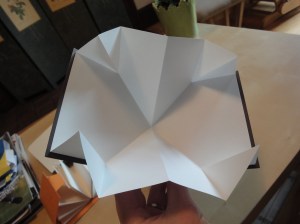
Here’s the Turkish map fold, open. It does fold down nice and flat – I think I have a city map of Paris folded in a similar way.
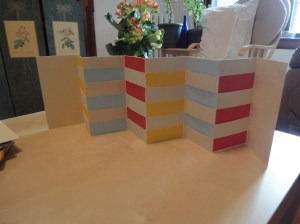
This has the best name of all: woven flexagon. We started with one long sheet (the cream-colored paper), and used a blade to make slices about 1″ apart; then, we took the colored papers and wove them between the slices. It’s quite cheerful-looking, but I have no idea what I’ll do with it.
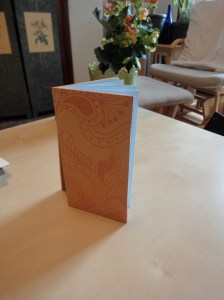
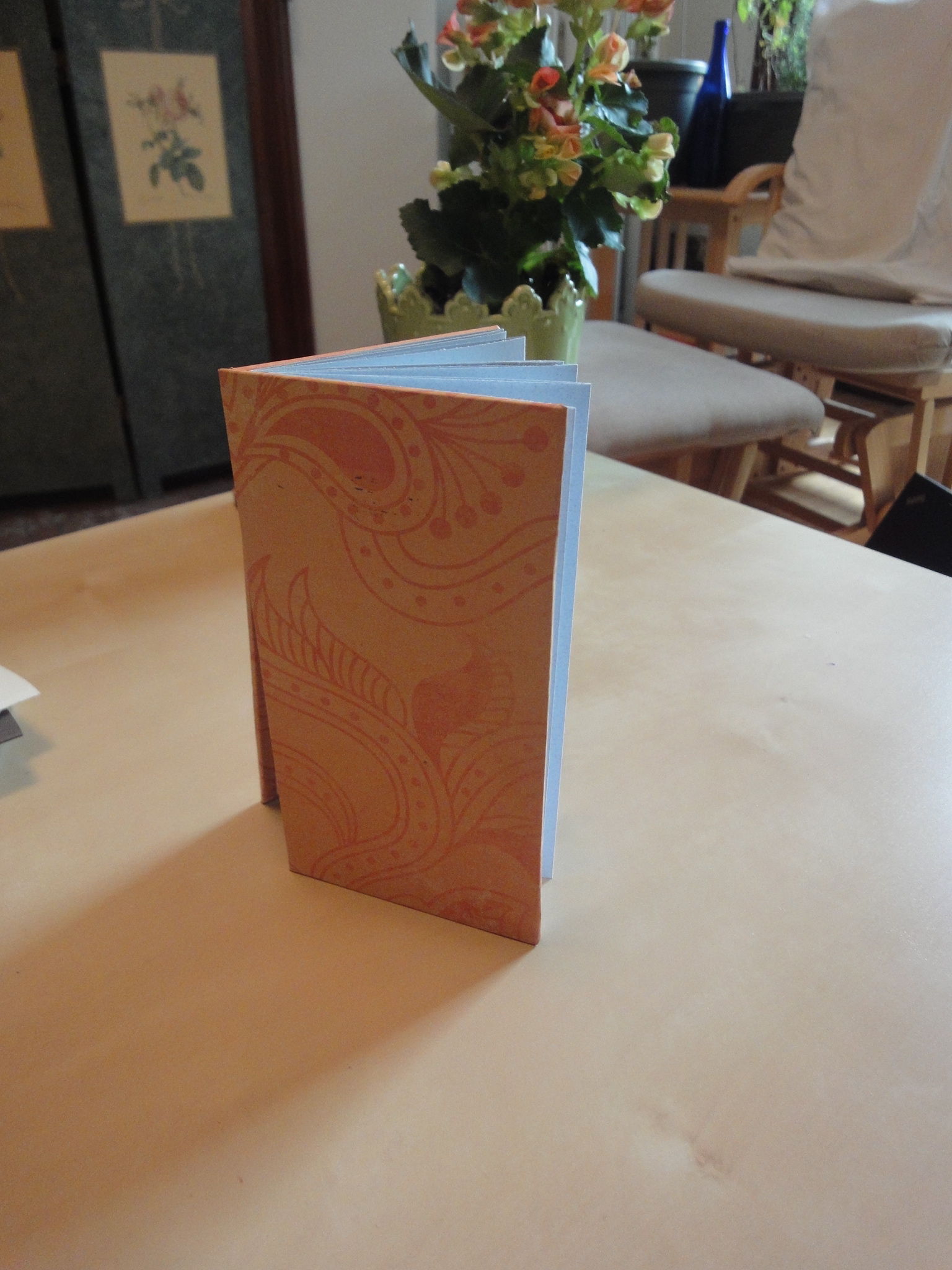
A simple accordion fold, with covers made of binder’s board covered with decorative paper. We got to use polyvinyl acetate (PVA), an archival-safe plastic adhesive, to glue the paper cover over the board. Sarah showed us how to tuck the corners in with a bone folder to make them smooth and sharp.
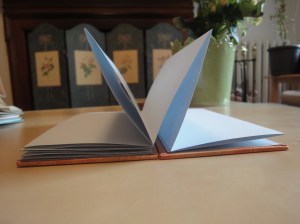
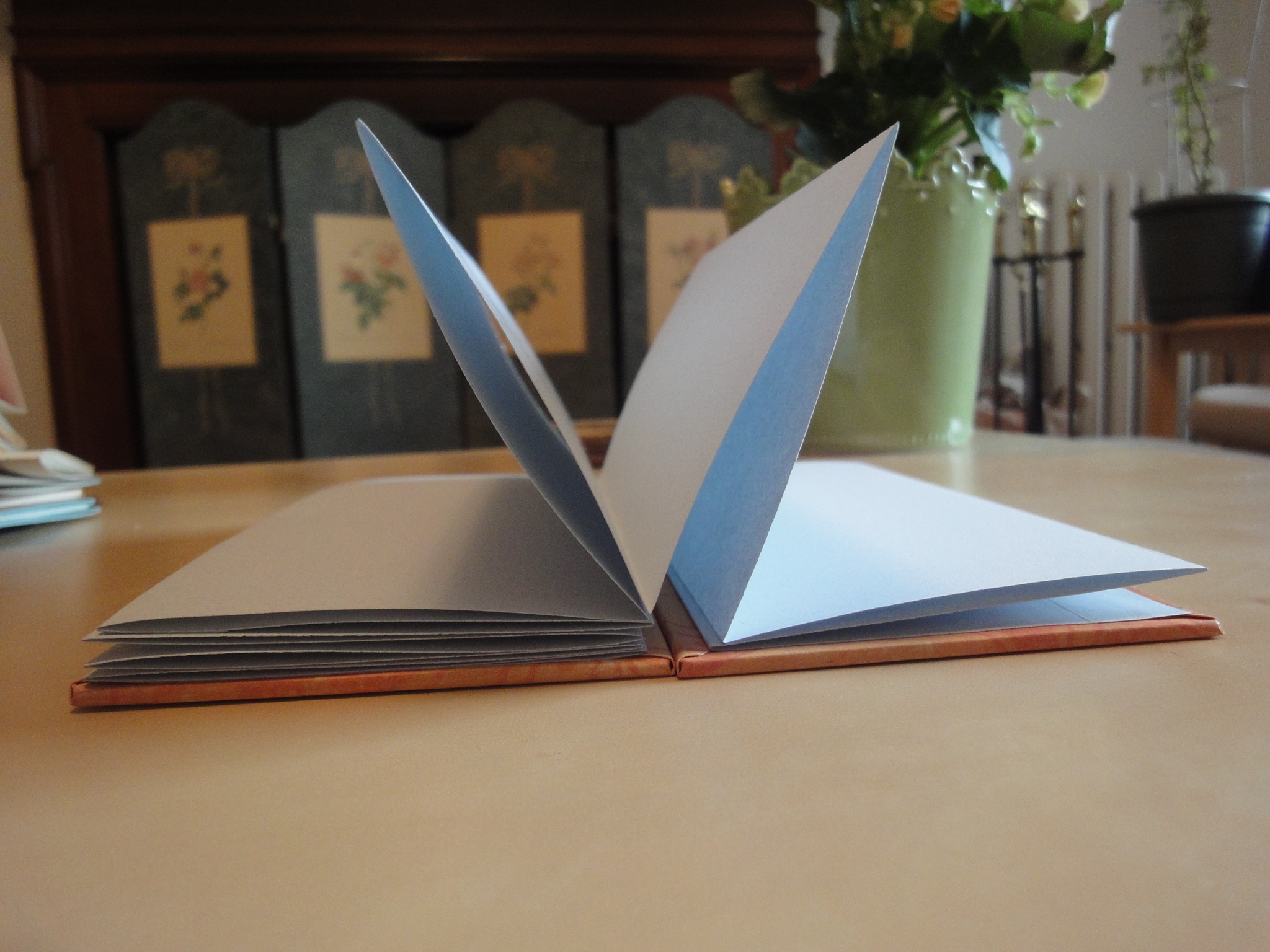
The same book, lying open. I preferred the sewing to the folding; I couldn’t make the folds 100% exact. Sarah also showed us how to make an accordion fold with pockets, which I would have liked to cover with the binder’s board, but mine didn’t quite stack straight.
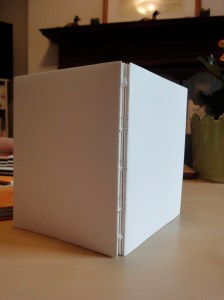
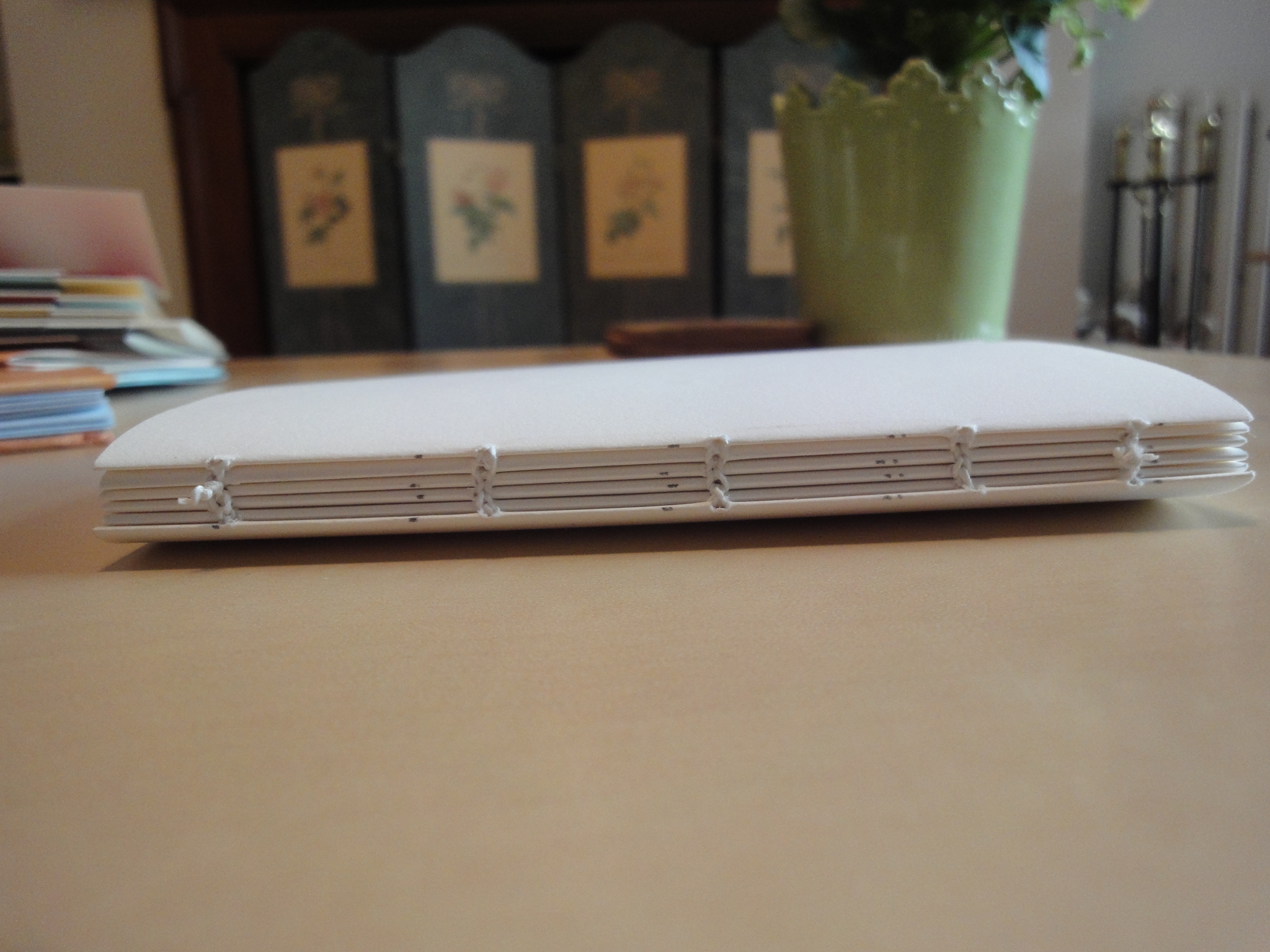
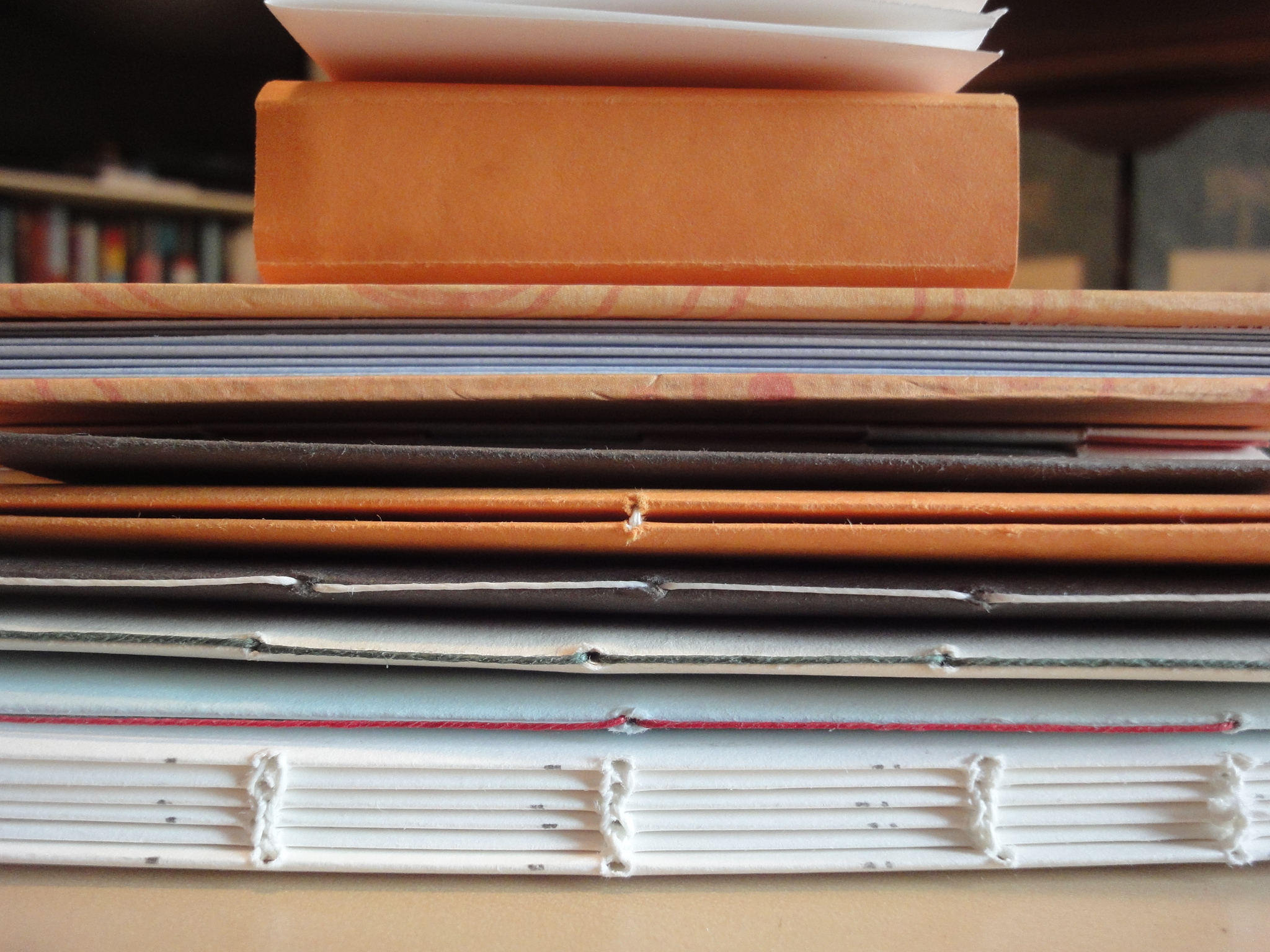
Finally, the chain stitch – this is the longest book, with five sections, or signatures, sewn together.
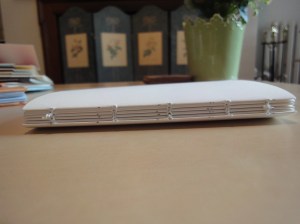
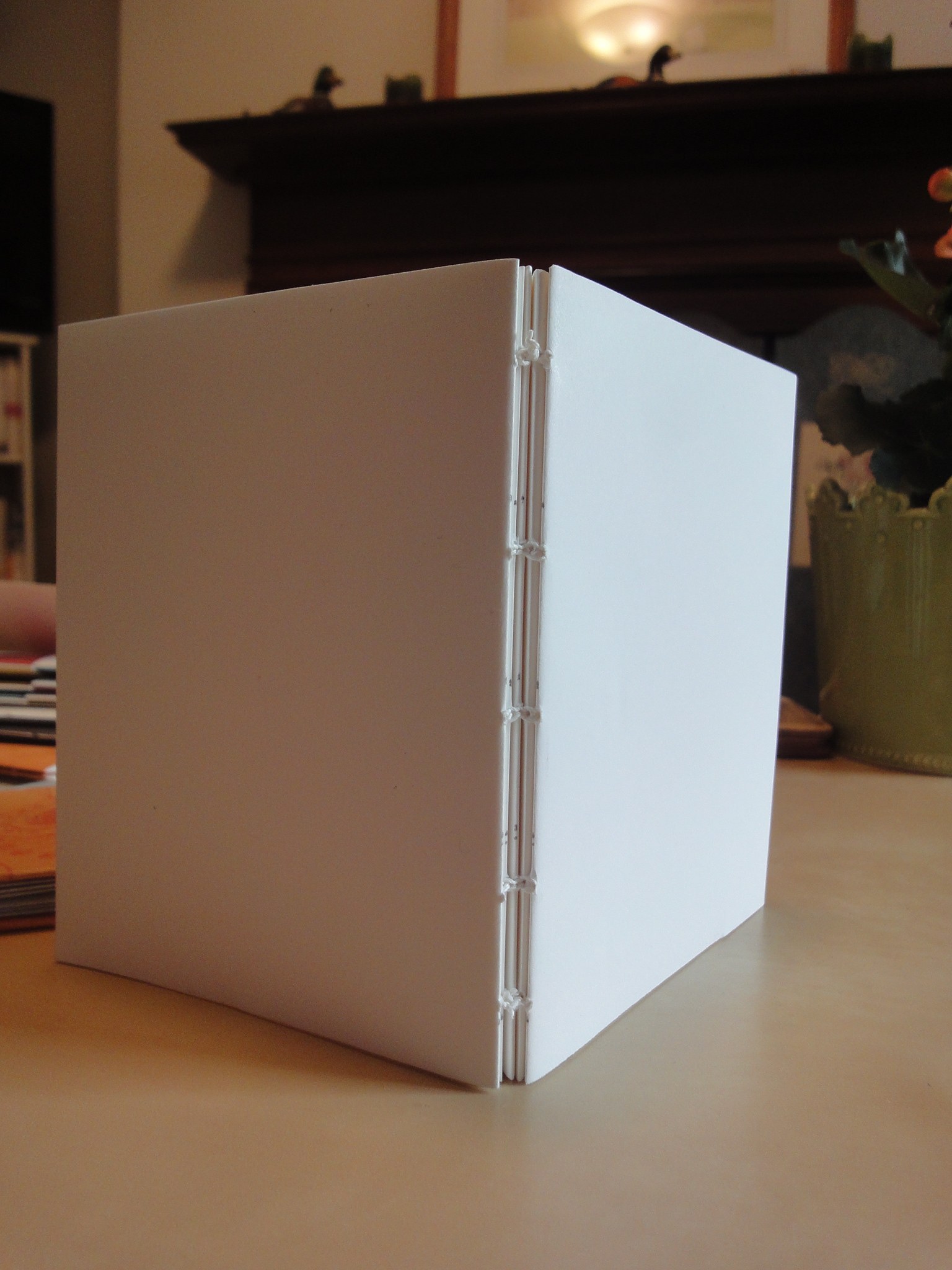
Here’s the chain-stitched booklet, closed. The stitching makes a nice pattern.
Other than being pretty, the chain stitch is also a nice binding because it allows the book to open flat, which is good for journals and sketchbooks, because you can write or draw deeper into the margins without worrying about the gutter.
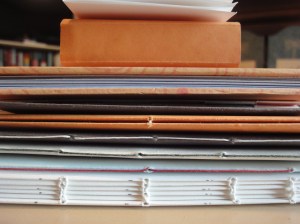
All the bindings!
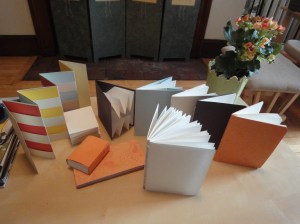
A flock of books – all hand-made in less than seven hours. Even though I probably won’t be using these bookmaking skills in a practical setting anytime soon, the workshop was a good experience: I learned new things, stretched the part of my brain that relates to making tactile things, and created a physical product to use or give as gifts. All in all, a Saturday well spent.
Amazon, Overdrive, Privacy?

Sarah Houghton, a.k.a. the Librarian in Black, has posted a 10-minute video offering her point of view on “why the Kindle format lending from Overdrive is anti-user, anti-intellectual freedom, anti-library, and something that all librarians should be aware of and disturbed by.” One of her core issues is that, when Kindle users borrow e-books from the library, Amazon keeps track of those records. Customers may be used to Amazon tracking their purchases, but libraries are much more careful about patron data.

The American Library Association (ALA) website has a section devoted to intellectual freedom, and to privacy and confidentiality. This section states, “Lack of privacy and confidentiality chills users’ choices, thereby suppressing access to ideas. The possibility of surveillance, whether direct or through access to records of speech, research and exploration, undermines a democratic society.” Therefore, “confidentiality of library records is a core value of librarianship.” Amazon does not care about keeping your reading or borrowing history private and confidential, and this is what Houghton – and many other librarians – are upset about. Patrons may be willing to sacrifice privacy and confidentiality for convenience, but many libraries have privacy policies in place – supported by state law – specifically in order to protect patron privacy. That isn’t something that ought to be given up lightly.

In defense of editors

“The only really necessary people in the publishing process now are the writer and reader,” [Amazon top executive Russell Grandinetti] said. “Everyone who stands between those two has both risk and opportunity.”

That’s a quote from a recent New York Times article about Amazon edging out publishers and dealing directly with authors. I can’t tell if it was quoted faithfully or taken out of context, but if it is a true statement of expression, I have to disagree. Even the best writers – however you define best – need editors. Not every author-editor relationship is a life-changing or earth-shattering one, but editing does improve books: editors might pose the right question at the right time, or suggest cutting an element that doesn’t move the story forward, or suggest a new angle. Writers can become so immersed in their own work they are unable to look at it clearly and objectively; here, too, an editor is helpful.

This is not to say that bad books don’t get published, even with an editor (define “bad” however you want – it’s out there). And it’s not to say that it’s completely impossible for an author to write and publish a work of quality without an editor – but that’s the exception, not the rule. After all, there are dozens of authors writing today who are top-notch, “experts” at what they do; those authors are still working with editors. Even Amazon is employing editors (though nameless executives won’t say how many).

The publishing industry gets a lot of flack. It’s not Wall Street; no one I met while I was working in publishing was in it for the money. It’s not innocent, either (come on, HarperCollins, 26?), but it does have a function, and it is a valuable part of the process by which an author produces a book and that book becomes commercially available. Amazon represents a legitimate threat to traditional publishers, but this is not the end of the world, let alone the industry. Radio wasn’t the end of books, TV wasn’t the end of books, and the Internet isn’t the end of books. If anything, the Internet proves how badly editors are needed.

Borrowing e-books from the library

This is by no means a universal set of instructions, but the New York Public Library (NYPL) blog has posted step-by-step instructions for how to check e-books out of the library with a Kindle. It’s a great visual walk-through, which is good because there are a lot of steps. I prefer the step-by-step screenshots, though – it’s the next best thing to having someone walk you through it one-on-one. (There’s a link to a video from OverDrive, as well.)

We aren’t “there” yet, but it’s exciting to see the progress being made with libraries and e-books.

Banned Books Week…

…has passed. But I just found this quote and wanted to share:

“Book-banning is ridiculous, if for no other reason than it makes people want to read the banned book even more. The exchange of ideas (even unpopular or inconvenient ones) is important in making us who we are, and helping us to promote independent thought. Also, books about witches and talking animals are awesome.” –Jenny Lawson, a.k.a. The Bloggess, for CafeMom