Building a Board Book Library

This post brought to you by the fact that my brother and SIL are expecting a baby this summer! So I’ve got board books and early literacy on the brain (even more than usual). 

Reading aloud to and with kids is something you can do from Day 1. Start early and make it part of your day, every day, as part of the five practices that build early literacy skills: talking, singing, reading, writing, and playing. Board books are an excellent way to start: they’re small, sturdy, and designed to appeal to babies and their caregivers. Some are wordless (like Tana Hoban’s Black & White books), some rhyme, some have tactile elements that invite touch (like the “That’s Not My…” series). Whether you’re looking to build a board book library of your own, looking for board books to gift, or wondering which board books to borrow from the library, here’s a place to start.

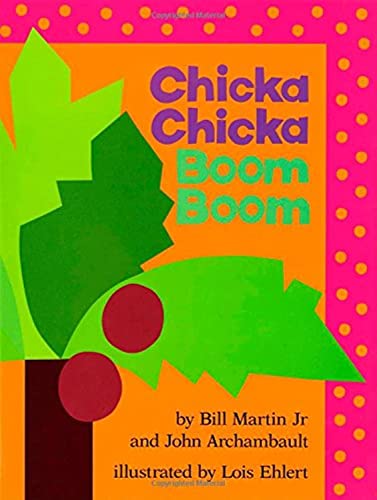
Right off the bat, let’s assume everyone is familiar with a handful of classics:Cover image of Chicka Chicka Boom Boom

  • Goodnight Moon by Margaret Wise Brown and Clement Hurd
  • The Very Hungry Caterpillar by Eric Carle
  • Chicka Chicka Boom Boom by Bill Martin Jr. and Lois Ehlert

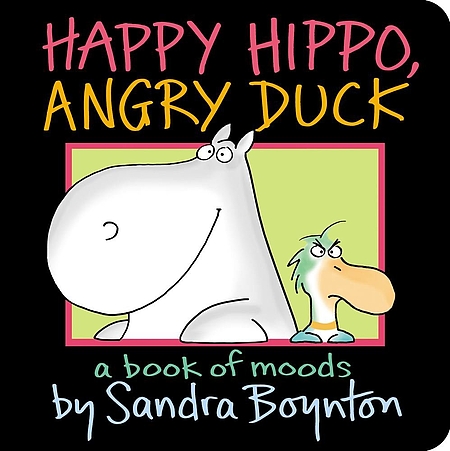
And then there is the Queen of the Board Books, Sandra Boynton. Her rounded characters are gentle and funny and her rhymes are easy to memorize. Here are my favorites of hers:

  • Happy Hippo, Angry Duck: A Book of MoodsCover image of Happy Hippo Angry Duck
  • But Not the Hippopotamus
  • Hippos Go Berserk
  • Belly Button Book

Developmentally, babies’ vision isn’t perfect when they’re born, so high-contrast art is good. They are also interested in faces, and especially if babies are being raised in a homogenous society, becoming familiar with diverse faces from an early age is important. With that in mind:

  • Tana Hoban’s Black & White booksGlobalBabies
  • I Kissed the Baby by Mary Murphy
  • Why the Face by Jean Jullien
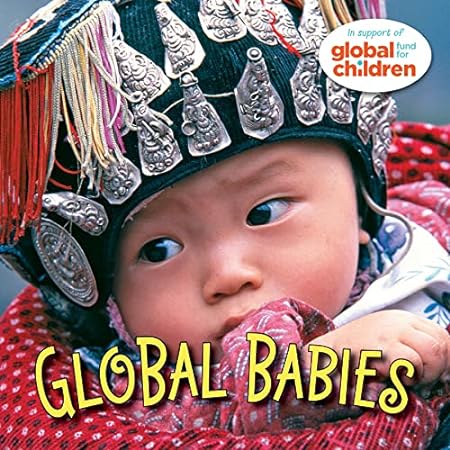
  • Global Babies
  • First 100 Words by Roger Priddy

As babies begin to learn that their arms and hands are part of their bodies, they start to reach for stuff and explore the world that way (i.e. by putting it in their mouths). Will some flaps get ripped, will some corners get chewed? Absolutely. These board books are interactive and hands-on:

  • Where is Baby’s Belly Button? by Karen KatzCover image of That's Not My Pony
  • Peek-A-Who by Nina Laden
  • Press Here / Mix It Up / Finger Worms by Herve Tullet
  • TouchThinkLearn by Xavier Deneux (Shapes, Numbers, Colors, Farm)
  • Cook in a Book by Lotta Niemenen (Pizza, Tacos, Cookies, etc.)
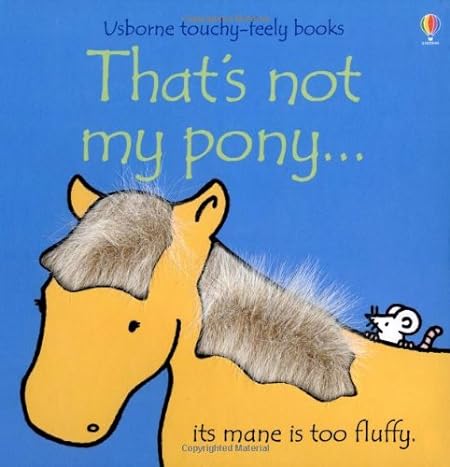
  • That’s Not My… (Dinosaur, Dragon, Pony, Puppy, etc.)
  • Flora and the Ostrich by Molly Idle

One language is good, two (or more) languages are better! Teaching babies a few signs can be incredibly useful for communication, and helpful in reducing frustration, even if you aren’t fluent in ASL.

  • My First Baby SignsAlma, Head to Toe by Juana Martinez-Neal (bilingual, Spanish/English)
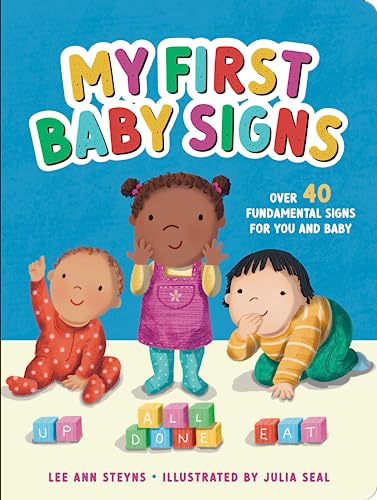
  • My First Baby Signs by Lee Ann Steyns and Julia Seal
  • The ABCs of Baby’s Needs by Loris Lora

A few more to know, just because! Several of these authors and author/illustrators publish full-size picture books as well, so even when babies outgrow board books, they can move right up to picture books with familiar styles.

  • What Do You Wear? by Taro Gomi
  • Oh No, George by Chris Haughton
  • Jump! by Tatsuhide Matsuoka
  • Not A Box by Antoinette Portis
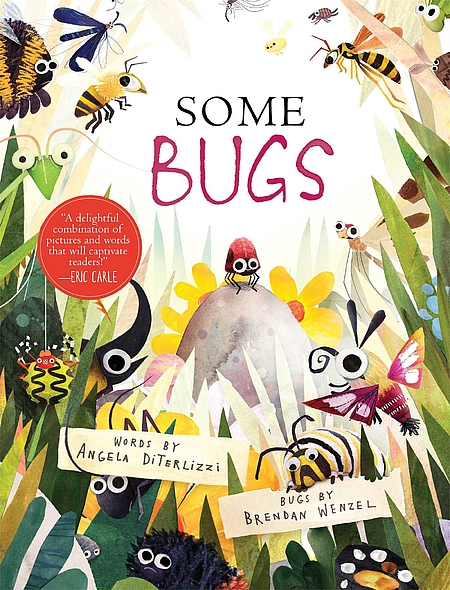
  • Some Bugs by Brendan Wenzel and Angela DiTerlizziSomeBugs
  • Hello, Hello by Brendan Wenzel

Resources:

Board books for babies and toddlers (June 2017)

Early Development, Language, and Literacy (Read to Grow)

The Positive Effects of Reading on Child Development (Reach Out and Read)

Help Your Child Learn to Read (Colorín Colorado)

The Five Practices: Talk, Sing, Read, Write, Play (Every Child Ready to Read)

That ol’ TBR pile and vacation reading

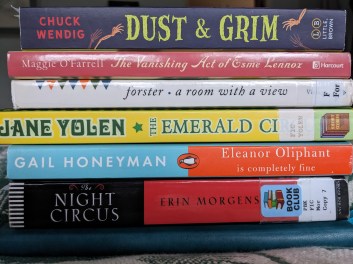
Last fall I took a photo of my TBR (To Be Read) pile. Looping back to that, how’d I do? Well, I’ve read three of the ten so far: the classic Eight Cousins by Louisa May Alcott, teen graphic novel Incredible Doom by Matthew Bogart, and As Brave As You by Jason Reynolds. (And I would have re-read The Great Believers in April, but had lent it to my mom and didn’t have time to get it back before we traveled. Instead, I re-read The Vanishing Act of Esme Lennox by Maggie O’Farrell, and Dust & Grim by Chuck Wendig, which I had been meaning to read since last fall but wasn’t in the photo.) I keep trying to get my book club to pick The Grammarians, but so far there’s only lukewarm interest.

Pile of books

Above: Vacation reading (six books for a five-day trip seems reasonable, if not restrained. And I read the top four: Dust & Grim, The Vanishing Act of Esme Lennox, A Room with a View, and Emerald Circus). I always like to bring one or two re-reads on a trip, so I know that I have something I’ll like in case I turn out to be not in the mood for the others.

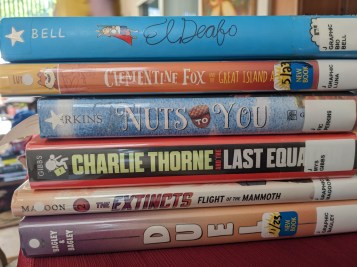
Pile of books with library spine markings

Above: Also, we went to the library while we were on vacation. From this pile, I read Clementine Fox and Duel, and we listened to the audiobook of Nuts to You (which was excellent). The 8yo re-read El Deafo and also enjoyed Clementine Fox and Nuts to You, as well as the stack of books she’d brought along from home. Airport delays, you’re no match for this family! (OK, not to tempt fate. But we’re unlikely to run out of reading material, at least.)

My TBR pile tends to linger and languish because, unlike library books, those books don’t have due dates. All of this is to say, the mid-year reading round-up is practically around the corner…

Open Books, Open Minds

Today is the Open Books, Open Minds “celebration of reading and literacy,” a free virtual event from LJ/SLJ and NCTE. I moderated a panel on “the joy of reading” with five authors:

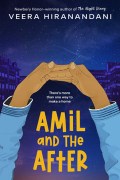
  • Veera Hiranandani (Penguin Young Readers), author of Amil and the After, How to Find What You’re Not Looking For, and The Night Diary, a Newbery Honor book.
  • Stuart Gibbs (Simon & Schuster), author of the Spy School, Funjungle, Moon Base Alpha, and Once Upon A Tim series
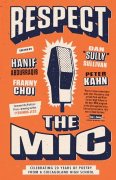
  • Peter Kahn (Penguin Young Readers), poet, educator, and project creator; co-editor of Respect the Mic: Celebrating 20 years of poetry from a Chicagoland High School
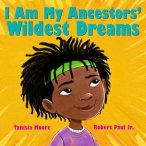
  • Tanisia “Tee” Moore (Scholastic), author of Micah Hudson: Football Fumble and picture book I Am My Ancestors’ Wildest Dreams
  • Claribel Ortega (Scholastic), author of Witchlings, Ghost Squad, and Frizzy, winner of the Massachusetts Children’s Book Award

All of the authors spoke beautifully and passionately about the importance and joy of books and reading. Brief notes on our conversation are below, and the whole day’s worth of panels and presentations will be available for online viewing for the next three months.

What does “the joy of reading” mean to you?

  • SG: (holding up a copy of The Westing Game by Ellen Raskin) “Reading creates memories.”
  • CO: Reading allows me to go into other people’s lives and experience things I wouldn’t do otherwise.
  • TM: “Books transport you.” (Cited The Snowy Day and Nancy Drew mysteries.)
  • VH: Books provide companionship.
  • PK: When you’re reading a paper book, you can’t multitask. You are in the moment.

How did you come to love reading? Cover image of Charlie Thorne and the Last Equation

  • TM: Was always a reader, and reading and writing were linked; kept a diary from age 6. Characters in books “were my friends.”
  • SG: Always a reader, read a huge number of library books – even found the G section where his book would be if he wrote one someday. [Ed. note: One! Haha]
  • VH: Had a lot of free choice, and never felt judged for her reading choices, even when she read comics. Having that freedom was important.
  • PK: Saw his parents reading for pleasure on vacation, so perceived it as a fun/leisure activity rather than a forced one.
  • CO: Always a reader. Books and libraries provided a safe space.

What about kids who haven’t discovered the joy of reading yet?Cover image of Frizzy

  • VH: Again, freedom to choose what you read is important. And parents can model reading, too.
  • TM: Allow kids to discover what they enjoy. Read together, or read what they’re reading, and let books start conversations.
  • SG: Books should be FUN! Graphic novels can be a gateway to reading other kinds of books.
  • PK: Read together, read aloud.
  • CO: Kids love graphic novels. Also, if they’re interested in other media (computer games, TV shows, etc.), make a connection to those other interests.
  • TM: If there’s a movie or TV version of the book, read/watch both and compare them.
  • VH: If kids read when they’re young, then drift away from it, they can come back to it: “It’s IN there.” True for adults too.

What are some ways your books can be, or have been, used in the classroom?RespecttheMic

  • PK: There is a website with videos to accompany Respect the Mic. Seeing poets perform their own work aloud increases engagement; there are also lesson plans and prompts.
  • SG: Did a lot of research for the Charlie Thorne series (partially inspired by reading Michael Crichton, who combined science and adventure), so history is woven in. Notes at the end of the book go some way toward explaining what parts are fact and what is made up, but students are encouraged to do their own research too.
  • CO: Witchlings has themes of prejudice, belonging, inequality, and socioeconomic status. Some teachers have asked students to use their problem-solving skills to suggest changes in the fantasy world of the book. What if…?
  • TM: I Am My Ancestors’ Wildest Dreams introduces readers to contemporary heroes, expands on Black history, and asks readers to consider when and how to make “good trouble.” It can be used in social studies and during Black History Month.
  • VH: Nisha, the protagonist of The Night Diary, and her twin Amil, protagonist of Amil and the After, are twins with very different styles of learning, ways of creating meaning, and ways of expressing themselves. Readers can consider their own and others’ learning styles, meaning-making, and expressions.

Why do you think reading is important, and how do you convey that to young readers?AmilAfter

  • SG: Reading about different worlds, cultures, and experiences creates empathy. Reading is a gateway.
  • VH: Echoes Rudine Sims Bishop’s “Mirrors, Windows, and Sliding Glass Doors.” Books allow people to enter into others’ lives and gain a deep understanding.
  • CO: Books are a place to learn about tough topics safely.
  • PK: Having hard (physical, paper) copies of books is more important than ever so that you can focus without distraction, scrolling, notifications.

How do you communicate a message/theme to young readers without being didactic?Cover image of I Am My Ancestors' Wildest Dreams

  • CO: TRUST your reader. Let things be messy. Some things aren’t fixed – that’s realism. Kids appreciate you being real with them.
  • TM: Use dialogue and action to show; allow readers space to figure things out on their own. It’s harder to write a picture book than people imagine!
  • SG: A little bit of messaging goes a long way; make it powerful, not repetitive.
  • VH: A didactic message reveals an adult agenda.

Is it mandatory to have a child in order to be a good children’s book author? (audience question)

  • TM: Most important is to BE A READER of the genre you want to write in. Spend time around kids (doesn’t have to be your own).
  • VH: Be in touch with your inner child.
  • CO: Talk with kids on school and library visits.

It was such a privilege to speak with these authors today and hear what they had to say about the joy of reading. Library news lately has been dominated by book bans and budget cuts, so to hear kidlit creators speak out so strongly in favor of free choice in reading was marvelous. I believe that kids will build an identity as a reader if they are allowed to choose their books (including graphic novels and audiobooks); if they see the adults in their lives reading books; if they engage in conversations about books. I believe that reading builds empathy, and prepares people to live in the world with other people, and to experience scary things in a safe way.

Happy reading to you all!

Nonfiction picture books in storytime

At the MSLA conference in 2021, Melissa Sweet presented her “Tips and Tools for Nonfiction Read-Alouds,” and since then I’ve been mindful of trying to include nonfiction picture books in storytime programs, as well as in displays and readers’ advisory. This week I had so many to choose from that I didn’t even get to them all!

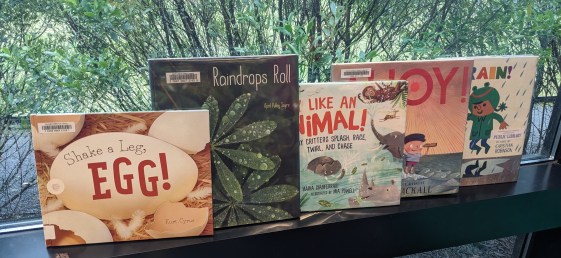
Picture books on the railing

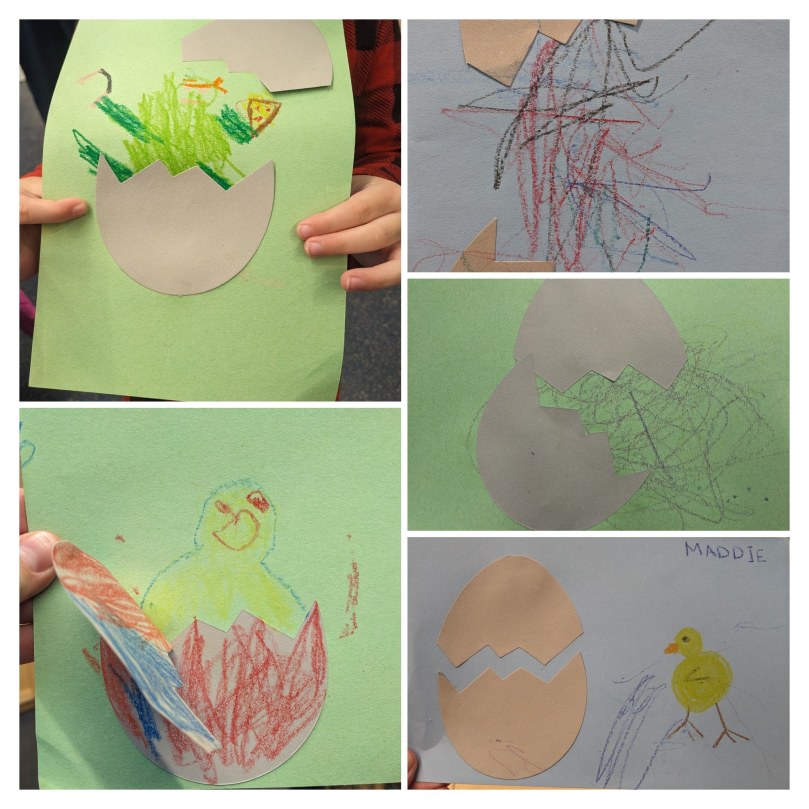
We ended up with a nice mix of fiction and nonfiction around a loose springtime theme. Today’s weather made Rain! by Linda Ashman and Christian Robinson a shoo-in for the lead-off book. Next we read  Shake A Leg, Egg! by Kurt Cyrus, which connected to our craft (see photos below). Shake A Leg is fiction, but the illustrations of different types of birds and the pond scenes are realistic and detailed. (I also had Whose Egg Is That? by Darrin Lunde and Kelsey Oseid; we skipped it for today, but I’ve had success reading all of their “Whose __ Is That?” books at storytimes. Preschool, kindergarten, and even first and second graders enjoy making predictions and guesses.)

Next we read Ahoy! by Sophie Blackall (and I’m just now realizing that four out of five of today’s books have exclamation points in their titles). A new Sophie Blackall book is always exciting, and this one features imaginative indoor play – perfect for a rainy day. Next we read Play Like An Animal! by Maria Gianferrari and Mia Powell, which features lots of unusual animals and plenty of active verbs and fun facts. And finally, the kids voted for Raindrops Roll for our final book. April Pulley Sayre’s photography is gorgeous, and every word is carefully chosen and necessary, with nothing extra.

The craft for today was inspired by the egg books, and also by the generous supply of die-cuts in the art room closet. I cut cracked egg shapes from pale gray paper so that kids could draw creatures hatching, and they were so creative! One kid made hers a lift-the-flap by only gluing down part of half of the eggshell; another (with help from Dad, I think) draw a Teenage Mutant Ninja Turtle, pizza slice in hand.

Photo collage of egg crafts

What nonfiction read-alouds do you use in storytime?

Book Tasting

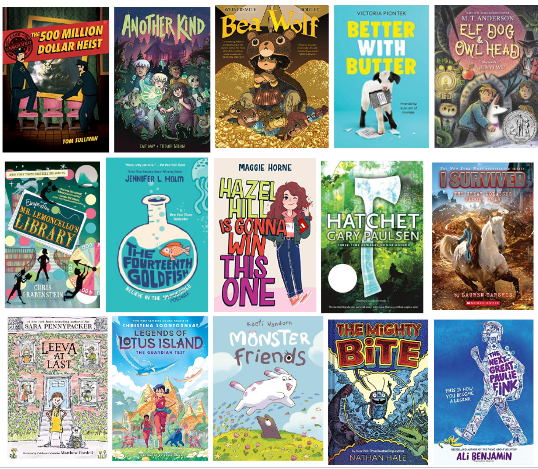
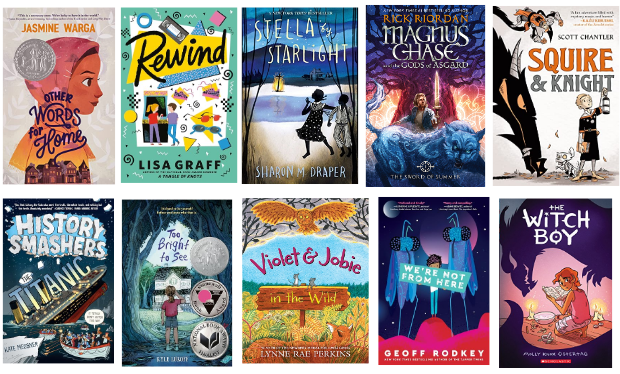
What is a book tasting? In this case, it’s a chance for a group of people (about 12 homeschooled kids from about third through sixth grade) to meet a group of books. They get a chance to browse, then get officially introduced via a book trailer, jacket copy, a brief read-aloud, or a book talk. Then they get to examine the books again, and vote for their top five to be the choice for their first book club meeting. Some spreadsheet-ing occurs, and then the winner is announced, and many books are checked out.

I planned this event with one of the homeschooling parents. I modeled the “menu” of books on past MCBA lists, which is how we ended up with 24 titles to “taste” today. It’s so hard to limit the list once the ideas start flowing – some of the kids in the group had suggestions as well – but 15-20 titles would have been sufficient, still allowing for various genres and formats without being overwhelming. (Although I don’t think the kids were overwhelmed, and those who had suggested titles were pleased to see them!)

HomeschoolBookTasting1HomeschoolBookTasting2

Kids browsed the books while everyone trickled in. Once everyone arrived, we did introductions (name, pronouns, favorite baked good) and considered the question, “How do you choose a book to read?” Kids mentioned the cover, the back or jacket copy, and the “first page test.” Perfect!

To introduce the books, I found some book trailers (links below) so I didn’t have to talk for forty minutes straight, and so kids could hear directly from some of the authors. (I also found one playlist – thank you, Lisa Graff! – which we listened to as people arrived, and an “AWWWW”-worthy photo of M.T. Anderson’s dog.) I wondered if the quality or format of the presentation for each book would sway the votes one way or another – would the top-choice books be the ones with the glossiest production value? – but my guess is this only happened in one case (Escape from Mr. Lemoncello’s Library).

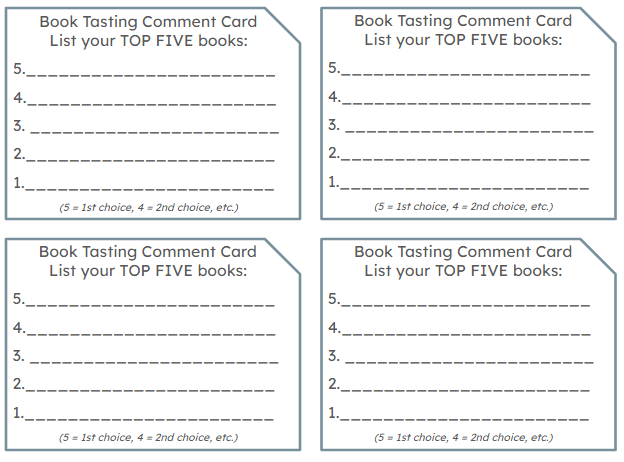
In the end, Gary Paulsen’s classic Hatchet won, with Lemoncello close behind, and Another Kind and The 500 Million Dollar Heist tied for third. I used an English major version of ranked choice voting, assigning 5 points to each person’s first-choice book, 4 points for second choice, 3 for third, and so on. The most votes (not points) any title got was five, and kids cheered or at least accepted the outcome (especially since other titles might be future discussion choices, and they could check out any book they wanted from the table today).

Book Tasting Comment Card - Top Five

Book trailer, articles, photos, and playlists:

We’ll reconvene in about six weeks to discuss the book, and I’ll be looking for a companion picture book for some of the group’s younger siblings to discuss. Maybe something about forests or general outdoorsy-ness, rather than a survival story. What picture book pairs well with Hatchet?

Storytime Top Ten

Reading Jbrary’s annual roundup of 2023 Favourite Storytime Picture Books made me think back to the list of Great Books for Two- and Three-Year-Olds I prepared back in April 2019. It’s actually still a pretty solid list! I don’t repeat books in storytime that often, because there are always so many good new ones, but there are several books on my 2019 list that are still in my rotation – Grumpy Pants, Huff & Puff, Hooray for Hat!, Where is the Green Sheep?, Carrot and Pea, A Parade of Elephants, and more.

I skimmed back over my storytime titles from September and picked a few to build this new list of storytime success books. Of course, every storytime is different – depending on who shows up, and how many, and what their energy level is, it’s a real YMMV (Your Mileage May Vary) situation. And there are some books that the kids connect to, and others the adults love – it isn’t always both. But as I see it, the storytime is for everyone who attends, from babies to grandparents. (I usually make a note when someone checks out one of the storytime books after the program is over; if they liked it enough to take it home, that’s a good sign!)

So, here are ten to try:

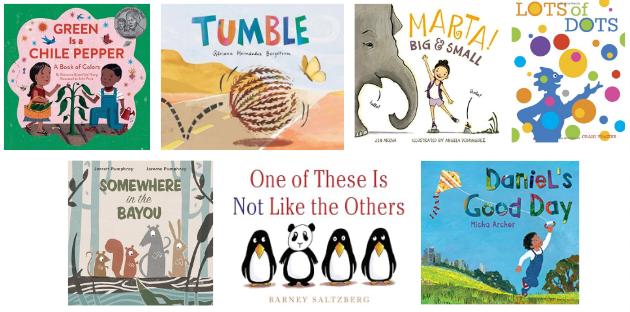
  • Are You Big? by Mo Willems
  • The Button Book by Sally Nicholls and Bethan Woollvin
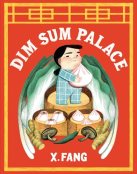
  • Dim Sum Palace by X. Fang
  • Daniel’s Good Day and Wonder Walkers by Micha Archer
  • Lots of Dots by Craig Frazier
  • Mr. Scruff by Simon James
  • Now by Antoinette Portis
  • One of These Is Not Like the Others by Barney Saltzberg
  • Somewhere in the Bayou by Jarrett and Jerome Pumphrey
  • Tumble by Adriana Hernandez Bergstrom

Cover images of Green is a Chile Pepper, Tumble, Lots of Dots, Marta Big and Small, Somewhere in the Bayou, One of these is Not Like the Others, Daniel's Good Day

And here are 10 more that overlap with the Jbrary list:

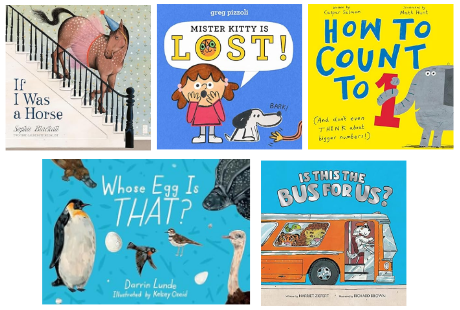
  • How to Count to One by Caspar Salmon
  • If I Was A Horse by Sophie Blackall
  • I’m Going to Build A Snowman by Jashar Awan
  • Is This the Bus for Us? by Harriet Ziefert and Richard Brown
  • Just One Flake by Travis Jonker
  • Mister Kitty is Lost! and Lucky Duck by Greg Pizzoli
  • The Rainbow Snail by Karin Akesson
  • Roll Little Pea by Cecile Bergame and Magali Attiogbe
  • Superbaby! by Stephanie Parsley Ledyard and Lincoln Agnew
  • Whose Egg/Footprint/Poop Is That? by Darrin Lunde and Kelsey Oseid

Cover images of If I Was A Horse, Mister Kitty Is Lost, How to Count to One, Whose Egg Is That, Is This the Bus for Us

Over the past half-year, I’ve made an effort to include Spanish/English bilingual books in my storytimes. Some of the ones that have worked well are:

  • Marta! Big and Small by Jen Arena and Angela Dominguez
  • I’m Hungry / Tengo Hambre and How Are You / Como Estas? by Angela Dominguez
  • Round Is A Tortilla / Green Is A Chile Pepper / One Is A Pinata by Roseanne Greenfield Thong and John Parra

What are your storytime favorites?

Book Browse Bear: Serendipitous Suggestions

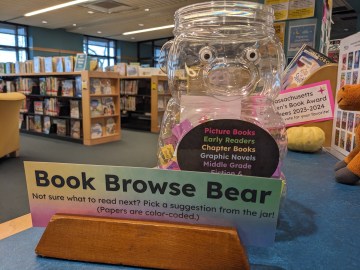
Inspired by the “don’t know what to read?” jar up in our teen room, which has suggestions by genre, and by an empty bear-shaped container I found in the closet, Book Browse Bear was born! There are about 40 titles in each of the following categories: picture books, early readers, chapter books, middle grade graphic novels, and middle grade fiction & nonfiction. (These are color-coded, naturally.) It’s been fun to see people digging into the jar, and fun to help them find the books on the shelves (or another book, if that one is checked out).

Book Browse Bear

If you’d like to make something similar for your library, you can use the link above to make a copy of my lists and adapt them to the collections on your shelves. It’s a great way to promote some favorite titles, especially backlist ones that may not be circulating as well anymore. Happy browsing!

Book Lists for Tough Topics

In any workplace, there are going to be certain questions you’ll be asked over and over again. (“Where’s the bathroom?” for example.) As a children’s librarian, people ask me lots of questions about library programs and services, and ask for help finding books – in particular, books about animals, books about “things that go” (trucks, construction vehicles, etc.), and books about dinosaurs. I am always happy to hand a kid a book about a backhoe or a brachiosaurus or a bat! But I also get questions from caregivers about weightier topics: starting school or switching schools, moving to a new home, managing big feelings, welcoming a new baby, or dealing with grief over the loss of a loved one.

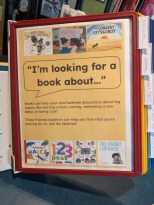
"I'm looking for a book about" page of the book listsWell, I may not theme my storytimes, but I’ve been keeping a google doc since about 2018 with lists of books by topic; between that and my notes-to-self in LibraryThing, I’m usually prepared with suggestions when these questions come up. This month, I’ve worked to create up-to-date lists for my library, with titles we own so that patrons can have a book in hand right away. I relied on my own lists, consulted some lists the previous librarian had created, and used some of the features in the library catalog to come up with suggestions for books about the first day of school, moving, new siblings, big feelings, and grief/loss, as well as alphabet and counting books and wordless picture books.

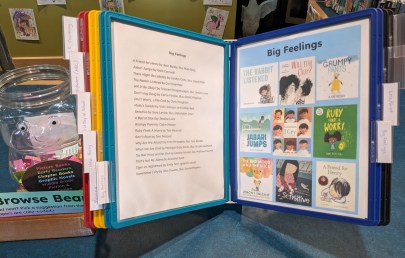
In my library travels, I’ve seen themed lists like these displayed in “flippy things” like this desktop reference system, which I was able to get for my library. The lists now live there, and I plan to keep them updated as relevant titles are published each year. If you’d like to see the lists, or adapt them for use in your own school or public library or classroom, the lists are available as a google doc and the visual lists (with book covers) are available as google slides. Feel free to make a copy and make them your own.

Book List open to "Big Feelings"

Next to the “flippy thing” in the photo above, you can kind of see the “Book Browse Bear,” another (more fun/random/spontaneous) readers’ advisory tool I made this month. But that will be another post!

To theme or not to theme?

Some storytime leaders are committed to themes; some aren’t. I fall into the latter camp, for some of the reasons articulated by Kary Henry on the ALSC blog, and Lindsey Krabbenhoft at Jbrary (“Storytime themes vs. storytime flow”). However, sometimes a theme emerges naturally, which happened this week.

Books on window ledge: Dancing Hands, Song in the City, I Can See Just Fine, and Mel Fell

There was an unusually small group at storytime this week, all regulars, so it was actually nice and cozy. As usual, we started with our “Hello, Friends” song with sign language, and it’s so cool to see the toddlers signing along. We read four books this week, with song cube songs and the Little Mouse flannel board activity in between:

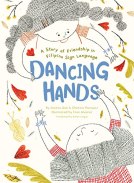
  • Dancing Hands: a story of friendship in Filipino sign language, by Joanna Que and Charina Marquez, illustrated by Fran Alvarez, translated by Karen Llagas (a Schneider Family Honor Book)
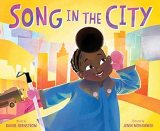
  • Song in the City by Daniel Bernstrom, illustrated by Jenin Mohammed
  • I Can See Just Fine by Eric Barclay
  • Mel Fell by Corey R. Tabor

Cover image of Dancing HandsAll of these books, in their own way, are about ability. Perception and communication also emerge as themes.
Dancing Hands worked well because it has minimal text, but shows readers how to make the signs the girls in the story are making (signs are also illustrated on the endpapers!). Dancing Hands feels a lot like My Best Friend by Julie Fogliano, illustrated by Jillian Tamaki, another favorite storytime book.

Cover image of Song in the CitySong in the City is a little bit longer, but the illustrations are super bright – featuring that warm yellow from the cover – the text rhymes, and there are a lot of sound effects. This was definitely the book that the adults in the room loved best. We all paused in the middle to close or cover our eyes, as Emmalene helps Grandma Jean do in the book, to focus on what we could hear.
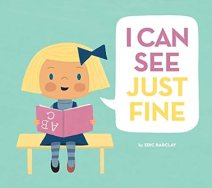
icanseeI would love I Can See Just Fine based on its title alone, but the execution is just perfect. A little girl named Paige has trouble seeing the board at school, reading her sheet music, and even identifying animals (she picks up a skunk and calls it a kitty). She is not excited to go to the eye doctor, or when they tell her she needs glasses, but when she stands in front of the huge array of frames to choose from on the wall, you can just feel her wonder and awe. She tries on lots of frames and chooses the right ones for her. I showed the group my own glasses, identifying the different parts (frames and lenses). I also shared with the group that the eye doctor is my favorite one to go to – they never give shots!
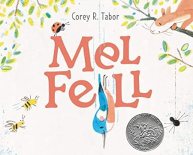
Cover image of Mel FellWe wrapped up with Mel Fell, which is about confidence and ability in a different way: a baby kingfisher’s first flight/dive. The orientation of this book is unique (in the photo above, the spine is actually on top), and there’s a fun rotation required part of the way through the story. We see community members – other residents of Mel’s tree – attempt to help, but ultimately, Mel was right about their readiness to fly!

After stories, songs, and Little Mouse, we sang and signed “Goodbye, Friends.” Our craft wasn’t connected to the books, though I did mention that peeling and placing stickers is good fine motor practice. And, as a kid, how often do you get to use as many stickers as you want? (I’m lucky in that my predecessor spent years hoarding stickers from various sources, so we have an entire box to choose from.)

Next week, we’ll be hosting a group from The Family Center, reading Hugs from Pearl by Paul Schmid, and making valentines.

Mock Newbery: Heavy Medal 2024

The Heavy Medal Award Committee (HMAC) is a Mock Newbery committee organized by Emily Mroczek-Bayci and Steven Engelfried (who have both served on the real Newbery committee previously) and including a mix of librarians (and, this year, one high school student) from all across the U.S.

Readers of the Heavy Medal blog nominate Newbery-eligible titles throughout the year, and eventually the nominees are winnowed down to a final fifteen(ish). Then the HMAC is assembled: every committee member reads all fifteen(ish) books, and each of us write an intro to one of the books on the blog, starting in late December and continuing into January. In the blog post, we consider the ways in which the book meets the Newbery criteria. After all the books are introduced and discussed in the comments, we vote on a final five books to discuss in a live webcast before the actual ALA Youth Media Awards (including the Newbery) are announced.

Cover images of HERCULES BEAL, LOST YEAR, FIRST TIME FOR EVERYTHING, MONA LISA VANISHES, THE SKULL

This year, the webcast was Friday, January 19 (you can view the recording here). The ALA YMA are next Monday, January 22, starting at 8 a.m. EST; you can watch the livestream here. (This is like the Oscars for kidlit.)

The real committees do a tremendous amount of reading and engage in carefully considered, thoughtful discussion, and there are always so many worthy books eligible for every award. Just because a book doesn’t wind up with a shiny medal or honor sticker after next week doesn’t mean it isn’t an excellent book. After all, “every book its reader, every reader their book.”

That said…I’m rooting hard for Simon Sort of Says by Erin Bow to win the Newbery this year. We’ll find out on Monday!