Keep ‘Em Coming – Fiction Series Creators Talk Shop

I may have left this one off the list originally because it wasn’t one I had planned to go to. However, it was a really interesting panel: authors Lauren Myracle, Jonathan Stroud, Dan Gutman, and author/editor David Levithan. Of these, I had only heard of David Levithan previously (he wrote The Lover’s Dictionary, which I thought was unique and poetic and just generally wonderful. Read it!) He has also, it turns out, written a whole bunch of young adult (YA) novels, and has edited over 300 YA series books, including many of the Babysitters’ Club books. (“I was the 19-year-old male reading The Babysitters’ Club on the subway…with a highlighter.”)
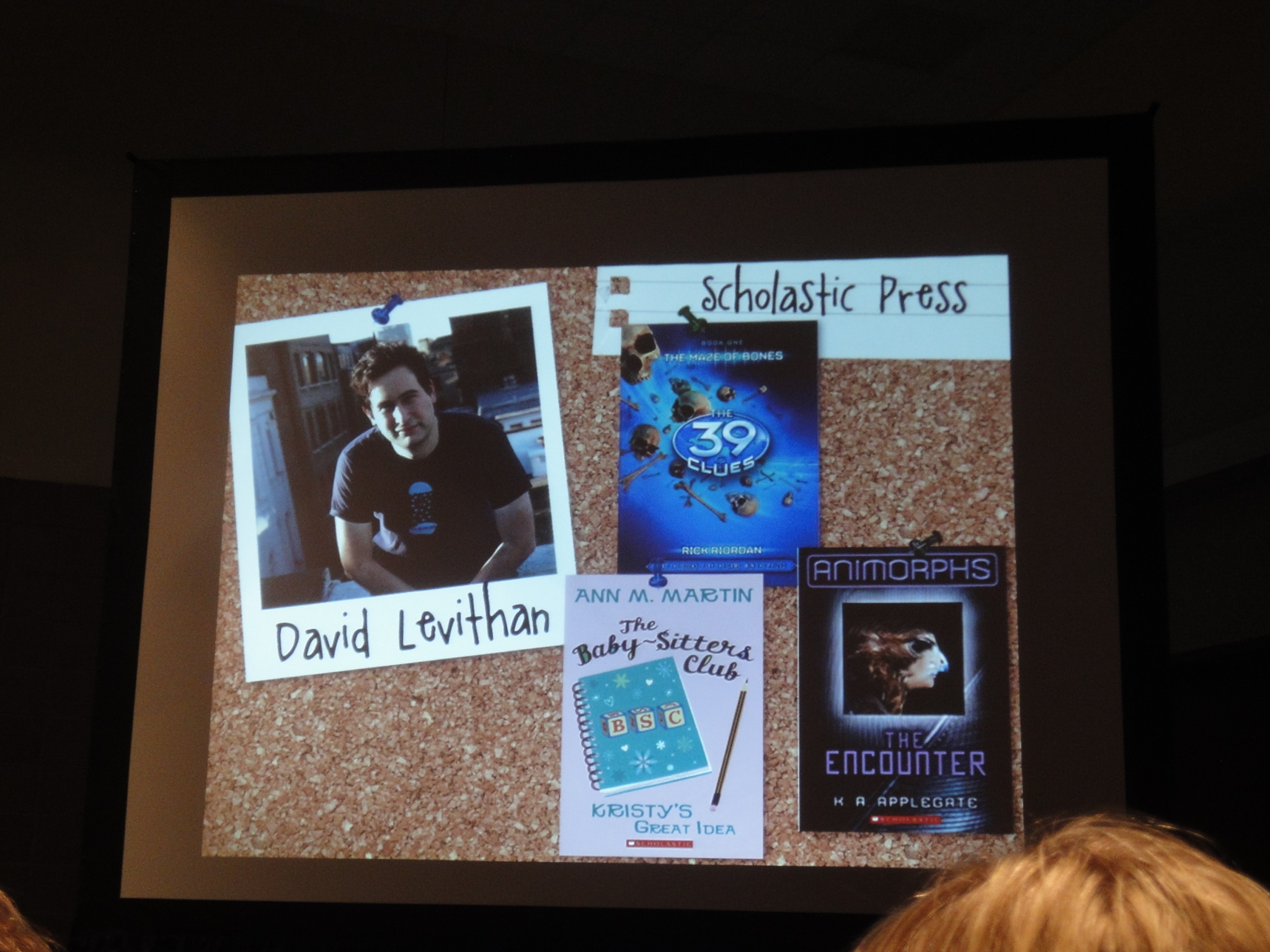
One explanation for the popularity of series books among teens, Levithan said, was “the love of story, the love of wanting to know what happens next, wanting the story to continue.” When kids – and adults, I would contest – find a book they like, they want more of it. However, speaking as an author rather than as an editor, Levithan said that sometimes, “There’s a reason I ended the book there – the story’s over.”

Other bits of wisdom from the panel:

Lauren Myracle: “Middle school is painful. Writing is painful. But writing about middle school…surprisingly cathartic!”

“Every book must be a game-changer.” I forget who said this – Stroud or Gutman, I think – but they were emphasizing the need for something to happen in each book in the series that caused the character to grow. The story may have its arc, but each book must have an arc of its own as well as be part of the larger story.

Jonathan Stroud talked about the importance of building a brand, which is easier with series books than with stand-alone novels.

Lauren Myracle: “Series are born in different ways.” Sometimes a story might be conceived as a series from the beginning; other times reader response might prompt a second book, and then a third.

Though there may not be the proliferation of series fiction for adults as there is for the YA group, adults are likely – speaking solely from experience here and not from any particular data – to develop loyalty to certain authors. The characters may not be the same from book to book, but one can have confidence in the quality of writing, character, and story.
Friends of the Library

Monday of this week was the annual meeting of the Friends of the Somerville Public Library. There was a guest speaker, Kenneth Gloss, the proprietor of the Brattle Book Shop in Boston. I have been there once – last summer a friend and I made a project of visiting all the used book shops we could find in Boston and Cambridge – and can vouch that it is an excellent place to poke around.

Gloss brought some “show and tell” objects: a 14th-century manuscript page (which has held up better than cheap novels printed much more recently); a cookbook from the 1790s that included a recipe for “how to cook eel, the common way”; and a facsimile of Poe’s Tamerlane. “Almost anything you can think of out there, people are interested,” he said.

For those who are interested in valuable/rare books, here are a few things to check for:

  • Is it a first edition?
  • Does it have an intact dust jacket (for hardcovers)?
  • Is it in good condition?
  • Is it signed by the author?
  • Is it an association copy? That is, has the author inscribed it to someone in particular?

And for those who are wondering about how to store old books properly, a good rule of thumb is “if you’re comfortable, the books are comfortable” – it shouldn’t be too hot or too cold, too dry or too humid. Keep the books out of direct sunlight, and don’t pack them too tightly on the shelf (or so loosely that they lean over).

For the book collectors out there, I also recommend Allison Hoover Bartlett’s excellent and enthralling The Man Who Loved Books Too Much: The True Story of a Thief, a Detective, and a World of Literary Obsession.

Speaking Volumes: Rare Books at the Isabella Stewart Gardner Museum

Earlier this week I went to an interesting talk at Simmons: Dr. Anne-Marie Eze, the Andrew W. Mellon Postdoctoral Curatorial Fellow at the Isabella Stewart Gardner Museum, spoke about Isabella Stewart Gardner as a rare book collector and about the upcoming exhibit “Illuminating the Serenissima: Books of the Republic of Venice” (May 3-June 19, 2011).

Though Isabella Stewart Gardner is most well known for collecting art, she began collecting books first; however, no one has looked at the rare book collection as a whole or considered Gardner as a collector/bibliophile till now. Dr. Eze is doing this, and cataloging the 5,000 books, which date from the 14th century through the 20th and include illuminated manuscripts, children’s books, incunabula, and inscribed “association” copies from authors with whom Gardner was friends – Henry James, for example.

In her talk, Eze noted – and seemed disappointed – that Gardner did not write in her books. Here seems to be the difference between a librarian/historian type and a rare book collector: the latter would want the book to be free of underlining and marginalia (unless it was the author’s or another famous person’s own notes, which could increase its value), but Eze would have been pleased to discover some, as a clue to Gardner’s life. I was reminded of a line of Rainer Maria Rilke’s from “Improvisations of the Caprisian Winter,” translated by Franz Wright:

So many things lie torn open
by rash hands that arrived too late,
in search of you: they wanted to know.

And sometimes in an old book
an incomprehensible passage is underlined.
You were there, once. What has become of you?

The Morgan Library

It is a tad bit embarrassing for me that I lived in New York for almost three years and never went to the Morgan Library. I remedied that this past weekend, and it was absolutely wonderful – I highly, highly recommend it to all book people.

It is a good size for a library-museum; you can see pretty much everything in under two hours without rushing. (Everything on display, anyway; there are treasure troves in underground vaults.) One room had a small Shakespeare exhibit, with early portraits of Shakespeare and a First Folio(!). The Diary exhibit upstairs was also wonderful; it featured quite a range of famous literary people, and showcased their tiny handwriting, inscrutable shorthand, and beautiful sketches.

Most of all, though, the library itself was stunning. On display was one of three(!) of the Gutenberg Bibles in the collection; music manuscripts from Mozart and other composers; beautiful illuminated manuscripts with jeweled covers; and early editions of every major work of fiction you could think of: Chaucer, Dickens, the Brontes, Shakespeare, Jonson. These were locked away, not on display, but the spines are visible behind glass.

As far as I know, Morgan did not spread the literary wealth the way that Carnegie did, but if you do have a chance to visit the Morgan Library, go!