Yet again, a minor sore throat/cold caused me to lose my voice, and it still wasn’t at full strength today – but I explained to the kids and they were SO QUIET. It was astonishing.
Our magical puppet/stuffed animal closet once again delivered, so we had Mr. Panda and the patient penguin from I’ll Wait, Mr. Panda. I also borrowed an idea from a parent/child yoga class I went to at another library recently, and we made stars with our bodies (feet apart, arms out to the sides) and rocked back and forth (balancing on one foot at a time, or just swaying) while singing “Twinkle, Twinkle, Little Star.”
Welcome, announcements
“Hello Friends” song with ASL, from Jbrary
Edward Gets Messy by Rita Meade: This story has a lot of words per page for this age group, but whether because of my quiet voice or the easily graspable subject matter, the kids sat and seemed to be listening!
Yoga
Worm Loves Worm by J.J. Austrian: A sweet story of two worms who just want to be married – and eventually they are, because Worm loves Worm.
Who in this room has thumbs? Okay, now hide your thumbs behind your back. “Where is Thumbkin?”
I’ll Wait, Mr Panda by Steve Antony, with panda stuffed animal and penguin puppet.
Yoga/song: Stand in “star” pose, balance/sway, and sing “Twinkle, Twinkle”
Kitten’s First Full Moon by Kevin Henkes
Carrot and Pea by Morag Hood
“Head, Shoulders, Knees, and Toes”
Perfect Square by Michael Hall (tie-in activity at the end)
“Goodbye Friends” song with ASL, from Jbrary
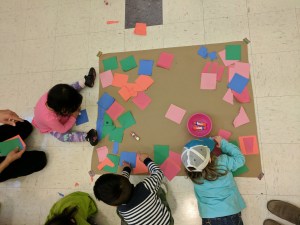
Clean up mats, put out project: Paper squares to tear, crumple, and glue
We still did six books as usual, but a little less singing (still, five songs/rhymes including our hello and goodbye), and wrapped up a little bit earlier than usual. The project was popular, though next time I’d cut the squares a little smaller; I had cut sheets of colored construction paper into six pieces each (not exactly squares, but close). With older kids, they could have worked on their own projects and used scissors and a hole punch to recreate some of the pictures in Perfect Square, if they’d wanted. Michael Hall’s books really lend themselves to craft tie-ins!
Today I covered our Friday session of Step Into Storytime, which skews a little younger (more twos than threes) and a little smaller.
Welcome and announcements (closed next Monday for Patriots Day)
“Hello friends” song with ASL
Name song (“____ is here today”)
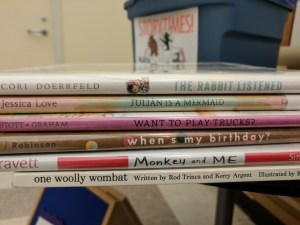
The Rabbit Listened by Cori Doerrfeld: Kind of a quieter lead-off book that I might not have chosen if I’d known the book beforehand, but it worked okay.
“Kookaburra”: I thought I’d introduce a new (old, actually, 1932) song. I printed out the lyrics and put them up, along with a picture of a kookaburra (we didn’t have a kookaburra puppet, believe it or not), and also made small copies for the grown-ups.
Julian Is A Mermaid by Jessica Love
Yoga flow – and we sang “Head Shoulders Knees and Toes” while we were doing it, because I saw a kid put her hands on her head.
Want to Play Trucks? by Ann Stott: This simple little story shows kids playing together, solving problems, and ultimately agreeing about the main thing in life: WE LIKE ICE CREAM!
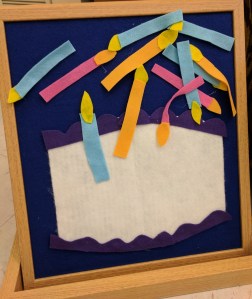
“Happy birthday” song and putting candles on flannel board cake. It didn’t look at all like I envisioned and that was perfect.
When’s My Birthday? by Julie Fogliano: This might not be a book you want to read over and over to your own kid, but it’s perfect for a group – you can put a ton of expression into it.
Yoga flow – using both sides of the body and the brain.
Monkey and Me by Emily Gravett: Probably one of my top five storytime books for this age group. It’s got a sing-song repetition AND animals. What more could you want?
“Kookaburra”: We sang it again (repetition helps learning), and I dropped in an early literacy tip (“If you’re wondering why we do so much singing in storytime, it’s because singing breaks words down into parts and introduces new words, all of which helps literacy development”). Plus I just love this song.
One Woolly Wombat by Rod Trinca and Kerry Argent: A counting, rhyming book full of Australian animals.
It’s a rainy day, so I looked for Christian Robinson’s book Rain, but it was out. I went with my original lineup, including some books about bugs and eggs hatching. Maybe because of the weather, we had a slightly smaller group today, about 12-13 kids.
Welcome, announcements (no storytime next Monday because of Patriots’ Day)
“Hello Friends” song with ASL from Jbrary
Name song (“____ is here today”)
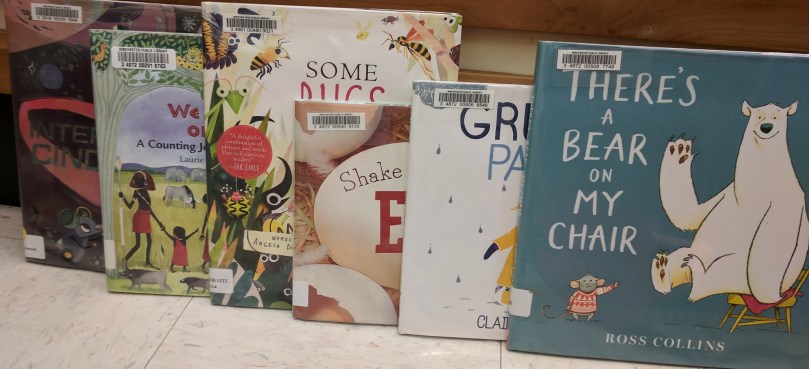
Interstellar Cinderella by Deborah Underwood, illustrated by Meg Hunt: This might’ve been too much of a reach for this group. The story is in rhyme, but it’s a little on the long side, or maybe there just isn’t the familiarity with the classic Cinderella tale yet, so it’s harder to enjoy variations. Some of the grown-ups liked it, though.
Song cube: “Where Is Thumbkin?” “ABCs”
We All Went On Safari by Laurie Krebs and Julia Cairns: Today we focused on the counting aspect of this book, but you could easily focus on animals instead.
Yoga flow
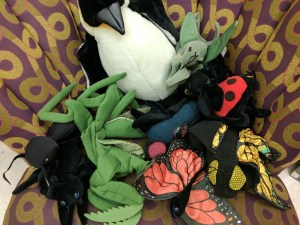
Bug puppets! We had a big basket of them in the closet, so I pulled them out and we looked at them one by one. One of them was even a caterpillar/butterfly, so the kids could see the transformation. We also had a ladybug, an ant, a spider, a fly, a monarch butterfly, a praying mantis, and a grasshopper. This was a perfect lead-in to…
Some Bugs: words by Angela DiTerlizzi, bugs by Brendan Wenzel. I love this book for storytime or one-on-one: it rhymes and moves quickly, and the illustrations are bright and interesting.
Song cube: “Itsy-Bitsy Spider,” “Row Row Row Your Boat”
Shake A Leg, Egg by Kurt Cyrus: One of my favorite springtime books, though maybe better one-on-one than in a group; the author/illustrator uses some really different perspectives, and there’s plenty of detail in the realistic illustrations. But I do love saying the first line (“Hello in there!”) like Miracle Max in The Princess Bride.
Speaking of eggs…time for shaker eggs and “Shake Your Sillies Out”!
Grumpy Pants by Claire Messer, with penguin puppet. Most of the kids came up to pet and hug the penguin, which helped its grumpy mood. There’s also counting (“One, two, three…SPLASH!”).
Yoga flow
There’s A Bear On My Chair by Ross Collins: Kids’ attention was starting to wander a little but the ending got a laugh from a couple grown-ups.
Drawing with crayons on butcher paper on the floor
Next Monday we’re closed for Patriots’ Day, but I’m covering another Step Into Storytime this Friday and might debut a flannel cake and candles I just made to go with When’s My Birthday? Stay tuned!
I made this handout to give to caregivers who attend my storytime at the library, and thought I would share it here as well. This is by no means an exhaustive list – it’s more like the tip of the iceberg. Enjoy! (And please add your favorites in the comments.)
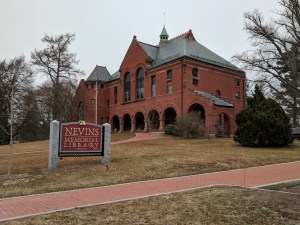
Last Friday, I went with our teen librarian to a one-day conference put on by the New England Round Table of Teen and Children’s Librarians (NERTCL) at the beautiful Nevins Memorial Library in Methuen, MA. The conference was called “Transform Our Communities, Transform Our World,” and featured Rita Meade (@ScrewyDecimal), a panel about drag storytime, Luke Kirkland from the Waltham Public Library talking about “Selling Social Justice Programs to Your Teens and Your Community,” and another panel about spaces and programs for the library’s youngest patrons (birth-5 years), as well as round table discussions before and during lunch. It was a fantastic day!
Rita Meade: “Keep Calm and Transform the World”
Rita began her presentation by acknowledging that the “do more with less” message that library staff so often hear is frustrating and unhelpful. (Actually, she began by mentioning her anxiety, and the fact that she almost turned down the offer to come speak to us. I’m glad she didn’t!) Then she gave her background and the path she took to working in a library: working as a page, then later getting a teaching degree, and only later turning to library science. She reviewed for SLJ and wrote for Book Riot, and also started a blog: “It’s frustrating and it’s tiring to always have to defend your job….Basically I kept running into people who didn’t understand what librarians did. ‘Oh, libraries are still a thing?’ So that’s where the blog came from.”
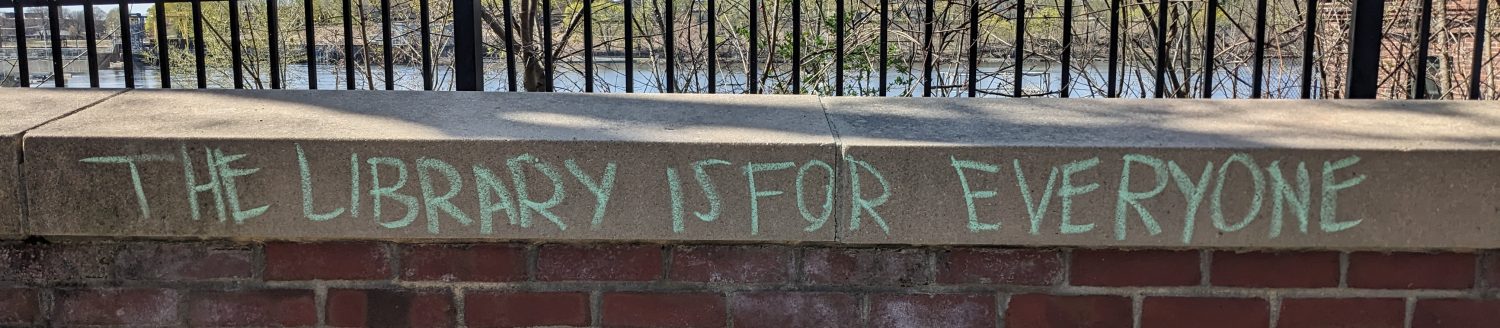
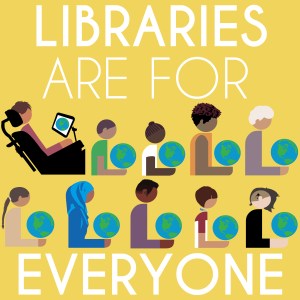
Now, she works at the Bay Ridge branch of the Brooklyn Public Library, where she believes that “Our job is to respond to community needs. It’s a balancing act….We fill a lot of gaps in society – We are being asked to fill a lot of these societal gaps, but we don’t always have the resources to do so….You can’t make everyone happy but our job is to try.” Because LIBRARIES ARE FOR EVERYONE, Rita is always working to counteract her own assumptions and biases, work against intolerance and ignorance, promote diversity in staffing and collections, and promote underrepresented voices. “Make inclusion the default. Err on the side of inclusion. Think about how your choices might affect the people in your space. More often than not, people are not telling us something.” She gave examples of ways that libraries can be political without being partisan: a march against hate, or a display about migration, illustrated with butterflies (“Migration is brave / essential / gorgeous”).
To our group, Rita emphasized that big changes don’t happen without risks, and normalizing helps promote acceptance. “One program at a time, one small thing at a time. These small steps lead to big changes.” (Here’s a small example that everyone can do: make your descriptions more inclusive: instead of “men and women” or “boys and girls,” say “people/everyone/friends.”) Programs she mentioned included drag queen storytime (about which more below), Genderful, and TeleStory. “We are in a unique position to be a positive influence.”
Nevins Memorial Library
Drag Storytime Panel and Presentation
We heard from four people about their different experiences hosting drag storytimes: Megan McLelland from Sturgis, MA; Jennifer Billingsley from Middletown, CT; Hillary Saxon from Cambridge, MA; and Alli T. Ultimately, my favorite quote from the session was this one from Alli T.: “People in fun costumes reading beautiful stories to children is not a new concept.”
“People in fun costumes reading beautiful stories to children is not a new concept.” -Alli Thresher
Each librarian who decided to host drag storytime at their library approached it carefully and thoughtfully. All were aware of the possibility of pushback from the community, and the importance of administrative support, but all felt it was worth it: “Reading to kids isn’t really what it’s about, inclusion and making everyone comfortable is what it’s about.” Overwhelmingly, the drag storytimes were well-attended, joyful events.
Here are some of the book titles mentioned:
The Book With No Pictures by B.J. Novak
10,000 Dresses by Marcus Ewert, illustrated by Rex Ray
Worm Loves Worm by J.J. Austrian, illustrated by Mike Curato
Some Monsters Are Different by David Milgrim
Julián is a Mermaid by Jessica Love
My Princess Boy by Cheryl Kilodavis, illustrated by Suzanne DiSimone
Luke Kirkland: “Selling Social Justice Programs to Your Teens and Your Community”
Luke is the teen librarian at the Waltham Public Library, and his presentation was about how to foster social justice in the teen population. Waltham is far more diverse than many other towns and cities in New England, so one of the questions that came up during the Q&A is how to start these conversations about social justice and racism that white kids might not already be having; how do you get them to ask the questions? Luke pointed back to the “Fandom Trojan Horse,” approaching a subject or topic they’re already interested from a social justice angle, as well as the documentary Accidental Courtesy, a TED talk by a former white supremacist, and even the picture book Don’t Touch My Hair by Sharee Miller.
One interesting project Luke presented was a presentation on “The Birth of Hip-Hop.” Nestled inside this attractive topic was a history of Jim Crow, fair housing protests, and redlining; see the Mapping Inequality project for more info.
As librarians, “We do research, we build community, we encourage civic dialogue.” Frame activism as a project-based learning activity. In Waltham, the library partnered with several other organizations (“lots of community collaboration takes some of the pressure off”) in the For Freedoms project, covering the front lawn of the library with yard signs. (Luke is planning to do this again, and noted that, while yard signs are expensive, the price drops when you order in bulk. Contact him if you want in!)
Additional takeaways: Libraries are not neutral; privilege has a way of reinforcing privilege; human rights are not partisan.
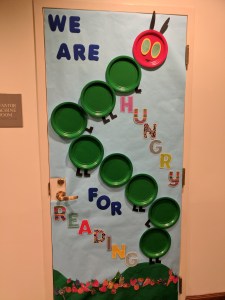
A display outside the Nevins library children’s room
Early Learning Spaces and Play
The last panel of the day featured librarians from four different libraries. Rachel Davis from the Thomas Memorial Library in Cape Elizabeth, ME, and Kayla Morin from the Goodwin Library in Farmington, NH, both spoke about becoming Family Place Libraries. Core components of Family Place libraries include: having your parenting collection near/next to/with the children’s materials; parent/child workshop series; specially designed spaces to play, learn, grow, and explore; and programs for babies and toddlers (focusing on the birth-3 years age group). In order to become a Family Place library, one youth services librarian and one administrator from the library must attend a four-day institute, complete an online training, and commit to the core components. Kayla said that becoming a Family Place library involved “retraining staff and patrons to think of the library as a welcoming space for everyone, including small kids.” Rachel said that once parents had time to socialize outside of storytime, they became more engaged during storytime (rather than talking to each other).
Seana Rabbito from the Waltham Public Library talked about turning an unused room into a PIE room (Play, Imagine, Explore) with a “Mind in the Making” grant. (Side note: What libraries have these unused rooms lying around??) The PIE room encourages play, nurtures curiosity, and fosters a lifelong love of learning. Theme-related learning activities hold attention and spark curiosity. It supports early literacy through play; book displays accompany each theme. Each different playspace helps build vocabulary, increase subject knowledge, hone communication skills, develop problem-solving skills, and improve gross and fine motor skills. Seana said the rotating display/theme does take a lot of work, but it’s hugely popular and has revitalized the space.
Finally, Katrina Ireland from the Northborough Free Library, MA, spoke about Mother Goose on the Loose (MGOL). Developed by Dr. Betsy Diamant-Cohen, the program is intended for kids birth-3 years and their caregivers. Katrina offers a series of 10 sessions of the 30-minute program, which includes opening rhymes, a drum sequence, Humpty Dumpty, and two developmental tips for adults; 80% of the content changes week to week (some repetition is key). MGOL embodies all five practices from Every Child Ready to Read (ECRR): singing, talking, reading, writing, playing.
Overall, it was a day full of fantastic ideas from presenters and attendees (particularly the table of Rhode Island librarians I was sitting with, most of whom I’d seen present at NELA last fall!). And the nice thing about the library world is that, while we care deeply about citing our sources, we’re always happy to share ideas – or as Rita said, “Steal the ideas, steal them all day.”
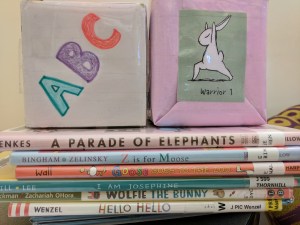
Happy April! Today was a super fun storytime. We had a great group of about 14 kids and their grown-ups, and I was excited for our activity/craft to go with A Parade of Elephants. Initially I was planning to read The Rabbit Listened, but ended up swapping it out for Z Is for Moose.
Welcome and announcements
“Hello friends” song with ASL from Jbrary
Hello Hello by Brendan Wenzel: I’m tempted to lead off with this book every time. It always elicits engagement from the kids and provides so many opportunities for moving and thinking.
Wolfie the Bunny by Amy Dyckman and Zachariah Ohora: This was a little long, but funny, and it doesn’t go where you think it’s going to go. The kids stuck with it (one of them took one look at the cover and observed, “That doesn’t look like a bunny!” Correct, kiddo.)
Yoga flow: mountain pose and forward fold, feet apart and gentle twist
I Am Josephine by Jan Thornhill and Jacqui Lee: In general I like to stick to books that have some kind of story (and forward momentum), but this one has questions and animals, which worked out pretty well. It’s also a good one-on-one book to discuss the different categories: living thing, animal, mammal, human being.
Song cube: “Itsy-bitsy Spider” and “Head, Shoulders, Knees, and Toes”
Goose Goes to the Zoo by Laura Wall: The last goose book until she writes a new one. The best part of this one was the page with all the honking: one kid yelled “It’s a car horn!” (It’s not. It’s geese.)
Yoga flow: tree/flamingo pose (there were flamingos in Goose Goes to the Zoo), Warrior 1 and 2
“ABC” song to get ready for…
Z Is for Moose by Kelly Bingham and Paul O. Zelinsky: If you’ve never read this aloud before, give it a few run-throughs first, to decide how you’re going to do the interruptions by Moose and Zebra. So funny, and a sweet ending.
Song cube: “I Had A Little Turtle”
Clean up mats
A Parade of Elephants by Kevin Henkes: We cleaned up the mats first because I wanted clear space for marching and parading. I also turned the flannel board around so everyone could see the flannel elephants, and lots of kids came up to touch them, take them off, and put them back on. Then we read the book and marched!
“Goodbye friends” song with ASL from Jbrary
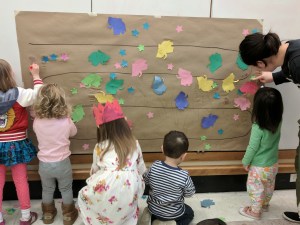
Craft: using glue sticks to glue paper elephants and stars to butcher paper on the wall. I drew a path for them to use if they wanted but we ended up with beautiful chaos, of course. The kids spent a long time doing this – gluing is always a fun activity.
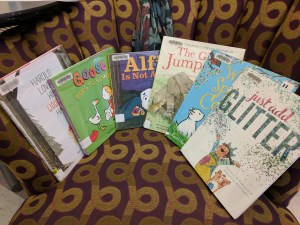
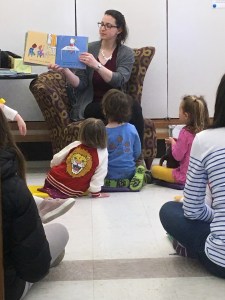
It was a beautiful day and a BIG group in our little storytime room today – about 18 kids plus a baby or two and accompanying grownups. It was a correspondingly loud storytime, so when possible, I used techniques to harness and direct the noise: CAW-ing like a crow in Harold and His Woolly Hat, HONK-ing with Goose Goes to School, lots of songs from the song cube.
Welcome and announcements
“Hello Friends” song with ASL from Jbrary
Harold Loves His Woolly Hat by Vern Kousky: I got a little brown bear out of our stuffed animal/puppet closet and let the kids pet it after the story. Hat tip to Lauren at the Robbins Library for reading Harold at her storytime a few months ago.
Yoga: forward fold to touch toes, stretch to touch ceiling
Goose Goes to School by Laura Wall: Again, Goose was a hit. I don’t know if it’s the bright colors or the text-to-illustration ratio or what, but it’s magic.
Song cube: Itsy-bitsy Spider, I Had A Little Turtle
Alfie Is Not Afraid by Patricia Carlin: Nearly all of the humor in this book comes from the juxtaposition between the pictures and the text, so I mentioned that upfront as something to look out for.
Yoga: Seated forward fold, stretch toward the ceiling, stretch to either side
When Spring Comes by Kevin Henkes: An informal poll shows that EVERYONE likes jumping in puddles.
“Shake Your Sillies Out” with shaker eggs (and scarves, because I ran out of eggs)
The Giant Jumperee by Julia Donaldson
Song cube: Zoom Zoom Zoom, We’re Going to the Moon; I’m A Little Teapot; Where Is Thumbkin?
Just Add Glitter by Angela DiTerlizzi and Samantha Cotterill: This has textured pages, which I let the kids feel after the story.
“Goodbye Friends” song with ASL from Jbrary
Clean up mats, get coloring sheets (I drew two different types of hat and made copies), color with crayons, come choose a colored pom pom and get a dot of glue.
I’ve missed two weeks of storytime – there was a snow day on March 4 and last week I was on vacation – and it felt like ages! It was good to be back today and see some familiar faces and some new ones. Today’s books were mostly on the shorter, simpler side, so we managed seven(!), as well as lots of songs and yoga.
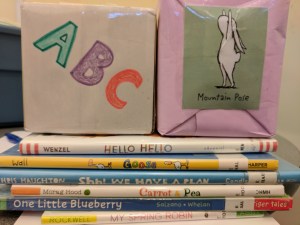
Hello Hello by Brendan Wenzel: Still one of the best lead-off books I know of – so many opportunities for getting kids engaged (“Who’s wearing stripes? Who’s wearing spots? Can you wiggle like an octopus?”)
Yoga flow: resting pose, mountain pose, forward fold, tree
Goose by Laura Wall: This went over splendidly. It has the perfect amount of text on each page for this group, and the simple illustrations on brightly-colored backgrounds work really well for a group.
Song cube: “If you’re happy and you know it,” “I had a little turtle”
Shh! We Have A Plan by Chris Haughton: I’ve done Oh No, George! several times in storytime but this was the first time I did Shh! and it was excellent! There is “shh”ing of course, which keeps things quiet, but also counting, and also pointing (“Where’s the bird? Did they catch it?”), and it’s funny.
Yoga flow
Carrot and Pea by Morag Hood
One Little Blueberry by Tammi Salzano, illustrated by Kat Whelan
Song cube: “Itsy-bitsy Spider,” “I’m a little teapot,” “Zoom zoom zoom, we’re going to the moon”
Oh No, George! by Chris Haughton: We were running ahead of schedule and I had a little extra time, so I used this one from my pile of backup books. Always a favorite. What WILL George do?
My Spring Robin by Anne and Lizzy Rockwell
“Goodbye friends” song with ASL from Jbrary
Clean up mats
Coloring sheet: I traced the robin from the last page of My Spring Robin, enlarged it by 20%, and made copies for kids to color with crayons. (One kid didn’t want the robin so I gave him a leftover Wonky Donkey. Leftovers never go to waste!)
It really was good to be back. And here’s one more new resource I heard about through one of my book groups: Diverse BookFinder. If you’re looking for picture books featuring people of color or indigenous people of color, this is a tremendous resource, including books from 2002 to the present. The design is clean and clear and easy to navigate, and I’m looking forward to discovering new picture books using the Diverse BookFinder.
As I think I’ve said before, I have rediscovered middle grade novels over the past year and have a new appreciation for them. Lately, I’ve read many graphic novels for this age group, and they are excellent – plus, some readers will pick up a graphic novel more eagerly than a traditional one. (Graphic novels: the gateway drug of reading.)
Raina Telgemeier, Svetlana Chmakova, Victoria Jamieson, and Shannon Hale depict the real struggles of sixth-, seventh-, and eighth-graders – the interpersonal conflicts and developments with friends, parents, siblings, and teachers. They address bullying and kindness; they know that middle school is a time when people are figuring out who they want to be, when what most of them want desperately is to fit in – and often, they act in ways they aren’t comfortable with in order to achieve that goal. (Hale’s Real Friends is autobiographical, as are Telgemeier’s Sisters and Smile).
New Kid by Jerry Craft covers that territory as well, but adds complexity by addressing race; Jordan Banks is one of the few Black kids at his New York private school, and while for the most part he doesn’t face overt racism, the microaggressions pile up, and it takes him some time to make friends he can talk to.
“So far, being a teenager is no fun at all.” -Smile, Raina Telgemeier
“I wasn’t sure leaving the group was the right choice. At least I’d had friends. Now sometimes I was so sad I could barely breathe.” -Shannon Hale, Real Friends
“I just…I feel like I don’t know who you are anymore.” “Well…maybe I don’t know who I am either!” -Roller Girl, Victoria Jamieson
“Kindness is the truest form of bravery.” -All’s Faire in Middle School, Victoria Jamieson
“Life is more complicated than sports. It’ll throw a lot of curveballs at you. You win some games and lose others…but in the end, it’s who’s on your team that really matters.” -Crush (Berrybrook Middle School), Svetlana Chmakova
“Oh, I see…it’s okay that this stuff happens to us…It’s just not okay for us to complain about it.” -New Kid, Jerry Craft
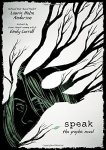
The past few months have also brought us graphic novel adaptations of Laurie Halse Anderson’s Speak and Lois Lowry’s The Giver. The former is YA rather than middle grade, and the art is quite different from the books above; Emily Carroll did an absolutely haunting job translating Speak into a new format. Melissa’s silence, the claustrophobic atmosphere of menace, and the slow healing and emerging that takes place are rendered in a way that honors and enhances the original.
“If you’re tough enough to survive this, they’ll let you become an adult.
I hope it’s worth it.” -Speak, Laurie Halse Anderson
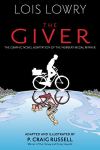
The Giver is often read in late grade school, though it’s one of those books that is thought-provoking no matter when in life you encounter it. Unlike the rest of the books here, it is set in a different reality than our own, a futuristic place of Sameness. P. Craig Russell produced the graphic novel version; cool blues and grays prevail, until Jonas’ moments of “seeing beyond” introduce flashes of color, and The Giver’s memories do the same. The Giver himself looks less Kindly and more ominous than I had pictured him, and the whole community has a 1950s vibe (on purpose). It’s very hard to improve on the original, and as one of the first utopia/dystopia novels that young readers encounter, it’s not in danger of falling by the wayside, but if this version of The Giver finds a new audience, all the better.
“We gained control of many things, but we had to let go of others.” The Giver, Lois Lowry
It was a full house this morning, with 16+ kids and their grown-ups, and a slightly wider age spread than usual – plenty of younger kids, but also some at the top of our 2-3 age range. It’s always helpful to have some older kids there, as they usually pay close attention to the pictures and are not shy about participating, which moves things along; during Do You Know Which Ones Will Grow? I had a chorus of two boys shouting “no!” after each thing that didn’t grow. Fun!
Welcome and announcements
“Hello Friends” song with ASL, from Jbrary
Huff and Puff by Claudia Rueda, with scarves for huffing and puffing
Yoga flow: Stretching tall with hands in the air, forward fold to touch toes, stretch tall again
Winter Is Here by Kevin Henkes and Laura Dronzek: Luckily(?) we had a spurt of windy snow earlier this morning.
Song cube: “If you’re happy and you know it, clap your hands”
Solutions for Cold Feet by Carey Sookocheff: I’ve been wanting to read this Canadian author/illustrator’s book at storytime for several weeks, and it finally seemed like the right time.
Here I switched up my original plan to read Goose by Laura Wall and read Chu’s Day by Neil Gaiman and Adam Rex, because a book with a huge sneeze in it is always, always a winner. Next week, Goose!
Yoga flow: more mountain pose and touching toes, as well as chair pose and tree pose
I’m My Own Dog by David Ezra Stein: This is one of those flip-the-script books and it’s got that humor going for it, but I’m not sure kids this age (or anyone, anymore) are familiar with dog behavior stereotypes that seem 1950s-ish (fetching slippers, etc.) Still, it’s a book about a dog, and it’s a just-right length for storytime.
Song cube: “Itsy Bitsy Spider” and “I Had A Little Turtle”
Do You Know Which Ones Will Grow? by Susan Shea: This seems like the perfect storytime book – stark, bright illustrations, fold-out flaps, rhyme – but the last time I read it there seemed to be no reaction whatsoever. This time it went great!
“Shake Your Sillies Out” with music and shaker eggs
“Goodbye Friends” song with ASL, from Jbrary
Stack mats, more music, bring out giant blocks, fin.




 Rita Meade: “Keep Calm and Transform the World”
 Now, she works at the


 The past few months have also brought us graphic novel adaptations of Laurie Halse Anderson’s Speak and Lois Lowry’s The Giver. The former is YA rather than middle grade, and the art is quite different from the books above; Emily Carroll did an absolutely haunting job translating Speak into a new format. Melissa’s silence, the claustrophobic atmosphere of menace, and the slow healing and emerging that takes place are rendered in a way that honors and enhances the original.
 The Giver is often read in late grade school, though it’s one of those books that is thought-provoking no matter when in life you encounter it. Unlike the rest of the books here, it is set in a different reality than our own, a futuristic place of Sameness. P. Craig Russell produced the graphic novel version; cool blues and grays prevail, until Jonas’ moments of “seeing beyond” introduce flashes of color, and The Giver’s memories do the same. The Giver himself looks less Kindly and more ominous than I had pictured him, and the whole community has a 1950s vibe (on purpose). It’s very hard to improve on the original, and as one of the first utopia/dystopia novels that young readers encounter, it’s not in danger of falling by the wayside, but if this version of The Giver finds a new audience, all the better.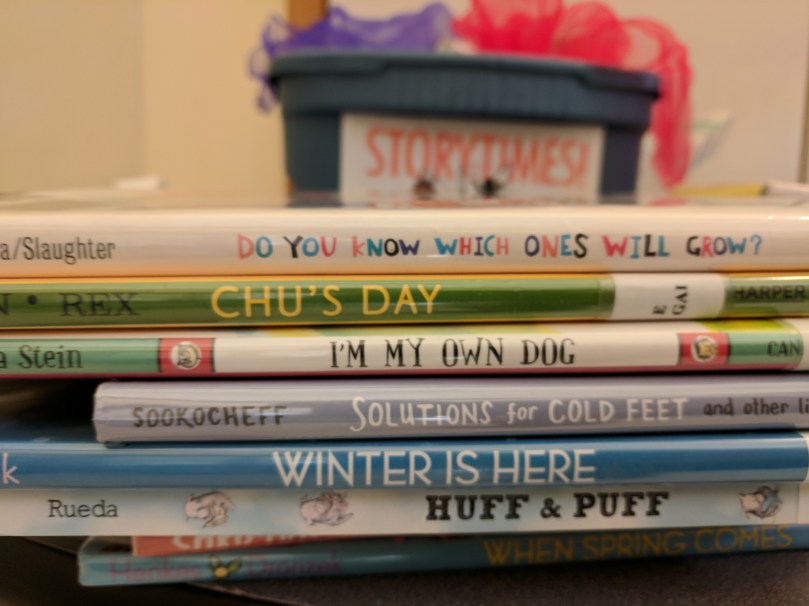
 Jenny Arch