Build it, and they will come.

In sixth or seventh grade, I was asked to write an essay in response to the question, “Who is your hero?” I didn’t have a good answer, though I know I wrote something. If you asked me that question now, however, I’d have a pretty good answer ready: author and independent bookseller Ann Patchett.

For those who haven’t followed the birth of Parnassus Books, the store Patchett co-founded in her hometown of Nashville, TN, when its last remaining bookstore closed, you can catch up with this article from The Atlantic, “The Bookstore Strikes Back.”

Here are a few excerpts:

On entering the book retail business: “[I]f I wanted to re-create the bookish happiness of my childhood, then maybe was the person for the job. Or maybe not. I wanted to go into retail about as much as I wanted to go into the Army.”

On other booksellers: “Booksellers do not guard their best secrets: they are a generous tribe, and were quick to welcome me into their fold and give me advice.”

On what local brick-and-mortar stores do that Amazon can’t: “All things happen in a cycle…the little bookstore had succeeded and grown into a bigger bookstore. Seeing the potential for profit, the superstore chains rose up and crushed the independents, then Amazon rose up and crushed the superstore chains. Now that we could order any book at any hour without having to leave the screen in front of us, we realized what we had lost: the community center, the human interaction, the recommendation of a smart reader rather than a computer algorithm telling us what other shoppers had purchased.”

On what you, the reader, can do: “Amazon doesn’t get to make all the decisions; the people can make them, by choosing how and where they spend their money. If what a bookstore offers matters to you, then shop at a bookstore. If you feel that the experience of reading a book is valuable, then read a book. This is how we change the world: We grab hold of it. We change ourselves.”

If I ever visit Nashville, it will be to go to Parnassus. However, I’ve been lucky enough to hear Ann Patchett give a reading (of State of Wonder) at a great independent bookstore between Cambridge and Somerville, Porter Square Books. It has beautiful displays, friendly staff, and great author events, so I visit regularly, though I don’t buy books that often (hey, I work in a library). However, if you received books as a gift from me this holiday season, they came from Porter Square Books. Is it more expensive than Amazon? Most of the time. Is it worth it? Yes.

Goodreads shelves

[Note: if you don’t use Goodreads, and never plan to, there is zero need to read this post. Scroll down to read about Banned Books Week, The Perks of Being A Wallflower, and other things instead.]

I’ve been using Goodreads, a social networking site for readers, since 2007. I started using it as a way to keep track of books I’d read, as well as to keep an actual (as opposed to mental) “to-read” list. I’m still using it that way, and now I have a personal database with five years of data that I can consult anytime someone needs a recommendation.

Not only can I sort books by self-created categories (“shelves”), such as young adult, mystery, history, or science, I can also look back on my own ratings and reviews, and see friends’ reviews as well. Friends’ reviews count for a lot: research has shown that a recommendation from a friend is likely to be more influential than a professional review, a bookstore or library display, or an auto-generated Amazon suggestion.

Overall, Goodreads’ usability and user experience (how easy and how pleasant it is to use the site) are pretty top-notch. The only problems I’ve ever had are (1) when the site is getting too much traffic and I’m not able to access it for a few minutes; this message is accompanied by an elegant line drawing of a woman sitting in a chair reading a book, and (2) creating a fourth permanent shelf for “partially-read” books, in addition to the three automatic shelves: read, currently-reading, and to-read.

This is such a small thing, but I’ve had conversations with other Goodreads users, and it’s come up for most of us. Though a book can be on as many of your self-created shelves as you want, it must also be on one – and only one – of the three original shelves. But what if a book is neither read, currently-reading, or to-read? What if you read the first few chapters and put it down, never to return? (There’s no guilt in that.) Many people have created shelves for these books, such as “partially-read,” “abandoned,” or “unfinished,” but the book still had to be on one of the original three.

This is no longer the case, I’m glad to report. I wrote to Goodreads about it, and a Customer Care Representative got back to me overnight to inform me that I could make my partially-read shelf “exclusive” by going to the Edit Shelves page and checking a box. Which I did. And it worked. I’m not sure how long that’s been an option – it wasn’t in 2007, I don’t think, but I could be wrong – but it is now.

So, big points to Goodreads for creating a great site and being responsive to its users. This is how it’s done.

The science of working together

At the launch event for Interop: The Promise and Perils of Highly Interconnected Systems, the authors John Palfrey and Urs Gasser gave an overview of interop and provided several relevant examples. Though they began years ago on a theoretical level (does increased interop lead to increased innovation?), interop is a deeply practical topic.

“Interop” here is short for interoperability, defined as “the ability to transfer or render useful data and other information across systems (including organizations), applications, or components.” The authors decided that this initial definition, however, could be broadened into “the science of working together” on many layers: institutional, human, data, and technological.

Though it may sound abstract, there are many good examples of how interoperability is important in daily life. Solutions to big societal problems depend on interop, said Palfrey and Gasser. They talked first about “smart cities,” which depend on sharing information: between police, firefighters, and ambulances, for example, and between various forms of transit (does your bus pass also work for the subway and the commuter rail systems?).

Next they talked about open platforms, such as Facebook, which made its API available so that anyone could build an app. However, this interconnectedness has a down side: many points of connection means more vulnerability to privacy and security breaches. (This is also true of credit cards – another example of interop – which are vulnerable to identity theft.)

Facebook is an example from the private sector, but the public sector can drive interop as well, by regulation and legislation, as Europe has done for standardized cell phone chargers.

Naturally, one of the areas in which I am most interested is that of libraries. Libraries, said Palfrey, are facing two large interop problems: preservation of knowledge over time, and the lack of an open standard for e-lending.

The first issue has to do with reformatting; over the past decade or two, data has been stored not just in print, but in a whole variety of other ways, including floppy disks, microfilm, microfiche, CDs, and on computers in a variety of formats, some of which are no longer readable because the software necessary is no longer in use. Libraries must be vigilant to make sure that the information they have is preserved in an accessible form.

The second problem is one that has been in the news more or less constantly for a few years: there is no open standard for e-lending. Instead, there are a lot of proprietary formats that are not interoperable at all (e.g. you can’t read a kindle book on a nook device). “This is crazy,” Palfrey said. “Why is this [print book] still better technology?”

I hope and trust that, in the next few years, an open standard for e-lending will develop. In an ideal world, both libraries and individuals would be able to buy and lend any e-book, which could be read on any device.

Fingers crossed.

Inventing the Future

Following links from this week’s issue of American Libraries Direct, I found two excellent, thoughtful articles about the current (and probably future) state of the publishing business, including background on Amazon and the ongoing Department of Justice case against Apple and the major publishers. The articles are so well-written and clear that I don’t have much to add, but I highly recommend reading them if you’re at all interested in ebooks – as a consumer, author, publisher, or librarian.

The first piece, “Why everyone is probably wrong about the DoJ ebooks case” by librarian Hugh Rundle, outlines both sides of the conversation taking place about ebooks: the confusion over what the DoJ case is actually about (investigating collusion to keep consumer prices high), and the short- and long-term implications of Amazon’s pricing (and effective monopoly) of ebooks. Rundle argues that the major publishers handed Amazon its current de facto monopoly on ebooks by insisting on DRM (Digital Rights Management). He concludes that “the future of books is not the present of books,” and that “the best way to predict the future is to invent it.”

Rundle linked to Charlie Stross’s piece, “What Amazon’s ebook strategy means.” Here is a fantastic article that includes Amazon’s history from its founding in 1994, as well as some important definitions (disintermediation, monopoly, and monopsony). Stross, too, argues that DRM is dead, or should be: “By foolishly insisting on DRM, and then selling to Amazon on a wholesale basis, the publishers handed Amazon a monopoly on their customers—and thereby empowered a predatory monopsony.”

Rundle also linked to a post on David Pakman’s blog, “Why should ebooks cost $15?” In this piece, Pakman writes, “Absent from most of this [ebook] coverage are two main questions: a) what is the right price for eBooks and who gets to set it, and b) why are eBooks not interoperable on different devices?” Leaving aside the first question for the moment, his second question is one of the main reasons I still don’t have – or want – an ereader. Imagine how much more appealing buying and reading ebooks would be if all ebooks were DRM-free and could be read on all devices – Kindles, nooks, iPads, Sony eReaders. As it is, however, if you buy a Kindle and some Kindle books, but then decide you want to switch to a nook…well, too bad, you can’t take your books with you, because you can’t read Kindle books on a nook.

Given all this, we can hope that ebooks will be DRM-free sooner rather than later. Increased interoperability would certainly be good for consumers, and maybe for publishers and retailers too.

Recommended Recommenders

A recent blog post on the Boston Globe site highlights seven “book recommendation websites” people can turn to for reading suggestions. I was already familiar with four of the seven, but decided to explore the rest for comparison’s sake. If I’ve made a mistake, feel free to correct me in the comments; conversely, if you are a devoted member of one of these sites and want to sing its praises, please feel free to do that as well!

Goodreads
This is a site I use every day; I’ve been a member since 2007, and have over a thousand books on my “shelves.” Goodreads offers a great way to keep track of what you’ve read (including when you read it, what you thought about it, your rating – out of five stars – and who recommended it to you), what you’re currently reading, and what’s on your to-read list for the future. You can create more shelves in addition to these three – historical fiction, for example, or biography – and you can see what your friends have read. Goodreads will recommend books for you based on your shelves, and you can see others’ lists, take quizzes, and sign up for giveaways. There are also many “Goodreads authors,” published authors who participate as members. One of my favorite features of the site is that it combines personal recommendations with crowd-sourced ones, so I can see what my friends thought of a book as well as what everyone else of Goodreads thought of it. Great usability, too – the interface is pleasant and intuitive, you can sort your lists by author, title, date read, date added, rating, etc., and you can get some nice descriptive statistics too.

LibraryThing
LT is similar to Goodreads in many ways: you can create your own shelves and tags, see your friends’ books, create a profile, get recommendations, and participate in giveaways. LT offers richer metadata, including Dewey Decimal Classification and Library of Congress Classification (DDC and LCC). The interface isn’t quite as user-friendly, but it’s a robust site, and if Goodreads didn’t exist, I’d happily use LT as my primary books-and-reading website.

Shelfari
Shelfari is powered by Amazon, which means two things: (1) it is designed to get you to buy books, preferably from Amazon, and (2) the design is beautiful and the user experience (UX) is fantastic. I remember an earlier version of the site, which was kind of clunky – maybe why I chose Goodreads instead of Shelfari five years ago – but it’s clean and colorful now. Shelfari rates high on content and interactivity; like Goodreads and LibraryThing, it’s a social networking site for readers (or in their words, “a community-powered encyclopedia for book lovers”). The front page pushes books that are already popular, including New York Times bestsellers and Amazon bestsellers, but if you dig deeper into the site, you can narrow by category or subject. One of the most useful features I discovered was the Series tab, where you can see all the books in an author’s series, in the correct order – definitely helpful at the reference desk.

Whichbook
I’ve already written about Whichbook; I like it very much. It isn’t nearly as robust as Goodreads, LT, or Shelfari, but it isn’t meant to be; it’s less a social networking site for bookworms and more of a reader’s advisory site. It’s whimsical, with its sliding scales (optimistic to bleak, funny to serious, safe to disturbing) instead of a traditional search box, and it does a good job suggesting off-the-beaten-path books rather than the most popular books. There are lists as well, in categories such as “Bad Luck and Trouble” and “Weird and Wonderful,” and you can also create your own lists. Whichbook promotes libraries over Amazon: the “borrow” button is ahead of the “buy” button.

What Should I Read Next?
WSIRN, as it’s called, is one of the most basic sites in this collection. You can create two lists: like and dislike. You can get recommendations based on any title on your list; however, these recommendations are based “purely on collective taste.” That is, books on the same list become associated with each other. This might work fine if everyone liked only one genre, so all mysteries were associated with each other, all romances associated with each other, etc., or if users were able to create and name multiple lists (e.g. “favorite biographies”), but that’s not the case. I have read and loved many books that were wildly different from each other, and the only thing they had in common was that I liked them; I wouldn’t necessarily recommend them both to the same person. That said, WSIRN is a simple, quick tool, and the developers may add functionalities in the future.

The Staff Recommends
The Staff Recommends is, as far as I can tell, McSweeney’s editor-at-large John Warner. (Supposedly also his “team of readers,” but all the reviews I read on the site were written by John.) TSR calls itself “an advertorial publication,” meaning they do get paid for recommending books, but they only recommend books they like; furthermore, proceeds are donated to a nonprofit, so I feel confident that the recommendations are honest. So, if you happen to have the same taste as John and his “team of readers,” you’re in luck! Whether you agree with him or not, the reviews are thoughtful and well-written. As of today, there are eight current selections and a few lists (e.g. crime novels) consisting of shorter reviews of more titles. TSR offers fewer points of view and less content than most of the other sites in the article, but it’s worth bookmarking nonetheless.

Gnooks
The main appeal of this site is the “literature map” that it creates when you type in the name of an author. However, there’s no information as to how the relationships between authors are determined. I want to know why Author A and Author B are considered similar: is it the subjects they write about? Their writing style? Hard to say. You can also get recommendations based on authors you like (I tried it; results were pretty accurate, but there were only three). I probably won’t use this regularly, but I do like that it’s author-centric rather than book-centric.
Sticklers Unite!

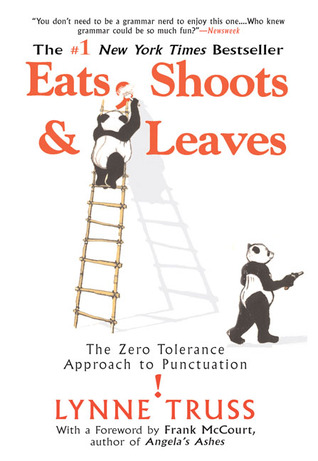
I just finished reading Lynn Truss’ excellent book, Eats, Shoots & Leaves. “Bestselling grammar book” is not a phrase you hear often, but this one is, and for a reason: in an impassioned, intellectual, and often quite humorous way, Truss makes her case for the importance of grammar and punctuation. The title comes from a joke whose punchline highlights the difference between “eats, shoots and leaves” (not a dinner guest you want in your house) and “eats shoots and leaves” (a panda).

Lynn Truss is probably at the forefront of the small subset of society that cares deeply and perhaps disproportionately about correct grammar, punctuation, and spelling. I too am part of this subset, and nodded along in complete agreement when I read, “To those who care about punctuation, a sentence such as “Thank God its Friday” (without the apostrophe) rouses feelings not only of despair but of violence.”

Perhaps the best argument Truss makes for punctuation is that its function in written communication and in literature is crucial; see the above example about the panda. One comma changes the meaning of the sentence entirely. Likewise, “You’re home” and “Your home” also have completely different meanings (in the former, you are at home; in the latter, the home in question belongs to you).

Those who rely on spellcheck to catch these errors are sunk; as this Slate article points out, spellcheck software is great at catching “nonword” errors, like “hte” instead of “the”; however, it doesn’t understand context, so it won’t stop you from using “complement” when you mean “compliment.” Web browsers, for the moment, have surpassed some spellcheck software; in the past five years, according to the Slate article, “Web browsers have become better at spelling than most humans.” What a thought: maybe the next Are You Smarter Than a Fifth Grader? will be Are You Smarter Than Your Browser? Someone call Ken Jennings.

Internet Archive

After having written about the Digital Public Library of America (DPLA) recently, it’s only fair that I should write about the Internet Archive as well. (Brewster Kahle, founder of Digital Librarian of the Internet Archive, is actually on the DPLA Steering Committee, so the two organizations are linked.) The Internet Archive is, quite simply, an Internet library. It is a nonprofit and was founded in 1996, so it’s been around for some time now.

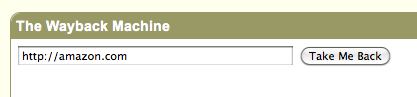
One of its cool features is the “Wayback Machine,” which allows you to plug in a URL and pick a date to see what a given website looked like, say, ten years ago (if it was around then).

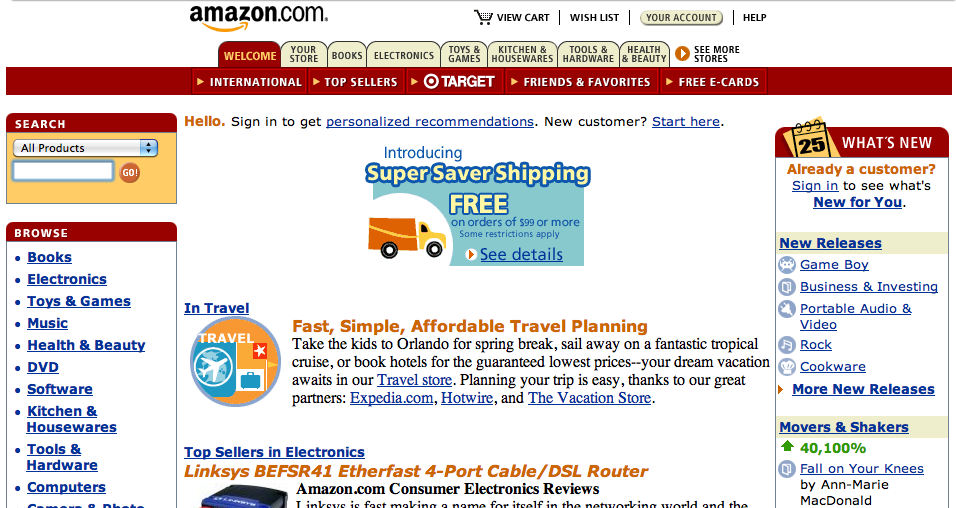
Amazon.com was around in 2002; let’s see what it looked like, shall we?

A little different than it looks today.

So the Wayback Machine is fun to play with (also, useful). And the Internet Archive’s digital library is a great project; but just in case digital copies aren’t enough, Kahle is also building a physical library (or, as The New York Times poetically puts it, an ark). “In case of digital disaster,” the article states, Kahle’s goal is to collect one copy of every book. Kahle said, “We must keep the past even as we’re inventing a new future. If the Library of Alexandria had made a copy of every book and sent it to India or China, we’d have the other works of Aristotle, the other plays of Euripides. One copy in one institution is not good enough.”

Considering how many various file formats and digital storage options we have already gone through in the past few decades, keeping one hard copy of every book isn’t a bad idea. Think about it: if you have some files on a floppy drive from 1998, can you still access them? And if you can’t access them, do they really exist, practically speaking? Whereas a book printed at the birth of the printing press hundreds of years ago can still be read by pretty much anyone (well, anyone patient enough to make their way through a whole variety of spellings).

A Day in the Life

Toward the end of this TechCrunch article about how Random House just tripled the price of ebooks for libraries, there was a link to this well-written, insightful blog post on MetaFilter about why libraries are not anachronistic – about why, in fact, they are more essential than ever.

In the post, the author urges the reader to “imagine this: you’re 53 years old, you’ve been in prison from 20 to 26, you didn’t finish high school, and you have a grandson who you’re now supporting because your daughter is in jail. You’re lucky, you have a job at the local Wendy’s. You have to fill out a renewal form for government assistance which has just been moved online as a cost saving measure (this isn’t hypothetical, more and more municipalities are doing this now). You have a very limited idea of how to use a computer, you don’t have Internet access, and your survival (and the survival of your grandson) is contingent upon this form being filled out correctly.”

Then the author goes through every step of the scenario, and concludes, rightly, “If you have any concept of a free and equal society, then libraries are still an integral part of that.”

Building the Digital Public Library of America

On Friday a friend and former classmate and I went to the “Building the Digital Public Library of America” program at Harvard, where Robert Darnton and John Palfrey both spoke and answered questions. Darnton is the Director of the University Library and also a professor at Harvard, as well as a co-founder of the DPLA, and the author of The Case for Books, among many others; Palfrey is also a Harvard professor and the chair of the DPLA steering committee, as well as the author of Born Digital and other books.

The DPLA is envisioned as “an open, distributed network of comprehensive online resources that would draw on the nation’s living heritage from libraries, universities, archives, and museums in order to educate, inform and empower everyone in the current and future generations.” Naturally this goal is viewed by some as utopian or simply impossible, but as Darnton said Friday, “We don’t have answers, [but we do have] the determination, expertise, funds, and public support…We will make it happen.” Calling the DPLA a big task is an understatement, but, Palfrey said, “This is exactly the moment to think this big…[if we don’t] we are falling short.”

There are design challenges and technical challenges, but “these challenges can be met and will be met,” said Palfrey. As for what exactly the DPLA will contain or look like, he said, “What is the DPLA? We’re not sure yet. And we’re not sure on purpose.” People have dedicated themselves to workstreams for the five elements of the DPLA: code, metadata, content, tolls & services, and community.

The biggest challenge is that of copyright; it’s why Google Books ultimately failed. In order to succeed, there must be some agreement between the creators (authors), the publishers, and the service/platform/distributors. Unlike Google Books, the DPLA aims to provide free access, not commercial access, to a broad public. Behind the DPLA is the belief that access to information is (a) the right of citizens, and (b) fundamental to democracy.

Models of this type already exist; one is Europeana, “a single access point to millions of books, paintings, films, museum objects and archival records that have been digitised throughout Europe. It is an authoritative source of information coming from European cultural and scientific institutions.”

The digital divide is one concern; despite the growth of e-readers and e-books, and the widespread (but not complete) availability of Internet access, for many people, print content is still more accessible than digital content, especially when digital content comes encumbered with DRM and other limitations.

Another concern, raised during the Q&A on Friday, is how the DPLA will affect public libraries. The people working on the DPLA are pro-library; many are librarians. Darnton emphasized that they are designing the DPLA “not to undercut public libraries…[but rather] to reinforce public libraries.” The DPLA, he argued, would make public libraries more important: not only could they serve as an access point, but librarians could create and curate local collections. Overall, the DPLA “is a very complex ecosystem and we need guides through it.” Librarians, Darnton says, can be those guides.

This is one of my answers when people ask if librarians are necessary anymore, because “everything is on the Internet.” Perhaps it is (though not everything is Google-able) – but can you find it? The proliferation of information, both in print and online, is overwhelming – “information overload,” anyone? – and most people could use some help sifting through the hundreds, thousands, or millions of search results to find something reliable and relevant. That’s one reason why librarians are necessary – and this librarian is excited to search within the DPLA as soon as it is up and running, just over a year from now.

Technology as a means to an end

Earlier this month, there was an op-ed in the New York Times titled “Internet Access Is Not a Human Right.” One of the main points of the piece was that internet access is always a means to an end – the “end” being some kind of content or service or tool.

It’s not an exact parallel, but this reminded me of the difference between information literacy – the ability to recognize the need for information, and to locate, evaluate, and use that information effectively – and information technology skills. Likely, you’ll need certain technology skills in order to locate information, but just because you know how to use search engines, databases, or online catalogs does not mean you have all the other skills as well.

As the Association of College & Research Libraries (ACRL) states, “Information literacy, while showing significant overlap with information technology skills, is a distinct and broader area of competence. Increasingly, information technology skills are interwoven with, and support, information literacy.” However, they aren’t the same thing. The means to access information has changed, is changing, and will continue to change in the future; ensuring that everyone has the right to access and the skills to do so  is the important thing.