What is SOPA? Bring in the nerds!

I was reading Jessamyn West’s insightful wrap-up of the SOPA strike, which contained several excellent links, a few of which I’ll re-share here.

Jon Stewart, on SOPA’s likely effect, and on Congress’ lack of understanding of the internet: “‘Bring in the nerds’…Really? Nerds? You know I think actually the word you’re looking for is experts” at 4:21-4:45. (Also funny: at 6:50-7:00, when “Imagine” starts to play, “Wait, no no no no no no, even as a joke we don’t have John Lennon copyright money!”)

West also linked to ProPublica, which offers a tool to look up your current members of Congress’ stance on SOPA/PIPA. Here also is a graphic showing the difference between Jan. 18 and Jan. 19 (it went from 80 supporters and 31 opponents to 65 supporters and 101 opponents).

Lastly, here’s a slightly older (Jan. 6) article from Publishers Weekly, arguing that libraries are in fact the best counter to piracy. Author Peter Brantley cites Tim O’Reilly’s 2002 essay, “Piracy is Progressive Taxation,” wherein O’Reilly says that the incentive for piracy (of e-books, in this case) is “dramatically reduced” when demand is satisfied in as many places and as many ways as possible.

I don’t have a statistic for what percentage of people pirate books, movies, music, or other content as opposed to obtaining it legally, whether by purchasing it, borrowing it from the library, or licensing it through various services, but I think that many people would prefer to obtain their content legally, and are even willing to pay for it, as comedian Louis CK proved recently with his “Live at the Beacon Theater” production, which he sold for $5 online. The takeaway: when buying or borrowing is easier than pirating, people are likely to borrow or buy.
The Day After

Here are several links regarding SOPA, PIPA, and yesterday’s blackout:

Columbia Law School professor Tim Wu pointed out the Web’s strength in this New York Times article, in which he was quoted as saying, “This is the first real test of the political strength of the Web, and regardless of how things go, they are no longer a pushover. The Web taking a stand against one of the most powerful lobbyers and seeming to get somewhere is definitely a first.”

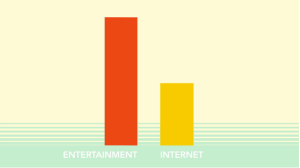
Political strength and economic strength are linked, and as the “Protect IP/SOPA Breaks the Internet” video notes, the “internet industry” now dwarfs the entertainment industry (most of Hollywood is for SOPA/PIPA, while most internet companies – including Google, Facebook, Wikipedia, and YouTube – oppose it). (See 2:48-2:57 – the yellow “internet” bar shoots skyward past the red “entertainment” bar.)

The American Library Association (ALA), which opposes SOPA/PIPA, put together this Quick Reference Guide (PDF), clearly delineating the basics and the structure of each bill. Read the District Dispatch in which ALA applauds the blackout.

Mashable offers a “read between the lines” deconstruction of the official White House response to two petitions (“Stop the E-PARASITE Act” and “Veto the SOPA bill”). The White House addresses legislative scope, non-legislative solutions, censorship and innovation, internet security and stability, and “demands of Congress a more intimate understanding of the Internet in general.”

Lastly, here’s a funny/poignant cover of Don McLean’s “American Pie” on TechCrunch.

SOPA/PIPA

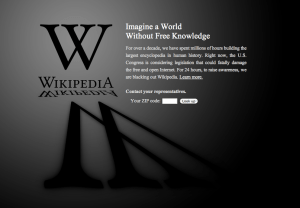
As you may already be aware, today, January 18, a number of sites (including Wikipedia) are participating in a blackout to protest SOPA and PIPA – the Stop Online Piracy Act and the Protect IP Act. A few days ago I linked to a Digital Trends article with a good description of what both bills are and what they would do if passed.  The site sopastrike.com is also informative, though it’s a little overwhelmed with traffic today and may be slow. Here’s a video from Fight for the Future which is also clear and informative regarding what the bills are intended to do vs. the effect they are likely to have in reality.

It seems to be a case of “the road to hell is paved with good intentions.” Most can agree that online piracy is bad, and that intellectual property and copyright do and should entitle the creators of works to the proceeds from those works. “Stop online piracy” is a good goal, but SOPA will not be able to do this effectively. As is pointed out in the video, the government already has tools to regulate the internet: the Digital Millennium Copyright Act (DCMA, 1998), the Prioritizing Resources and Organization for Intellectual Property Act (PRO-IP, 2007), and the Anti-Counterfeiting Trade Agreement (2011).

What can you do? Read about SOPA and PIPA, educate yourself, and take action. There are a number of ways, from blacking out your own website if you have one, to contacting your representatives.