The Massachusetts Library Association’s annual conference theme this year is “the greatest job on earth.” And I guess we can claim that, because a quick internet search shows there’s not a lot of consensus on the issue. Moving on!
The keynote speaker was Dr. Deborah L. Plummer, Vice Chancellor and Chief Diversity Officer at UMass Medical School and UMass Memorial and author; her presentation was called “Radical Respect in Troubling Times,” and it was followed by a “Communicating Across Differences Workshop.” Plummer spoke about how to turn “Us and Them into We” through conversation – and not just conversation with the people you already agree with. It’s easy to respect people who look / think / talk / behave / worship / vote like you; it takes work to get out of your echo chamber. But bumping up against difference is how we learn about others and about our own identities.
The paradox of diversity, said Plummer, is that (1) we are unique and like no one else (personality); (2) we’re each like some other people (similar backgrounds, views, genes, etc.); (3) we’re all like everyone else (i.e., human). And we don’t each have one identity; we have multiple and intersecting identities. We may emphasize or project one or another of these depending who we’re with. “Identity pulling” is okay if you’re the one choosing to do it, but it’s not okay for one person to do it for someone else.
Plummer gave the attendees strategies for successful “bumping”: (1) Focus on being respectful rather than being right; (2) Check your assumptions, and de-escalate if necessary by saying something like “I’m sorry, I made an assumption”; (3) Mirror the other person’s style by “grabbing their handle” – figure out if they are coming from the head, the heart, or the gut/soul; (4) “Take a helicopter ride” and observe from a distance if the other person doesn’t have the capacity to change their viewpoint or behavior.
Plummer also listed her three components of radical respect:
- Admiration: “Wouldn’t it be great if we treated differences like a challenge instead of a threat?” (We have different physiological responses to these: we react to a challenge with adrenalin, and to a threat with cortisol.)
- Civility: Listen for understanding, rather than for rebuttal
- Dignity: Honor that needs and concerns exist. Where do they come from?
 There was a break after the keynote, and then the next set of morning sessions. I chose to stay with Plummer for the “Communicating Across Differences Workshop,” which included some of the same material as her keynote with additional exercises and examples, starting with a few of the classic Psych 101 images to demonstrate our ability to make perceptual shifts. You can’t actually hold multiple realities or perspectives at once, but you can shift back and forth between them – and if you don’t see another reality on your own, sometimes you can once someone points it out to you. (Ah, see what she did there? Clever.)
In this session, Plummer spoke about the traditional approach to difference compared to the contemporary one, and used an analogy of an hourglass: If the sand in the top is the dominant culture (white, male, Christian, healthy and able-bodied, adult, heterosexual, upper-class, educated), those on top are afraid of simply flipping the hourglass; “we have a better chance for creating equity if we tip the hourglass on its side.”
Communicating successfully across differences is tricky; Plummer’s “Intention vs. Impact” slide shows how a sender’s intended message might impact a receiver. If the impact is positive, we have effective communication; if it’s negative, we need to acknowledge and clarify. Intent and impact are both important; one of Plummer’s examples was a Black Lives Matter display. Some people thought it was an anti-police message, which wasn’t exactly the sender’s intended meaning (it was more like, Black Lives Matter too).

Following this slide was one with a number of conversational “bounce backs,” ways to recover and things to say when a conversation goes wrong, such as “Help me to understand…” and “My experience has been…” Everyone will make mistakes, and these can help move the conversation forward if done with a degree of cultural humility and commitment to learning.
 Next was a “diversity petal” exercise: we identified the dominant or “up” identities for race, gender, age, mental/physical ability, sexual orientation, class, education, and religion and then our own identities within each category, then placed a check mark next to any category where our own identity matched the dominant one. Plummer pointed out that marginalized people know more about the dominant culture; part of privilege is not having to learn about how life is for others. “Black people know a lot more about white people than white people know about Black people. Women know a lot more about men than men know about women. People who have a disability know a lot more about the world that’s designed for people who are healthy and able.”
We came back to the “multiple realities” images to hammer home the point that just because you don’t see (or experience) something doesn’t mean that it isn’t there (or doesn’t exist). Plummer is a champion of cross-racial friendships (Some Of My Friends Are…), and pointed out how going through life with people who are different than you can highlight the ways in which you experience the world differently (or ways in which the world treats you differently).
All of this is ongoing; no one has “arrived,” but we can commit to continuing the conversation.
To Be Continued (more sessions from Monday, and sessions – and a presentation library website usability testing – on Wednesday)










 Whitney Scharer was up first, showing slides and then reading from her debut novel about Lee Miller, known as a model for Vogue and surrealist Man Ray’s muse, though she was a photographer in her own right, and co-inventor of the technique of solarization. (Aside: Every student should have a project like the one mentioned in Meg Wolitzer and Holly Goldberg Sloan’s new middle grade novel, To Night Owl From Dogfish, “Give the right person the credit.”) Scharer discovered Miller at an exhibit featuring Man Ray at the Peabody Essex Museum in 2011, and was interested in the two of them “being in love and making art together.” (Miller went on to be a war reporter; she reminded me of Robert Capa’s partner, Gerda Taro, who was killed while documenting the Spanish Civil War.) Scharer read a scene from her novel in which Miller describes what she calls “wild mind”: her ability to set any expression on her face while modeling, yet thinking of anything she wants, setting her mind free. The scene (possibly the whole novel?) was in present tense.
 Next, Jenna Blum (The Stormchasers, Those Who Save Us) talked about and read from her new novel, The Lost Family, set in New York and centered around a Holocaust survivor, Peter, who lost his wife and daughters. He now owns and runs a restaurant called Masha’s, after his late wife, and has sworn not to get involved with anyone again – but, of course, he does. The novel is about Peter and his second wife and their daughter, “a whole family trying to put its arms around a loved one’s PTSD.” Blum didn’t have slides, but she did share a cocktail of her own invention, and cream puffs called “Masha’s Little Clouds”; she said that she invented and kitchen-tested all the menu items in the book.
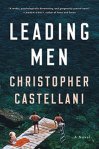 Finally, Christopher Castellani (A Kiss From Maddalena, The Saint of Lost Things, All This Talk of Love) talked about his newest novel, Leading Men, which imagines a party thrown by Truman Capote in Portofino in 1975, the guests, and the aftermath. Castellani said that people always want to know “how much is true and how much is not true,” so he explained that the party did happen, and that Tennessee Williams and his lover Frank Merlot really were invited, but that Williams’ journal does not mention the party in the days or weeks following it. Using both “real and invented people,” Castellani imagined and invented “between the cracks of what was known about these people.” Merlot is his main character; Williams isn’t a “point of view character” largely because he is too well-known, has written and been written about too much; Merlot, though not obscure, is less of a known quantity. Castellani admitted that it was daunting to write dialogue for characters like Capote and Williams; he would often use an “anchor quote” from their writings in order to get the tone of the dialogue and scene, and would sometimes remove the “scaffolding” once the scene was finished.
 Rita Meade: “Keep Calm and Transform the World”
 Now, she works at the