MLA Conference, Day Two (Thursday), Part Two

Michael Colford, Director of Library Services at the Boston Public Library, moderated the panel, “Authors, Authors, Authors!: Three Local Authors Strut Their Stuff!” The local authors featured were Claire Messud, Christopher Castellani, and Laura Harrington. Each author had a different writing background, and all three were fascinating, refreshing, entertaining, and articulate as they spoke about their work, the book world, and culture in general. It was a wonderful panel, and the fact that it was held in the tent with fresh air and natural light didn’t hurt either.

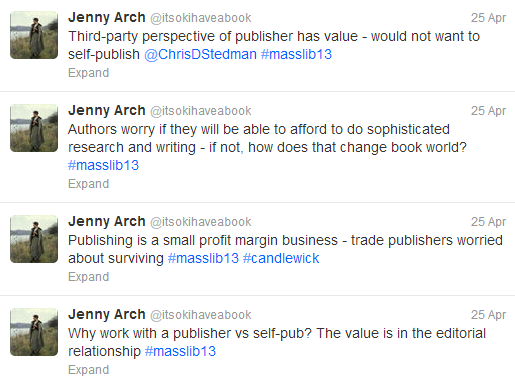
Laura Harrington, author of Alice Blissimmediately earned cheers by saying, “Librarians are some of my favorite people….Librarians and teachers are my heroes.” Alice Bliss is Harrington’s first novel, but she is an experienced writer, having spent the last 25 years writing for the theater: operas, radio plays, screenplays, librettos, lyrics, and more. With her novel, she said, “I wanted to reconnect to the creative process by becoming a beginner again.”

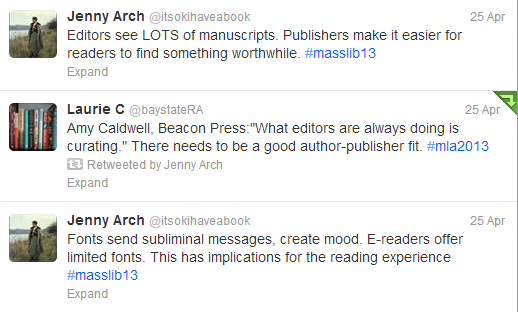
authortweet1

Christopher Castellani, author of A Kiss From MaddalenaThe Saint of Lost Things, and All This Talk of Lovestarted with an overview of his books so far. His three novels deal with the same family, but each book can also stand alone; each covers a two-to-three year time span, from Italy in WWII, to immigrant life in the U.S. in the 1950s, to tension between the first and second generations of the family. He originally imagined the work as one “epic, sprawling saga” – “I wanted to write something like One Hundred Years of Solitude but for Italians” – but the story found form across three books instead. Rather than one main character, the books feature an ensemble cast.

Claire Messud, author of (most recently) The Woman Upstairs, as well as The Emperor’s Children and several other novels, spoke generally about writing (“Writers are like magpies”), rants, and angry women. Nora, the main character in The Woman Upstairs, has been perceived by critics as angry, and Messud observed, “Women’s anger is uncomfortable….If a woman is angry, she’s ‘unhinged.'” Readers confront this right away: the beginning of The Woman Upstairs is “the rantiest bit.”

“I’ve been a delighted reader of rants,” Messud said, “but all the ranters are men.” Maybe, she indicated to the mostly female audience, it’s our turn. She mentioned the Chekhov story “The Lady With the Dog” and expressed her admiration for the way the author wrote the character’s internal life. “All her torment is invisible….I wanted to write about what’s below the surface for people.” When the question of Nora’s anger came up again during the Q&A, Messud stated: “Nobody eviscerated on the table is gonna look pretty.” If Nora was real and walked into a room, you’d think she was perfectly pleasant; you’d like her. But as the reader, you see everything under the surface, not just her public face. Nora’s complexity might make her hard to like, but “Giv[ing] voice to true human experiences, that’s our job [as authors].”

While readers’ and critics’ reactions to the book are worth discussing, The Woman Upstairs also examines the questions, “What is the cost of making art? What do you have to sacrifice?”

Q&A

The issue of women and anger arose from Alice Bliss as well; Harrington said that readers have been judgmental and unforgiving of Angie, Alice’s mom, who falls apart a bit when her husband, Alice’s dad, goes to war. All This Talk of Love is not without an angry woman, either: one of the characters finally speaks for herself after a lifetime of others speaking for her, and giving up things she doesn’t want to give up, creating conflict within the family. In fiction as in real life, rage, Messud noted, “comes from helplessness, a lack of agency, struggling for control.” (She also mentioned Blood Wedding (Bodas de Sangre), a play by Federico Garcia Lorca, full of angry female characters. I read this play when I studied abroad in Spain, but hadn’t heard anyone mention it since.)

The next question from Colford had to do with families. All three writers acknowledged that, as Messud put it, “For anybody writing anything, our own experience of family informs the fiction that we write.” Castellani spoke about the “inescapability of each other and the narratives we have constructed for each other….When we change, it sends shockwaves through our family.” Harrington illuminated the fine line of using pieces of real people in one’s fictional characters: “How do you do this in a way that is inspired by real people but not slavish to them?”

Colford particularly complimented Harrington’s supporting characters (“I love supporting characters in novels”), and she credited an inspiring work (Our Town by Thornton Wilder) and her past work as a playwright: “A playwright’s job is to write great characters for actors to play.” At the same time, a playwright must be “very economical with ‘brushstrokes,'” using few words to describe each character.

An audience member asked Harrington about transitioning from a collaborative medium to a solitary one. She answered, “Collaborating is either heaven or hell. You often find yourself married to someone before you’ve had a first date.” In theater, however, “All those moving pieces [can] fall to pieces,” and with novel writing, it was “a relief to be in control.” Writing for theater and opera involves compression; novel writing allows for expansion.

On the question of character likability, Harrington said, “Likability is a slippery slope….If we’re focused on likability we’re going to forget the possibility of transformation.” While Messud acknowledged that “Readers desire to identify with the character [and] feel that she is admirable,” she pointed out that this is a gendered point of view: “Let’s try to make a list of the male protagonists we want to be friends with.” (It reminded me of when voters elected Bush because he was someone they’d like to have a beer with; great, have a drink with him, but let someone serious run the country.)

maine_sullivaninterestings_wolitzercorrections_franzen
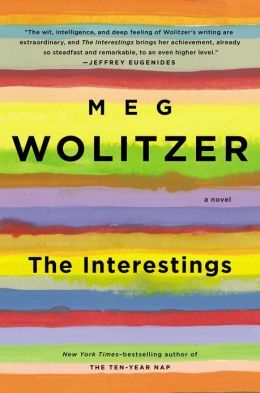
Gender makes a difference when it comes to the author, too – or at least, how publishers package authors’ books and how critics review them. “Character-driven family novels” are one example of this: think Jonathan Franzen’s The Corrections vs. Meg Wolitzer’s The Interestings (or J. Courtney Sullivan’s Maine). Castellani, who studied with Jonathan Franzen in college, said that he (Franzen) said, “It’s not as if I invented the family novel,” though The Corrections is often held up as an example of this type of book. Harrington pointed out that the same dichotomy applies to novels about war; reviewers write about male authors’ war novels as a group (not to pick on Slate, but here’s an example), and don’t mention novels about war written by women.

Despite this obvious unequal treatment, the panel ended on a positive note. An audience member asked Messud whether she’d seen Ron Charles’ book review of The Woman Upstairs (YouTube video), and she said yes – she thought it was very funny. (It is.) Overall, the “Authors, Authors, Authors!” panel was one of the most pleasurable parts of the conference. I wouldn’t have thought to group these three authors (or their books) together, but it worked just beautifully, thanks to the moderator and the panelists themselves.

Two more Thursday sessions to write about, coming soon!

MLA Conference, Day Two (Thursday), Part One

I had a hard time deciding which Thursday morning session to go to, but ultimately I chose “On Life Support, but Not Dead Yet!: Revitalizing Reference for the 21st Century” and I’m glad I did. Jason Kuhl of the Arlington Heights (IL) Memorial Library (AHML) and Celeste Choate of the Ann Arbor District Library (AADL) presented, and both had excellent ideas to share. As most librarians know, demand for “traditional” reference services have been declining, with many fewer “ready reference” questions as well as fewer complex reference questions. Multitudes of column inches in newspapers (screen inches in online publications) have been devoted to whether libraries are relevant in today’s world, and probably an equal amount has been written by librarians and our allies on why libraries are in fact relevant.

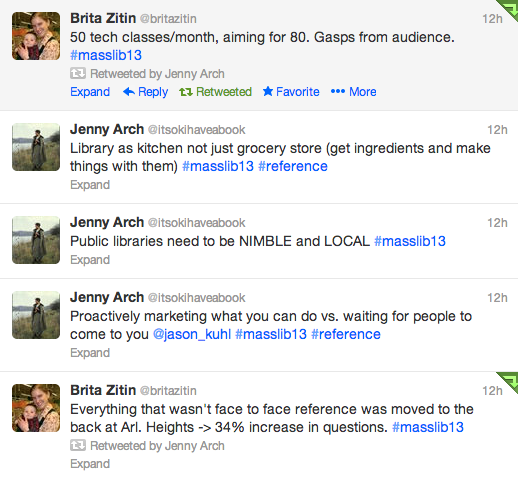
But as some libraries shift toward the “library as community center” model, others consider how to highlight the reference services that have always been libraries’ strength. One of the most obvious ways, Jason pointed out, was to make the reference desk visible: put it in a high-traffic area, near an entrance, or just make sure it’s not behind a wall where patrons have to seek it out. Another way that Arlington Heights increased the number of questions answered (by 34%!) was to separate face-to-face interactions from phone, e-mail, and chat interactions; that is, when a librarian was at the reference desk, s/he was only responsible for face-to-face interactions with patrons physically in the library. Librarians away from the desk handled all other types of reference questions. In addition to boosting the number of questions answered, this solution seems to me like a big stress-reliever; instead of trying to answer four questions at once, staff can focus on just one, and give that patron better service.

Jason also talked about a reshuffling of responsibilities at the two desks at the Arlington Heights library. Previously, they had an “Information” desk and a “Welcome” desk. At the info desk, staff with MLS degrees answered traditional reference questions, helped with database research, did technical instruction, and handled genealogy and business questions; at the welcome desk, staff without an MLS answered questions about the catalog, helped with technology, and did readers’ advisory. This distinction was unclear to patrons (most patrons, not unreasonably, assume that everyone who works in a library is a librarian with the same level of expertise), so the desk responsibilities were shifted and the names were changed accordingly. Now, patrons could go to the “Digital Services” desk to ask about the public computers, digital content, technology instruction, and e-readers/tablets/phones, or they could go to the “Information Services” desk with questions about genealogy and business, readers’ advisory, or the catalog. Some staff at each desk had an MLS and some did not. Though it required cross training for staff, the new system was more intuitive for patrons.

Jason noted the importance of “proactively marketing what you can do versus waiting for people to come to you,” as well as the importance of being “nimble and local,” by responding to rising unemployment by offering help for jobseekers, for example. The library also offers technology classes, and staff noticed that attendance at these classes rose even as public computer use declined. The Arlington Heights library is able to offer more than the usual tech classes: they offer sessions on blogging, Twitter, Android vs.  iOS, and where to listen to music online. The library is “not just a grocery store, but also a kitchen,” Jason said, meaning it is not just a place to come get things, but also a place to make things. “Libraries,” he finished, “help people be successful in their lives.”

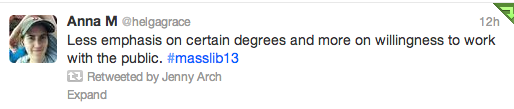
referencetweet1


Celeste from AADL presented next, starting with an overview of the library system. The AADL is one main library and four branches; they have 8.8m checkouts, 1.6m visits, and about 80k attendance at programs annually, but reference questions have declined sharply, from 126k in 2003-2004 to 51k in 2011-2012. The AADL took a hard look at “What job needs to be done? Who is qualified to do it? Who answers which questions?” They have several levels of staff, from clerks to MLS students to library technicians, librarians, supervisors, and managers. Each level of staff spends a certain amount of time on the desk every week (the library is open 74 hours/week year-round), but there is a six-week training program that supports non-MLS staff on the desk. There is also peer-to-peer training in the form of a staff wiki, and a variety of ways for patrons and staff alike to ask questions.

referencetweet3

All of these changes seem designed to support library staff’s responsiveness to the public and to each other. Staff create wayfinders and tools for the public, like homework help, and staff and the public also create resources together, like readalike lists. There is also an “on demand” digitization process; digitization can be a long, slow process, so why not let the public decide what they want to see first? Patrons can request digitized copies of articles from old local newspapers, and instead of simply delivering that item to that patron, the item is made available to the public as well. The public also helps tag items in the catalog (crowdsourcing!) with the Points-o-Matic game.

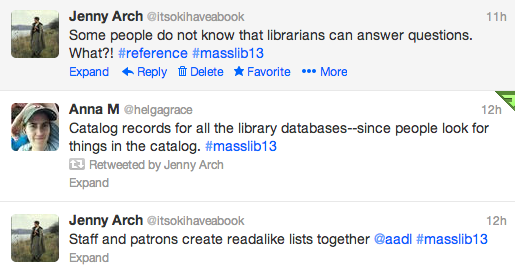
A final small outreach effort was to add a short message to the  “Ready for Pickup” notices that are automatically e-mailed to patrons when their requested items arrive at the library. Instead of just saying that the item is ready, the AADL added a sentence along the lines of “Did you know the library can answer questions?” Because, unbelievably, some people do not know this. (Celeste’s own grandmother, apparently, was one of these people. “What do you think I do all day, Grandma?”)

referencetweet2

All of the ideas that Jason and Celeste presented were thought-provoking and inspiring. I especially like the idea of a combination staff/patron chat where staff can provide answers to their fellow staff as well as to patrons (Celeste called this “the channel”), but I have to say my favorite idea is separating face-to-face reference from phone/e-mail/chat reference, and handling the latter off-desk. At AHML, this seemed to have many positive effects: it reduces stress on desk staff, improves the F2F experience for patrons, and allows library staff to answer more questions (a ringing phone doesn’t go unanswered because the person on the desk is helping someone else).

This post wound up being pretty long, so I’ll write about the remaining three Thursday sessions in the next post(s). Stay tuned, and please share your thoughts in the comments!


MLA Conference, Day One (Wednesday), Part Two

The afternoon sessions at MLA on Wednesday were just as good as the morning sessions. First up after lunch was “Library Services and the Future of the Catalog: Lessons from Recent ILS Upgrades,” with representatives from the Boston Public Library (BPL), the Merrimack Valley Library Consortium (MVLC), UMass Dartmouth, and the Massachusetts Board of Library Commissioners (MBLC); the first three library systems had recently changed from one ILS (Integrated Library System) to another, and the MBLC had helped MVLC and two other Massachusetts library consortia with the search process and transition.

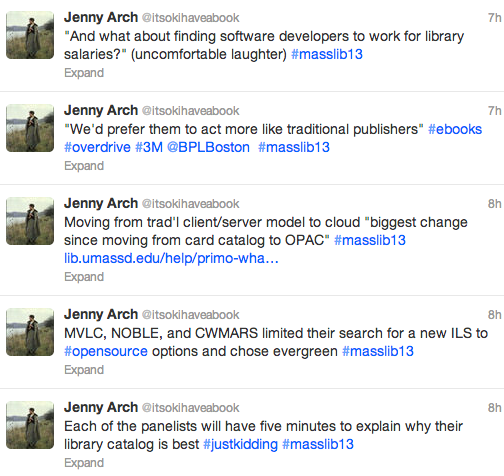
The speakers explained why their libraries wanted to change from one ILS to another and the decision-making process involved in choosing a new ILS; they also spoke about the process of the change and how it affected users and staff, pointed out some of the differences – good and bad – between old and new systems, and talked about the future of library catalogs. They touched on the differences between open source and proprietary systems: with open source, you need more in-house talent (software developers on staff), but you have more control, as well as access to the open source community; proprietary systems require less technical skill from library staff, as fixing bugs and implementing new features are outsourced.

ILStweets1

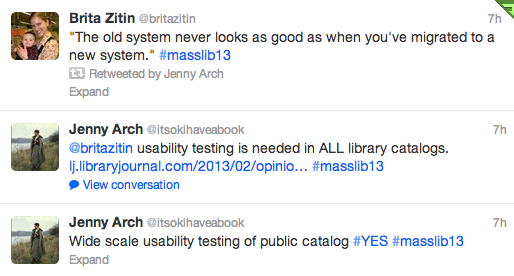
All library systems experienced some growing pains during the change; in some cases, initial training was good, but follow-up training could have been better. “The old system never looks as good as when you’ve migrated to a new system,” one speaker said somewhat ruefully. “It’s always going to be harder than you think,” said the MVLC representative. However, when asked how they felt three months after migrating to the new system, overall everyone seemed satisfied with their new ILSs, though each had a laundry list of wishes, and much of the reporting seemed based on anecdotal evidence rather than formal evaluation of either staff or patron experiences.

ILStweets2Every ILS has usability issues, and usability testing with patrons would likely identify areas in need of improvement for each ILS; developers don’t always develop with real users in mind. (As Aaron Schmidt pointed out in Library Journal, most library catalogs are designed to prioritize the collection, not the people searching the catalog.)

The last session I attended on Wednesday was “Loaning eReaders to the Public: Legal and Strategic Challenges,” where Anne Silvers Lee and Jamie Wilson from the Free Library of Philadelphia and Melissa Andrews from the Boston Public Library spoke about the lessons they learned in the process of developing programs to circulate e-reading devices: the Free Library lent B&N nooks, and the BPL will be lending iPad minis starting next month.

This was a fascinating session that started off with some startling statistics. E-readers, Ann said, are “not a cutting-edge thing anymore”; forty percent of libraries loan e-readers. Why did the Free Library want to lend e-readers? They considered the digital divide (the gap between those who are familiar with technology and those who don’t use it; in Philly, 41% of the population of 1.5 million does not have internet access at home), patron demand, innovation, and transliteracy.

The library obtained a grant to purchase e-readers and hire part-time staff to help train patrons on how to use the devices. They chose nooks because B&N offers institutional accounts for invoicing and batch wifi delivery of new content; they were also aware that Amazon had already sent out at least one cease-and-desist letter for lending Kindles. Jamie referenced copyright experts Mary Minow and Peter Hirtle of LibraryLaw.com and Cornell University, respectively, whose opinions the Free Library sought to determine the legality of their lending program. He summed up their response as “We’ve looked into this, we think it’s all right,” with Hirtle less sure than Minow (who also included a long list of caveats).

ereaders1

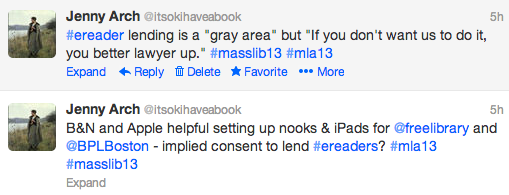
During the Q&A at the end of the session, I suggested that B&N and Apple’s cooperation in helping the libraries set up their devices for lending implied consent, but apparently it’s still a “gray area.” However, Ann said, “If [device manufacturers] don’t want us to do it, [they] better lawyer up.”

ereaders2Jamie explained the Free Library’s system for lending: the program was limited to patrons fifty years of age or older, all of whom had to have a library card and a valid ID. There were steep late fees in place (though fears that the devices would be stolen proved unfounded; none went missing), and all users had to take a training class. All of the nooks circulated from the senior center in the Main Branch, and all were pre-loaded with the same selection of fiction and nonfiction bestsellers and classics. Because they weren’t buying content through a third-party vendor like OverDrive or 3M, they could purchase titles from all “Big 6” publishers.

Results once the program launched were somewhat disappointing, with lower use of the devices than they had anticipated. In response, the library lowered the age requirement for borrowing, expanded the availability to other locations, dropped the training requirement (while providing even more training classes), and eventually repurposed some of the nooks for staff training.
ereaders3

Then, of course, there was the lawsuit: the National Federation for the Blind sued the library because the nooks were not accessible. The lawsuit was resolved, but it stands as a cautionary tale, and the BPL accordingly proceeded with caution when planning their own e-reader lending program. The NFB had sent a letter to the mayor of Boston stating that it was an ADA violation to lend nooks or Kindles; only iPads were appropriately accessible (more than just text-to-speech capability is required for a device to be considered accessible).

The BPL purchased 70 iPad minis with a grant, and worked with Apple to ensure that users’ personal data was protected and that any content a user had added to the device was wiped between checkouts. The iPads are preloaded with 40 high interest titles as well as some apps; they will circulate for two weeks at a time, and patrons will be able to place holds on them through the catalog (though Melissa anticipates long wait times due to their popularity). The iPads will show up in the results list when patrons search the catalog for books that have been preloaded onto the iPads; this is something that the Free Library staff thinks would have boosted circulation of their devices, which only appeared in the catalog if you searched for them by device name.

Overall, this was an informative session. All three speakers were well prepared and articulate, and the learning curve was evident in the changes that the Free Library made to its own lending program as well as how the BPL developed its lending program. As I’ve said before, libraries are all about sharing, and learning from each other’s experiences is one way of doing that. For any library that is considering implementing an e-reader lending program, I’d definitely recommend consulting these folks’ resources.

Next: the Thursday sessions at MLA were also fantastic. Stay tuned for not-so-concise summaries of four more sessions (probably in two parts, probably tomorrow or early next week). The Twitter hashtag war continues, so make sure to check #mla13 and #masslib13 (I was mostly using the latter).

MLA Conference, Day One (Wednesday), Part One

Today was the first day of the Massachusetts Library Association Conference in Cambridge. The conference site, located near the MIT campus, was surrounded by police, who were out in force for the memorial service for fellow officer Sean Collier. (Librarians may have seen that many police in one place before, but I doubt the police had seen that many librarians.) It made for a somber beginning, and people trickled into the 9am sessions a few minutes late due to some of the roads being closed.

Despite missing the first few minutes of the session on “Teaching Technology to Patrons and Staff,” I enjoyed Ann Lattinville and Peter Struzziero’s presentation about the series of “Tech 101” classes that they offer at the Scituate Town Library, and Jessica Lamarre’s presentation on her work with the “teen tech squad” at the Pembroke Public Library. (This was the only session during which I wasn’t on Twitter, because I didn’t get the MLA wireless password until afterward. You’d think that would be in the conference packet, or on the website…) I came in just as Ann and Peter were finishing talking about the Library Edge Initiative’s Benchmark test, and how their library’s results had led them to offer more technology training for patrons at their library, including classes on how to set up an e-mail account, Facebook and Pinterest accounts, and a “tech petting zoo” to showcase e-readers, tablets, and library databases and resources like Zinio.

They talked about the importance of having a lesson plan, giving handouts at programs as well as having them available around the library, branding (“Tech 101”), different types of marketing, and using videos to provide an overview (they showed Eric Qualman’s video “Social Media 2013,” but also recommended resources from WebJunction and TechSoup). They also emphasized the importance of promoting the library as “a place of interactive learning,” not just a warehouse for books.

Jessica’s Teen Tech Squad is a different kind of technology program; her teen volunteers are trained to help other patrons with technology needs. At first this was a drop-in program, but people didn’t always show up, so she changed it to an appointment model, which worked better. She assessed the teens’ skills and areas of expertise with different software and devices, and did role-playing exercises with them to improve their teaching skills, patience, and ability to talk through problems.

The next session I attended was “Afraid to Advocate? Get Over It!” Eric Poulin from Greenfield and John Ramsay from Springfield gave the Western Massachusetts perspective, acknowledging the perception in Western Mass that their tax money comes to the eastern part of the state and doesn’t return. Point being that they know the importance of fighting for their libraries. (By this point in the conference, I had gotten the MLA wireless password and found the Twitter hashtag – or one of them – and began posting during the sessions.)

advocacytweets


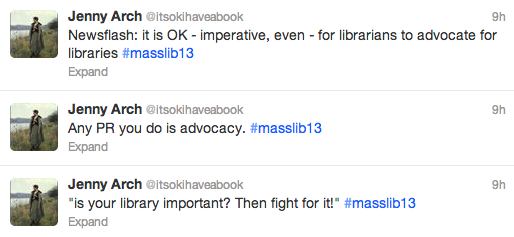
Eric and John talked about legislative breakfasts, usually held annually, and the importance of attending them, getting to know your local legislators in an informal context. Libraries can also host legislative breakfasts, and are definitely a great place for photo ops. Participation can’t be just once, though; it should be ongoing, to build a relationship: “Legislators are people too. They work for us and they are part of our community.” Librarians, of course, know that libraries are important, but not everyone knows that, and librarians can be unwilling to stand up and be loud. “Is your library important? Then fight for it! …Fighting for libraries is good citizenship.”

As public employees, librarians can’t ask or tell patrons who to vote for in local elections, or how to vote on an override, but they can provide balanced information about the issues. The Massachusetts Trial Court Law Libraries are a good resource for those who want to get involved but are afraid of crossing a legal line. Not all advocacy is political, though; any PR is advocacy, from newsletters to photo ops to social media to special events at the library. “It’s not just gonna happen by itself.”

advocacytweets2


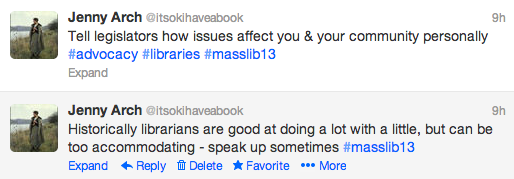
John spoke about three branch libraries closing in Springfield, and how public support brought them back. “Libraries are, in some ways, an equalizer,” he said, and Springfield patrons showed that their library was important to their community. Eric shared a story from Greenfield, where a new mayor made a particularly egregious comment about libraries and within two days the community mobilized and marched on city hall [could not find news article to link to]. He also joined the fight when the high school was considering cutting its librarian position. “Tell legislators how issues affect you personally,” he said. And don’t wait for a crisis to talk to legislators; they’re more likely to listen if you have a relationship already in place. “Anticipate the questions so you have the answers” when you talk to them.

Another part of advocacy is making sure the library has a positive image with the public. “Points of friction” may include late fees or other customer service issues; consider how your library staff handles these.

MLA logo

All that was just before lunch on Day One. More to come in the next post, where I’ll write about “Library Services and the Future of the Catalog: Lessons from Recent ILS Upgrades” and “Loaning eReaders to the Public: Legal and Strategic Challenges.” For now, you can check out the highlights on Twitter by searching for #mla13 or #masslib13.


Happy National Library Week

This week is National Library Week, the time of year that we “celebrate the contributions of our nation’s libraries and librarians and promote library use” (as opposed to the rest of the year…when we also do those things). Jessamyn West wrote a NLW post full of great links at the actual beginning of the week, which is well worth checking out. The Swiss Army Librarian posted a wonderful quote from the very pro-library author Neil Gaiman back in 2011, which is worth revisiting. And of course, the #nlw13 tag is also active on Twitter.

On Monday afternoon – Marathon Monday – I was sitting with a friend of a friend who is considering leaving academia (she’s a few years into a PhD in English Literature) and becoming a librarian. We had met up to talk, and she asked me what librarians were like. I told her one of the striking things I had noticed about librarians as compared to people in other professions: on the whole, they – we – are collaborative, not competitive. We are friendly and helpful and very willing to share our work, our discoveries, and of course our favorite books. “There may be asshole librarians out there,” I said, “but I haven’t met one yet.”

NLW2013_logo

Calling all researchers: timeline of the end of repair

During the major blizzard in February (dubbed Nemo), my digital camera stopped working. When I turned it on, the lens would extend, then retract; it would do this a few times and then give a error message to turn it off and back on again. This did not solve the problem, so I began wondering if I could get it repaired, or if I would have to replace it. This repair-or-replace question made me think of a timeline I had seen, which I will describe:

Physical description: It was a black-and-white timeline (though it could originally have been in color); I had it on an 8.5×11″ paper, which I had to blow up onto multiple pages in order to see all the small print properly.

Content: I’m not sure what the earliest year represented was, but the timeline extended through the present and into the future. It showed when repair stopped being a viable option for everyday objects like clothes, shoes, toasters, and radios; when built-in obsolescence, or planned obsolescence, made it cheaper to buy a new item to replace the old one, or simply impossible to repair the old item.

Question3I wanted to find this timeline again. I started with a Google search, using a variety of keywords (repair, replace, timeline, obsolescence/obsolete, chart, technology, etc.), and then switched to a Google image search. I couldn’t find it, so I looked through my grad school notebooks, thinking maybe it had been a handout from one of my classes. It wasn’t there, so I reached out to grad school friends and professors, none of whom specifically remembered what I was trying to describe (though some said it sounded cool), or could help me find it.

Next, I reached out to the Swiss Army Librarian, an ace reference librarian in Chelmsford, MA. He spent a generous amount of time helping me try to dig up the timeline, consulting print and online materials, but we still haven’t found it. However, we found a number of other cool resources along the way:

  • the Consumer Reports Repair or Replace Timeline access to the timeline itself requires a subscription to CR, but you may well have access through your local public library, as many libraries purchase subscriptions. (If you happen to live in Arlington, MA, click here.)
  • an article from The Economist by Tim Hindle called “Planned Obsolesence” from March 23, 2009
  • the book Made to Break: technology and obsolescence in America by Giles Slade, which didn’t have the timeline I was thinking of, but it makes interesting reading. (It will probably make you angry.)
  • a very long piece from Adbusters by Micah White called “Consumer Society is Made to Break” from October 20, 2008, which includes a clip of (and link to) a short film called The Story of Stuff, and a reproduction of Bernard London’s 1932 pamphlet entitled “Ending the Depression Through Planned Obsolescence,” which contains the following rather incendiary proposal:

“I would have the Government assign a lease of life to shoes and homes and machines, to all products of manufacture, mining and agriculture, when they are first created, and they would be sold and used within the term of their existence definitely known by the consumer. After the allotted time had expired, these things would be legally “dead” and would be controlled by the duly appointed governmental agency and destroyed if there is widespread unemployment. New products would constantly be pouring forth from the factories and marketplaces, to take the place of the obsolete, and the wheels of industry would be kept going and employment regularized and assured for the masses.”

For those who are now fascinated and/or infuriated by the whole concept planned obsolescence thing: if you research further and find that chart, please let me know!

Copyright and Plagiarism

Last month, I attended two webinars on copyright with Mary Minow of LibraryLaw.com. The first was Copyright Basics, and the second was called Hot Issues in Copyright; the webinars were presented by the Massachusetts Library System.

librarylaw_logo

Some of the material was familiar, of course, but some was new. Minow (coincidentally, the aunt of a close friend of mine) confirmed that all original creative content is automatically copyrighted to its creator. However, in order to gain the additional level of legal protection required to bring a lawsuit against someone who has infringed upon your copyright, it is necessary to get the official copyright from the government (there is an excellent Q&A page at copyright.gov).

600px-US-CopyrightOffice-Seal

Some people infringe upon others’ copyrighted work because they think they can get away with it; others do it out of ignorance. Using a Creative Commons (CC) license is one way to raise awareness that you hold the copyright to your work, and that others must ask permission before using it. There are a variety of CC licenses, but, as it says on the site, “All Creative Commons licenses have many important features in common. Every license helps creators — we call them licensors if they use our tools — retain copyright while allowing others to copy, distribute, and make some uses of their work — at least non-commercially. Every Creative Commons license also ensures licensors get the credit for their work they deserve.”

cc.logo

Though I had included a note on the “About” page of this blog and my other blog (“Unless otherwise noted, all blog content © Jenny Arch”), I added Creative Commons licenses recently as well – partly thanks to Minow’s reminder, and partly because, coincidentally, some of my own work was plagiarized right around the same time.

The internet is vast; I never would have known about it had an alert former co-worker not e-mailed me to let me know. She sent me a link to a post entitled “Plagiarism Sucks: It’s More Than Just Drama” on the blog Sparkles and Lightning, which is written by Annabelle, a high school senior in California. Annabelle’s fellow blogger Jessi (of Auntie Spinelli Reads) compiled a list of plagiarized reviews and bloggers, which Annabelle included in her post; my former co-worker noticed that one of my Goodreads reviews (for Close Your Eyes by Amanda Eyre Ward) was on the list.

I can’t slap a Creative Commons license up on Goodreads, because they have their own Terms. The “User Content” section of these terms includes the statement, “You understand that publishing your User Content on the Service is not a substitute for registering it with the U.S. Copyright Office, the Writer’s Guild of America, or any other rights organization.” This means that content-producing Goodreads users retain their automatic copyright, but don’t have an official government copyright – the same as if that content was posted on a blog online.

goodreads_logo

The “License Grant” section of the Goodreads terms reads, “By posting any User Content on the Service, you expressly grant, and you represent and warrant that you have a right to grant, to Goodreads a royalty-free, sublicensable, transferable, perpetual, irrevocable, non-exclusive, worldwide license to use, reproduce, modify, publish, list information regarding, edit, translate, distribute, publicly perform, publicly display, and make derivative works of all such User Content and your name, voice, and/or likeness as contained in your User Content, in whole or in part, and in any form, media or technology, whether now known or hereafter developed, and to grant and authorize sublicenses of the foregoing for any purpose at the sole discretion of Goodreads.”

The key words in the above paragraph are grant and license. By adding content to Goodreads, all users give Goodreads permission to “use, reproduce, modify, publish,” etc. that original content. I’m not a lawyer or an expert in copyright law, but it seems pretty clear from these terms that the user still retains the copyright to their original content, while giving Goodreads these permissions.

Neither Goodreads nor its users, however, give permission for user content to be copied by a third party and passed off as their own work – otherwise known as plagiarism.

Bookish Resolutions

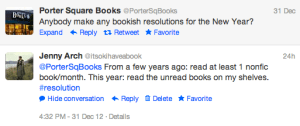
My first successful New Year’s resolution that I made, kept, and remembered, was: read at least one nonfiction book a month. Then, as now, I was reading about 10-15 books a month, and they were nearly all fiction. I decided I needed to push myself to branch out and read in some other areas, like (auto)biography, history, and science. Thus did I discover such excellent books as The Ghost Map, The World Without Us, The Man Who Loved Books Too Much, and The Wordy Shipmates, not to mention Tina Fey’s Bossypants and Keith Richards’ Life.

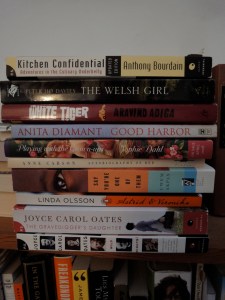
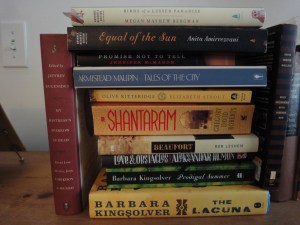
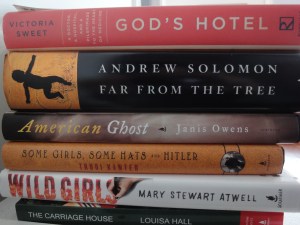
In the years between that resolution and this new year, I have accumulated a number of books that I haven’t yet gotten around to reading. Most are fiction, but some are nonfiction. Most I’ve bought used, some have been sent to me by thoughtful and generous friends. It used to be that if a book was in the house, I had read it or was in the process of reading it; now that’s not the case. (Partly because I work in a library; I’m surrounded all the time by free books that I can just borrow and give back, and which always seem to take precedence over the books that I own, which don’t have due dates.)

bookishresolutionI want to get through my shelves of unread books, either by reading them or by deciding that I don’t want to read them. After I’ve read them, I may keep them, may donate them, or may pass them on to friends, but there are too many unread books in the house.

So help me out: have you read any of the below? Loved them? Thought they were a waste of time? A few came with personal recommendations and are at the top of the list: Far From the Tree, God’s Hotel, Shantaram. If you’ve got opinions on those or any of the others, please share!


unread1unread2unread3


More 2012 favorites

Cross-posted as “Favorites of 2012” on the Robbins Library blog.

My colleague Linda posted her favorite reads of the year a few days ago, and we’ve definitely enjoyed some of the same ones: I too would highly recommend the fresh and funny Where’d You Go, Bernadette?the wise, wonderful and heartbreaking The Fault in Our Stars, the paranoia-inducing Gone Girl, and the erudite essays in More Baths, Less Talking.

To these, I’ll add a few of my own, with links to reviews (below). These are books I’ve read in 2012, not necessarily books published in 2012, though many of them were.

Fiction

gold2 Gold by Chris Cleave

The Light Between Oceans by M.L. Stedman

Cascade by Maryanne O’Hara (this is our Staff Picks book for February, and Maryanne herself will be joining us for the discussion!)

The Language of Flowers by Vanessa Diffenbaugh

rulesofcivility Rules of Civility by Amor Towles

Billy Lynn’s Long Halftime Walk by Ben Fountain

Bring Up the Bodies by Hilary Mantel (sequel to Wolf Hall; both books won the Booker Prize)

Arcadia by Lauren Groff


The Thousand Autumns of Jacob De Zoet
by David Mitchell (author of Cloud Atlas)

Vaclav and Lena by Haley Tanner

Maine by J. Courtney Sullivan

Fault in our Stars The Fault in Our Stars by John Green

My Sister Lives on the Mantelpiece by Annabel Pitcher

Nonfiction

Let’s Pretend This Never Happened: A Mostly True Memoir by Jenny Lawson (a.k.a. The Bloggess)

The Wordy Shipmates by Sarah Vowell (I listened to the audiobook)

Agree? Disagree? What are some of your recent favorites? Leave a comment!

Favorite Books of 2012

Today at work, I got an e-mail requesting staff send in their picks for favorite books of 2012. (Have I mentioned how much I like working in a library?) We were to submit no more than three each, which as every avid reader knows is a difficult-to-impossible task. However, it’s easier to think of it as “three of your favorite books” rather than “your three favorite books.”

With that caveat in mind, I headed over to my Goodreads page (I ❤ Goodreads) and sorted my shelf of books I had read by date read. Mentally, I filtered out books that were published before 2012; this meant I couldn’t include obvious shoo-in Rules of Civility by Amor Towles or The Language of Flowers by Vanessa Diffenbaugh, both published in 2011.

And yet: so many good books came out this year! The marvelous John Green’s The Fault in Our Stars, Maria Semple’s fresh and original Where’d You Go, Bernadette?, Hilary Mantel’s Bring Up the Bodies, the much-feted sequel to Wolf Hall…and then there are the nonfiction books, such as Jenny Lawson’s laughter-and-tears-inducing memoir, Let’s Pretend This Never Happened, and Ken Jennings’ clever Because I Said So: The Truth Behind the Myths, Tales, and Warnings Every Generation Passes Down to Its Kids.

Yet in the end, here are the three I chose:

gold2GOLD by Chris Cleave
Set before and during the London Olympics, Gold is timely; yet it is timeless in the way that it represents people’s best and worst natures, particularly the struggle between career ambitions and family life. Kate and Zoe are close friends and rival cyclists, competing for one spot on the London Olympic team. Zoe is focused solely on training, while Kate has a family: her husband Jack, another Olympian, and their eight-year-old daughter Sophie, who is battling leukemia. Flashbacks to earlier periods in the characters’ lives reveal crucial backstory in this wrenching novel.

lightbetweenoceansTHE LIGHT BETWEEN OCEANS by M.L. Stedman
This is a beautiful book with strong characters and a thought-provoking central dilemma. Tom Sherbourne returns from fighting in the Great War and takes a job as a lighthouse keeper on a remote island of the coast of Australia; he and his wife, Isabel, are deeply in love, but Isabel is inconsolable over her inability to have a child. When a lifeboat washes up on their beach containing a dead man and a live baby, Isabel begs Tom to keep it. The Light Between Oceans is the extraordinary story of that decision, and of how to act in the present when the past cannot be changed.

cascadeCASCADE by Maryanne O’Hara
“Life is full of tough choices between less-than-perfect alternatives,” says one character in this Depression-era novel, and that about sums it up for twenty-six-year-old Desdemona Hart. Dez married Asa Spaulding to provide stability for her ailing father, who died a few months later. Asa doesn’t understand Dez’s reluctance to start a family, but traveling artist Jacob does: Dez wants to go to New York City to pursue her career in art. On top of this dilemma, the town of Cascade is itself at risk: men from Boston visit the town as a potential site for a new reservoir. Will Dez fight to save the town and her father’s famous playhouse, or will she flee to follow her dream? The historical setting is vivid, and Dez is a compelling character; the decision she must make is one that many people still face today.