Researching and Writing Historical Fiction

Cross-posted as “Truth in Fiction” on the Robbins Library blog.

As November, otherwise known as National Novel Writing Month (NaNoWriMo), was drawing to a close, I had the opportunity to attend a program that I had set up at the Robbins Library: authors Margot Livesey and Adam Braver came to have a conversation about researching and writing historical fiction. Margot is the author of, most recently, The Flight of Gemma Hardy, a retelling of Jane Eyre; Adam’s newest novel is Misfit, about Marilyn Monroe.

Do you research first and write after, write and research at the same time, or write first and research after? “Research feeds imagination,” said Livesey. She does some preliminary research before writing, just enough for a chapter or a draft, then researches retrospectively as needed. Both authors agreed that they could get bogged down or sidetracked, and that research could be an excellent procrastination tool.

Braver said he will look up facts he needs as he writes, and “sometimes it leads to something [else],” but he also does a large amount of preliminary research, using newspapers and interviews. Both authors said they have worked and researched in public libraries, using newspapers, microfilm and microfiche, and of course books. At home, Livesey has two computers: one that “doesn’t know the Internet exists,” and another that is online. She writes on the offline computer, and only goes to the online one if she really needs to look something up.

How do you manage to spend so much time with your novels and not get sick of them; how do you manage to persevere? “Not getting sick of it is the challenge,” Braver responded. He said he usually goes through 15 – 20 revisions per book, and would often like to quit when it’s “good enough,” but “I’m restless until I feel like it’s right.”

How do you deal with conflicting versions of history? Braver answered that conflicting versions often become the story. Like historians, novelists are looking for the truth behind the facts; the facts may be irrefutable, but the order in which they are told is what makes a story.

How much is fact and how much is fiction? What liberties do you take when you write fiction set in the past? As a reader of fiction, Livesey said, “I count on fiction to tell me the truth…be faithful in certain ways.” One might, for example, add a burn unit to a hospital that didn’t have one, but not drop bombs on a city that wasn’t bombed. (Of course, authors can address what’s true and what’s invented in an Afterword.)

“I think readers mind very much about precision,” said Livesey, estimating that about 30% of the mail she receives from readers contains corrections to her work. However, “people are forgiving…unless it’s sloppy.”

What’s the difference between writing about a period some people remember, as opposed to writing about a time no one alive remembers? Braver said that certain periods in the past are viewed “in sepia tone,” and his goal is to “strip away the nostalgia,” and make the reader feel as though, by opening the novel, they are opening a door into the past.

Braver writes about well-known historical figures – President Lincoln, Jackie Kennedy, Marilyn Monroe – but focuses on the periphery, on moments that occurred out of the public spotlight. Livesey’s characters, by contrast, are “modest,” and invented. “Small details of ordinary life,” she said, can be more important than big events.
Librarian by Name

This past summer, Amy Frazier wrote a post on the Hack Library School blog called “Librarian by Name, Geek by Nature.” The post itself deals with the idea of what is taught/learned in Library and Information Science (LIS) programs (a.k.a. library school), and what isn’t. Her article focused on what isn’t taught – what we don’t learn, and what we wish we did.

I rarely read the comments on any blog post or article, but the comments on this one are well worth reading; it’s a real conversation. People weigh in about the importance (or not) of coding skills and other IT skills; other “wishlist” items include more courses on project management, teaching, and customer service.

The desire to learn, not just in school but throughout life, is somewhat characteristic of librarians. One theme that is repeated throughout the comments is that library students and librarians would like to learn more technical skills and coding languages, but the course offerings in most programs are insufficient.

Like many of the participants in the discussion, I went to Simmons, where the only required technology course was Technology for Information Professionals. I lucked out (i.e., fought my way in) and took this class with Michael Leach, who gave us both a conceptual background and some hard skills. Linda Braun’s Web Development and Information Architecture course, though, was the one that made me excited about technology and coding and gave me confidence in the skills I had learned in her class, and in my ability to learn more.

However, I spend a lot of time with software developers – full-time coders  – and the odd technology librarian, and my knowledge of HTML/CSS/PHP pales to nothing next to theirs. (They write in a variety of languages including PHP, JavaScript, C++, Python, Ruby on Rails, and others.) As Andromeda Yelton wrote, “We can always find people who make us feel inadequate as coders. Sometimes it’s genuinely because they’ve forgotten more code than we’re ever likely to know, but most of the time? They know things we don’t because code is big. No one knows all of it.”

Not every librarian needs to be a coding expert, but if the discussion over on Hack Library School is any indication, most want to learn more – or at least have enough of an understanding to communicate with those who do it full-time. At the very least, librarians should be a few steps ahead of patrons in terms of tech-savviness.


NELA, Part III

Here’s my final post about NELA ’12. (Read about Sunday afternoon’s sessions here, and Monday morning’s events here.) The following two sessions were on Monday afternoon:

Library Renewal, Ryan Livergood

Neither publishers nor libraries are happy with the current model(s) of access to digital content (e-books and digital audiobooks) through libraries: not all publishers will sell or license e-content to libraries, and librarians aren’t pleased with the cost, availability, or difficulty. Library Renewal proposes a new model: “fairly priced equitable access to e-content.” To this end, Library Renewal is building the non-profit infrastructure that will allow rights-holders to sell directly to libraries, have transparent pricing, and be easy for patrons to use.

Some have predicted that in ten years, libraries will circulate more digital content than physical content. If one accepts that (a) technology makes libraries more relevant and useful, and (b) communities need libraries to thrive, this new infrastructure begins to look absolutely essential. Furthermore, it streamlines the process: instead of Publishers –> Vendor (e.g. Amazon, OverDrive) –> Libraries –> Vendor –> Patrons, it looks more like Publishers –> Libraries –> Patrons.

Now if only Library Renewal had the same kind of funding as the DPLA.

Reshaping Reference, Julie Kinchla and Patty DiTullio

Julie Kinchla, Head of Information Services at the Winchester Public Library, spoke about opportunities to create change, and types of changes to consider. Opportunities include major and minor renovations, strategic planning, technology upgrades, new staff hires, and analyzing usage statistics. Types of changes include weeding, downsizing the reference desk, redesigning the reference stacks, and offering different types of reference services, such as tiered, roving, or book-a-librarian. New technology (think iPad) makes roving reference a good choice for helping patrons at their point of need, a smaller desk is more approachable, and generic business cards make it easier for patrons to contact reference librarians.

Patty DiTullio, Director of the Amesbury Public Library, spoke about the importance of having a mission and vision for the library. Working in an old building, a small space with significant constraints, DiTullio described implementing a new model – making changes to the circulation and reference desks – as “adventures in change management.” She said that retraining staff was a circular process, not a linear one.

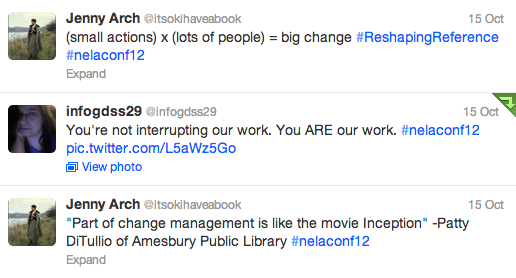
Staff buy-in is important to any change, as is clarification of division of labor (e.g. when does a circ question become a reference question?). Patrons, too, need to be “retrained”; a great sign for the reference desk is “You’re not interrupting our work, you ARE our work.” (A similar sign says simply, “Interrupt me!”)

Even if a brand-new building, major or minor renovation isn’t in the cards, we can all use DiTullio’s formula: (small actions) x (lots of people) = big change

See also: the Swiss Army Librarian’s NELA conference wrap-up.

NELA, Part II

Read NELA Part I here (or scroll down to previous post). Here are my summaries of the first two sessions on Monday; the last two will make up the final NELA post.

Connecting through Social Media panel

Ryan Livergood, Library Director of the Arlington (MA) libraries, led off with some guidelines for libraries using social media. He reminded the audience that social media was more than just advertising and shouldn’t be just one-way, but should be an interactive dialogue that engages the community. When trying to decide which platform(s) to use, he said, “Go where your users are.”

Next, Michael Wick of the Peabody (MA) Institute Library talked about what works in social media: conversations, informing your community, finding a niche, and instruction. (Wick is the local hero who created the how-to videos for downloading e-books from the Wellesley Free Library and throughout the Minuteman network.)

Finally, Ona Ridenour and Allison Babin from the Beverly Public Library talked about how they use Pinterest. They have created many beautiful and useful boards with visually curated content, and in many cases (such as book lists), links to click through to the library catalog. After their presentation, I was much more open to Pinterest than I had been.

The need for a social media policy arose during the Q&A session. Not all libraries have one, though most follow a few rules of thumb: be respectful, create/reuse appropriate content, think twice before posting anything, and follow/friend only other organizations, not people.

The Trouble With E-Books, Scott Kehoe and Danny Pucci

Massachusetts Library System consultant Scott Kehoe outlined the history of the relationship between publishers and librarians, focusing on recent thorny issues surrounding e-books, such as digital rights management (DRM), proprietary hardware and software, and the erosion of the First Sale Doctrine. It’s clear that another solution is necessary; for out-of-copyright works, that solution is already in the works, in the form of the Internet Archive and Open Library.

Digital Projects Librarian Danny Pucci of the Boston Public Library also spoke about e-books (she described OverDrive as the BPL’s “28th branch,” and said it had the second-highest circulation after the main branch, Copley) and digitization. The BPL works with the Internet Archive to digitize library materials and make them available to a wider audience online; visual collections are available on Flickr.


New England Library Association (NELA) Conference

The New England Library Association (NELA) conference was Sunday, October 14 through Tuesday, October 16th. I attended the first two days, and every panel and session I went to was valuable. Plus, it was a great opportunity to see former classmates and colleagues, and meet new people (otherwise known as networking, I suppose).

I’ll just do a brief overview with a few takeaway points from each session I attended. Anyone who’s looking for a more exhaustive analysis, head on over to the official conference blog; if you’re looking for specific play-by-play, search for #nelaconf12 on Twitter.

Keynote Address: Librarians’ New Dawn, T. Scott Plutchak

Plutchak spoke personally about his granddaughter, a digital native who also enjoys print media and sees them not as competitive, but simply as different experiences. Print is part of a rich world and a broad range, said Plutchak, but applying print terms to the digital world is rarely successful.

He affirmed that communities do need librarians’ knowledge, skills, and abilities, and encouraged us to take credit for our work: “Libraries don’t do things, people do things. Librarians do things.” The librarians’ mission and function is to connect people with knowledge, something that’s just as important now as it has always been.

New England Library Leadership Symposium (NELLS) panel

This panel was similar to the one I attended at MLA last May; participants and mentors from NELLS spoke about their experience at the “life-changing” week-long program that was described only half-jokingly as “library summer camp.” The focus is on leading from within, managing change, and appreciative inquiry. ALA president Maureen Sullivan helped develop the curriculum and will be moderating at NELLS 2013.

Beyond the Book Sale: Friends of the Library

Representatives of three different Friends groups, as well as Ernie DiMattia, the president of the Ferguson Library (CT), spoke about how Friends groups can help their libraries. The Friends’ purpose is primarily to raise funds beyond the municipal and state money that libraries receive; one common way to do this is a book sale (annually or ongoing). The Friends often provide funds for library programs, as well as museum passes. They should support and promote the library, and be advocates for the library within the community.

That was all for Sunday; I’ll post about the Monday sessions next.

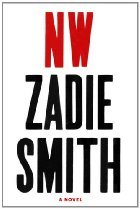
NW by Zadie Smith

Last Wednesday, I rushed home after work to feed and walk the dog, then rushed to the Cambridge Public Library to see Zadie Smith read from her new book, NW, and answer questions. Despite minimal advertising for the program, there was a long line; in addition to the auditorium where she was speaking, the CPL staff opened up an auxiliary room and set up a simulcast; I was one of the last four people allowed into the overflow room, and I was glad just to get in.

Smith read two sections from NW, one from the middle where Felix Cooper visits Annie, and one where Natalie Blake is part of a confrontation in a playground. (The book’s title, which refers to northwest London, reflects the author’s belief that “a novel is a local thing.”) Hearing an author read from her own work is nearly always enjoyable, and in this case it also helped give us Americans an idea of what the various NW characters were supposed to sound like (as we follow Smith’s advice, “Read what isn’t you,” e.g. the unfamiliar).

NW is divided into three parts, each focusing on a different character and each with a different narrative style. Felix’s story, in the middle, was the most straightforward, but only tangentially connected to Leah Hanwell and Natalie (formerly Keisha) Blake’s stories. The book opens with Leah, and ends with Natalie, whose section is broken into numbered segments; part of this ran in The New Yorker before the book was published.

As those who have read Zadie Smith’s work before know, she is fiercely intelligent and it can take some effort to keep up with her writing; additionally, in NW, the shifts in writing style will keep you on your toes. All three of the main characters grapple with their past, present, and future: in short, their identities. Though the writing is nontraditional and the characters are confused about who they are, NW has, in a way many other novels don’t, “thematic coherence” that resonates.

Read my full review, with quotes, on Goodreads.

Banned Books Week: Celebrating the Freedom to Read

Preparing for Banned Books Week at the library (September 30-October 6), I’m getting excited ahead of time. The American Library Association (ALA) has several cool badges and banners available to download for free (remember to give credit for the images if you use them).

Reprinted by permission of the American Library Association.

On the ALA site, you can also see lists of the most frequently banned/challenged books, by author, year, or decade. You can also see that almost half of the Radcliffe (now Columbia) Publishing Course Top 100 Novels of the 20th Century have been challenged or banned; if you did any of your assigned reading in school, I can pretty much guarantee that at least one of those books is on that list.

The most frequently challenged/banned books list is overwhelmingly comprised of classics (think To Kill A Mockingbird and Brave New World) and young adult literature (The Giver, A Wrinkle in Time, Harry Potter). The most common reasons for challenges are “sexually explicit,” “offensive language,” and “unsuited to age group,” and the most likely challenger, by a tremendous margin, is a parent.

I was fortunate that during my childhood and adolescence, my parents, teachers, and librarians never told me I couldn’t read a book. Reading has always been a positive part of my life, not something that ever harmed me – even when I was reading material “unsuited to my age group.”

Let’s all celebrate our freedom to read, not just September 30-October 6, but all year, every year – because reading is magic.


The Song of Achilles by Madeline Miller

An alternative title for this post, taken from author Madeline Miller’s event last night at Porter Square Books, could be: Mythological Fiction: “Am I really having a centaur in my novel?”

 “Mythological fiction” is how Miller categorizes her novel, The Song of Achilles, rather than historical fiction or simply literary fiction, and it’s apt: The Song of Achilles is a retelling of part of Homer’s Iliad, complete with heroes, gods, and mortals. Authors who choose to adapt or retell myths have a choice, said Miller, to write the gods as characters or to explain away their presence (e.g., Was it Poseidon or an earthquake?). Miller chose to include the gods as characters, notably Achilles’ sea-nymph mother Thetis, and his and Patroclus’ teacher, the centaur Chiron.

 Miller’s impetus for writing The Song of Achilles was Achilles’ extreme grief over Patroclus’ death in the Iliad. To explain Achilles’ reaction to Patroclus’ fate, she writes about their adolescence and coming of age together from Patroclus’ point of view. The Song of Achilles tells an ancient story in an accessible way; the writing is both modern and lyric. Of adapting Homer’s original material, Miller said, “Great artists [such as Homer] understand human nature…the stories in the past illuminate the present…great art has great psychological insight.” The story seems modern because human nature has not changed: pride, love, grief, and revenge are as familiar to us now as they were three thousand years ago.


Why it makes sense to support public libraries

State Stats has created an awesome infographic about why it makes sense to support public libraries, especially during economic downturns. Unfortunately, economic downturns are precisely the times that library budgets tend to get slashed (or, in the best cases, level funded). No matter who you are – job-seeker, student, parent, someone who doesn’t want to (or can’t afford to) pay for books and movies – the library helps you! So please, take two minutes to read the infographic and pass it on.