Anne Fadiman: “Never Do That To A Book”

Anne Fadiman, author of Ex Libris: Confessions of a Common Reader (and other books), spoke at the Main Branch of the Cambridge Public Library on April 1 as part of Harvard University’s 375th Anniversary. In her talk she revisited the subject she addressed in one of the essays in Ex Libris, “Never Do That To A Book”: in short, she identified two different types of book lovers, the “courtly” and the “carnal.” Courtly lovers treat the book as a sacred object; carnal lovers have a more physical relationship with books – folding down pages, underlining, highlighting, and writing marginalia, and in the odd case, using bacon for bookmarks.

Though Fadiman was most likely correct to say that “Everyone in this room loves books, but not in the same way,” most of the audience identified themselves as somewhere in the middle of the courtly/carnal scale. Fadiman is, by her own admission, a carnal lover of books, believing that marginalia is “a way of turning a monologue into a dialogue.” Reading, she believes, “is a relationship like any other.”

Fadiman also said, early in her talk,”The story of our lives is the story of our books,” which reminded me of a fragment of a poem (“Improvisations of the Caprisian Winter”) by Rainer Maria Rilke (translated by Franz Wright):

So many things lie torn open
by rash hands that arrived too late,
in search of you: they wanted to know.

And sometimes in an old book
an incomprehensible passage is underlined.
You were there, once. What has become of you?

I am also somewhere in the middle of the courtly/carnal book lover scale; in books that I own, I have written and underlined (but only in pencil). I have folded down the corners of pages (but only until I finish the book – then I write down all the quotes I wanted from the dog-eared pages and un-dog-ear them). I do not splay books face-down; I do not highlight; I do not sleep with them under my pillow (though there is a stack on the nightstand and another stack on the floor).

And of course, whether the book was my own or belonged to the library, I would never use bacon for a bookmark.

Booktalk

A booktalk is exactly what it sounds like: a talk about books. Earlier this month, I gave a booktalk to the Wilmington Women’s Club at the library; it was a lot of fun picking the books, writing up a booklet ahead of time, and giving the talk.

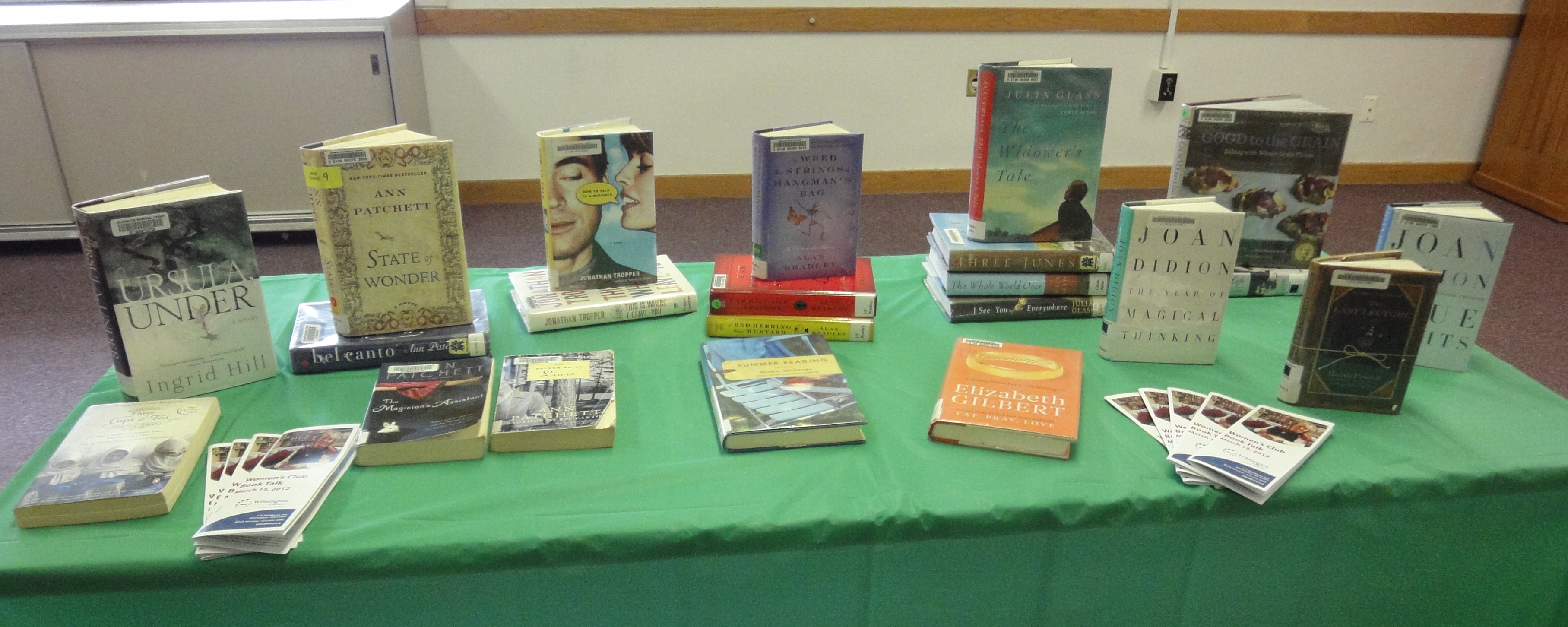
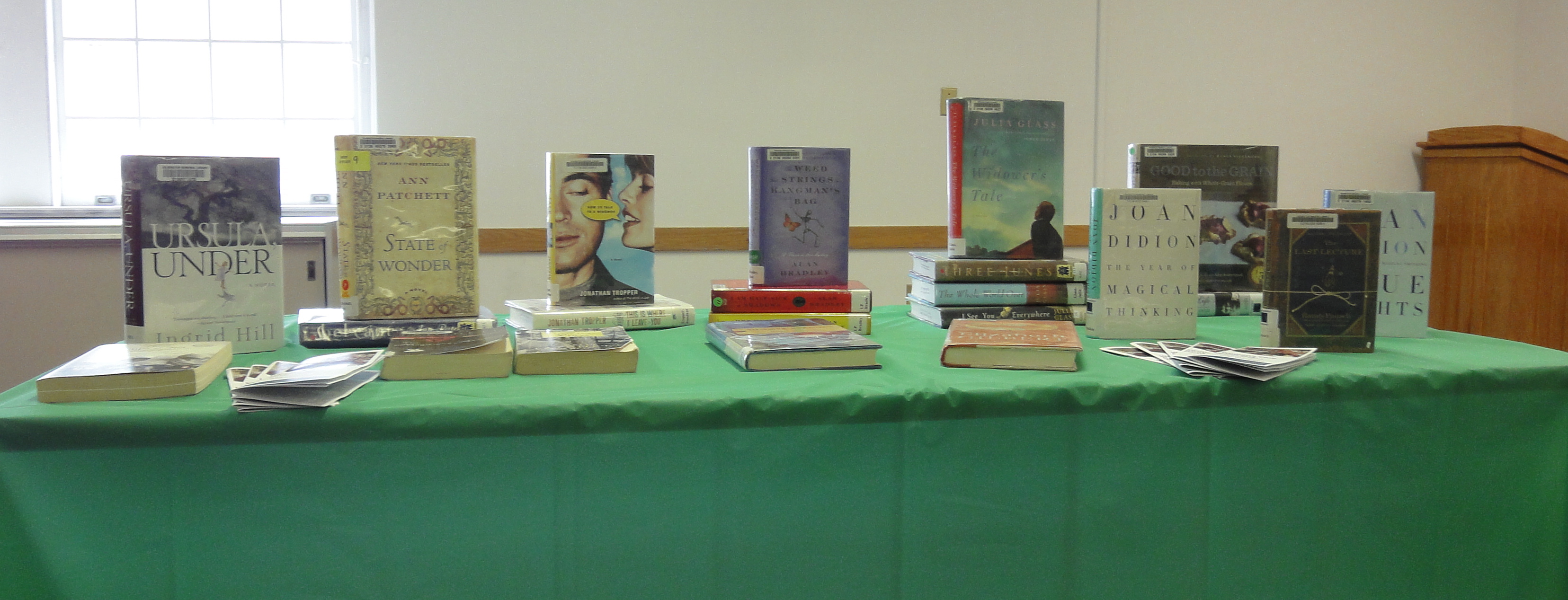
Right before the talk, I pulled all of the books I could find from the shelves and created this display. Some of the books were out, of course, but most are here, and in some cases I included the authors’ other books, if s/he had any.

From left to right: Ursula, Under by Ingrid Hill; State of Wonder, The Magician’s Assistant, The Patron Saint of Liars, and Bel Canto by Ann Patchett; How to Talk to A Widower and Then We Came to the End by Jonathan Tropper; Summer Reading by Hilma Wolitzer (An Available Man wasn’t available); Alan Bradley’s Flavia de Luce books (The Sweetness at the Bottom of the Pie is the first); Commitment by Elizabeth Gilbert; The Widower’s Tale, Three Junes, The Whole World Over, and I See You Everywhere by Julia Glass; The Year of Magical Thinking and Blue Nights by Joan Didion; Good to the Grain by Kim Boyce; and The Last Lecture by Randy Pausch and Jeffrey Zaslow (author of The Girls From Ames).

Not pictured (fiction): Her Fearful Symmetry and The Time Traveler’s Wife by Audrey Niffenegger; Wayward Saints by Suzzy Roche; The Flight of Gemma Hardy by Margot Livesey; The Tea Rose by Jennifer Donnelly; The Paris Wife by Paula McLain; I Married You for Happiness by Lily Tuck

Not pictured (YA): The Hunger Games by Suzanne Collins; The Fault in Our Stars by John Green

Not pictured (biography/memoir): Bossypants, Tina Fey; The Happiness Project, Gretchen Rubin; My Life in France, Julia Child and Alex Prudhomme; An Exact Replica of a Figment of My Imagination, Elizabeth McCracken

Not pictured (nonfiction): The Girls From Ames: A Story of Women and Friendship by Jeffrey Zaslow; The Spirit Catches You and You Fall Down by Anne Fadiman; The Girls Who Went Away by Ann Fessler; The Ghost Map by Steven Johnson

Hopefully, there’s something for everyone!

Do not pass Go, do not collect two hundred dollars: Apple and the publishers vs. Amazon?

Do you buy e-books? Did you feel surprised, taken aback, betrayed, indignant, outraged when the average e-book price suddenly jumped from $9.99 to $12-15? Now: have you thought about why those prices changed?

First, it’s important to understand that $9.99 is not the actual cost of an e-book: Amazon set that price point, and they were taking a loss on every e-book sale, in the hopes of luring more and more customers to buy their Kindle e-reader. Amazon was able to set e-book prices because they bought the books from publishers on the “wholesale” model: Amazon paid the publishers about half the cover price of the book, then set its own price for its customers.

A quick note about the real cost of a book: just because it’s a digital version – an e-book – rather than a book printed on paper doesn’t mean it was free to produce. Authors, editors, publicists and marketing people still had to be paid, offices still had to have lights on and computers running. The cost of paper and printing is somewhere in the neighborhood of $3 for a hardcover, less for a paperback.

So with the wholesale model, publishers could not set their own prices for books. With the “agency” model, however, they could: when Apple entered the e-book market, it allowed publishers to set their own prices and take 70% (Apple taking the remaining 30%). Apple also “reportedly stipulated” that publishers who used the agency model couldn’t sell their books for less to anyone else; thus, no more selling to Amazon on the wholesale model. The price change across the board is what drew the attention of both consumers and of the Justice Department, which is threatening Apple and five of the “big six” publishers with “allegedly colluding to raise prices.” (Never mind when airlines change their prices and policies one suspiciously close to the other. And do not get me started on cable companies. Or Amtrak.)

However, Washington Post columnist Steven Pearlstein advises the long view in this situation. True, when Apple broke up Amazon’s de facto monopoly, prices for consumers went up, not down; but, he points out, “What looked to consumers like a great bargain at $9.99 a book looked to others in the industry suspiciously like predatory pricing, or selling below cost today in order to gain a monopoly and raise prices in the future.” Which is better, he asks, “a market in which Amazon uses low prices to maintain its e-book monopoly and drive brick-and-mortar bookstores out of business, or one in which the major book publishers, in tacit collusion with Apple, break Amazon’s monopoly and raise prices?”

When you think about it that way, maybe paying an extra few dollars for your e-books is worth it.

Internet Archive

After having written about the Digital Public Library of America (DPLA) recently, it’s only fair that I should write about the Internet Archive as well. (Brewster Kahle, founder of Digital Librarian of the Internet Archive, is actually on the DPLA Steering Committee, so the two organizations are linked.) The Internet Archive is, quite simply, an Internet library. It is a nonprofit and was founded in 1996, so it’s been around for some time now.

One of its cool features is the “Wayback Machine,” which allows you to plug in a URL and pick a date to see what a given website looked like, say, ten years ago (if it was around then).

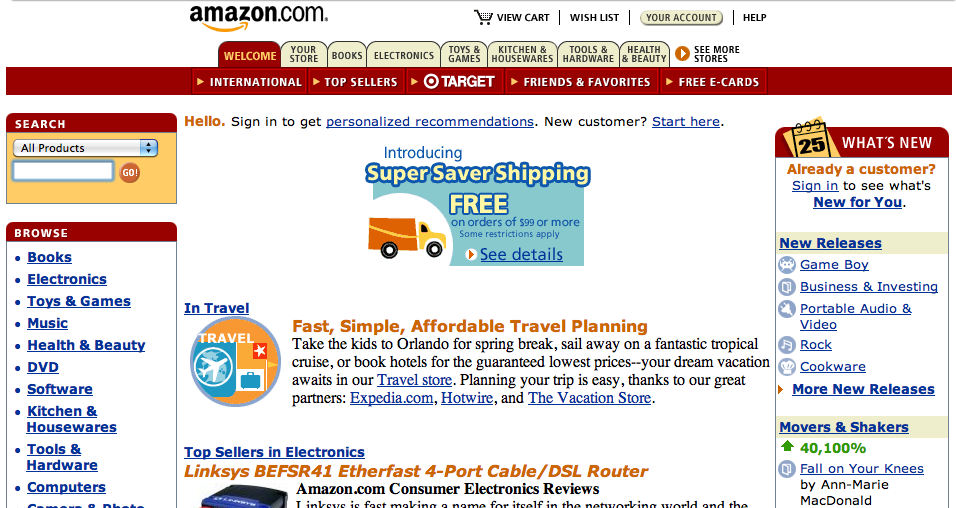
Amazon.com was around in 2002; let’s see what it looked like, shall we?

A little different than it looks today.

So the Wayback Machine is fun to play with (also, useful). And the Internet Archive’s digital library is a great project; but just in case digital copies aren’t enough, Kahle is also building a physical library (or, as The New York Times poetically puts it, an ark). “In case of digital disaster,” the article states, Kahle’s goal is to collect one copy of every book. Kahle said, “We must keep the past even as we’re inventing a new future. If the Library of Alexandria had made a copy of every book and sent it to India or China, we’d have the other works of Aristotle, the other plays of Euripides. One copy in one institution is not good enough.”

Considering how many various file formats and digital storage options we have already gone through in the past few decades, keeping one hard copy of every book isn’t a bad idea. Think about it: if you have some files on a floppy drive from 1998, can you still access them? And if you can’t access them, do they really exist, practically speaking? Whereas a book printed at the birth of the printing press hundreds of years ago can still be read by pretty much anyone (well, anyone patient enough to make their way through a whole variety of spellings).

A Day in the Life

Toward the end of this TechCrunch article about how Random House just tripled the price of ebooks for libraries, there was a link to this well-written, insightful blog post on MetaFilter about why libraries are not anachronistic – about why, in fact, they are more essential than ever.

In the post, the author urges the reader to “imagine this: you’re 53 years old, you’ve been in prison from 20 to 26, you didn’t finish high school, and you have a grandson who you’re now supporting because your daughter is in jail. You’re lucky, you have a job at the local Wendy’s. You have to fill out a renewal form for government assistance which has just been moved online as a cost saving measure (this isn’t hypothetical, more and more municipalities are doing this now). You have a very limited idea of how to use a computer, you don’t have Internet access, and your survival (and the survival of your grandson) is contingent upon this form being filled out correctly.”

Then the author goes through every step of the scenario, and concludes, rightly, “If you have any concept of a free and equal society, then libraries are still an integral part of that.”

Building the Digital Public Library of America

On Friday a friend and former classmate and I went to the “Building the Digital Public Library of America” program at Harvard, where Robert Darnton and John Palfrey both spoke and answered questions. Darnton is the Director of the University Library and also a professor at Harvard, as well as a co-founder of the DPLA, and the author of The Case for Books, among many others; Palfrey is also a Harvard professor and the chair of the DPLA steering committee, as well as the author of Born Digital and other books.

The DPLA is envisioned as “an open, distributed network of comprehensive online resources that would draw on the nation’s living heritage from libraries, universities, archives, and museums in order to educate, inform and empower everyone in the current and future generations.” Naturally this goal is viewed by some as utopian or simply impossible, but as Darnton said Friday, “We don’t have answers, [but we do have] the determination, expertise, funds, and public support…We will make it happen.” Calling the DPLA a big task is an understatement, but, Palfrey said, “This is exactly the moment to think this big…[if we don’t] we are falling short.”

There are design challenges and technical challenges, but “these challenges can be met and will be met,” said Palfrey. As for what exactly the DPLA will contain or look like, he said, “What is the DPLA? We’re not sure yet. And we’re not sure on purpose.” People have dedicated themselves to workstreams for the five elements of the DPLA: code, metadata, content, tolls & services, and community.

The biggest challenge is that of copyright; it’s why Google Books ultimately failed. In order to succeed, there must be some agreement between the creators (authors), the publishers, and the service/platform/distributors. Unlike Google Books, the DPLA aims to provide free access, not commercial access, to a broad public. Behind the DPLA is the belief that access to information is (a) the right of citizens, and (b) fundamental to democracy.

Models of this type already exist; one is Europeana, “a single access point to millions of books, paintings, films, museum objects and archival records that have been digitised throughout Europe. It is an authoritative source of information coming from European cultural and scientific institutions.”

The digital divide is one concern; despite the growth of e-readers and e-books, and the widespread (but not complete) availability of Internet access, for many people, print content is still more accessible than digital content, especially when digital content comes encumbered with DRM and other limitations.

Another concern, raised during the Q&A on Friday, is how the DPLA will affect public libraries. The people working on the DPLA are pro-library; many are librarians. Darnton emphasized that they are designing the DPLA “not to undercut public libraries…[but rather] to reinforce public libraries.” The DPLA, he argued, would make public libraries more important: not only could they serve as an access point, but librarians could create and curate local collections. Overall, the DPLA “is a very complex ecosystem and we need guides through it.” Librarians, Darnton says, can be those guides.

This is one of my answers when people ask if librarians are necessary anymore, because “everything is on the Internet.” Perhaps it is (though not everything is Google-able) – but can you find it? The proliferation of information, both in print and online, is overwhelming – “information overload,” anyone? – and most people could use some help sifting through the hundreds, thousands, or millions of search results to find something reliable and relevant. That’s one reason why librarians are necessary – and this librarian is excited to search within the DPLA as soon as it is up and running, just over a year from now.
Bookstores and Libraries

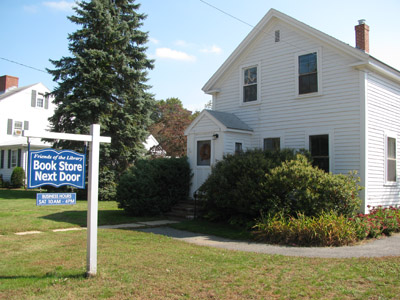
The Boston Globe ran an article yesterday about bookstores connected with libraries. The Book Store Next Door, run by the Friends of the Wilmington Memorial Library, is cited as an example. TBSND brings in funds for the library, and it’s a great place for community members to pick up cheap used books as well. Plus it’s in a charming little house – definitely worth a visit if you’re in the area!

Photo courtesy of the Wilmington Memorial Library.

A longer post about the process of weeding in libraries – i.e. getting rid of books – is in the pipeline.

Free Library of Philadelphia

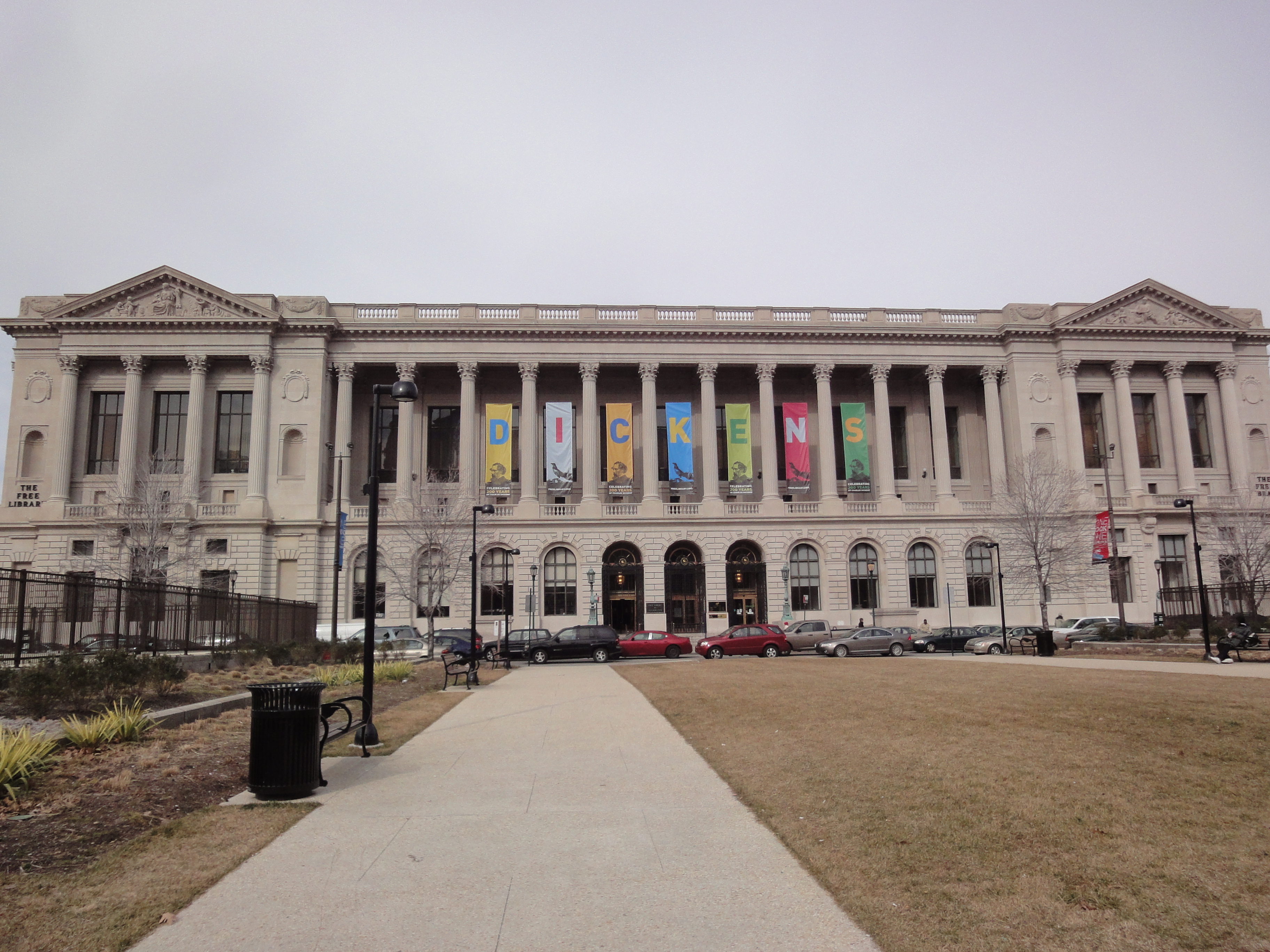
On a recent visit to Philadelphia, I went into the Free Library of Philadelphia (open on Sundays!). Part of it was closed for renovations, but the building itself is beautiful and there was a neat exhibit on Dickens.

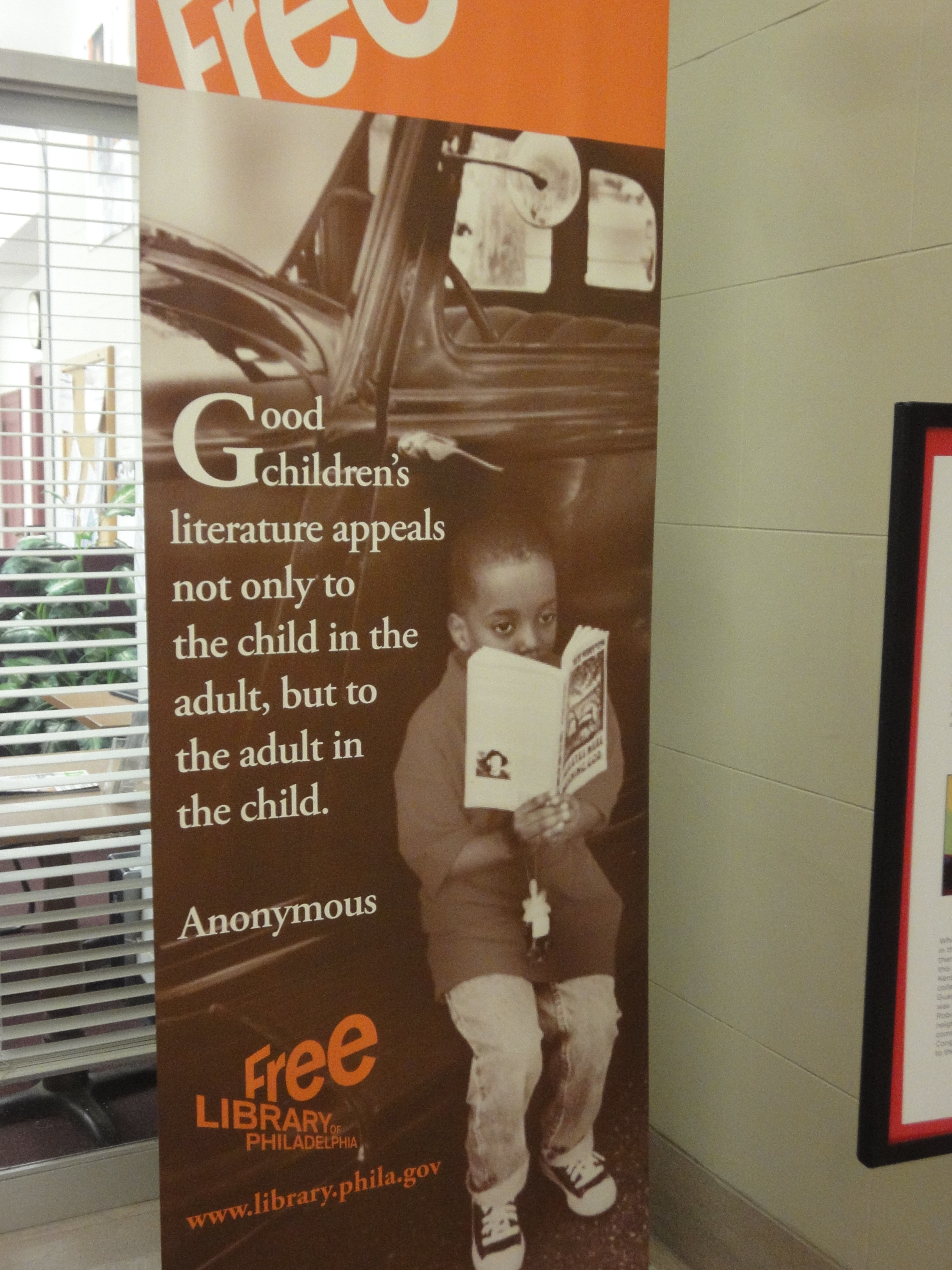
On the way out, I saw this quote on a sign:

“Good children’s literature appeals not only to the child in the adult, but to the adult in the child.” -Anonymous

Something to think about.

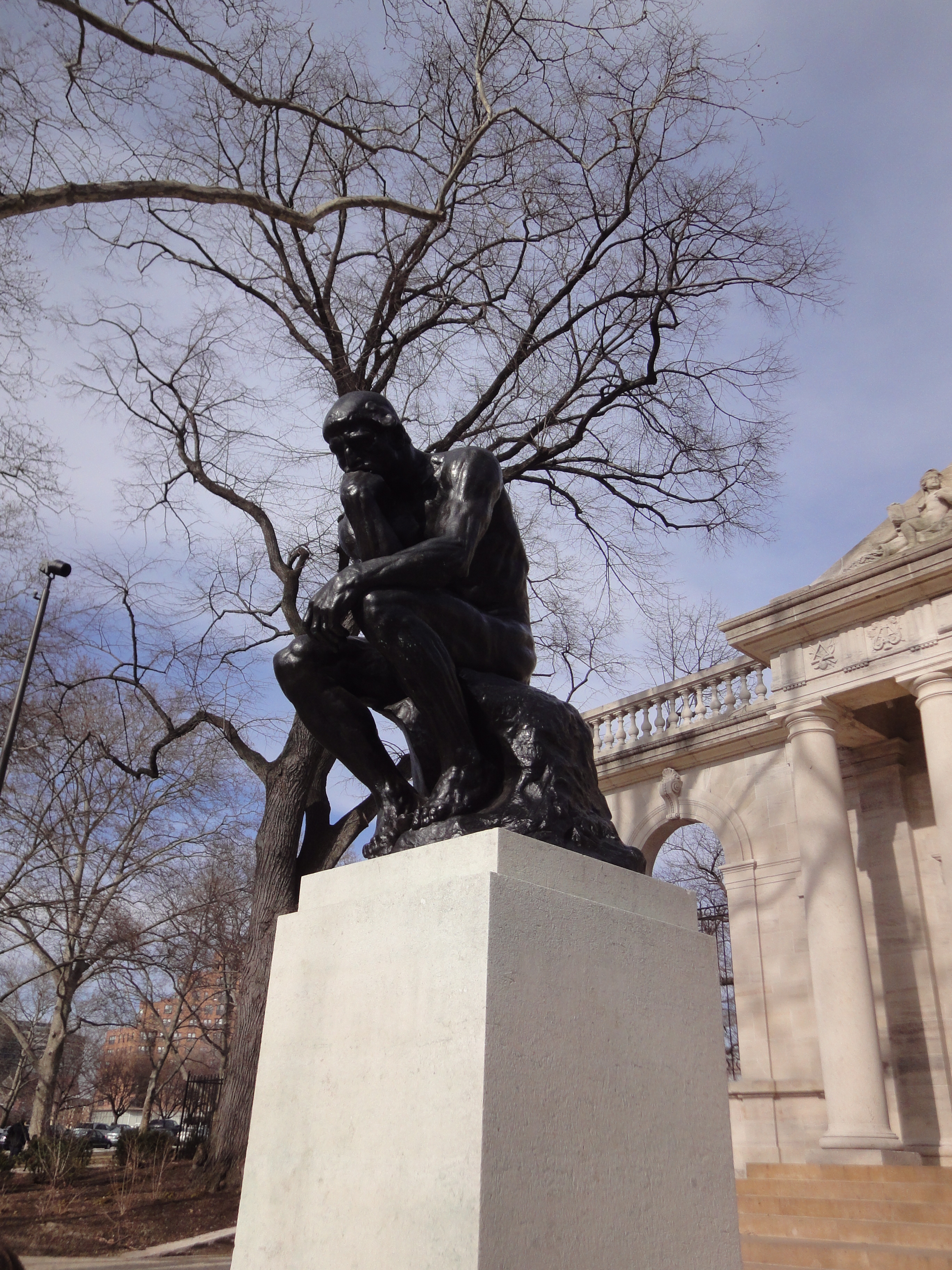
(The Rodin Museum is just a quick walk from the library. The Thinker (above) is there, as well as The Gates of Hell and The Burghers of Calais. Worth wandering by if you’re in the area!)

Research and Publication

Two recent pieces in the New York Times – an article and an op-ed – address the issue of the publication of scientific research, and access to that research. The op-ed, “Research Bought, Then Paid For” by Michael Eisen, the founder of the non-profit, open-access Public Library of Science (PLoS), argues that research that was funded or subsidized by taxpayers ought to be available to those taxpayers free of charge. In a nutshell, “if taxpayers paid for it, they own it.” Eisen encourages scientists to publish their work in open-access journals instead of journals like Science, Nature, and Cell, which charge steep subscription fees – often to the same universities whose researchers submitted the papers and provided peer-review services for free.

The January 16 article “Cracking Open the Scientific Process” explains the issue in a slightly more balanced way (and reveals that some open-access journals, PLoS included, charge authors publication fees to authors). However, though of course the issue is more complicated than it appears at first glance, Eisen has a point about the principle of the thing: publicly funded research should be available to the public. Additionally, as the Jan. 16 article illustrates, many sites allow and encourage collaboration and networking, enhancing the scientific community and helping solve research questions more quickly.

I am reminded of the TED Talk on Open-source cancer research, wherein researcher Jay Bradner published and shared research instead of patenting it – the opposite, he pointed out, of what a pharmaceutical company would do – based on the principles of open-source and crowdsourcing.

A January 20 article in The Atlantic (“Locked in the Ivory Tower: Why JSTOR imprisons academic research”) also addresses the issue of the “broken economics of academic publishing.” The author summarizes, “Step back and think about this picture. Universities that created this academic content for free must pay to read it. Step back even further. The public – which has indirectly funded this research with federal and state taxes that support our higher education system – has virtually no access to this material, since neighborhood libraries cannot afford to pay those subscription costs.” She suggests circumventing the publishers, eliminating the print journal, and putting the content online.

Whether or not that’s the solution that enough people, organizations, and institutions eventually coalesce around, it’s clear that something must be done about the current state of academic research and publication – and it will probably happen sooner rather than later.

Edited to add (2/4/12): Some researchers, inspired by open-access champion Peter Suber and British mathematician and Fields medalist Tim Gowers, are boycotting the journal publisher Elsevier.

Technology as a means to an end

Earlier this month, there was an op-ed in the New York Times titled “Internet Access Is Not a Human Right.” One of the main points of the piece was that internet access is always a means to an end – the “end” being some kind of content or service or tool.

It’s not an exact parallel, but this reminded me of the difference between information literacy – the ability to recognize the need for information, and to locate, evaluate, and use that information effectively – and information technology skills. Likely, you’ll need certain technology skills in order to locate information, but just because you know how to use search engines, databases, or online catalogs does not mean you have all the other skills as well.

As the Association of College & Research Libraries (ACRL) states, “Information literacy, while showing significant overlap with information technology skills, is a distinct and broader area of competence. Increasingly, information technology skills are interwoven with, and support, information literacy.” However, they aren’t the same thing. The means to access information has changed, is changing, and will continue to change in the future; ensuring that everyone has the right to access and the skills to do so  is the important thing.