Library Q&A

Stack Exchange, “a network of free, community-driven Q&A sites,” now has a Library and Information Science site in beta. Most of the library Q&A I have seen has been through LinkedIn groups’ discussions (mostly ALA), so this seems like a great forum for detailed, professional questions.

Because librarians are all about sharing knowledge, I’m optimistic that this site will be successful if enough library professionals know about it. So, librarian-friends, check it out! Read the FAQ before jumping in and asking/answering.

Massachusetts Library Association Conference

I was lucky to be able to attend MLA today. I heard some great speakers and panels and met some inspiring (and friendly!) people. “The Future of Libraries: The Next Generation,” featuring six panelists who have only been librarians for five years, was excellent, and skillfully moderated by Maureen Sullivan. One of my favorite audience questions to this panel was “What is your hope for your profession that will keep you in it?”

The next panel, “The Future of Library Leadership,” featured participants in the 2011 New England Library Leadership Symposium (NELLS). All had insightful things to say and great examples of their leadership skills in action; all demonstrated the value of close relationships with professional peers. Though many NELLS participants were in management positions, some were not, proving that leadership is not just for managers.

I’ll go into both these panels in more depth in future posts; I’ll also touch on the “Reading Women” talk, Random House Book Buzz, and the closing keynote (Maureen Sullivan, Keith Fiels, and Molly Raphael). More to come!

“I can’t imagine not wanting to learn.”
-Jeremy Shaw-Munderback, “Next Generation” panelist

Real Good for Free

I’ve read a lot of articles and blog posts over the past few years about e-readers, e-books, and the resulting tension between publishers and libraries. In the “Sparring Over E-Books” section of her article “Changing Policies on Digital Books Wreak Havoc on Libraries,” Jenny Shank repeats the publishers’ argument about “friction.” Essentially, publishers are fine with libraries lending books to patrons for free, as long as it is slightly more difficult for people to use the library than to buy books in a store or online. However, if it’s just as easy to borrow a book from the library as it is to buy it, then (the argument goes), sales will plummet.

Let’s backtrack to the days before online ordering, when buying a book meant going to a bookstore, and borrowing one meant going to the library. If you got a book from the library, you had to return it, meaning you had to make one extra trip; if you bought the book, you didn’t have to go back to the bookstore until you wanted to. An extra trip is a little extra friction, a little added inconvenience (assuming you aren’t the kind of person who goes to the library every week whether your books are due or not).

With online sales of both e-books and print books, it became much easier to buy books and have them shipped to you; frictionless, one might say (except for the friction of the money leaving your account). Now that libraries are also offering e-books – or at least trying to – some publishers are objecting that there ought to be some inconvenience introduced to the process, that it should be harder to borrow an e-book than to buy one. To these publishers I say: have you ever tried to borrow an e-book from a library? For most systems, “one-click” doesn’t enter into it.

But for argument’s sake, let’s pretend borrowing an e-book from a library is as easy as buying and downloading one from Amazon or Barnes & Noble (or one of the independent bookstores that offers e-books). People have been able to get books from the library for free for years. And has that caused the collapse of the publishing industry? No, it has not. (Remember: libraries buy their books from publishers! Libraries are customers, too. And libraries buy a lot of books.)

One book borrowed does not equal one lost sale. In fact, people who borrow are also people who buy; this is true of music as well as books, as Christopher Harris points out in American Libraries (“Giving Away Music Increases Sales…Just Like For Books”).

The title of this post comes from a Joni Mitchell song. “Real Good for Free” is on the album Miles of Aisles.

Treasure Hunt

Professor Greg Downey at the University of Wisconsin-Madison created an amazing assignment for his digital native students: find information that’s not online. And where did most of them turn for help? Libraries!

In the User Instruction course I took last fall, we spent a lot of time discussing “one-shot” instruction: those 45-minute or hour-long sessions an instruction librarian might get with a freshman class to teach them everything they need to know about the library (hint: impossible. Remember, some people get Master’s degrees for this). Usually, librarians concentrate on the online catalog and one or two major databases, and that’s all they have time for.

Downey, however, clearly recognizes the importance of research, online and off, as well as all that libraries have to offer, in terms of physical materials as well as online databases and additional software and technology. This assignment reflects that recognition and respect for libraries and research; it’s also a great reminder that not everything is available on the Internet.

I’ve heard that “librarians like to seek; everyone else likes to find.” Finding is certainly satisfying, but it seems like Downey’s students got into the seeking aspect as well, and that’s what good research is about. Great assignment!

Happy National Library Week!

April 8-14 is National Library Week! Show your support for your library by visiting in person, commenting on or “liking” your library’s social media pages (Facebook, Twitter, etc.) if it has them, participating in Library Snapshot Day on Thursday, volunteering, writing to your library director, or calling or writing to your local government representatives to let them know what libraries mean to you.

One of my favorite library statistics is that on average, a person will pay about $40 per year in taxes to support the library. That is less than the cost of two hardcover books – and libraries aren’t just for books (though they do usually have plenty of hardcovers, paperbacks, ebooks, and audiobooks). They also offer DVDs, public internet access, and programs – from storytime and crafts for kids, to movie screenings, to computer and technology workshops, and much more. What do you love about libraries? Leave a comment!

Let Us Now Praise Libraries, Librarians

An article in the Boston Sunday Globe caught my eye this morning, with the headline “Let Us Now Praise Libraries, Librarians.” (A true librarian would have titled it “Let Us Now Praise Librar*”; hats off to you if you get the joke.) The article’s author, Anthony Doerr, writes about his childhood reading, “Here’s what I think about now: No one ever told me no. Not Mom, not the prim librarians stamping return dates onto slip after slip. No one ever said: This book is outside your age range; this book is too complicated.”

I had a similar childhood experience, reading far ahead of my “age appropriate reading level” and not coming to any harm. I’ve thought about this topic before (see the last three paragraphs of the post “Whose Common Sense?“), and I’m glad to see a similar attitude in print. Doerr writes, “…I worry that we are presenting reading to our kids as a labor to suffer through for which a reward can be earned at the end….The message to young people is obvious: Books are good for you. What’s missing, however, is the idea that sustained reading is magic, a kind of magic that can be wildly addictive, even dangerous.”

He then goes on to create a fantastic analogy, based on the fact that when the brain is stimulated (“when a person is thinking imaginatively and creatively”), it produces endorphins: “Great books are like drugs, readers [are] like junkies, and, yes, to stretch the analogy into absurdity, good librarians [are] like drug dealers.” He finishes, “So, to all you beautiful librarians out there, with National Library Week in the offing….Keep on putting books in the hands of readers, because as every good dealer knows, all it takes is one fix and your patrons are hooked.”

One of the most magical, engaging, imaginative, creative books I can think of is Nick Bantock’s Griffin & Sabine, which is the first of six books (all equally magical) detailing the correspondence between Griffin and Sabine. It’s not your typical epistolary novel (see The Guernsey Literary and Potato Peel Pie Society, also an excellent book), because each postcard and letter Griffin and Sabine exchange is rendered with “their” artwork and handwriting; the reader pulls actual letters out of actual envelopes. (For this reason, my first encounter with the books was in Special Collections at the Mount Holyoke College library.) If you can find these, I highly recommend them; you will find yourself immersed and filled with wonder. “Sustained reading is magic,” indeed.

Anne Fadiman: “Never Do That To A Book”

Anne Fadiman, author of Ex Libris: Confessions of a Common Reader (and other books), spoke at the Main Branch of the Cambridge Public Library on April 1 as part of Harvard University’s 375th Anniversary. In her talk she revisited the subject she addressed in one of the essays in Ex Libris, “Never Do That To A Book”: in short, she identified two different types of book lovers, the “courtly” and the “carnal.” Courtly lovers treat the book as a sacred object; carnal lovers have a more physical relationship with books – folding down pages, underlining, highlighting, and writing marginalia, and in the odd case, using bacon for bookmarks.

Though Fadiman was most likely correct to say that “Everyone in this room loves books, but not in the same way,” most of the audience identified themselves as somewhere in the middle of the courtly/carnal scale. Fadiman is, by her own admission, a carnal lover of books, believing that marginalia is “a way of turning a monologue into a dialogue.” Reading, she believes, “is a relationship like any other.”

Fadiman also said, early in her talk,”The story of our lives is the story of our books,” which reminded me of a fragment of a poem (“Improvisations of the Caprisian Winter”) by Rainer Maria Rilke (translated by Franz Wright):

So many things lie torn open
by rash hands that arrived too late,
in search of you: they wanted to know.

And sometimes in an old book
an incomprehensible passage is underlined.
You were there, once. What has become of you?

I am also somewhere in the middle of the courtly/carnal book lover scale; in books that I own, I have written and underlined (but only in pencil). I have folded down the corners of pages (but only until I finish the book – then I write down all the quotes I wanted from the dog-eared pages and un-dog-ear them). I do not splay books face-down; I do not highlight; I do not sleep with them under my pillow (though there is a stack on the nightstand and another stack on the floor).

And of course, whether the book was my own or belonged to the library, I would never use bacon for a bookmark.

Booktalk

A booktalk is exactly what it sounds like: a talk about books. Earlier this month, I gave a booktalk to the Wilmington Women’s Club at the library; it was a lot of fun picking the books, writing up a booklet ahead of time, and giving the talk.

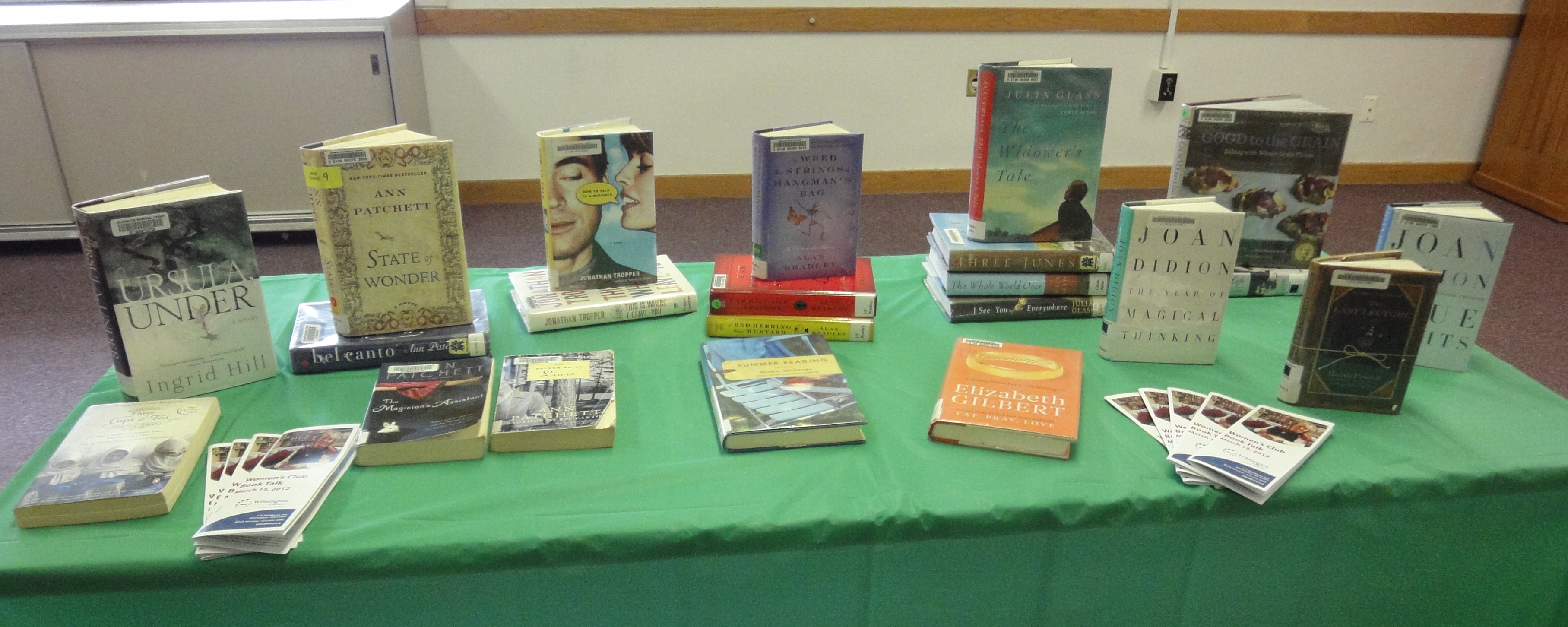
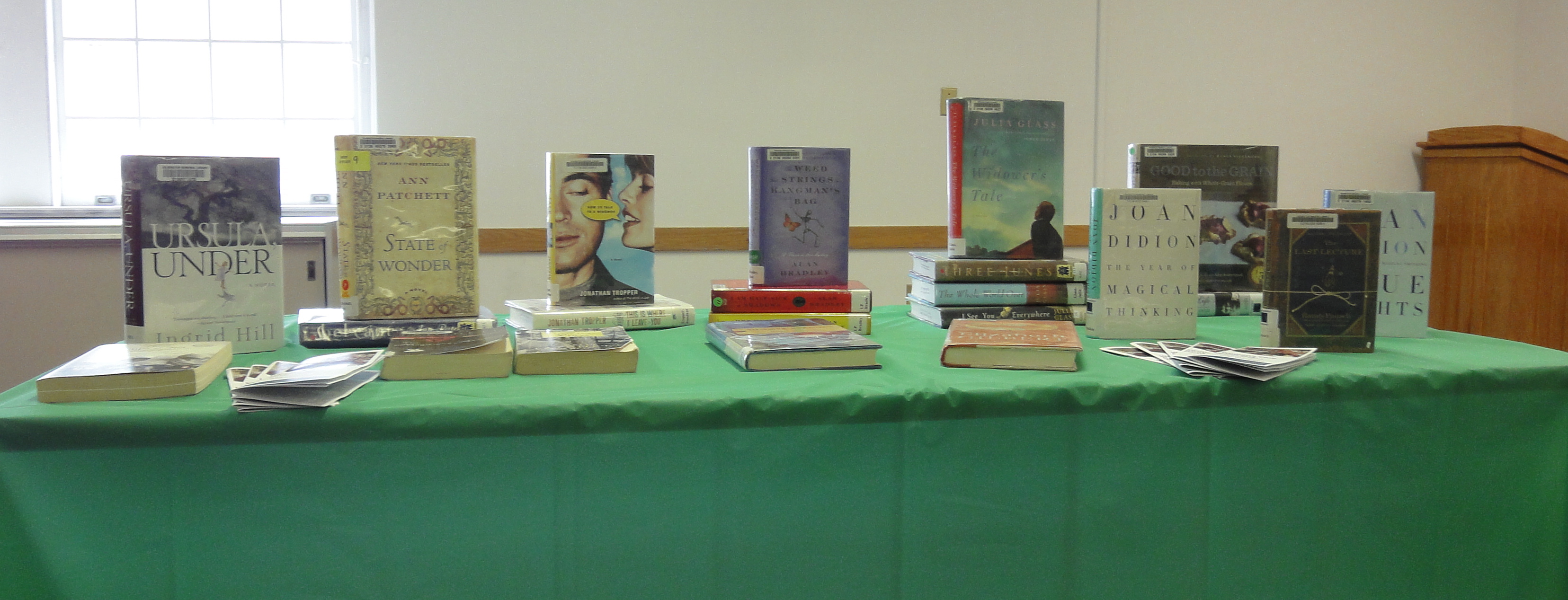
Right before the talk, I pulled all of the books I could find from the shelves and created this display. Some of the books were out, of course, but most are here, and in some cases I included the authors’ other books, if s/he had any.

From left to right: Ursula, Under by Ingrid Hill; State of Wonder, The Magician’s Assistant, The Patron Saint of Liars, and Bel Canto by Ann Patchett; How to Talk to A Widower and Then We Came to the End by Jonathan Tropper; Summer Reading by Hilma Wolitzer (An Available Man wasn’t available); Alan Bradley’s Flavia de Luce books (The Sweetness at the Bottom of the Pie is the first); Commitment by Elizabeth Gilbert; The Widower’s Tale, Three Junes, The Whole World Over, and I See You Everywhere by Julia Glass; The Year of Magical Thinking and Blue Nights by Joan Didion; Good to the Grain by Kim Boyce; and The Last Lecture by Randy Pausch and Jeffrey Zaslow (author of The Girls From Ames).

Not pictured (fiction): Her Fearful Symmetry and The Time Traveler’s Wife by Audrey Niffenegger; Wayward Saints by Suzzy Roche; The Flight of Gemma Hardy by Margot Livesey; The Tea Rose by Jennifer Donnelly; The Paris Wife by Paula McLain; I Married You for Happiness by Lily Tuck

Not pictured (YA): The Hunger Games by Suzanne Collins; The Fault in Our Stars by John Green

Not pictured (biography/memoir): Bossypants, Tina Fey; The Happiness Project, Gretchen Rubin; My Life in France, Julia Child and Alex Prudhomme; An Exact Replica of a Figment of My Imagination, Elizabeth McCracken

Not pictured (nonfiction): The Girls From Ames: A Story of Women and Friendship by Jeffrey Zaslow; The Spirit Catches You and You Fall Down by Anne Fadiman; The Girls Who Went Away by Ann Fessler; The Ghost Map by Steven Johnson

Hopefully, there’s something for everyone!

Do not pass Go, do not collect two hundred dollars: Apple and the publishers vs. Amazon?

Do you buy e-books? Did you feel surprised, taken aback, betrayed, indignant, outraged when the average e-book price suddenly jumped from $9.99 to $12-15? Now: have you thought about why those prices changed?

First, it’s important to understand that $9.99 is not the actual cost of an e-book: Amazon set that price point, and they were taking a loss on every e-book sale, in the hopes of luring more and more customers to buy their Kindle e-reader. Amazon was able to set e-book prices because they bought the books from publishers on the “wholesale” model: Amazon paid the publishers about half the cover price of the book, then set its own price for its customers.

A quick note about the real cost of a book: just because it’s a digital version – an e-book – rather than a book printed on paper doesn’t mean it was free to produce. Authors, editors, publicists and marketing people still had to be paid, offices still had to have lights on and computers running. The cost of paper and printing is somewhere in the neighborhood of $3 for a hardcover, less for a paperback.

So with the wholesale model, publishers could not set their own prices for books. With the “agency” model, however, they could: when Apple entered the e-book market, it allowed publishers to set their own prices and take 70% (Apple taking the remaining 30%). Apple also “reportedly stipulated” that publishers who used the agency model couldn’t sell their books for less to anyone else; thus, no more selling to Amazon on the wholesale model. The price change across the board is what drew the attention of both consumers and of the Justice Department, which is threatening Apple and five of the “big six” publishers with “allegedly colluding to raise prices.” (Never mind when airlines change their prices and policies one suspiciously close to the other. And do not get me started on cable companies. Or Amtrak.)

However, Washington Post columnist Steven Pearlstein advises the long view in this situation. True, when Apple broke up Amazon’s de facto monopoly, prices for consumers went up, not down; but, he points out, “What looked to consumers like a great bargain at $9.99 a book looked to others in the industry suspiciously like predatory pricing, or selling below cost today in order to gain a monopoly and raise prices in the future.” Which is better, he asks, “a market in which Amazon uses low prices to maintain its e-book monopoly and drive brick-and-mortar bookstores out of business, or one in which the major book publishers, in tacit collusion with Apple, break Amazon’s monopoly and raise prices?”

When you think about it that way, maybe paying an extra few dollars for your e-books is worth it.
Internet Archive

After having written about the Digital Public Library of America (DPLA) recently, it’s only fair that I should write about the Internet Archive as well. (Brewster Kahle, founder of Digital Librarian of the Internet Archive, is actually on the DPLA Steering Committee, so the two organizations are linked.) The Internet Archive is, quite simply, an Internet library. It is a nonprofit and was founded in 1996, so it’s been around for some time now.

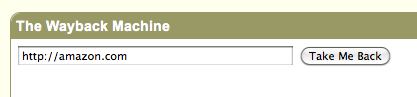
One of its cool features is the “Wayback Machine,” which allows you to plug in a URL and pick a date to see what a given website looked like, say, ten years ago (if it was around then).

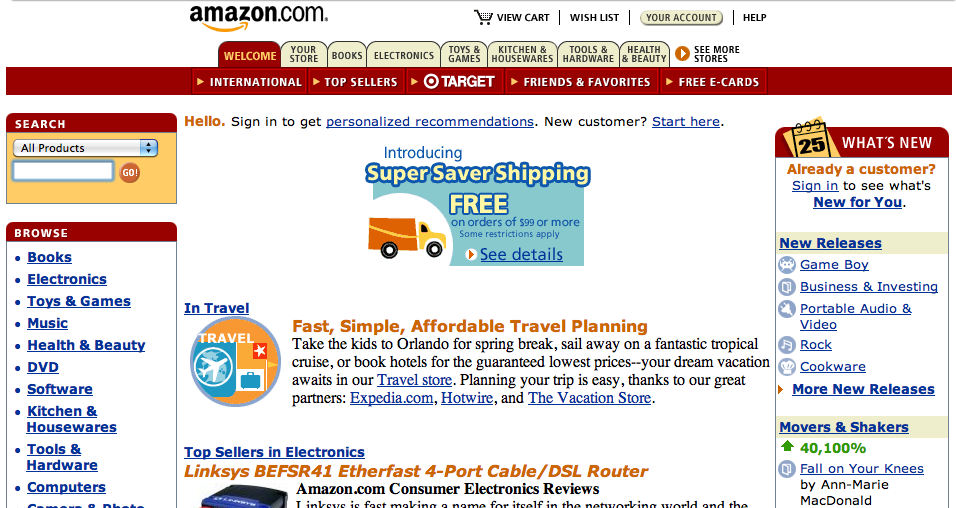
Amazon.com was around in 2002; let’s see what it looked like, shall we?

A little different than it looks today.

So the Wayback Machine is fun to play with (also, useful). And the Internet Archive’s digital library is a great project; but just in case digital copies aren’t enough, Kahle is also building a physical library (or, as The New York Times poetically puts it, an ark). “In case of digital disaster,” the article states, Kahle’s goal is to collect one copy of every book. Kahle said, “We must keep the past even as we’re inventing a new future. If the Library of Alexandria had made a copy of every book and sent it to India or China, we’d have the other works of Aristotle, the other plays of Euripides. One copy in one institution is not good enough.”

Considering how many various file formats and digital storage options we have already gone through in the past few decades, keeping one hard copy of every book isn’t a bad idea. Think about it: if you have some files on a floppy drive from 1998, can you still access them? And if you can’t access them, do they really exist, practically speaking? Whereas a book printed at the birth of the printing press hundreds of years ago can still be read by pretty much anyone (well, anyone patient enough to make their way through a whole variety of spellings).