ALA Annual 2011: A GSLIS Student Perspective

Tonight I was one of the panelists at an ALASC event at Simmons, ALA Annual 2011: A GSLIS Student Perspective. Four GSLIS students who attended the ALA Annual Conference in June shared our experiences; we covered the logistics of attending the conference, how to save money, devising a schedule for yourself, networking, and other topics. The event was recorded and the podcast will soon be up on GSLISCast.

I have linked previously to a piece on Hack Lib School to which I contributed with other Student-to-Staffers, and GSLIS alum Stacie Williams wrote a piece as well. I hope current students find this useful if/when they go to ALA Annual or Midwinter!

How much data? LOTS.

Yesterday I attended the Library Science Fair organized by the Simmons chapter of ASIS&T. Current GSLIS student Mark Tomko gave an impressive presentation titled “Translating Biological Data Sets Into Linked Data” (he’ll be presenting this at the 10th European Networked Knowledge Organisation Systems (NKOS) Workshop in Berlin later this month). Mark did a great job explaining both the biological aspects (“all the biology you need to know fits on one slide, and the font isn’t even that small,” he promised) and the importance of linked data to an audience who was not necessarily expert in either field.

Ben Florin (GSLIS alum, former staff, currently a web developer at the Boston College Libraries) also gave a talk entitled “What I don’t like about our library’s website, plus why we haven’t changed it yet, and what we’re doing about it.” He took us on a virtual tour of the BC Libraries site, pointing out its pros (prominent discovery tool, i.e. search) and cons (a fixed interface, with wasted screen space, instead of responsive design).

The example of responsive design Ben gave was The Boston Globe’s new site; if you go to the home page there and resize your browser window, the layout will adjust from three columns to two to one (as you go smaller), and then from one to two to three (as you make the window larger again). The layout of the BC Libraries page, on the other hand, remains fixed at two columns.

Chances are I will not end up working as a software engineer (or biologist), and maybe not even as a web developer; however, it was interesting to hear two extremely bright people talk about their work as it relates to libraries and organizational schemes.

Whose Common Sense?

This is another event that wasn’t on the initial schedule I drew up for myself, but a fellow student-to-staffer (and YALSA member) told me about it, and we went together. I’m so glad I did, especially as I’m taking a young adult literature class this fall; I got a jump on thinking about some of the issues that plague this particular group of readers.

Whose Common Sense?: How Labeling Systems Hurt Young Readers was sponsored by the ALA Intellectual Freedom Committee, and featured four amazing panelists:

Barbara Jones, Director of the ALA Office for Intellectual Freedom, began the session by making the distinction between book reviews and ratings: book reviews treat books as a whole; ratings target elements in books (e.g. sex, violence, etc.). This was perhaps the most objective statement of the whole session, because it was an impassioned session; while some panelists displayed understanding as to where “the other side” was coming from, others did not hold back, though for the most part they were preaching to the choir – librarians generally are for intellectual freedom and readers (of any age) making their own choices, and against censorship.

Michael Norris of Simba offered several statistics, reminding the audience that “not everyone loves books.” In fact, there are 5 print book buyers for every one e-book buyer, and 40% of iPad owners have never bought (or, presumably, read) an e-book. However, he added, censorship is one of the least effective ways to get boys to read books. (Girls are more likely than boys to read on their own.)

Jeffrey Nadel spoke as if he were the nation’s top five debate teams all rolled into one and someone had just hit the two-minute timer. Which is to say: well-spoken, well-rehearsed, articulate, impassioned, persuasive, and armed to the teeth with rhetoric. “What is protection?” he asked, then answered, “A group of people presuming to know better for another group.” In this case, protection is an “intellectual blockade” to exploration and curiosity; Nadel argued that restricting reading can actually harm young people, and that ratings take away freedom and creativity. Young people, he said, are the only protected/regulated “class” in the country, and yet “youth are unique.” He cited the problem with age-based ratings in other forms of media (e.g. movies), which is that “not all 13-year-olds are inherently the same.”

Parents, educators, and anyone with a shred of common sense knows this; one kid might be ready to dive into the Harry Potter series at age 7, while another might not be ready until 10. Christine Jenkins followed this nicely, describing the right and wrong approaches to helping a child find a book. If a kid comes up to the librarian and says, “I need a book,” “How old are you?” is the wrong response; instead, ask “What have you read that you’ve liked?” – just as you would for any other patron. Help with the discovery process, she advised, then let go.

As for ratings and age labels, Jenkins said, they only “give the illusion of control”; furthermore, attitudes shift in response to labels. Yet people are eager to label: the group Parents Against Bad Books in Schools, for example, pays lip service to the idea that “Bad is not for us to determine. Bad is what you determine is bad. Bad is what you think is bad for your child.” That, of course, is followed by a plethora of lists of books with “bad content.”

It’s this kind of mindset that sends David Levithan over the edge. These organizations, companies, and activists – the pro-ratings (and pro-censorship) groups – appear to be nonjudgmental, caring, and objective, but, Levithan said – and he has a point – “you cannot have an objective warning label.” Warning labels imply judgment; warning labels are “the enemy of the truth”; they are devoid of context. “The problem with warning labels,” Levithan said, “is that they’re fucking crazy. They are everything that the freedom to read is NOT about.”

Warning labels are reductive, he argued, and we cannot reduce literature to ratings. In terms of encouraging young people to read, he said, “You have to keep those gates open wide to everything…You can save time [using labels] and end up losing everything.”

All of this occurred before the Q&A session. During the Q&A, one audience member immediately brought up the Wall Street Journal article “Darkness Too Visible,” by Meghan Cox Gurdon, and this topic dominated most of the rest of the time. Gurdon’s article was a protest against the darkness, violence, and “depravity” of young adult literature. She lamented the fact that so many YA books contain “ugliness” and “damage, brutality, and loss.” The article provoked a tremendous reaction; author Sherman Alexie wrote an articulate and passionate defense, also in the WSJ, a few days later (“Why the Best Kids Books Are Written in Blood”).

Alexie was one of the many who spoke out. “When a body of [work/literature] is attacked, the people who it helped come to its defense,” said Levithan. “We are reflecting the problem, not creating it.” Sometimes, the consensus of the session seemed to be, it is better to the let child/young adult experience [fill in the blank] in a book rather than in real life – to have that experience vicariously through the safety of literature. Conversely, for those children and teenagers who have experienced the “dark” subject matter in books in their own lives, they are likely to be comforted, not damaged, by the books – they can empathize with the characters, and know they are not alone. And generally – like any other group of readers – if teens don’t like a book, they will stop reading and put it down.

Another question, after the WSJ article debate, was how to counter the idea that kids need to be protected from ideas. There is a proven link between leisure reading and educational achievement. It is important that kids have access to books that are interesting to them; our role as librarians is to make sure they have that access. Worse than books being challenged is books being censored preemptively – teachers not adding books to their syllabi or librarians not buying books for the library collection because they expect the book to be challenged.

Throughout this panel, I tried to think of a book – any one book, ever – that I had read that had damaged me in some way. I have read over a hundred books a year since grade school, and I know that I have read many of the most frequently banned/challenged books, including more than 30 from each of the most frequently challenged books of the decade lists (1990-1999 and 2000-2009; there’s a lot of overlap). Many of them have been assigned in school – see the list of challenged classics. (Ironically, people have wanted to ban Fahrenheit 451 and 1984 a lot. Bradbury and Orwell would be proud. Or horrified.)

The point is, I couldn’t think of one book I had ever read that I would have preferred to be “protected” from. I’m not a statistically significant sample size, just a case study, but my experience has led me to believe in the freedom to read, for people of all ages. Parents might have the right to determine what their own children are allowed to read, but they should not have the right to determine this for anyone else – not in school libraries, and not in public libraries. Ratings systems make it easier to target those books with “bad content,” and it’s a slippery slope from rating to banning.
“Everything we do is pervaded by technology”: the LITA Tech Trends panel

After an unforgivably long lapse (“it was summer” doesn’t count as an excuse, does it?), I’m here to write about the rest of my ALA experience. First, the LITA (Library and Information Technology Association) Tech Trends panel. The panelists*:

  • Nina McHale, Assistant Professor and Web Librarian, Auraria University (Colorado)
  • Clifford Lynch, Director of the Coalition for Networked Information
  • Monique Szendze, Director of Information Technology, Douglas County Public Library (Colorado)
  • Jennifer Wright, Assistant Chief for Materials Management, Free Library of Philadelphia
  • Lorcan Dempsey, Vice President of Research at OCLC

*I didn’t manage to write down everyone’s full name at the time; I checked against this post from the Metadata Blog. The quote in the title of this post is from Lorcan Dempsey, during the Q&A.

In the first round, Nina talked about the content management system Drupal, which is “free as in kittens” – i.e., you don’t pay for it, but there’s a steep learning curve. Clifford talked about mobile apps, and the difference between apps and customized browsers. Monique spoke about mobile/proximity-based marketing, noting that 87% of libraries in the U.S. have free wi-fi; interactive is better than static, as it is more likely to be targeted and relevant (as well as grant-friendly and cost-effective).

Jennifer highlighted social reading – sites like Goodreads and LibraryThing that are designed to foster social interaction around books and reading, but also features built into e-readers such as Kindle and Kobo. To end the first round, Lorcan spoke about managing down print collections – developing infrastructure to support regionally based hubs (consortia) as libraries begin to cut down on some print material in favor of e-books and online journal subscriptions.

In the second round, Nina spoke about web accessibility and vendor awareness (which has, she noted, improved over the past ten years). (To learn more about accessibility and section 508, you could go to the government site…but then you might want to try Wikipedia.) Clifford spoke about imaging, computational photography, and images as interpretative/interactive data sets as opposed to fixed images (maps and other geospatial data, for example, are good candidates for this).

Jennifer talked about “the death of the mouse,” and using cameras and OCR (optical character recognition) as input in the future; she also talked about the trackpad vs. the mouse.  Personally, I can see the move away from the mouse already, with so many people using laptops with trackpads or touchscreens, and of course the iPad touchscreen as well. Poor mouse: </mouse>

Lorcan spoke about LibGuides as a set of curated resources or microcollections, and Monique wrapped up the panel with a discussion about online books (“what is a book?”).

This was a popular event, held in one of the smaller (but still large) auditoriums. It was interesting to hear more about those trends I was already aware of, and get some new ones on the radar as well.

Amy Pattee quoted in Salon.com article

This fall I’ll be taking Amy Pattee’s course on Young Adult (YA) Literature. I’ve been working my way through the reading list already: Forever by Judy Blume (I somehow missed this when I was younger, though I did read Are You There, God? It’s Me, Margaret), Boy Meets Boy by David Levithan, Stitches by David Small (actually I read this in galley form before it was published – they were giving it away at BEA a couple years ago), and many others.

One of Amy’s articles was quoted in a Salon.com piece back in July, “The case for raunchy teen lit.” Generally speaking, in the U.S., when parents or other adults get upset about or offended by a book and want to censor it, it is often because they (the books, not the adults) are “sexually explicit.” (Offensive language is next, followed by violence. See statistics on challenges on the ALA site.) In Europe, on the other hand, violent content is much more likely to raise opposition than is sexual content; one could extrapolate from this and say that Europeans are more comfortable with sex, and Americans are more accepting of violence.

Either way, the Salon article makes a good point; it’s much safer to explore these topics through literature than in person.

Readers’ Advisory, or, What do I read next?

For my summer class, I’ve been working on designing an evaluation of readers’ advisory services at a public library. “Readers’ advisory” is the library-speak term for suggesting books that people will like, either directly (through a conversation or “readers’ advisory interview”) or indirectly (e.g., displays).

I’ve been doing this for family and friends for years without realizing it was a “service” – we just called it talking about books. But it is definitely something that people expect from libraries (and from bookstores), and of course now there are online tools as well, from Amazon’s “If you like this, you might also like…” feature to social networking sites like Goodreads and LibraryThing to the subscription-based NoveList.

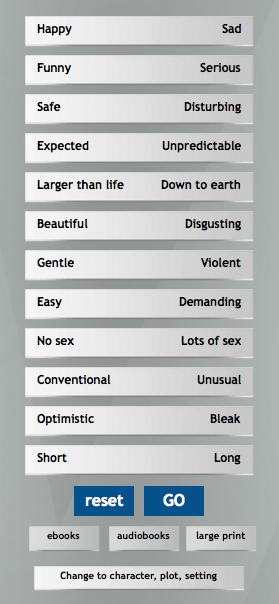
Whichbook is a site I learned about recently, and it’s unique in a number of ways. First, it’s incredibly browsable – I got pulled in right away. I don’t think any online experience can really replicate the experience of wandering around in a bookstore or library, but this comes closer than anything else I’ve found.

You can manipulate a number of factors (see below) to get results, and you can also look through lists (“weird and wonderful,” “bad luck and trouble,” “a terrible beauty”), or search by author.


Whichbook’s About page explains that all of the books are fiction or poetry, written in or translated to English, and published within the last ten years. They focus on “books people won’t find for themselves,” not bestsellers, and have a wide range.

The site is British, and once you’ve found a book that interests you, there are links to borrow from a library or buy through Amazon. If you’re not in the UK, there’s a link to WorldCat, so you can find a copy of the book in a library near you. I’ve played with the variables a lot, and the results are promising: a few books that I’ve already read and enjoyed came up, as well as a number of titles I hadn’t heard of before but that looked good. Try it out!

Summer InfoLink

Still a bit backlogged with more New Orleans posts to come, as well as a post about the Wikipedia in Higher Education Summit; meanwhile, here’s a short piece I wrote on GSLIS After Dark for this summer’s issue of InfoLink. I’m also in the “Summer Reading” article.

Speaking of summer reading, I just finished Ben Nugent’s American Nerd: The Story of My People, and would definitely recommend it to anyone interested in the evolution and psychology of the nerd. It’s a great blend of well-researched history and the author’s personal experience.

And for those who are looking for a tech-heavy young adult novel set in a dystopian but not-too-distant future (lots of people are looking for that kind of book, right?), try Cory Doctorow’s Little Brother. The main character is well-written and compelling, and you will learn a lot about technology, privacy, and security in a painless way. Warning: it may make you a little paranoid.

Wikipedia and Sue Gardner

One of my favorite programs at ALA Annual was Sue Gardner‘s talk on Wikipedia. Gardner is the Executive Director of the Wikimedia Foundation, the nonprofit behind Wikipedia, and she is an incredible speaker: dynamic, enthusiastic, and prepared. She answered questions in a direct manner (and she’s quotable).

We are getting to the point in academia where Wikipedia is becoming accepted as a reliable reference tool. It is a great jumping-off point. You wouldn’t cite it in a paper – but then, you wouldn’t cite any other encyclopedia in a paper, either, after about third grade. Its value is in its currency, relevance, and most of all in its citations.

Gardner said that Wikipedia is an “inherently radical” nonprofit, supporting the idea that “people have a right to access to information.” She described the “virtuous circle, by which participation leads to quality, which leads to a broader reach, which leads to greater participation. There is “no such thing as perfect accuracy” – even recognized authoritative sources such as Britannica have errors, and those can’t be corrected as quickly as Wikipedia can, and they aren’t as widely or frequently monitored, either.

Wikipedia is a “credentials-neutral environment – some people need to be anonymous.” However, unlike communism, which looks good in theory but breaks down in practice, some problems for Wikipedia are theoretical rather than practical: “Wikipedians are fierce defenders of editorial integrity,” so while self-serving articles are a concern in theory, they are not so much of a problem in practice.

One of the main goals of Wikipedia, said Gardner during the Q&A, is “to get information to people so they can make informed decisions about their lives.” Gardner – former director of the Canadian Broadcasting Company’s website and online news – also encouraged questioning the nature of “authority” – “Is Fox News a ‘reliable source’?”

Journalism, Gardner said, “is not really a profession, it’s a job for curious people.” Also, it seems, a job for students and librarians: part of a recent public policy initiative encourages teachers and professors to assign students to write for Wikipedia. There are over 100,000 Wikipedia editors worldwide; these editors work for free, because they enjoy it and believe in it. The average Wikipedia contributor/editor is 25 years old, a STEM (Science/Technology/Engineering/Math) grad student – and male. Wikipedia contributors skew male; librarians skew female. Gardner’s message was clear: “We want you as Wikipedians.”

It was a galvanizing talk – read the American Libraries write-up here – and I’m excited to be attending the first Wikipedia in Higher Education Summit tomorrow.

Stories for a Saturday Evening

Storyteller Elizabeth Ellis told a wonderful story wherein a friend introduced her to someone else, saying, “Elizabeth used to be a librarian.” Elizabeth to the audience: “Nobody used to be a librarian.” (Apparently “Once a ____, always a ____” is true of a lot of careers.)

This is the second time I’ve been under the spell of a professional storyteller as an adult, and I highly encourage you to take advantage of the experience if you ever get the chance. Check out the National Storytelling Network calendar of events for events in your area.

This event, sponsored by ALSC (Association for Library Services to Children), was a perfect end to a long day.