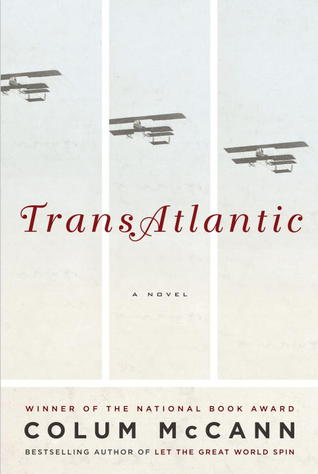
TransAtlantic by Colum McCann

LibraryThing’s batch of author interviews for the month include Julie Wu, author of debut novel The Third Son (which I wrote about in March) and Colum McCann, author of Let The Great World Spin and, most recently, TransAtlantic. I picked up a galley of TransAtlantic from the Random House booth at the Massachusetts Library Association conference last month, in part because I had both enjoyed and been impressed by Let The Great World Spin. Many books are enjoyable, and many books are impressive, but the two don’t always overlap.

TransAtlanticTransAtlantic takes place in three discrete time periods around three significant events: Frederick Douglass’ trip to Ireland in 1845, WWI pilots Jack Alcock and Teddy Brown’s flight from England to Ireland in 1919, and George Mitchell’s diplomatic efforts to end the Troubles in 1998. However, these characters are not the only main characters; four generations of women, beginning with Lily Duggan, a maid in the household that hosts Frederick Douglass, are also connected to these events.

The different time periods, events, and character relationships are a lot for a reader to keep track of, and in the end I found that the book left impressions rather than memories. Any one of the three central stories would have been enough for a book on its own, but McCann’s style is to twine many narratives together into one. I’m not sure he succeeds here as completely as in Let The Great World Spin, but the writing is absolutely beautiful (especially if you happen to be a fan of sentence fragments, which I am).

MLA Conference, Day Two (Thursday), Part Three

On Thursday afternoon, I attended the session “Analyze Your Collection.”

weedingtweet1

“Collection analysis” in this case seemed to be a polite synonym for weeding (withdrawing books from the library collection). Two representatives from the Thomas Crane Public Library in Quincy, MA, Claudia Shutter and William Adamczyk (now of the Milton Public Library), spoke about their experience using the tool/service CollectionHQ. They described CollectionHQ as a “weeding/collection development tool” that “optimizes performance of materials”; CollectionHQ “talks” to the ILS monthly via FTP, so the library regularly sees new data.

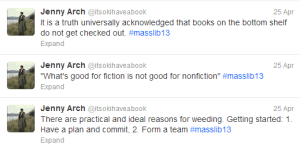
Adamczyk spoke about the practical and ideal reasons for weeding. Practical reasons have to do with space, aesthetics, and cleanliness; “ideal” reasons have to do with updating the collection, keeping accurate statistics, and improving catalog searches. To get started, he said, (1) have a plan and goals and commit to it/them, and (2) form a team, then discuss, prioritize, and standardize.
weedingtweet2

Systematically weeding the library collection is “a great inventory project.” The hands-on aspect plus the CollectionHQ tool helped the Thomas Crane staff identify “dead items,” grubby items, and areas that were over- or under-stocked by comparing the items in the collection to the demand for those items. CollectionHQ also helped them maintain an accurate inventory and clean up their database. (Throughout the project, they used special red book trucks for weeding, so those carts wouldn’t be confused with regular circulation carts.)

Thomas Crane reported that their results after weeding and using CollectionHQ were “better circulation and better turnover, better aesthetics, better browsing, more space on the shelves…a better understanding of over/under-stocked areas.”

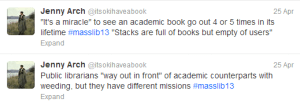
Next, we heard from Rick Lugg from Sustainable Collection Services. SCS “offers deselection decision-support tools to academic libraries.” Academic library stacks, Lugg said, are often “full of books but empty of users.” As he pointed out, it’s not free to keep a book on the shelf (see “On the Cost of Keeping a Book” by Paul Courant and Matthew Nielsen, p. 81-105, PDF), and so weeding – or “deselection” is necessary in academic libraries too. Lugg acknowledged that public librarians are “way out in front” of their academic counterparts in terms of weeding, but that academic libraries have a different mission than public libraries, and that mission includes preservation.
weedingtweet3

Lugg defined three categories of material: archive copies, service copies, and surplus copies. He spoke about redundancy, in terms of keeping a book on the shelf when it could be easily accessed elsewhere, either online (via HathiTrust or Google Books) or from another library. With “independent action in a collective context…safety is built into the system.” With SCS, libraries have the ability to “combine elements in a way that makes sense locally” and use the “rules-based interactive system” to make “data-driven decisions.” For example, a librarian could create a deselection list of withdrawal candidates that were published before 1990, have never circulated, and that are owned by at least 100 other libraries; these lists can be iterative, as weeding is “an ongoing process” rather than “one massive project.”


weedingtweet4

weedingtweet5

Overall, this was an okay session; though it was neat to see some of the CollectionHQ and SCS output, the session felt a bit like an advertisement, and I’m already very much on the weeding bandwagon for both “practical” and “ideal” reasons here at the public library. It was interesting to consider the additional parameters that academic librarians have to consider when weeding, though.

The final panel I attended at MLA on Thursday was “Print and Digital Publishing: How are Publishers, Editors, and Authors Adapting,” moderated by Skip Dye of Random House, with Liz Bicknell of Candlewick Press, M.T. Anderson (author of Feed and many other young adult novels), Amy Caldwell of Beacon Press, and Chris Stedman (author of Fathiest).

Skip Dye began by asking the question, “Adapting?” and answering it, “Are we?” The basic cycle of the publishing industry hasn’t changed: authors find agents, agents pitch the book to editors at publishing houses, publishers acquire the book and distribute it to the market. Within that cycle, however, there’s a lot of room for difference. Some editors still prefer to mark up a physical manuscript with pen or pencil (“I think with a pencil in my hand,” said Bicknell), while others will make corrections and suggestions on an electronic copy of the manuscript and e-mail it back to the author. Some editors – at Scholastic, for example – work entirely over e-mail, Anderson said, but that changes the revision process, not the writing process. At Candlewick, Bicknell said, books are still “conceived as print books,” then made “e.” Caldwell said she preferred to edit shorter pieces electronically, but still preferred to read long books on paper, for the better sense of cohesion and pacing.

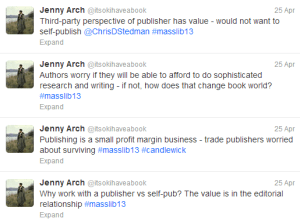
The two really disruptive elements to the publishing industry at this moment are e-books and self-publishing, and those topics made up most of the panel’s discussion in this session. The editors and authors on the panel made many salient points about how e-books affect publishing in ways large and small. Caldwell pointed out that “it does take work to make a book into an e-book”; Bicknell explained that permissions were tied to the number of copies published, so even though e-book sales are not connected to physical quantity, they can be limited by permissions. “Trade publishing is a small profit margin business,” she said. Anderson, too, expressed concern about that margin. If advances continue to shrink, authors may no longer be able to afford to write research-intensive, sophisticated books – “Then what?”

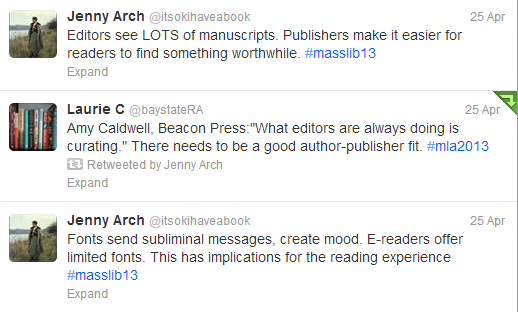
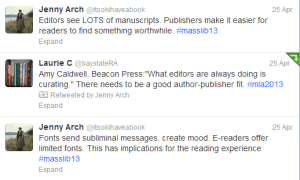
Skip Dye raised a seemingly small but non-trivial point: permissions are necessary not just for other authors’ or artists’ work, but for fonts as well. Different e-readers and tablets display different fonts, and often offer only a limited choice. Bicknell added, “Fonts send subliminal messages…[they] create mood.” (Surely some readers of this blog are familiar with the documentary Helvetica? And we all have our favorite fonts…I am fairly certain I could identify a single line from an Ann Patchett novel based solely on the font.) Dye mentioned that different devices also display different levels of color saturation, which has an effect on illustrated books, especially children’s books.
printdigpubtweet1

The discussion then turned to self-publishing. Chris Stedman is a 26-year-old active blogger, a digital native who writes and edits on the computer, and reads and writes on paper – yet he still chose to write a book and work with a traditional publisher instead of self-publishing. He said that the value of a traditional publisher lies in the “third-party perspective,” an editor’s experienced eye instead of a friend or family member’s opinion. Caldwell spoke about the author-publisher match, describing publishers as “curators in certain areas.” (Beacon Press, for example, is “an independent publisher of serious fiction and nonfiction.”)

On the topic of self-publishing, Caldwell said, “Publishers can be wrong, and not want to take risks. But, editors see lots of manuscripts and know how hard it is to write a good book. There’s so much stuff, finding something you want to spend time with is hard….Publishers make it easier for readers to find something worthwhile.” Anderson too chimed in, agreeing that self-publishing allows for “democratization” but asking, “How do you end up with the grassroots but not the dirt?” Whereupon publishers were compared to the “special environment” of hydroponics.

printdigpubtweet2During the Q&A, Stedman stated, “The way in which we consume media is changing dramatically.” Writers are trying different formats (might we see a resurgence of the long-form essay, or the novella?). Caldwell mentioned the attention span issue; with the proliferation of information (and entertainment), shorter formats like “singles” or long articles might do well.
printdigpubtweet3

This final panel might have been trying to cover too much ground in its allotted time, but the panelists certainly touched on a number of interesting topics. As a former assistant at a literary agency, I can attest that about 99.98% of manuscripts submitted were nowhere near the quality of a published book, and even with help from an agent and an editor, most of them never would be. (Which is not to say that awful books don’t get published – they do – or that worthwhile manuscripts don’t get rejected – they do.) Whatever else changes, editing is a crucial part of the writing and publishing process.

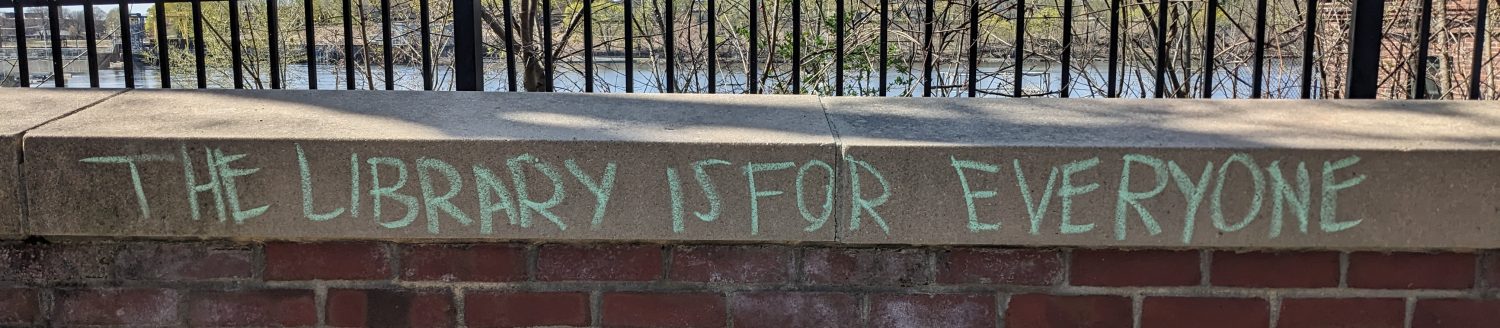
masslibtweet

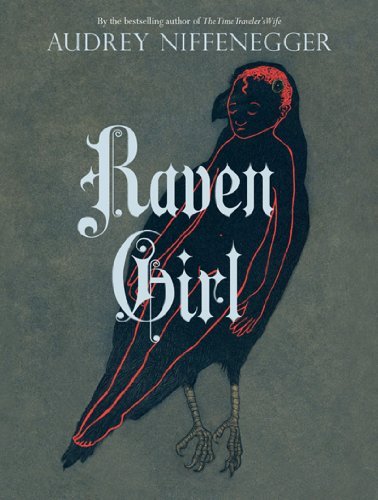
Raven Girl by Audrey Niffenegger

ravengirlToday I’m feeling quite grateful to book publicists, particularly to one who works at Abrams Comic Arts, publisher of Audrey Niffenegger’s new graphic novel, Raven Girl. In a time when libraries and publishers are sometimes on opposite sides of the fence, this is a good reminder that on both sides are people who love books and want to share them.

Audrey Niffenegger is best known for her novel The Time Traveler’s Wife, in which Clare (the wife) and Henry (the time traveler) are often separated against their will; it is an unusual and powerful love story. Her next novel, Her Fearful Symmetry, features identical twins who inherit their aunt’s London flat next to Highgate Cemetery; it is a ghost story, but the ghost realm and the human realm prove to be more porous and permeable than in other ghost stories.

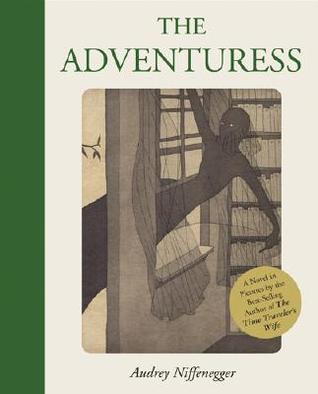
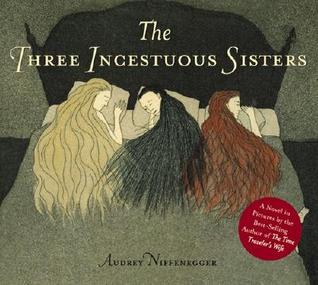
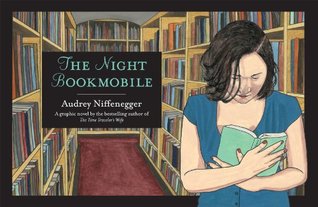
Readers of these novels, however, may have missed Niffenegger’s other work; she is both an author and an artist, and these two talents come together in her graphic novels. The Night Bookmobile was serialized in The Guardian before being published in book form in 2010. The Three Incestuous Sisters (2005) and The Adventuress (2006) preceded it. And now, we have Raven Girl, in which readers of Niffenegger’s previous graphic novels will recognize her characteristic style in both the art and the story itself.

Raven Girl was conceived as “a new fairy tale,” and that is exactly what it is. A postman falls in love with a raven; their daughter is born with the form of one, but she longs for what she feels is her true form. Instead of a witch or a fairy godmother, she finds a doctor who can help her effect the change. As in a fairy tale, some details and impossibilities are glossed over; as in a fairy tale, the animal and human worlds overlap; as in a fairy tale, some characters have happy endings, and some come to unfortunate ends.

In the illustrations paired with the text, remarkable detail contrasts with simple, flowing lines, and muted browns, blues, and greens. As you read, you may find yourself looking back and forth between the text and the art, as together, they amplify the power of the story.

Like most of Niffenegger’s work, Raven Girl is magical, dark, and unusual. I highly recommend it, not just for those who are already fans of the author, but as an entry point for those who have not yet discovered her.

adventuressthreeincestuoussistersnightbookmobile


Disclosure: I received my copy of this book from the publisher. I received no compensation for this review. Raven Girl will be available May 7.

Copyright and Plagiarism

Last month, I attended two webinars on copyright with Mary Minow of LibraryLaw.com. The first was Copyright Basics, and the second was called Hot Issues in Copyright; the webinars were presented by the Massachusetts Library System.

librarylaw_logo

Some of the material was familiar, of course, but some was new. Minow (coincidentally, the aunt of a close friend of mine) confirmed that all original creative content is automatically copyrighted to its creator. However, in order to gain the additional level of legal protection required to bring a lawsuit against someone who has infringed upon your copyright, it is necessary to get the official copyright from the government (there is an excellent Q&A page at copyright.gov).

600px-US-CopyrightOffice-Seal

Some people infringe upon others’ copyrighted work because they think they can get away with it; others do it out of ignorance. Using a Creative Commons (CC) license is one way to raise awareness that you hold the copyright to your work, and that others must ask permission before using it. There are a variety of CC licenses, but, as it says on the site, “All Creative Commons licenses have many important features in common. Every license helps creators — we call them licensors if they use our tools — retain copyright while allowing others to copy, distribute, and make some uses of their work — at least non-commercially. Every Creative Commons license also ensures licensors get the credit for their work they deserve.”

cc.logo

Though I had included a note on the “About” page of this blog and my other blog (“Unless otherwise noted, all blog content © Jenny Arch”), I added Creative Commons licenses recently as well – partly thanks to Minow’s reminder, and partly because, coincidentally, some of my own work was plagiarized right around the same time.

The internet is vast; I never would have known about it had an alert former co-worker not e-mailed me to let me know. She sent me a link to a post entitled “Plagiarism Sucks: It’s More Than Just Drama” on the blog Sparkles and Lightning, which is written by Annabelle, a high school senior in California. Annabelle’s fellow blogger Jessi (of Auntie Spinelli Reads) compiled a list of plagiarized reviews and bloggers, which Annabelle included in her post; my former co-worker noticed that one of my Goodreads reviews (for Close Your Eyes by Amanda Eyre Ward) was on the list.

I can’t slap a Creative Commons license up on Goodreads, because they have their own Terms. The “User Content” section of these terms includes the statement, “You understand that publishing your User Content on the Service is not a substitute for registering it with the U.S. Copyright Office, the Writer’s Guild of America, or any other rights organization.” This means that content-producing Goodreads users retain their automatic copyright, but don’t have an official government copyright – the same as if that content was posted on a blog online.

goodreads_logo

The “License Grant” section of the Goodreads terms reads, “By posting any User Content on the Service, you expressly grant, and you represent and warrant that you have a right to grant, to Goodreads a royalty-free, sublicensable, transferable, perpetual, irrevocable, non-exclusive, worldwide license to use, reproduce, modify, publish, list information regarding, edit, translate, distribute, publicly perform, publicly display, and make derivative works of all such User Content and your name, voice, and/or likeness as contained in your User Content, in whole or in part, and in any form, media or technology, whether now known or hereafter developed, and to grant and authorize sublicenses of the foregoing for any purpose at the sole discretion of Goodreads.”

The key words in the above paragraph are grant and license. By adding content to Goodreads, all users give Goodreads permission to “use, reproduce, modify, publish,” etc. that original content. I’m not a lawyer or an expert in copyright law, but it seems pretty clear from these terms that the user still retains the copyright to their original content, while giving Goodreads these permissions.

Neither Goodreads nor its users, however, give permission for user content to be copied by a third party and passed off as their own work – otherwise known as plagiarism.

Bookish Resolutions

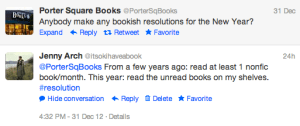
My first successful New Year’s resolution that I made, kept, and remembered, was: read at least one nonfiction book a month. Then, as now, I was reading about 10-15 books a month, and they were nearly all fiction. I decided I needed to push myself to branch out and read in some other areas, like (auto)biography, history, and science. Thus did I discover such excellent books as The Ghost Map, The World Without Us, The Man Who Loved Books Too Much, and The Wordy Shipmates, not to mention Tina Fey’s Bossypants and Keith Richards’ Life.

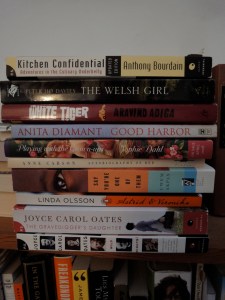
In the years between that resolution and this new year, I have accumulated a number of books that I haven’t yet gotten around to reading. Most are fiction, but some are nonfiction. Most I’ve bought used, some have been sent to me by thoughtful and generous friends. It used to be that if a book was in the house, I had read it or was in the process of reading it; now that’s not the case. (Partly because I work in a library; I’m surrounded all the time by free books that I can just borrow and give back, and which always seem to take precedence over the books that I own, which don’t have due dates.)

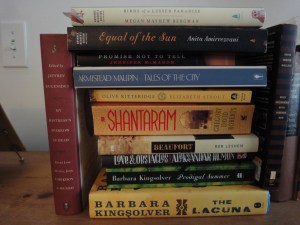
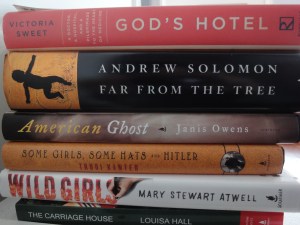
bookishresolutionI want to get through my shelves of unread books, either by reading them or by deciding that I don’t want to read them. After I’ve read them, I may keep them, may donate them, or may pass them on to friends, but there are too many unread books in the house.

So help me out: have you read any of the below? Loved them? Thought they were a waste of time? A few came with personal recommendations and are at the top of the list: Far From the Tree, God’s Hotel, Shantaram. If you’ve got opinions on those or any of the others, please share!


unread1unread2unread3


To finish or not to finish?

Among the countless “best of 2012” lists out there, Laura Miller’s recent piece for Salon, “Five Books I Bailed On in 2012” caught my attention. Every serious reader I know, myself included, has given up on a book before. Some of us feel unreasonable guilt about this; some will only give up right away, or not at all; some force themselves to read at least halfway before jumping ship. But, we try to convince ourselves, we are reading for pleasure. No one is forcing us to finish every book we start, and in fact, isn’t our time better spent finding and reading books we truly enjoy?

These unfinished books linger in limbo, on our “partially-read” or “on the back burner” shelves on Goodreads. Maybe we’ll return to them someday; some of them we’ll never open again. I consulted my own shelf of unfinished books to make a “books I bailed on” list like Laura Miller’s. I should note that (a) these were books I started in 2012, not necessarily books that were published in 2012, and (b) the experience of reading is, of course, entirely subjective; feel free to disagree with my opinions.

landinglightherebulletLanding Light by Don Paterson and Here, Bullet by Brian Turner.

These volumes have nothing in common except that they are both books of poetry that I ordered from the library.  However, I find it necessary to read poems in small doses; I’ve never read a book of poems straight through, because I need time to absorb and reflect. But then I put the book down and pick up something else…and then it’s time to return it to the library. (This is why I prefer owning books of poetry rather than borrowing them.) A more disciplined approach – one poem a night before bed, or one every morning before getting up – is a great idea in theory, but not one I’ve been able to pull off. However, the fact that I didn’t finish these books doesn’t mean I didn’t like them; I’d recommend both.

Paterson is a Scottish poet; Turner is an American soldier who fought in Iraq and who holds an MFA from the University of Oregon. I first read about Landing Light in the New York Times and the poem included in the article, “Luing,” is one of my favorites, especially the last three lines. I discovered Here, Bullet via the Times as well; I collected fragments from various poems in the collection in my Goodreads review.

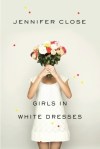
whitedressesGirls in White Dresses by Jennifer Close

I was tricked into picking this up by the flap copy (which made it sound like literary fiction instead of chick lit) and inexplicably good reviews (“genuinely empathetic…richly satisfying” –Booklist, “modern and funny…original” –Library Journal, “artfully spare prose” –Publishers Weekly). I found it to be frustratingly superficial, and put it down after 47 pages.

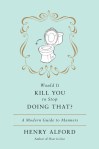
woulditkillyouWould It Kill You to Stop Doing That: A Modern Guide to Manners by Henry Alford

I enjoyed this, but was eager to move on to other books. Alford is intelligent and pleasant to read, but if you have to choose between this rant on manners and Lynn Truss’ excellent Talk to the Hand, I’d recommend the latter.

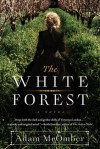
whiteforestThe White Forest by Adam McOmber

This book’s flap copy, cover, and reviews all drew me in; it looked like exactly the kind of book I would like, if not love. Yet after 15 pages, I wasn’t drawn into the story or compelled by the characters. I may pick it up again in the future – maybe it was just one of those “right book at the wrong time” cases – but probably not.

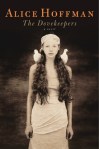
dovekeepersThe Dovekeepers by Alice Hoffman

This is one I may come back to at some point. I’ve liked Alice Hoffman’s books in the past (Practical MagicThe Story Sisters), and I didn’t dislike this one; it just didn’t grab me, and I had a few other books I was more excited about reading at the time.

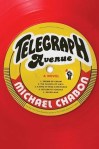
telegraphaveTelegraph Avenue by Michael Chabon

This is the big one. With the exception of Wonder Boys, I have loved every Michael Chabon book I’ve read, and so I had high hopes for Telegraph Avenue, and yet, on page 199, I threw in the towel. The bones of a good story are there, and the foundations of good characters; I especially liked Aviva and Gwen, the wives of the two main adult male characters, and main characters in their own right. I’m also sympathetic to the plight of independent stores to big corporate stores (as are many of Chabon’s readers, I suspect). So why did I put it down? It seemed as though the writing, instead of revealing the story, was obscuring it. I’m all for writing that is both intellectual, colorful, and poetic, but this was just too over the top for me. It was with regret but also relief that I put it down unfinished.

Agree? Disagree? What books linger on your back burner?

Cross-posted on the Robbins Library blog.

Edited to add: Tim Parks wrote an article (“Why Finish Books?”) for the New York Review of Books blog on March 13, 2012 that touches on a different aspect of the “to finish or not to finish” question. Parks clearly agrees that if you are not enjoying a book, it is perfectly okay to stop reading and pick up a book you will enjoy instead; however, he also posits that some readers might stop reading books that they are enjoying, and that does not necessarily mean that the book was bad or that the reader didn’t like it, just that the reader had had enough. It is an interesting article, whether or not you agree. -4/18/13

More 2012 favorites

Cross-posted as “Favorites of 2012” on the Robbins Library blog.

My colleague Linda posted her favorite reads of the year a few days ago, and we’ve definitely enjoyed some of the same ones: I too would highly recommend the fresh and funny Where’d You Go, Bernadette?the wise, wonderful and heartbreaking The Fault in Our Stars, the paranoia-inducing Gone Girl, and the erudite essays in More Baths, Less Talking.

To these, I’ll add a few of my own, with links to reviews (below). These are books I’ve read in 2012, not necessarily books published in 2012, though many of them were.

Fiction

gold2 Gold by Chris Cleave

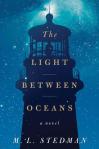
The Light Between Oceans by M.L. Stedman

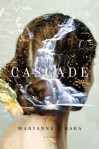
Cascade by Maryanne O’Hara (this is our Staff Picks book for February, and Maryanne herself will be joining us for the discussion!)

The Language of Flowers by Vanessa Diffenbaugh

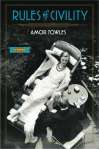
rulesofcivility Rules of Civility by Amor Towles

Billy Lynn’s Long Halftime Walk by Ben Fountain

Bring Up the Bodies by Hilary Mantel (sequel to Wolf Hall; both books won the Booker Prize)

Arcadia by Lauren Groff


The Thousand Autumns of Jacob De Zoet
by David Mitchell (author of Cloud Atlas)

Vaclav and Lena by Haley Tanner

Maine by J. Courtney Sullivan

Fault in our Stars The Fault in Our Stars by John Green

My Sister Lives on the Mantelpiece by Annabel Pitcher

Nonfiction

Let’s Pretend This Never Happened: A Mostly True Memoir by Jenny Lawson (a.k.a. The Bloggess)

The Wordy Shipmates by Sarah Vowell (I listened to the audiobook)

Agree? Disagree? What are some of your recent favorites? Leave a comment!

Favorite Books of 2012

Today at work, I got an e-mail requesting staff send in their picks for favorite books of 2012. (Have I mentioned how much I like working in a library?) We were to submit no more than three each, which as every avid reader knows is a difficult-to-impossible task. However, it’s easier to think of it as “three of your favorite books” rather than “your three favorite books.”

With that caveat in mind, I headed over to my Goodreads page (I ❤ Goodreads) and sorted my shelf of books I had read by date read. Mentally, I filtered out books that were published before 2012; this meant I couldn’t include obvious shoo-in Rules of Civility by Amor Towles or The Language of Flowers by Vanessa Diffenbaugh, both published in 2011.

And yet: so many good books came out this year! The marvelous John Green’s The Fault in Our Stars, Maria Semple’s fresh and original Where’d You Go, Bernadette?, Hilary Mantel’s Bring Up the Bodies, the much-feted sequel to Wolf Hall…and then there are the nonfiction books, such as Jenny Lawson’s laughter-and-tears-inducing memoir, Let’s Pretend This Never Happened, and Ken Jennings’ clever Because I Said So: The Truth Behind the Myths, Tales, and Warnings Every Generation Passes Down to Its Kids.

Yet in the end, here are the three I chose:

gold2GOLD by Chris Cleave
Set before and during the London Olympics, Gold is timely; yet it is timeless in the way that it represents people’s best and worst natures, particularly the struggle between career ambitions and family life. Kate and Zoe are close friends and rival cyclists, competing for one spot on the London Olympic team. Zoe is focused solely on training, while Kate has a family: her husband Jack, another Olympian, and their eight-year-old daughter Sophie, who is battling leukemia. Flashbacks to earlier periods in the characters’ lives reveal crucial backstory in this wrenching novel.

lightbetweenoceansTHE LIGHT BETWEEN OCEANS by M.L. Stedman
This is a beautiful book with strong characters and a thought-provoking central dilemma. Tom Sherbourne returns from fighting in the Great War and takes a job as a lighthouse keeper on a remote island of the coast of Australia; he and his wife, Isabel, are deeply in love, but Isabel is inconsolable over her inability to have a child. When a lifeboat washes up on their beach containing a dead man and a live baby, Isabel begs Tom to keep it. The Light Between Oceans is the extraordinary story of that decision, and of how to act in the present when the past cannot be changed.

cascadeCASCADE by Maryanne O’Hara
“Life is full of tough choices between less-than-perfect alternatives,” says one character in this Depression-era novel, and that about sums it up for twenty-six-year-old Desdemona Hart. Dez married Asa Spaulding to provide stability for her ailing father, who died a few months later. Asa doesn’t understand Dez’s reluctance to start a family, but traveling artist Jacob does: Dez wants to go to New York City to pursue her career in art. On top of this dilemma, the town of Cascade is itself at risk: men from Boston visit the town as a potential site for a new reservoir. Will Dez fight to save the town and her father’s famous playhouse, or will she flee to follow her dream? The historical setting is vivid, and Dez is a compelling character; the decision she must make is one that many people still face today.

Build it, and they will come.

In sixth or seventh grade, I was asked to write an essay in response to the question, “Who is your hero?” I didn’t have a good answer, though I know I wrote something. If you asked me that question now, however, I’d have a pretty good answer ready: author and independent bookseller Ann Patchett.

For those who haven’t followed the birth of Parnassus Books, the store Patchett co-founded in her hometown of Nashville, TN, when its last remaining bookstore closed, you can catch up with this article from The Atlantic, “The Bookstore Strikes Back.”

Here are a few excerpts:

On entering the book retail business: “[I]f I wanted to re-create the bookish happiness of my childhood, then maybe was the person for the job. Or maybe not. I wanted to go into retail about as much as I wanted to go into the Army.”

On other booksellers: “Booksellers do not guard their best secrets: they are a generous tribe, and were quick to welcome me into their fold and give me advice.”

On what local brick-and-mortar stores do that Amazon can’t: “All things happen in a cycle…the little bookstore had succeeded and grown into a bigger bookstore. Seeing the potential for profit, the superstore chains rose up and crushed the independents, then Amazon rose up and crushed the superstore chains. Now that we could order any book at any hour without having to leave the screen in front of us, we realized what we had lost: the community center, the human interaction, the recommendation of a smart reader rather than a computer algorithm telling us what other shoppers had purchased.”

On what you, the reader, can do: “Amazon doesn’t get to make all the decisions; the people can make them, by choosing how and where they spend their money. If what a bookstore offers matters to you, then shop at a bookstore. If you feel that the experience of reading a book is valuable, then read a book. This is how we change the world: We grab hold of it. We change ourselves.”

If I ever visit Nashville, it will be to go to Parnassus. However, I’ve been lucky enough to hear Ann Patchett give a reading (of State of Wonder) at a great independent bookstore between Cambridge and Somerville, Porter Square Books. It has beautiful displays, friendly staff, and great author events, so I visit regularly, though I don’t buy books that often (hey, I work in a library). However, if you received books as a gift from me this holiday season, they came from Porter Square Books. Is it more expensive than Amazon? Most of the time. Is it worth it? Yes.

Researching and Writing Historical Fiction

Cross-posted as “Truth in Fiction” on the Robbins Library blog.

As November, otherwise known as National Novel Writing Month (NaNoWriMo), was drawing to a close, I had the opportunity to attend a program that I had set up at the Robbins Library: authors Margot Livesey and Adam Braver came to have a conversation about researching and writing historical fiction. Margot is the author of, most recently, The Flight of Gemma Hardy, a retelling of Jane Eyre; Adam’s newest novel is Misfit, about Marilyn Monroe.

Do you research first and write after, write and research at the same time, or write first and research after? “Research feeds imagination,” said Livesey. She does some preliminary research before writing, just enough for a chapter or a draft, then researches retrospectively as needed. Both authors agreed that they could get bogged down or sidetracked, and that research could be an excellent procrastination tool.

Braver said he will look up facts he needs as he writes, and “sometimes it leads to something [else],” but he also does a large amount of preliminary research, using newspapers and interviews. Both authors said they have worked and researched in public libraries, using newspapers, microfilm and microfiche, and of course books. At home, Livesey has two computers: one that “doesn’t know the Internet exists,” and another that is online. She writes on the offline computer, and only goes to the online one if she really needs to look something up.

How do you manage to spend so much time with your novels and not get sick of them; how do you manage to persevere? “Not getting sick of it is the challenge,” Braver responded. He said he usually goes through 15 – 20 revisions per book, and would often like to quit when it’s “good enough,” but “I’m restless until I feel like it’s right.”

How do you deal with conflicting versions of history? Braver answered that conflicting versions often become the story. Like historians, novelists are looking for the truth behind the facts; the facts may be irrefutable, but the order in which they are told is what makes a story.

How much is fact and how much is fiction? What liberties do you take when you write fiction set in the past? As a reader of fiction, Livesey said, “I count on fiction to tell me the truth…be faithful in certain ways.” One might, for example, add a burn unit to a hospital that didn’t have one, but not drop bombs on a city that wasn’t bombed. (Of course, authors can address what’s true and what’s invented in an Afterword.)

“I think readers mind very much about precision,” said Livesey, estimating that about 30% of the mail she receives from readers contains corrections to her work. However, “people are forgiving…unless it’s sloppy.”

What’s the difference between writing about a period some people remember, as opposed to writing about a time no one alive remembers? Braver said that certain periods in the past are viewed “in sepia tone,” and his goal is to “strip away the nostalgia,” and make the reader feel as though, by opening the novel, they are opening a door into the past.

Braver writes about well-known historical figures – President Lincoln, Jackie Kennedy, Marilyn Monroe – but focuses on the periphery, on moments that occurred out of the public spotlight. Livesey’s characters, by contrast, are “modest,” and invented. “Small details of ordinary life,” she said, can be more important than big events.