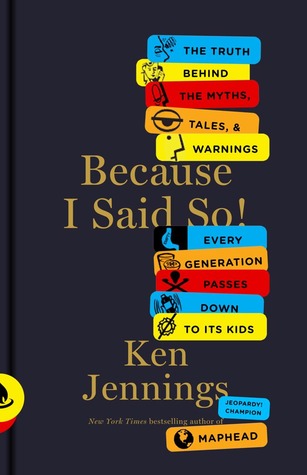
Because I Said So! by Ken Jennings

 Because I Said So!: The truth behind the myths, tales, and warnings every generation passes down to its kids by Ken Jennings is perhaps the only book I can think of that I can wholeheartedly, unreservedly, recommend to EVERYONE, even those who usually don’t read nonfiction. Young or old, male or female, left brain or right brain, parent or child, skeptical or gullible, superstitious or scientific, this book is for you. Really.

The subtitle sums it up: this is the Mythbusters of books (with, alas, fewer explosions). Jennings takes dozens of myths, tales, and warnings, from “don’t swim after eating” to “put on a sweater, I’m cold,” and does the legwork to discover where they came from, and whether they’re true or false; sometimes, it turns out to be a little of both. Debunking or affirming each claim in just a few pages, his writing is clear, concise, and often amusing. For example, here’s a snippet of how he debunks the “no swimming after eating” warning:

“It is true that when we eat, our body diverts blood to the stomach to aid in digestion, but, as you may have noticed after every meal you ever ate in your life, that doesn’t immediately immobilize your arms and legs….Not one water death has ever been attributed to post-meal cramping.”

Truly, I recommend this to everyone. And, the scheduled publication date is December 4, just in time for the holidays. Usually, I try to avoid giving books as gifts (partly because I’m a librarian and people expect it), but I’ll probably be buying this for at least one person. So there: it has the librarian stamp of approval!

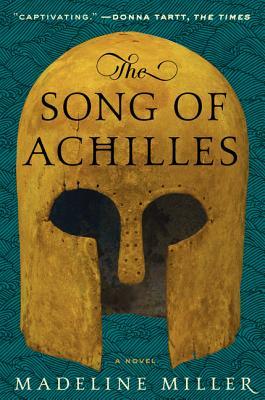
The Song of Achilles by Madeline Miller

An alternative title for this post, taken from author Madeline Miller’s event last night at Porter Square Books, could be: Mythological Fiction: “Am I really having a centaur in my novel?”

 “Mythological fiction” is how Miller categorizes her novel, The Song of Achilles, rather than historical fiction or simply literary fiction, and it’s apt: The Song of Achilles is a retelling of part of Homer’s Iliad, complete with heroes, gods, and mortals. Authors who choose to adapt or retell myths have a choice, said Miller, to write the gods as characters or to explain away their presence (e.g., Was it Poseidon or an earthquake?). Miller chose to include the gods as characters, notably Achilles’ sea-nymph mother Thetis, and his and Patroclus’ teacher, the centaur Chiron.

 Miller’s impetus for writing The Song of Achilles was Achilles’ extreme grief over Patroclus’ death in the Iliad. To explain Achilles’ reaction to Patroclus’ fate, she writes about their adolescence and coming of age together from Patroclus’ point of view. The Song of Achilles tells an ancient story in an accessible way; the writing is both modern and lyric. Of adapting Homer’s original material, Miller said, “Great artists [such as Homer] understand human nature…the stories in the past illuminate the present…great art has great psychological insight.” The story seems modern because human nature has not changed: pride, love, grief, and revenge are as familiar to us now as they were three thousand years ago.


The Growing Pains of E-Books

Like many librarians in public libraries, I spend a fair amount of time explaining how various e-readers work, how the digital media catalog (separate from the regular library catalog) works, and how to accomplish the many steps required to download an e-book from the library collection.

I know that we live in a time of unprecedented and rapid technological growth and change, and that what we are going through now is just growing pains. The book industry, like other media industries (music, film), is trying to figure out how to deal with this change.

But it’s not happening fast enough, or thoughtfully enough. The prevalent model right now is one book, one reader: libraries buy (or, more often, license) one digital copy of a book, and one library user can borrow it at a time. With vendors and digital rights management (DRM), publishers are attempting to make the digital world obey the same rules as the print world, but this is artificial and must give way to a better model.

Even with the current model, most major publishers are not participating; they refuse to sell or license e-books to libraries. This comes as a surprise to many library users, which means librarians must do a better job of raising public awareness, notes San Rafael Public Library Director Sarah Houghton (a.k.a. the Librarian in Black).

There are other models out there: Brian Herzog (a.k.a. the Swiss Army Librarian) explains a newer platform called Freading, a token-based system that eliminates waiting lists. The main catch is that Freading’s 15,000+ books don’t include any from the “Big Six” publishers (HarperCollins, Random House, Penguin, Macmillan, Hachette, Simon & Schuster), and therefore many popular titles.

Eventually – sooner rather than later, one hopes – the major publishers will see that their fears are unfounded, and that selling or licensing e-books to libraries will not gut their sales. (After all, selling print books to libraries didn’t kill the book industry.) In an article that reported research findings showing “a symbiotic relationship between library patronage and consumer book purchasing,” School Library Journal editor-in-chief Rebecca Miller said, “It’s exciting to have data to back the sense that library use is also an economic engine for the book industry. Publishers now have proof of how libraries support their business models.”

For years, articles asking “Are libraries obsolete?” and wondering, “Will [fill in the blank] be the death of libraries?” have abounded. Libraries are still here, though, and most want to remain relevant; we want to continue offering “the highest level of service to all library users through appropriate and usefully organized resources” (ALA Code of Ethics). In many cases, libraries offer not just access to resources but also a community center, a place for people to meet, learn, work, and create. Now, with the rise of self-publishing, the question has become: Are publishers relevant? Are publishers obsolete?

Not quite yet. The mainstream publishing industry still has value. Its editors and publicists have decades of experience in identifying great work, improving it and polishing it through the editorial process, spreading the word about it through publicity and advertising, and printing and distributing it.

But the Big Six aren’t the only game in town. While they drag their feet, libraries would do well to consider other sources of e-content. As Jamie LaRue points out in his recent Library Journal piece, “All Hat, No Cattle: A call for libraries to transform before it’s too late,” independent publishers have shown themselves to be much more open to working with libraries than mainstream publishers have been. Additionally, digitization projects throughout the country have made more content available online; and of course there is self-published material.

So, publishers: what’s stopping you from reaching more readers by selling e-books to the “staggeringly effective marketing machine” (LaRue) that is the library? And librarians: it’s time for us to work together to explore other options instead of letting the Big Six call the shots. As LaRue points out, “If we pay public dollars for content, then we must be able to take possession of the copies. Anything else is sheer vendor lock-in and shirks our obligation to preserve the public record.”

Libraries and librarians are waiting, impatiently but often too quietly, for publishers to work with us on this. It has the potential to be a situation where everyone wins: publishers profit, authors reach a wider audience, libraries provide excellent service, readers have access to a wide variety of resources.
 

Reviewers and Readers: what do we want?

I read a lot of books (understatement of my life), and a lot of book reviews (especially since it’s now part of my job), but until recently I did not know about Bookmarks Magazine. They have their own reviews, but they also provide links to reviews elsewhere. Two of the most useful features on the site are “see all of this week’s reviews” and “see most-reviewed books (last 8 weeks).”

For collection development purposes (i.e. buying books for the library), I’ve been relying on traditional sources, like Publishers Weekly, Booklist, Kirkus Reviews, and Library Journal. These are all great resources, but I also really appreciate being able to go to Bookmarks to read several reviews of a book at once.

Recently, having just read Gold by Chris Cleave (and having attended a reading at the Brookline Booksmith), I was curious as to how it was being reviewed in the mainstream press. Thanks to NetGalley, I had the opportunity to read Gold before its official publication date, knowing little about it except the basic premise, and form my own opinion (in a word: lovefest) before I read the opinions of others. Reading some of the reviews Bookmarks linked to, I found that others’ opinions were decidedly mixed, with at least one reviewer (LA Times) complaining of “a feeling of being manipulated.”

Now, book reviewing is a subjective thing, but this seemed to be an odd complaint. No one really likes the word “manipulate,” but isn’t that what all writers, fiction and nonfiction, aspire to do? Nonfiction authors nearly always have an agenda; they are trying to convince you to see things a certain way. (Granted, while plenty of nonfiction has an obvious bias, other nonfiction aspires to be bias-free. It’s basically impossible, but points for effort.)

Fiction, on the other hand…fiction is made up. Invented. Imaginary. Necessitates, frequently, a “willing suspension of disbelief.” We read fiction because we are hungry for stories, and because even though characters and places might be made-up, they are also often deeply true. The authors who can manipulate us best are the ones we love most.


Real Good for Free

I’ve read a lot of articles and blog posts over the past few years about e-readers, e-books, and the resulting tension between publishers and libraries. In the “Sparring Over E-Books” section of her article “Changing Policies on Digital Books Wreak Havoc on Libraries,” Jenny Shank repeats the publishers’ argument about “friction.” Essentially, publishers are fine with libraries lending books to patrons for free, as long as it is slightly more difficult for people to use the library than to buy books in a store or online. However, if it’s just as easy to borrow a book from the library as it is to buy it, then (the argument goes), sales will plummet.

Let’s backtrack to the days before online ordering, when buying a book meant going to a bookstore, and borrowing one meant going to the library. If you got a book from the library, you had to return it, meaning you had to make one extra trip; if you bought the book, you didn’t have to go back to the bookstore until you wanted to. An extra trip is a little extra friction, a little added inconvenience (assuming you aren’t the kind of person who goes to the library every week whether your books are due or not).

With online sales of both e-books and print books, it became much easier to buy books and have them shipped to you; frictionless, one might say (except for the friction of the money leaving your account). Now that libraries are also offering e-books – or at least trying to – some publishers are objecting that there ought to be some inconvenience introduced to the process, that it should be harder to borrow an e-book than to buy one. To these publishers I say: have you ever tried to borrow an e-book from a library? For most systems, “one-click” doesn’t enter into it.

But for argument’s sake, let’s pretend borrowing an e-book from a library is as easy as buying and downloading one from Amazon or Barnes & Noble (or one of the independent bookstores that offers e-books). People have been able to get books from the library for free for years. And has that caused the collapse of the publishing industry? No, it has not. (Remember: libraries buy their books from publishers! Libraries are customers, too. And libraries buy a lot of books.)

One book borrowed does not equal one lost sale. In fact, people who borrow are also people who buy; this is true of music as well as books, as Christopher Harris points out in American Libraries (“Giving Away Music Increases Sales…Just Like For Books”).

The title of this post comes from a Joni Mitchell song. “Real Good for Free” is on the album Miles of Aisles.

Inventing the Future

Following links from this week’s issue of American Libraries Direct, I found two excellent, thoughtful articles about the current (and probably future) state of the publishing business, including background on Amazon and the ongoing Department of Justice case against Apple and the major publishers. The articles are so well-written and clear that I don’t have much to add, but I highly recommend reading them if you’re at all interested in ebooks – as a consumer, author, publisher, or librarian.

The first piece, “Why everyone is probably wrong about the DoJ ebooks case” by librarian Hugh Rundle, outlines both sides of the conversation taking place about ebooks: the confusion over what the DoJ case is actually about (investigating collusion to keep consumer prices high), and the short- and long-term implications of Amazon’s pricing (and effective monopoly) of ebooks. Rundle argues that the major publishers handed Amazon its current de facto monopoly on ebooks by insisting on DRM (Digital Rights Management). He concludes that “the future of books is not the present of books,” and that “the best way to predict the future is to invent it.”

Rundle linked to Charlie Stross’s piece, “What Amazon’s ebook strategy means.” Here is a fantastic article that includes Amazon’s history from its founding in 1994, as well as some important definitions (disintermediation, monopoly, and monopsony). Stross, too, argues that DRM is dead, or should be: “By foolishly insisting on DRM, and then selling to Amazon on a wholesale basis, the publishers handed Amazon a monopoly on their customers—and thereby empowered a predatory monopsony.”

Rundle also linked to a post on David Pakman’s blog, “Why should ebooks cost $15?” In this piece, Pakman writes, “Absent from most of this [ebook] coverage are two main questions: a) what is the right price for eBooks and who gets to set it, and b) why are eBooks not interoperable on different devices?” Leaving aside the first question for the moment, his second question is one of the main reasons I still don’t have – or want – an ereader. Imagine how much more appealing buying and reading ebooks would be if all ebooks were DRM-free and could be read on all devices – Kindles, nooks, iPads, Sony eReaders. As it is, however, if you buy a Kindle and some Kindle books, but then decide you want to switch to a nook…well, too bad, you can’t take your books with you, because you can’t read Kindle books on a nook.

Given all this, we can hope that ebooks will be DRM-free sooner rather than later. Increased interoperability would certainly be good for consumers, and maybe for publishers and retailers too.

Decisions, Making

Two seemingly unrelated bits of news/opinion in this post, but both have to do with decision-making on some level. To start, one of the first articles I read this morning was Ann Patchett’s op-ed in the New York Times about the Pulitzer Prize Board’s failure to select a fiction winner from the three finalists. As Patchett points out, this is not only disappointing for the authors (“It’s fine to lose to someone, and galling to lose to no one”), it’s also a letdown for readers and for booksellers. Here are the past winners.

Another article I read today is from ASIS&T: Thom Haller wrote on the topic “What happens when architectural questions are not asked?” (architecture, here, is information architecture, or IA). He used Facebook as an example, and it’s a good one: who hasn’t been confused by Facebook’s changing structure, or its hierarchy and organizing principles (or lack thereof), not to mention its always-in-flux privacy policies? The problem Haller discussed was that of labels (or lack of labels) for “content clusters,” and it’s something that would probably come up in a basic usability test; right now, it’s not really clear what the difference between “public” and “all” is, unless there is a label for each group of options (there isn’t).

For such a huge site, there are some surprising difficulties in terms of navigation and settings. I almost have to assume that these difficulties are planned, or at least unresolved, on purpose; it seems like Facebook wants certain actions (privacy settings, unfriending) to be difficult.

So as not to end on a negative note, please enjoy this list of fake Massachusetts town names from McSweeney’s. And may I also recommend Jenny Lawson’s (a.k.a. The Bloggess) just-published memoir, Let’s Pretend This Never Happened? Read a snippet here. (Unless you’re at work, because most people’s work doesn’t usually provoke hysterical laughter, and this might. You’ve been warned.)

Bring back the midlist!

There’s a great blog post on YARN (Young Adult Review Network) about the danger of the blockbuster mentality in the publishing world, and about the value of the fast-disappearing “midlist” – books that neither sold millions of copies nor flopped, by authors who had talent and the potential and promise to keep writing good quality books.

We can all identify the blockbusters – The Hunger Games, Twilight, Harry Potter are the obvious ones in YA, and all of those had crossover appeal, which helped them sell even more. There are adult blockbusters too – just look at The New York Times bestseller list. Again, nothing against reading popular books, but let’s brainstorm our favorite off-the-beaten path books – fiction or nonfiction, YA or adult. Here are a few of mine:

Overture by Yael Goldstein

All My Friends Are Superheroes by Andrew Kaufman

The China Garden by Liz Berry

The Good People of New York by Thisbe Nissen

The Stolen Child by Keith Donohue

A Pigeon and a Boy by Meir Shalev

The Various and Celandine by Steve Augarde

Lucky Girls: Stories by Nell Freudenberger

Love Begins in Winter: Stories, Simon Van Booy

What about you? Books that maybe haven’t hit the bestseller list or been heaped with literary awards or prizes, books that haven’t received much publicity buzz from publishers or reviewers, but good books nevertheless. Share your favorites in the comments!

Do not pass Go, do not collect two hundred dollars: Apple and the publishers vs. Amazon?

Do you buy e-books? Did you feel surprised, taken aback, betrayed, indignant, outraged when the average e-book price suddenly jumped from $9.99 to $12-15? Now: have you thought about why those prices changed?

First, it’s important to understand that $9.99 is not the actual cost of an e-book: Amazon set that price point, and they were taking a loss on every e-book sale, in the hopes of luring more and more customers to buy their Kindle e-reader. Amazon was able to set e-book prices because they bought the books from publishers on the “wholesale” model: Amazon paid the publishers about half the cover price of the book, then set its own price for its customers.

A quick note about the real cost of a book: just because it’s a digital version – an e-book – rather than a book printed on paper doesn’t mean it was free to produce. Authors, editors, publicists and marketing people still had to be paid, offices still had to have lights on and computers running. The cost of paper and printing is somewhere in the neighborhood of $3 for a hardcover, less for a paperback.

So with the wholesale model, publishers could not set their own prices for books. With the “agency” model, however, they could: when Apple entered the e-book market, it allowed publishers to set their own prices and take 70% (Apple taking the remaining 30%). Apple also “reportedly stipulated” that publishers who used the agency model couldn’t sell their books for less to anyone else; thus, no more selling to Amazon on the wholesale model. The price change across the board is what drew the attention of both consumers and of the Justice Department, which is threatening Apple and five of the “big six” publishers with “allegedly colluding to raise prices.” (Never mind when airlines change their prices and policies one suspiciously close to the other. And do not get me started on cable companies. Or Amtrak.)

However, Washington Post columnist Steven Pearlstein advises the long view in this situation. True, when Apple broke up Amazon’s de facto monopoly, prices for consumers went up, not down; but, he points out, “What looked to consumers like a great bargain at $9.99 a book looked to others in the industry suspiciously like predatory pricing, or selling below cost today in order to gain a monopoly and raise prices in the future.” Which is better, he asks, “a market in which Amazon uses low prices to maintain its e-book monopoly and drive brick-and-mortar bookstores out of business, or one in which the major book publishers, in tacit collusion with Apple, break Amazon’s monopoly and raise prices?”

When you think about it that way, maybe paying an extra few dollars for your e-books is worth it.

Rules for Writing Fiction

This two-part article from The Guardian (UK) isn’t new, but it’s worth another read even if you saw it when it was first published. Writers including Elmore Leonard, Margaret Atwood, Philip Pullman, Jonathan Franzen, Anne Enright, Hillary Mantel, Zadie Smith, and many more offer their personal rules for writing fiction. A few that are repeated throughout many lists include “take long walks,” “avoid adverbs,” and (seems obvious, but…) “write.” Many encourage habit and routine; many also admit it’s fine to break the rules sometimes. Whether you’re a writer or a reader, the lists are fascinating.

Read Part One

Read Part Two