Research and Publication

Two recent pieces in the New York Times – an article and an op-ed – address the issue of the publication of scientific research, and access to that research. The op-ed, “Research Bought, Then Paid For” by Michael Eisen, the founder of the non-profit, open-access Public Library of Science (PLoS), argues that research that was funded or subsidized by taxpayers ought to be available to those taxpayers free of charge. In a nutshell, “if taxpayers paid for it, they own it.” Eisen encourages scientists to publish their work in open-access journals instead of journals like Science, Nature, and Cell, which charge steep subscription fees – often to the same universities whose researchers submitted the papers and provided peer-review services for free.

The January 16 article “Cracking Open the Scientific Process” explains the issue in a slightly more balanced way (and reveals that some open-access journals, PLoS included, charge authors publication fees to authors). However, though of course the issue is more complicated than it appears at first glance, Eisen has a point about the principle of the thing: publicly funded research should be available to the public. Additionally, as the Jan. 16 article illustrates, many sites allow and encourage collaboration and networking, enhancing the scientific community and helping solve research questions more quickly.

I am reminded of the TED Talk on Open-source cancer research, wherein researcher Jay Bradner published and shared research instead of patenting it – the opposite, he pointed out, of what a pharmaceutical company would do – based on the principles of open-source and crowdsourcing.

A January 20 article in The Atlantic (“Locked in the Ivory Tower: Why JSTOR imprisons academic research”) also addresses the issue of the “broken economics of academic publishing.” The author summarizes, “Step back and think about this picture. Universities that created this academic content for free must pay to read it. Step back even further. The public – which has indirectly funded this research with federal and state taxes that support our higher education system – has virtually no access to this material, since neighborhood libraries cannot afford to pay those subscription costs.” She suggests circumventing the publishers, eliminating the print journal, and putting the content online.

Whether or not that’s the solution that enough people, organizations, and institutions eventually coalesce around, it’s clear that something must be done about the current state of academic research and publication – and it will probably happen sooner rather than later.

Edited to add (2/4/12): Some researchers, inspired by open-access champion Peter Suber and British mathematician and Fields medalist Tim Gowers, are boycotting the journal publisher Elsevier.

Amazon vs. Bricks-and-Mortar

It’s not even Amazon vs. the independent bookstores anymore; now it’s Amazon against any physical bricks-and-mortar bookstore that offers browsability, serendipity, and (hopefully) knowledgeable, informed, helpful staff who can make personalized suggestions tailored to your needs, likes, and dislikes.

Author Richard Russo wrote an op-ed in The New York Times on December 11 about Amazon’s competitive strategy of encouraging buyers to use its price check app in stores by offering credits to consumers, who then buy from Amazon instead of from stores. (It should be noted that while book prices can be checked with the app, they do not qualify for the promotion.)

Russo sent this news on to a number of other authors, including Scott Turow (president of the Authors Guild), Stephen King, and Ann Patchett. King called the strategy “invasive and unfair”; Turow suggested that it might not be “lawful” for Amazon to encourage consumers to go to a store solely to obtain pricing information without any intention of buying; and Patchett said, “I do think it’s worthwhile explaining to customers that the lowest price point does not always represent the best deal. If you like going to a bookstore then it’s up to you to support it. If you like seeing the people in your community employed, if you think your city needs a tax base, if you want to buy books from a person who reads, don’t use Amazon.”

Authors and bookstore owners and employees aren’t the only ones who object to Amazon’s price check promotion; Maine Senator Olympia Snowe said, “Amazon’s promotion – paying consumers to visit small businesses and leave empty-handed – is an attack on Main Street businesses that employ workers in our communities.”

Fortunately, it is not all bad news for bookstores. An “unusually vibrant selection” of books this season seems to have helped bookstore foot traffic and sales, which are up from this time last year. Former Borders customers are finding other bookstores, too. One bookstore owner in Seattle said, “What’s extraordinary about the books that are out there is that they’ve been so well written and such a pleasure to read. Maybe people have an appetite for nonfiction right now, just for some sort of grounding in reality.”

The book business is, as much as book lovers would like to deny it, a business, but Amazon’s price check app and promotion are “bare-knuckles” enough to leave a bad taste in one’s mouth. Before doing ordering all your holiday presents on Amazon, consider what you get for a few extra dollars at the bookstore: personal recommendations from people who read. Of course, the level of service stores offer varies, but if you’re in the Cambridge/Somerville area, I can recommend the excellent Porter Square Books in good faith.

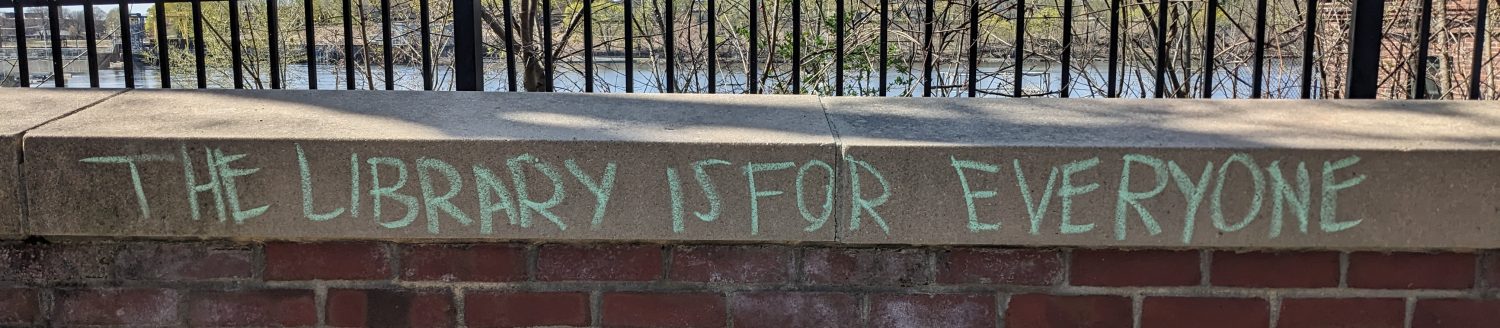
And if you aren’t looking to buy, just looking to read, another great place to get a recommendation is your local library. 🙂

Two Approaches

The Authors Guild has spoken out against Amazon’s Lending Library, arguing that Amazon’s contracts with publishers cover only the sale of books, not lending or giveaways. For additional background on this issue, here’s my November 3 post with several links. The Guild may have a point here, and urges its authors to contact their agents and publishers.

In the “good news” category, however, we have Ann Patchett’s new independent bookstore, Parnassus Books, opening soon in Nashville, TN. The most recent NYT article notes that small, independent bookstores compete “where Amazon cannot: by being small and sleek, with personal service, intimate author events and a carefully chosen rotation of books” (including e-books). Best of luck to Ann, her business partner Karen Hayes, and Parnassus Books!

Amazon, Library?

In case you haven’t already heard, Amazon recently announced the Kindle Owners’ Lending Library. Unlike borrowing books from a public library (free! Well, your taxes pay for it), in order to borrow books from Amazon’s library, you must (a) own a Kindle, and (b) have Amazon Prime membership, which unless you get the student deal is $79/month. Is this bad for libraries? Actually, probably not.

While I don’t want to generalize, I will say that people who belong to categories (a) and (b) above may still visit public libraries, but they probably don’t rely on them as their only source of information/entertainment. Even for those who do have a Kindle and Prime membership, public libraries still offer a much wider selection of e-books for the Kindle and other e-readers than Amazon’s “library,” which offers just over 5,000 titles.  And, none of the Big Six – the six largest U.S. publishers – have jumped on the bandwagon yet, so although some bestsellers are available, many are not.

This isn’t a ploy to compete with libraries; it’s a ploy to sell more Kindle devices. The one advantage Amazon has is that it can lend any title instantly; there’s no wait time, unlike libraries, where – even with e-books – the library has a limited number of copies and only one patron can borrow any given copy at a time (i.e., library owns 10 copies of The Hunger Games, 10 patrons can borrow The Hunger Games at a time – just like print). However, Amazon pays publishers for this privilege – mostly a flat fee, but sometimes per item, as it’s borrowed. So Amazon isn’t making money on lending content – they’re just trying to make Kindle ownership and Prime membership as appealing as possible.

Further reading:

Wall Street Journal
Huffington Post
New York Times
Amazon (press release)

In defense of editors

“The only really necessary people in the publishing process now are the writer and reader,” [Amazon top executive Russell Grandinetti] said. “Everyone who stands between those two has both risk and opportunity.”

That’s a quote from a recent New York Times article about Amazon edging out publishers and dealing directly with authors. I can’t tell if it was quoted faithfully or taken out of context, but if it is a true statement of expression, I have to disagree. Even the best writers – however you define best – need editors. Not every author-editor relationship is a life-changing or earth-shattering one, but editing does improve books: editors might pose the right question at the right time, or suggest cutting an element that doesn’t move the story forward, or suggest a new angle. Writers can become so immersed in their own work they are unable to look at it clearly and objectively; here, too, an editor is helpful.

This is not to say that bad books don’t get published, even with an editor (define “bad” however you want – it’s out there). And it’s not to say that it’s completely impossible for an author to write and publish a work of quality without an editor – but that’s the exception, not the rule. After all, there are dozens of authors writing today who are top-notch, “experts” at what they do; those authors are still working with editors. Even Amazon is employing editors (though nameless executives won’t say how many).

The publishing industry gets a lot of flack. It’s not Wall Street; no one I met while I was working in publishing was in it for the money. It’s not innocent, either (come on, HarperCollins, 26?), but it does have a function, and it is a valuable part of the process by which an author produces a book and that book becomes commercially available. Amazon represents a legitimate threat to traditional publishers, but this is not the end of the world, let alone the industry. Radio wasn’t the end of books, TV wasn’t the end of books, and the Internet isn’t the end of books. If anything, the Internet proves how badly editors are needed.