What’s the first thing you remember?

A couple days ago, our library director issued a call for contributions to our annual “staff picks/best books” column for the local paper. I skimmed my LibraryThing catalog to look over what I’d read this past year, disqualifying anything that was published before 2012…and I ended up with nineteen (19)* titles that belonged in my own personal “favorite” category.

*Compiling the “other favorites” list at the end of this post, I added a few more.
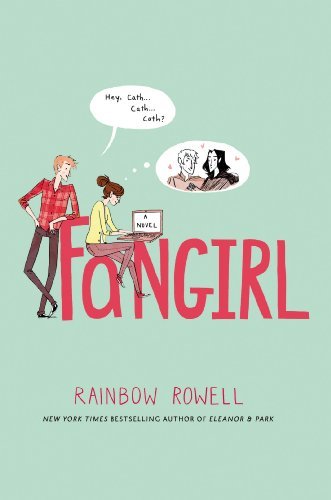
fangirlFor my contributions for the column, I excluded YA books because many of us on staff – including, of course – the YA librarian – read and love YA, and I figured the books I would write about (Every Day by David Levithan, Eleanor & Park and Fangirl by Rainbow Rowell, Wonder by R.J. Palacio, The Raven Boys and The Dream Thieves by Maggie Stiefvater, Code Name Verity by Elizabeth Wein, and Just One Day by Gayle Forman) are the ones they would write about also.

I still couldn’t possibly narrow it down to fewer than five. Here’s what I wrote about my choices (below), and after those are the rest of the list.

Instructions for a Heatwave by Maggie O’Farrell
O’Farrell’s sixth novel is set in London during the legendary heatwave of 1976. Robert Riordan goes to get the paper one morning and disappears; his wife, Gretta, is frantic, and calls their three grown children home. Misunderstandings between siblings are resolved and buried secrets come to light, but the true genius of this book is how deeply the reader sees inside each character, while the characters lack that same insight into each other.

feverFever by Mary Beth Keane
I’m afraid this brilliantly imagined work of historical fiction did not receive the buzz it deserved. Keane brings Irish immigrant Mary Mallon, a.k.a. “Typhoid Mary,” to life in early 1900s New York, and creates a portrait of a woman whose calling was cooking, but whose cooking was lethal. For perhaps the first time, readers will have sympathy for Mary.

The Smartest Kids in the World by Amanda Ripley
Ripley follows three American exchange students through a year in Finland, Poland, and South Korea – all countries whose PISA scores have shot up over the past decade – to investigate how these countries have improved their education systems and whether the United States can adopt a new approach successfully. The writing is lively and clear, the research is solid, the results are not tremendously surprising – it comes down to teachers and rigor.
lifeafterlife_atkinson

Life After Life by Kate Atkinson
Life After Life is like the movie Sliding Doors, but with more doors; protagonist Ursula Todd tries them all, dying and being reborn into her same life again and again. Born in England in 1910, Ursula lives through (or doesn’t) World War I, the Spanish flu, World War II and the Blitz. It’s historical fiction, time travel, and philosophical what-if all rolled into one masterful book.

The Impossible Lives of Greta Wells by Andrew Sean Greer
“The impossible happens once to each of us,” the story begins. Greta in 1985 is grieving: her twin brother is dead of AIDS and her lover has left her. But then Greta wakes up in 1918, and then in 1941. In each time, she is herself, in the same apartment, with the same friends and family, but their relationships are different. As Greta cycles through three selves – in 1918, 1941, and 1985 – she eventually realizes she must decide whether to return to her present, or stay in the past. Toward the end of this beautiful book, she concludes, “What is a perfect world except for one that needs you?”
happymarriage

Other nonfiction favorites:
Lean In by Sheryl Sandberg
This is the Story of a Happy Marriage by Ann Patchett (essays)
I Don’t Know by Leah Hager Cohen
The Reason I Jump by Naoki Higashida, translated by KA Yoshida and David Mitchell
Just My Type: A Book About Fonts by Simon Garfield
Dear Friend: Rainer Maria Rilke and Paula Modersohn-Becker by Eric Torgersen (1998)
oceanattheendofthelane

Other fiction favorites:
The Ocean at the End of the Lane by Neil Gaiman
Sisterland by Curtis Sittenfeld
Me Before You by Jojo Moyes
The Aviator’s Wife by Melanie Benjamin
Z: A Novel of Zelda Fitzgerald by Therese Anne Fowler
The Vanishing Act of Esme Lennox and The Hand That First Held Mine by Maggie O’Farrell
Astray by Emma Donoghue (short stories)

gogiants

Poetry:
Go Giants by Nick Laird
Aimless Love by Billy Collins
Dog Songs by Mary Oliver

Here are last year’s favorites.

The title of this post is a line from Tom Stoppard’s play Rosencrantz and Guildenstern Are Dead.
David Levithan and Rainbow Rowell at Brookline Booksmith

The Monday before Thanksgiving, I trekked across the river to Brookline to see David LevithanRainbow Rowell, Bill Konigsburg, and Paul Rudnick at the Booksmith. Each author read from one of their books: Rudnick read from Gorgeous, Konigsburg from Openly Straight, Rowell and Levithan from Fangirl (hers) and Two Boys Kissing (his). This might be the first time I’ve seen a pair of authors do a joint reading like this – Levithan made a very funny Levi – and they seemed like they were really having fun (though maybe YA authors just have more fun, in general).

DSC06152

After the readings, they opened up Q&A right away. Here are some snippets:

Levithan, on the 10th anniversary of Boy Meets Boy: “Boy Meets Boy was about creating reality. With Two Boys Kissing I wanted to write something that reflected reality.”

On a reaction to Rowell’s decision to write a novel about college-age characters: “‘College students don’t read.’ I know, be offended, write a letter! ‘Nobody wants to read about college students.’ But I don’t think of writing for one specific audience.” And, she added, readers often want to read about characters a little bit older than themselves (e.g. high school students would be interested in reading about college students).

On the extra pressure Levithan felt for his novel Love is the Higher Law: “You write a bad book, that’s okay. You write a bad book about 9/11, that’s bad.”

Levithan, on writing the character A in Every Day: It was less difficult than he expected; “[When you] take gender out of the equation, sexual orientation doesn’t exist.”

Rowell, on humor in writing: “Funny is subjective.” If a joke she wrote made her laugh, she fought to keep it in the manuscript, even if her agent or editor wasn’t sure about it.

Rowell, on why she chose the physical appearances for Eleanor and Park that she did (chubby and red-headed, and half-Korean, respectively): “You make the decision and you don’t always know where it came from, but it comes from somewhere.” And on attractiveness and attraction: “Attraction happens between two people. That’s it. Two people become attractive to each other.”

Levithan, on making stuff up: “If you’re a writer you make up everything. You’re always being presumptuous.”

On Rowell’s jealousy of the Harry Potter/Internet generation: “Fanfic writers have different rules than published authors.”

Rowell, on writing: “The more you do it, the better you get.”

Levithan, on writing: It’s like the cello. No one expects you to pick up a cello and play a concerto your second time playing. It’s like a muscle you have to develop and strengthen with practice. “Allow yourself to fuck up a lot…Don’t put an expiration date [on your writing], just keep going.”

Someone asked, “What happens when The Lover’s Dictionary Twitter account (@loversdiction) reaches the letter Z?” Levithan said he’s going to wait and see how Sue Grafton (A is for Alibi) handles it, because she’s going to get to the end of the alphabet first. The Twitter account, which he started as a promotion for the book’s release, is now longer than the actual book. He’s currently on the letter G (“Good, adj.: You should choose this so much that it no longer feels like a choice”), and expects to be done in a decade or so. (On losing track of time: “Isn’t 2013 like twelve years from now? No, it’s not.”)

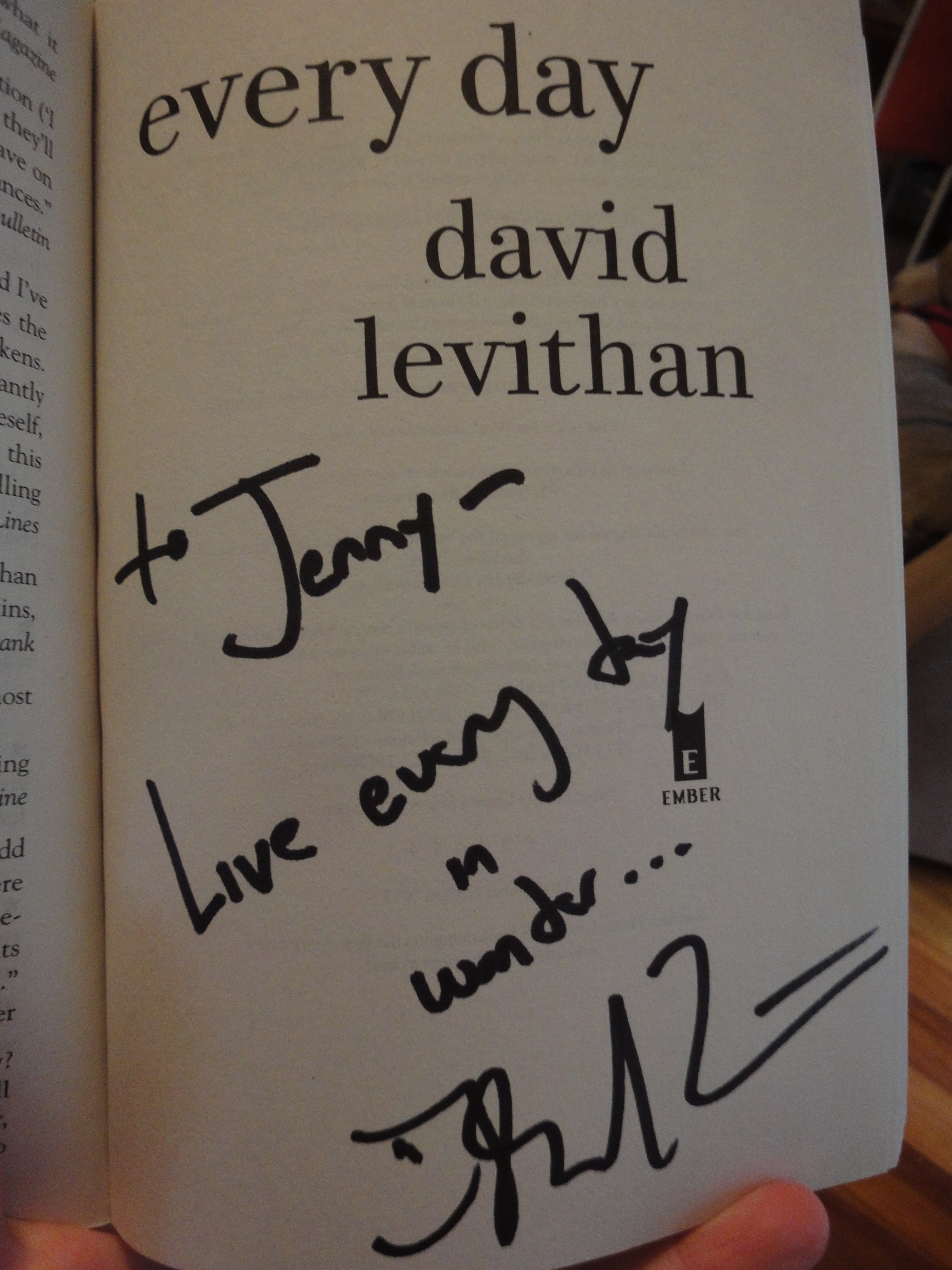
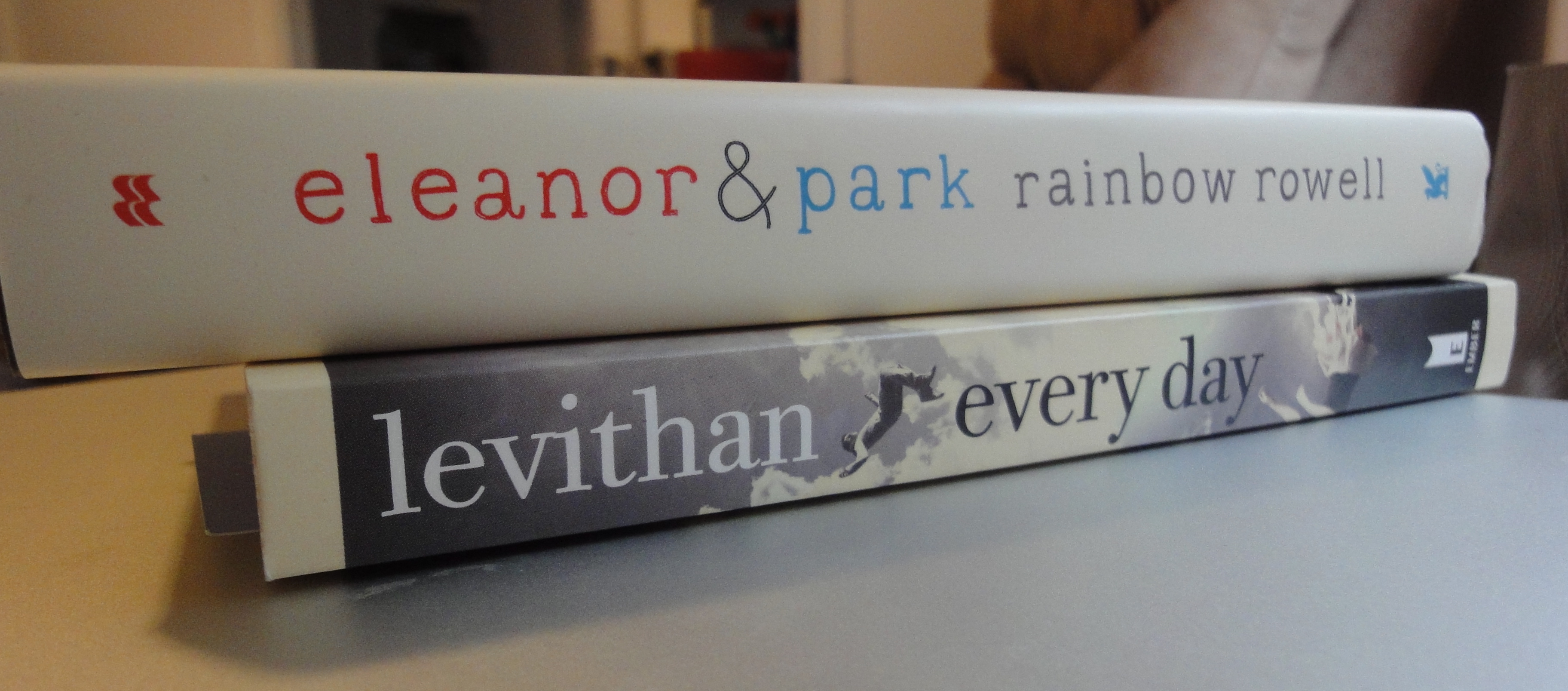
After the Q&A, the authors signed copies of their books. Here’s my new paperback copy of Every Day:

DSC06155


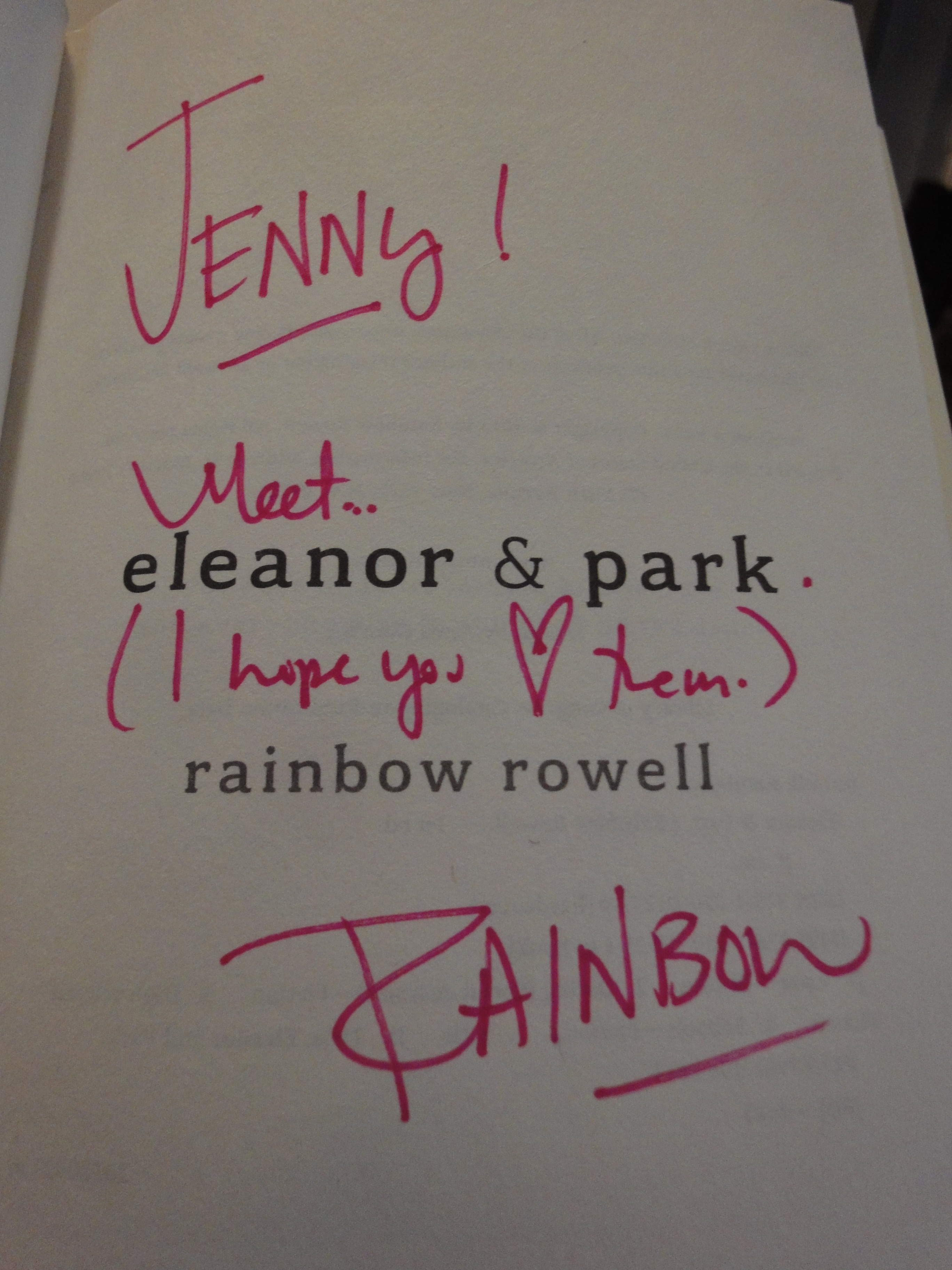
And here’s my new hardcover of Eleanor & Park. The first time I “read” it was the audiobook – and Rebecca Lowman is superb – but I’m looking forward to reading it again in print.

DSC06154


Of course, I already do love them.

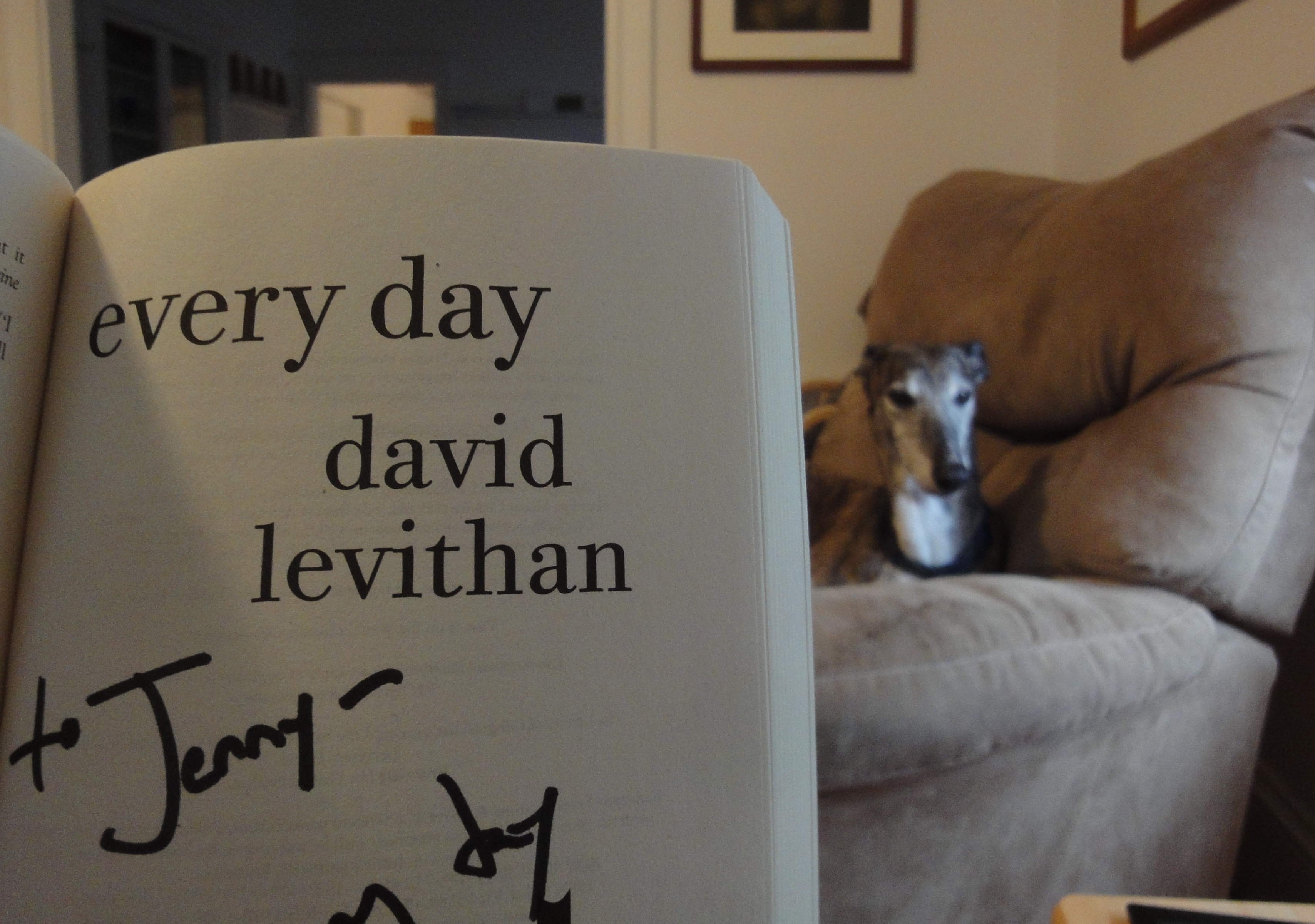
The dog, however, is less impressed. Here she is in the background of the title page of Every Day:

DSC06156

She’d be more impressed if she could read, though. (Or if paper tasted more like chicken. But I’m very glad it doesn’t, or none of the books in my house would be safe.)

Anyway…YA books! Read them! Especially these ones.


National Novel Writing Month (NaNoWriMo)

Last year, on the last day of November, Dana Sachs published an essay in Publishers Weekly called “Doing 50,000 Words in 30 Days.”  The title of the article refers, of course, to National Novel Writing Month (NaNoWriMo), which started in San Francisco in 1999 and has grown and spread since then. Now there are participants all over the world – over 300,000 in 2012 – and hundreds of “write ins,” many at libraries.

NaNoWriMo2013bannerThe idea behind NaNoWriMo is simple: write a novel in a month. Specifically, write 50,000 words in 30 days. This works out to 1,667 words per day. (For reference, Sachs’ essay in PW is 750 words.) Admittedly, 50,000 words is pretty short for a novel – about 200 pages – but still, to write that much in a month is nothing to sneeze at, regardless of quality.

In fact, quality isn’t the point of NaNoWriMo. As Sachs writes, “Many writers…suffer from a gnawing perfectionism that can, at its worst, torment us over the placement of a single comma. Forget completing a first draft; perfectionists have trouble completing even a paragraph. NaNoWriMo forces us to ignore our incapacitating inner critic and keep going. The genius of NaNoWriMo is that it obliges us to (temporarily) lower our standards.”

After November, the writer has a working draft; s/he can edit, cut, amend, tinker, and add. The novel may eventually go into a drawer (or computer folder, more likely), may be self-published, may be published through the traditional process with an agent and an editor. No matter the outcome, it’s still an achievement: you’ve made something. And NaNoWriMo provides an encouraging community in which to make that something.

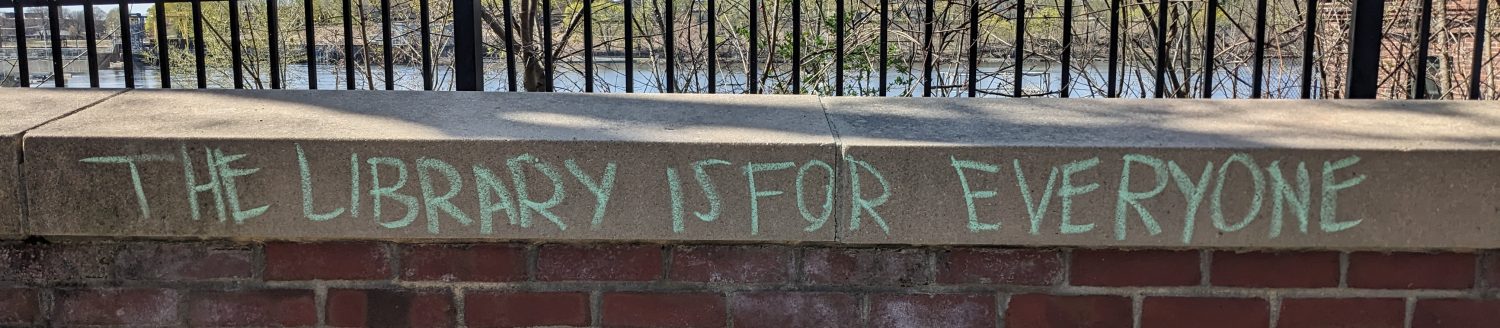
nano_12_new_Come_Write_In_Logo1Library literature has been full of buzz about MakerSpaces lately. Many libraries are re-envisioning their mission and redesigning their space. This is an old idea with a new label (“making” instead of “crafting”) and new technology (e.g. 3D printers). The library was never purely a place for consumption; people have always come to libraries to create as well as consume. And what better place to write (or “make”) a book than a library?

That’s why I’m pleased to be hosting Write Ins at the Robbins Library for the second year in a row. Are you a writer in the Arlington area? “Come Write In.” 

“The real secret is that anyone can write a book… Writing is for everyone, and this is your chance to scrawl your name across the page. By month’s end, you’ll have done that which many dream of, but never accomplish.” -Gennifer Albin, author of Crewel

“As you enter this month of writing, write for yourself. Write for the story. And write, also, for all of the people who doubt you. Write for all of those people who are not brave enough to try to do this grand and wondrous thing themselves.”  -Kate DiCamillo, author of The Tale of Despereaux and Because of Winn-Dixie

“Everyone has a different idea of what constitutes ‘appropriate content’”

There is lots of great Banned Books Week-related stuff on Twitter this week (#BannedBooksWeek), and today’s Library Link of the Day was an NPR segment from Tell Me More called “Could banning books actually encourage more readers?” (Answer: we hope so!) My favorite find via Twitter (so far, at least) is this post from Shoshana at the Brookline Booksmith. It was a good reminder that librarians aren’t the only ones fighting for intellectual freedom and defending everyone’s right to read; publishers and booksellers are in it with us. 

Shoshana wrote, “Everyone has a different idea of what constitutes ‘appropriate content.’ I’ve talked with a lot of parents about what’s right and what’s not right for their kids to read. Some parents want to avoid anything “scary.” Others ask about the The Hunger Games and relax as soon as they learn that although it’s about teenagers being forced to fight to the death, it doesn’t have any sexual content….What I love about the customers in our kids’ section, though, is that the question is pretty much always what’s appropriate for the particular kid in question, not what should be published or be on our shelves….People around here seem to get that what’s all wrong for one reader might be just right for another; even siblings have different levels of scariness tolerance or ability to understand difficult topics.”

She makes a great point: what is “appropriate” for one reader may not be appropriate for another (this is one of the reasons that putting ratings on books is a terrible idea). This is part of readers’ advisory, and it’s a great skill – as a bookseller or a librarian – to be able to talk with parents about what their kids are ready to read (or to talk directly with kids; I know an eight-year-old who didn’t feel ready to read Harry Potter when he was seven, but feels like he might be ready now).

Remember: Every reader his/her book, and every book its reader.


Fall Titles: The Signature of All Things, The Lowland

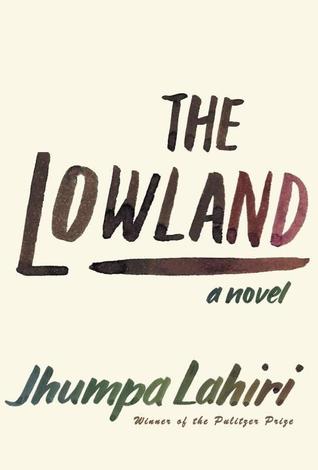
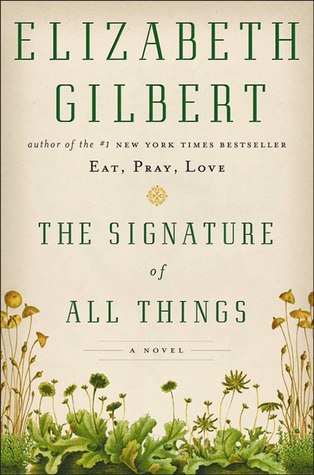
This fall should be a good one for publishers and readers alike. Many beloved authors are coming out with new titles in September, October, and November, including Margaret Atwood (MaddAddam), Stephen King (Doctor Sleep), Amy Tan (The Valley of Amazement), and several others. I was lucky enough to read advance copies of two of these anticipated titles: The Lowland by Jhumpa Lahiri, and The Signature of All Things by Elizabeth Gilbert.

lowland First, and most eagerly awaited, The Lowland: a friend of mine who attended ALA in Chicago snagged a galley and generously let me borrow it. Lahiri (Interpreter of Maladies, The Namesake, Unaccustomed Earth) treads familiar ground with a story of an Indian family, some of whom move to the American Northeast, and some of whom stay behind in India.

Those who read the fiction section of The New Yorker may recognize the first several pages of The Lowland, in slightly altered form; it was published as “Brotherly Love” in the June 10 issue earlier this year. The brothers are Subhash and Udayan: the elder is cautious, the younger is reckless (“[Subash’s] parents did not have to worry about him and yet they did not favor him. It became his mission to obey them, given that it wasn’t possible to surprise or impress them. That was what Udayan did”).

Though the brothers grow up side by side, their paths diverge, with Udayan becoming involved in a dangerous political movement – the drastic consequences of which echo for decades after Udayan’s death and Subhash’s marriage to his brother’s widow, Gauri.

The narration is a close third person, shifting perspectives every so often, from Subhash, to Gauri, to their daughter Bela, to the brothers’ mother Bijoli, and finally to Udayan. Lahiri creates intensely believable characters in the Mitra family, and she covers a significant time span with her spare, beautiful prose.

The Lowland has been shortlisted for both the National Book Award and the Man Booker Prize.

signatureofallthingsThe Signature of All Things by Elizabeth Gilbert (Stern Men; Eat, Pray, Love; Committed) covers an even greater span of time, at a much more leisurely pace. For once, I could not agree more with the Publishers Weekly review, which is a marvel of conciseness. This thoroughly researched story begins with Henry Whittaker, a scrappy young thief whose father works at Kew Gardens. Henry eventually becomes one of the wealthiest men in Philadelphia, and his daughter, Alma, grows up on the family estate, White Acre.

Alma is given all the advantages Henry did not have, especially education; but, because she is plain (especially compared to her beautiful adopted sister, Prudence), she must resign herself to spinsterhood while Prudence and their mutual friend, Retta, both marry.

Alma devotes her time to business – after her mother Beatrix’s death, she is Henry’s right hand – and the study of mosses. Her life continues in this quiet, circumscribed, but more or less satisfying manner until the arrival of Ambrose Pike, an orchid artist. For the second time in her life, Alma falls in love, and she and Ambrose marry, but the marriage is not what either of them expected, and Ambrose leaves White Acre.

Soon afterward, the inimitable Henry Whittaker dies, and Alma decides, finally, to leave White Acre and travel. She follows Ambrose’s path to Tahiti, and after a few years there, makes her way to her mother’s homeland of Holland.

Gilbert incorporates her research into the story in a way that is natural, not distracting – a harder task than it appears. From beginning to end, she maintains control over the story and the characters; I was aware of the narrator’s voice and presence throughout the time I was reading. Perhaps this slight distance was the reason I did not feel the full emotional impact of admittedly dramatic events throughout Alma’s life. Still, this is a unique book, and an especially great choice for those who are interested in botany, science, history, or travel.

E-books in libraries

Cross-posted, in modified form, from the Robbins Library blog.

It’s a real struggle sometimes to refrain from prefacing the name Cory Doctorow with the phrase “my hero.” In addition to being an author (Little Brother and Homeland, among others), blogger, journalist, and the co-editor of Boing Boing, he is also a tremendous advocate for libraries. In particular, he often writes about the relationship between libraries and publishers.

Most public libraries have jumped on the e-book bandwagon, and have found some platform from which to lend e-books for patrons to borrow. However, these platforms are usually somewhat clunky (though they are improving), and publisher restrictions hamper what books libraries are able to buy and how we are able to lend them. Thus, for the most part, e-books work much the same way print books do: one person can use them at a time, and if more than one person wants to read a particular book, there is a waitlist.

The “one copy/one user” model, as it is called, is an artificial constraint put in place by the publishers, who require each e-book to come wrapped in digital rights management (DRM) software. DRM limits what readers can do with their e-books: an e-book with DRM will only work on certain devices, usually can’t be moved from one device to another, can’t be lent or shared, and can’t be copied.

Of course, publishers are correct to be concerned. E-books are new territory, and it’s much easier to copy a digital file than it is to copy a print book. However, as Doctorow points out, libraries are, and always have been, publishers’ greatest allies. Especially with the decline of brick-and-mortar bookstores, it is often librarians, not booksellers, who connect readers with new authors.

Here are a couple of paragraphs from one of Doctorow’s latest essays on the topic, but I encourage you to read the whole piece:

“There are libraries in every town, and even though they’re under terrible assault in the age of austerity, they remain the mark of a civilized society and benefit from librarians’ amazing organizational skills. The modern library has become something like a bookstore, where helpful staff who love books and authors take enormous pride in ‘‘hand-selling’’ the publishers’ products to their patrons. Libraries host some of the best author events, too, providing a vital space for readers and writers to connect.

Unlike every other channel for e-books, libraries are not the publishers’ competitors. They don’t want to sell devices. They don’t want to win over customers to a particular cloud. They just want readers to read, writers to write, and publishers to sell. They deserve a better deal than they’re getting.”

Librarians continue to push the conversation along, but meanwhile, we’re still buying (well, licensing) e-books for our patrons at unfair prices, under unfair restrictions. But it’s not all doom and gloom: some publishers, like sci-fi imprint Tor, are experimenting with DRM-free books, and so far that has not led to an explosion of e-book piracy, so perhaps more publishers will move in that direction.


Open Letter: Authors for Library E-Books

Naturally the subject of e-books in libraries arose during the week at NELLS. For those who are unfamiliar with the issue, Maureen Sullivan’s open letter to publishers (9/28/2012) is a good place to begin. In it, she explains how libraries support publishers by improving literacy, instilling a lifelong love of reading, and aiding discovery of new authors and genres. E-books in libraries will no more cannibalize e-book sales to consumers than print books in libraries have (i.e., they won’t; research shows that most people who borrow from the library also buy books).

A4LE_badge2

The Authors for Library E-Books campaign (@Authors4LE on Twitter; #A4LE) is an effort to encourage authors to speak out on this issue. Libraries and authors are natural allies, and we all need to speak up to bring this change about. To this end, I contacted a few authors that I have met over the years – through publishing or through author events at bookstores and at the library. I’ve included a template of my letter here; if you know an author (or two, or five, or twelve) who supports libraries, feel free to tweak this and send it along. I personalized each one by mentioning a recent reading of theirs that I’d attended, a program they’d done at a library, or a new book of theirs coming out soon.

An Open Letter to Authors for Library E-Books

Dear [Author],

I hope you are having a good summer so far. I know you are a strong supporter of libraries, and I thought you might like to join ALA’s “Authors for Library E-Books” effort.

I’m sure you’re aware of the ongoing discourse between publishers and libraries on this topic. As it stands, each publisher has come up with a different solution: HarperCollins, for example, licenses e-books to libraries at a reasonable cost, but those licenses expire after 26 uses. Other publishers, such as Random House, charge libraries more than three times the consumer price for e-books and digital audiobooks.

Author and library advocate Cory Doctorow has made a short (four minutes) video about why he supports the Authors for Library E-Books campaign. He says, “Libraries have been so important to the careers of writers, and librarians are such fabulous advocates for authors….Libraries should be able to buy books and they should be able to buy them on fair terms.”

Join Cory Doctorow, Jodi Picoult, Ursula Le Guin, and many other authors who stand with libraries on this issue. You can sign onspeak out, and learn more at the A4LE site, or of course feel free to contact me with any questions or feedback.

Sincerely,
Jenny

We built this together

“We need editors, and we need publishers, and we need booksellers….We built this together, and we’re going to keep building it together.” -John Green at the American Booksellers Association Annual Awards (he gives librarians a shout-out too)

The book business may be changing, but that doesn’t mean that many “traditional” elements aren’t crucial (see “In defense of editors,” October 2011). Books may have only one author, but many hands and minds go into their production, let alone their success.

The Sea of Tranquility by Katya Millay

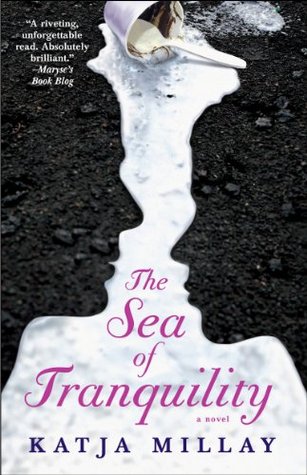
sea of tranquilityNote: The Sea of Tranquility was initially self-published. It was well-reviewed by book bloggers, and picked up by a mainstream publisher, the Atria imprint of S&S, which will issue a paperback edition in June 2013. The version I read was an advance copy of the Atria edition.

The Sea of Tranquility is narrated in the first person, alternating between Josh Bennett and Nastya Kashnikov (not, as we learn eventually, her real name). Josh is seventeen; following the death of his mother and sister in a car accident when he was eight, and the subsequent death of his father and grandparents, he has been emancipated and lives alone.

A former piano prodigy who has suffered a terrible trauma, Nastya has come to live with her aunt Margot and begins attending the same high school as Josh, where she does everything possible to alienate people. Most significantly, Nastya doesn’t talk; she hasn’t spoken out loud to anyone in over a year.

Despite, or perhaps because of, Nastya’s silence, her handsome and charming classmate Drew becomes attached to her, and occasionally drags her out to parties. After she gets too drunk at one of them, he brings her to his friend Josh’s house for help; though they don’t hang out at school, Drew is Josh’s only close friend.

It’s not rocket science to see where the book is headed; though both Josh and Nastya are closed off to others, afraid of being hurt again, they are attracted to each other. (This setup practically begs for a voiceover: Will they share their secrets and help each other heal from past hurts? Will they learn to love again?) Though there is little real suspense, I found the characters compelling, and the book strangely hard to put down; Josh and Nastya certainly do have chemistry, and Nastya’s backstory is eventually revealed through a coincidence that doesn’t feel too contrived.

The author follows Rule #1 of YA novels (and fairy tales): get rid of the parents. Josh’s parents are dead, and Nastya lives with her aunt, but Margot is a nurse, and their schedules rarely have them home at the same time. Nastya has little contact with her parents and her brother, Asher, except for a couple visits and a few necessarily one-way phone calls.

In terms of genre, I’d call it literary fiction/YA romance; it has some dark scenes and heavy themes, but the characters are 16-18 years old and much of the book takes place in or around the high school or the characters’ homes. The writing is good, and if it’s sometimes melodramatic, well, so are teenagers. Though I was skeptical, I definitely enjoyed The Sea of Tranquility, and would read more from this author.

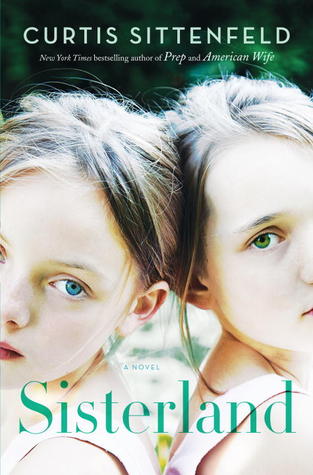
Sisterland by Curtis Sittenfeld

SisterlandFrom birth, twins Daisy and Vi Shramm have had what they call “senses,” psychic abilities. Vi embraces hers, but after a bad experience in middle school, Daisy tries as hard as she can to ignore her senses and be normal. In college, she goes by Kate (from her middle name, Kathleen), and when she marries she takes her husband’s last name; so although Vi Shramm and Kate Tucker still live in their hometown of St. Louis, Missouri, their twinship isn’t obvious.

Not only do they differ in name and in appearance, their lives have taken different courses as well: Kate attended college, married, and is a stay-at-home mom, whereas Vi, after a wandering course, is a practicing psychic in town. When she predicts a massive earthquake, Kate is torn: she believes her sister, but will she support her? Kate’s husband Jeremy is a professor at Washington University, and his close friend and colleague Courtney Wheeling is an expert in seismology there; she insists that there is no way to predict an earthquake.

Sisterland is narrated by Kate, and the reader has access to all of her thoughts, feelings, and insecurities. Though the majority of the story takes place during the lead-up to the predicted date of the earthquake, there are also episodes from the twins’ childhood, adolescence, and college years, as well as Kate and Jeremy’s courtship, and their friendship with the Wheelings (Hank is a stay-at-home dad). As usual, Sittenfeld manages to cover a significant span of time without sacrificing the story’s depth.

Throughout her life, and the book, Kate’s frequent conflicts with her sister are a manifestation of her internal conflict: she has the “senses,” but she doesn’t trust them or want them; she wants to embrace conformity, be normal, be good. But can she be true to herself while ignoring this aspect of her character? The main conflict, when it comes, has little to do with Kate’s psychic abilities (or her quashing of them); it is surprising but utterly believable.

Sittenfeld has a talent/skill for making her characters’ words and actions seem reasonable by revealing their deepest thoughts and feelings. I sympathized with Kate, though it occurred to me to wonder how I would feel if Sittenfeld had chosen to narrate the story from Vi’s point of view. Sisterland encompasses a number of issues: traditional beliefs vs. new age-y ones, the value of working vs. stay-at-home parenting (and how that affects partners’ relationships), race, fidelity, and compromise. For those who were impressed by Prep and/or American Wife, be assured that Sisterland is as good, if not better.

I received a galley from Random House at the Massachusetts Library Association conference in April. Sisterland will be published on June 25, 2013.

prepamericanwife