Pleasure reading should be pleasurable

Makes sense when you think about it, right? Yet so many of us feel obligated to finish a book once we’ve started it, and feel guilty if we set it aside. We really should read it, because a friend recommended it, or it got a good review, or it’s on a topic we really ought to know more about, or everyone else is reading it, or we put it on our to-read list four years ago (but we can’t remember why), or it’s a classic…fill in the blank however you like.

But unless a book is assigned reading for school or work, then presumably you’re reading for pleasure, and pleasure reading should be pleasurable. Not that you shouldn’t ever explore a new genre or try a book that you find a bit difficult, but if you’re 25 or 50 or 100 pages in and you’re just not that into it, then by all means, put it down and pick up something else instead! You have this librarian’s permission.

This is something I have worked on for years myself. I was inspired partly by Knopf editor Marty Asher, who said something along the lines of “I don’t have time to read anything but great books” (and that was almost a decade ago). Of course, you might well think a book is going to be great and it turns out not to be: you can only judge so much by the cover, title, author, first sentence, first page, flap copy, reviews, etc. Most of us don’t choose books we think we’re going to dislike on purpose.

And yet it can be so hard to put down a book we’ve invested some time in already. It feels like giving up; it feels like failure. And who knows? We’re optimistic; maybe it will get better in another 25, 50, 100 pages. But no: at some point you begin to feel certain that this book is not the one for you, at least not right now. (“Every reader his/her book, every book its reader“).

One side effect of my free time having been somewhat curtailed of late is that I have become much better at putting down a book that doesn’t hook me quickly. This is usually not a reflection on the book’s quality; it’s just not for me, not right now. For example, I have decided to return M.T. Anderson’s Symphony for the City of the Dead to the library – despite the fact that it was personally recommended to me by a reader I trust, and that it was a finalist for the YALSA Award for Excellence in Nonfiction for Young Adults – because I just can’t get excited about the siege of Leningrad right now.

What can I get excited about? Young adult fiction, apparently: I’ve read nine YA novels so far this year, including some truly stellar books (all right, let’s name names: Simon vs. the Homo Sapiens Agenda, Like No Other, Dumplin’, Roller Girl, Echo, A Step Toward Falling, Bone Gap, Rain Reign). I’ve also read (and re-read) some excellent picture books. And, I got to read Gayle Forman’s upcoming adult novel Leave Me, which is just as good as her YA; I read it in just two days, and I have a three-month-old baby, so that should tell you something. (The thing it should tell you is “read Leave Me“!)

So there you have it, from a librarian: if you don’t like what you’re reading, and you don’t have to read it, put it down and read something you love instead. That’s the beauty of the public library: millions of books just there for the borrowing. Don’t do what I did and spend an entire month trying to slog through a book you aren’t that excited about: you’re not being graded, and ticking a box on a checklist you made yourself isn’t nearly as satisfying as spending time reading a book you love. In fact, I think there’s a song about this. Let it go…

[All that said…my library is hosting a 2016 Reading Challenge with some interesting categories, and one book can count toward more than one category. Click through to read more if you’re interested in participating.]

Do you debut? Focus on first books

I only realized how few new debuts* I read when I was offered the chance to contribute to another Reader’s Shelf column in Library Journal,New Year, Nearly New Books: Favorite 2015 Debuts.” Looking back through nearly a year’s worth of reading, there weren’t very many for me to choose from, but I did really enjoy The Magician’s Lie by Greer Macallister. If you like magic and illusion, turn-of-the-century America, and (possibly) unreliable narrators, it would be a great book to curl up with this winter.

*”New debuts” isn’t redundant, I don’t think: an author’s first book is a debut whether it was published ten years ago or ten days ago. And if it was ten years ago, then hopefully there have been a few since, and you’ve got some catching up to do!

Do you seek out debuts? I don’t make a point of it, though I certainly don’t have anything against them – if it’s recommended to me or gets glowing reviews or has a great hook, I’m just as interested in a first novel as a tenth, and discovering a new writer is a pleasure. Really, the only downside to reading a new debut is that you’ll be waiting for the next one instead of diving into an author’s backlist.

Do you like to read everything an author has written, or do you read more selectively, even if you really like the author? Do you like to read an author’s work chronologically, reverse-chronologically, or does the order not matter to you?

Books on the radio

I was invited to be on Wisconsin Public Radio at the end of December to talk about audiobooks: why people might try them, how to find a book (or narrator) they like, when they might even be preferable to print books. Being on the radio was fun! It’s archived on WPR’s Central Time website (though I haven’t listened; I don’t want to hear how many times I said “um”). If you want to download or listen online, it’s from 5:30-6pm (unless you need to catch up on your local Wisconsin news and chit-chat, in which case, go ahead and listen to the whole thing).

I’ve written about audiobooks on this blog in the past; if you missed those posts, don’t worry, you can access them here, because the internet is forever: “I’d listen to her read a grocery list: on audiobooks” (3/12/14) and “Audiobook recommendations for a friend” (10/3/14). Or if you don’t want to click through, here’s the bullet point version:

  • How to get started if you’re new to audiobooks: Try listening to a book you’ve already read; choose a shorter book; listen to the first few minutes of a few different ones to see which narrator’s voice you like best.
  • Remember, taste is subjective: You might prefer a male or female narrator, a full cast production, American voices or other accents, slow or fast talkers.
  • How to get audiobooks: You can buy them, of course, but that gets expensive! Your local library probably offers audiobooks on CD and/or Playaways (a small device that contains one whole book), and may offer downloadable audiobooks as well through Overdrive, hoopla, or another platform. If you’re hearing impaired, you can get access to audiobooks for free in every state.
  • Value-added aspects: Some authors read their own books, which can be especially fun if they are familiar voices already, like Tina Fey, Amy Poehler, Sarah Vowell, Neil Patrick Harris, or Aziz Ansari. Neil Gaiman and Jenny Lawson also read their own books, which I highly recommend.
  • A social experience: Before school vacations and holidays, lots of people come to the library looking for audiobooks the whole family can enjoy on long car trips. Finding a book everyone will enjoy can be a fun challenge depending on ages and tastes!
  • Seamless switching between formats: I haven’t done this myself, but one of the callers said she switched back and forth between the Kindle e-book and Audible audiobook; Amazon owns Audible so accounts can be synced for seamless transitions between audio and print.

Do you listen to audiobooks? Do you have a favorite genre to listen to, or a favorite narrator?


Best Books I’ve Read in the Second Half of 2015

See Top Ten Books I’ve Read So Far in 2015 from July 1. I will still talk your ear off about Greenglass House and Graceling. And Trigger Warning and NPH’s Choose Your Own Autobiography are superb audiobooks. Here are ten of the books I’ve enjoyed in the second half of the year:

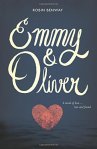
Emmy & Oliver by Robin Benway: Cover image of Emmy & OliverEmmy’s best friend (and boy-next-door), Oliver, was kidnapped by his father when he was seven; he returns at age 17, and reconnects with Emmy and her friends. Good realistic/romantic fiction for those who liked The Face on the Milk Carton by Caroline B. Cooney and Sweethearts by Sara Zarr.

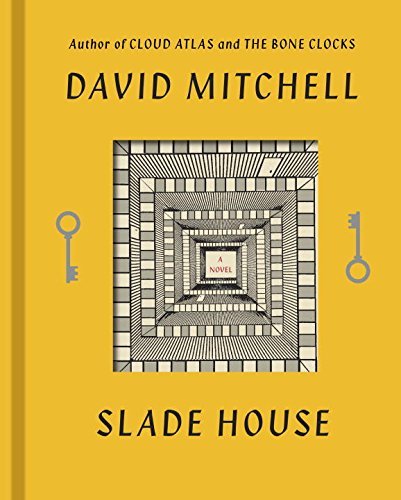
Slade House by David Mitchell: This haunted house story is a companion to The Bone Clocks, so of course I loved it; there’s no need to read The Bone Clocks to enjoy Slade House, though, so if this is your first foray into Mitchell’s universe, you can start with this more concise novel. The titular Slade House appears every nine years so its inhabitants can harvest a soul to prolong their lives, but the last victim it lures in is on to them. Deliciously creepy. (I got an early copy and wrote the blurb for LibraryReads.)

We Never Asked for Wings by Vanessa Diffenbaugh: Just as good as The Language of Flowers, but with illegal immigration instead of the foster care system and homelessness as the central issue. Not to say that it’s an “issue book”; the Mexican-American characters at the center of the story are real and complex, their dilemmas hard and heartbreaking.

Useful, Usable, Desirable by Aaron Schmidt and Amanda Etches: I’ve already written about this one here. If you work in a library, or design any kind of product or service or platform for library users, read this book!

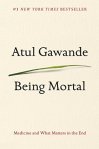
Being Mortal by Atul Gawande: Cover image of Being MortalI’m consistently impressed with Gawande’s writing ability, and the clarity with which he communicates his message. In this case, he addresses the issues presented by an aging population, on both the societal and the individual level. An important book that is also easy to read.

The Dive from Clausen’s Pier by Ann Packer: If you’ve been having second thoughts about settling down with the guy you’ve been dating for years and are now engaged to, and he becomes paralyzed in an accident, do you stay with him? Or do you go? This is Carrie Bell’s decision, and The Dive From Clauden’s Pier is a character study of a young woman making a difficult decision about what she should do, and what that might mean about the kind of person she is.

Modern Romance by Aziz Ansari and Eric Klinenberg: Though I’m no longer in the dating pool, I enjoyed listening to how romance has changed and how it has stayed the same in recent history. The audiobook was great; it’s stand-up comedy backed up with smart social science.

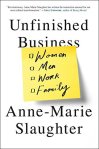
Cover image of Unfinished BusinessUnfinished Business by Anne-Marie Slaughter: The author of The Atlantic article “Why Women Still Can’t Have It All” has written a book about the unequal value American society places on competition (ambition, putting oneself first, breadwinning) and care (providing care for children, aging parents, other family members or friends); the former is traditionally male, the latter traditionally female. In order to address gender inequality, we must also adjust the value we place on competition and care.

George by Alex Gino: George is a fourth grader who was born a boy but knows she’s really a girl. But how does she tell her family and friends? And how will they react when she does? This is most likely – hopefully – just the beginning of transgender lit for children and teens, and it’s a sweet, realistic story that avoids extremes: there’s no horrific bullying, but not everyone is instantly accepting either. George’s friend Kelly is a great character also.

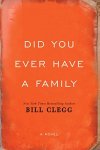
Did You Ever Have a Family by Bill Clegg: Cover image of Did You Ever Have a FamilyA story of grief and guilt, told by multiple narrators – the survivors of a tragedy and those related to them. For those who liked The Illusion of Separateness by Simon Van Booy, How to Start a Fire by Lisa Lutz, The Children’s Crusade by Ann Packer, Fellow Mortals by Dennis Mahoney, The Grief of Others by Leah Hager Cohen.

That’s it for me for 2015. If I read any outstanding books in the next week, I’ll tell you about them in January. Meanwhile, what were your favorite books of the year?

Readers’ Advisory: Novels featuring real historical characters

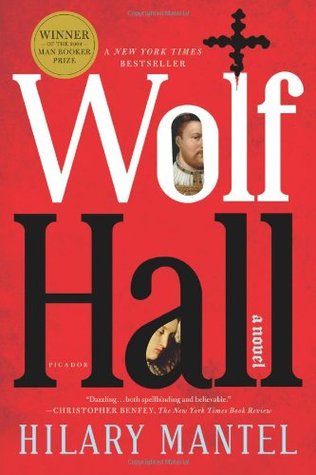
The Massachusetts Library System (MLS) has a new series called “5 in 15 Booktalks,” where librarians talk about 5 titles in 15 minutes or less. I got to work with the excellent MLS staff to put together a “5 in 15 member edition” booktalk, where I talk about novels that feature real historical characters, including:Cover image of Wolf Hall

  • Thomas Cromwell in Hilary Mantel’s Wolf Hall and Bring Up the Bodies
  • Edith Wharton in Jennie Fields’ The Age of Desire
  • Mary Mallon (a.k.a. Typhoid Mary) in Mary Beth Keane’s Fever
  • Anne Morrow Lindbergh in Melanie Benjamin’s The Aviator’s Wife
  • Vanessa Bell (nee Stephens) in Priya Parmar’s Vanessa and Her Sister

Watch the video (me talking over slides). It was hard for me to narrow my list down to five titles, so I mention some others during the talk, including The Other Boleyn Girl by Philippa Gregory, The Paris Wife by Paula McLain, Z by Therese Anne Fowler, Sutton by J.R. Moehringer, and a few others.

What’s your favorite novel featuring a real historical character? Or do you prefer your historical fiction to have a purely invented main character? Share in the comments!

LibraryReads October 2015 list

LibraryReadsLibraryReads is an initiative that was launched in September 2013 and has been going strong ever since. Simply put, LibraryReads is “The top ten books published this month that librarians across the country love”; it’s a list of ten books compiled every month by library staff across the country. All library staff are eligible to vote and write reviews. I’ve seen presentations from the LibraryReads organizers at least twice (once at the Massachusetts Library Association conference in May 2015, once at BEA in May 2014), and have written occasional reviews for the books I’ve managed to read ahead of time, but this is the first time one of my reviews has been featured, and I couldn’t be happier that it’s for David Mitchell’s Slade House.

Cover image of Slade House“Every nine years, Slade House appears in a little alley in London, and every nine years, someone – or multiple someones – disappears into it, never to be seen again. Slade House is a lacuna, frozen in time, and its inhabitants need a new soul every nine years for their continued survival. Fans of The Bone Clocks will inhale this compact, six-part work that draws on Mitchell’s previously established mythology and, of course, reintroduces a familiar character or two. New readers, however, won’t be lost, as important pieces are explained to each new character who is drawn into Slade House. Literary fiction, fantasy, and a dose of horror combine here to make a deeply satisfying book.”

See all ten of October’s LibraryReads picks here. I’m also looking forward to After You by Jojo Moyes, The Secret Chord by Geraldine Brooks, and Welcome to Night Vale. October is always a good month for publishing!


Epistolary books on The Reader’s Shelf

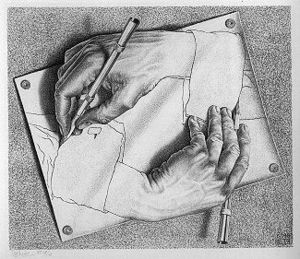
M.C. Escher's Drawing Hands
M.C. Escher’s Drawing Hands, via Wikipedia

I’ve written about letters and epistolary novels here before, but I revisited the topic with my friend, librarian and fellow blogger Brita, in the Reader’s Shelf column for Library Journal. It was tough to narrow down our initial list of epistolary books to just six titles, but we did it!

Library Journal logo


Check it out, dear reader, and let us know what you think. Then come back and let us know, what are your favorite epistolary books?

Top Ten Books I’ve Read So Far in 2015

I always enjoy threegoodrats’ “Top Ten Tuesday” posts, inspired by The Broke and the Bookish, and this week I thought I’d chime in as well (even though it isn’t Tuesday), because the topic is “top ten books I’ve read so far in 2015” and that sounded like a fun list to make.

Listed in the order that I read them, with links to reviews/quotes in LibraryThing:

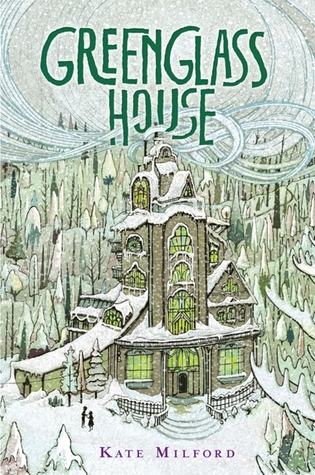
Cover image of Greenglass House1. Greenglass House by Kate Milford: Friends and strangers alike will attest I have not shut up about this book since reading it in January. It is absolutely overflowing with “appeal factors” such as: adoption, a snowbound closed-house mystery (a la Agatha Christie) in a smugglers’ inn, a role-playing game, stories within stories, an entire fictional place complete with its own history and lore, plenty of hot chocolate, Christmas, and a ghost. And it’s got a beautiful cover.

2. Alanna (Song of the Lioness quartet) by Tamora Pierce: I definitely should have read this in middle school or at least high school, but I’m glad I didn’t let it slip by completely. A fantastic set of fantasy novels with that “strong female protagonist” that everyone loves (plus horses, plus a magical crystal that prevents pregnancy). I inhaled all four of these in the space of a week.

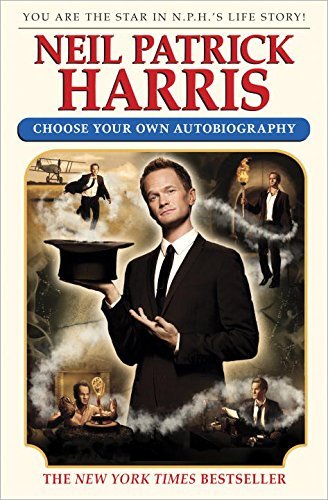
Cover of NPH Choose Your Own Autobiography3. Neil Patrick Harris: Choose Your Own Autobiography: This is one of the best audiobooks I’ve ever listened to (but get the print version too so you can see the pictures). Entertaining and funny but not at the expense of depth. A must for all NPH fans, and the “choose your own adventure” format worked better than it had any right to.

4. Don’t Make Me Think by Steve Krug: I’ve been meaning to read this for ages – it could/should have been on my 2015-TBR list – and it was well worth it. Anyone who uses computers, let alone anyone who makes software or hardware, ought to read this book (and also Don Norman’s The Design of Everyday Things).

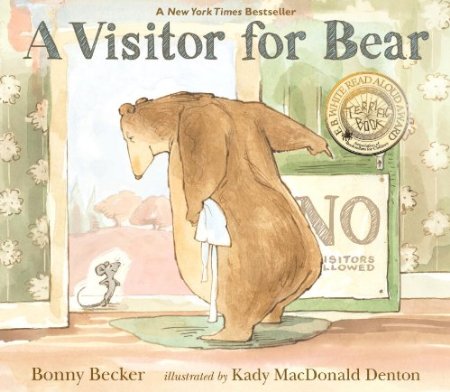
Cover of A Visitor for Bear5. Bear & Mouse series by Bonny Becker: Starting with A Visitor for Bear (spoiler: it’s Mouse!), I adored these picture books, which have just the right amount of beauty, charm, and humor. A Birthday for Bear, A Bedtime for Bear, and A Library Book for Bear are all worthwhile follow-ups to the first in this series.

6. Dead Wake by Erik Larson: For someone who has read an awful lot about the Titanic, this was my first book about the Lusitania, and it was fascinating. I’d been a little disappointed by Larson’s last, In the Garden of Beasts, but Dead Wake was gripping from start to finish. Larson provides several points of view: captain, crew, and passengers on the ship; the U-boat crew; President Wilson; and the secret, pre-Bletchley “Room 40” in England.

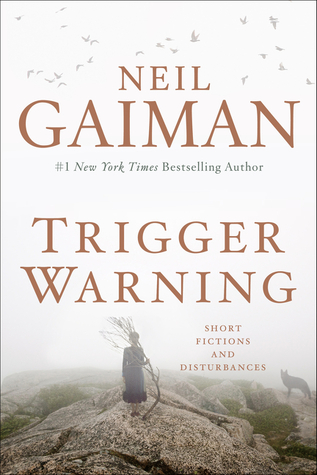
Cover image of Trigger Warning7. Trigger Warning by Neil Gaiman: Another fantastic audiobook, read by the author himself. There’s not a dud in this collection of strange stories, myths, and even poems, but there are a few standouts; my favorites were the Doctor Who story “Nothing O’Clock,” “Black Dog” (featuring Shadow from American Gods), and “And Weep, Like Alexander.”

8. Bringing Up Bebe by Pamela Druckerman: Like many much-hyped books, I avoided this for a while, but when I read it I discovered it was much more practical and less frothy than I had expected. A useful insight into another way of doing things (plus a recipe for yogurt cake).

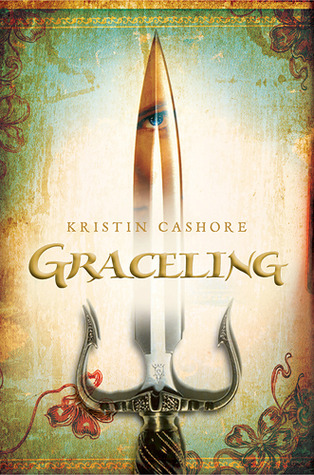
Cover image of Graceling9. Graceling, Fire, and Bitterblue by Kristin Cashore: I just wrote a whole separate blog post about how much I loved these three books. I already want to re-read (re-listen-to) Graceling. If you liked the Song of the Lioness quartet or the His Dark Materials trilogy, you need to read these.

10. Far From the Tree by Andrew Solomon: I started this back in 2013, but didn’t finish until I bought the e-book; in this case, not carrying around a thousand-page tome really did help. If everyone in the world read just the introduction to this book (48 pages or so), the world would be a better place. Solomon is a talented writer who did an immense amount of research, speaking with experts and families, and Far from the Tree provides an astonishing level of insight into various kinds of difference or “horizontal identities.”

I will resist the temptation to continue the list with honorable mentions. What have your favorite books been so far this year?

MLA 2015: Through the Library Lens, Part II

Here we go, Day Two of MLA! Read about Monday sessions here.

Flexibility in Library Design, or Agile Libraries that Evolve with You, presented by Lauren Stara and Rosemary Waltos of the MBLC and Sal Genovese of the Walpole Public Library (Tuesday, May 5, 8:30am)

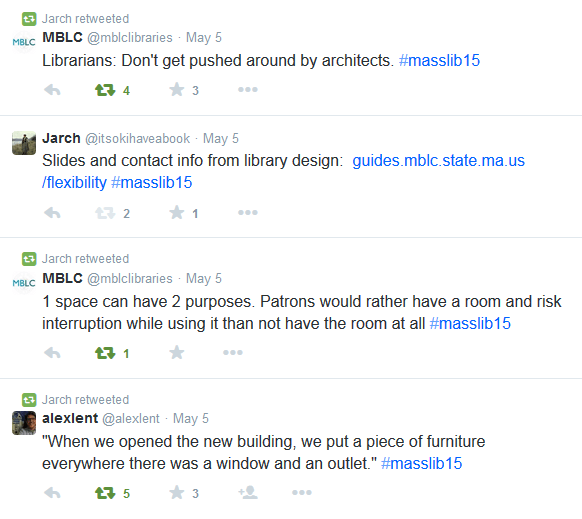
Three cheers for Lauren Stara, who posted her presentation slides online in advance of this session. Check out her slides for lots of great visuals of “lightweight, portable, modular, convenient, approachable” furniture, from service desks to comfy chairs; she included examples from many libraries in the U.S. and Canada. (The presenters’ contact info and a link to several useful Pinterest boards are available through that link as well.) There were tons of tweets during this session (see below), and between those and the slides, I don’t have much to add except that I’m in favor of flexible, adaptable design in libraries and I want to use at least 75% of these ideas right away. Also, I’ve added Aaron Schmidt’s Useful, Useable, Desirable to my ever-growing to-read list.
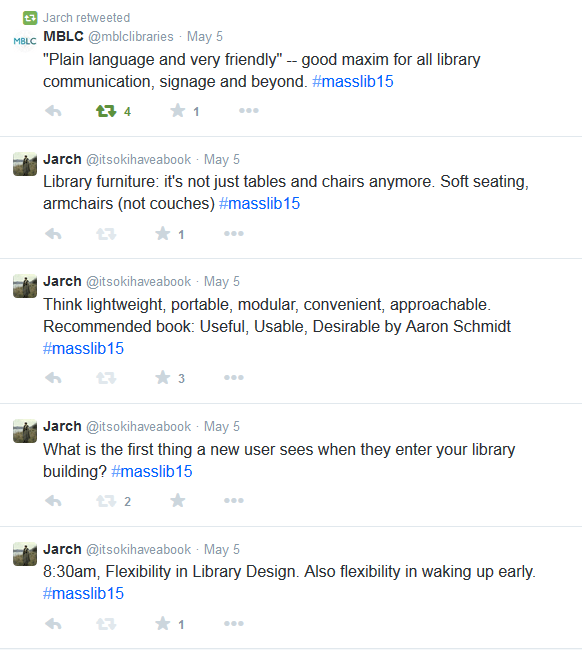
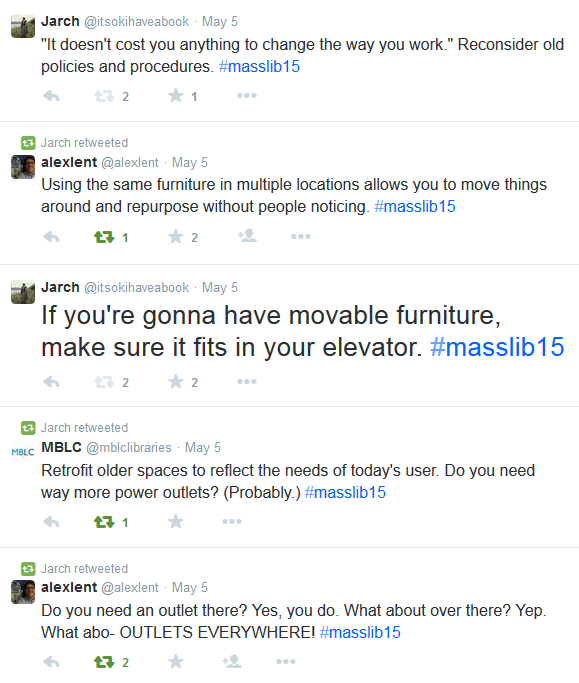
Screenshot of tweets including What is the first thing a new user sees when they enter your library building?Screenshot of tweets including If you're gonna have movable furniture, make sure it fits in your elevator.Screenshot of tweets, including "When we opened the new building, we put a piece of furniture everywhere there was a window and an outlet."

An Introduction to Fighting Surveillance and Promoting Privacy in Libraries, presented by Alison Macrina of the Library Freedom Project and Kade Crockford of the ACLU (Tuesday, May 5, 9:50am)

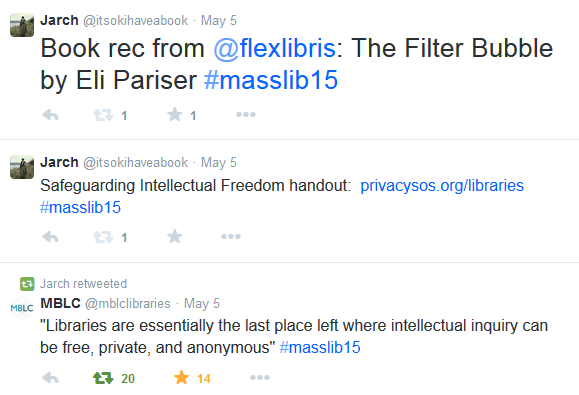
I’ve heard Kade and Alison before, but even though most of their presentation was familiar, it’s worth hearing and sharing again – plus I picked up a couple of new tips, as usual. Alison introduced a whole series of online privacy tools, which are also collected on the Library Freedom Project’s resources page.

Libraries can introduce patrons to some of these tools by installing them on public computers, and posting signs to explain the changes and raise awareness about protecting online privacy. The TOR browser is one option (“it’s not just for criminals anymore!”), and the Firefox browser with the DuckDuckGo search engine and HTTPS Everywhere and Privacy Badger plugins is another great choice. (I’m planning to switch from the Ghostery plugin to Privacy Badger, after learning that Ghostery sells information to advertisers – though this is something you can control in your settings if you do have it installed.) Good privacy options (secure texting and phone calls) for mobile phones  can be downloaded from Open Whisper Systems.
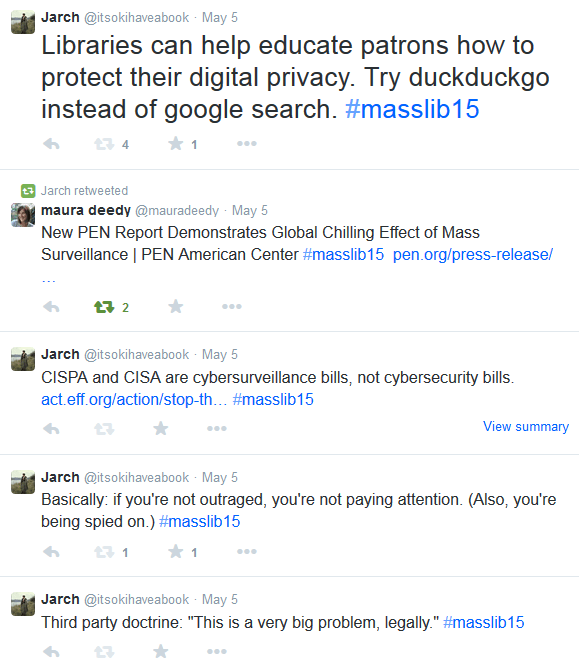
Screenshot of tweets, including Libraries can help educate patrons how to protect their digital privacy. Try duckduckgo instead of google search.

Screenshot of tweets, including Book rec from @flexlibris: The Filter Bubble by Eli Pariser #masslib15

Advocacy and Your Library, with panelists Edward M. Augustus, Jr., City Manager of Worcester; Representative Kate Hogan, 3rd Middlesex, Chair, Public Library Caucus; John Arnold, Town Moderator, Westborough. Moderators: Susan McAlister, Dinah O’Brien, and Beverly Shank, MLA Legislative Committee Co-Chairs  (Tuesday, May 5, 11:15am)

The takeaway point from this session: the importance of building a relationship with local legislators so that your only contact with them isn’t when you’re asking for money. (At the same time, “You are never going to get what you want if you don’t ask for it.”) It’s important for library staff to be involved, and also to encourage library trustees and patrons to advocate for the library; often, a patron’s voice is more persuasive to a legislator than a librarian’s. When librarians do speak on behalf of the library, the focus ought to be “We’re not here to preserve my job, we’re trying to make the community a better place.”

Demonstrating real outcomes for real people, through qualitative (anecdotes, stories) and quantitative (numbers and statistics) evidence, is most effective. Collaborating and building coalitions with other community groups is also helpful; there are many groups and limited resources. That said, libraries do a lot with a little – specifically, with 0.07% of the Massachusetts state budget.
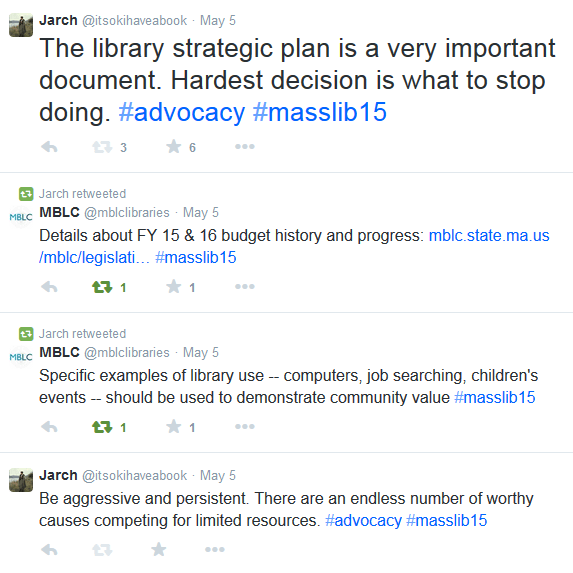
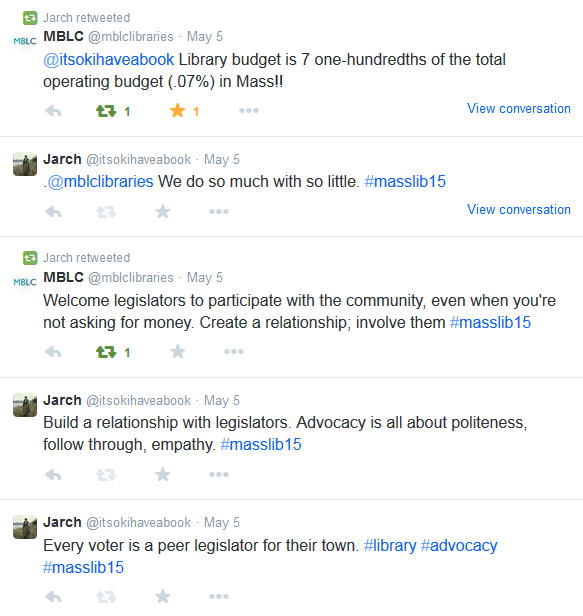
Screenshot of tweets, including Be aggressive and persistent. There are an endless number of worthy causes competing for limited resources. #advocacyScreenshot of tweets, including Library budget is 7 one-hundredths of the total operating budget (.07%) in Mass!!

A Whale of a Good Time: Summer Library Programming for All Ages, presented by Jennifer Harris and Margaret McGrath of the Plymouth Public Library (Tuesday, May 5, 2:30pm)

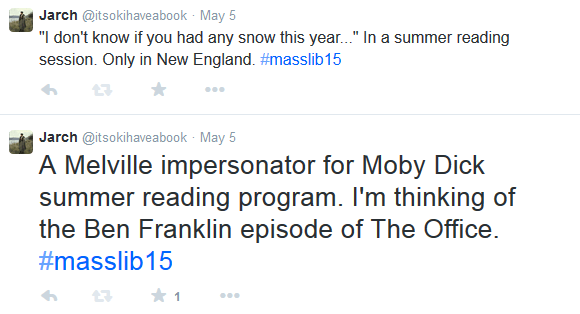
Attendees had two choices during this session: get inspired, or take your ball and glove and go home, because this was a hell of a summer reading program/community read (“One Book, One Community”). First of all, they got people to read Moby-Dick, which is impressive on its own. Second, they did a massive PR push, with mailings to 25,000 households and visits to all the elementary schools, raising awareness for all ages; high school art students were recruited to help with PR design. Third, they used every last drop of a $3,000 programming budget, spreading programs for all ages throughout the summer. Programs included three book discussions (it’s 600+ pages, folks), concerts on the lawn in front of the library, knot-tying lessons, a mini-readathon, a craft program series for teens, a hard tack tasting (verdict: not tasty), a movie screening, a Melville impersonator, a field trip to the New Bedford Whaling Museum, and visits from two separate inflatable whales.

Key to the success of the Plymouth Public Library program was staff buy-in and great brainstorming sessions, as well as a healthy budget, good planning, and great PR (in addition to the mailings, they were active on Facebook, Twitter, Flickr, and Pinterest, and events appeared in the Boston Globe and on local TV as well).

Our library does a Community Read (Arlington Reads Together) in the spring, separate from our summer reading programs for children, teens, and adults. I’m curious how many other libraries combine their Community Read with summer reading.
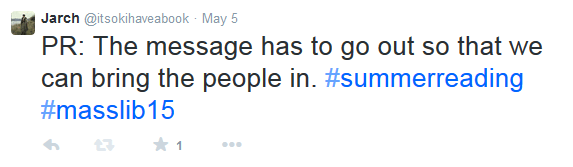

Screenshot of tweet: PR: The message has to go out so that we can bring the people in. #summerreading #masslib15Screenshot of tweet: "If someone doesn't call you back, and you call a few days later and they still don't call you back, move on!" #lifeadvice #masslib15Screenshot of tweets: A Melville impersonator for Moby Dick summer reading program. I'm thinking of the Ben Franklin episode of The Office. #masslib15

RA Toolbox: Staying Alive – Readers’ Advisory Continuing Education, presented by Laurie Cavanaugh of the Holmes Public Library, Nanci Milone Hill of the Parker Memorial Library, Molly Moss, of the Forbes Library, and Leane M. Ellis of the Lucius Beebe Memorial Library (Tuesday, May 5, 4:15pm)

Each panelist in this session had been the recipient of a LSTA grant for readers’ advisory, administered through the MBLC, so each panelist talked about how they’d implemented the grant, as well as how they’d come to be interested (and expert) in readers’ advisory. Molly had a background in science and academic libraries; readers’ advisory was the most intimidating part of working at a public library reference desk for her. She tackled the task and became involved in the Adult Reading Round Table (ARRT) of Illinois. There is now a Readers’ Advisory Round Table (RART) for every region of Massachusetts (Northeast, West, Metrowest, Southeast), and each one has a blog.

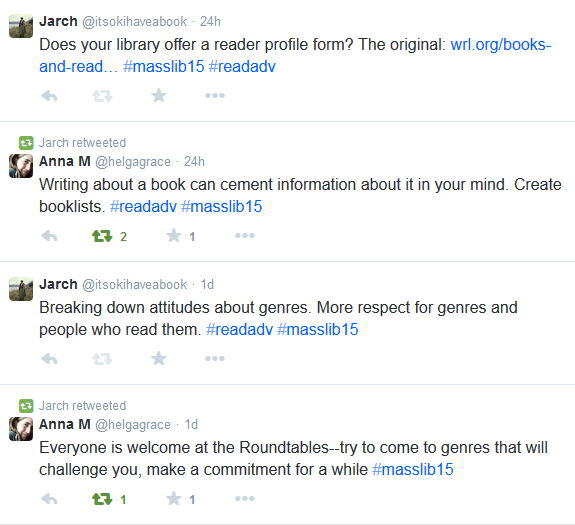
Grant money can be put toward speaker fees, conference fees, materials (books), shelf talker materials (those plastic things that clip on to shelves), staff time, and mileage. Nanci invited Duncan Smith from NoveList to speak to her staff, as well as the Sisters in Crime; Molly invited Barry Trott of the Williamsburg (VA) Regional Library. The WRL was the first library to put a “reader profile form” online; many libraries, including the Forbes in Northampton and the Robbins in Arlington, have adapted the form (with permission) to use on their own websites. Librarians at the Forbes have also done blitz-style RA, asking patrons to post to the library’s Facebook wall with a book they liked, and recommending another book based on that one.

All the panelists talked about genre studies. A typical model includes monthly or bi-monthly meetings where participants read one “benchmark” book in a genre or subgenre, and one secondary selection. This allows for common ground (the book everyone read) and new recommendations. Genre studies can be done within a library, in partnership between two libraries, and through the round table groups across the state. Virtual participants are welcome in the Massachusetts Readers’ Advisory Goodreads group.

Laurie said that readers’ advisory was “customer service in the digital age,” providing a personal touch. Leane, too, said that RA was “public service on a personal level for your readers and potential readers.” Customized forms are just one way to provide great recommendations to patrons; other models include “five to try” booklists, “If you like [author/title, TV show, etc.], you might also like [___],” subgenre booklists, and staff picks lists.

This session concentrated on the LSTA RA grant and implementing genre studies, rather than specific RA tips such as including appeal factors as well as a summary when talking or writing about a book (and no spoilers!). The RA interview was covered in a previous session, RA Toolbox: Conversing with the Reader – the Readers’ Advisory Interview. Additional RA tips and resources are available from MLS. The MLA RA Toolbox handout should, hopefully, be available soon on the Presentations & Handouts page of the conference site.
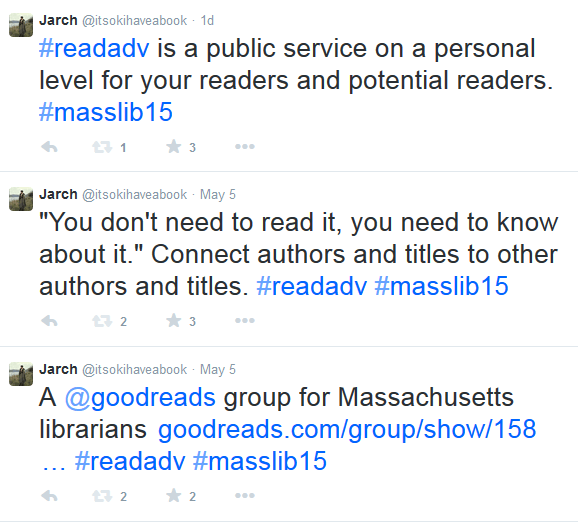
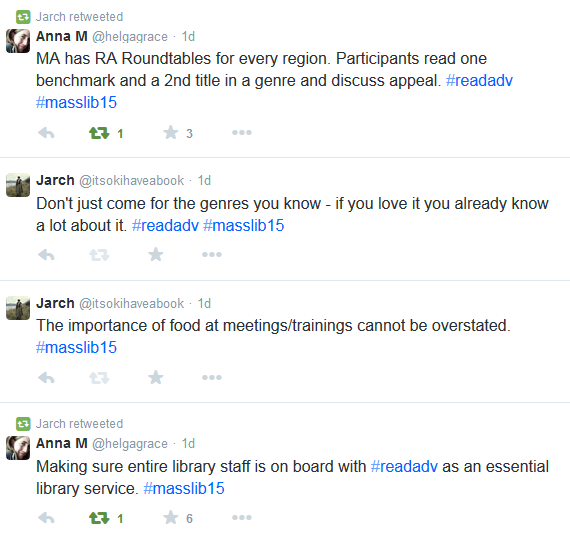
Screenshot of tweets including #readadv is a public service on a personal level for your readers and potential readers.Screenshot of tweets including Making sure entire library staff is on board with #readadv as an essential library service. #masslib15Screenshot of tweets including Writing about a book can cement information about it in your mind. Create booklists. #readadv #masslib15 2 retweets 1 favorite

Overall, a great conference experience that gave me plenty of ideas and resources to follow up on in the coming weeks, plus an opportunity to see friendly faces from grad school, past library work, fellow committee members, and even friends from Twitter.

If you have questions about any of these recaps, or have written your own recaps to share, please ask or link in the comments!
 

MLA 2015: Through the Library Lens, Part I

Thanks to my library’s wonderful support for professional development, once again I got to attend the Massachusetts Library Association (MLA) annual conference. This year’s theme was “through the library lens,” though none of the sessions I went to specifically addressed what that might mean. (Could it just be a joke about how most of us wear glasses?) (Probably not.) The conference hashtag was #masslib15 and several of us were active on Twitter during the conference.

Throughout my session recaps, I will include links to presentations and slides when possible; most aren’t available online yet, but they should be posted on the presentations & handouts page of the MLA site. (I spoke to a conference organizer about maybe having the materials posted online before the conference started; she said it was hard enough to get the details of everyone’s programs in advance of the conference, getting presentations ahead of time would be next to impossible.)

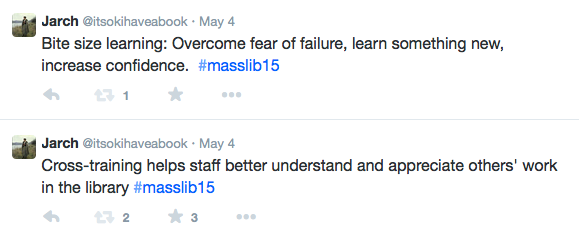
Bite-Size Learning: Staff Training a Little at a Time, presented by Michelle Filleul, Amy Lannon, and Patty O’Donnell of the Reading Public Library (Monday, May 4, 10:30am)

This session started off with a seven-minute video (“Did You Know 2014“); it’s worthwhile, but I recommend watching it without the sound. The main point is that the world is changing rapidly, especially technology. Libraries can encourage their staff to be “lifetime learners” and create a learner-centric culture by implementing a “bite-size learning” program: each participating staff member gets to spend an hour a week learning something new. This learning is self-directed, internally motivated, goal-oriented, and self-paced; it is relevant to the individual, and is experiential (learn by doing).

Individuals might choose to familiarize themselves with Overdrive or read storytime blogs; they might explore Ancestry.com or take a webinar on any number of subjects. Managers/leaders can start with competency checklists and tailor them to their departments. Staff set specific goals and check in with their supervisor each week to track progress; supervisors participate in the program too. Seeing department heads and directors learn new things sets a good example and breaks down the fear of failure that can accompany trying something out of one’s comfort zone.

A paralibrarian from Reading spoke movingly about how the bite-size learning helped her; she said, “Technology isn’t my thing, but learning is….I don’t want to become a senior citizen who didn’t keep up with technology. I want to communicate with the younger generation on their terms….We have to know how to do these things.” Learning new skills builds confidence in one’s ability to learn, and in one’s ability to help others – a pretty big payoff in exchange for an hour a week.

Screenshot of tweet: Self-directed learning: internally motivated, goal oriented, self-paced, relevant to learner, experiential #masslib15Screenshot of two tweets: Cross-training helps staff better understand and appreciate others' work in the library -and- Bite size learning: Overcome fear of failure, learn something new, increase confidence.

Stealth Reference: Reaching Non-Library Users, presented by Margot Malachowski from the Baystate Health Sciences Library, Anne Gancarz from the Chicopee Public Library, and John Walsh from the Newton Free Library (Monday, May 4, 1:15pm)

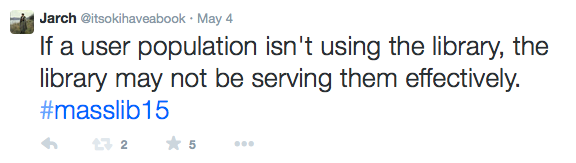
“Stealth reference” is a very cool name for what is usually referred to as “outreach.” Margot from Baystate talked about identifying your vulnerable populations, and aligning programs with community needs. She teaches the public directly, taking questions and answering them by mail (five stars for follow-up!), and she also teaches the people who teach the public, like The Literacy Project.

Screenshot of tweet: If a user population isn't using the library, the library may not be serving them effectively.

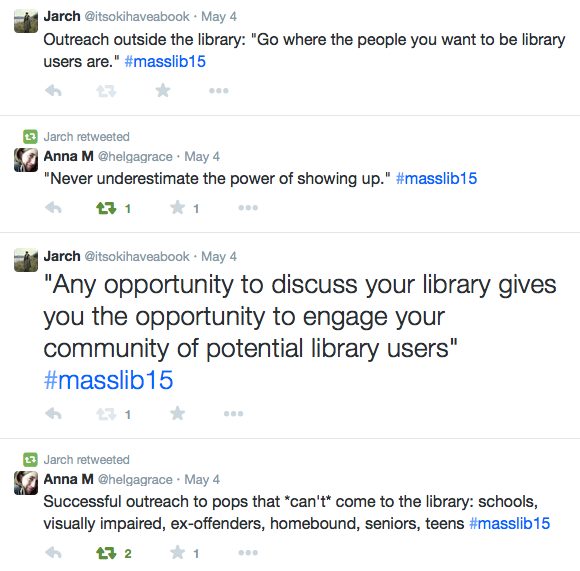
Anne from Chicopee asked herself, “Who am I seeking? What am I offering?” and asked what motivation potential users had to come to the library. Anne, I suspect, doesn’t sleep much: she has gone into schools, visited homebound patrons, worked with teens, connected to the visually impaired community, gone to the farmers’ market, worked with the sheriff and ex-offenders, and worked with the Council on Aging (COA); there is a bookmobile in her future. Anne suggested collaboration: with town departments like Parks & Rec, the COA, planning boards, and local events. She noticed that program popularity is cyclical; what works one year may not work the next year. “We’re always awesome and helpful,” she said, “but people don’t always know that.” If every library had a Community Services Librarian like Anne, more people would know about all the things libraries have to offer.

Screenshot of tweets and RTs, including "Any opportunity to discuss your library gives you the opportunity to engage your community of potential library users"

Last but not least, John also talked about leaving the library building, going where the people you want to be users are, and showing them what they’re missing. “They don’t know they want things” or they don’t think the library has them. He recommended contacting businesses in the area; even chains like Starbucks and Whole Foods sometimes have community relations people who may be eager to help. Bring some handouts with you, he advised, but those handouts should be immediately useful – a calendar of events, a link to the digital media catalog, etc.

One of the challenges libraries face with outreach efforts – assuming that library leadership supports it – is finding the time for staff to leave the building. Many public libraries are short-staffed, and most won’t consider leaving the reference desk unattended while librarians are at the farmers’ market, the high school, or the senior center. Off-desk hours are precious too – that’s when we order books and other materials, plan programs, create booklists and displays and flyers and a hundred other things – but starting small is better than nothing at all.

Connecting the Dots of Internet Freedom: The Future of Free Speech, presented by Evan Greer from Fight for the Future (Monday, May 4, 2:45pm)

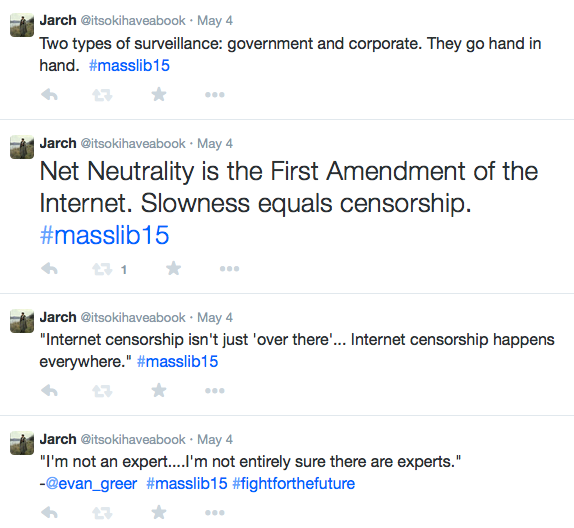
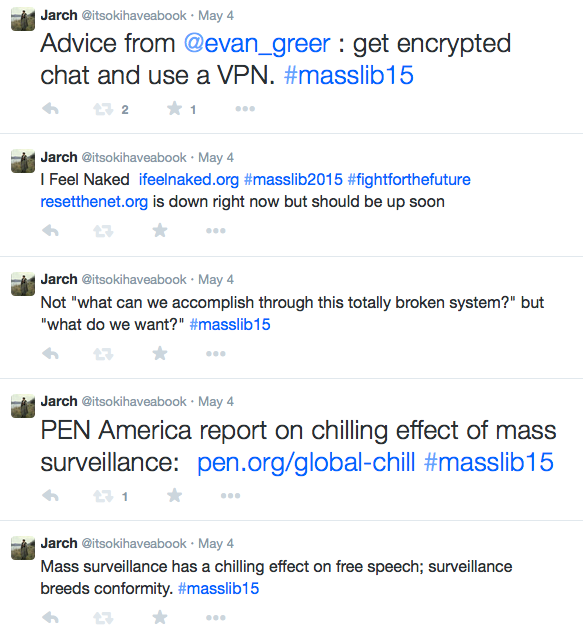
Like many privacy advocates, Evan is an impassioned speaker. She concentrated on four modern threats to freedom of expression on the Internet: (1) attacks on Net Neutrality, (2) mass surveillance, (3) overzealous copyright enforcement, and (4) secretive trade deals, e.g. the Trans-Pacific Partnership (TPP). Her presentation was both entertaining and convincing, though I suspect the people in attendance were convinced before they showed up. I tweeted throughout this session; see below for tweets and additional links.

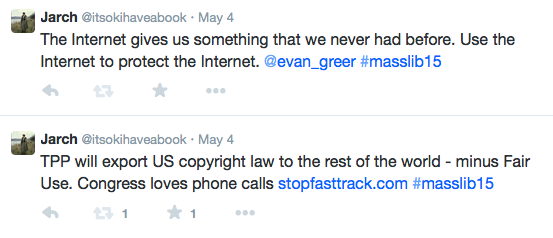
Screenshot of tweets, including Net Neutrality is the First Amendment of the Internet. Slowness equals censorship. Screenshot of tweets, including PEN America report on chilling effect of mass surveillance:  http://pen.org/global-chill  #masslib15Screenshot of tweets including TPP will export US copyright law to the rest of the world - minus Fair Use. Congress loves phone calls https://www.stopfasttrack.com/ Links:

Power of the Written Word: Librarian Influence Through Writing Reviews, presented by Kristi Chadwick of the Massachusetts Library System, Rebecca Vnuk of Booklist, and Nanci Milone Hill of the M.G. Parker Memorial Library in Dracut (Monday, May 4, 4:00pm)

Rebecca, Kristi, and Nanci all gave general advice about writing reviews as well as specific tips for which publications are looking for reviewers and whether or not they pay (mostly they don’t, but book reviewing shows engagement with the profession and looks good to potential future employers, etc.). They also talked about how they got started; they all “fell into it” (but only if “falling into it” means seeking out and creating opportunities for writing reviews and honing their blogging skills).

Rebecca (Shelf Renewal) talked about some of the standard review publications – Library Journal and SLJ, Booklist, Kirkus, VOYA – and their different style guides. Find your voice: is it conversational or formal? Figure out what you want to say and who your audience is. Incorporate readers’ advisory aspects (e.g. appeal factors) into your reviews, and a sense of humor. If you do get your reviews published in one of these sources, cut out your printed review and compare it to what you submitted, line by line; this will improve your reviews. Take cues from existing blogs and websites, and practice writing reviews on Amazon, Goodreads, or LibraryThing.

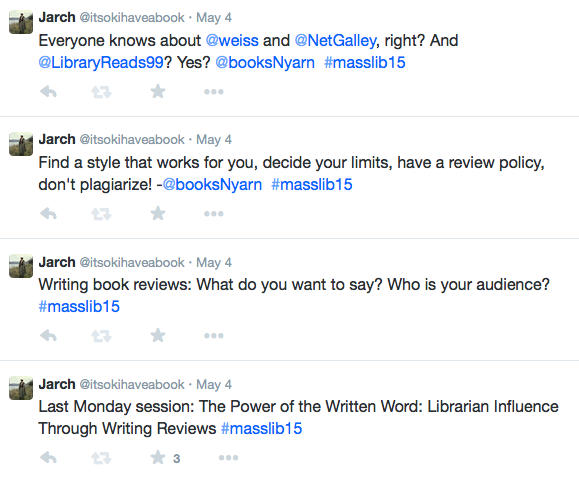
Kristi’s advice: find your review style, decide your limits, have a review policy, and don’t read other reviews of the book you’re reviewing (beware unintentional plagiarism). Identify the hook, the who/what/when/where/why, who the book will appeal to, and of course…no spoilers! Get e-galleys through NetGalley and/or Edelweiss and submit reviews to LibraryReads.

Screenshot of tweets, including Writing book reviews: What do you want to say? Who is your audience? #masslib15 -and- Find a style that works for you, decide your limits, have a review policy, don't plagiarize! -@booksNyarn Nanci suggested getting involved with your local Readers’ Advisory Round Table (every region of Massachusetts has one), and mentioned a few less obvious candidates for would-be reviewers and writers: NoveList, Public Libraries magazine, Bookmarks magazine, ALA Editions, the Massachusetts Center for the Book, and your local newspaper. Creating readers’ advisory materials for your own library is good practice too: shelf talkers (“If you like ___, try ___”), author and title readalikes, appeal readalikes, “five to try” (genre suggestions), etc.

As usual, presenters mentioned so many good resources and opportunities that follow-up will take me the next several weeks. And this was just day one – stay tuned for day two.