Facebook and Privacy

On January 9, all Facebook users who haven’t already changed their profiles over to the new Timeline format will see their pages change anyway. As always with changes to Facebook, there have been mixed reactions, but Facebook at least ought to get credit for giving users a heads-up this time, instead of their usual MO (i.e., “it’s easier to get forgiveness than permission”).

Every time Facebook makes even a minor change is a good time to check your privacy settings (if you’re a Facebook user; not everyone is); with a major change like Timeline, definitely look at your privacy settings, because changes to the site mean changes to your privacy. Users can experiment with Timeline for a seven-day period before it goes live on the 9th – it’s not a bad idea to use this time not just to play around with the new layout, but also to see how the privacy settings have changed or been re-set. Unfortunately (intentionally?), these settings aren’t the easiest to manipulate or change, but it can be done.

And while you’re doing that, you might also reconsider what kind and how much personal information you share voluntarily – not just on facebook, but elsewhere on the internet. Geoff Duncan’s article in Digital Trends, “Why 2012 is starting to look like 1984,” is informative and sobering on the topic of personal privacy (or lack thereof). He also provides an excellent overview of the SOPA and PIPA bills (Stop Online Piracy Act and Protect IP Act, respectively), and this year’s National Defense Authorization Act (NDAA), which expands on the Patriot Act.

In a nutshell, it seems that whereas sharing personal information used to be an “opt-in” process, it’s now more “opt-out” – and sometimes you can’t.

Edited to add: While we’re on the topic of privacy, the Daring Librarian reminds us that it’s probably time to change all of our passwords. You may have dozens for all the different sites you go to; think about creating a formula so they’re easier to remember. (Here’s some more advice on password strength from xkcd.)
Open Library

If you aren’t already familiar with Open Library, a project of the non-profit Internet Archive, you now have one more reason to head over and check it out: all 50 state librarians have voted to build an alliance with IA. What does this mean? The Chief Officers of State Library Agencies (COSLA) and Open Library will be working together to ensure free access to e-books through all public libraries in the U.S.

Already, anyone can borrow e-books from Open Library‘s collection of 10,000 e-books, provided by the Internet Archive and its partner libraries. You can borrow up to 5 books for 2 weeks each, in a variety of formats (in-browser, e-Pub, or PDF). If your public library is a member, you may have access to even more.

Happy reading!

How to Cook Without a Book?

“But a Nook can’t read, so a Nook can’t cook. So…what good to a Nook is a hook cook book?”
One Fish Two Fish Red Fish Blue Fish, Dr. Seuss

I’m sure that’s not what Barnes & Noble had in mind when they named their e-reader.

A recent article in the New York Times asks if cookbooks are obsolete (leading question much?). It describes how a number of wonderful apps are sweeping traditional cookbooks and recipe cards off the kitchen counter and back onto their shelves to gather dust.

As usual, there is plenty of room for both sides. Certainly, some people will gravitate toward these apps and e-versions of cookbooks on tablets or e-reader devices, either replacing or enhancing their print cookbooks; others will ignore the new toys (audio, video, flowcharts, built-in timers and glossaries) and continue using their print books.

There’s also a middle ground: Eat Your Books offers a way to search through all the indexes of all your cookbooks for a particular recipe. The recipes themselves can’t be accessed through the site unless they are free online, but by searching the indexes of all the books you already own, you can find what you’re looking for much more easily; it’s a way of semi-digitizing your cookbooks. You can also add blogs such as Chocolate & Zucchini and Smitten Kitchen to your “shelves” and search those too.

Incidentally, the NYT article neglects to mention what would happen if one were to spill soup onto one’s iPad.

Amazon, Overdrive, Privacy?

Sarah Houghton, a.k.a. the Librarian in Black, has posted a 10-minute video offering her point of view on “why the Kindle format lending from Overdrive is anti-user, anti-intellectual freedom, anti-library, and something that all librarians should be aware of and disturbed by.” One of her core issues is that, when Kindle users borrow e-books from the library, Amazon keeps track of those records. Customers may be used to Amazon tracking their purchases, but libraries are much more careful about patron data.

The American Library Association (ALA) website has a section devoted to intellectual freedom, and to privacy and confidentiality. This section states, “Lack of privacy and confidentiality chills users’ choices, thereby suppressing access to ideas. The possibility of surveillance, whether direct or through access to records of speech, research and exploration, undermines a democratic society.” Therefore, “confidentiality of library records is a core value of librarianship.” Amazon does not care about keeping your reading or borrowing history private and confidential, and this is what Houghton – and many other librarians – are upset about. Patrons may be willing to sacrifice privacy and confidentiality for convenience, but many libraries have privacy policies in place – supported by state law – specifically in order to protect patron privacy. That isn’t something that ought to be given up lightly.

Borrowing e-books from the library

This is by no means a universal set of instructions, but the New York Public Library (NYPL) blog has posted step-by-step instructions for how to check e-books out of the library with a Kindle. It’s a great visual walk-through, which is good because there are a lot of steps. I prefer the step-by-step screenshots, though – it’s the next best thing to having someone walk you through it one-on-one. (There’s a link to a video from OverDrive, as well.)

We aren’t “there” yet, but it’s exciting to see the progress being made with libraries and e-books.

The Case of the Missing Hypertext Novel

Right below the Nobel article in Salon, there was an article about hypertext novels, titled “Why the Book’s Future Never Happened,” Hypertext fiction, according to Wikipedia, is electronic literature with hyperlinks that allow for non-linearity and reader interaction. (Not having read one, the impression that I get is something between a choose-your-own adventure novel and a novel told in a non-linear fashion, e.g. with flashbacks or different character perspectives.)

Apparently there was a lot of hype about hypertext fiction back in the ’90s – it was supposed to be “the next big thing,” but it never really took off. The author of the Salon article posits that hypertext fiction was “born into a world that wasn’t quite ready for it,” and additionally, its failure had more to do with its content than with the its format. That is, the first hypertext novels simply weren’t very good. (“True, the hypertext offers you the puzzle-solving pleasure of making sense of the story, arranging the pieces in your head to see the whole mosaic, but why would you do that, if the pieces don’t suggest a picture you care to see? Not every puzzle has an interesting solution.”)

The article’s author suggests that hypertext novels are even more difficult to write than regular novels, because “the sections have to be readable along multiple paths; they have to be richly related in multiple ways; and they have to keep you reading.” However, non-linear fiction has been written before: the author offers Pale Fire by Vladimir Nabokov and and Hopscotch by Julio Cortazar as examples, and I might add to that: The Time Traveler’s Wife?

How much data? LOTS.

Yesterday I attended the Library Science Fair organized by the Simmons chapter of ASIS&T. Current GSLIS student Mark Tomko gave an impressive presentation titled “Translating Biological Data Sets Into Linked Data” (he’ll be presenting this at the 10th European Networked Knowledge Organisation Systems (NKOS) Workshop in Berlin later this month). Mark did a great job explaining both the biological aspects (“all the biology you need to know fits on one slide, and the font isn’t even that small,” he promised) and the importance of linked data to an audience who was not necessarily expert in either field.

Ben Florin (GSLIS alum, former staff, currently a web developer at the Boston College Libraries) also gave a talk entitled “What I don’t like about our library’s website, plus why we haven’t changed it yet, and what we’re doing about it.” He took us on a virtual tour of the BC Libraries site, pointing out its pros (prominent discovery tool, i.e. search) and cons (a fixed interface, with wasted screen space, instead of responsive design).

The example of responsive design Ben gave was The Boston Globe’s new site; if you go to the home page there and resize your browser window, the layout will adjust from three columns to two to one (as you go smaller), and then from one to two to three (as you make the window larger again). The layout of the BC Libraries page, on the other hand, remains fixed at two columns.

Chances are I will not end up working as a software engineer (or biologist), and maybe not even as a web developer; however, it was interesting to hear two extremely bright people talk about their work as it relates to libraries and organizational schemes.

“Everything we do is pervaded by technology”: the LITA Tech Trends panel

After an unforgivably long lapse (“it was summer” doesn’t count as an excuse, does it?), I’m here to write about the rest of my ALA experience. First, the LITA (Library and Information Technology Association) Tech Trends panel. The panelists*:

  • Nina McHale, Assistant Professor and Web Librarian, Auraria University (Colorado)
  • Clifford Lynch, Director of the Coalition for Networked Information
  • Monique Szendze, Director of Information Technology, Douglas County Public Library (Colorado)
  • Jennifer Wright, Assistant Chief for Materials Management, Free Library of Philadelphia
  • Lorcan Dempsey, Vice President of Research at OCLC

*I didn’t manage to write down everyone’s full name at the time; I checked against this post from the Metadata Blog. The quote in the title of this post is from Lorcan Dempsey, during the Q&A.

In the first round, Nina talked about the content management system Drupal, which is “free as in kittens” – i.e., you don’t pay for it, but there’s a steep learning curve. Clifford talked about mobile apps, and the difference between apps and customized browsers. Monique spoke about mobile/proximity-based marketing, noting that 87% of libraries in the U.S. have free wi-fi; interactive is better than static, as it is more likely to be targeted and relevant (as well as grant-friendly and cost-effective).

Jennifer highlighted social reading – sites like Goodreads and LibraryThing that are designed to foster social interaction around books and reading, but also features built into e-readers such as Kindle and Kobo. To end the first round, Lorcan spoke about managing down print collections – developing infrastructure to support regionally based hubs (consortia) as libraries begin to cut down on some print material in favor of e-books and online journal subscriptions.

In the second round, Nina spoke about web accessibility and vendor awareness (which has, she noted, improved over the past ten years). (To learn more about accessibility and section 508, you could go to the government site…but then you might want to try Wikipedia.) Clifford spoke about imaging, computational photography, and images as interpretative/interactive data sets as opposed to fixed images (maps and other geospatial data, for example, are good candidates for this).

Jennifer talked about “the death of the mouse,” and using cameras and OCR (optical character recognition) as input in the future; she also talked about the trackpad vs. the mouse.  Personally, I can see the move away from the mouse already, with so many people using laptops with trackpads or touchscreens, and of course the iPad touchscreen as well. Poor mouse: </mouse>

Lorcan spoke about LibGuides as a set of curated resources or microcollections, and Monique wrapped up the panel with a discussion about online books (“what is a book?”).

This was a popular event, held in one of the smaller (but still large) auditoriums. It was interesting to hear more about those trends I was already aware of, and get some new ones on the radar as well.

Wikipedia in Higher Education

July is just flying by. Earlier this month, I attended part of the Wikipedia in Higher Education Summit. I knew from the Reference class I took last fall that Wikipedia is about as reliable as other encyclopedias, but the idea of incorporating it into the classroom – professors assigning students to edit existing pages or create new ones – is somehow revelatory. Most reference sources are one-way – you consult them, they don’t consult you (unless you’re an acknowledged expert in your field). Wikipedia is a two-way information source, in that you can consult it and contribute to it. This is becoming legitimized and encouraged in academia, and it’s exciting.

I’ve collected a few articles around this topic here, in reverse-chronological order, with links and snippets. It’s worth noting that David Ferriero, the archivist of the United States (and a GSLIS alum!), spoke at the summit, supporting Wikipedia in higher ed. (Ferriero also had good things to say about the National Archives’ “Wikipedian-in-Residence” – a GSLIS student).

Read on – and please add any relevant links in the comments.

July 11, 2011, “Wikipedia Aims Higher,” Inside Higher Ed
Late last week, the Wikimedia Foundation, which runs the encyclopedia, took another step toward assuming the mantle of an accessory of higher education: it held an academic conference. The first-ever Wikipedia in Higher Education Summit convened professors who had incorporated Wikipedia into their teaching, as well as others who were considering doing so, to talk about pros and cons of assigning students to improve the publicly edited online encyclopedia.

May 1, 2011, “For More Students, Working on Wikis is Part of Making the Grade, New York Times
Although wikis, with their collaborative approach and vast reach online, have been around for at least 15 years, their use as a general teaching tool in higher education is still relatively recent. But an increasing number of universities are now adopting them as a teaching tool.

February 5, 2011, “Web-Dominated Web Site Seeking Female Experts,” New York Times
Today women earn 57 percent of the bachelor’s degrees, 61 percent of the master’s degrees and, as of 2009, a majority of doctorates in the United States. It is inconceivable that this well-educated majority should be largely absent from the world’s most popular interactive encyclopedia project.

January 30, 2011, “Define Gender Gap? Look Up Wikipedia’s Contributor List,” New York Times
In 10 short years, Wikipedia has accomplished some remarkable goals. More than 3.5 million articles in English? Done. More than 250 languages? Sure. But another number has proved to be an intractable obstacle for the online encyclopedia: surveys suggest that less than 15 percent of its hundreds of thousands of contributors are women.

September 7, 2010, “Wikipedia for Credit,” Inside Higher Ed
Some professors believe Wikipedia has no place in the footnotes of a college paper. But could it have a place on the syllabus?

Wikipedia and Sue Gardner

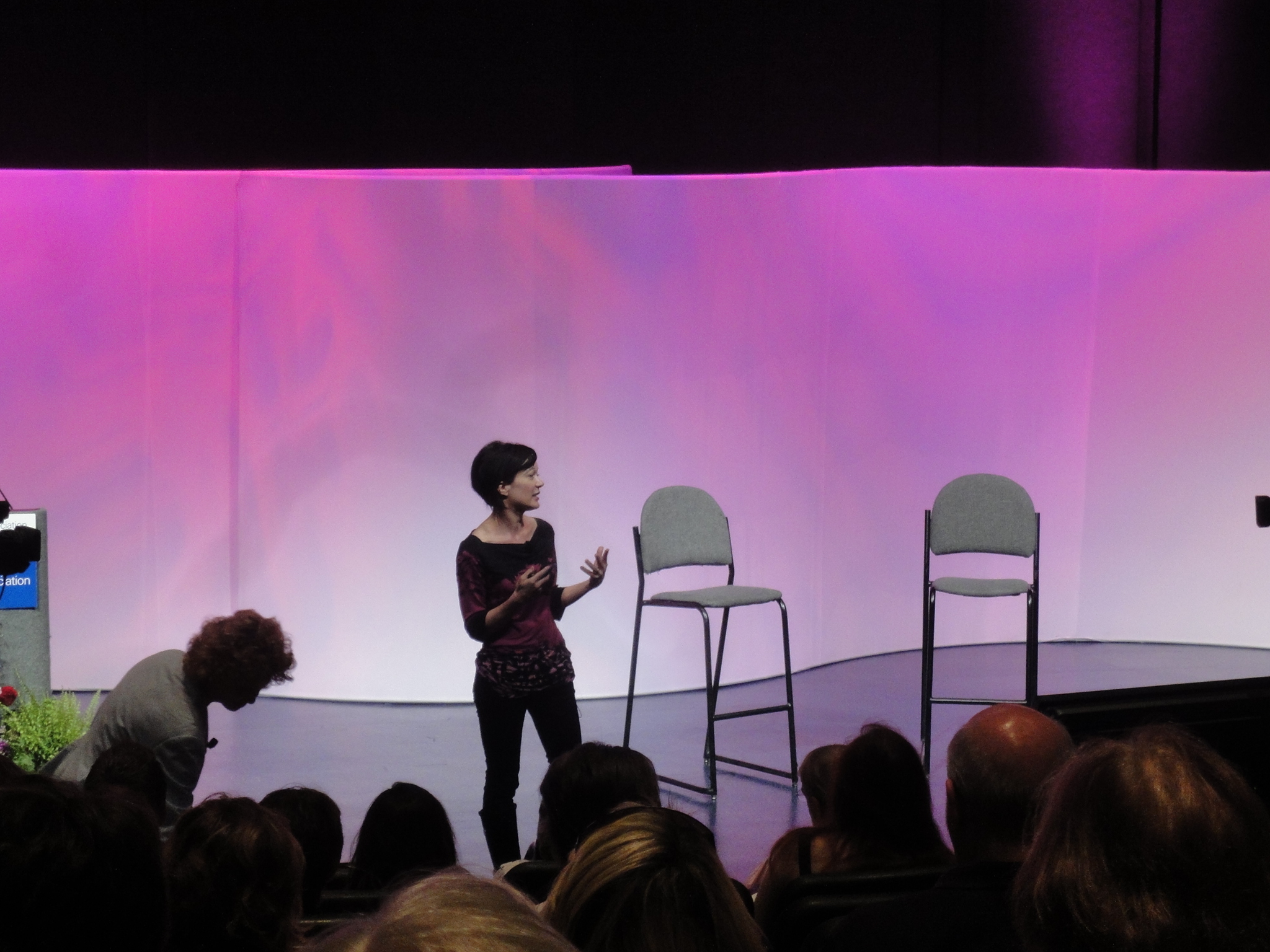
One of my favorite programs at ALA Annual was Sue Gardner‘s talk on Wikipedia. Gardner is the Executive Director of the Wikimedia Foundation, the nonprofit behind Wikipedia, and she is an incredible speaker: dynamic, enthusiastic, and prepared. She answered questions in a direct manner (and she’s quotable).

We are getting to the point in academia where Wikipedia is becoming accepted as a reliable reference tool. It is a great jumping-off point. You wouldn’t cite it in a paper – but then, you wouldn’t cite any other encyclopedia in a paper, either, after about third grade. Its value is in its currency, relevance, and most of all in its citations.

Gardner said that Wikipedia is an “inherently radical” nonprofit, supporting the idea that “people have a right to access to information.” She described the “virtuous circle, by which participation leads to quality, which leads to a broader reach, which leads to greater participation. There is “no such thing as perfect accuracy” – even recognized authoritative sources such as Britannica have errors, and those can’t be corrected as quickly as Wikipedia can, and they aren’t as widely or frequently monitored, either.

Wikipedia is a “credentials-neutral environment – some people need to be anonymous.” However, unlike communism, which looks good in theory but breaks down in practice, some problems for Wikipedia are theoretical rather than practical: “Wikipedians are fierce defenders of editorial integrity,” so while self-serving articles are a concern in theory, they are not so much of a problem in practice.

One of the main goals of Wikipedia, said Gardner during the Q&A, is “to get information to people so they can make informed decisions about their lives.” Gardner – former director of the Canadian Broadcasting Company’s website and online news – also encouraged questioning the nature of “authority” – “Is Fox News a ‘reliable source’?”

Journalism, Gardner said, “is not really a profession, it’s a job for curious people.” Also, it seems, a job for students and librarians: part of a recent public policy initiative encourages teachers and professors to assign students to write for Wikipedia. There are over 100,000 Wikipedia editors worldwide; these editors work for free, because they enjoy it and believe in it. The average Wikipedia contributor/editor is 25 years old, a STEM (Science/Technology/Engineering/Math) grad student – and male. Wikipedia contributors skew male; librarians skew female. Gardner’s message was clear: “We want you as Wikipedians.”

It was a galvanizing talk – read the American Libraries write-up here – and I’m excited to be attending the first Wikipedia in Higher Education Summit tomorrow.