ALA Chicago

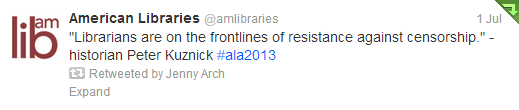
I didn’t get to attend ALA’s Annual Conference in Chicago this year, but I followed along virtually on Twitter (#ala2013) and through others’ blog posts and articles.

alaRT

On June 27, Maureen Sullivan announced the launch of the “Authors for Library eBooks” initiative. A District Dispatch blog post, “Bestselling authors call for library ebook lending,” quotes Jodi Picoult: “Whether it’s a digital file or a paper copy, I want readers to find my books—and all books—in their libraries!” (As readers of this blog know, not all publishers make all their ebooks available for libraries to purchase.)

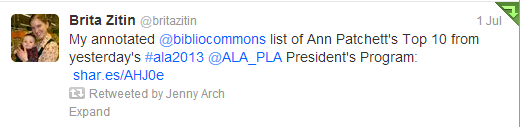
My friend Brita, who attended the conference through the Student-to-Staff program (the same way I did in 2011), wrote this great piece on Ann Patchett’s PLA President’s Program: “Ann Patchett, Readers’ Advisor Extraordinaire.” She also created a Bibliocommons list of Patchett’s top ten recommendations.

ALAbibliocommons

YA Authors Decode Dystopia“: I would have loved to have been in the audience for this author panel on dystopian fiction, featuring Lois Lowry, Cory Doctorow, Veronica Roth, and Patrick Ness. The authors identified “an important component of dystopian fiction that makes it so appealing: the ability to place oneself intimately in the action. The ‘what if’ factor draws readers into dystopian fiction, making them imagine how they would react if faced with calamity.”

I would have loved to sit in on PLA’s “Long e-Overdue” panel as well, which featured Jamie LaRue of the Douglas Country (CO) Libraries, Mary Minow of Library Law, and Michael Porter of Library Renewal. The idea of “library-managed e-content platforms”  as an alternative to middleman-style vendors such as OverDrive and 3M is a great goal to aim for.

I also followed along with the “New Adult: What Is It & Is It Really Happening?” panel on July 1 via Twitter (#ala13na). The panelists provided a huge list of “new adult” resources, including articles, blog posts, and booklists. Depending on who you listen to, “new adult” is either a “hot new category” in publishing, or a useless and annoying marketing ploy; it’s either fiction that features main characters in the 18-25 (ish) age range, bridging the gap between YA and adult, or it’s typical YA but with sex scenes. It’s definitely an emerging niche, though, and there’s lots to discuss.

Finally, from American Libraries Magazine, there’s a list of “10 Steps to a Better Library Interior.” The first step (“fresh perspective”) even includes one of my favorite cleaning/de-cluttering tips, which is to take everything out, then only put back the things you really want to keep. (Or at least imagine you’re doing so: obviously it’s impractical to move computers, furniture, and tens of thousands of books out of the library and into the parking lot.)

Conferences are both exhausting (travel, long days, rushing from one room to another, meeting lots of new people) and energizing (meeting new people, encountering new ideas, thinking about how you can bring those ideas back to your own library or workplace). I’m glad I was able to follow along virtually this year, thanks to those who wrote, tweeted, and linked.

Edited to add: My friend and fellow Student-to-Staffer (2011) wrote a great recap of all the programs, panels, and roundtables she attended at ALA 2013, including sessions on young adult literature, graphic novels, ARCs, and the New Adult panel. It’s worth a read, especially if you’re a YA librarian and/or a school librarian.

Password creation and user experience (UX)

File under: Something is Wrong on the Internet.

We have passwords for everything. We have passwords for e-mail, for online banking, for social networking sites (Facebook, Twitter, Tumblr, Pinterest…), for our phones, for our debit cards, for photo sharing sites, for online magazine and newspaper subscriptions, et cetera. Every company with a website wants you to create a login and password, so they can (a) start collecting information about you, and (b) inundate you with tailored advertising.

But I’m not writing about the necessity of these multiple login/password combinations (or lack thereof); I’m writing about the annoyance and frustration that results from each company and service having different requirements for creating a password. You know: it must be between 6-15 characters (or 8-12, or 6-20), it must be a combination of letters and numbers (or letters, numbers, and special characters), you can/cannot use spaces, it is(n’t) case sensitive…and so on.
password_tips

Obviously it’s wise to use different passwords for different sites. That way, if (for example) your Facebook account gets hacked, the hackers don’t automatically have your password to your Amazon account, your bank, etc. However, remembering dozens of passwords is tricky, and writing them down or saving them someplace online presents problems too (though I’ve heard good things about the password manager LastPass).

My current approach is to use a “stem,” a combination of letters and numbers, and attach a different prefix or suffix that is easy for me to remember, depending on the site or service I’m using. Inevitably, though, a set of password requirements comes along that causes me to have to tweak my formula in a way that ensures I will not remember it in the future, and so I’ll have to send myself a password reminder and re-set it the next time I want to log in.

UNLESS, before prompting me with the “Forgot your password?” link to send that reminder, the site simply provided its password requirements (e.g. the “Password Tips” image above, which is from the Starbucks website). Then I’d be able to remember, or at least make a very good guess, as to how I’d modified my usual password, and not have to go through the process of re-setting my password again and again.

This is a tragically simple fix that would improve user experience so much, and yet almost no website does it. Yes, The Internet, that’s a challenge.

unless_lorax

Image from Tumblr via Google Image Search. Copyright most likely held by the estate of Dr. Seuss (Theodor Geisel) or Random House. Obviously I neither created nor hold the rights to The Lorax, the publication of which preceded my birth by at least a decade.


Roundup: Reading and writing elsewhere

I haven’t posted here in a little while, but I have managed to write a few posts elsewhere. On the Robbins Library blog, I wrote about four WWII books that I’ve read recently: The Guernsey Literary and Potato Peel Pie Society by Annie Barrows and Mary Ann Shaffer, Life After Life by Kate Atkinson (which I wrote about here previously), All the Light There Was by Nancy Kricorian (who is coming to the Robbins Library this fall!), and Rose Under Fire by Elizabeth Wein, author of the fantastic Code Name Verity.

Over on my personal blog (mostly recipes and dog photos), I wrote about which thirteen (13) books I brought with me on a recent one (1) week vacation, and then which of those I actually read. Also, if you’re interested in seeing what The Casual Vacancy or Mockingjay look like in Icelandic, or what The Fault in Our Stars looks like in French, I took photos of those book covers in the Reykjavik City Library and a bookstore in the 11th arrondissement of Paris, respectively.

In other news, I found out I’ve been accepted to the New England Library Leadership Symposium (NELLS), along with my friend Anna, an awesome young adult librarian (read her blog! Unlike me, she actually sticks to a schedule). We’ll be there, along with 26 other participants, for a week later this summer, and I’m pretty excited to meet other librarians from around New England, exchange ideas, learn a lot…and maybe go canoeing.

Life After Life by Kate Atkinson

lifeafterlife_atkinsonUrsula Todd is born during a snowstorm in England in February 1910. The doctor is unable to make it through the snow; the umbilical cord is wrapped around Ursula’s neck; she is born blue; she dies.

Ursula Todd is born during a snowstorm in England in February 1910. The doctor arrives in time to save her from a dangerous birth, and she lives – for a while, before being smothered to death in her cradle by a cat.

Ursula Todd is born during a snowstorm in England in February 1910. After the Armistice in 1918, the Todd family’s maid, Bridget, goes to a celebration in London, and returns with the Spanish flu, to which Ursula succumbs.

Ursula Todd is born during a snowstorm in England in February 1910. She grows up, moves to London, and dies in a cellar during the Blitz.

Ursula Todd is born during a snowstorm in England in February 1910. In school, she has an aptitude for languages; after school, she travels in Europe, eventually settles in Germany, and becomes friends with Eva Braun.

These are only a few of the many lives Ursula leads. In each successive life, she is haunted by persistent deja vu. She sometimes senses when something bad is about to happen, and does what she can to avert it, but her actions are as likely to create worse consequences as they are to avert disaster. She never fully realizes or articulates to herself exactly what is happening, though she does grasp it in a vague way, and readers will pick up on the pattern (perhaps cycle is a better word) after a while.

“We only have one [life] after all, we should try and do our best. We can never get it right, but we must try.”
“What if we had a chance to do it again and again,” Teddy said, “until we finally did get it right? Wouldn’t that be wonderful?”

Life After Life is a bit like a Choose-Your-Own-Adventure story, except that the author is making the choices, and she chooses all of them. A better analogy might be the movie Sliding Doors, but with many more doors, and Ursula goes through every door instead of choosing between them. Whatever your preferred description, Life After Life is a stunning, unique, creative, compelling story. As Sarah Lyall wrote in The New York Times, “Each version is entirely and equally credible. In this way, Atkinson gets to indulge in what might be the ultimate novelist’s fantasy: producing a never-ending story in which any past, any future, even any present, is possible.”

She had been here before. She had never been here before….The past seemed to leak into the present, as if there were a fault somewhere. Or was it the future spilling into the past?….”Time isn’t circular,” she said to Dr. Kellet. “It’s like a…palimpsest….And memories are sometimes in the future.”

It is evidence of Atkinson’s skill that the reader is willing to invest and re-invest in Ursula’s character and the many different storylines. Some are easier than others to leave behind, and some linger in the mind. Each permutation also gives insight into the other characters, primarily Ursula’s family: her mother Sylvie, her father Hugh, Hugh’s sister Izzie, the Todds’ cook and maid and neighbors.

I feel as though this book is larger than I was able to wrap my mind around fully in just one reading, and I’d love to read it again and discuss it. (Book club…?)


We built this together

“We need editors, and we need publishers, and we need booksellers….We built this together, and we’re going to keep building it together.” -John Green at the American Booksellers Association Annual Awards (he gives librarians a shout-out too)

The book business may be changing, but that doesn’t mean that many “traditional” elements aren’t crucial (see “In defense of editors,” October 2011). Books may have only one author, but many hands and minds go into their production, let alone their success.

The Sea of Tranquility by Katya Millay

sea of tranquilityNote: The Sea of Tranquility was initially self-published. It was well-reviewed by book bloggers, and picked up by a mainstream publisher, the Atria imprint of S&S, which will issue a paperback edition in June 2013. The version I read was an advance copy of the Atria edition.

The Sea of Tranquility is narrated in the first person, alternating between Josh Bennett and Nastya Kashnikov (not, as we learn eventually, her real name). Josh is seventeen; following the death of his mother and sister in a car accident when he was eight, and the subsequent death of his father and grandparents, he has been emancipated and lives alone.

A former piano prodigy who has suffered a terrible trauma, Nastya has come to live with her aunt Margot and begins attending the same high school as Josh, where she does everything possible to alienate people. Most significantly, Nastya doesn’t talk; she hasn’t spoken out loud to anyone in over a year.

Despite, or perhaps because of, Nastya’s silence, her handsome and charming classmate Drew becomes attached to her, and occasionally drags her out to parties. After she gets too drunk at one of them, he brings her to his friend Josh’s house for help; though they don’t hang out at school, Drew is Josh’s only close friend.

It’s not rocket science to see where the book is headed; though both Josh and Nastya are closed off to others, afraid of being hurt again, they are attracted to each other. (This setup practically begs for a voiceover: Will they share their secrets and help each other heal from past hurts? Will they learn to love again?) Though there is little real suspense, I found the characters compelling, and the book strangely hard to put down; Josh and Nastya certainly do have chemistry, and Nastya’s backstory is eventually revealed through a coincidence that doesn’t feel too contrived.

The author follows Rule #1 of YA novels (and fairy tales): get rid of the parents. Josh’s parents are dead, and Nastya lives with her aunt, but Margot is a nurse, and their schedules rarely have them home at the same time. Nastya has little contact with her parents and her brother, Asher, except for a couple visits and a few necessarily one-way phone calls.

In terms of genre, I’d call it literary fiction/YA romance; it has some dark scenes and heavy themes, but the characters are 16-18 years old and much of the book takes place in or around the high school or the characters’ homes. The writing is good, and if it’s sometimes melodramatic, well, so are teenagers. Though I was skeptical, I definitely enjoyed The Sea of Tranquility, and would read more from this author.

Sisterland by Curtis Sittenfeld

SisterlandFrom birth, twins Daisy and Vi Shramm have had what they call “senses,” psychic abilities. Vi embraces hers, but after a bad experience in middle school, Daisy tries as hard as she can to ignore her senses and be normal. In college, she goes by Kate (from her middle name, Kathleen), and when she marries she takes her husband’s last name; so although Vi Shramm and Kate Tucker still live in their hometown of St. Louis, Missouri, their twinship isn’t obvious.

Not only do they differ in name and in appearance, their lives have taken different courses as well: Kate attended college, married, and is a stay-at-home mom, whereas Vi, after a wandering course, is a practicing psychic in town. When she predicts a massive earthquake, Kate is torn: she believes her sister, but will she support her? Kate’s husband Jeremy is a professor at Washington University, and his close friend and colleague Courtney Wheeling is an expert in seismology there; she insists that there is no way to predict an earthquake.

Sisterland is narrated by Kate, and the reader has access to all of her thoughts, feelings, and insecurities. Though the majority of the story takes place during the lead-up to the predicted date of the earthquake, there are also episodes from the twins’ childhood, adolescence, and college years, as well as Kate and Jeremy’s courtship, and their friendship with the Wheelings (Hank is a stay-at-home dad). As usual, Sittenfeld manages to cover a significant span of time without sacrificing the story’s depth.

Throughout her life, and the book, Kate’s frequent conflicts with her sister are a manifestation of her internal conflict: she has the “senses,” but she doesn’t trust them or want them; she wants to embrace conformity, be normal, be good. But can she be true to herself while ignoring this aspect of her character? The main conflict, when it comes, has little to do with Kate’s psychic abilities (or her quashing of them); it is surprising but utterly believable.

Sittenfeld has a talent/skill for making her characters’ words and actions seem reasonable by revealing their deepest thoughts and feelings. I sympathized with Kate, though it occurred to me to wonder how I would feel if Sittenfeld had chosen to narrate the story from Vi’s point of view. Sisterland encompasses a number of issues: traditional beliefs vs. new age-y ones, the value of working vs. stay-at-home parenting (and how that affects partners’ relationships), race, fidelity, and compromise. For those who were impressed by Prep and/or American Wife, be assured that Sisterland is as good, if not better.

I received a galley from Random House at the Massachusetts Library Association conference in April. Sisterland will be published on June 25, 2013.

prepamericanwife

TransAtlantic by Colum McCann

LibraryThing’s batch of author interviews for the month include Julie Wu, author of debut novel The Third Son (which I wrote about in March) and Colum McCann, author of Let The Great World Spin and, most recently, TransAtlantic. I picked up a galley of TransAtlantic from the Random House booth at the Massachusetts Library Association conference last month, in part because I had both enjoyed and been impressed by Let The Great World Spin. Many books are enjoyable, and many books are impressive, but the two don’t always overlap.

TransAtlanticTransAtlantic takes place in three discrete time periods around three significant events: Frederick Douglass’ trip to Ireland in 1845, WWI pilots Jack Alcock and Teddy Brown’s flight from England to Ireland in 1919, and George Mitchell’s diplomatic efforts to end the Troubles in 1998. However, these characters are not the only main characters; four generations of women, beginning with Lily Duggan, a maid in the household that hosts Frederick Douglass, are also connected to these events.

The different time periods, events, and character relationships are a lot for a reader to keep track of, and in the end I found that the book left impressions rather than memories. Any one of the three central stories would have been enough for a book on its own, but McCann’s style is to twine many narratives together into one. I’m not sure he succeeds here as completely as in Let The Great World Spin, but the writing is absolutely beautiful (especially if you happen to be a fan of sentence fragments, which I am).

The Sleeping Policeman: DRM is not harmless

doctorow_cory_republica_2013The title of Cory Doctorow’s recent talk at the re:publica conference in Berlin, “It’s not a fax machine connected to a waffle iron,” is a phrase I heard him use at an event for his recent book, Homeland (the follow-up to Little Brother) at the Harvard Bookstore in March. Indeed, the two talks shared a theme as well as some overlapping material, but I believe it’s worth writing about again. (I’ve provided the approximate times of the video for quotes, if you want to jump right to that section of the talk.)

Doctorow explained digital rights management (DRM) in simple terms, then said, “From the beginning it was a fool’s errand. This is a break once, break everywhere exercise in futility that can’t prevent copying” (~10min30sec). Those who create DRM know that it doesn’t stop copying, but that it’s a speed bump (“sleeping policeman,” in Britain). However, “the speed bump is between the people who want to do the right thing and their enjoyment of the media….The speed bump is only there if you’re doing the right thing” (~11min/~12min). DRM will be broken by those who are tech-savvy, and will frustrate users who aren’t, even when they’re trying to use the product they purchased in an “approved” way.

Doctorow continued, “It’s impossible to talk about technology questions without examining and weighing legal code at the same time as we consider software code” (~14min). The World Intellectual Property Organization (WIPO), established in 1967, “made it illegal to reverse engineer or interoperate with any technology that had any DRM in it” (15min30sec). This has had the chilling effect of reducing innovation; products are designed to be resistant to user modification (this is called “robustness”). Therefore, “digital rights management effectively bans free and open-source software” (~18min40sec).

“Why does it matter if you can’t interoperate with a system?” Doctorow asked rhetorically. One answer is, because it kills innovation (~19m). Take DVDs and DVD players, for example: “DVDs have been out since 1996. And not one feature has been added to them since 1996….You are legally allowed to watch your DVDs. Period….And that is what you get when you add DRM to any technology” (~21min30sec/~23min).

But interoperability “is only the first-order casualty of DRM.” The most dire consequence of DRM is (the loss of) transparency (~23min20sec). Devices come pre-loaded with “anti-features” that instead of saying “yes, Master,” say “I can’t let you do that, Dave” (~23min45sec). Lest we find these anti-features on our devices and simply put them in the trash, they are hidden from us:  they are “designed to lie to you” (~25min).

And that, Doctorow said, is the true cost of DRM. “When you add DRM to a system, you create a legal requirement for opacity, and an injunction against reporting weak security….Computers have the power to liberate us or to enslave us. When computers don’t tell us what they’re doing, they expose us to horrible risks. And when the law prohibits third parties from finding out what our computers are doing, and telling us about it, those risks are magnified” (~28min/29min30sec).

Computers, Doctorow pointed out, are ubiquitous. He gestured to the audience, “Everything in this room has a wireless interface. You are basically in a microwave oven now” (~33min40sec). And he warned against complacency: “We [the tech-savvy] can break DRM, but that doesn’t mean it’s harmless” (~36min15sec). DRM and other ways that our technology is designed to work against us instead of for us have serious consequences. “People who believed that computers and networks could solve problems also saw that they had the potential for terrible oppression” (~37min). The internet is “the nervous system of the 21st century, where everything we do today involves the internet and everything we do tomorrow will require it” (~39min20sec). “We can build a network that is part of our freedom or part of our oppression….I want a free and fair world….There is no way to fight oppression without free devices and free networks” (~45min30sec/~44min20sec).

Quotes from the Q&A

The first person referred to the story Doctorow had mentioned about Barnaby Jack’s identification of a security flaw in implanted defibrillators: “I wouldn’t want to attach my heart to the internet.”

In response to another question, Doctorow made an analogy between the regulation of drinking water in London and the regulation of computer networks: “It should always be legal to blow the whistle. It should always be legal to know things about your water….We should regulate water with the gravitas of something that is literally life or death, not just for us, but for everybody in the world whose  destinies we’re intermingled with. And this is true of networks and computers…” (~54min30sec)

Another question concerned the youngest generation, and how they might contribute. Doctorow said, “I really firmly believe that a sense of agency, control, and the right to tinker is at the core of raising a generation that will not allow their computers to become tools of oppression” (~58min30sec). He mentioned two tools that allow kids to create rather than consume: Popcorn, a video remixing tool from Mozilla, and Scratch, a simple programming language from the Lifelong Kindergarten Group at the MIT Media Lab. (Of course, once you’ve created content, you have to be aware of how and where you’re sharing it; if you’re using a platform such as facebook or tumblr, what are their terms of agreement? And around we go again.)

Watch Cory’s talk here, or by clicking on the image at the top of this post.

Library Learning Goes Online

I wrote recently about MOOCs and online learning, so naturally I was interested in the new AL Live webcast, Library Learning Goes Online, and it did not disappoint. The moderator was Sarah Steiner, the Social Work and Virtual Services Librarian at Georgia State University Library, and the speakers were John Shank, Instructional Design Librarian and Associate Director of the Center for Learning and Teaching at Penn State University, and Lauren Pressley, Director for Learning & Outreach at Virginia Tech University Libraries.

Similarities and differences between online and face-to-face (F2F) teaching and learning

Online and F2F are “more similar than different,” said Pressley. In both cases, instructors must establish learning objectives and identify learning outcomes. There are more variables online than F2F, and more design options; Shank warned of “options overload,” noting that this may be more of a challenge for public libraries because they tend to have fewer resources and less expertise in this area. Pressley said that the “intentional stance” required for instructional design of online courses “bleeds over into F2F,” and Shank agreed that “technology starts a discussion.”

Costs and benefits of teaching and learning online

“Communication is on a different scale,” said Shank, meaning the instructor has more  reach, but can lose the intimacy from the F2F environment, as well as other forms of interaction, such as nonverbal communication. Pressley agreed, “Whatever you gain from the online environment, you lose something else.” Being online can provide a sense of isolation or connection; more people may be connected, but the connection is shallower.

Shank also noted that the time investment necessary in order to get deep meaningful engagement is a challenge. Pressley reminded instructors and students alike that “it is a real class! Block out time to do work, interactions, and planning.” She also added another benefit of online learning, which is that it can be a great option for distance learning, and for solving space issues (not enough classrooms, or not enough space in classrooms).

Mere convenience aside, there are real advantages to online learning. Shank observed that the online environment can draw out people who wouldn’t speak up in class, and it serves different styles of learners, especially those who prefer to have time to reflect before responding.

Time investment

Inarguably, there is an additional time investment required for teaching an online class: Pressley listed content creation, upfront prep time, and consideration of instructional design principles. Content can be reused in future classes, but communication is time intensive. Shank noted that transparency increases because students can tell exactly how responsive the instructor is. Likewise, depending on the tools being used, the instructor can see the exact degree of each student’s participation.

Student engagement with the material

Here too, there are similarities between online and F2F instruction. Pressley advised, “Present content in an interesting and useful way; let students interact with you and each other; tie the material to real-world need.” Shank added, “Increase conversations and dialogues” with tools such as chat, realtime polls, and built-in activities. Steiner added that students can be engaged with each other as well as the instructor.

Assessment and active learning

Pressley identified three categories of assessment: course evaluation, ongoing, qualitative assessment during the learning process (formative), and learning outcomes (summative). In her classes, she gets feedback “on the fly” using Google surveys or SurveyMonkey, scavenger hunts, and other methods; strategies will be different depending on whether the course is credit-based or a “one shot” class or workshop.

Shank suggested building feedback into any activity, online or F2F. He also does a learning analysis, examining how much students access course content and how that relates to performance. If students are disengaged and not doing well, he shows them a graph of time spent on class work vs. grade in course (“There is always a statistically significant correlation”).  He strips personal data out, of course, but the exercise also has the effect of showing students that instructors can track their engagement and performance.

MOOCs (Massive Open Online Courses)

Shank identified the “big three” MOOC providers at the moment: Coursera, Udacity, and edX. MOOCs, he said, are “not new technology, but the timing wasn’t right till now.” Given the limited access to and high cost of higher education, MOOCs seem like a perfect solution in terms of the access and cost. Shank predicts, “[MOOCs] are going to evolve, not go away,” and that the interactivity element of them may increase.

Pressley took a MOOC herself, and said that she interacted with the content and her classmates, but not professor. “It’s a pretty good deal, for free,” she said, but asked, “When you pay for higher ed, what are you paying for?” Pressley said that there are things that instructors in higher ed can learn from the MOOC model, but that MOOCs would not replace higher ed institutions entirely; their impact on higher ed is “not the end of days.”

Shank agreed that MOOCs are “part of the landscape.” Technology, he said, has had its impact on other industries such as music and finance; now it is having an impact on education. He asked, “How can we use this platform to show people what we do as librarians?” Parents and incoming students are a prime audience for academic librarians. Shank stated, “Librarians are more important than ever because we live in the information age.” He also mentioned that public libraries could serve as meetup points for students taking MOOCs, so that they can meet in person as well as online, creating a hybrid/blended learning experience.

Troubleshooting new technology

Shank said, “Test it before you do it! Be prepared.” Pressley advised, “Get there early – give yourself a cushion.” When you have a large audience, she said, “Choose less experimental technology,” go for something more simple and reliable,  and have a backup way of communicating the information. Experiment with newer, more complex, or less reliable technology in small groups. Steiner suggested having a backup person available, as well as backup technology, as least while setting up.

Best practices for teaching online

Shank reminded instructors that “learners have little experience, it’s new technology.” There is a learning curve, and patience is required on both sides. Assessment is also crucial; Pressley said, “Ask strategy questions, not skill questions: ‘What was your approach to finding…’ [rather than] ‘What did you use?'” Technology, Shank said, “Gives us more ways to assess, understand, and communicate.” Analytics about students’ work habits and behavior can be useful to instructors.

Changes in the near future

“Consumers are becoming producers,” said Shank, giving the example of citizen journalists. Open educational resources are also growing, as is content curation. Pressley mentioned the competency-based educational movement, as well as personal learning networks, rich informal learning spaces, and MOOCs. Shank spoke about learner analytics, “bits and bytes instead of people with souls.”

Overall, this was an excellent presentation and I’m glad I watched it. Some of the material was familiar from the User Instruction class I took in grad school, and from my own experiences with online learning in that class and others; some of the content was familiar from reading recent articles on the topics of MOOCs and higher education. However, this presentation provides the unique perspective of librarians positioned within higher ed, which makes it especially worthwhile. Click to watch (opens in a new window):

ALLive