MLA Conference, Day One (Wednesday), Part One

Today was the first day of the Massachusetts Library Association Conference in Cambridge. The conference site, located near the MIT campus, was surrounded by police, who were out in force for the memorial service for fellow officer Sean Collier. (Librarians may have seen that many police in one place before, but I doubt the police had seen that many librarians.) It made for a somber beginning, and people trickled into the 9am sessions a few minutes late due to some of the roads being closed.

Despite missing the first few minutes of the session on “Teaching Technology to Patrons and Staff,” I enjoyed Ann Lattinville and Peter Struzziero’s presentation about the series of “Tech 101” classes that they offer at the Scituate Town Library, and Jessica Lamarre’s presentation on her work with the “teen tech squad” at the Pembroke Public Library. (This was the only session during which I wasn’t on Twitter, because I didn’t get the MLA wireless password until afterward. You’d think that would be in the conference packet, or on the website…) I came in just as Ann and Peter were finishing talking about the Library Edge Initiative’s Benchmark test, and how their library’s results had led them to offer more technology training for patrons at their library, including classes on how to set up an e-mail account, Facebook and Pinterest accounts, and a “tech petting zoo” to showcase e-readers, tablets, and library databases and resources like Zinio.

They talked about the importance of having a lesson plan, giving handouts at programs as well as having them available around the library, branding (“Tech 101”), different types of marketing, and using videos to provide an overview (they showed Eric Qualman’s video “Social Media 2013,” but also recommended resources from WebJunction and TechSoup). They also emphasized the importance of promoting the library as “a place of interactive learning,” not just a warehouse for books.

Jessica’s Teen Tech Squad is a different kind of technology program; her teen volunteers are trained to help other patrons with technology needs. At first this was a drop-in program, but people didn’t always show up, so she changed it to an appointment model, which worked better. She assessed the teens’ skills and areas of expertise with different software and devices, and did role-playing exercises with them to improve their teaching skills, patience, and ability to talk through problems.

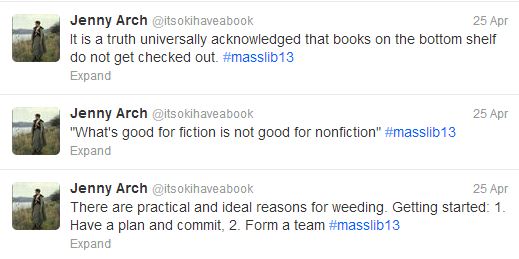
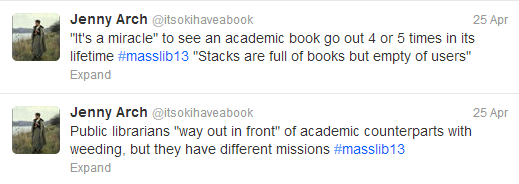
The next session I attended was “Afraid to Advocate? Get Over It!” Eric Poulin from Greenfield and John Ramsay from Springfield gave the Western Massachusetts perspective, acknowledging the perception in Western Mass that their tax money comes to the eastern part of the state and doesn’t return. Point being that they know the importance of fighting for their libraries. (By this point in the conference, I had gotten the MLA wireless password and found the Twitter hashtag – or one of them – and began posting during the sessions.)

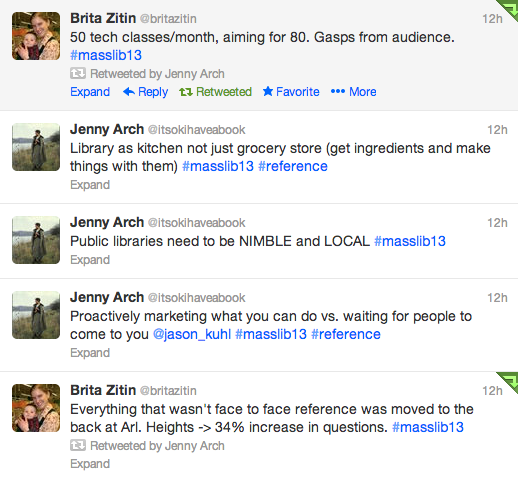
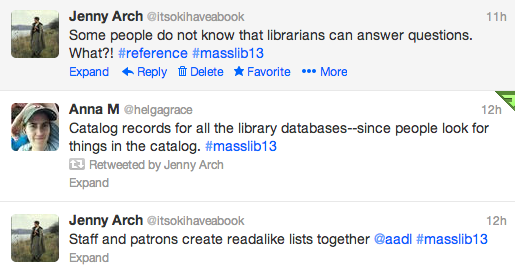
advocacytweets


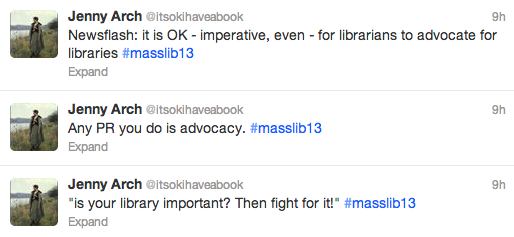
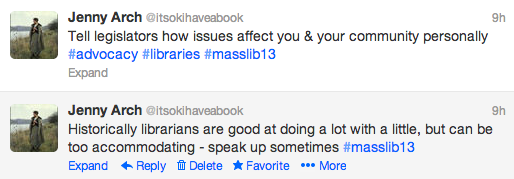
Eric and John talked about legislative breakfasts, usually held annually, and the importance of attending them, getting to know your local legislators in an informal context. Libraries can also host legislative breakfasts, and are definitely a great place for photo ops. Participation can’t be just once, though; it should be ongoing, to build a relationship: “Legislators are people too. They work for us and they are part of our community.” Librarians, of course, know that libraries are important, but not everyone knows that, and librarians can be unwilling to stand up and be loud. “Is your library important? Then fight for it! …Fighting for libraries is good citizenship.”

As public employees, librarians can’t ask or tell patrons who to vote for in local elections, or how to vote on an override, but they can provide balanced information about the issues. The Massachusetts Trial Court Law Libraries are a good resource for those who want to get involved but are afraid of crossing a legal line. Not all advocacy is political, though; any PR is advocacy, from newsletters to photo ops to social media to special events at the library. “It’s not just gonna happen by itself.”

advocacytweets2


John spoke about three branch libraries closing in Springfield, and how public support brought them back. “Libraries are, in some ways, an equalizer,” he said, and Springfield patrons showed that their library was important to their community. Eric shared a story from Greenfield, where a new mayor made a particularly egregious comment about libraries and within two days the community mobilized and marched on city hall [could not find news article to link to]. He also joined the fight when the high school was considering cutting its librarian position. “Tell legislators how issues affect you personally,” he said. And don’t wait for a crisis to talk to legislators; they’re more likely to listen if you have a relationship already in place. “Anticipate the questions so you have the answers” when you talk to them.

Another part of advocacy is making sure the library has a positive image with the public. “Points of friction” may include late fees or other customer service issues; consider how your library staff handles these.

MLA logo

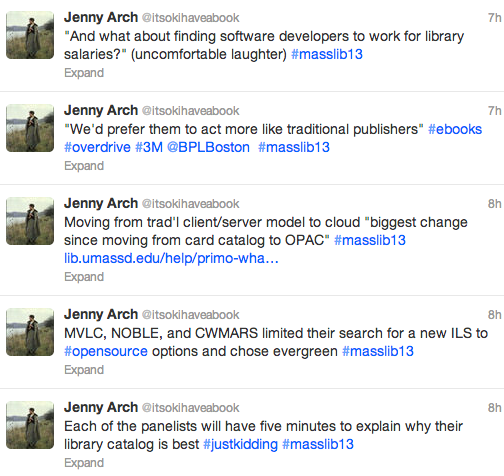
All that was just before lunch on Day One. More to come in the next post, where I’ll write about “Library Services and the Future of the Catalog: Lessons from Recent ILS Upgrades” and “Loaning eReaders to the Public: Legal and Strategic Challenges.” For now, you can check out the highlights on Twitter by searching for #mla13 or #masslib13.


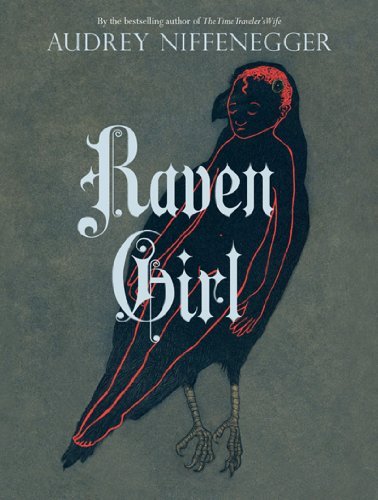
Raven Girl by Audrey Niffenegger

ravengirlToday I’m feeling quite grateful to book publicists, particularly to one who works at Abrams Comic Arts, publisher of Audrey Niffenegger’s new graphic novel, Raven Girl. In a time when libraries and publishers are sometimes on opposite sides of the fence, this is a good reminder that on both sides are people who love books and want to share them.

Audrey Niffenegger is best known for her novel The Time Traveler’s Wife, in which Clare (the wife) and Henry (the time traveler) are often separated against their will; it is an unusual and powerful love story. Her next novel, Her Fearful Symmetry, features identical twins who inherit their aunt’s London flat next to Highgate Cemetery; it is a ghost story, but the ghost realm and the human realm prove to be more porous and permeable than in other ghost stories.

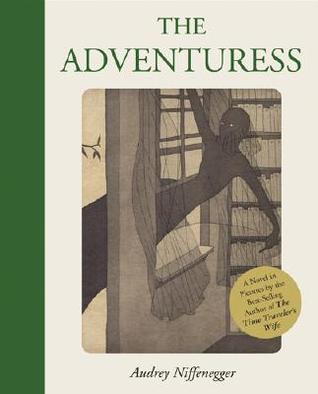
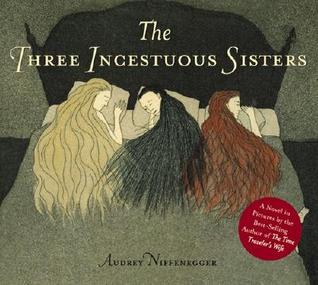
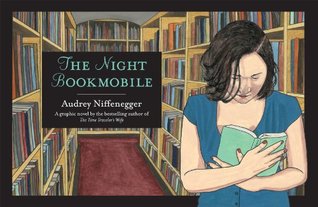
Readers of these novels, however, may have missed Niffenegger’s other work; she is both an author and an artist, and these two talents come together in her graphic novels. The Night Bookmobile was serialized in The Guardian before being published in book form in 2010. The Three Incestuous Sisters (2005) and The Adventuress (2006) preceded it. And now, we have Raven Girl, in which readers of Niffenegger’s previous graphic novels will recognize her characteristic style in both the art and the story itself.

Raven Girl was conceived as “a new fairy tale,” and that is exactly what it is. A postman falls in love with a raven; their daughter is born with the form of one, but she longs for what she feels is her true form. Instead of a witch or a fairy godmother, she finds a doctor who can help her effect the change. As in a fairy tale, some details and impossibilities are glossed over; as in a fairy tale, the animal and human worlds overlap; as in a fairy tale, some characters have happy endings, and some come to unfortunate ends.

In the illustrations paired with the text, remarkable detail contrasts with simple, flowing lines, and muted browns, blues, and greens. As you read, you may find yourself looking back and forth between the text and the art, as together, they amplify the power of the story.

Like most of Niffenegger’s work, Raven Girl is magical, dark, and unusual. I highly recommend it, not just for those who are already fans of the author, but as an entry point for those who have not yet discovered her.

adventuressthreeincestuoussistersnightbookmobile


Disclosure: I received my copy of this book from the publisher. I received no compensation for this review. Raven Girl will be available May 7.

Happy National Library Week

This week is National Library Week, the time of year that we “celebrate the contributions of our nation’s libraries and librarians and promote library use” (as opposed to the rest of the year…when we also do those things). Jessamyn West wrote a NLW post full of great links at the actual beginning of the week, which is well worth checking out. The Swiss Army Librarian posted a wonderful quote from the very pro-library author Neil Gaiman back in 2011, which is worth revisiting. And of course, the #nlw13 tag is also active on Twitter.

On Monday afternoon – Marathon Monday – I was sitting with a friend of a friend who is considering leaving academia (she’s a few years into a PhD in English Literature) and becoming a librarian. We had met up to talk, and she asked me what librarians were like. I told her one of the striking things I had noticed about librarians as compared to people in other professions: on the whole, they – we – are collaborative, not competitive. We are friendly and helpful and very willing to share our work, our discoveries, and of course our favorite books. “There may be asshole librarians out there,” I said, “but I haven’t met one yet.”

NLW2013_logo

MOOCs and online learning

Massive Open Online Courses (MOOCs) are gaining popularity, prompting much discussion among those involved in higher education. Some champion the spread of knowledge through technology, while others call MOOCs the death knell of higher education as we know it, and still others point out that the MOOC experience cannot replace the traditional college experience. There are now a number of companies and institutions that offer a platform for MOOCs: there’s Coursera, edX (founded by MIT and Harvard), Udemy, Stanford Engineering Everywhere (SEE), and many others.

The Boston Globe recently profiled Lexington “writer and entrepreneur” Jonathan Haber, who has set himself the goal of earning “a one-year MOOC BA,” taking a range of classes on a variety of platforms in 2013 – certainly an interesting way of achieving firsthand knowledge on the issue. I can’t speak (or write) with such first-hand authority, having never taken a MOOC myself, but I did take some online and “blended” classes (some in-person meetings, some online lectures and discussions) in grad school, so I will write a little bit about that.

Technical difficultiesTeachers face a learning curve when moving from a classroom environment to an online environment. On one hand, there is new software to learn, which can create glitches for even the savviest professor. Course management software is idiosyncratic, and teachers may need to become familiar with other software programs (like Camtasia for recording lectures) in addition to course management software like Blackboard or Moodle.

On the other hand, techniques that work in the classroom don’t always transfer well to an online environment, and it can be trial-and-error to discover what types of assignments work well online. The first semester or two can be rough as professors troubleshoot new tools and figure out what works and what doesn’t; students can help by recognizing the learning curve teachers face (many put in extraordinary amounts of extra time), and by doing their best to stay with the course schedule, even if there aren’t physical meetings to attend.

Synchronous or asynchronous? Online courses may be synchronous – everyone “present” at the same time – or asynchronous, where the professor posts a lecture and the students can watch it whenever is convenient (usually within a specified time frame). Asynchronous courses give students flexibility and control over not just where they learn (at home instead of in a classroom, for example), but when (so night owls and early birds are both happy).

Communication: If the students don’t see the professor on a regular basis in the classroom, they must have some way to communicate. Professors should establish communication guidelines/ground rules at the outset of the class, letting students know when they will be available and how they can be reached. I have taken classes with professors who would respond to an e-mail in minutes; professors who were on Skype and Gchat and Twitter; professors who held traditional office hours and could be reached by phone.

Communication is of paramount importance for several reasons: there may be a technological glitch that the teacher is unaware of (inaudible audio file, broken link); students might need clarification on assignment instructions; students will want feedback on their work. Ideally, there will be at least two channels of communication – and professors should remember that not every student is on facebook or wants to communicate that way.

Discussion boards: Online discussion boards are now part of many traditional classes as well as online ones. As a student, I came to appreciate discussion boards for a few reasons. The act of writing is more considered than the act of speaking; writing responses to prompts reinforced my own learning and increased my grasp of the material. Reading others’ comments was valuable as well, because written comments were more thoughtful and clear than spoken ones – people weren’t just saying the first thing that came to mind, as they do in a classroom. The interaction between students on the discussion board was impressive as well: people responded to each other’s posts and sometimes cited outside sources, providing links to extra materials. In a “blended” class, discussions carried over from the online forum into the classroom.

Swash_ornament_zeimusu

In many ways, my experience with online learning is vastly different from that of students who take MOOCs. I was in classes with 20-30 other students, and we received as much feedback on our work as we would have in a traditional classroom setting. But there are similarities too: as with most education, the student is at least partially accountable for his or her own learning, and to a great degree you get out of it what you put into it. If you do the reading, attend (or listen to) the lectures, and participate in discussions (in person or online), you’ll learn. Good teachers will find ways to adapt what works in the classroom to what works online. The success of MOOCs so far (and of TED talks) prove that there is an untapped desire to learn in many people, and that’s something to celebrate and encourage.

Edited to add: A.J. Jacobs, who I can’t help but think of as a stuntman of the author world (experimenting with certain ways of life and then writing about them, e.g. The Year of Living Biblically), has written a piece for the Times opinion pages called “Two Cheers for Web U!” Despite the enthusiastic title, he points out a few drawbacks to MOOCs, and predicts that, while they offer benefits to some, they won’t ever replace brick-and-mortar colleges. –4/21/13

The Great Migration

The Amazon acquisition of Goodreads came right on the heels of another major change that I didn’t blog about here (though I did do plenty of reading about it): Google is shutting down its RSS tool, Google Reader, on July 1 of this year. This news sent its millions (but not enough millions, apparently) of loyal users in search of alternatives.

Google_Reader_logo_GalliganFor those who don’t use any RSS feed: how they work is that you add subscriptions – to blogs, news sites, or webcomics, for example – and all new content from those sites is collected in one place. It’s a great way of keeping track of content from many places on the web, especially if they post content at irregular intervals; by highlighting new content when it appears, the RSS feed ensures that none of the sites you want to follow disappear from your radar.

So, which tool to use to replace Google Reader? I don’t have a smartphone, but I wanted something that I could access from my home computer, my work computer, and my tablet; I wanted something browser-based, not an app or plugin I’d have to install. Lifehacker’s March 13 article about Google Reader alternatives is worthwhile if you’re still trying to decide which one to switch to, as is the March 14 article from Extreme Tech.

the-old-reader-logoIf I’d had a smartphone, I might have gone with Feedly (my roommate’s choice), and I’m not ruling out changing to NewsBlur (Cory Doctorow’s choice) in the future, but for now I’ve switched to The Old Reader. It did feel a bit like going back in time, and because so many others were switching over at the same time, it took a few days(!) to import the OPML file that I had exported from Google Reader, but it’s been working well so far.

Uploading my exported Goodreads data to LibraryThing took a little time as well, but not as long as I expected, and I was very pleased with the outcome; all my Goodreads “shelves” became tags in LibraryThing (e.g. young adult, science, cooking, magic, to-read). I’m still getting used to navigating around the LT interface, as I’ve only really used it for cataloging before, but I’ve had no major problems so far, and the documentation is very good, so I can often find the answers to my questions.

The LT staff, including Tim Spalding, are active and responsive members of the site. The “LibraryThing: How to Succeed in an Amazon/Goodreads World” thread has been so active that it has spawned several additional topic threads. Barbara Fister has also written a good overview about the “culture clash” that occurred when a wave of Goodreads users joined LibraryThing (“culture shock: when Goodreads and LibraryThing collide“).

LT_logoIf you’re thinking of becoming a member of LT, or if you’re just curious to learn more about what it is, you can’t do better than this collaborative piece from LT staff and members, “What Makes LibraryThing LibraryThing?” They address the difference between users and customers (LT is free only up to 200 books; after that, you’re required to pay, but the amount is “suggested” and you can get either annual or lifetime membership at a very reasonable price): “We have no ‘users.’ If you’re not the customer, you’re the product. If a social website can’t support itself on customers and straightforward products, it’ll eventually sell out what you gave it—your data, your friends, and the community itself….We want what paying creates—customers, with loyalty and rights—not “users.'”

The “user vs. customer” difference is becoming more apparent as platforms launch and close, are bought and sold. As Alex Kantrowitz noted in an article for Forbes (“Google Reader Shutdown a Sobering Reminder That ‘Our’ Technology Isn’t Ours,” March 13), “The death of Google Reader reveals a problem of the modern Internet that many of us likely have in the back of our heads but are afraid to let surface: We are all participants in a user driven Internet, but we are still just the users, nothing more. No matter how much work we put in to optimize our online presences, our tools and our experiences, we are still at the mercy of big companies controlling the platforms we operate on.”

This is something to consider seriously: the major social media sites (e.g. Facebook, Twitter) are free, and users produce the content, signing away more rights than they’re aware of by agreeing to the various sites’ Terms & Conditions. Though everyone likes free, there are some things worth paying for, and having a little more control in the content you produce, and a little more confidence that the platform on which you’re creating it won’t be unceremoniously pulled out from under you, is sometimes worth it. (Not to say, of course, that just because you pay for something, it will always be reliable, TIME WARNER. Companies go under, or they’re sold, or they change.)

demandprogressSpeaking of Terms & Conditions, the Computer Fraud and Abuse Act (CFAA) makes it extremely perilous to violate T&C (or Terms of Service); according to the Department of Justice, it can even be a felony. Read more and find out how you can take action to protect the internet as we know it.

This just in: Academic publisher Elsevier just acquired Mendeley, to the dismay of many of Mendeley’s users. Elsevier is notoriously expensive and anti-open access, whereas Mendeley is (was?) a free research and reference management tool. Many users will probably be jumping ship to Zotero, a similar service.

Amazon buys Goodreads

I experienced that sinking feeling as soon as I saw the link, even before I clicked on it: http://techcrunch.com/2013/03/28/amazon-acquires-social-reading-site-goodreads/. The full headline from Tech Crunch is “Amazon Acquires Social Reading Site Goodreads, Which Gives the Company A Social Advantage Over Apple.”

My immediate and unconsidered reaction is that this can only be bad news. Goodreads is a site I have been using since 2007: the user experience is excellent, the communication from the company is of high quality and transparency, and they seem trustworthy and reliable in the way that they handle their users’ information (unlike, say, facebook, which has made a number of massive missteps where users’ private information is concerned).

Amazon, on the other hand, mines its users’ data voraciously: they know not just what you’ve bought, but what you’ve considered buying, and what other people who bought the thing you’re looking at bought. If you have a Kindle, they know not just what you’re reading, but what you’ve highlighted, where you’ve made notes and comments, where you’ve stopped reading, where you’ve lingered – far more than I, for one, really want them to know. (Part of the reason I don’t have a Kindle.)

In a PaidContent article, “Amazon acquires book-based social network Goodreads,” Laura Hazard Owen writes, “Goodreads has served as a fairly “neutral” hub for readers until now — a place where publishers and authors can market and promote their books without being tied to a specific retailer. Until 2012, Goodreads sourced all of its book data from Amazon, but it then decided that the company’s API had become too restrictive and switched its data provider to the book wholesaler Ingram. “Our goal is to be an open place for all readers to discover and buy books from all retailers, both online and offline,” Goodreads told me at the time of the switch. While being an “open place for all readers” may still be Goodreads’ goal, it’s now clearly tied to promoting books for sale on Amazon.”

Below is a screenshot I took today, 3/28/13. You can see the page for Homeland by Cory Doctorow; there’s the cover image, a blurb (usually provided by the publisher), the cataloging data (publisher, publication year, language, format, etc.), and below that, my review, because I was logged in at the time I took the screenshot and I’ve read and reviewed Homeland (I recommend it).


goodreads_getacopy

Between the book info and my review, it says “Get a copy” and there are three buttons. The first one goes to Barnes & Noble; the third one goes to WorldCat, so you can find the book in a library near you, wherever you are in the world (very cool!); the middle one, “online stores,” has a drop-down menu, which includes the following retailers in this order: Kobo, Indigo, Abebooks, Half.com, Audible, Alibris, iBookstore, Sony, Better World Books, Target.com, Google Play, IndieBound, and last of all, Amazon. (If you click “more” after that, it takes you to a page where you can compare booksellers’ prices for used and new editions.)

goodreads_dropdown


I don’t know what else will change once Amazon is in charge of Goodreads, but I bet Amazon moves up that list from the bottom. Will Goodreads even continue linking to other booksellers? I hope so.

There is an open letter on Goodreads now from the founder, Otis Chandler, rhapsodizing about bringing Goodreads to the Kindle. There’s a press release on Amazon where VP of Kindle content Russ Grandinetti talks about Goodreads and Amazon’s “share[d] passion for reinventing reading.” All of it makes me more wary than excited, but we’ll see what happens.  Meanwhile, I’ll be backing up my data more religiously than usual (if you have an account, you can export all the content you’ve added to Goodreads from the import/export page).

The Great Gatsby

“I want to write something new – something extraordinary and beautiful and simple + intricately patterned.” -Fitzgerald in a letter to his editor, Maxwell Perkins, July 1922 (from The Sons of Maxwell Perkins: Letters of F. Scott Fitzgerald, Ernest Hemingway, Thomas Wolfe, and Their Editor, edited by Matthew J. Bruccoli, University of South Carolina Press, 2004)

This week at work, I led a book discussion about F. Scott Fitzgerald’s The Great Gatsby. (We celebrated “Gatsby Month” in March, planned around the new movie version, the release date of which was unfortunately pushed back. However, I believe we’ve drummed up some excitement for its eventual release in our area.)

Gatsby_1925_jacketI’ve read Gatsby a number of times: first in eleventh grade, again before the end of high school, at least once in college and at least once since. I’ve written multiple papers on it, and would give it my vote for Great American Novel if I had to choose just one. Which is to say, I felt I knew it sufficiently well so that I didn’t need to re-read it again before my book discussion at the library.

However, a few days before the discussion, a co-worker (who had led a discussion the week before) sent me this article from Salon, entitled “Nick Carraway is gay and in love with Gatsby.” Though I’d noticed in my readings that Nick never seemed all that interested Jordan Baker, it hadn’t occurred to me that it was because he was gay; I figured she just wasn’t all that likable. (She plays golf. She cheats at golf. Or at least, that’s the rumor.)

Greg Olear, author of the Salon piece, included significant textual evidence to back up his claim. As the narrator, Nick is responsible for introducing each of the other characters to the reader. He describes the men and the women very differently; he notes Daisy’s voice, Jordan’s posture, and Myrtle’s dress, but he describes Tom’s physicality and Gatsby’s air of favorable understanding. Olear also draws the reader’s attention to the scene between Nick and Mr. McKee, which I had forgotten about, or never really noticed or understood; but, as Olear points out, in a book that is so economical with words, surely Fitzgerald wrote that scene for a reason.

Why does it matter if Nick Carraway is gay? Because he is the narrator, and we trust him to be impartial (or at least to tell us when he isn’t). If, as Olear suggests, Nick is in love with Gatsby, then Nick “romanticizes Gatsby in the exact same way that Gatsby romanticizes Daisy.” (Olear also sums up something I’ve felt since my first reading of the book – that Daisy is “unworthy of [Gatsby’s] obsession.”)

gatsbymovieEven if it isn’t true – and who’s to say? – it’s an interesting lens through which to read the book, and it will be interesting to see how they reinterpret the story for the screen this time around (IMDB now says the release date is May 10).

Speaking of books being adapted into movies, Book Riot ran a recent piece on just that topic: “What do readers really want from literary adaptations?” See the excerpt below (emphasis is mine):

“[A] big reason for the challenge [of adapting a book to the screen] is that it’s so difficult in the first place to determine exactly what we readers (presumably a sizable portion of these films’ audience) want from our adaptations. There are, as I see it, two general modes of thought. On the one hand are those who want replication–a careful, detailed transfer from page to screen. These folks ask that the director and writer(s) revere the book and recognize the grave responsibility with which they have been entrusted. On the other hand are those who simply want the spirit of the work to reach the screen, and willingly cede the often proprietary instincts that come with loving a particular book to those charged with adapting it….The lesson here should be obvious: the bigger a fan you are of a given book, the less sensible you’re likely to be when it comes to its adaptation.” 

Funny Books

I read (and recommend) a lot of literary fiction. Also a fair number of (auto)biographies and a decent amount of narrative nonfiction about science and history, a lot of young adult literature (not that YA can’t be literary – it often is), and a smattering of other genres. But a couple weeks ago I saw a Kirkus list of “10 Great Books That Will Make You Laugh Out Loud,” and I thought I’d compile my own list. I originally wrote this post for the library blog, but I’ve tweaked some things, and changed all the links below so they go to Goodreads instead of the library catalog.

Heather Armstrong: Better known to the Internet as Dooce, Heather Armstrong is a blogger and a mother, but to call her a “mommy blogger” would be misleading. Ex-Mormon Armstrong writes with passion, humor, obscenity, and honesty about her life, her family, and her mental health. Her 2009 book, It Sucked and Then I Cried: How I Had a Baby, a Breakdown, and a Much Needed Margarita, is probably the funniest book about post-partum depression in existence.

iwastoldtheredbecakeSloane Crosley: The titles of her two essay collections, I Was Told There’d Be Cake (2008) and How Did You Get This Number? (2010) should give an indication of Crosley’s wit, attitude, and willingness to write about situations so embarrassing that most of us would never speak of them aloud, let alone commit them to paper and make them publicly available. Yet, after reading either of these books, you will probably want her to be your new best friend.

Tina Fey: The star of 30 Rock and one of the reigning queens of comedy, Tina Fey’s Bossypants (2011) chronicles her childhood, adolescence, and her entry into the world of comedy. She’s matter-of-fact, down to earth, and extremely funny. (“If you retain nothing else, always remember the most important Rule of Beauty: ‘Who cares?'”) I have heard that the audiobook version of Bossypants is also excellent.

goodomensNeil Gaiman and Terry Pratchett: These two sci-fi/fantasy geniuses collaborated on the 1990 novel Good Omens: the Nice and Accurate Prophecies of Agnes Nutter, Witchwhich begins: “Current theories on the creation of the Universe state that, if it was created at all and didn’t just start, as it were, unofficially, it came into being between ten and twenty thousand million years ago. By the same token the earth itself is generally supposed to be about four and a half thousand million years old. These dates are incorrect.” And away we go. [This is the only one on the list I haven’t read, but it comes to me highly recommended, and I have enjoyed other Neil Gaiman books.]

Justin Halpern: You might be inclined to write off Sh*t My Dad Says as no more than flash-in-the-pan Twitter material, but give this book a chance: Halpern’s dad’s quotes are grouped by theme, and the sections are divided by short, heartfelt, insightful essays that make it really worthwhile. Plus, the essays give your laughing muscles a break.

On Accidents: “I don’t give a shit how it happened, the window is broken…Wait, why is there syrup everywhere? Okay, you know what? Now I give a shit about how it happened. Let’s hear it.” –Sh*t My Dad Says

mindykalingMindy Kaling: Is Everyone Hanging Out Without Me? (and Other Concerns) (2011) reads like the younger generation’s Bossypants. Kaling’s writing style is casual and conversational, amusing (“The staircase in our third-floor walk-up was the steepest, hardest, metal-est staircase I have ever encountered in my life. It was a staircase for killing someone and making it seem like an accident”) and sometimes even wise (“One friend with whom you have a lot in common is better than three with whom you struggle to find things to talk about”).

lawson_letspretendJenny Lawson: Otherwise known as The Bloggess, Lawson’s first book, published last year, is called Let’s Pretend This Never Happened: (A Mostly True Memoir). I have yet to meet someone who has read this hilarious and bizarre book without laughing. For a little taste what you’re in for, check out this blog post: “Would you like to buy a monkey?”

Karl Pilkington: Ricky Gervais (The Office, U.K. version) needs someone to be unkind to, and it’s very often Karl Pilkington. Pilkington has a wholly original worldview, and the three of his books that I’ve read – Ricky Gervais Presents: The World of Karl Pilkington (with Ricky Gervais and Stephen Merchant, 2006), Happyslapped by a Jellyfish (2007), and Karlology: What I’ve Learnt So Far (2008) – are bound to delight fans of absurd British humor. (I also recommend the Ricky Gervais Show podcasts.)

Simon Rich: Former Harvard Lampoon president and a writer for SNL, the prolific Rich is also the author of several short story collections and short novels, including Ant Farm: and Other Desperate Situations (2007)Free Range Chickens (2008), and What in God’s Name (2012)From what the dalmatians on the fire truck are really thinking to what angels do in heaven, Rich has a wildly humorous explanation for things it hasn’t even occurred to you to wonder about yet.whatingodsname

David Sedaris: Where to begin? Sedaris has written many books, including essay collections, memoirs, and short stories; his work has often appeared in The New Yorker. Start with a relatively recent essay collection, When You Are Engulfed in Flames (2008), or go earlier and check out Me Talk Pretty One Day (2000). If you’re feeling festive, try Holidays on Ice (1997); if you’re in the mood for very dark versions of Aesop’s fables, try Squirrel Meets Chipmunk: A Modest Bestiary (2010). Most of his work is also available in audio.

eatsshootsleavesLynne Truss: Does it infuriate you when you see “your” when it should be “you’re,” or when someone answers a cell phone in the middle of dinner? English author Lynne Truss is the champion of proper punctuation and modern manners. Eats, Shoots & Leaves: the Zero Tolerance Approach to Punctuation (2004) is “a book for people who love punctuation and get upset when it is mishandled”; Talk to the Hand: the Utter Bloody Rudeness of the World Today, or Six Good Reasons to Stay Home and Bolt the Door (2005) is Truss’s “rallying cry for courtesy.”

wordyshipmatesSarah Vowell: Laugh and learn as Sarah Vowell explains history with a modern (liberal) perspective and incisive sense of humor. From the Massachusetts Bay Colony (The Wordy Shipmates, 2008) to Hawaii (Unfamiliar Fishes, 2011) to dead presidents (Assassination Vacation, 2005), Vowell provides some of the most entertaining scholarship out there. Like David Sedaris and Tina Fey, she narrates her own audiobooks.

Did I neglect to mention your favorite funny book? Let me know in the comments.

The Third Son by Julie Wu

thirdsonThe Third Son by Julie Wu (Algonquin Books, expected publication date April 30, 2013)

In one of those “small world” occurrences, I heard about this book from a friend I met through ultimate frisbee; he had been in contact with the author via Twitter. I read a description of the book and was interested; historical fiction set in the post-WWII era is right up my alley. I went to NetGalley and requested an advance reader’s copy (ARC), which the publisher, Algonquin, graciously granted, and I read the book over the course of a few days.

“A wound that never healed. A promise never to be fulfilled. That was family.”

Saburo, the titular third son of a Taiwanese family in Japan-occupied Taiwan, has been maltreated by his family ever since the death of his younger brother, Aki. Both his father and mother punish him physically, and he gets the smallest share of every meal, causing him to be diagnosed with malnutrition. He is bright but dreamy, and neither his teachers nor his parents appreciate his intelligence. One of his few tender experiences as a young boy is when he meets young girl, Yoshiko, during an air raid; he also experiences kindness from his cousin Toru, a doctor.

Once the Japanese have been defeated, the Chinese come, and once again Taiwan is under another country’s rule. Amidst chaos, oppression, and death, Saburo finds Yoshiko again. Saburo’s older brother Kazuo makes advances on Yoshiko, but she and Saburo marry. Saburo vows to take the legendarily difficult exam to go to America and study at a university, despite the fact that, unlike Kazuo, he did not attend the best university in Taiwan. He studies on his own, with Yoshiko’s support, and passes; he then must leave Yoshiko and their new baby, Kai-ming, to go to America.

Throughout the novel, Saburo faces many obstacles; some are political (his father is a politician; quotas from Taiwan to the U.S. make visas difficult to get; there is corruption on both/all sides), but many stem from his family’s unjust treatment of him. The difficulties Saburo faces because of his family are worse than any he encounters because of the political events in Taiwan; this has the twin effects of lessening the impact of important political events (e.g. the anti-government uprising in February 1947 and the “White Terror” that followed) and making the story more universal and Saburo more relatable.

Once in the U.S., Saburo faces a new choice: to do as his family instructed, spending only one semester studying engineering (his talent and passion) and one studying pharmacy, to help with the family business upon his return, or spend all his time on engineering. His loyalty to his family in spite of their treatment of him is incomprehensible to many Americans he meets, who encourage him to put himself first for once and follow his dream of earning a Master’s in engineering and bringing Yoshiko to live with him in the States. Saburo is torn between the two value systems, but with Yoshiko’s encouragement, he finally makes his choice.

The Third Son is a well-written historical novel, an immigration saga that illuminates core differences between two cultures. Those who enjoyed Alan Brennert’s Honolulu or Julie Otsuka’s The Buddha in the Attic will almost certainly enjoy The Third Son.

honolulubuddha_attic

Calling all researchers: timeline of the end of repair

During the major blizzard in February (dubbed Nemo), my digital camera stopped working. When I turned it on, the lens would extend, then retract; it would do this a few times and then give a error message to turn it off and back on again. This did not solve the problem, so I began wondering if I could get it repaired, or if I would have to replace it. This repair-or-replace question made me think of a timeline I had seen, which I will describe:

Physical description: It was a black-and-white timeline (though it could originally have been in color); I had it on an 8.5×11″ paper, which I had to blow up onto multiple pages in order to see all the small print properly.

Content: I’m not sure what the earliest year represented was, but the timeline extended through the present and into the future. It showed when repair stopped being a viable option for everyday objects like clothes, shoes, toasters, and radios; when built-in obsolescence, or planned obsolescence, made it cheaper to buy a new item to replace the old one, or simply impossible to repair the old item.

Question3I wanted to find this timeline again. I started with a Google search, using a variety of keywords (repair, replace, timeline, obsolescence/obsolete, chart, technology, etc.), and then switched to a Google image search. I couldn’t find it, so I looked through my grad school notebooks, thinking maybe it had been a handout from one of my classes. It wasn’t there, so I reached out to grad school friends and professors, none of whom specifically remembered what I was trying to describe (though some said it sounded cool), or could help me find it.

Next, I reached out to the Swiss Army Librarian, an ace reference librarian in Chelmsford, MA. He spent a generous amount of time helping me try to dig up the timeline, consulting print and online materials, but we still haven’t found it. However, we found a number of other cool resources along the way:

  • the Consumer Reports Repair or Replace Timeline access to the timeline itself requires a subscription to CR, but you may well have access through your local public library, as many libraries purchase subscriptions. (If you happen to live in Arlington, MA, click here.)
  • an article from The Economist by Tim Hindle called “Planned Obsolesence” from March 23, 2009
  • the book Made to Break: technology and obsolescence in America by Giles Slade, which didn’t have the timeline I was thinking of, but it makes interesting reading. (It will probably make you angry.)
  • a very long piece from Adbusters by Micah White called “Consumer Society is Made to Break” from October 20, 2008, which includes a clip of (and link to) a short film called The Story of Stuff, and a reproduction of Bernard London’s 1932 pamphlet entitled “Ending the Depression Through Planned Obsolescence,” which contains the following rather incendiary proposal:

“I would have the Government assign a lease of life to shoes and homes and machines, to all products of manufacture, mining and agriculture, when they are first created, and they would be sold and used within the term of their existence definitely known by the consumer. After the allotted time had expired, these things would be legally “dead” and would be controlled by the duly appointed governmental agency and destroyed if there is widespread unemployment. New products would constantly be pouring forth from the factories and marketplaces, to take the place of the obsolete, and the wheels of industry would be kept going and employment regularized and assured for the masses.”

For those who are now fascinated and/or infuriated by the whole concept planned obsolescence thing: if you research further and find that chart, please let me know!