Virtual event: Starfish author Lisa Fipps at the Newton Free Library

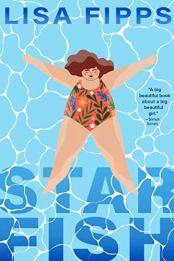
Cover image of StarfishBig thanks to the children’s librarians at the Newton Free Library for organizing, promoting, hosting, and moderating a delightful virtual author visit with Lisa Fipps, author of the novel in verse Starfish, a Printz honor book. Lisa was incredibly friendly and personable, doing only a short introduction before answering tons of questions from the Newton Free Library book club and other attendees.

Some snippets:

  • On the writing process: Lisa sees “movie trailers in my head”
  • On autobiographical fiction: Ellie got “the watered down story of my life” with authentic emotions
  • To those who say “things like that would never happen”: “They do.”
  • On growing up without seeing herself in books: “I didn’t know anybody like me” (#RepresentationMatters)
  • On wanting to make post-publication changes: “I don’t know any writer who doesn’t look back on a book” and want to change something. Lisa didn’t read Starfish until six months after it was published, and while there are small things she would change if she could, “I’m okay with it.”
  • On how to get published: “First you have to write the story.” Then find an agent (hers is Liza Boyce), who will help you find an editor (hers is Nancy Paulsen).
  • Will there be a sequel or prequel? The Printz committee asked this too! Not sure.
  • On future books: Nancy is editing book number two now, and Lisa is writing book number three.
  • How long does it take you to write a book? Starfish took eight months, the next book took six. Lisa is trying to write 2-3 books a year; “I want to be a full-time author and you need to write a lot to make that happen.” (Currently she works at the Kokomo-Howard County Public Library in Indiana)
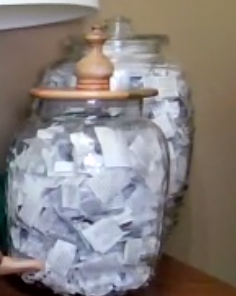
  • On that stuff on the table behind you: the penguin collection is because Nancy Paulsen’s imprint is part of Penguin Random House (which at least two librarians agree should have been called Random Penguin when they merged). The “inspiration jars” (see photo) are full of good reviews, fan letters, kind words, etc. That’s a lot of warm fuzzies!Screenshot of "inspiration jars"
  • On the role of music in writing: Lisa creates a playlist for every book she writes, to get into the characters’ heads; when actually writing, she listens to music with no lyrics.
  • How have family members responded to Starfish? “I have no idea, I’m estranged from my [biological] family” (except for a nephew); “I have families of choice.”
  • Advice for young writers? Write. And read a lot. “I try to read 3-5 books a week.”
  • What time of day do you write? Evenings after work, with marathon writing sessions (8-10 hours!) on weekends.
  • Do you read other novels in verse? Yes! The first one she read was Stop Pretending by Sonya Sones. “I think verse is a way to tell a powerful story in a short amount of words.”
  • On Ann Patchett’s advice to read your work aloud to yourself: “You will hear any clunkiness in your writing like that.” Lisa even recommends doing this while wearing foam earplugs.
  • On the therapist character in Starfish: Lisa used the wisdom of therapists mixed with the personality of a critique partner. (Readers loved Ellie’s therapist. Librarian Ms. Bery included Starfish in her list of books that normalize therapy.)
  • On Catalina’s character: Catalina is a “composite character” (bits and pieces of different people).

Thank you so much, Lisa Fipps and Newton Free Library!
Caitlin Moran discusses her Moranifesto

Cover image of MoranifestoOn November 30, journalist and author Caitlin Moran (pronounced CAT-lin mo-RAN) spoke in conversation with Boston Globe columnist Meredith Goldstein at the Brattle Theater in Cambridge, hosted by the Harvard Bookstore. It was dark and rainy, but good to be in a room full of feminist librarian types. I haven’t yet read Moran’s newest book, Moranifesto, but I loved her book How to Be A Woman and her previous essay collection, Moranthology. I initially discovered her via her essay “Alma Mater” in The Library Book, and I still think of a passage from it often:

“The shelves were supposed to be loaded with books – but they were, of course, really doors….A library in the middle of a community is a cross between an emergency exit, a life raft and a festival. They are cathedrals of the mind; hospitals of the soul; theme parks of the imagination….They are the only sheltered public spaces where you are not a consumer, but a citizen instead.”

-“Alma Mater,” Caitlin Moran

Like most of the audience, I was prepared for Moran to be her unselfconscious, energetic, hilariously uncensored self, and she launched in right away about having just gotten her period and being on codeine (which I’m pretty sure you cannot get over the counter in this country) and coffee. The coffee was winning, I think, because she was talking faster than Lauren Graham.

In shifting from writing about pop culture and feminism, Moran said that at first she had felt “ill-qualified” to write about politics, but gained confidence when she realized that many political figures were former journalists. She stated, “Politics does not work anymore,” and said that we need to form new political parties in the U.K. and U.S. Moran believes in action: “If you started complaining three minutes ago, you should’ve started doing something two minutes ago.”

Of certain of our current political figures, Moran said, “These are not politicians, they are agents provocateurs.” She said that the tone of politics has been set by the Internet, which is  largely young, male, and lawless – “like California during the Gold Rush.”

“EVERYTHING is going to change in the next twenty years.”

Moran believes the left’s biggest enemy is itself. Whereas the goal of conservatism is to keep things as they are (the status quo), the left has two goals: to redistribute power and to invent a future. It is far harder to create something new than to preserve something, which leads to greater dissent, even among those who agree on a progressive agenda.

Moran read from one of the essays in Moranifesto, “Advice to Teenage Girls.” Some of her advice:

  • “‘Yet’ is a very useful word.”
  • “When in doubt, listen to David Bowie.”
  • “Go out there and change the world so it works for you.”

“I think everyone should write a manifesto,” Moran said. What will her next book be? How to Be Famous. “Celebrities are the Greek gods of our time.”

Q&A

The questions from the audience were mostly serious, but the answers ranged. In one case Moran’s answer skittered so far from the topic of the question so quickly that the only possible explanation is a tesseract. Suffice to say that Moran has clearly given the issue of Muppet sex some thought. Her answer offended an audience member; Moran listened to the complaint and responded that she was glad the person had spoken up: “I try to make everyone feel like they can say anything.”

Another audience member asked how we can encourage a cultural shift so that sexual violence and rape is taken seriously? Moran’s idea is to drop the word “sexual” in front of the word “assault”; “physical assault” sounds more serious.

Moran also talked about the online environment and social media. She said, “If you had a town planner, they’d never build the Internet the way it is. There are no safe public spaces….We need to find a new way [of designing and using social media]. This is a “problem of culture, not politics.” There is more money in argument and dissent than in agreement, thus “the world becomes angrier and more afraid.” The U.S., Moran pointed out, will never be invaded – our biggest danger is ourselves (internal dissent).

Ending on a serious note, Moran said that the Brexit vote and the Trump election are part of the same phenomenon, dating back to the 2008 crash. Neither approach of the current political systems – austerity or stimulus – brought anyone to justice for the events of 2008. Instead, the strategy of those in power to stop a revolution was to create a sub-class so people’s anger was directed down instead of up (to the elite).

And back out into the rainy night we went.

Lynne Truss at the library

Late last year, I saw that Lynne Truss (author of Eats, Shoots & Leaves; cue grammatically justified string of exclamation points) was publishing a novel this spring. I requested the e-galley, and received not only the galley itself, but a note from an acquaintance asking if I’d be willing to write a blurb for it. (Claire and I met in 2007 at the Columbia Publishing Course; after a stint at Knopf, she’d landed at the excellent Melville House, whereas I had left publishing after a few years and gone into libraries instead.)

I wrote the blurb, and then I asked if, by any chance, Lynne would be doing a U.S. book tour, and if so, would she like to come speak at the library where I work? Indeed, as it happened, Lynne would be coming to the States, and incredibly, she did make a special trip to the library. And I have to say, Lynne is one of the loveliest authors I’ve ever had the pleasure to meet, as well as one of the funniest. Below is a little summary of the event.

Cross-posted at the Robbins Library blog.

Lynne Truss read to an audience of more than twenty people at the Robbins Library this past Monday night, inspiring much laughter and a few book purchases. Lynne read from her new novel, Cat Out of Hell, and she read from two sections near the beginning, “So you don’t have to know quite so much.”

Cat Out of Hell 300dpi (2)Lynne told us that the novel was commissioned by Hammer, a publisher of horror in the U.K. “I only wrote it because someone wanted it….Anything I’m asked to [write], I’m more likely to [write]….I like to write for a person.” She had never written in the horror genre before, but knew right away she wanted to write a comic gothic novel exploring the origin of the common phrase “cats have nine lives.” (Originally, her idea was for a story called Nine Lives, about a cat who had killed nine people. That’s not quite what happens in Cat Out of Hell.)

She knew from the beginning she wanted to use a pastiche structure, as she has long been a fan of “the phony documentary element of gothic novels,” which are often represented as a collection of letters and other documents (or, in the case of Bram Stoker’s Dracula, typewritten – a new technology at the time).

One concerned potential reader asked Lynne, “Does the cat die?” to which Lynne replied, “You’ll be much more worried about the dog.” (The dog is called Watson, so that his owners, Alec and Mary, can use Lynne’s favorite Sherlock Holmes line: “Come at once, if convenient. If not convenient, come all the same.”)

Lynne's American publisher, Melville House, made a video for the book's release. What do the cats think of all this?
Lynne’s American publisher, Melville House, made a video for the book’s release. What do the cats think of all this?

As for humor – Cat Out of Hell is quite funny – one audience member asked if Lynne laughed at her own jokes as she is writing. “Yes!” But humor is “high-risk: if people don’t find it funny then you’ve failed completely. And humor is very subjective.”

Structure aside, Lynne didn’t have the content of the story plotted out before she began writing. “If I don’t know where it’s going, the reader can’t possibly be ahead of me!” I’ve read a fair few mysteries in my time, and I’d agree with the author here – it would be rather difficult to guess where the story is going. You’ll just have to read it for yourself!

Other Lynne Truss books:

Eats, Shoots & Leaves: the zero-tolerance approach to punctuation

Talk to the Hand: the utter bloody rudeness of the world today, or, six good reasons to stay home and bolt the door

Making the Cat Laugh: one woman’s journal of life on the margins

The Lynne Truss Treasury: columns and three gothic novels