 The official theme of this year’s New England Library Association (NELA) conference in Newport, Rhode Island, was “Soaring together: Empowering librarians to lead.” I attended only one day of the conference, but as usual, it was a good day with informative panels, friendly vendors (hi, Islandport Press!) and a chance to connect with librarians across the region, including grad school classmates and former co-workers (hi, Katie!), and make new connections (hi, Martha’s Vineyard librarians!).
Let’s jump right in, and I’ll be as concise as I can!
Elizabeth (Liz) Bull from the University of Southern Maine presented “Feeding the Community: Libraries as Centers of Food Security.” Being an academic librarian, she made a LibGuide with definitions and resources. Here are a few takeaways from her talk, as well as contributions from the audience:
- Forty-seven million people, including 14 million children, experience food insecurity annually in the U.S.
- A food pantry or “community care corner” in a library meets people where they are – and brings new people into the library. Some people feel more comfortable visiting the library than a food pantry, or can’t get to a food pantry during its open hours.
- Donations should not be placed directly in the food pantry area, but should be funneled through staff. This keeps the area neat and well-stocked, and helps staff keep track of the volume of food and other items going out; those numbers are useful to demonstrate the program’s worth.
- Hygiene items are also needed; a librarian from Hyannis, MA, suggested the resource Aunt Flow for menstrual products.
- One library has a “tree” with paper “leaves” in its teen room; teens can take a leaf from the tree, bring it to the library desk, and collect the item written on the back of the leaf (a snack, a tampon or pad, etc.)
- For those who work with children: do not use consumable food (e.g. uncooked rice, pasta) in sensory bins or art projects. Be sensitive to those experiencing food insecurity.
- Partner with other community organizations, and explore grant opportunities!
- Get buy-in from staff so “everyone is pulling in the same direction” and the program doesn’t collapse if the one person running it leaves; on the other hand, Food Pantry Manager can be its own position.
- Too Good to Go is an organization/app that aims to reduce food waste; see if it’s active in your area (in New England, it looks like it’s in Boston, Providence, and Portland so far).
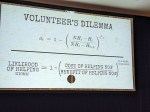
 Clayton Cheever from Norwood, MA and Allyson Malik from Oak Bluffs, MA, presented The Revolution Will Not Be Alphabetized: The History & Future of Good Trouble in Libraries.” Although libraries and librarians have not always been on the right side of history, many of us are following the late Representative John R. Lewis’s famous encouragement to get in “good trouble” now. Libraries are that “third space” where all are welcome to come and find resources – whether that means books, connecting with a social worker, or attending a joyful storytime or other event. The presenters introduced “the Volunteer’s Dilemma” (surprising an audience not used to seeing mathematical formulas) that explains how a group can benefit from an individual (or individuals) making a costly sacrifice (think of the old Oregon Trail computer game).
  After running through a toolkit (Communication, Services, Collection, Programs, Policies, Technology), the audience received scenarios to consider in small groups and report back. See also: The Library Freedom Project.
“Keeping the People Fed: Food Bank and Library Partnerships Across New England” brought together librarians and food bank employees from Massachusetts, Connecticut, and Rhode Island to discuss different partnerships and initiatives. Because the federal government is no longer collecting and sharing data on food insecurity, Feeding America is the current best resource for this type of information. And due to the ongoing government shutdown, November SNAP benefits are threatened, putting an overwhelming strain on food banks; “SNAP is the first line of defense, food banks are second” (and lots of people rely on both).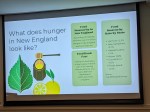
Caitlin Kelley, Montague (MA) library director, talked about how she and her staff grew one shelf into a larger food pantry, including a refrigerator and chest freezer, in their small branch library. “This expansion was only possible with collaboration” with the Western Mass Food Bank, local organization Heartwings, a Community Development block grant, a United Way grant, and a grant from ARSL. “By working together we’re able to enhance our offerings” – and see benefits like a 26% increase in visits to the branch, increased partnerships, a changed perception about what libraries do/are, and more full bellies in the community.
 Finally, Pioneer Valley Performing Arts (PVPA) librarian Austin Clark and I presented on “Patron-Inspired Programs,” including different ways of communicating with patrons/students and trying out the programs they seem interested in. Sherborn librarian Quincy Knapp contributed slides as well (thanks, Quincy!) when our third panelist had to drop out a few weeks before the conference. Our slides are here.
 Jenny Arch