NESCBWI25: Hope is the thing with feathers

NESCBWI conference logoThe New England Society of Children’s Book Writers & Illustrators (NESCBWI) spring conference was last weekend in Stamford, and it felt much like a library conference…possibly because every other attendee I met was either a teacher, librarian, or a teacher-librarian. I took a mere 14 pages of notes, which I’ll try to condense to key takeaways here. But first, I’m grateful to the organizers (almost all volunteers), presenters, panelists, and other attendees for creating an opportunity to come together to share a love of children’s literature and art, offering encouragement as well as actionable advice, and reaffirming our mission to tell and share all stories, for all kids.

From Rajani LaRocca’s morning keynoteCover image of Red White and Whole
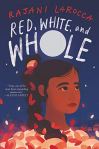
In which there was extensive, and justified, quoting of Madeleine L’Engle:

  • Everyone deserves to see themselves in books, and everyone deserves to read about people who are not exactly like them – and learn how much we have in common. “Stories make us more alive, more human, more loving.” –Madeleine L’Engle
  • Rajani’s hopes for her stories: None of us is just one thing. History doesn’t define us but it should inform us. Create communities where everyone belongs.
  • Children are not pre-human, they are pre-adult. “The great thing about getting older is that you don’t lose all the other ages you’ve been.” -Madeleine L’Engle
  • We write, even fiction, to tell the truth. Write the stories that matter to you, because if they matter to you, they matter to us all.
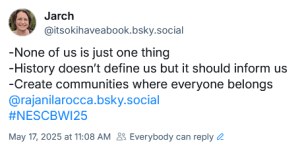
screencap of bluesky quoting Rajani LaRocca

“Heartbeat and Pacing of Picture Books” with Deborah Freedman
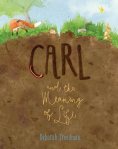
Cover image of Carl and the Meaning of LifeDeborah Freedman is an author/illustrator with a background in art and architecture; she also gave the closing keynote. She has written and illustrated many books, including Carl and the Meaning of Life.

  • Deborah showed storyboards of her own picture books, with thumbnail sketches. “It’s easy to trick ourselves into thinking something’s more finished than it is – don’t get too tight too early.”
  • She showed many examples, including: Where the Wild Things Are* by Maurice Sendak (for its brilliant pacing and “meaty middle”), Wave by Suzy Lee (for its brilliant use of the gutter), Giant Squid by Candace Fleming and Eric Rohmann (for structure that reflects the story), Again! by Emily Gravett (for its pacing and humor), Uptown by Bryan Collier (for its call-and-response).
  • She talked about page turns as they relate to pacing (“Each page is like an open question or incomplete thought…you have to turn the page to find out the answer”). “The gutter acts as a comma, page turn acts like a giant comma.”
  • “Detail can slow a story down – use it intentionally.”

*In their newsletter “Looking at Picture Books,” Jon Klassen and Mac Barnett dissected Where the Wild Things Are. Even if you know this book very, very well, you will likely notice something new.

“Words That Float: Writing the Novel in Verse” with Rajani LaRoccaCover image of Mirror to Mirror
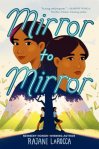
  • Verse novels, like picture books, can tackle difficult subjects in a way that is accessible rather than overwhelming. There is more space on the page, more space in the mind and heart of the reader to process what’s going on.
  • Verse novels are best suited to stories that are character-driven, with interiority, emotion, told in close first person, present tense, not plot-heavy; the focus is on the interior journey rather than a complicated plot (but you DO have to have a plot). Character is the heart of a verse novel; the most important transformation is emotional.
  • Find the kind of poetry that fits your character and what they’re trying to say. If you have multiple characters, each might use a different type of poetry. Voice is inherently tied to character.
  • Repeat things at the beginning, middle, and end of the book. The meaning changes because your character has changed. You want the ending to reflect the beginning. A “keystone poem,” often written early on, encompasses the theme, important symbol, or central conflict of the story; it’s the “hub” or center of the wheel from which all the “spokes” emerge.
  • Tell the truth: “We read fiction because we want to know the truth about people.”
  • Linda Sue Park’s advice on repetition: If something isn’t mentioned in the first half of the book, don’t use it in the second half.
  • Examples of excellent verse novels: Blood Water Paint by Joy McCullough, The Poet X by Elizabeth Acevedo, The Last Fifth Grade of Emerson Elementary by Laura Shovan, Unsettled by Reem Faruqi, Garvey’s Choice by Nikki Grimes
  • Recommended podcast: Day Brain vs. Night Brain
  • There was so much more packed into this presentation! These are merely a few mushrooms from the mycorrhizal network (see how I didn’t say “tip of the iceberg”? Use original metaphors! Although “mycorrhizal” is maybe not the most poetic.)

facade of Stamford Public Library (Ferguson)After lunch, I walked over to Stamford’s Public Library. It is amazing!
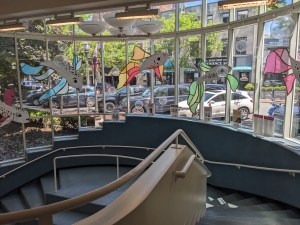
Ferguson interior stairwell and windows

Editor panel, moderated by Pam Vaughan

Editors Jessica Anderson (Christy Ottaviano/LBYR), Julie Blivens (Charlesbridge), Alexandra (Alex) Hinrichs (Islandport), Sasha Illingworth (LBYR), and Matt Phipps (GP Putnam’s Sons/PYR) answered a series of questions about the publishing industry today.

  • Challenges in the industry? One person is often doing the work of multiple people, which slows things down (and publishing is already kind of a slow business).
  • R&R? If an editor asks for a Revise & Resubmit, do it!! But take your time with it – they don’t need it back right away. They want to see that you’ve listened and put the work in.
  • Acquiring? Editors have different communication styles – as do authors. Phone calls, video calls, email, texting, or some of each.
  • What’s in a rejection? “Not right for our list” means it doesn’t fit the profile of what they know they’re good at selling. “It just didn’t come together for me” means it’s not there yet – go back to your critique group. “I don’t have a vision for this” may mean they can see problems but not solutions, or that they’re not the right “campaign manager” for this author/book. You want someone who can be a strong advocate for you and your work.
  • Current MSWL? Editors talked about their current Manuscript Wish Lists. “Finding the right editor for the right illustrator is like matchmaking.”
  • Common mistakes in submissions? Not researching the publishing house. Not including an attachment. Not specifying a category/age range (e.g. middle grade fantasy, 8-12). Not embedding art (for illustrators).
  • Hopeful signs in children’s publishing? Everyone feels passionately about children’s literacy. Children’s literature is inherently hopeful. More independent bookstores are opening up, more small presses. “We are each other’s community.”

Story Studio with Christy Yaros

  • This lightning-fast workshop could have easily taken a whole day, if not a week! (Christy did offer another workshop earlier in the day.) In this one, the focus was on the theme: What is your book trying to say, and how do you weave it in so it doesn’t feel forced? At each step, we did a quick writing exercise answering the guiding questions.
    • Step 1: What emotional or philosophical truth sits at the heart of your story? What does your protagonist learn by the end? What belief does your story affirm, challenge, or complicate? What question about life does your story explore?
    • Step 2: Theme lives in the tension between what your character wants and what they need. Fill in the blanks: At the beginning, my character believes __ (linked to what they want). By the end, they understand __ (linked to what they need). This shows that __ (they have gone on this emotional journey, your theme in action).
    • Step 3: Relationships that reinforce or resist: Which characters help your theme shine? Which ones challenge or contradict it? Presenting alternate interpretations of the theme gives the reader choices, rather than telling them what to believe. We’re giving kids a framework for how to look at stuff.
    • Step 4: Emotional moments that bring theme to life: Look for moments where your character’s belief is tested – and something hurts but teaches.
  • Think of theme as what your character needs; plot is what they want; and the arc is where want and need come up against each other.
  • Christy recommended the book Craft in the Real World (2021) by Matthew Salesses

“Bookends: Beginnings & Endings in Picture Books” with Pam VaughanCover image of Tenacious Won't Give Up
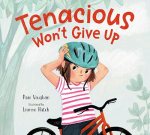
  • There were many practical takeaways from this workshop, and lots of examples. Pam contacted other authors and asked them for early drafts of the first and last sentences of their published books, so we could compare and see how they’d changed from the early versions to the final ones.
  • Five Cs (character, curiosity, conflict, connection, care) and the W effect – the attitude of your book (wonder why / wow! / wait, what? weird / word choice / witty / whisk you away).
  • Sometimes your beginning hints, winks, links, nods, and/or leads to your ending.
  • In a picture book, conflict can be a subtle thing, it doesn’t have to be a fight.
  • Story structure may be circular, cumulative, conceptual, classic, list, pattern, dialogue, quest, mirror, interactive.
  • Your beginning: Cut for clarity? Add for context? Hint at your ending? Hone your voice? Toy with your word choice?
  • Endings are powerful. How do you want to leave your reader feeling? “Oohs” and “Ahhs” (Aha! Haha! Hmm…, Ahh…, Aww)
  • Tips for beginnings and endings: Try writing 10-20 first/last sentences. Read them out loud. Cut as many words as you can (but use as many words as you need). How many five Cs can you include? Can you amp up the W effect? Connect your beginning to your ending (and your ending to your beginning).
  • Recommended text: The Heroine’s Journey (2020) by Gail Carriger

Agent Panel: Marissa Brown, Chrisy Ewers, Amy Thrall Flynn, Stephen Fraser, Carter Hasegawa, Rachel Orr, Sera Rivers

  • What does an agent do? Agents wear many hats! Matchmaker (between author and editor), unlicensed therapist, unlicensed financial advisor (chasing down royalty payments), looking for new talent (those R&Rs are unpaid – agents don’t get paid until they sell a book), negotiator (between author and publishing house), strategize and advocate for an author’s career.
  • Advice for after an author signs with an agent? There is a lot of waiting – be writing while you’re waiting! Publishing is a small world; be someone people want to work with (courteous, punctual, nothing hideous on social media, etc.). Reputations matter.
  • When you offer representation, what questions do you want authors to ask you? Remember it is a mutual interview. What kind of working relationship do you want? What kind of feedback do you want, and how much? What’s your communication style? “Any agent is not the right agent.” Show that you’ve done your research.
  •  Pet peeve or “pet fave”? Didactic stories (peeve). Getting to call an agent with an offer (fave). Thoughtful revisions that show the author listened to your advice (fave).  “Always look for: why would a child want to read this? How does it connect with your audience? Your mission as a creator of books for children, you have to be thinking about who the book is for. We need to respect children and understand their world.” -Amy
  • One hopeful thing about the industry? Books are inherently hopeful. It’s an evergreen industry – children are born every day and they need stories and books. “We’re gonna win. Hope always wins.” -Sera

After the panel, authors and illustrators were encouraged to join a critique group (find NESCBWI critique groups here). Everyone went home Saturday with lots to think about!meme of Dwight Schrute from The Office, Assistant to the Regional Manager
On Sunday, we met the NESCBWI regional team. (With apologies to these incredibly dedicated and hardworking volunteers, every time someone said “assistant regional advisor,” I thought “assistant TO the regional advisor.) Next, the Crystal Kite Awards were presented to Liz Goulet Dubois, Winsome Bingham, Abi Cushman, and Federico Erebia.

Winsome Bingham said (among other things):Cover image of The Walk
  • “If stories weren’t powerful, they wouldn’t be banning books.”
  • “There are so many different ways to tell a story.”
  • “We all like what we like…write what your heart tells you to write.”
  • All it takes is one person. “If you send your stuff out and no one gets it…keep writing.”
  • “Rejection is a good thing…if you don’t send your stuff out, they don’t know what you can do.”
  • “You have to believe there’s a reason you’re doing this. It’s not gonna pay off overnight, it’s a slow game.”

Federico Erebia said:Cover image of Pedro & Daniel
  • “It’s okay to be different, it’s okay to write different. There are many ways to tell stories.”
  • You realize at some point that you’re not just speaking up for yourself, you’re speaking up for a community – you may not even realize it’s your community.
  • I have been an activist for 45 years…”I have never been this afraid of America, in America, for America.”
  • “We have the power of the pen. We have our voices. Together we can effect change.”
  • “It may one day be too late to be on the right side of history.”

Abi Cushman said:Cover image of Wombats Are Pretty Weird
  • People don’t always get what you’re trying to do…[but also] sometimes your best just isn’t where it needs to be…and you just don’t know.”
  • Yes, this industry is tough, and yes, you’re going to get a lot of rejections. Keep writing the stories you’re passionate about in the way that you want to write them.

Deborah Freedman closing keynote
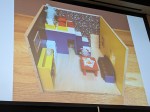
Mouse house modelRemember a thousand words ago when I said Deborah Freedman was going to come up again? Here she is! She gave a beautiful closing keynote with visuals of her beautiful art (and architectural models, including a little mouse house). Here are a few takeaways from her talk:

  • A well-written text trusts illustrators; a good book trusts readers.
  • What is the emotional heart of the book? What is the real conflict and resolution? It’s funny how long it can take and how hard it can be to figure out “what’s it about?”
  • The stories are made up, but the feelings are true.
  • How are we going to get through this world we’re in right now without connecting with each other?
  • A picture book might be a child’s first exposure to art and poetry.
  • We have to expand our own understanding of the world if we want to expand children’s understanding. When we explore what it means to be human we become better creators and maybe even better humans.

And that’s a wrap on NESCBWI25. I’m glad I went. I met lots of other writers and writer/illustrators and we exchanged contact information so we can critique and cheerlead and maybe see each other next year.

I’m grateful to my friend who hosted me during the weekend, and as a thanks for those who read this all the way to the end, here are some photos of her puppy:


Beagle puppy and ladybug toyBeagle puppy speckled tummy

If you’re still here and you want more SCBWI content, my blog posts from the Winter 2021 conference are here and here. Happy writing, and happy reading!
Picture books: lodged in the heart

Toward the end of the picture book panel at the SBCWI winter conference, Sarah Baker said, “We all have special books in our lives that we keep coming back to over and over again.” She asked the panelists (Joanna Cárdenas, Elizabeth Bicknell, and Andrea Welch) to talk about “a classic book for you – what is it about that book that has that magic for you, what makes it exciting and important and lasting?”

They mentioned enduring classics (The Snowy Day by Ezra Jack Keats, The House in the Night by Susan Marie Swanson and Beth Krommes) and more obscure titles (Sara & Hoppity by Roberta Leigh), as well as contemporary books (the upcoming Watercress by Andrea Wang and Jason Chin). Of course, it got me thinking: what childhood books did I bring with me into adulthood and parenthood? What new books have become “important and lasting” to me in the past five years?

Usually when I am putting together a book list, I have a hard time keeping it short, but this time, it wasn’t that hard to narrow it down.

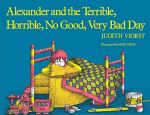
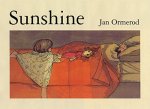
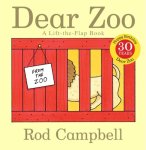
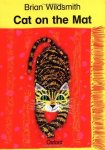
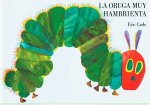
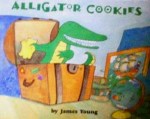
From childhood, the picture books I remember best are Where the Wild Things Are by Maurice Sendak, The Very Hungry Caterpillar by Eric Carle, Dear Zoo by Rod Campbell, Sunshine by Jan Ormerod, The Cat On the Mat by Brian Wildsmith, Alexander and the Terrible, Horrible, No Good, Very Bad Day by Judith Viorst, Millions of Cats by Wanda Gag, and Alligator Cookies by James Young (I have yet to meet someone else who has even heard of that last one, but all the others are pretty well-known).

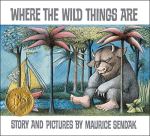
What makes these books memorable? For some, it’s the ubiquity: just try working as a children’s librarian and not encountering Dear Zoo, The Very Hungry Caterpillar, or Wild Things.  As a librarian, I’ve gained a new appreciation for these three. Caterpillar is endlessly appealing: it’s a counting book, a days of the week book, an animal and food book, a book about transformation. Dear Zoo has the lift-the-flap element, animals, and a happy ending. And Where the Wild Things Are – people have probably written entire theses on Wild Things, but what I think of now – thanks to Megan Dowd Lambert – is the air frames around the illustrations on the initial pages, and how the illustrations become full-bleed as the story progresses. The pictures quite literally expand as Max’s imagination takes over the story, before he returns to his “very own room.”

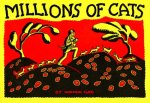
Millions of Cats is perhaps not as universally well-known as those three, but it has that lovely repeated refrain (“hundreds of cats, thousands of cats, millions and billions and trillions of cats”), it has a landscape format perfectly suited to the old man’s journey, and it has unique black and white art. The slightly smaller-than-average trim size makes it feel intimate, as well. Likewise, Sunshine by Jan Ormerod, a wordless picture book, is suffused with warmth; it’s an intimate look at a family’s morning routine, which felt familiar (all families have routines) and different at once.

Cat on the Mat rhymes and has a great moment of drama, resulting in an ending that mirrors the beginning – a lovely symmetry that even very young children can appreciate. Alligator Cookies also rhymes, has a fun hide-and-seek element, and – for my money – is a far better rainy-day book than The Cat in the Hat. Plus, there’s a recipe! I remember making “alligator cookies” as a kid (peanut butter, corn flakes, and green food coloring: “you don’t have to bake them, you just have to eat them!”).

Alexander and the Terrible, Horrible, No Good, Very Bad Day by Judith Viorst and Ray Cruz is a classic for a reason. There’s the distinctive art, with its detailed cross-hatching and Alexander’s grumpy expression, but even more, there’s the universal experience of having the kind of bad day where so many little things pile up on you that you think about moving to Australia. The final revelation (“Some days are like that. Even in Australia”) underscores the universality of bad days – and the hope that tomorrow will be different.

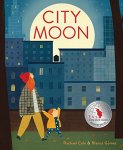
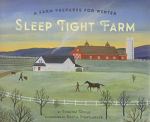
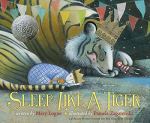
What picture books have burrowed into my heart since these? Naturally, a few of them are bedtime books: City Moon by Rachael Cole and Blanca Gomez, Sleep Tight Farm by Eugenie Doyle and Becca Stadtlander, Sleep Like A Tiger by Mary Logue and Pamela Zagarenski. Each of these takes a different angle on easing into rest: in City Moon, a mother and young son take a walk through a city, looking for the moon before bedtime. In Sleep Tight Farm, a whole family works together to “put the farm to bed” before winter. In Sleep Like A Tiger, a girl insists she’s not sleepy, and her parents say she doesn’t need to go to sleep, but she does need to put on her pajamas, brush her teeth, and get under the covers. Once there, the girl asks if all animals sleep, and comes up with her own example. (Zagarenski’s magical illustrations are what tip this book into “favorite” status for me; she wrote and illustrated Henry and Leo as well, another close-to-my-heart book.)

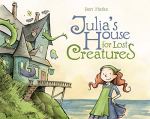
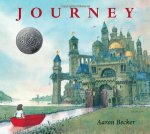
Nearly all of the other books have an element of fantasy, starting with Ben Hatke’s Julia’s House for Lost Creatures and Aaron Becker’s Journey trilogy (Journey, Quest, and Return). The art styles are completely different: Hatke also creates graphic novels, and that style carries over to his picture books, which mix comics frames and full-bleed art. Julia as a character is so expressive and independent; she’s welcoming and nurturing, but she has boundaries as well and isn’t afraid to enforce them. Her world is full of the fantastic, but she brings order to it (and tea and toast). Becker’s art…I would like to live inside Becker’s art. As in the best wordless picture books, I notice something new every time I read them, every journey the nameless protagonist takes (first alone, then with a friend, and finally with her father). The girl is lonely, loyal, brave, creative, and quick; she enters easily into a magical world through a door she draws herself (a la Harold and the Purple Crayon).

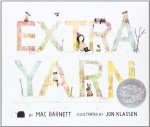
Extra Yarn by Mac Barnett and Jon Klassen fits under the fantasy umbrella as well: Annabelle finds a box full of yarn of every color, and no matter how much she knits, there is always extra yarn. “Things began to change in that little town,” but Annabelle’s yarn is stolen by a greedy archduke – who finds the box empty when he opens it. He throws it out the window, and it floats on an ice floe back to Annabelle. Extra Yarn has moral justice, humor, and Annabelle’s creativity and generosity, as well as a poetic, repeated turn of phrase: “But it turned out, [she/it/there] was.”

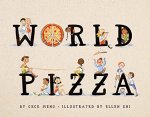
World Pizza by Cece Meng and Ellen Shi involves a wish come true, in a roundabout way: on a hilltop with her family, a mother makes a wish for world peace, but she sneezes in the middle of her wish, and gets world pizza instead. Pizza rains down all over the world, with all kinds of unique toppings; everyone eats until “their bellies were full and everyone was happy.” In a coda at the end, one of the children says he’s sorry Mama didn’t get her wish. “Next time,” she replies with a smile.

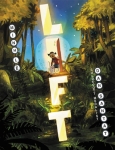
Lift by Minh Lê and Dan Santat nods to portal magic like Journey: older sister Iris takes an old elevator button out of the trash and sticks it on the wall next to her closet door. Ding! The button lights up, and Iris opens the door to a new somewhere else each time: jungle, international space station, snowy mountain summit. At first, Iris wants to escape her little brother, but it’s his cries that bring her back, and ultimately, she realizes that she wants him with her on her next adventure. Lift has a timeless feel, but, published in the summer of 2020, its core message (“After all, everyone can use a lift sometimes”) felt so needed. (There’s also the subtle wordplay of “lift” as both noun and verb, though we usually say “elevator” in the U.S.)

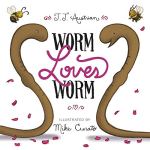
Worm Loves Worm by J.J. Austrian and Mike Curato uses animal characters to illuminate the absurdity of fixed gender roles, and to show that we don’t need to do things a certain way just because “That’s how it’s always been done.” Curato’s absolutely charming Worms (not to mention Cricket, Beetle, the Bees, and Spider) are all the argument anyone needs that love is more important than traditions; love shines in this kind, gentle book, with touches of humor throughout.

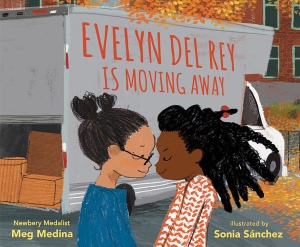
Cover of Evelyn Del Rey is Moving AwayLastly, Evelyn Del Rey Is Moving Away by Meg Medina and Sonia Sanchez centers around the heartbreaking and very real experience of having a best friend move away. On the very first spread, narrator Daniela tells the reader that her “mejor amiga, my número uno best friend” has invited her over to play, “Just like today is any other day.” From that sentence, the reader knows it’s not like any other day – today is different. The girls play while the last boxes are packed and loaded, even “Evelyn’s mirror with the stickers around the edge” (that detail!). At last, all that’s left is to say goodbye: “Evelyn Del Rey is moving away. So she won’t be right here anymore.” (Just try to read this book without tearing up. I cannot do it.) However, the story ends on a note of hope: the final page shows a grown-up Daniela, reading a letter from Evelyn, because these “número uno amigas” stayed in touch.

There are, of course, many more picture books that I love, that make me laugh, that teach a lesson gently, that amaze me with their art and creativity, that I love to share aloud with kids, but these ones are especially special. As Liz Bicknell of Candlewick said about her own list, this group might seem eclectic, but I’ve tried to pinpoint exactly what it is I love about each one. What are your favorite picture books?

SCBWI Winter Conference follow-up

Because I am not in possession of a Time Turner like Hermione, I couldn’t attend all of the sessions of SCBWI during the weekend, but fortunately – yet another silver lining of virtual conferences! – the recordings of all of the sessions are available to attendees for the next month. Here are my notes on the three keynotes and panels that I didn’t cover last weekend (and here are my notes on the sessions I attended last weekend).

Genre Breakout Sessions: Two Editors Discuss What’s Hot, What’s Not, What They’re Acquiring and the Rules of the Road . Picture Books: Elizabeth (Liz) Bicknell (editorial director at Candlewick), Joanna Cárdenas (senior editor at Kokila, imprint of Penguin Young Readers) and Andrea Welch (executive editor at Beach Lane Books, S&S)

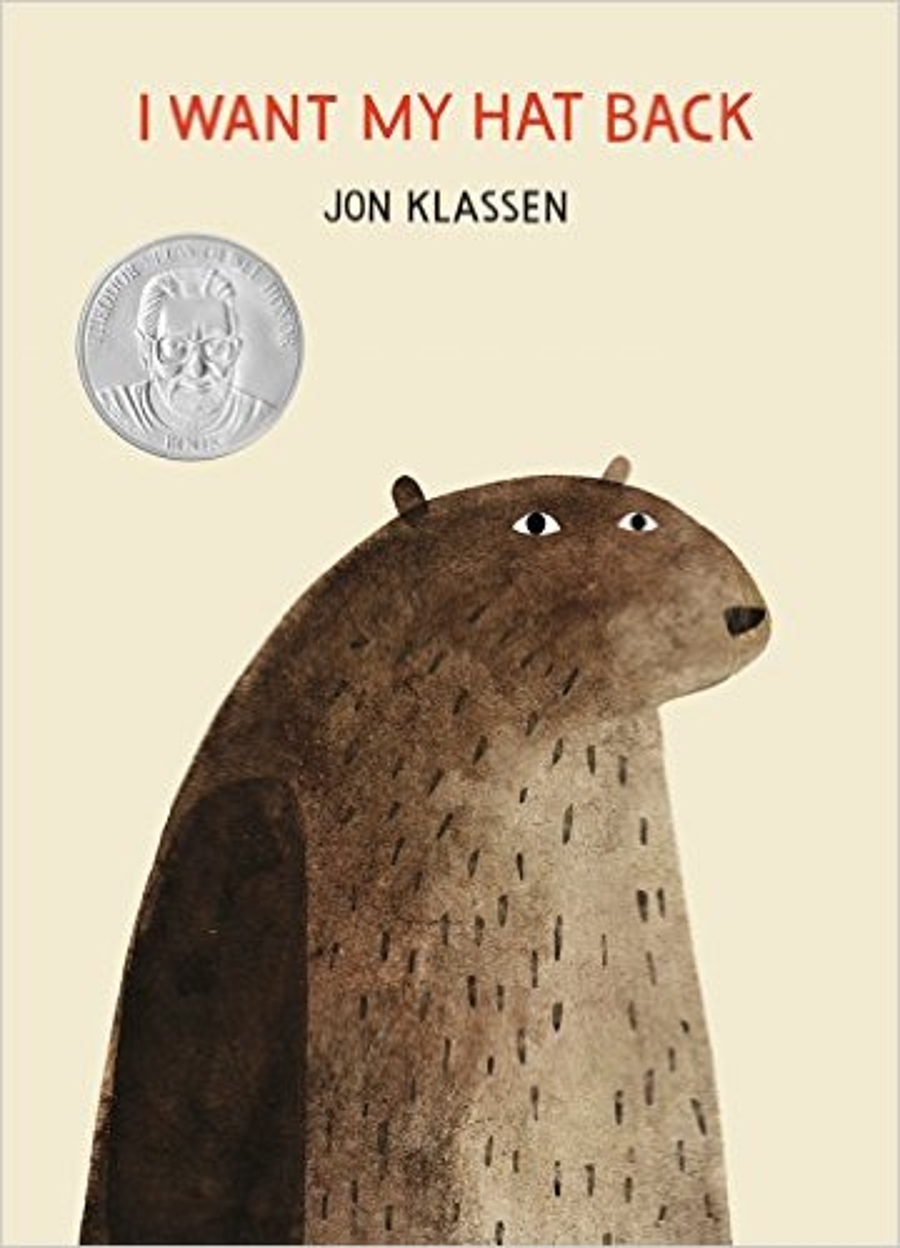
I Want My Hat Back

  • Liz Bicknell is drawn to stories about (in)justice, nature, and stories that show human foibles in a humorous way. “In all of these subject areas, I hope that the storytelling and the art will be compelling and arresting so that the underlying messages will be absorbed…I hope that readers will grow up to love the world and to embrace all those who inhabit it.”
    • Fun fact: Liz said that she was the only editor who didn’t want to change the ending of Jon Klassen’s I Want My Hat Back, which she acquired for Candlewick. Can you imagine it with a different ending?! And that is why you need the right editor for the right book.
  • Joanna Cárdenas said that Kokila’s mission is “centering stories from the margins” to “more accurately reflect the world that we live in and we add depth to the way that readers see the world and their place in it.” They publish “Books that make an impact…Books for children and teens across genres and formats… [Books that] entertain and inspire. [Books that] push against harmful, entrenched narratives.”
  • Andrea Welch is looking for books that “help children of all backgrounds see the world in new and exciting ways.” She said, “When I’m reading new projects, I always pay attention to my gut reaction primarily.” She asks, Am I intrigued by a story or a concept or a topic? Does the manuscript feel different or unusual in some way? Does the writing/voice capture me? Do I find myself wanting to read the story aloud? Do I feel excited to sit down and share the work with a child? Are artist/illustration possibilities popping into my head? Then, does market/audience exist for this book? Can I get the rest of my team excited about it?
  • Andrea said that in her role as an editor, “Those conversations [with author/illustrators] move a project forward. I have a vision for each book, but ultimately my job as an editor is to help author/illustrator tell the story they set out to tell in the most impactful way.”
  • Joanna said, “Great picture books are entire worlds captured in 32 or 40 pages…really good picture books help a young reader orient themselves in space…and in time.”
  • Joanna also said that rather than try to identify or follow trends (it takes so long to make a picture book that trends aren’t as much of a thing in that format), “What is helpful is for creators to read current picture books. Read every year things that are coming out… Be aware of what’s coming out, who are your contemporaries… Understand how your work might fit somewhere in there. Read, read, read, read, read.”
  • For illustrators, Joanna is looking for someone who can tell a whole story in one picture. “Something that makes me ask questions not because I’m confused but because I’m intrigued.”
  • For authors, Andrea is looking for that feeling of “the author has taken my hand and led me into the story, the story is executed in such a way that I’m on board and in from the beginning.” It can be a strong voice, an unusual topic – that feeling of being swept up by a manuscript. What doesn’t work is “when I feel like I’m just dropped into action right away,” there’s dialogue between characters I don’t know yet. “I like to be led and not just thrown in.”
  • Joanna’s advice: “Creating stories for young readers is a huge responsibility. Picture books are an introduction to the world, to interpersonal relationships, and how things work.”
  • Liz’s advice for writers: “Take some picture books that you really admire and reverse-engineer them – type up the text of that picture book.” You’ll get a sense of length, pacing, page turns, and what illustration brings to the story that isn’t in the text.

Keynote Address: Looking Back to Move Forward, Tami Charles

  • “Life is like an arrow: sometimes you get pulled back only to get launched into something beautiful.” (Quote unattributed)Tami Charles author photo
  • Growing up, “I never really saw myself, my friends, or my community” reflected in literature. Now, we have Jacqueline Woodson, Carole Boston Weatherford, Meg Medina, and many more – “I would have loved to have had their books as a child….REPRESENTATION IS EVERYTHING….I wanted to add my voice.”
  • Over the years, “My writing grew stronger, and my rejections grew nicer.”
  • “The word ‘no’ has empowered me, broken me, and put me back together again. The word ‘no’ holds power, but on the flip side, the word ‘yes’ holds beauty. And somewhere in the middle of that, there exists hope. And it’s that hope that keeps us going…”
  • “Collectively, this work that we do is bigger than us.”
  • “Celebrate the yeses, learn from the nos. Allow them both to launch you…”
  • Re: writer’s block after rejection: “There’s a beauty in pausing. If you’re not writing, there’s a reason for that. And the reason is probably that you need to be reading, you need to be studying.” Especially read the genre that you want to write in. “I write as widely as I read. And I read a lot.”
  • “Don’t give up on the stories that you shelve.” May be wrong format or wrong time.
  • “In this journey…success is going to look different….Your path is your own. Don’t look at what someone else is doing to compare how you’re doing in your own journey.”

Mock Acquisition Meeting: Wendy Loggia and Delacorte Publishing Team

Delacorte is an imprint of Random House Children’s, with a focus on MG and YA fiction (“where commercial + literary intersect”). There are nine members on the Delacorte editorial team; four of them, including Wendy Loggia, were on the panel (Hannah Hill, associate editor; Ali Romig, editorial assistant; and Lydia Gregovic, editorial assistant), along with Kelly McGauleyfrom marketing, Adrienne Weintraub from school and library marketing, Jillian Vandall from publicity, and Kim Wrubel from subsidiary (sub) rights. Delacorte is invested in their authors in the long term; “we’re acquiring authors, not books.” Looking for books that reflect our (editors’) personal taste and that have hungry readers in the marketplace. Wendy said, “Every acquisition is unique” – editors discuss, and loop in other departments as necessary. In this mock meeting, they discussed five titles, and revealed whether they acquired them or not, and why. It was a fascinating fly-on-the-wall experience, hearing about appeal factors and other considerations, like summer reading, audiobook rights, school library and classroom potential, and the Scholastic book fair.

  • Reasons to say YES to a manuscript: authentic emotions, relatable, discussion-worthy themes, strong commercial voice, good hook(s), fresh, emotionally resonant, standout quality/breakout potential.
  • Reasons to say YES to an author: positive, clear communicator, engaged in their community, familiar with genre tropes, flexible and open to change, social media presence.
  • Reasons to say NO to an author/manuscript: not strong or unique enough, a glut of that type of book in the marketplace, point of sale (POS) numbers on previous similar titles not encouraging; if the author had an opportunity to revise and the revision isn’t as strong as the editors had hoped. (It’s hard to break someone out if they’re writing the same kind of book for a different publisher; “Maybe consider writing something completely different and give yourself a fresh start.”) If an editor decides not to make an offer, in most cases, “We give feedback to the agent/author, information about what worked for us and what didn’t.”

Did you attend SCBWI Winter Conference? What were your most important takeaways?

SCBWI Winter Conference

The Society of Children’s Book Writers and Illustrators (SCBWI) is usually held in New York, but this year, of course, it’s virtual. Ordinarily, there are about 1,000 attendees, but the online format hosted 4,000 attendees – many of whom were illustrators who contributed to the Virtual Portfolio Showcase, which is full of incredible art! (Not sure how long that link will be live.)

This is my first time attending (#SCBWIBIRD, per Jolie Stekly) and in many ways it’s similar to the many library conferences I’ve attended (except: there were ASL interpreters and closed captioning in every session!). The Golden Kite awards were Friday night, and the weekend was packed with sessions from 11:30am through the evening (EST). In a few time slots there were multiple choices for sessions, but all of them were recorded and will be available to conference attendees through March; I plan to catch up on those I missed over the next week, but in the meantime, here are some quotes and takeaways. (Note: I use quotation marks when I’m pretty certain I’ve got the exact quote. If there are no quotation marks, it’s close to the actual words used, but not exact.)

#NY21SCBWI badgeFriday, February 19

Orientation for first-time conference attendees: Jolie Stekly

  • “This is an industry full of turtles.” Slow & steady.
  • “If you’re able to be yourself, you have no competition. All you have to do is get closer and closer to the essence.” (Quote unattributed)

Golden Kite Awards Presentation & Gala

Saturday, February 20

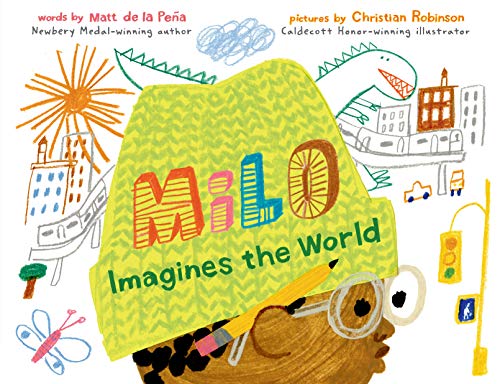
Keynote Conversation: Matt de la Peña and Christian Robinson, The Picture Book as a Perfect Marriage Between Author and Illustrator

  • Matt read their new picture book, Milo Imagines the World. “Maybe you can’t really know anyone just by looking at their face.”MiloImaginesTheWorld
  • “I try to enter every picture book through [children’s] point of view…. What is it like if you don’t have all the information and the only thing you can really read is the adults?” (Matt)
  • “I don’t think good writers go into a story with a message…but I do think good writers go into a story with a point of view.” (Matt)
  • “I’m curious, how many wizards do you have at your school?”(Matt, pushing white teachers/librarians to make sure all book collections are diverse)
  • “Drawing and making pictures was my way of making space for myself.” (Christian)
  • “Talent can get you a job but character can help you keep it.” (Christian)
  • “Play well with others…. You have to make compromises and you have to trust that everyone has the same goal in mind – to make the best book possible and get it to the most readers possible.” (Christian)
  • “Authors of picture books have two jobs: you have to get the story right and you have to get the music right.” (Matt)
  • “A true collaboration is putting your collaborator in the best position to succeed.” (Matt)

State of the Industry Keynote: The Hard Questions and the Truthful Answers: Jean Feiwel with Lin Oliver

  • Jean Feiwel on adapting to the culture of each company she worked for: What do they want from me, and what can I accomplish for them?
  • On combining fiction and science in the Magic School Bus series: My answer to people who say “you can’t do that” is “of course it wasn’t the way it was done, but I did it anyway.”
  • Children are humans with information needs. “Rather than keep content away from kids, I think it’s important to expose them to many different types of books.” Adults should be “not gatekeepers, but ambassadors.”
  • “The market is crying out for diversity and expansion… The real growth and opportunity is in doing NOT what you did last year…but to change the landscape.” If publishers have a limited perspective, they’ll have a limited list.
  • Children today don’t have the prejudice against pictures anymore. Artists are incredibly varied and sophisticated. Illustrations add to the story. “Those boundaries don’t truly exist.”
  • Creators (authors, illustrators) should “be in the world,” be on social media, be well-read.

Behind the Scenes at a New York Publishing House: An Insider’s Tour of Simon & Schuster Books for Young Readers with Laurent Linn, Katrina Groover, Chava Wolin, and Paula Wiseman

Diagram of a book's circle of life

  • Art Director Laurent Linn’s “circle of life of a book” graphic (right)
  • Publisher and Editor Paula Wiseman offered an analogy: “the editors are the beads and the publisher is the chain”
  • “Backlist is frontlist to those who haven’t read it.” Paula Wiseman pointed out that children’s literature gains new readers every few years.
  • Laurent Linn described Katrina Groover, Managing Editorial Director, as both an air traffic controller and orchestra conductor. In her words: “What I am responsible for is meeting deadlines.”

Genre Breakout Sessions: Two Editors Discuss What’s Hot, What’s Not, What They’re Acquiring and the Rules of the Road 

  • I watched the middle grade session with Tricia Lin (Random House) and Krista Vitola (S&S), but plan to watch the picture book session with Elizabeth Bicknell, Joanna Cardenas, and Andrea Welch ASAP!
  • “Editorial opinions vary. If we don’t fall in love with a voice, it doesn’t mean another editor won’t fall in love with that voice.” (Krista)
  • You’re always going to write more than what ends up in the finished publication. “You still [need] to write those pages, because they’re gonna help you later in the story.” (Krista)
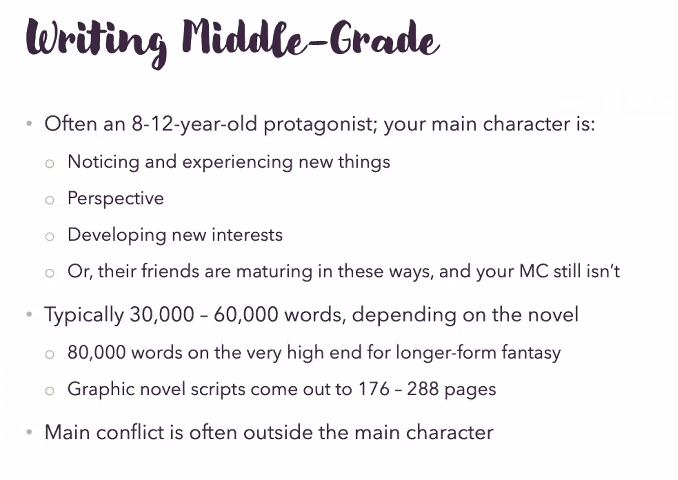
  • Series is the bread-and-butter of middle grade. Character driven, concept driven. (Krista)Screen shot of Writing Middle Grade slide
  • “A second pair of eyes is always super important. Someone not as close to your project as you are can really bring fresh eyes, things you would never be able to catch on your own. We get second readers all the time on our end…. Open yourself up to that feedback. Receive it with an open mind.” (Tricia)
  • There’s this idea of success in publishing…it’s important to keep in mind is that everything is subjective – what you choose to write, what I choose to acquire, what the customer is going to buy…every step of the way, it’s so subjective. You’re here, and you’re writing. With every idea you brainstorm and every word you write. … We’re trying to reach people, we’re trying to do good. (Tricia)

Keynote Address: Looking Back to Move Forward, Tami Charles (I was zoomed out and needed a break, I will watch this one ASAP as well. The tweets from her talk were ecstatic!)

Zoom Peer Critique: Picture Book: Despite a few technical difficulties – handled with grace and perseverance by April Powers and Julian Petri – a huge number of us eventually got into breakout groups for a useful critique, employing the “sandwich style” (praise, constructive criticism, praise).

Sunday, February 21

Keynote Conversation: Jerry Craft and Victoria Jamieson, moderated by April Powers

  • “All children need to see all children in their books.” (April)
  • “It’s hard to know which feedback to take and which feedback not to take.” (Victoria)
  • “If I don’t have to put words in a panel, I don’t.” (Jerry)
  • I like to have the pictures say one thing and the words say another…. That’s one of the beauties of graphic novels…that makes it a really sophisticated art form. Kids have to read something visually and in words and put them together. (Victoria)
  • Story arc for picture books: introduce character quickly, then they start having problems; a little denouement at the end.
  • Timeline for making a graphic novel? (1) brainstorming/developing, (2) sketches/writing, (3) final art (Victoria)
  • Every author/illustrator collaborator is different. At one point Victoria wished aloud to “phone a friend” (Shannon Hale and LeUyen Pham), so I found a couple of interviews with them: School Library Journal and Publishers WeeklyScreenshot of story arc

Mock Acquisition Meeting with Wendy Loggia and Delacorte Publishing Team (planning to watch recording)

Mock Book Cover/Book Design Production Meeting with Yaffa Jaskoll and Scholastic Publishing Team (Stephanie Yang, Baily Crawford, Maeve Norton)

  • “There are a lot of opinions to consider and it takes time to make everyone happy.” (Yaffa)
  • On designing a series (e.g. Baby Sitters Club): Each book has to look individual and also look like part of the series (Yaffa)
  • Key takeaways (for illustrators): Keep your social media updated. Reply to email quickly (within 24 hours). Do your research, stay current, keep your work fresh. The conceptual solution is as important as execution; try a few different designs. Find where your style fits naturally and build on that. Be flexible: it can take a bunch of tries to get the art just right. Show variety in your artwork. “You never know what we’re going to gravitate to.”

Real Talk with Four Agents: A Deep Dive Into the Children’s Publishing Business: Kirby Kim (Janklow & Nesbit), Kevin Lewis (EMLA), Erica Rand Silverman (Stimola), Saba Sulaiman (Talcott Notch)

  • “I’ve always felt like I could be a good advocate for others.” (Kirby)
  • “It’s never too early to get engaged in the industry…. You don’t have to wait to have a book published.” (Erica)
  • “Children are really, really receptive to difference… Characters who don’t look like them, think like them. They embrace silliness, absurdity, the unexpected.” (Saba)
  • “You should be encouraged if you’re unpublished, that’s not a bad thing.” (Erica)
    • Or “pre-published,” per Lin Oliver.
  • “You have to care about something, and you have to engage in that thing you care about…. Find that thing that you can do, and do it!” (Kevin)
  • “Go by your compass, not your clock.” (Kirby, quoting Alvina Ling)

Keynote Address: Becky Albertalli and Adam Silvera: Writing for the Contemporary YA Audience, introduced/moderated by Kim Turrisi

  • Something that surprised me as an author…You end up hearing from readers all around the world and you find out that there are people who have something in common with you that you thought you were totally alone in feeling. It’s the most bizarre, surreal, and wonderful experience to have. (Becky)
  • “It’s really hard to keep in mind that our specific experiences can be night and day from other people… There are a lot of people who need a lot of different kinds of stories.” (Becky)
  • To some people it might feel like only marginalized stories are getting attention right now, and it’s like no, we’re gathering steam for sure, but there’s still so much catching up to do…. Not reading widely is doing a disservice to your worldview and your reading experience. (Adam)Screen Shot 2021-02-21 at 5.19.49 PM
  • Writing tips from Adam: I create a list of 10 random things/details about a character to get to know them. Helps get closer to the heart of the character. “All these choices lead to that authenticity.” There’s world-building in a contemporary space as much as there is in a fantasy space.
  • How to create high stakes if the main character is not facing a huge, life-changing problem? “The stakes are how badly your characters want the outcome that they want.” (Becky)
  • Re: social media: Authenticity is so important to me but also really scary…Privacy gets really complicated. It’s part of the job to figure out those boundaries. (Becky)
  • I was not prepared. I wasn’t prepared for being talked about in a public way. There’s a big difference between being a writer and being an author. (Adam)

My Life in Children’s Books: A Rare Appearance by the Legendary Patricia MacLachlan, in Conversation with Lin Oliver

  • “I like books that allow me to enter them, and if there are too many words, I don’t know where I’m going.”
  • A book should speak to all readers: “Something for the adult to hold, and something for the child to grab onto.”
  • Landscape: “It matters where a book takes place, and what’s going on and where it is.” Recognize your landscape: where did you come from, where have you been, where are you going, what is your great sadness and great joy?
  • Children know everything. They’re also very direct. “They believe everything and they want to know everything.”
  • Quoting her father: “The title taps you on the shoulder and the first line takes you by the hand.”
  • “Children matter.” They see everything, they know everything, they don’t always understand it. It’s nice to be able to reach out and touch them, even if it’s to ask them a question, or show them someone else going through what they’re going through. We owe them…quality of attention.

And that’s a wrap! It was a great first SCBWI conference experience, even if it wasn’t in person. (On the plus side: I didn’t have to travel; I got to do yoga stretches, hang out with my kid, and eat snacks between sessions; and I could be in sweatpants the whole time. On the minus side, I actually like meeting people in person.) Overall: pandemic sucks, technology is a good workaround – and made the conference more accessible – children’s books are here to stay, everyone involved in the creation of children’s books is pretty cool.