Finnish Lessons: What Can the World Learn from Educational Change in Finland?

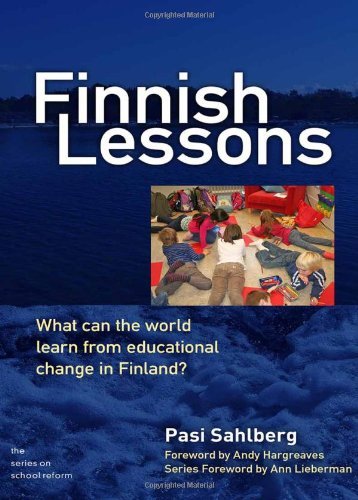
finnishlessonsI first heard about Finnish Lessons: What Can the World Learn from Educational Change in Finland? by Pasi Sahlberg from the review “Schools We Can Envy” by Diane Ravitch in the New York Review of Books (3/8/12), but I didn’t pick it until December 2014. Reading Finnish Lessons was an enlightening experience, and a frustrating one. Enlightening, because Sahlberg shows how Finland developed a shared philosophy, set a goal, and achieved that goal by using evidence-based research; frustrating because the U.S. and many other countries are taking an opposite approach, despite evidence that this approach – competition between schools instead of cooperation, an increase in standardized testing – has been shown not to work.

Underpinning Finland’s steady educational improvement since the 1970s is a set of shared philosophies:

  • All pupils can learn if they are given proper opportunities and support.
  • Understanding of and learning through human diversity is an important educational goal.
  • Schools should function as small-scale democracies.
  • The role of public education must to be educate critical and independent-thinking citizens.

The basis of Finland’s education policy is that instruction is the key element that makes a difference in what students learn in school – not standards, assessment, or alternative instructional programs. To that end, teacher education was overhauled, so that now all teachers in Finland have master’s degrees, and all principals are or have been teachers. Teachers are trusted in society, and have autonomy within their classrooms. This approach has been successful; Sahlberg writes, “What PISA surveys, in general, have revealed is that education policies that are based on the idea of equal educational opportunities and that have brought teachers to the core of educational change have positively impacted the quality of learning outcomes.”

The Finns value equity in education, “a principle that aims at guaranteeing high quality education for all in different places and circumstances.” In practice, this means that Finnish students, no matter where in the country they live, receive an equally high level of instruction and support. And within schools, “ability grouping” (also called tracking or streaming) was stopped in 1985. Instead, teachers pay attention to students who have special educational needs; Sahlberg writes, “The basic idea is that with early recognition of learning difficulties and social and behavioral problems, appropriate professional support can be provided to individuals as early as possible.” So many students receive help at one point or another during their time in school that special education is not stigmatized the way it sometimes is in the U.S.  And, as in medicine, an ounce of prevention is worth a pound of cure.

As I was writing this post, the Library Link of the Day featured the Washington Post article “Requiring kindergarteners to read – as Common Core does – may harm some” by Valerie Strauss (1/13/15). Strauss quotes from the report “Reading in Kindergarten: Little to Gain and Much to Lose” by Nancy Carlsson-Paige, Geralyn Bywater McLaughlin, and Joan Wolfsheimer Almon: “Many children are not developmentally ready to read in kindergarten. In addition, the pressure of implementing the standards leads many kindergarten teachers to resort to inappropriate didactic methods combined with frequent testing. Teacher-led instruction in kindergartens has almost entirely replaced the active, play-based, experiential learning that we know children need from decades of research in cognitive and developmental psychology and neuroscience” (emphasis mine). Why on earth are we developing new standards in the U.S. that aren’t research-based? Why are we, in fact, doing the opposite of what the research indicates we should do? Incidentally, in Finland, school doesn’t start till age 7 – but of course, there are free, high-quality preschools that most children attend before then. (Universal preschool, let alone daycare, being another thing we don’t have here.)

It’s true that Finland is a very different country from the U.S.: it has a smaller, more homogenous population, a better social safety net for its citizens (only 4% of children in Finland live below the poverty line, compared to 20% in the U.S.). Sahlberg addresses those differences in his book, but it doesn’t change the main message, which he states in the introduction: “There is another way to improve education systems. This includes improving the teaching force, limiting student testing to a necessary minimum, placing responsibility and trust before accountability, and handing over school- and district-level leadership to education professionals.” In this country, we’re moving in the exact opposite direction, in spite of the fact that these strategies – teaching a prescribed curriculum, increasing standardized testing, relying on tests to measure accountability – haven’t worked in the past.

Thinking back to my own education, I know Sahlberg is right when he says “instruction is the key element.” What I remember best are my teachers: their enthusiasm, creativity, and dedication. The projects they came up with, the inventive paper topics they assigned, all of the resources they included beyond textbooks: novels and paintings and primary source documents. I remember their handwritten feedback on papers and tests, and the learning that occurred because of those comments. When you take a standardized test, no one goes over it with you afterward; you don’t know what you got right or where you made a mistake, so you can’t learn from it, you can only be anxious, or forget the experience. Students must be able to learn from their mistakes and failures; if failure only brings punishment instead of a learning opportunity, the fear of failure will become so great that students will stop trying anything creative or challenging, and their learning will become a smaller, more circumscribed thing. Are those the kind of citizens we want to produce? I don’t think so. I hope not.

Nick Hornby reads from Funny Girl in Cambridge

Despite being wildly excited for a new Hornby novel, and having read Funny Girl in galleys, I would have missed this event completely if it weren’t for my husband, who (a) discovered it was happening, and (b) called to get us tickets about three hours before the event started (after a brief, “oh no, Nick Hornby is in town tonight but it’s sold out!” panic). Usually I detest surprises of any kind, but it turns out that “Nick Hornby’s doing a reading and book signing tonight and we have tickets” is in the good surprises category.

DSC08002
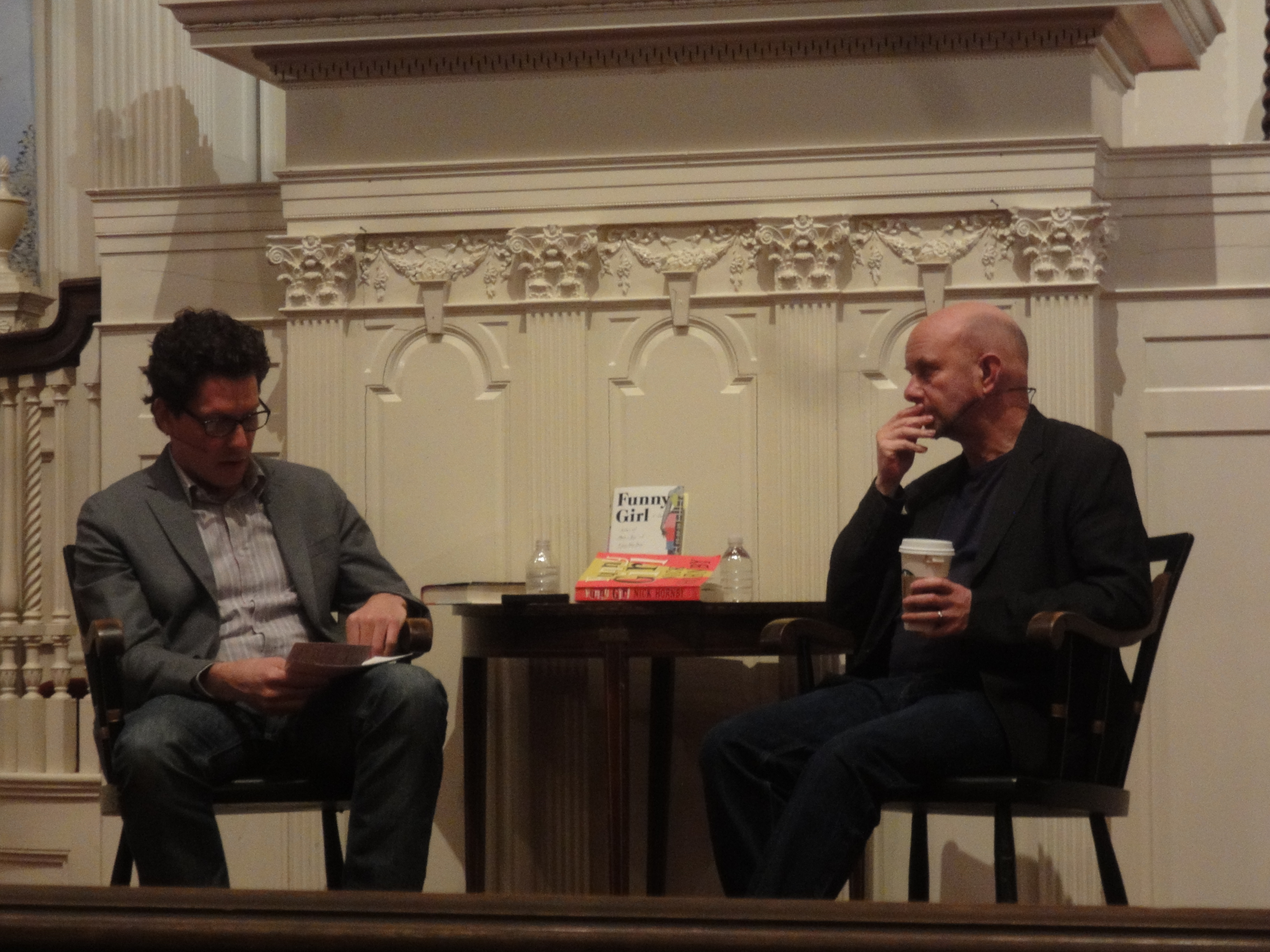
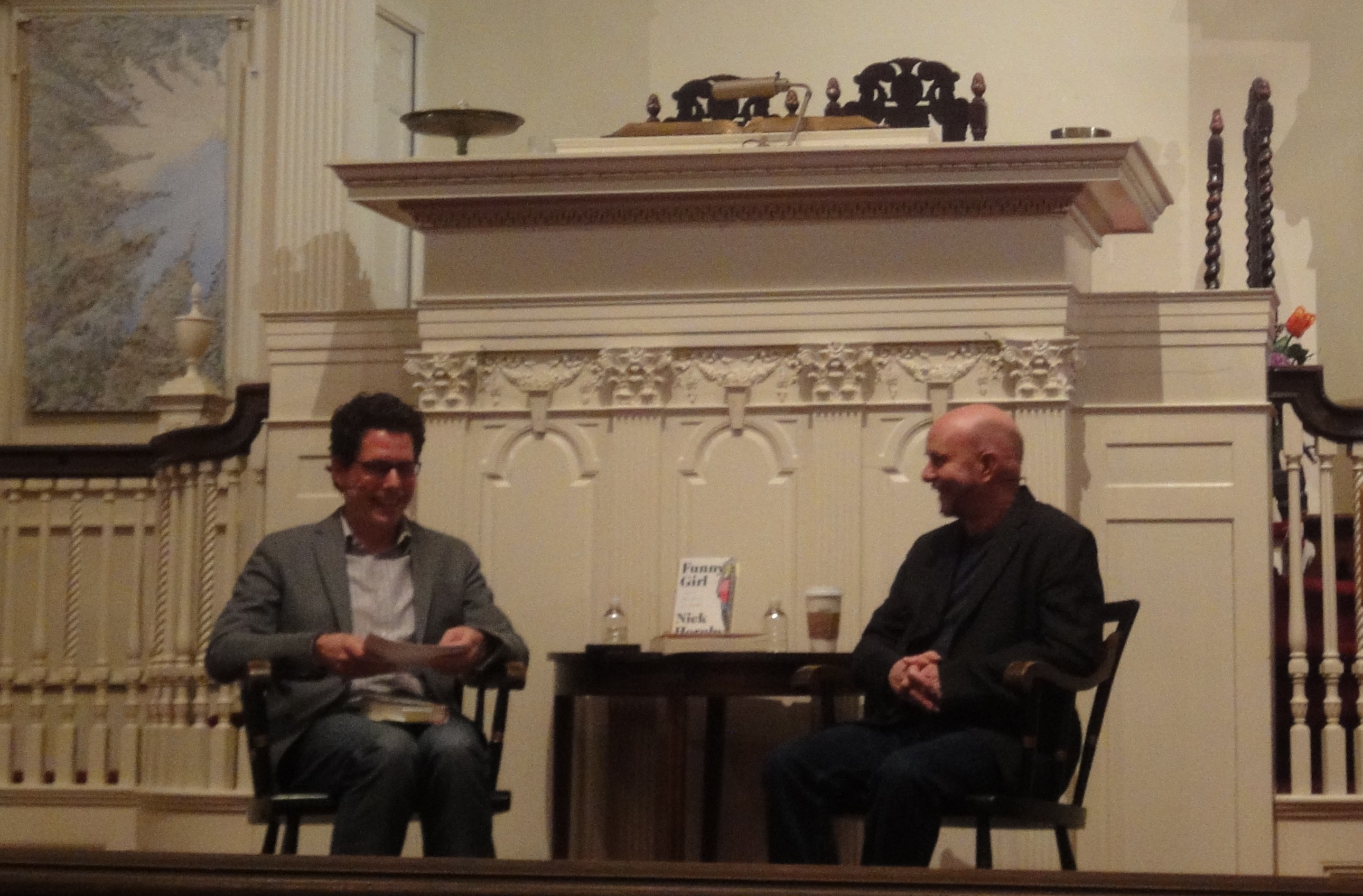
Harvard Book Store event: Ethan Gilsdorf and Nick Hornby at the First Parish Church in Cambridge

Hornby appeared in conversation with Ethan Gilsdorf at the First Parish Church in Cambridge in an event organized by the Harvard Book Store. Serena, the book store employee who introduced him, said that his new novel Funny Girl achieved the “Nick Hornby trifecta”: smart, funny, and a little bit sad. This was the first stop on the U.S. tour, so there was the obligatory joke about snow, and didn’t he wish he’d started in California and worked in the other direction? (Snow didn’t stop fans from attending; it was a pretty full house.)

funnygirl-us
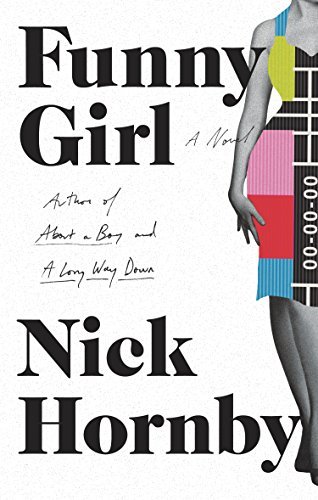
The U.S. cover of Funny Girl.

Gilsdorf asked Hornby what intrigued him about the time period and setting (London in the 1960s), and Hornby answered that his interest was born out of his work on An Education, which ended in 1963, and a conversation he’d had with actress Rosamund Pike. “Beautiful women are not often allowed to be comediennes,” Hornby realized, and thus the fictional British Lucille Ball – the main character of Funny Girl – was born. He also wanted to write about “the joy of collaborative work…the joy of conversation about lines in movies.” Hornby said, “All this fierce intelligence goes into popular entertainment,” and that statement more than any other might best sum up Funny Girl, whose characters believe at their cores in the value of comedy.

Did Hornby think of Funny Girl as historical fiction, a sort of alternate reality? He worked backward from the ending, a coda in which all the characters are in their 70s, looking back on their careers. If that was in the present, then their early careers would have been around 1964, ’65 – where An Education ended. The 1960s “was a really fantastic time for television…if you had a hit show then, everybody watched it.” Funny Girl, Hornby said, is more about the birth, life, and death of a hit show than about any one character; having read the book, I have to agree. Sophie herself admits, “It was always about the work. She’d never been in love with Clive, but she’d been in love with the show since the very first day.”

Funny Girl includes images of ephemera along with the text: real photos from the time, mock scripts from the TV show in the book – called Barbara (and Jim) – and other bits and pieces. “Why don’t novels have photographs? Why shouldn’t they?” Hornby asked. He even included a cover for one of his character’s books, which a designer at Penguin created.

funnygirl-uk
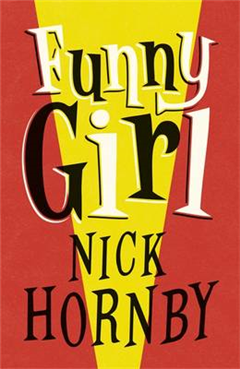
The U.K. cover of Funny Girl.

Though the book is mostly about Sophie – the eponymous funny girl – Hornby chose to read a section about her co-star, Clive. He read from the U.K. edition, and bent the cover back in a way that was almost physically painful to see (my husband saw the expression on my face and wondered if Hornby was bleeding. No, I said, the book is hurting). After reading, he talked again about Lucille Ball. “We didn’t have anything like that” in England…”Monty Python was so male.” He enjoyed creating an alternate history, giving England a comedienne. “I’ve done my bit,” he said, getting a laugh from the audience.

Next, Hornby and Gilsdorf talked about Hornby’s screen adaptation of Cheryl Strayed’s memoir Wild. Some people had expressed doubts about a man writing the screenplay, and Hornby admitted he was neither a hiker nor a woman. (Never mind that men have been writing female characters, and vice versa, for centuries.) But “it’s a book about being unable to hike…written with a liberal arts sensibility.” Furthermore, “it was a memoir, there [on the page] was the woman’s head!” In the book, Strayed reveals much in the first chapter, but Hornby decided to make it “an emotional mystery” so viewers “see the damage this grief has caused.”

DSC08001Gilsdorf asked about the romanticized life of the writer, referencing a section of Hornby’s website, “An Average Day.” Hornby’s advice to writers is, first, “if you can stop [writing], stop,” and second, “if you can write 500 words a day…do the maths…we should all be capable of writing a book a year.” (I’m not a “maths” person, but this is the approach I take in my fiction writing as well; for my first manuscript, I set the bar even lower, at 250 words a day, then bumped it to 500. For my second manuscript, I aimed for 750 words a day. It really does add up.) Hornby mentioned the Freedom app to block the internet, though “it’s ridiculous you have to pay somebody money to stop you doing something you’re paying for…”

DSC08009The audience questions were a varied lot, including far more questions about football (soccer) than I’ve ever heard at an author event. But the first question concerned not Arsenal but the Spree, Hornby’s name for the editors at The Believer, where he writes his “Stuff I’ve Been Reading” column. Vendela Vida first asked if he would write a music column, but he’d just finished writing about music for The New Yorker and wanted to write about reading instead, “about how one thing leads to another.” (Incidentally, the running joke about the Spree is one of my favorite running jokes in print. Though I’m not sure how many others there are.)

Another audience member asked about Hornby’s collaboration with Ben Folds, about which I knew nothing, and which I will now track down. Someone else asked if he had thought about Barbra Streisand when choosing the title – the working title was Miss Blackpool – and Hornby replied that Funny Girl is “one adjective and one of the most common nouns in existence…I don’t think [Streisand] can copyright it.” Another person asked if Hornby had researched band websites when he was inventing the Tucker Crowe sites in Juliet, Naked; Hornby replied that he’d done no research for the book, but had looked at about 900 band websites for “my own purposes.” With that kind of “intense personal engagement,” he said, “you can only ever disappoint creatively.”

One interesting question was about stumbling blocks in publishing for writers whose first language wasn’t English. “The bar is raised higher,” Hornby admitted, but “so many amazing writers [e.g. Aleksandar Hemon] have written novels not in their first language…The biggest obstacle to being a writer is the job itself, not the language.” Someone else asked what book or author had had the most influence on him; the answer was Anne Tyler, particularly Dinner at the Homesick Restaurant, for her warmth, accessibility, and emotional intelligence. “I can’t be Salman Rushdie” Hornby said (and thank goodness for that), but Anne Tyler showed him there was another kind of book, one he could try to write. The last question was about tone, and whether the sense of humor in Hornby’s books was a conscious addition. “It is self-expression,” Hornby said. “It’s how it comes out.” The difficult part is compressing the parts that are easy to write – dialogue, in his case – so that every scene moves the story forward.

DSC08006
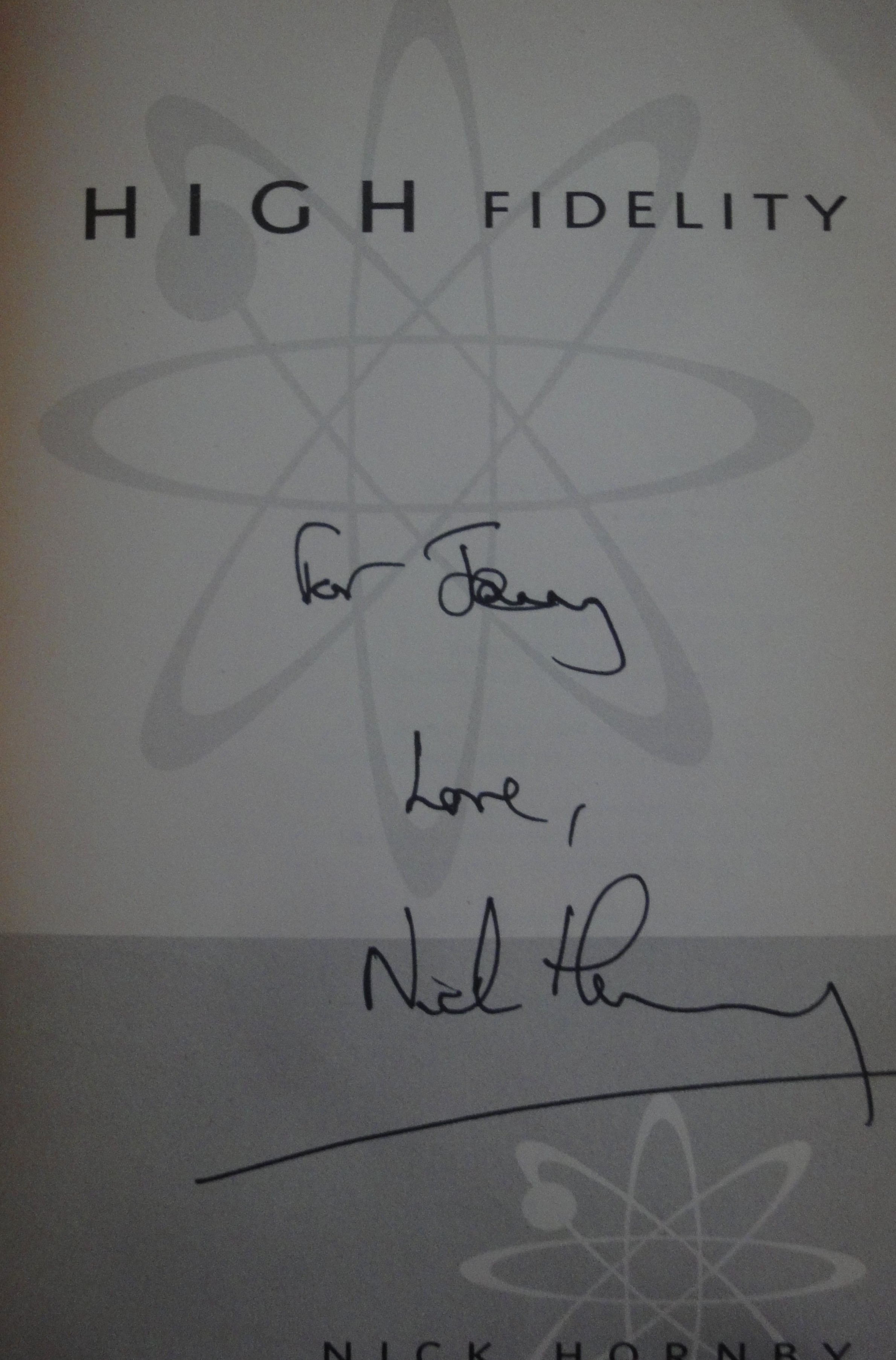
My signed 1995 paperback of High Fidelity.

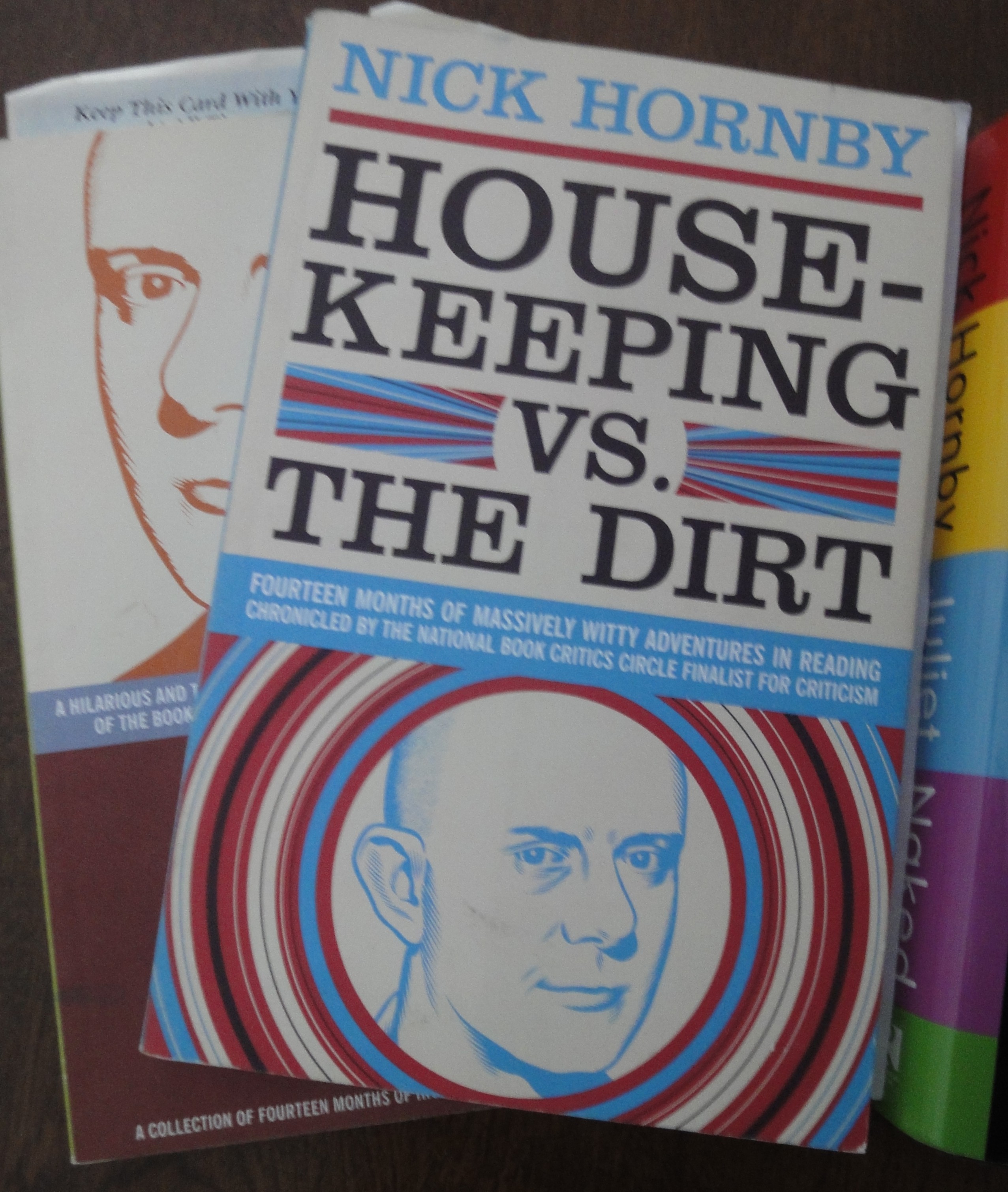
In my excitement about this event, I only grabbed novels before leaving the house (High Fidelity and Juliet, Naked), forgetting the essays entirely (I’ve got The Polysyllabic Spree and Housekeeping vs. the Dirt, and my friend Josh has Shakespeare Wrote for Money; we bought all three together when McSweeney’s had a deal several years ago). When I reached the front of the signing line, I remembered to compliment the author on the track list for Juliet, Naked, which I’ve admired since I first read it for being able to tell so much story in so few words. (I also said the “top five” thing. Come on, wouldn’t you?)

Five Librarian Bloggers to Follow

I’m honored to be included in this Information Today feature by Brandi Scardilli, “Five Librarian Bloggers to Follow,” along with David Lee King, Justin Hoenke (a.k.a. Justin the Librarian), Rita Meade (a.k.a. Screwy Decimal), and Joe Hardenbrook (a.k.a. Mr. Library Dude). Please read Brandi’s article and check out some of my fellow librarian bloggers’ sites!

I’ll just be over here, wishing I’d come up with a cleverer name for this blog when I started it six years ago.

JustintheLibrarianTwitter

Privacy in a Networked World, III

This is the third and last post about Privacy in a Networked World. See the first post (Snowden and Schneier) here and the second post (John DeLong and John Wilbanks) here.

“The Mete and Measure of Privacy,” Cynthia Dwork, Microsoft Research

This was probably the presentation I was least able to follow well, so I’ll do my best to recap in English-major language; please feel free to suggest corrections in the comments. Dwork talked about the importance of being able to draw conclusions about a whole population from a representative data set while maintaining the confidentiality of the individuals in the data set. “Differential privacy” means the outcome of data analysis is equally likely independent of whether any individual does or doesn’t join the data set; this “equally likely” can be measured/represented by epsilon, with a smaller value being better (i.e. less privacy loss). An epsilon registry could then be created to help us better understand cumulative privacy loss.

Dwork also talked about targeted advertising. Companies who say “Your privacy is very important to us” have “no idea what they’re talking about” – they don’t know how to (and may have little interest in) keeping your data private. And when you hear “Don’t worry, we just want to advertise to you,” remember – your advertiser is not your friend. Advertisers want to create demand where none exists for their own benefit, not for yours. If an advertiser can pinpoint your mood, they may want to manipulate it (keeping you sad, or cheering you up when you are sad for a good reason). During this presentation, someone posted a link on Twitter to this article from The Atlantic, “The Internet’s Original Sin,” which is well worth a read.

Dwork quoted Latanya Sweeney, who asked, “Computer science got us into this mess. Can computer science get us out of it?” Dwork’s differential privacy is one attempt to simplify and solve the problem of privacy loss. Slides from a different but similar presentation are available through SlideServe.

“Protecting Privacy in an Uncertain World,” Betsy Masiello, Senior Manager, Global Public Policy, Google

Masiello’s talk focused on what Google is doing to protect users’ privacy. “It’s hard to imagine that Larry and Sergey had any idea what they were building,” she began. Today, “Everything is mobile…everything is signed in.” Services like Google Now send you a flow of relevant information, from calendar reminders to traffic to weather. In addition to Google, “the average user has 100 accounts online.” It’s impossible to remember that many passwords, especially if they’re good passwords; and even if they’re good passwords, your accounts still aren’t really safe (see Mat Honan’s  2012 article for Wired, “Kill the Password: Why a String of Characters Can’t Protect Us Anymore“).

To increase security, Google offers two-factor authentication. (You can find out what other sites offer 2FA by checking out twofactorauth.org. Dropbox, Skype, many – but not all – banks, Facebook, LinkedIn, Tumblr, and Twitter all support 2FA.) Masiello said that after news of hacks, they see more people sign up for 2FA. “It’s an awareness problem,” she said. In addition to 2FA, Google is encrypting its services, including Gmail (note that the URLs start with https). “E-mail is still the most common way people send private information,” she said, and as such deserves protection.

“Encryption is the 21st century way of protecting our personal information,” said Masiello. Governments have protested companies who have started using encryption, but “governments have all the tools they need to obtain information legally.” As Cory Doctorow has pointed out many times before, it’s impossible to build a back door that only the “good guys” can walk through. Masiello said, “Governments getting information to protect us doesn’t require mass surveillance or undermining security designed to keep us safe.” The PRISM revelations “sparked a very important debate about privacy and security online.” Masiello believes that we can protect civil liberties and national security, without back doors or mass surveillance.

“Getting security right takes expertise and commitment,” Masiello said. She mentioned the paper “Breaking the Web” by Anupam Chander and Uyen P. Le, and said that we already have a good set of guidelines: the OECD Privacy Principles, which include collection limitation, data quality, purpose specification, use limitation, security safeguards, openness, individual participation, and accountability. As for Google, Masiello said, “We don’t sell user data; we don’t share with third parties.” All of the advertising revenue is based on user searches, and it’s possible to opt out of interest-based ads. (Those creepy right-sidebar ads that used to show up in Gmail, having mined your e-mail to produce relevant ads, appear to be gone. And good riddance.)

Finally, Masiello talking about developing/setting industry standards for privacy and security that would facilitate innovation and competition. But privacy isn’t even the main concern in the future: it’s identity – what it means, and how we construct it.

“Sur-veillance, Sous-veillance and Co-veillance,” Lee Rainie, Director of Internet, Science and Technology Research, Pew Research Center

Lee Rainie definitely walked away with the “Most Neutral, Fact-Based Presentation” Award. Rainie has spoken at library conferences in New England before, but I – perhaps unwisely – chose to go to other sessions, so this was the first time I saw him speak, and he was great. Furthermore, all of his slides are available on SlideShare. He started off with a few findings:

1. Privacy is not binary / context matters

2. Personal control / agency matters

3. Trade-offs are part of the bargain

4. The young are more focused on network privacy than their elders (this is only surprising if you haven’t read danah boyd’s excellent It’s Complicated: The Social Lives of Networked Teens, and in fact Rainie quoted boyd a few slides later: “The new reality is that people are ‘public by default and private by effort.'”)

5. Many know that they don’t know what’s going on

6. People are growing hopeless and their trust is failing

The Pew Research Center has found that consumers have lost control over companies’ use and control of their data; they have adopted a transactional frame of mind (e.g. giving up control of personal data in exchange for the use of a platform or service). In general, trust in most institutions has gone down, with the exceptions of the military, firefighters, and librarians(!). But there is a pervasive sense of vulnerability, and users want anonymity – mostly from advertisers, hackers, and social connections, rather than the government (see slide below).

Lee Rainie, slide 30, "Who users try to avoid: % of adult users who say they have used the internet in ways to avoid being observed or seen by..."
Lee Rainie, slide 30, “Who users try to avoid: % of adult users who say they have used the internet in ways to avoid being observed or seen by…”

This slide supports the argument for privacy, especially against the “nothing to hide” argument: people desire – and deserve – privacy for many reasons, the least of which is to avoid the government or law enforcement. (Mostly, someone on Twitter pointed out, we want to avoid “that guy.”)

As for the future of privacy, people are feeling “hopeless.” Rainie remembered saying, in the early 2000s, “There’s going to be an Exxon-Valdez of data spills…” and there have been many since then, but little has been done to protect consumer privacy. “How do we convince people to have hope?” he asked.

Panel: “What Privacy Does Society Demand Now and How Much is New?” Danny Weitzner (moderator), Kobbi Nissim, Nick Sinai, Latanya Sweeney

Fortunately, the moderator and panelists have different initials. The questions and responses below are paraphrased from the notes I took during the panel session.

DW: What sort of privacy does society demand now? Is privacy different now?

NS: Access to your own data has always been a art of privacy; also the right to correct, erase, and transfer. Your data should be useable and portable.

KN: The ability to collect a lot of data all the time is new. There is a different balance of power (companies have too much).

LS: Privacy and security are just the beginning. Every American value is being changed by technology. Computer scientists aren’t trained to think of social science effects and the power of technology design.

DW: Cryptography and math are a foundation we can trust if implemented properly, as Snowden said this morning.

LS: I dislike choosing between two things. We need a cross-disciplinary approach, a blended approach.

NS: Any great company should constantly be trying to improve user experience. How does privacy/security get integrated into design?

KN: Aim for mathematical solutions/foundations. We need to re-architect economic incentives, regulations, how all the components work together.

DW: Where will the leadership and initiative come from? Government?

KN: Academia, research. We need to find ways to incentivize.

LS: Economic [incentives] or regulations are necessary for privacy by design. They’re all collapsing…every single one of them [Facebook, the IRS] is heading for a major disaster.

DW: People care about control of their data, yet the information environment is increasingly complicated.

LS: Society benefits from technology with certain protections.

KN: Regulations we have today were designed in a completely different era. We may be in compliance, and still we have damaged privacy severely.

LS mentioned HIPPA, NS mentioned the Consumer Bill of Rights, DW mentioned “Privacy on the Books and on the Ground.”

DW: Privacy practices and discussion are/is evolving in the U.S.

LS: A huge dose of transparency would go a long way. This is the new 1776. It’s a whole new world. Technology is redefining society. The Federal Trade Commission could become the Federal Technology Commission.

DW: Are you optimistic? Are we heading toward a positive sense of privacy?

NS: Yes, by nature I’m optimistic, but complexity and user experience (user accounts, passwords) frustrates me. Entrepreneurs do help change the world.

KN: The genie is out of the bottle. This forces us to rethink privacy. Nineteen-fifties privacy has changed and isn’t the privacy we have today, but that doesn’t mean that privacy is dead. Privacy is a sword and a shield.

DW: We’re at the beginning of a long cycle. It’s only been a year [and a half] since Snowden. What do we expect from our government and our companies? How powerful should government and private organizations be? Marketing/advertising issues are trivial compared to bigger issues.

LS: The cost of collecting data is almost zero, so organizations (public and private) collect it and then figure out how to use it later. They should be more selective about collection. If we can expose the harm, it will lead to change.

Question/comment from audience: A lot of people are not aware they’re giving away their privacy (when browsing the internet, etc.).

LS: We need transparency.

NS: We need regulation and consumer protection.


Privacy in a Networked World, II

This is the second post about Privacy in a Networked World. The first post, about the conversation between Bruce Schneier and Edward Snowden, is here.

“Privacy in a Networked World,” John DeLong, Director of the Commercial Solutions Center, NSA

Other than the length and volume of applause, it’s difficult to measure an audience’s attitude toward a speaker. I’ll venture, though, that the audience of Privacy in a Networked World was generally pro-Snowden; the attitude toward John DeLong can perhaps be characterized as guarded open-mindedness laced with a healthy dose of skepticism.

DeLong’s talk was both forceful and defensive; he wanted to set the record straight about certain things, but he also knew that public opinion (in that room, at least) probably wasn’t in his favor. (He said repeatedly that he did not want to have an “Oxford-style debate,” though his talk wasn’t set up as a debate in the first place.) “Let’s not confuse the recipe with the cooking,” he said, in a somewhat belabored analogy where the NSA’s work was the cooking and the law was the recipe. (I cook a lot at home, and I’ll just say, I can usually tell when I’m looking at a bad recipe, and opt to adapt it or not make it at all.)

DeLong quoted at length from Geoffrey R. Stone’s “What I Told the NSA.” (Stone was a member of the President’s Review Group in fall 2013, after the Snowden revelations.) Stone’s conclusions were not altogether positive; he found that while the NSA “did its job,” many of its programs were “highly problematic and much in need of reform.” But it’s the Executive Branch, Congress, and FISA who authorized those programs and are responsible for reforming them. Stone added, “Of course, ‘I was only following orders’ is not always an excuse….To be clear, I am not saying that citizens should trust the NSA. They should not. Distrust is essential to effective democratic governance.”

DeLong said, “The idea that the NSA’s activities were unauthorized is wrong, wrong in a magnificent way.” He emphasized that the NSA is not a law enforcement agency, it’s an intelligence agency. He spoke in favor of people with different backgrounds and expertise – lawyers, engineers, mathematicians, privacy experts, etc. – coming together to work out solutions to problems, with respect for each others’ abilities. “Technology,” he said, “always comes back to how we as humans use it.” At present, “We do not have technologies that identify privacy risks….Privacy engineering could be one of the most important engineering feats of our time.”

DeLong talked about rebuilding the nation’s confidence in the NSA. “Confidence is the residue of promises kept,” he said. “More information does not necessarily equal more confidence.” (Someone on Twitter pointed out that much depends on the content of the information.) The talk was a good reminder not to villainize the entire NSA; part of DeLong’s forcefulness was undoubtedly on behalf of his co-workers and staff whom he felt were unfairly maligned. And technology that could identify privacy risks, built by people who have different perspectives and backgrounds, would be excellent. But do we need technology that identifies privacy risks, or do we need stronger oversight and better common sense? Mass surveillance erodes trust in government and hasn’t been terribly effective; what more do we need to know to put a stop to it?

“Privacy and Irony in Digital Health Data,” John Wilbanks, Chief Commons Officer, Sage Bionetworks

John Wilbanks gave a fast-paced, interesting talk about health data. The “irony” in the title of his talk soon became clear when he gave the example of Facebook’s mood manipulation experiment compared to a study of Parkinson’s disease. The sample size for Facebook was many times larger, with a constant flow of information from “participants,” as opposed to a much smaller sample population who filled out a survey and answered questions by phone. “What does our society value?” Wilbanks asked. This question can be answered by another question: “What do we surveil?”

Wilbanks showed a graph representing cardiovascular disease and terrorism: there is 1 death every 33 seconds from cardiovascular disease – “That’s like 9/11 every day” – and yet there’s not nearly the same kind of “surveillance” for health that there is for terrorism. Participating in a research study, Wilbanks said, is like “volunteering for surveillance,” and usually the mechanisms for tracking aren’t as comprehensive as, say, Facebook’s. Of course, privacy laws affect health research, and informed consent protects people by siloing their data; once the study is concluded, other researchers can’t use that data, and there’s no “network effect.”

Informed consent, while a good idea in theory, often leads to incomprehensible documents (much like Terms of Service). These documents are written by doctors, reviewed by lawyers, and edited by committee. Furthermore, said Wilbanks, people in health care don’t usually understand issues of power and data. So, he asked, how do we run studies at internet scale and make them recombinant? How do we scale privacy alongside the ability to do research? Wilbanks demonstrated some ideas to improve on traditional informed consent, which could also allow research subjects to get a copy of their own data and see which researchers are using data from the research in which they participated.

Obviously there are risks to individuals who share their personal health data, but there can be advantages too: more scientists having access to more data and doing more research can lead to more breakthroughs and improvements in the field of medicine.

Last year, Wilbanks talked about privacy and health data on NPR; you can listen to the segment here.

Still to come: Microsoft, Google, Pew, and a panel on “What Privacy Does Society Demand Now and How Much is New?” 

Privacy in a Networked World

This is the first post about Privacy in a Networked World, the Fourth Annual Symposium on the Future of Computation in Science and Engineering, at Harvard on Friday, January 23.

A Conversation between Bruce Schneier and Edward Snowden (video chat)

Bruce Schneier is a fellow at the Berkman Center for Internet & Society, and the author of Data and Goliath. Edward Snowden was a sysadmin at the NSA who revealed the extent of the government’s mass surveillance. The conversation was recorded (no joke) and is available on YouTube.

I have to say it was an incredibly cool feeling when Snowden popped up on the giant screen and was there in the room with us. There was sustained applause when he first appeared and also at the end of the conversation, when he was waving goodbye. Schneier started by asking Snowden about cryptography: What can and can’t be done? Snowden replied, “Encryption…is one of the few things that we can rely on.” When implemented properly, “encryption does work.” Poor cryptography, either through bad implementation or a weak algorithm, means weak security. End points are also weak spots, even if the data in transit is protected; it’s easier for an attacker to get around crypto than to break it.

Snowden pointed out a shift in the NSA’s focus over the last ten years from defense to offense. He encouraged us to ask Why? Is this proper? Appropriate? Does it benefit or serve the public?

The explosion in “passive” mass surveillance (collecting everything in case it’s needed later) is partly because it’s easy, cheap, and simple. If more data is encrypted, it becomes harder to sweep up, and hackers (including the NSA) who use more “active” techniques run a higher risk of exposure. This “hunger for risk has greatly increased” during the War on Terror era. Their targets are “crazy, unjustified….If they were truly risk averse they wouldn’t be doing this…it’s unlawful.”

Snowden said that the NSA “is completely free from any meaningful judicial oversight…in this environment, a culture of impunity develops.” Schneier said there were two kinds of oversight: tactical oversight within the organization (“did we follow the rules?”) and oversight from outside of the organization (“are these the right rules?”). He asked, “What is moral in our society?”

Snowden asked if the potential intelligence that we gain was worth the potential cost. He stated that reducing trust in the American infrastructure is a costly move; the information sector is crucial to our economy. The decrease in trust, he said, has already cost us more than the NSA’s budget. “They are not representing our interests.”

Schneier, using his NSA voice, said, “Corporations are spying on the whole internet, let’s get ourselves a copy!” (This was much re-tweeted.) “Personal information,” he said, “is the currency by which we buy our internet.” (Remember, if you can’t tell what the product is, you’re the product.) It’s “always amusing,” he said, when Google complains about the government spying on their users, because “it’s our job to spy on our users!” However, Schneier thinks that the attitudes of tech companies and standards bodies are changing.

These silos of information were too rich and interesting for governments to ignore, said Snowden, and there was no cost to scooping up the data because until 2013, “people didn’t realize how badly they were being sold up the river.” Schneier said that research into privacy-preserving technologies might increase now that there is more interest. Can we build a more privacy-preserving network, with less metadata?

“We’ve seen that the arguments for mass surveillance” haven’t really held up; there is little evidence that it has stopped many terrorist attacks. Schneier cited an article from the January 26, 2015 edition of The New Yorker, “The Whole Haystack,” in which author Mattathias Schwartz lists several recent terrorist attacks, and concludes, “In each of these cases, the authorities were not wanting for data. What they failed to do was appreciate the significance of the data they already had.”

Unlike during the Cold War, now “we all use the same stuff”: we can’t attack their networks and defend our networks, because it’s all the same thing. Schneier said, “Every time we hoard a zero-day opportunity [knowing about a security flaw], we’re leaving ourselves vulnerable to attack.”

PrivacyNetworkedWorld

Snowden was a tough act to follow, especially for John DeLong, Director of the Commercial Solutions Center for the NSA, but that’s exactly who spoke next. Stay tuned.


Manual for the Future of Librarianship

libraryandMy librarian friend Brita, who knows about everything before I do, recently wrote a blog post about her submissions to the Manual for the Future of Librarianship project (under the auspices of the ALA Center for the Future of Libraries, inspired by the Long Now Foundation’s Manual for Civilization). She inspired me to do the same, and I’m sharing my submissions here as well.

1. It’s Complicated: The Social Lives of Networked Teens by danah boyd
itscomplicatedIt’s Complicated is a must-read for teachers, parents, librarians, and anyone who disparages Millennials or “kids these days.” Researcher boyd unpicks the mindset that kids don’t care about privacy and shows how much of online life is “public by default, private through effort” instead of the other way around, making privacy difficult to obtain for those using social media. She makes the case that adults can best protect kids and teens by educating them about risks. boyd also addresses inequality and information literacy.

2. Little Brother by Cory Doctorow
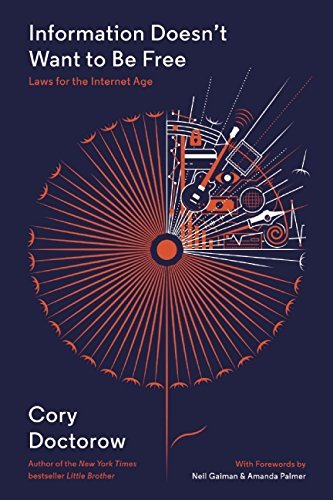
littlebrotherLittle Brother is a young adult novel, but adults can learn a lot from it too: it’s a fast-paced story set in San Francisco before, during, and after a terrorist attack blows up the Bay Bridge. Seventeen-year-old high school student and hacker Marcus Yallow (a.k.a. w1n5t0n) and his friends are swept up by the Department of Homeland Security as the DHS cracks down on the city, and Marcus’ new mission is to expose their abuse of power. Marcus is more tech-savvy than most people, but Doctorow explains everything in a way that is interesting (and paranoia-inducing). It’s easy to imagine this scenario coming to life, and it leads readers to consider the relationship between privacy, security, and freedom. The follow-up novel, Homeland, is also worth reading.

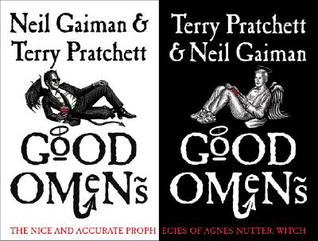
3. “Why Our Future Depends on Libraries, Reading, and Daydreaming” by Neil Gaiman

Neil Gaiman in October 2013. Photo by Robin Mayes.

British author Neil Gaiman writes across genres and for all ages, and he’s a passionate advocate for libraries. In October 2013, he gave a particularly strong and articulate lecture on the importance of fostering literacy through teaching children to read and making sure they have access to books they enjoy. He also spoke about the positive correlation between fiction and empathy, which has now been shown in a number of studies, and the importance of libraries: “libraries are about freedom. Freedom to read, freedom of ideas, freedom of communication…Libraries really are the gates to the future.” [I wrote about this same speech at length soon after it was published online by The Guardian.]

Julia Glass at the Weston Public Library

On a night that introduced me to the concept of “ice mist” (I think that’s what it was), there was a packed house at the Weston Public Library to see Julia Glass read from her newest novel, And the Dark Sacred Night. I’d seen Glass speak once before, in conversation with her editor at the McNally Jackson bookstore in Soho in 2009, and thanks to a major tidying effort, I turned up my notes from that event just a few weeks ago. At the time, Glass said:

“All serious fiction is emotionally autobiographical.”

“If you choose fiction, you distort.”

“There are always mysteries and things we will never know [about the people we’re closest to]….You cannot know everything about the people you love the most.”

Her words, and especially the concept of emotional truth in fiction, stayed with me, enough to get me out of the house on an ice-misty night. (What is that, Massachusetts? Seriously.)

Hardcover book jacket

In Weston, Glass started by observing the difference between a hardcover tour and a paperback tour: during a hardcover tour, the material is fresher in the author’s mind, but most audience members haven’t had a chance to read the book yet. With a paperback tour, on the other hand, the author may have forgotten details about the book, but the audience is more likely to have read it.

She spoke about her local connection, having grown up in Lincoln, MA and worked in the library there: “I really regard that library as my third parent.” Glass also talked about how she begins her books. Writers approach stories in different ways, but Glass comes to her stories through character. Malachy Burns’s mother Lucinda, a secondary character in Three Junes, was inspired in a unique way: Glass and her partner were stuck in traffic*, and the bumper sticker on the car in front of them read “Life: What a Beautiful Choice.”  That, Glass realized, encapsulated Lucinda’s Catholic outlook.

*Glass’s advice for couples stuck in traffic is: Don’t talk! It will only lead to fighting over whose fault it is that you’re stuck in traffic. She believes that the declining divorce rate is due at least in part to the rise of GPS devices.

Unlike some authors with ideas spilling out of their heads and onto scraps of paper everywhere, Glass says she doesn’t have lots of ideas for books. “Every time I’m coming to the end of one book, I’m terrified it’s the last one.”

“All of my books stand alone…but I do seem to be in the habit of bringing characters back.”

Paperback cover
Paperback cover

Glass’s books are all set in the semi-recent past. Does she rely on her memory to fill in details appropriate to the decade or year? She laughed at the idea of relying entirely on memory, but said that “personal stories that people tell me make their way into fiction,” and her books are usually set on “familiar turf” (New York, New England). But “research is important for every book…I always want to give myself a challenge…What’s something I really want to know about?” Fiction writers, Glass said, “are the people who want to be everything,” and researching for books is a great way to learn more about other topics and vocations. “There are so many ways of being and living in this world. The ‘what-if’ questions drive us.” Glass is particularly interested not just in what people choose to do, but in how that vocation in turn shapes them.

But research, for Glass, comes after writing. “I bluff my way through writing first, and research later.” For her books, she has interviewed oncologists; doctors familiar with HIV/AIDS treatment in the early days of the disease; classical cellists; and professional bakers of wedding cakes. She has also explored YouTube, especially when seeking particular pieces of music, and has learned to look at the number of page views to find the best quality videos. “YouTube is very dangerous.”

She writes her books from beginning to end, not allowing herself to skip over difficult scenes. Her manuscripts tend to be much longer than the final published versions of her books. Glass’ editor Deb Garrison told her, “You have a wonderful sense of responsibility to your readers…[but] they don’t have to know everything.” This revelation led Glass to cut an entire section from Daphne’s point of view from And the Dark Sacred Night.

After Glass read two scenes from the novel (one from Kit Noonan’s perspective, one from Walter’s), an audience member asked if she could talk more about her third book, I See You Everywhere. “You could see it as a novel, perhaps,” Glass said, but it’s really a collection of linked stories, all of which stand on their own; in fact, one of the stories won the Chicago Tribune Nelson Algren award, which was, Glass said, one of the best moments of her life. I See You Everywhere is her most autobiographical novel, which she published once she decided she did not want to write a memoir; “I just wanted to write about a certain kind of sibling relationship.”

I haven’t read And the Dark Sacred Night yet, but I plan to read it soon, and I can definitely recommend Three Junes, The Whole World Over, I See You Everywhere, and The Widower’s Tale. Thanks to the Weston Public Library for hosting, and to Julia Glass for a lovely and inspiring evening.

Incidentally, the ice mist has now turned to snow.

The Official TBR Challenge

2015tbrbutton

I have officially entered the Official 2015 TBR Pile Challenge. I’ve tagged twelve of the titles on my TBR shelf (plus two books I don’t own but have been meaning to read, The Art of Fielding by Chad Harbach and Graceling by Kristin Cashore) with “2015-TBR” in LibraryThing. Thanks to Linda at Three Good Rats for the nudge to join the official challenge.

2015-TBR2015-TBR2

I hope to read even more books from my TBR shelf this year, but this challenge is a good start. I do like checking things off a list…not that books should ever be reduced to mere list items.

The TBR shelf

At the end of 2013, I reorganized my books, shelved all the books I owned but hadn’t read yet together, and declared that I would read them all in 2014.

This plan failed.

In terms of quantity, it wasn’t an ambitious goal. (I ended up reading 147 books last year, and that’s if you count conservatively.) However, as noted previously, I’m much better at reading books with due dates (either from the library or borrowed from friends) than books without them.

Of the 26 books on that top To-Be-Read (TBR) shelf (pictured here), I actually read only three: Life After Life, The Welsh Girl, and Above All Things. Incidentally, they were really good and I’m definitely glad I got around to them. I tried reading White Tiger, both in print and as an audiobook, and decided not to finish it; I also set aside Archetype partway through. There were eight others I decided I wasn’t ever going to read, and I got rid of them.

I still intend to read (or start reading and definitively give up on) twelve of my 2013 TBR books:

Birds of Paradise

Equal of the Sun

Wild Girls (this is my book club pick for January, so I know I’ll read it)

Good Harbor

The Waterproof Bible

American Ghost

Kitchen Confidential

Quiet

The Te of Piglet

The Gospel According to Jesus (my dad sent me this, and I don’t read enough of the books he sends)

Some Girls, Some Hats, and Hitler

My Heart is an Idiot

From the lower shelf in the photo, I still intend to read God’s Hotel (sent to me by my oldest friend – oldest in terms of time we’ve known each other, not in terms of her calendar age) and Far From the Tree.

I have decided that A Passion for Books is more of a reference book than a cover-to-cover book, therefore I feel no guilt about keeping it, even though I don’t necessarily plan to read it this year.

Over the course of 2014, even as I got rid of some books I finally accepted I wasn’t going to read (or if I did, I’d get them from the library), I added more books to the shelf. So in addition to the titles mentioned above, I plan to read the following:

Invisibility

Nora Webster

The Starboard Sea

City of Women

We Are Called to Rise

The History of Us

Between Shades of Gray

So that’s 21 altogether, which – if I were to read nothing else but these until I had finished them all – should take about three months (Far From the Tree is 976 pages). Make that 22, because I set Our Band Could Be Your Life aside after the third chapter last January and have been meaning to finish it ever since. That’s a year now, if anyone’s counting.

The 2014 TBR shelf, featuring many titles from the 2013 TBR shelf.

This is doable. Possibly I can sneak a few more of these in as book group choices, but either way, I’ll either read them or get rid of them “this morning. By noon. By noon or one. By 1:37 exactly!”

Gold star and a Mark Knopfler soundtrack to you if you recognized the Empire Records quote there. But seriously, I’m planning to read these by the end of June. Or by 12/31/15 exactly. Wish me luck, and let me know if I should bump any of them to the top of the list, or off of it.