“New Adult” Revisited, Or, Where are all the books about college?

It’s easy to find books about characters in high school. And it’s easy to find books about adult characters anywhere, doing anything. But there is a sparsely populated area between these two: books about characters who are transitioning from childhood/teenagerhood to adulthood. A few years ago, in response to a post on the Young Adult Review Network (YARN), I struggled to come up with a handful of titles that fit this category. YARN responded with additional titles (November 2011), but I don’t think anyone was satisfied that there were enough “new adult” books at the time.

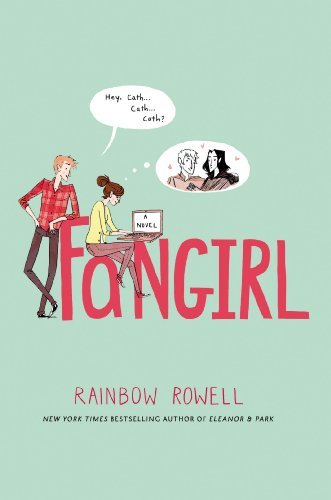
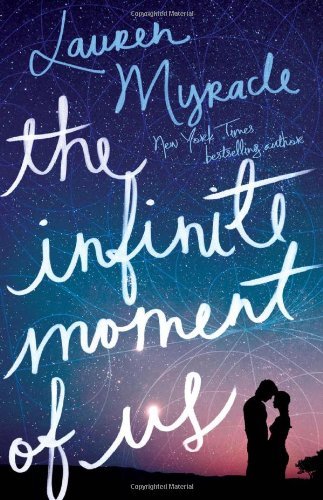
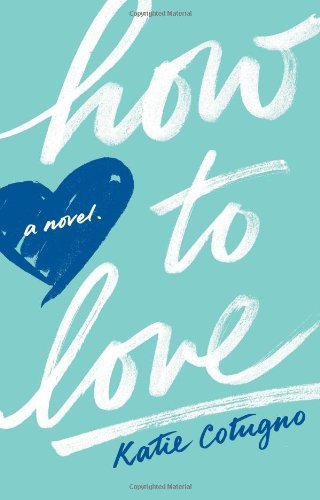
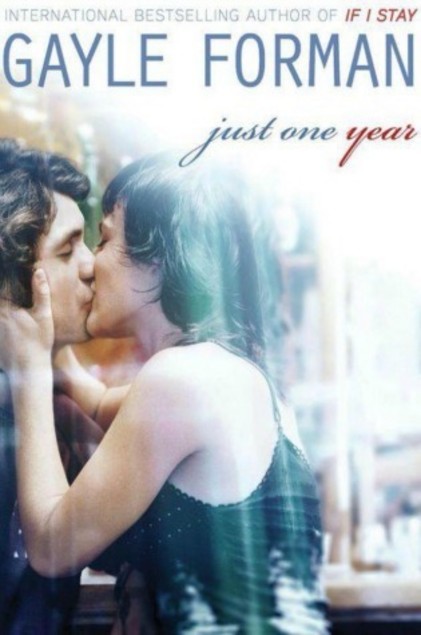
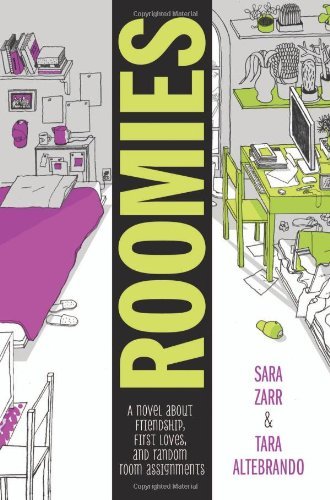
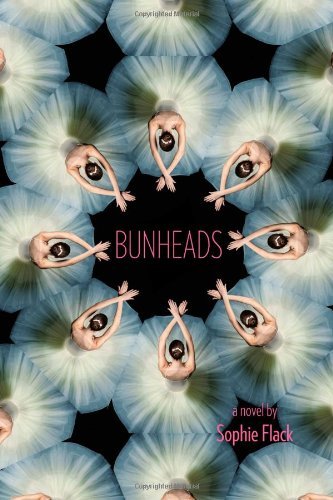
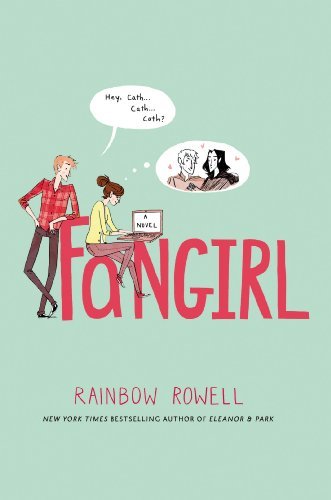
fangirlinfinitemomentofusThe topic came up again at ALA 2013. I didn’t attend in person, but followed the coverage on blogs and Twitter; Hannah Gomez’s piece for YALSA’s The Hub provides a great recap, as well as a link to a resource list, which has been updated – a pleasant surprise! – since the conference. (There’s another good piece on The Hub about adult books with teen appeal, from August 2012. I’d add Tell the Wolves I’m Home by Carol Rifka Brunt to this list, and I’m not alone – it’s a 2013 Alex Award winner.) I was glad to see that a few of my recent favorites that fit snugly into the “new adult” category are on the reader’s advisory resource list, including Bunheads by Sophie Flack, The Infinite Moment of Us by Lauren Myracle, Fangirl by Rainbow Rowell, Roomies by Sara Zarr and Tara Altebrando, and Just One Day and Just One Year by Gayle Forman; I’d also add How to Love by Katie Cotugno.

howtolovejustoneyearThe years after high school, whether they include college or not, and the first few years in the working world are a transitional time of great change and (hopefully) growth. It is strange that authors haven’t mined this emotion-rich area more. Perhaps these books fell into that gray area that is neither YA nor adult, and publishers weren’t sure how to market them, but if that’s the case, it’s a weak one: so many adults are openly reading YA lit now that these”crossover” books should appeal to both audiences, rather than being lost between them.

roomiesbunheads

Lourdes at YARN made an important point about some of the books I suggested back in 2011: that they contained an element of nostalgia, and were told from an adult point of view in a present that looked back on the past, as opposed to being told from the point of view of a young adult in the present. The books I mentioned above fit this criteria much better, and I hope to discover and read more of these (suggestions are welcome in the comments).

However, as a reader, I like the adult-looking-back perspective; one example I can think of is Joshua Henkin’s Matrimony, which starts when its three main characters are in college. Maggie Shipstead’s forthcoming Astonish Me (April 2014) also begins when its main character is a young adult, and it follows her until her own son is a teenager. (I’d definitely recommend it to anyone who liked Bunheads.) Much of the action in Karen Joy Fowler’s We Are All Completely Beside Ourselves takes place when the narrator is in college, though in the present she is middle-aged. Eleanor Brown’s The Weird Sisters also deals with three young women who have been out in the world for a few years, but who don’t yet feel like (or, sometimes, act like) adults. All the Light There Was by Nancy Kricorian is also adult fiction, but its main character, Maral, grows from fourteen to twenty during WWII in Paris – perfect for “new adults” who like historical fiction, as Maral makes several difficult and important choices as she comes of age.

The titles in the paragraph above were gleaned from my own reading over the past several months, so clearly “new adults” exist in literature – they can just be hard to find. I’d love to see more books like Fangirl and Roomies, though. Again, if you have suggestions, let me know in the comments!

Note: There are many definitions of the “new adult” category (and many disagreements about whether it’s a genre or a marketing ploy, exciting or a hassle), but no consensus. Therefore, I’m using my preferred definition of “new adult”: books about characters who are in the 18-25-year-old range, told from their perspective (not necessarily first person, present tense, but not from an adult perspective looking back). 

Best of 2011, Part the Third: Nonfiction

Some might say it’s too late to revisit favorite nonfiction books read in 2011, but I disagree, partly because I am intent on cleaning out my drafts folder, and partly because plenty of good nonfiction stands the test of time. Especially when that test is only three years. (Those who are interested in my other “best of 2011” reading posts can catch up with the “prequel,” favorite young adult books, humor and baking books – separate categories, same post – and fiction).

As I’m now writing about books I read about three years ago and my memories of them are not comprehensive, my notes will be correspondingly brief, but I still remember and recommend the following biographies, histories, and memoirs:

Under the Banner of Heaven: a story of violent faith by Jon Krakauer (2003): Booklist calls this a “true-crime/religious expose, which delves deep into the heart of Mormon fundamentalism,” which sums it up neatly. Krakauer alternates between a history of Mormonism and contemporary Mormon fundamentalism. As always, he chooses a gripping topic and writes in a clear, compelling way.

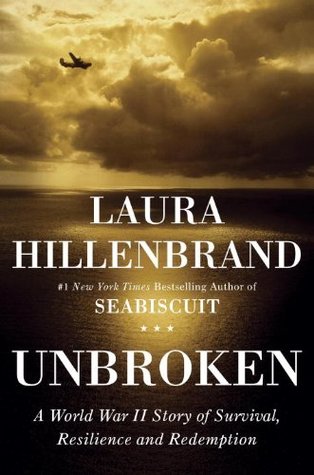
unbrokenUnbroken: a World War II story of survival, resilience, and redemption by Laura Hillenbrand (2010): Incredibly, for a book that came out four years ago, there are still holds on the library copies. This is an enduring work: an incredible piece of scholarship and research, written in an accessible and gripping way, with some truly stomach-churning scenes. Technically it’s a biography of Louis Zamperini, an Olympic runner in the 1930s and an airman in WWII who was shot down, spent over a month at sea, only to be held as a Japanese POW for the remainder of the war, but the story seems too big to belong to just one person.

The Devil in the White City: murder, magic, and madness at the fair that changed America by Erik Larson (2003): Larson’s book, too, remains popular more than a decade after its initial publication. He tells twin narratives: that of the Chicago World’s Fair architects, and that of the serial killer Henry Holmes. The year 1893 comes alive, both the “white city” and the “black city.” I had thought that the two narratives would eventually weave together and converge, and that doesn’t happen, but it’s still an excellent read – sometimes terrifying, filled with interesting details (did you know the Ferris Wheel premiered at the Chicago World’s Fair?), and never boring.

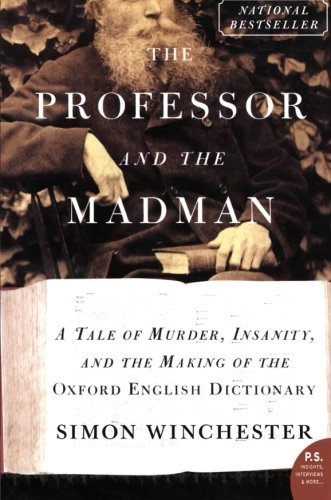
professorandmadmanThe Professor and the Madman: a tale of murder, insanity, and the making of the Oxford English Dictionary by Simon Winchester (1998): The subtitle really sums it all up. The eponymous professor, James Murray, was the editor of the first edition of the OED, and the eponymous madman was one Dr. William Minor, an American doctor incarcerated in an asylum in England, and a significant contributor to the OED. Fascinating on a number of levels, and refreshingly brief at under 300 pages.

Tender at the Bone by Ruth Reichl (1998) and My Life In France by Julia Child (2006): Those who like memoirs and who are interested in food couldn’t choose a better book than Tender at the Bone. Reichl is a funnier writer than I expected, and I still intend to read her other books (Garlic and Sapphires, Comfort Me With Apples). Having said that, for those who like history and travel as well as memoirs and cooking, My Life in France is the book for you. Child is funny, observant, brave, and unselfconscious; I adored this book.

Life by Keith Richards (2010) and John Lennon: The Life by Philip Norman (2008): If you are planning to read both of these books, read Lennon first; Norman’s book is packed with detail, thanks to his thorough research, but it is less lively and immediate than Richards’ Life. Partly the difference stems from the voice; Lennon is a biography, while Life is an autobiography, and Richards’ account has the benefit of being in his own words. He remembers far more than anyone could expect him to, and in addition to plenty of anecdotes, Life contains memorable lines like “I imagined everything. I never thought it would happen.” (The audiobook is great too.) The Norman is a bit drier, but it does contain plenty of early Beatles history, who-wrote-what-and-why bits, and perspective on the later years; while one can’t help thinking John was a bit of a jerk, Yoko Ono is presented in a way that even I can’t hate her (as I was brought up to do). On balance, though, Keith’s book is just more fun.

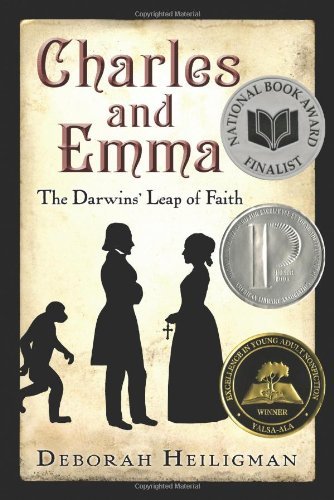
charlesandemmaCharles and Emma: The Darwins’ Leap of Faith by Deborah Heiligman (2008): Biographies written for adults – especially biographies of such major historical figures as Charles Darwin – tend to be doorstops, which can deter those of us who want to learn about someone without, perhaps, learning every single thing about them that a biographer can unearth. Charles and Emma is written for a young adult audience, but it’s a wonderful book for older readers too. Heiligman chooses to view Darwin’s life through the lens of his marriage to his cousin Emma Wedgwood; she is a faithful Christian, and he is a scientist whose theory still sends modern Christians into fits (see: evolution vs. “intelligent design” in science textbooks). Their marriage is a microcosm of this debate that is still ongoing, but it is a thoughtful and respectful one.

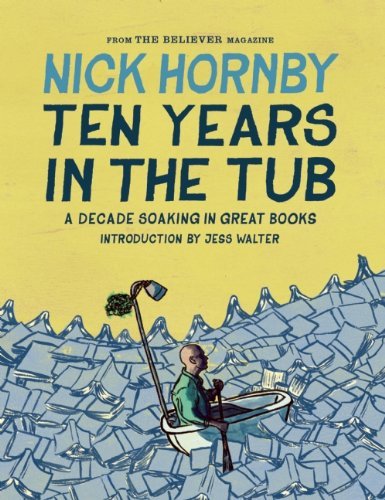
Ten Years in the Tub by Nick Hornby

I hesitate to mention this, as it’s January 14 and this is my first post here since the beginning of the year (though I did write about Simon Garfield’s engaging To the Letter, and the letter-writing resolution it inspired, on my other blog last week), but one of my new year’s resolutions is to post here more regularly: specifically, once a week, although occasionally there may be extra posts, and I’m allowing myself to miss the occasional week for vacations, illnesses, etc. I’m sure my twenty readers will be crushed by these lapses.

While I was considering a reasonable frequency for blog posts, I was also considering content. Should I limit myself to book reviews? That would focus things a bit more; this could be a book review blog. But I like having the latitude to write about any issue relevant to libraries, publishing, intellectual freedom, etc. that catches my interest, so I decided not to change the content much.
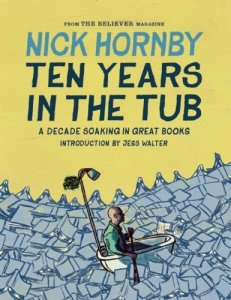
tenyearsinthetubThat said, Nick Hornby’s Ten Years in the Tub, a collection of his columns for the Believer over the past decade, presents a really excellent structure for writing about books, the only problem being that Nick Hornby’s already gone and done it. Even though, given 2,000 words a month, I’d write different things about different books (and I wouldn’t write at all about cricket or football), it seems a bit cheap to steal his format.

For today, then, I’ll just write about what Hornby has written about what he’s read. (How’s that for meta?) For those who aren’t familiar with his Believer column, he starts each one off with a list of “Books Bought” and “Books Read.” (It’s already a brilliant idea, isn’t it?) The overlap between the two lists varies from month to month, as you can imagine, and it’s interesting to see how one book leads to another, what gets read and what gets set aside, sometimes cropping up months later.

As he is writing about so many books in a relatively small space, his transitions can be a bit jarring (or rather, transitions are often lacking entirely); some books receive several paragraphs of attention and others are dealt with in a sentence or two. We can forgive this unevenness though, because Hornby writes with humor, self-deprecation, and intelligence. He often turns on himself, retracting something he wrote in a previous month or even earlier in the same column; for example, one month he writes, “Books are, let’s face it, better than everything else.” Yes! But the next time the World Cup rolls around, he does a reversal.

Hornby has a talent for articulating thoughts that might have occurred to many of us in a fuzzier form, but he does it in a way that is concise and sharp, observant and true. In two or three separate columns, he wrote about major works that have influenced literature in a significant way since their publication. Here he is, once he’s finally gotten around to reading In Cold Blood by Truman Capote: “But the trouble with influential books is that if you have absorbed the influence without ever reading the original, then it can sometimes be hard to appreciate the magnitude of its achievement.” And here again, after reading The Prime of Miss Jean Brodie by Muriel Spark (whose other books he gobbled up like candy – or perhaps the more apt metaphor in his case would be ‘inhaled like cigarettes’): “Influential books are often a disappointment, if they’re properly influential, because influence cannot guarantee the quality of the imitators, and your appetite for the original has been partially sated by its poor copies.” Finally, here he is on Voltaire: “The trouble with Candide is that it’s one of those books that we’ve all read, whether we’ve read it or not….The meat was picked off it and thrown to the crowd in the eighteenth century…”

It just so happens I’ve read and loved all three of those books, though I was younger than Hornby when I read them. (I’m still younger than him now. Ha!) Candide, in particular, I read in eleventh grade; I remember being intimidated because it was old, and French, and a classic, but felt better when I saw how tiny it was, and upon reading it thought it quite funny and not intimidating at all. I do see his point about The Prime of Miss Jean Brodie; I saw the movie after reading the book (I think) and Maggie Smith was – as she always is – tremendous, and memorable. The point stands, though, about influence, and it makes me feel a bit better that I didn’t love Catcher in the Rye the way I was supposed to, even though I read it when you’re supposed to (age 16 or thereabouts). For a young adult classic, I love The Perks of Being a Wallflower a hundred times better.

Though at one point Hornby warns against revisiting old favorites, in case they don’t hold up over time, he also sees forgetting as an opportunity. In one column, he writes, “A couple of months ago, I became depressed by the realization that I’d forgotten pretty much everything I’ve ever read….I am now cheered by the realization that, if I’ve forgotten everything I’ve ever read, then I can read some of my favorite books again as if for the first time.” This is cheering, indeed. I used to re-read books much more often than I do now; as Hornby says, “I don’t reread books very often; I’m too conscious of both my ignorance and my mortality.” But at least a few times a year, I’ll read a book that I know, usually even before I’ve finished it, that I want to read again. Off the top of my head: Gold by Chris Cleave, The Rules of Civility by Amor Towles, The Night Circus by Erin Morgenstern, and Me Before You by Jojo Moyes. (Incidentally, that’s two British authors and two Americans, two men and two women. Neat.)

After I graduated from college and began working in publishing, I went on what could pretty accurately be described as a two- or three-year fiction binge. I forget which year it was that I made a resolution to read at least one nonfiction book a month, but I did it when reading nothing but fiction came to feel like eating nothing but candy. (Not to say that fiction can’t be just as “good for you” as nonfiction. I’m not getting into that here.) So when Hornby wrote that he was “beginning to see that our appetite for books is the same as our appetite for food, that our brain tells us when we need the literary equivalent of salads, or chocolate, or meat and potatoes,” I knew exactly what he meant. (My reading diet has been much more balanced since that resolution, though it still skews toward fiction.)

In two of his more recent essays, Hornby wrote about books “of the moment” – those books saturated with contemporary period details, set in a very particular place and time, complete with all its cultural references. It’s often noted in criticism of books like this that they will lose their appeal over time. “The received wisdom is that novels too much of the moment won’t last; but what else do we have that delves so deeply into what we were thinking and feeling at any given period? ….Some fiction at least should deal with the state of the here and now, no matter what the cost to the work’s durability, no?” Hornby asks. These books, he argues, have just as much if not more historical value than well-researched historical fiction, because they provide insight to what people were thinking and feeling in a given place and time.

Speaking of “the moment,” why, when we have e-books, do people still buy and read printed books? In part because “all the books we own, read or unread, are the fullest expression of self we have at our disposal….With each passing year…our libraries become more and more able to articulate who we are.” For readers, our books are us, and our bookshelves show who we are, what we love, who we aspire to be. As Oscar Wilde said, “It is what you read when you don’t have to that determines what you will be when you can’t help it.”

As someone who often tracks down books referenced, even fleetingly, in other books, it’s not surprising that I ended up with a nice list of books to add to my already intimidatingly long “to-read” list by the time I came to the end of Ten Years in the Tub. Here they are:
skelligFiction (including children’s/YA)
Mystic River by Dennis Lehane
We’re in Trouble: stories by Chris Coake
Skellig by David Almond
Tom’s Midnight Garden by Philippa Pearce (nearly certain I read this as a child, but have forgotten it sufficiently to warrant a re-reading)
Ten Thousand Saints by Eleanor Henderson
any book by Anne Tyler
sarahvowellNonfiction
How to Live: or, a life of Montaigne, in one question and twenty attempts at an answer by Sarah Bakewell (on top of Hornby’s recommendation, I remember that the reviews and awards for this book were spectacular)
Book of Days: personal essays by Emily Fox Gordon
A Giacometti Portrait by James Lord
The Rights of the Reader by Daniel Pennac
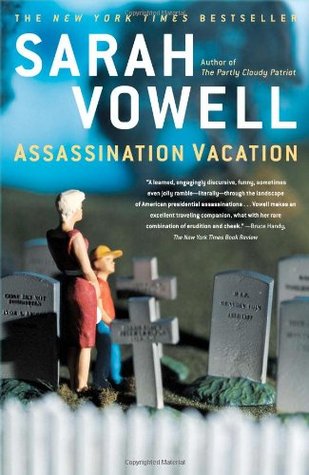
Assassination Vacation by Sarah Vowell (this was already on my to-read list; I loved The Wordy Shipmates and Unfamiliar Fishes)
 

Yearly wrap-up, 2013 edition

In the spirit of those sites that do a weekly wrap-up (like Dooce’s “Stuff I found while looking around” and The Bloggess’ “Sh*t I did when I wasn’t here”), here are a few odds and ends I found while going through my work e-mail inbox and my drafts folder.

How to Search: “How to Use Google Search More Effectively” is a fantastic infographic that will teach you at least one new trick, if not several. It was developed for college students, but most of the content applies to everyday Google-users. Google has its own Tips & Tricks section as well, which is probably updated to reflect changes and new features.

How to Take Care of Your Books: “Dos and Don’ts for Taking Care of Your Personal Books at Home” is a great article by Shelly Smith, the New York Public Library’s Head of Conservation Treatment. Smith recommends shelving your books upright, keeping them out of direct sunlight and extreme temperatures, and dusting. (Sigh. Yes, dusting.)

The ARPANET Dialogues: “In the period between 1975 and 1979, the Agency convened a rare series of conversations between an eccentric cast of characters representing a wide range of perspectives within the contemporary social, political and cultural milieu. The ARPANET Dialogues is a serial document which archives these conversations.” The “eccentric cast of characters” includes Ronald Reagan, Edward Said, Jane Fonda, Jim Henson, Ayn Rand, and Yoko Ono, among others. A gem of Internet history.

All About ARCs: Some librarians over at Stacked developed a survey about how librarians, bloggers, teachers, and booksellers use Advance Reader Copies (ARCs). There were 474 responses to the survey, and the authors summarized and analyzed the results beautifully. I read a lot of ARCs, both in print and through NetGalley or Edelweiss, and I was surprised to learn the extent of the changes between the ARC stage and the finished book; I had assumed changes were copy-level ones, not substantial content-level ones, but sometimes they are. (I also miss the dedication and acknowledgements.)

E-books vs. Print books: There were, at a conservative estimate, approximately a zillion articles and blog posts this year about e-books, but I especially liked this one from The Guardian, “Why ebooks are a different genre from print.” Stuart Kelly wrote, “There are two aspects to the ebook that seem to me profoundly to alter the relationship between the reader and the text. With the book, the reader’s relationship to the text is private, and the book is continuous over space, time and reader. Neither of these propositions is necessarily the case with the ebook.” He continued, “The printed book…is astonishingly stable over time, place and reader….The book, seen this way, is a radically egalitarian proposition compared to the ebook. The book treats every reader the same way.”

On (used) bookselling: This has been languishing in my drafts folder for nearly two years now. A somewhat tongue-in-cheek but not overly snarky list, “25 Things I Learned From Opening a Bookstore” includes such amusing lessons as “If someone comes in and asks for a recommendation and you ask for the name of a book that they liked and they can’t think of one, the person is not really a reader.  Recommend Nicholas Sparks.” Good for librarians as well as booksellers (though I’d hesitate to recommend Sparks).

The-Library-Book-154x250_largeOn Libraries: Along the same lines, I really enjoyed Lucy Mangan’s essay “The Rules” in The Library Book. Mangan’s “rules” are those she would enforce in her own personal library, and they include: (2) Silence is to be maintained at all times. For younger patrons, “silence” is an ancient tradition, dating from pre-digital times. It means “the absence of sound.” Sound includes talking. (3) I will provide tea and coffee at cost price, the descriptive terms for which will be limited to “black,” “white,” “no/one/two/three sugars” and “cup.” Anyone who asks for a latte, cappuccino or anything herbal anything will be taken outside and killed. Silently.

On Weeding: It’s a truth often unacknowledged that libraries possessed of many books must be in want of space to put them – or must decide to get rid of some. Julie Goldberg wrote an excellent essay on this topic, “I Can’t Believe You’re Throwing Out Books!” I also wrote a piece for the local paper, in which I explain the “culling” of our collection (not my choice of headline).

“What We Talk About When We Talk About Public Libraries”: In an essay for In the Library with the Lead Pipe, Australian Hugh Rundle wrote about the lack of incentives for public librarians to do research to test whether public libraries are achieving their desired outcomes.

Public Journalism, Private Platforms: Dan Gillmor questions how much journalists know about security, and how much control they have over their content once it’s published online. (Article by Caroline O’Donovan at Nieman Journalism Lab)

Choose your favorite year-end metaphor, or, Bookish resolutions (again)

I dearly wish my “end-of-the-year to-blog-folder cleanup” could be as neat and tidy as Brian’s, but alas, there are 21 unfinished drafts, some going back as far as 2011. That might be a good project for the last days of December and the first part of January, but first I’m trying to compile my year-end reading statistics, a project that has been snarled by a mid-year switch from Goodreads to LibraryThing (documented here and here).

I’ve been using LT pretty much exclusively since September, but LT’s statistics, while charmingly quirky (are the authors of the books I read dead or alive?), aren’t the sort I’m looking for. Goodreads, on the other hand, offers stats that are less imaginative but more practical: how many books read this year? How many pages? I thought I’d solve the problem by importing some of my LT data back into Goodreads, sans reviews, but Goodreads didn’t recognize my “date started/date finished” headings (which I had to acquire in a hacky way to begin with, because that information isn’t included in LT’s export feature: I tweaked some display preferences, got a print view, copied and pasted into Excel).

So it’s all a bit of a mess, but as best I can tell I read 159 books this year (so far!), but subtract seven “partially-read” books from that number to get 152 books for 2013. That’s about 12.6 books per month (though again, December isn’t over, and I’m halfway through David Sedaris’ laugh-out-loud Let’s Explore Diabetes With Owls). This number is rather astonishingly close to last year’s: I read 159 books in 2012. I don’t really expect to improve upon that, but of course it’s not about the numbers really; it’s about the quality, and I did read some wonderful books this year.

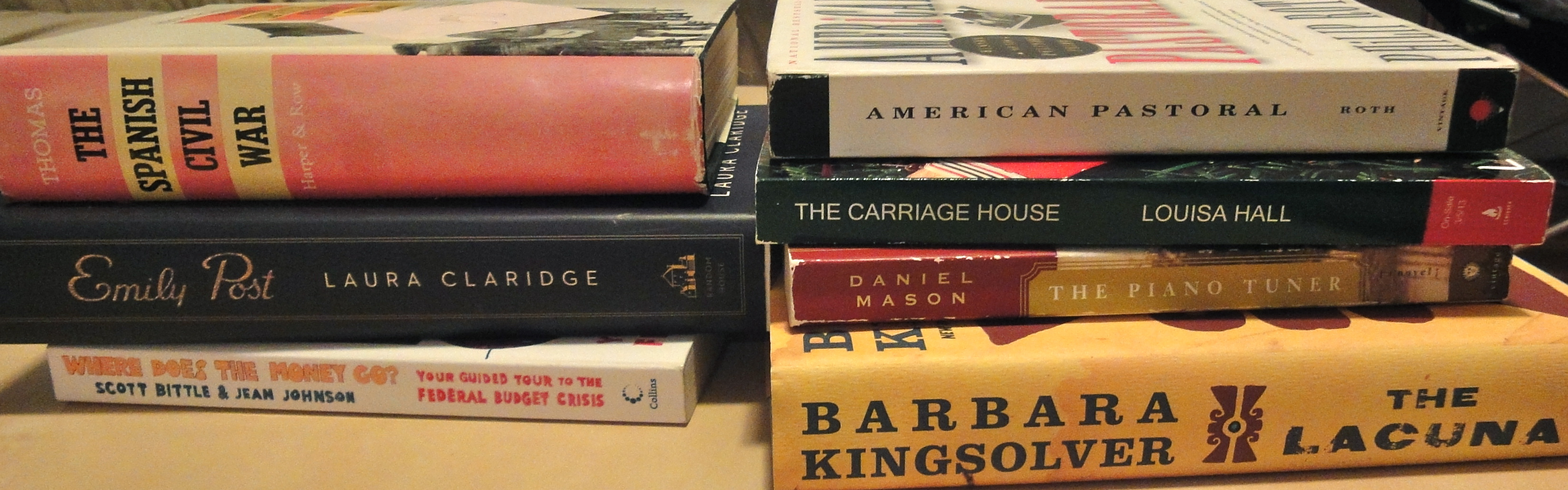
And how did I do on my New Year’s resolution to read all the unread books on my shelves at home? Not terribly well at all. Of those pictured in the link, I read two (Olive Kitteridge and The Carriage House), but throughout the year the “at home and unread” shelf/pile(s) morphed. (Yes, I think morphed is the word.) I decided not to read (and therefore, to give away) several of them (see below), but many I still intend to read, and my dear sweet friends at various publishing houses sent even more. Fortunately, I had Christmas* day to take all my books off their shelves, dust, rearrange, and catalog: the “to be read” books are now on a shelf (okay, 1.5 shelves) in the living room, where I’ll be faced with them every day. I also bought the e-book of Far From the Tree, which I started and loved but could not make myself lug around (900+ pages!); now that it’s more portable I have no excuse.

*That’s what Christmas is for, right? Movies, Chinese food, and cataloging one’s books?

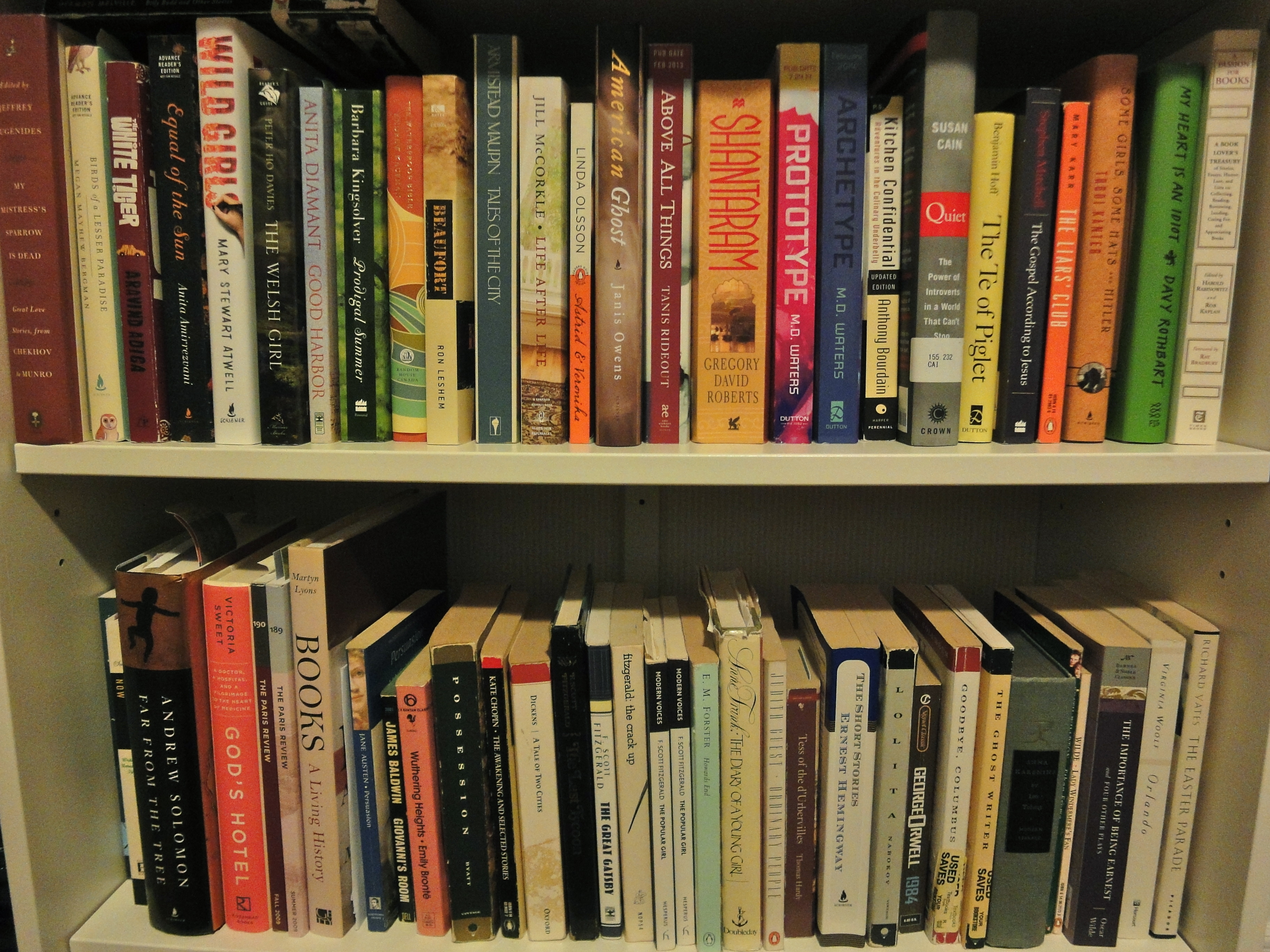
So, here’s the to-read shelf for 2014 (click to enlarge):

DSC06250

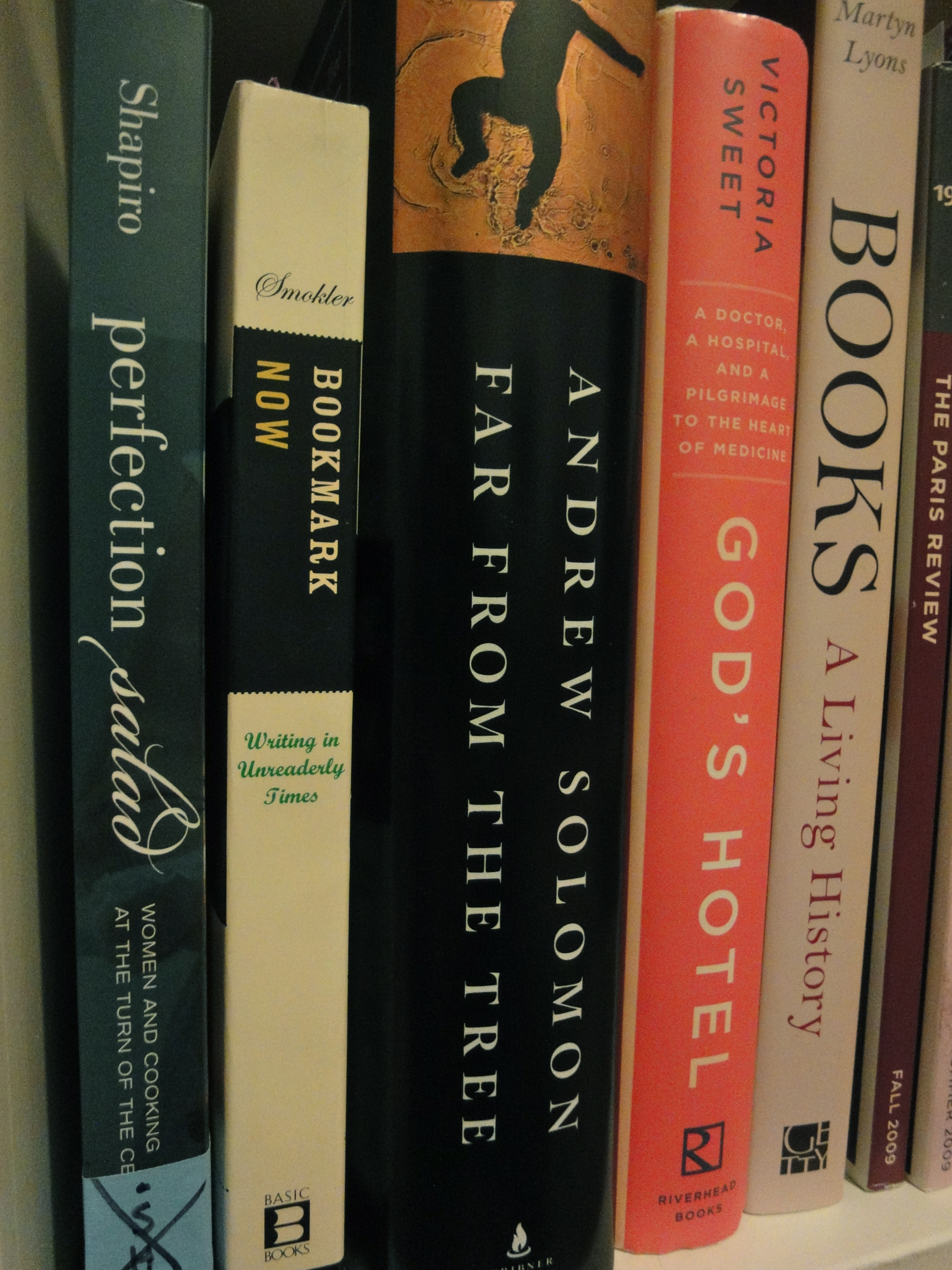
It’s all the books on the top shelf, starting with short stories, then fiction, then nonfiction, which continues onto the first part of the next shelf (see below).

DSC06251Do you see your favorite book on my to-read shelf? Tell me why I should move it to the top of the list!

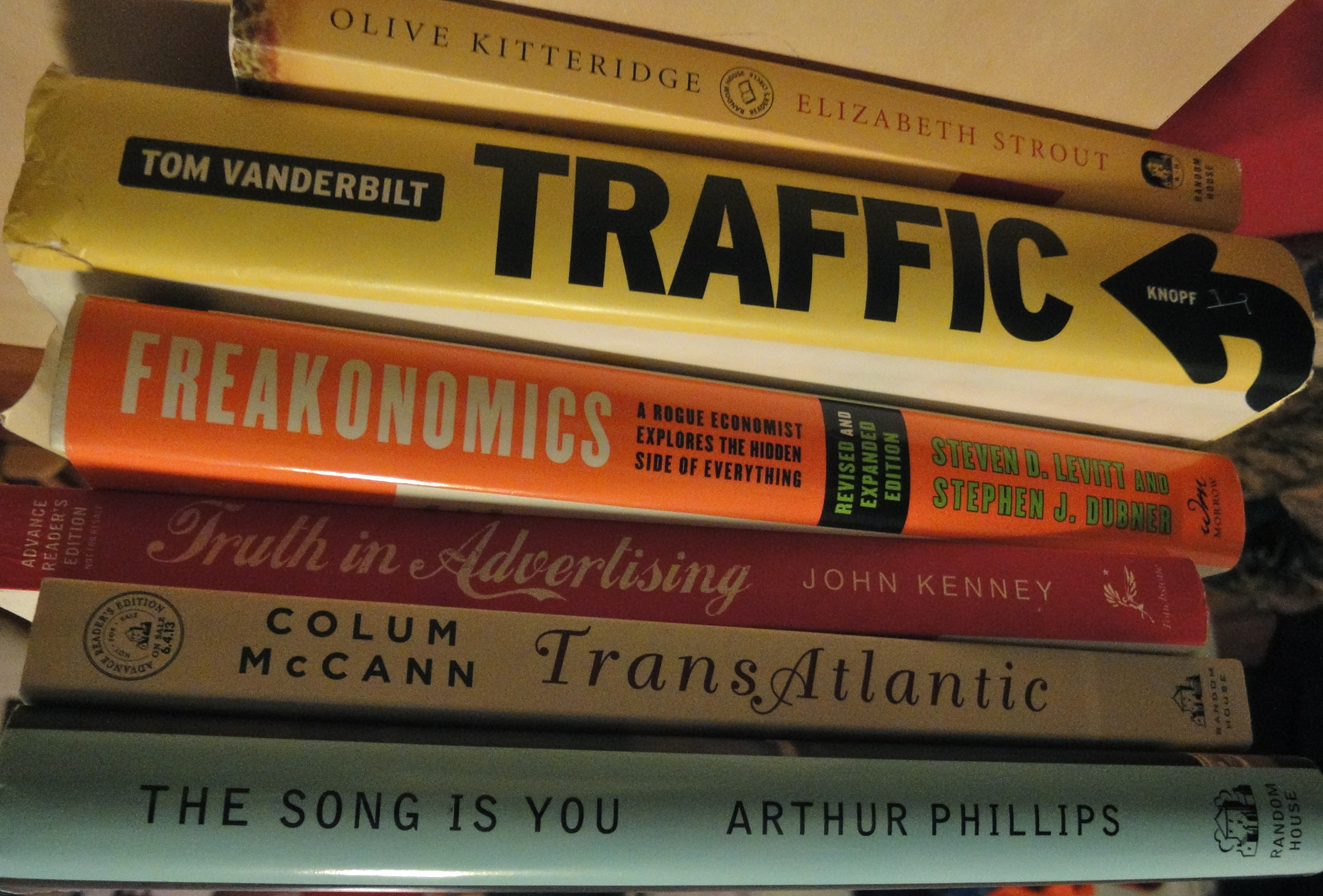
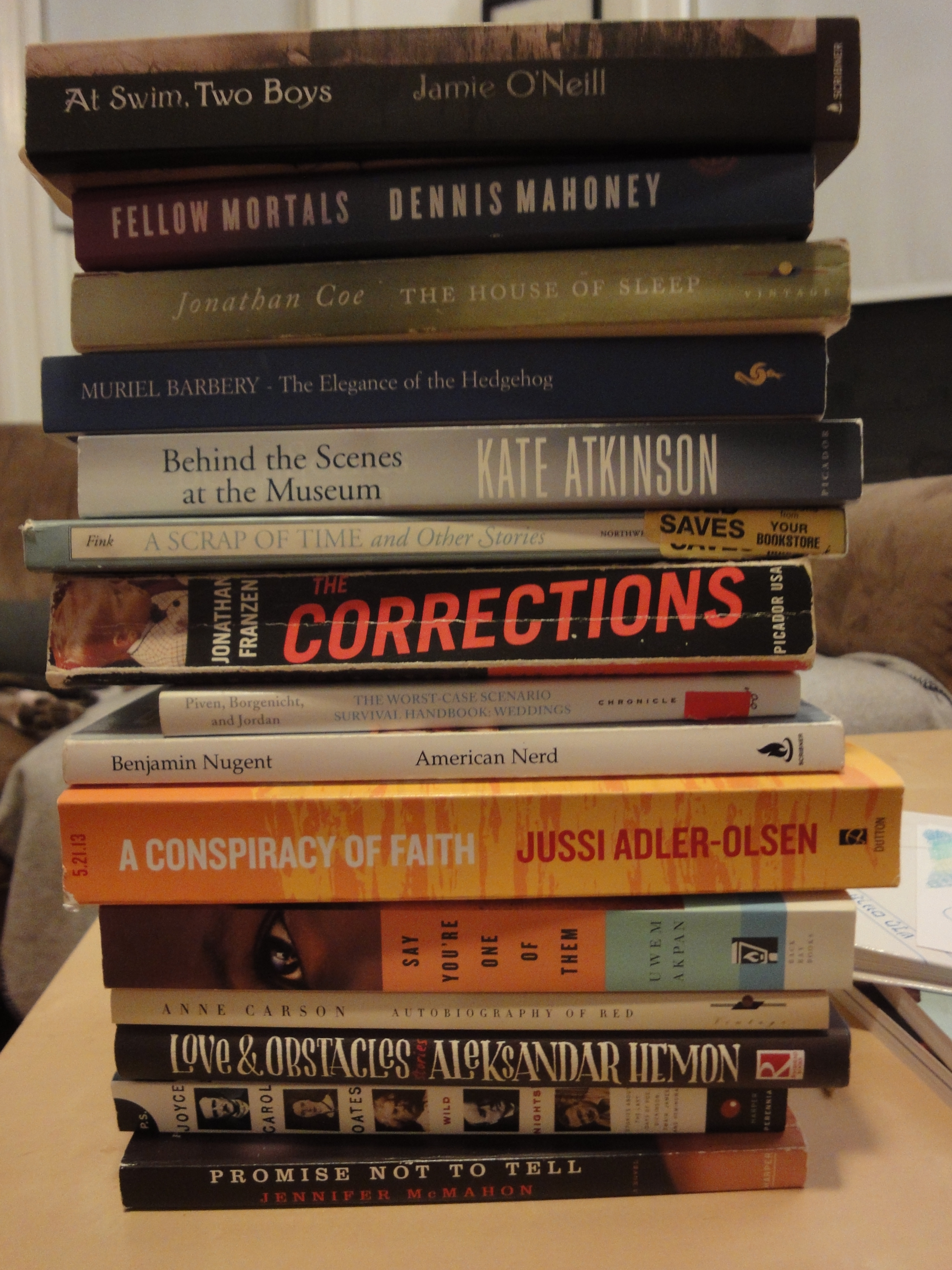
Here are the books I deaccessioned (fancy word for “got rid of”) or am deaccessioning soon:

DSC06080

Of the books in the photo above, I read Olive Kitteridge, TransAtlantic, The Song Is You, and about half of TrafficThe others remain unread (by me).

DSC06245

Of those in this photo, I read the nine on top, but the five on the bottom went unread.

DSC06081

Of these, I read four and a half. Or thereabouts.

So that’s it, my year in reading. Did you make a bookish resolution? I’m curious to hear.


“Love is easy and strange”: Maggie O’Farrell

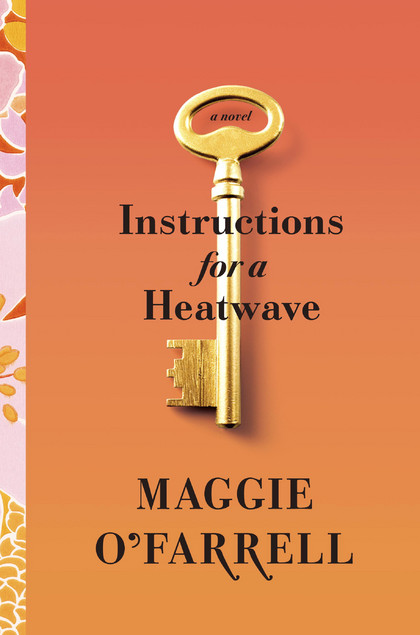
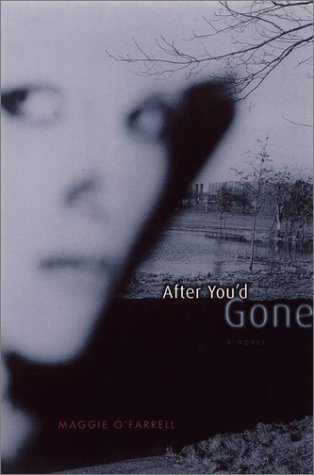
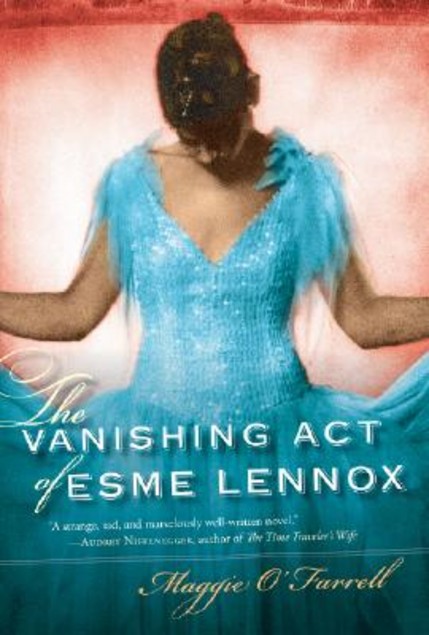
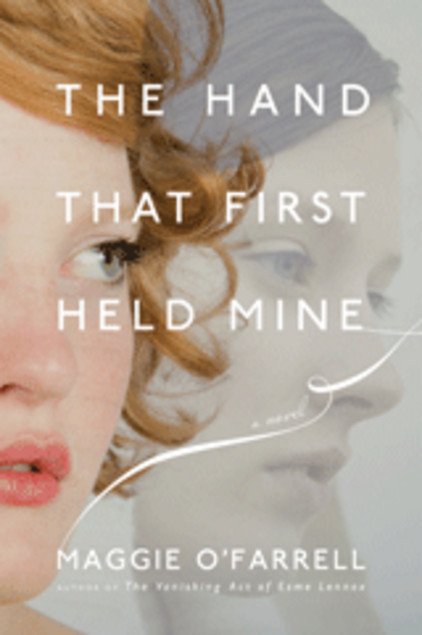
instructionsheatwaveI mentioned Instructions for a Heatwave by Maggie O’Farrell in my previous post highlighting some of my favorite books of 2013 (and a few from 2012). What I did not mention is that, since listening to John Lee narrate Instructions for a Heatwave, I’ve listened to or read every other novel of hers I could get my hands on, starting with The Vanishing Act of Esme Lennox (2006, read by Anne Flosnik), continuing with The Hand That First Held Mine (2010, also read by Anne Flosnik), and most recently, After You’d Gone (2001). Just now I’m waiting for The Distance Between Us (2004) to arrive from another library; after that, there’s My Lover’s Lover (2003), and then I’ll be waiting for her next book just like everyone else, I imagine – impatiently.

Ann Patchett, one of my all-time favorite authors, has said that she writes the same book over and over, and it is true that her books feature characters in situations that are unfamiliar to them, often accompanied by strangers. Agatha Christie wrote mysteries that took place in enclosed environments, such as a small village or a country estate; Jojo Moyes often (though not always) writes love stories that are connected through generations, adding an element of historical resonance and nostalgia. O’Farrell’s gift, talent, or fixation (as Patchett says, I write the book I want to read) is for explosive family secrets – usually something hidden from a younger generation by an older one, slowly uncovered as the two stories are woven together.

afteryoudgoneAfter You’d Gone is an early example of this pattern. Alice Raikes was born in Scotland but is living in London; one day, she takes a train to Edinburgh, where her sisters meet her at the station. However, when Alice goes to the loo, she sees something so shocking that she leaves her sisters, takes a train back to London, and, later that day, steps off the curb into moving traffic. While Alice lies in a coma and her family travels to be with her, Alice’s history and that of her family is slowly revealed. Alice’s mother Ann married Ben even though she did not love him – a fact not lost on Ben’s mother Elspeth – and when Alice learns her mother’s secret, it changes her own relationship to her whole family. This revelation, on top of Alice’s grief over a recent tragedy of her own, leads to Alice’s desperate action. The story is narrated mostly in the third person, but there are a few sections in first person, for no clear reason. This puzzlement aside, the book is almost flawless; though the plot is not as intricate and unguessable as in later books, the pacing and characters are superb.

vanishingactesmelennoxMore than almost any other book I’ve read, The Vanishing Act of Esme Lennox illustrates in heartbreaking fashion the social constraints on women as recently as two generations ago, by juxtaposing Esme’s story with that of her grand-niece, Iris. Iris receives a call one day from Cauldstone Hospital; despite her ignorance of Esme’s existence – her grandmother Kathleen (Kitty) never mentioned siblings – Iris is listed as the elderly Esme’s next of kin. Nevertheless, Iris can’t abandon Esme, so she brings her home with her temporarily. Esme – who doesn’t seem mad at all, despite having spent most of her life institutionalized – is stunned by Iris’ life: her freedom to live alone, wear what she likes, manage her own business, not rely on a husband or father. These were the things Esme wanted for herself, but which were unthinkable in her time, and that situation led to tragedy upon tragedy. Narration is in the third person, alternating between Iris’ and Esme’s point of view, occasionally interspersed with Kitty’s stream-of-consciousness thoughts from within her Alzheimer’s haze. In this way, the reader understands Esme’s story more fully than Iris does, but Iris still understands enough to piece together crucial parts of the past. The story concludes with Esme and Kitty meeting again for the first time since they were teenagers, and a final, shocking event.

handthatfirstheldmineThe Hand That First Held Mine also weaves two stories together from different time periods, but in this case it is less immediately apparent how they are connected. In the mid-1990s (?), Ted and Elina are at home with their new baby, after a horrifying labor and a near-death experience for Elina, the trauma of which she has blocked out. The memories trickle back, however, and having a baby in the house seems to be bringing back Ted’s earliest memories as well; these memories raise questions that Ted’s mother refuses to answer. The answers, of course, lie in the past: in the late 1950s, Lexie Sinclair runs away to London, where she falls in love with Innes Kent. She works at Innes’ magazine and eventually moves in with him, but this makes Innes’ wife Gloria furious, despite the fact that she and Innes are separated. Gloria turns her daughter Margot against Innes and Lexie, with long-reaching consequences for them all. (In fact, when I got to the part where a major piece of the puzzle is revealed, I actually said “Oh my God” out loud.) In The Hand That First Held Mine, O’Farrell’s genius for intricate plotting is breathtaking, and her gift for characterization will leave no reader unaffected.

Of all the reading I’ve done this year, Maggie O’Farrell’s books have been some of the best. Though I wouldn’t want to be one of her characters, I’ll be recommending her books for years to come.

What’s the first thing you remember?

A couple days ago, our library director issued a call for contributions to our annual “staff picks/best books” column for the local paper. I skimmed my LibraryThing catalog to look over what I’d read this past year, disqualifying anything that was published before 2012…and I ended up with nineteen (19)* titles that belonged in my own personal “favorite” category.

*Compiling the “other favorites” list at the end of this post, I added a few more.

fangirlFor my contributions for the column, I excluded YA books because many of us on staff – including, of course – the YA librarian – read and love YA, and I figured the books I would write about (Every Day by David Levithan, Eleanor & Park and Fangirl by Rainbow Rowell, Wonder by R.J. Palacio, The Raven Boys and The Dream Thieves by Maggie Stiefvater, Code Name Verity by Elizabeth Wein, and Just One Day by Gayle Forman) are the ones they would write about also.

I still couldn’t possibly narrow it down to fewer than five. Here’s what I wrote about my choices (below), and after those are the rest of the list.

Instructions for a Heatwave by Maggie O’Farrell
O’Farrell’s sixth novel is set in London during the legendary heatwave of 1976. Robert Riordan goes to get the paper one morning and disappears; his wife, Gretta, is frantic, and calls their three grown children home. Misunderstandings between siblings are resolved and buried secrets come to light, but the true genius of this book is how deeply the reader sees inside each character, while the characters lack that same insight into each other.

feverFever by Mary Beth Keane
I’m afraid this brilliantly imagined work of historical fiction did not receive the buzz it deserved. Keane brings Irish immigrant Mary Mallon, a.k.a. “Typhoid Mary,” to life in early 1900s New York, and creates a portrait of a woman whose calling was cooking, but whose cooking was lethal. For perhaps the first time, readers will have sympathy for Mary.

The Smartest Kids in the World by Amanda Ripley
Ripley follows three American exchange students through a year in Finland, Poland, and South Korea – all countries whose PISA scores have shot up over the past decade – to investigate how these countries have improved their education systems and whether the United States can adopt a new approach successfully. The writing is lively and clear, the research is solid, the results are not tremendously surprising – it comes down to teachers and rigor.

lifeafterlife_atkinson

Life After Life by Kate Atkinson
Life After Life is like the movie Sliding Doors, but with more doors; protagonist Ursula Todd tries them all, dying and being reborn into her same life again and again. Born in England in 1910, Ursula lives through (or doesn’t) World War I, the Spanish flu, World War II and the Blitz. It’s historical fiction, time travel, and philosophical what-if all rolled into one masterful book.

The Impossible Lives of Greta Wells by Andrew Sean Greer
“The impossible happens once to each of us,” the story begins. Greta in 1985 is grieving: her twin brother is dead of AIDS and her lover has left her. But then Greta wakes up in 1918, and then in 1941. In each time, she is herself, in the same apartment, with the same friends and family, but their relationships are different. As Greta cycles through three selves – in 1918, 1941, and 1985 – she eventually realizes she must decide whether to return to her present, or stay in the past. Toward the end of this beautiful book, she concludes, “What is a perfect world except for one that needs you?”

happymarriage

Other nonfiction favorites:
Lean In by Sheryl Sandberg
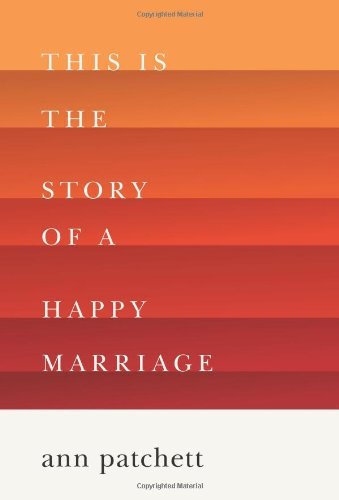
This is the Story of a Happy Marriage by Ann Patchett (essays)
I Don’t Know by Leah Hager Cohen
The Reason I Jump by Naoki Higashida, translated by KA Yoshida and David Mitchell
Just My Type: A Book About Fonts by Simon Garfield
Dear Friend: Rainer Maria Rilke and Paula Modersohn-Becker by Eric Torgersen (1998)

oceanattheendofthelane

Other fiction favorites:
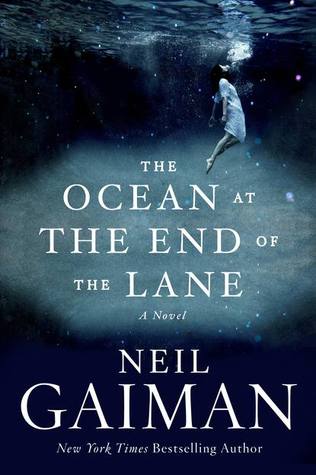
The Ocean at the End of the Lane by Neil Gaiman
Sisterland by Curtis Sittenfeld
Me Before You by Jojo Moyes
The Aviator’s Wife by Melanie Benjamin
Z: A Novel of Zelda Fitzgerald by Therese Anne Fowler
The Vanishing Act of Esme Lennox and The Hand That First Held Mine by Maggie O’Farrell
Astray by Emma Donoghue (short stories)

gogiants

Poetry:
Go Giants by Nick Laird
Aimless Love by Billy Collins
Dog Songs by Mary Oliver

Here are last year’s favorites.

The title of this post is a line from Tom Stoppard’s play Rosencrantz and Guildenstern Are Dead.

David Levithan and Rainbow Rowell at Brookline Booksmith

The Monday before Thanksgiving, I trekked across the river to Brookline to see David LevithanRainbow Rowell, Bill Konigsburg, and Paul Rudnick at the Booksmith. Each author read from one of their books: Rudnick read from Gorgeous, Konigsburg from Openly Straight, Rowell and Levithan from Fangirl (hers) and Two Boys Kissing (his). This might be the first time I’ve seen a pair of authors do a joint reading like this – Levithan made a very funny Levi – and they seemed like they were really having fun (though maybe YA authors just have more fun, in general).

DSC06152

After the readings, they opened up Q&A right away. Here are some snippets:

Levithan, on the 10th anniversary of Boy Meets Boy: “Boy Meets Boy was about creating reality. With Two Boys Kissing I wanted to write something that reflected reality.”

On a reaction to Rowell’s decision to write a novel about college-age characters: “‘College students don’t read.’ I know, be offended, write a letter! ‘Nobody wants to read about college students.’ But I don’t think of writing for one specific audience.” And, she added, readers often want to read about characters a little bit older than themselves (e.g. high school students would be interested in reading about college students).

On the extra pressure Levithan felt for his novel Love is the Higher Law: “You write a bad book, that’s okay. You write a bad book about 9/11, that’s bad.”

Levithan, on writing the character A in Every Day: It was less difficult than he expected; “[When you] take gender out of the equation, sexual orientation doesn’t exist.”

Rowell, on humor in writing: “Funny is subjective.” If a joke she wrote made her laugh, she fought to keep it in the manuscript, even if her agent or editor wasn’t sure about it.

Rowell, on why she chose the physical appearances for Eleanor and Park that she did (chubby and red-headed, and half-Korean, respectively): “You make the decision and you don’t always know where it came from, but it comes from somewhere.” And on attractiveness and attraction: “Attraction happens between two people. That’s it. Two people become attractive to each other.”

Levithan, on making stuff up: “If you’re a writer you make up everything. You’re always being presumptuous.”

On Rowell’s jealousy of the Harry Potter/Internet generation: “Fanfic writers have different rules than published authors.”

Rowell, on writing: “The more you do it, the better you get.”

Levithan, on writing: It’s like the cello. No one expects you to pick up a cello and play a concerto your second time playing. It’s like a muscle you have to develop and strengthen with practice. “Allow yourself to fuck up a lot…Don’t put an expiration date [on your writing], just keep going.”

Someone asked, “What happens when The Lover’s Dictionary Twitter account (@loversdiction) reaches the letter Z?” Levithan said he’s going to wait and see how Sue Grafton (A is for Alibi) handles it, because she’s going to get to the end of the alphabet first. The Twitter account, which he started as a promotion for the book’s release, is now longer than the actual book. He’s currently on the letter G (“Good, adj.: You should choose this so much that it no longer feels like a choice”), and expects to be done in a decade or so. (On losing track of time: “Isn’t 2013 like twelve years from now? No, it’s not.”)

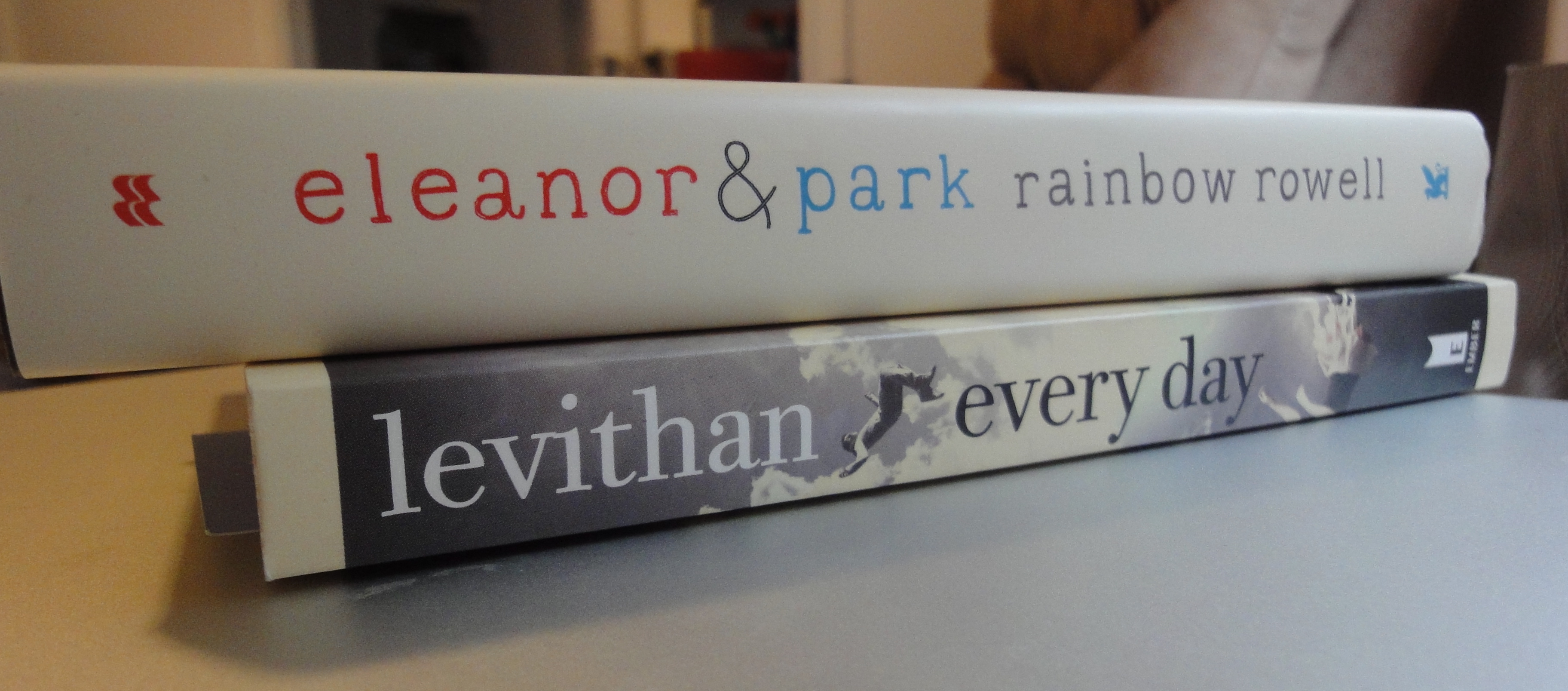
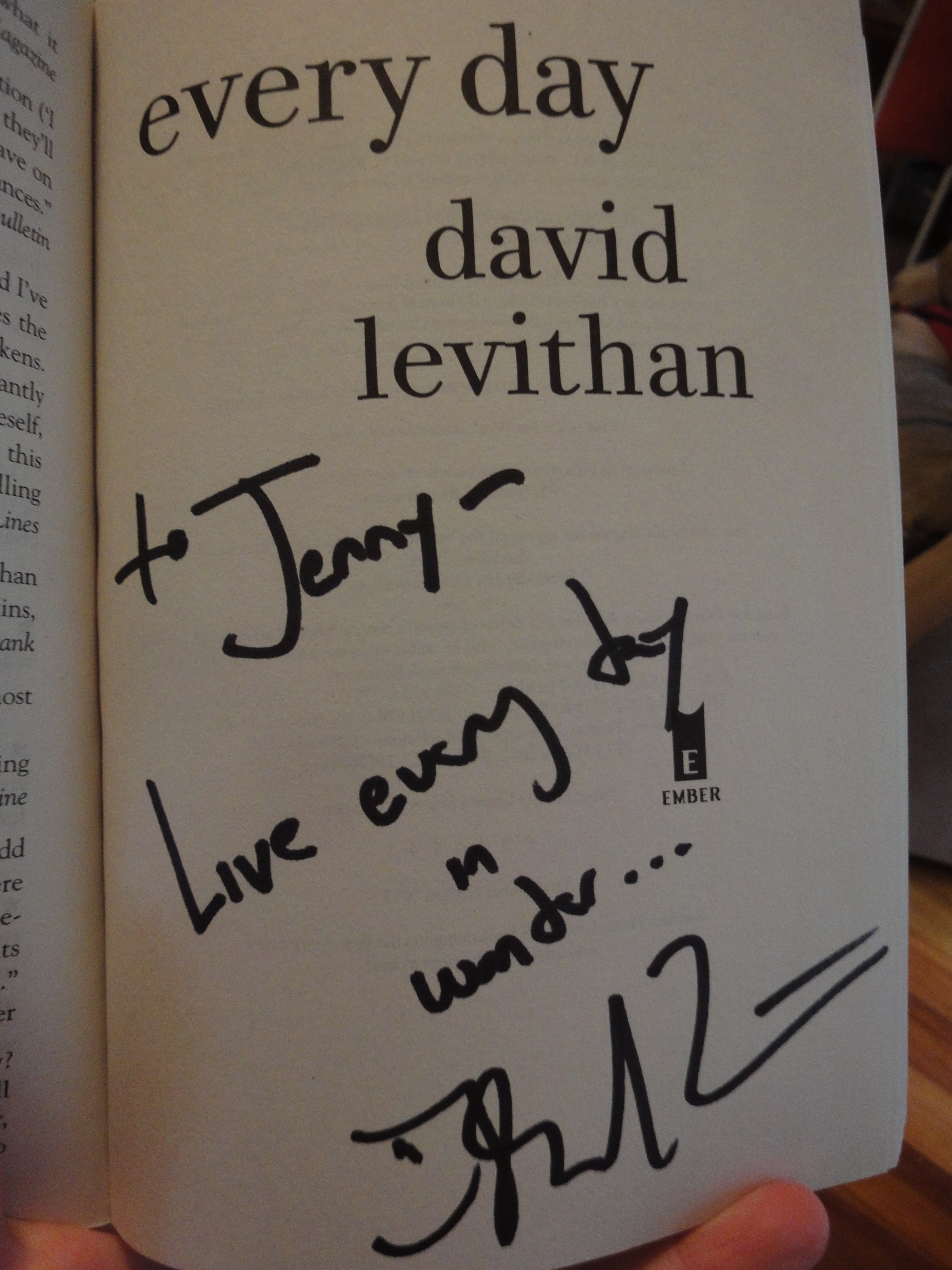
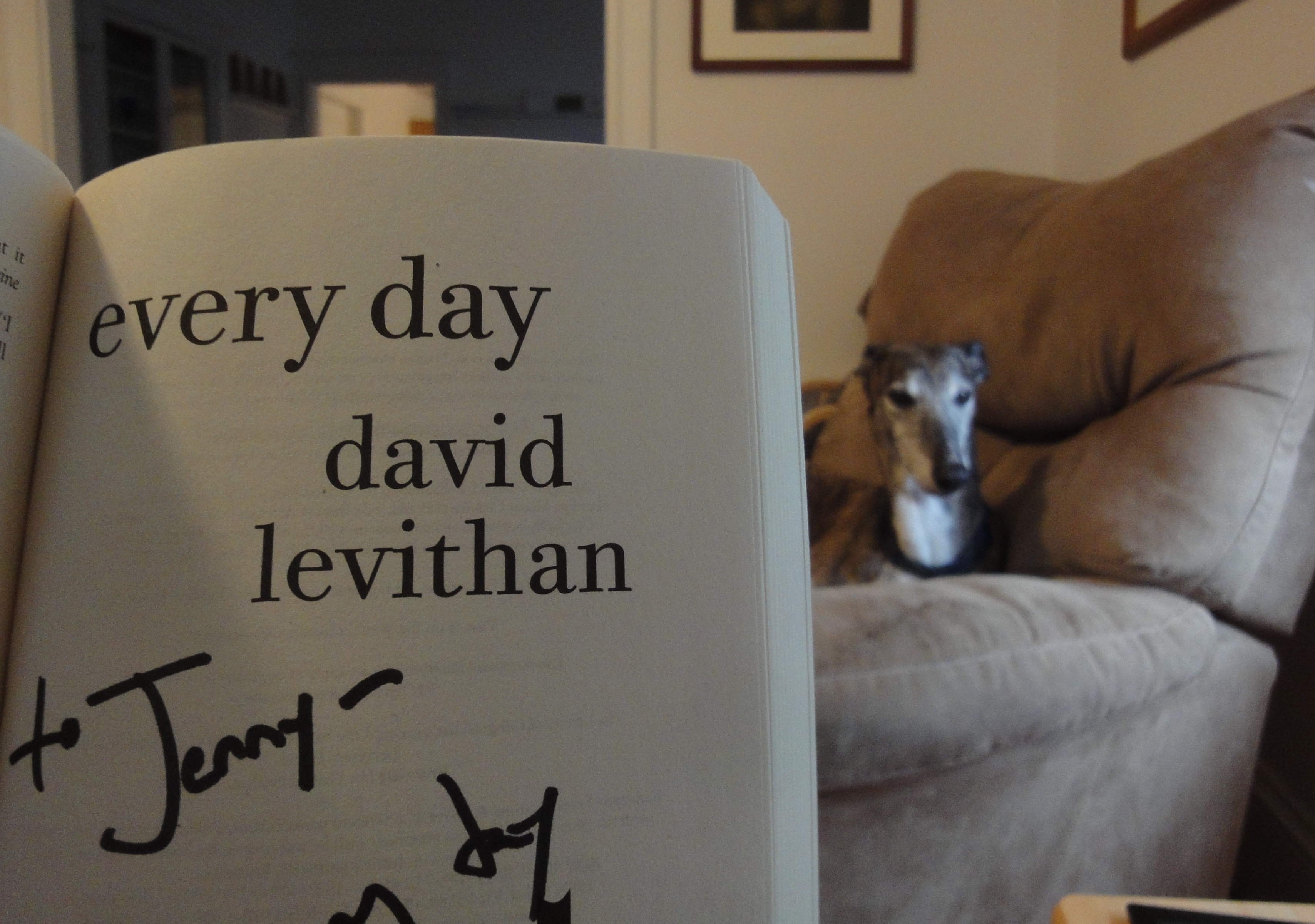
After the Q&A, the authors signed copies of their books. Here’s my new paperback copy of Every Day:

DSC06155


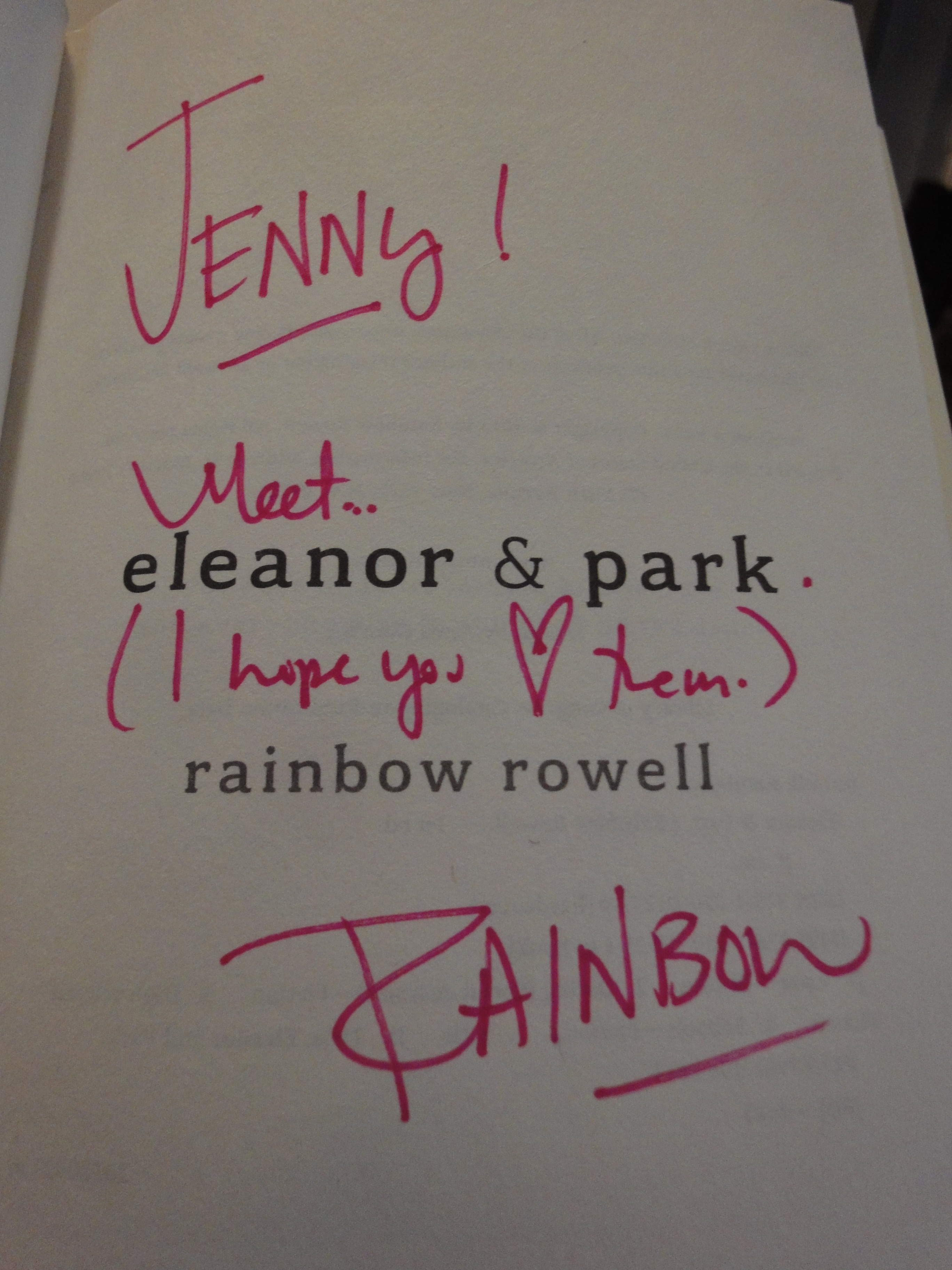
And here’s my new hardcover of Eleanor & Park. The first time I “read” it was the audiobook – and Rebecca Lowman is superb – but I’m looking forward to reading it again in print.

DSC06154


Of course, I already do love them.

The dog, however, is less impressed. Here she is in the background of the title page of Every Day:

DSC06156

She’d be more impressed if she could read, though. (Or if paper tasted more like chicken. But I’m very glad it doesn’t, or none of the books in my house would be safe.)

Anyway…YA books! Read them! Especially these ones.


Media Consumption Assignment

Catching up on those blogs that I read regularly but not every single day, I saw this post from Dan Gillmore at Mediactive: “My Media Habits: One Day.” Gillmore teaches a course in media literacy at Arizona State University, and this was his assignment for his students (and himself):

For one full day, keep track of your own media consumption.  I don’t care if it’s reading a newspaper (in print or online), TV or radio program (broadcast or online), Facebook, YouTube, blogs, Twitter or anything else. Take notes. Then, do a blog post on your own impressions of how you get information and entertainment. For example, what are your main sources of news? Why do you trust them (if you do), and which do you trust more than others? Do you go to news organizations’ home pages or do you mostly read articles via links from other places, such as Facebook? A key question: What do you think you might be missing? Do you care? In general, I want you to explore your own use of media as a consumer. (We’ll look at media creation later on in the course.)

I decided I would do the assignment also. I chose a weekday that I was off work (November 8), and here’s what it looked like:

~9:30-10:30am: Checked e-mail, Twitter, Feedly (webcomics including xkcd, food blog Smitten Kitchen, etiquette blog Emily Post, friend’s blog post that included a link to a piece in Ploughshares Literary Magazine, which I saved to read later). Finished reading an interview (Neil Gaiman interviewing Lou Reed) that a friend had sent me a few days ago. I have a separate e-mail folder (Unroll.me) for newsletters, etc., and I get daily e-mails of headlines from The New York Times and Boston Globe there. I added photos to a blog post for work (about six-word memoirs) and published it (I suppose that’s creation, not consumption). Glanced at Facebook notifications, didn’t click any links or spend more than a minute on the news feed page. Also from Unroll.me folder: Goodreads with updates on what friends have read or added, Publishers Lunch newsletter. Did not check weather (I usually use weather.com), and was surprised by some hail later in the day.

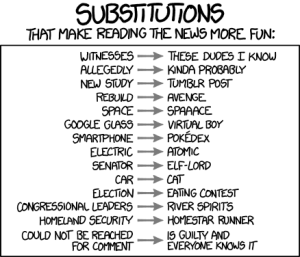
substitutions

~12:30pm: Read a few pages of This Is The Story of A Happy Marriage by Ann Patchett.

~4:30pm: Used Amazon to look up the title of a book someone recommended to me over coffee; requested the book through my library catalog. Used Scrivener to figure out a typeface, then replied to a thread on Twitter; followed a link from Twitter and read an article from The Atlantic. Used Feedly to read the three most recent posts on Copyfight, skim the last few days of posts from Cory Doctorow on BoingBoing, and read the most recent three posts on Dooce.

~9:00-10:30: Read more of the Ann Patchett book; watched two episodes of 30 Rock (final season) from Netflix.

I’ll answer Gillmore’s questions one by one, starting with…

What are your main sources of news? nytlogo379x64

The New York Times and the Boston Globe, but primarily the NYT. Also, fairly often: the Washington Post, The New Yorker, The Atlantic, The Guardian (UK), Slate, BoingBoing, Wired, TechCrunch, and NPR. If it is a local news event, I’ll check the Patch.

Why do you trust them (if you do), and which do you trust more than others?

Many of the publications I read online have a long history in print. I trust that the journalists used sound and ethical methods, the articles have been edited for copy and content, and the facts have been checked (though some error is inevitable, especially with the pressure of the 24-hour news cycle). Reputation is part of it, but consistent quality is also important.

Do you go to news organizations’ home pages or do you mostly read articles via links from other places, such as Facebook?

For the Times and the Globe, I get daily e-mails of the headlines. The Globe tends to be sports-heavy, but the Times includes the first three headlines of each section of the paper, so that gives a broader overview (on November 8, I noticed headlines about trans fats, health care, food stamps, and the Twitter IPO). I will occasionally click links from Facebook, but I’m not on there very much. I’m more likely to click a link from Twitter, where I follow a few friends but mostly literary sources (booksellers, librarians, publishers, authors, book bloggers) and related people/organizations (ALA-OIF, EFF, etc.).

What do you think you might be missing? Do you care? 

I realize that most if not all of my usual sources have a liberal slant (anywhere from moderate to pronounced), so I’m not getting articles from a conservative point of view (though I am seeing the liberal reaction to conservative views and actions). I tend to read multiple articles on the same topics over time; there are topics I will pass over entirely, and certain issues I follow closely.

Also, nearly all of my media consumption is through the written word, whether online or in print (we get The New Yorker and Rolling Stone at home); I rarely see TV news, and only occasionally do I hear radio news (except for NPR’s weekly news quiz show, “Wait Wait…Don’t Tell Me,” which isn’t exactly news itself). Though I wish I had time to read more in-depth, long-form journalism from international sources, I feel like I get a good enough overview from my daily sources and frequent nonfiction books.

LibraryThing vs Goodreads, redux

Back in April I wrote about transitioning from Goodreads to LibraryThing after Amazon bought Goodreads. The transition was a bit halting, but I have now more or less stopped updating my Goodreads account (though I still contribute to my library’s account for readers’ advisory purposes) and shifted all my activity over to LibraryThing.

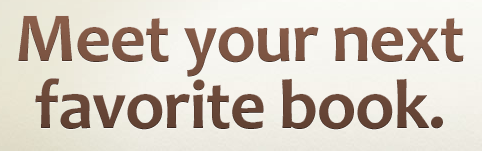
Though both Goodreads and LT are social reading sites, they are different in a number of ways. For example, let’s look at the messages on their home pages, before sign-in. Here’s Goodreads:

goodreads_home_logo

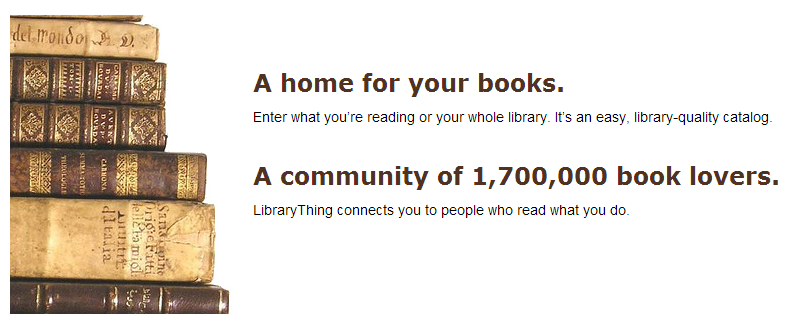
And here’s LibraryThing:

LT_home_logo

Goodreads (“Meet your next favorite book”) is encouraging readers to find new books to read, through lists (“shelves”), ads, and other users’ reviews. LibraryThing, on the other hand (“A home for your books…A community of book lovers”) emphasizes its cataloging quality and its user community.

There are a variety of uses for social reading sites (and by no means are Goodreads and LibraryThing the only choices), but my primary uses are (in descending order of importance):

  1. Keep track of what I’ve read and what I want to read.

  2. Write and store reviews and notes on the books I’ve read.

  3. See what my friends are reading and read their reviews.

I also appreciate the chance to get the occasional early review copy (I’ve gotten one or two from Goodreads over the past six years, and at least four from LT over the past year), and the serendipity of connecting with authors (more than once, authors on Goodreads have contacted me after I’ve written a review of their book: one ended up attending a book club meeting, and another gave a presentation at the library).

So, how do the two sites compare? Let’s go point by point.

Keep track of what I’ve read and what I want to read. I’m certainly able to do this on both sites. Goodreads has “read,” “currently reading,” and “to-read” shelves, whereas LibraryThing has “to-read” and “currently reading” collections (everything else is, by default, “read”). I like Goodreads’ “date added” sorting option, but I like that LibraryThing offers different display styles.

LY_styleoptions

Write and store reviews and notes on the books I’ve read. One of LT’s aforementioned display styles includes reviews – so you can see all your reviews at a glance, rather than having to click into each book’s record. You can also click directly into the review to make any edits. There is no way to skim all your reviews in Goodreads.

See what my friends are reading and read their reviews. Goodreads has a clear advantage here, because most of the people I know who are on a social reading site are on Goodreads. I’m not that interested in reading strangers’ reviews, but I do like seeing what my friends are reading. Fortunately, I still get e-mails from Goodreads with updates that include friends’ reviews.

goodreads_greenbuttonIn terms of function, then, the sites aren’t all that different. Though I’m committed to LT now, I still don’t find it as intuitive or user-friendly as Goodreads (though, like most LT users, I’m not a fan of Goodreads’ dreaded green button).

LibraryThing organization

Even after a few months of using LibraryThing, I still don’t navigate it effortlessly. The font is absolutely tiny, which leads to a cluttered appearance. Searching within your library takes a second or two longer than I’d like to return results (yes, I’m impatient). The organization also takes some getting used to – the Home tab shows your most recent books, but if you click into a book’s record from there, it just shows metadata and other users’ reviews, not your review or when you started or finished the book; that information is under the Your Books tab (this is where you can choose your own display style).

There’s a separate tab to Add Books, and when you search, there’s usually only one edition of the book, whereas Goodreads lists all of them (hardcover, paperback, mass market, audiobook, various publishers, etc). However, if you put in the ISBN of the specific edition you’re looking for, it will show up.

The other tabs – Groups, Talk, Local, More, and the mysteriously named Zeitgeist (“more information than you require,” indeed, though it’s probably useful/interesting for some) – I don’t use often, though I probably should look at the Local tab more often to see what’s going on. It’s customizable too, so you can choose your favorite bookstores, libraries, or other literary venues to see what authors might be in town. The More tab includes the link to Early Reviewer books.

Stats are accessed from the Home tab; I don’t look at stats that often, just a few times a year, but LT presents them pretty creatively. For instance, my library (which, to be fair, includes books on my “to-read” shelf as well as those I’ve read and am currently reading), if stacked book upon book, would be slightly taller than the Great Pyramid, slightly shorter than the Washington Monument. The value of its weight in gold would be $22,173,471. Goodreads data, on the other hand, is a bit more straightforward – number of books read in a calendar year, number of pages read, etc. I wish LT had these types of numbers as well.

Overall, I’m not thrilled with LibraryThing, but I’m going to stick with it because it isn’t owned by Amazon, which means my personal data isn’t being harvested (at least not so rapaciously and overtly). Perhaps some of the things that irk me about it will change, and more of my friends will join over time. Till then, it does what I need it to do.