The Importance of Spelling

An article in today’s Boston Globe covered a renewed interest in spelling; apparently, spelling has become “popular” again. Though many rely on spellcheck functions within word processing programs or e-mail, those can’t catch everything (and they often miss words that are spelled correctly but used in the wrong context – see The Oatmeal’s list of “10 Words You Need to Stop Misspelling”). Correct spelling may not be crucial in instant messages or texts, but it is still important in academic and professional contexts – and according to the Globe article, kids are eager to learn words in order to compete in spelling bees.

One interesting point the article raised was that maybe spelling hasn’t deteriorated; maybe it was always this bad, but it was less public. UC Berkeley professor and linguist Geoffrey Nunberg said, “People never knew how to spell…They kept it a secret unless you saw their shopping lists or Christmas letter. You didn’t see the comments they wrote on other people’s blogs. You didn’t see their own blogs. I think a lot of what is perceived as the decline of spelling is just that we see a lot more spelling by a much wider range of people than we used to.’’

Facebook and Privacy

On January 9, all Facebook users who haven’t already changed their profiles over to the new Timeline format will see their pages change anyway. As always with changes to Facebook, there have been mixed reactions, but Facebook at least ought to get credit for giving users a heads-up this time, instead of their usual MO (i.e., “it’s easier to get forgiveness than permission”).

Every time Facebook makes even a minor change is a good time to check your privacy settings (if you’re a Facebook user; not everyone is); with a major change like Timeline, definitely look at your privacy settings, because changes to the site mean changes to your privacy. Users can experiment with Timeline for a seven-day period before it goes live on the 9th – it’s not a bad idea to use this time not just to play around with the new layout, but also to see how the privacy settings have changed or been re-set. Unfortunately (intentionally?), these settings aren’t the easiest to manipulate or change, but it can be done.

And while you’re doing that, you might also reconsider what kind and how much personal information you share voluntarily – not just on facebook, but elsewhere on the internet. Geoff Duncan’s article in Digital Trends, “Why 2012 is starting to look like 1984,” is informative and sobering on the topic of personal privacy (or lack thereof). He also provides an excellent overview of the SOPA and PIPA bills (Stop Online Piracy Act and Protect IP Act, respectively), and this year’s National Defense Authorization Act (NDAA), which expands on the Patriot Act.

In a nutshell, it seems that whereas sharing personal information used to be an “opt-in” process, it’s now more “opt-out” – and sometimes you can’t.

Edited to add: While we’re on the topic of privacy, the Daring Librarian reminds us that it’s probably time to change all of our passwords. You may have dozens for all the different sites you go to; think about creating a formula so they’re easier to remember. (Here’s some more advice on password strength from xkcd.)

When Will There Be Good News?

Yes, I borrowed the title of a Kate Atkinson book for this post (although if you’re going to read her, I highly recommend Case Histories instead). It is now a full week into the new year (happy 2012!) and this is my first post; I have written others but they did not seem like the right ones with which to begin the year.

This morning, however, I read an article in the Boston Globe about a 13-year-old Massachusetts boy who contacted artists to create trees, which he would then donate the the nonprofit Reach Out and Read; the organization could auction off the artists’ trees at their annual fundraiser to raise money for early literacy.

Not only is this a cool idea, and an admirable (and successful) effort on the part of a teenage boy, but what really got to me was his quote at the end of the article: “Sometimes when people say they don’t like to read, the truth is they just haven’t found a book they like.’’ Sounds like a future librarian to me…

People just don’t make sense anymore

A brief round-up of mostly unrelated pieces of news/commentary:

In a blog post for the Harvard Business Review, Dan Pallotta discusses the problems of “abstractionitis,” “acronymitis,” “Valley Girl 2.0,” and “meaningless expressions” – in other words, people don’t use real words with real meanings anymore.

It would be great if there was Netflix for books…oh wait, there is! It’s called the library.

Borders employees take one last jab at Amazon, reminding customers of one advantage physical stores have over online ones.

Education and testing

Recently I have read several articles about various aspects of the education system in the U.S. Most people agree that our educational system is not wholly successful. However, that’s where the discussion about how to improve the system begins – and where the agreement ends. Everyone has a different idea about what success looks like and how to measure it.

Two recent articles in The Washington Post were critical of standardized testing. One describes the results (and implications) when an adult – a school board member – took the 10th grade standardized math and reading tests. The adult, to put it mildly, did not do well on the tests, and said, “It makes no sense to me that a test with the potential for shaping a student’s entire future has so little apparent relevance to adult, real-world functioning.” (Apparently this issue persists through higher education as well; employers are finding that college grads lack job skills.)

Another article cited the revolt of New York state school principals against students’ test scores being used to evaluate teachers. The most problematic part of this plan is that there has been no pilot testing. In an “open letter of concern,” the principals wrote, “We are very concerned…that at the state level, change is being imposed in a rapid manner and without high-quality evidentiary support. Our students, teachers and communities deserve better. They deserve thoughtful reforms that will improve teaching and learning for all students.”

After giving background and articulating specific concerns, they offer recommendations, one of which is, “Pilot and adjust the evaluation system before implementing it on a large scale. Any annual evaluation system should be piloted and adjusted as necessary based on field feedback before being put in place state-wide. In other words, the state should pilot models and then use measures of student learning to evaluate the model.”

Tests are an instrument of measurement; pilot tests are essential to ensure that the tests are measuring what they are supposed to be measuring. Furthermore, in the evaluation and assessment part of the research process, testing is only the “gathering data” step – but there’s no point doing assessment at all if you aren’t going to act on the results. Testing, in large part, confirms what we already know; what are we going to do about it?

An op-ed by Duke professor Helen Ladd and author of the Fiske Guide to Colleges Edward Fiske in The New York Times earlier this month cited the acknowledged and proven correlation between economic advantage and student performance. Federal education policy, they write, does not take this into account. Setting testing requirements will not help; supporting high-quality early childhood and preschool education programs will, they suggest.

There are a few takeaway points from all this. One: Standardized tests must be tested themselves before being used state- and nation-wide to assess student learning and achievement, or to assess teachers and principals. Two: There is little purpose in testing at all if the true problems are not going to be addressed, and if insufficient support is going to be given to solve these problems. And lastly: Education ought to prepare students for their adult life; it ought to arm them with higher-order thinking skills (i.e. application, analysis, synthesis, evaluation).


Amazon vs. Bricks-and-Mortar

It’s not even Amazon vs. the independent bookstores anymore; now it’s Amazon against any physical bricks-and-mortar bookstore that offers browsability, serendipity, and (hopefully) knowledgeable, informed, helpful staff who can make personalized suggestions tailored to your needs, likes, and dislikes.

Author Richard Russo wrote an op-ed in The New York Times on December 11 about Amazon’s competitive strategy of encouraging buyers to use its price check app in stores by offering credits to consumers, who then buy from Amazon instead of from stores. (It should be noted that while book prices can be checked with the app, they do not qualify for the promotion.)

Russo sent this news on to a number of other authors, including Scott Turow (president of the Authors Guild), Stephen King, and Ann Patchett. King called the strategy “invasive and unfair”; Turow suggested that it might not be “lawful” for Amazon to encourage consumers to go to a store solely to obtain pricing information without any intention of buying; and Patchett said, “I do think it’s worthwhile explaining to customers that the lowest price point does not always represent the best deal. If you like going to a bookstore then it’s up to you to support it. If you like seeing the people in your community employed, if you think your city needs a tax base, if you want to buy books from a person who reads, don’t use Amazon.”

Authors and bookstore owners and employees aren’t the only ones who object to Amazon’s price check promotion; Maine Senator Olympia Snowe said, “Amazon’s promotion – paying consumers to visit small businesses and leave empty-handed – is an attack on Main Street businesses that employ workers in our communities.”

Fortunately, it is not all bad news for bookstores. An “unusually vibrant selection” of books this season seems to have helped bookstore foot traffic and sales, which are up from this time last year. Former Borders customers are finding other bookstores, too. One bookstore owner in Seattle said, “What’s extraordinary about the books that are out there is that they’ve been so well written and such a pleasure to read. Maybe people have an appetite for nonfiction right now, just for some sort of grounding in reality.”

The book business is, as much as book lovers would like to deny it, a business, but Amazon’s price check app and promotion are “bare-knuckles” enough to leave a bad taste in one’s mouth. Before doing ordering all your holiday presents on Amazon, consider what you get for a few extra dollars at the bookstore: personal recommendations from people who read. Of course, the level of service stores offer varies, but if you’re in the Cambridge/Somerville area, I can recommend the excellent Porter Square Books in good faith.

And if you aren’t looking to buy, just looking to read, another great place to get a recommendation is your local library. 🙂
MLS

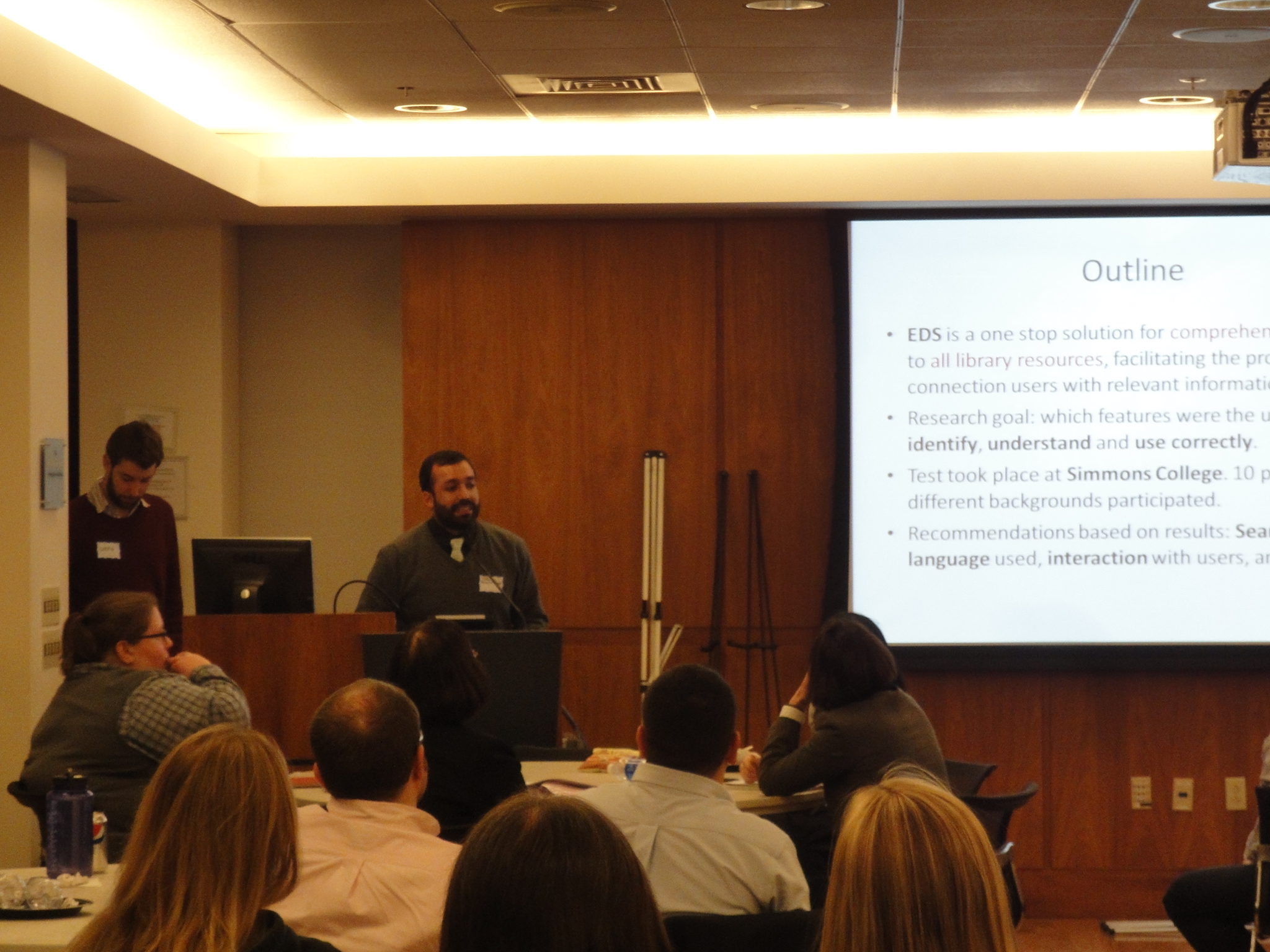
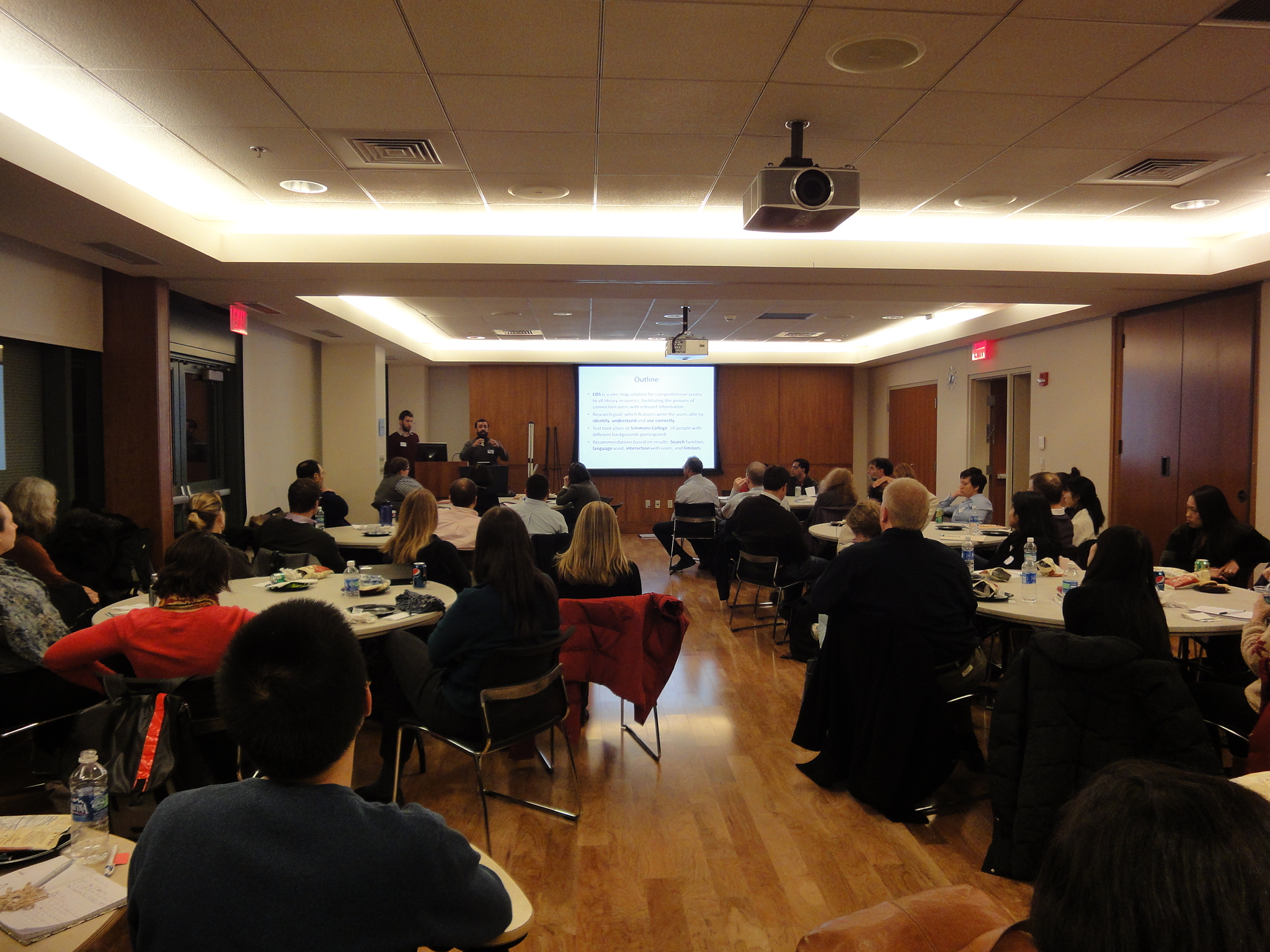
After yesterday afternoon’s half-hour group presentation in class (LIS 531Y, Usability and User Experience Research) on our team’s usability study on the EBSCO Discovery Service (EDS), and last night’s condensed presentation on the same to the Usability Professionals Association (UPA) Boston Chapter, I am completely done with papers and presentations (and all other work) for my MLS degree. HURRAY!

Photos: one group member from each EBSCO team presented the results of the usability tests to the UPA Boston meeting on at Simmons College on December 12.

As it happens, a recent (December 7) Library Journal article included comparisons of four discovery services, the first of which was EDS. Amanda Clay Powers of the Mississippi State University Libraries observed that EDS worked especially well for undergraduates (novice) and for doctoral students and faculty (advanced), but less well for upper-level undergraduates and master’s students, who were still best served by subject-specific databases.

The research we did in Usability and User Experience Research this semester was focused less on content and more on usability and specific system features (such as the cite tool, the “find similar books” option, and the ability to save or share search results). Still, the LJ article was an interesting overview, especially as it compared multiple discovery interfaces.

One Week

One week of classes left! I have been busy recently with final projects and papers (some parts of which I may post here in the future), but the end is in sight. Meanwhile, a few articles on usability, user experience, and design:

UX Hierarchy of Needs – The author proposes that there is a “UX hierarchy of needs,” namely (from the bottom up) Functionality, Information, Aesthetics, and Usability. The first two are the basic needs, the latter two are the higher needs. However, I’m inclined to switch usability and aesthetics – as a user, I’d rather a system be easy to use than pretty to look at (although aesthetics is more than just “prettiness” – it also encompasses branding).

9 Rules to Make Your Icons Clear and Intuitive – Much more thought and planning goes into (or should go into) those tiny buttons than you might think. This article (same author and site, UXMovement, as above) covers some good basic rules-of-thumb, such as labeling icons, grouping similar icons, and keeping icon order and placement consistent. However, some established icons that break one or more of these rules still work well because so many people know what to look for – the chain link representing the hyperlink, for example, or the ABC for strikethrough. (The author recommends a blue underlined L for the first, and a struck-through S instead of ABC for the latter.)

14 Guidelines for Web Site Tabs Usability – Many sites use tabs for navigation; they are good real-world metaphors (most people are familiar with filing cabinets or binders), they improve content organization, and they are “visually pleasing.” The author outlines some guidelines, illustrating many of his points with appropriate screenshots (remember when Amazon used tabs?). Among these guidelines: tab labels should be 1-2 words, in plain language; tags should be organized in an order that makes sense to users, and related tags can be grouped; and the active and inactive tabs should be clearly indicated so the user can tell what section of the website they are currently in.

Two Approaches

The Authors Guild has spoken out against Amazon’s Lending Library, arguing that Amazon’s contracts with publishers cover only the sale of books, not lending or giveaways. For additional background on this issue, here’s my November 3 post with several links. The Guild may have a point here, and urges its authors to contact their agents and publishers.

In the “good news” category, however, we have Ann Patchett’s new independent bookstore, Parnassus Books, opening soon in Nashville, TN. The most recent NYT article notes that small, independent bookstores compete “where Amazon cannot: by being small and sleek, with personal service, intimate author events and a carefully chosen rotation of books” (including e-books). Best of luck to Ann, her business partner Karen Hayes, and Parnassus Books!

Open Library

If you aren’t already familiar with Open Library, a project of the non-profit Internet Archive, you now have one more reason to head over and check it out: all 50 state librarians have voted to build an alliance with IA. What does this mean? The Chief Officers of State Library Agencies (COSLA) and Open Library will be working together to ensure free access to e-books through all public libraries in the U.S.

Already, anyone can borrow e-books from Open Library‘s collection of 10,000 e-books, provided by the Internet Archive and its partner libraries. You can borrow up to 5 books for 2 weeks each, in a variety of formats (in-browser, e-Pub, or PDF). If your public library is a member, you may have access to even more.

Happy reading!