Step Into Storytime, November 4

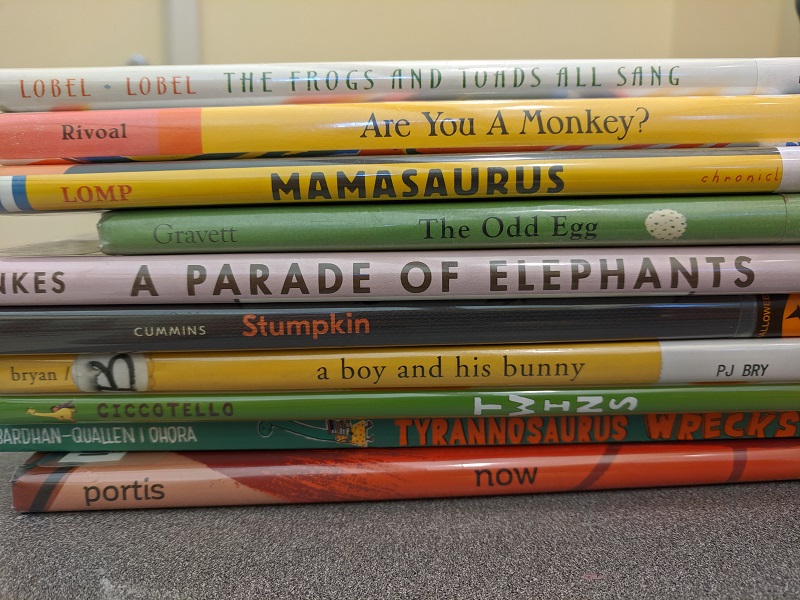
Stack of picture books

Storytime today started with a small enough group (just 8 kids, plus an infant) that I swapped the name song in for “The More We Get Together.” I always like to do the name song if there are ten kids or fewer, because (a) it helps me learn the kids’ names and (b) some of them really love being the center of attention! Usually we have more than ten kids, though, so the name song would take up too much time. Today some more came in throughout storytime, and we ended up with about 11.

  • Welcome and announcements (I remembered – I’m very proud of myself – that next Monday is a holiday and the library will be closed, so my next storytime after this is in two weeks)
  • “Hello Friends” song with ASL (Jbrary)
  • Name song (“___ is here today” x3 “we all clap our hands, ___ is here today”)
  • Three short poems from The Frogs and Toads All Sang by Arnold Lobel
  • Are You A Monkey?: a tale of animal charades, by Marine Rivoal, translated/adapted by Maria Tunney. This is a much longer book than I’d usually use for a group of 2-3-year-olds, but it has so many opportunities for participation (animal sounds and motions) that it worked as a lead-off book…
  • …provided we did “Shake Your Sillies Out” with egg shakers right afterward!
  • And we kept our egg shakers for The Odd Egg by Emily Gravett. I would have liked to have Monkey and Me in the lineup instead, but it was checked out, and The Odd Egg worked well with the shakers – I asked the kids to shake on page turns or when we said the word “egg.”
  • Mamasaurus by Stephan Lomp: This is a “where’s my mother?” plot, but with dinosaurs. It’s not my most favorite picture book of all time, but I thought the dinosaurs might appeal. It seemed to hold their attention well enough.
  • The mouse house game! They love this. We played three times.
  • “Where is Thumbkin?” song/fingerplay
  • A Parade of Elephants by Kevin Henkes: I have felt elephants for this, but didn’t use them today; we just counted, marched, and made elephant sounds.
  • “Head, Shoulders, Knees, and Toes”
  • “Goodbye Friends” with ASL (Jbrary)
  • Put away mats, color with markers(!) and crayons on butcher paper (This is the first time I put out markers. I did ask the grown-ups to help make sure the caps got on the markers when they were done, and they did!).

“Little mouse, little mouse, are you in the orange house?”
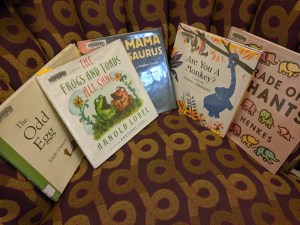
The final lineup of picture books read today
The Odd Egg, The Frogs and Toads All Sang, Mamasaurus, Are You A Monkey?, A Parade of Elephants

Step Into Storytime, October 28

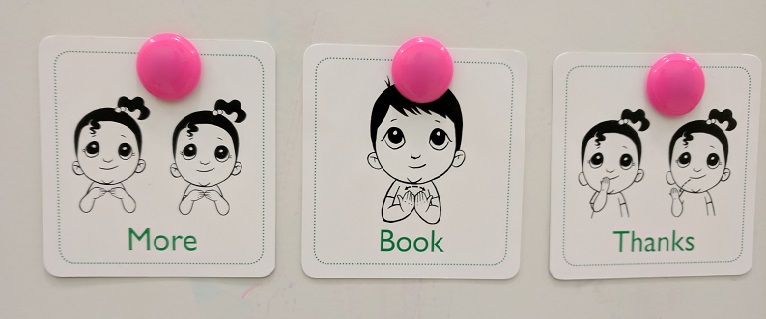
Sign language flash cards (more, book, thanks)
Baby Sign Language flash cards for “more,” “book,” and “thanks”

After missing the last two Mondays (for Indigenous Peoples’ Day and the NELA conference), it was so nice to be back at storytime! And I was able to bring two new elements to storytime today, another song with ASL from NELA and a mouse house felt board game from the Belmont Public Library storytime earlier this month.

  • Welcome and announcements
  • “Hello Friends” song with ASL (Jbrary)
  • “The More We Get Together” song with signs for “more,” “together,” “happy,” “be,” and “friends” (hat tip to the Chelmsford children’s librarians at NELA!)
  • The Giant Jumperee by Julia Donaldson and Helen Oxenbury
  • My Name Is Elizabeth by Annika Dunklee and Matthew Forsythe
  • “Shake Your Sillies Out” with shaker eggs
  • Shh! We Have A Plan by Chris Haughton
  • “Row, Row, Row Your Boat”
  • The mouse house game: “Little mouse, little mouse, are you in the [color] house?” We played it three times, with me switching the houses and mouse location each time (I made six houses, but only four fit on the felt board at one time).
  • Not A Stick by Antoinette Portis
  • “Twinkle Twinkle Little Star,” standing in star position and rocking side to side
  • Spots in a Box by Helen Ward
  • “Goodbye Friends” song with ASL (Jbrary)
  • Clean up mats, put down paper for spots craft (using glue sticks to stick colored spots to the butcher paper)

The new song and game went well. Lately I’ve been feeling like six books is too many – most other storytimes I’ve been to for this age group usually do only three or so – and five is still plenty.

I always sketch an outline of my plan for storytime, and it always changes a little bit. This time I switched the order of two books (Not A Stick and Shh! We Have A Plan), switched the order of two movement songs (“Shake Your Sillies Out” and “Twinkle,” because one kid saw the shaker eggs and got very excited), and added a song (“Row Row Row,” because there is paddling in Shh! We Have A Plan). The baby sign language cards pictured above I ended up taking down before storytime started (they’re great up close, but hard to see from farther away). I also had A Parade of Elephants and several other books available as options, but did stick with my original lineup. Next week, elephants! (And dinosaurs.)

Left: stack of storytime books. Right: the final lineup of five books on the storytime chair.

SLJ Day of Dialog at Cambridge Public Library

The School Library Journal (SLJ) Day of Dialog at the Cambridge Public Library was a day-long event that brought librarians, authors, and publishers together. The day included:

  • Three keynote speakers: Erin Entrada Kelly (Hello Universe), Deborah Heiligman (Torpedoed), and Nikki Grimes (Ordinary Hazards)
  • Three panels: picture book, nonfiction, and tween/teen
  • Two “book buzz” presentations, where representatives from different publishers gave lightning talks highlighting their upcoming books

There was an hour break for lunch, and a few minutes between the keynotes, panels, and book buzzes to speak with folks from the publishing houses, meet authors, and get books signed. It really felt like we were all book-lovers, all on the same side: the side of making great books and getting them into the hands of readers.

Highlights from Erin Entrada Kelly’s keynote, which focused on honesty in middle grade literature:

  • The most important thing is to write honestly; it’s important for young readers to experience practical truths
  • In Blackbird Fly, bullies don’t get comeuppance. “A lot of times that does not happen…That’s how the real world works.” It’s important for young people to see the world mirrored back at them.
  • Young people are already their own complex beings with their own beliefs
  • “My hope is that young readers, when they finish reading my book” or any book, is that they can be their own hero, see their own worth and value…they don’t have to conform to our society.
  • “Walking around like an open wound” -being sensitive, empathetic, compassionate, etc. – is not a liability, as long as you’re the best version of yourself. “Characters don’t change the core of who they are, they accept the core of who they are.”
  • “Even though the world isn’t perfect, we can make it better….Change happens when ordinary people do extraordinary things”
  •  “Someone once told me, Everyone has a year in their childhood where things change, and there was a before and an after…for me that year was twelve.”

The picture book panel was Julia Denos, E.B. Goodale, Kyle Lukoff, Vita Murro, and Cornelius Van Wright. I was already a fan of Julia Denos and E.B. Goodale’s picture book Windows, and was delighted to pick up their new collaboration, Here and Now, which is a wonderful book for bedtime or any time you need to wind down. Kyle Lukoff (When Aidan Became A Brother) and Vita Murrow (Power to the Princess) were engaging speakers, and Cornelius Van Wright’s (The Little Red Crane) response to the question “How would your book have been different a decade ago?” made me laugh out loud: “A truck book would have been the same.” The moderator’s last question was what the authors’ favorite books were when they were kids, and if those influenced the kinds of books they create now.

In the first book buzz, I wrote down several titles from Candlewick and Charlesbridge to look up when they come out, including This Boy by Lauren Myracle and Not A Bean by Claudia Guadalupe Martinez. I also chatted with the editorial director of Owl Kids about Sloth at the Zoom, which was on the cover of one of their catalogs. (If you haven’t read Sloth at the Zoom, you should go do that right now. It’s about a sloth that gets sent to the Zoom instead of the Zzzzzoo.)

After lunch, Deborah Heiligman gave the afternoon keynote, about the process of writing her new book, Torpedoed. (See her interview in the Horn Book: Deborah Heiligman Talks With Roger.) She talked about “Deb’s Rules for Researching”: start with primary sources, don’t write everything down, only take “oh wow” notes. She also talked about writing for middle grade: what does that mean? What do they know, what don’t they know?

The nonfiction panel was Kim Chafee (Her Fearless Run), Marge Pellegrino (Neon Words), Melissa Stewart (Seashells, Feathers), and Carole Boston Weatherford (Box). The moderator, Maggie Bush, observed that children’s nonfiction used to be more “utilitarian,” whereas now it’s often more heavily illustrated, and there are more narrative nonfiction books than the type of dry fare students might use for book reports. One of the authors – I think Melissa Stewart – explained that her picture book nonfiction has “Multiple layers of text” to “make the book accessible to different age groups.” There’s the main text, secondary text, etc. I’ve definitely noticed this in picture book nonfiction (e.g. Gail Gibbons, Nick Seluk), and it’s great.

The teens & tweens panel was Craig Battle (Camp Average), Ryan LaSala (Reverie), Maulik Pancholy (The Best At It), Christina Soontornvat (A Wish in the Dark), and Karen Rayne (Trans+). Moderator Ashleigh Williams observed a “a common theme between these different books…how compassion shows up in difficult places.” All of the authors spoke about representation and diversity. A few key quotes:

  • Christina Soontornvat: “In your middle grade years, you are really ready to confront…Maybe it’s not working the way it should….maybe the way society is set up is not fair”
  • Maulik Pancholy: “Kids live complex lives…you can’t lie to them.”
  • Ryan LaSala: Internal fantasy worlds are sometimes a response to unkind realities… “just because you’ve gone through shit doesn’t mean you are absolved from having compassion for others”
  • Christina Soontornvat: “One small act of kindness or one small act of cruelty has these reverberating impacts”
  • Karen Rayne: “You are the expert on your self.”
  • Christina Soontornvat: Kids are eager to push back, ask questions, be activists, be aware of the world they’re living in, they want to be more inclusive.

I got fidgety during the second book buzz and went to visit the publishers’ tables. The last speaker of the day was Nikki Grimes. Highlights:

  • A tenth grade teacher told her “Good enough, isn’t” and taught her to strive for excellence.
  • “The words you traffic in have the power to save lives….reading and writing were my survival tools”
  • “The right story at the right time for the right reader is magical.” What is the right story? One to which the reader can relate in some special way.
  • Representation matters, and not just for children
  • Library card: “a magic pass I used to climb into someone else’s skin any time I needed”
  • “Stories unite us, stories transform us, stories anchor us”

Thank you to SLJ and the Cambridge Public Library for a fantastic day! I’m already looking forward to next year.


Step Into Storytime, October 7

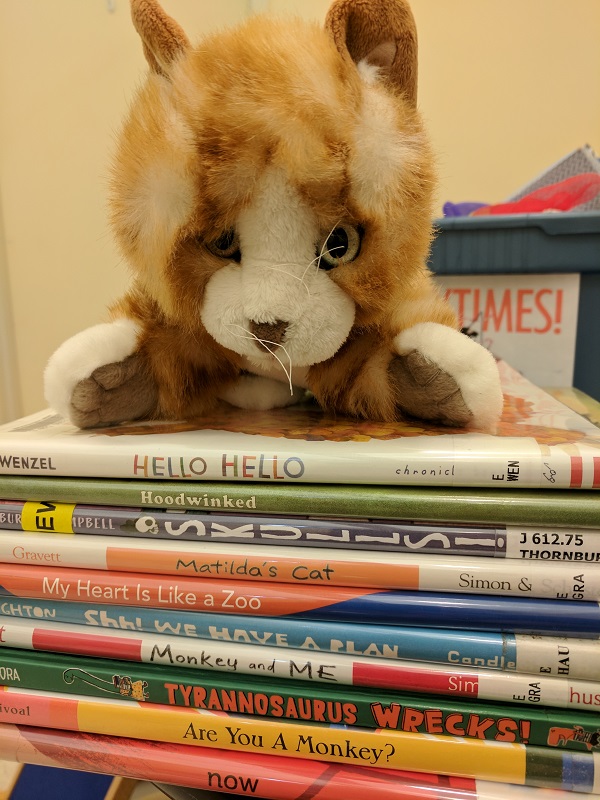
Cat puppet on stack of picture books

Today we started with 13 kids and ended up with at least 18, as a few more trickled in during our hello song and first book. I don’t read holiday-specific books, but we had a spooky/zoo theme today, in honor of it being October.

  • Welcome and announcements (the library is closed next Monday)
  • “Hello Friends” with ASL (Jbrary)
  • Hello Hello by Brendan Wenzel: This is one of my favorite books to start a storytime with, because of the many opportunities for movement, observation, and saying hello to our friends and neighbors.
  • Hoodwinked by Arthur Howard: I started by asking who had a pet, and what kind, then introduced Mitzi, who wants a pet too. This is on the longer side for the younger kids, but they made it through! I found an orange cat puppet in the closet, just like Hoodwink.
  • Yoga and songs: “I Had A Little Turtle,” “If You’re Happy And You Know It.” One kid started to cry, so we segued from mountain pose and toe-touching into star pose and sang “Twinkle Twinkle” as we swayed back and forth.
  • Matilda’s Cat by Emily Gravett: Fortunately, Matilda’s cat looks a lot like Mitzi’s cat Hoodwink, so I could use the same puppet.
  • Skulls! by Blair Thornburgh: This might be the first time I’ve read a nonfiction picture book at storytime, and it worked out great! Halloween decorations are starting to appear, so kids had seen skeletons, and the book has a positive, reassuring message about skulls (“they’re like a car seat for your brain!”).
  • “Head, Shoulders, Knees, and Toes” (we’d identified eyes, ears, mouth, and nose in Skulls!) and some more songs.
  • My Heart Is Like A Zoo by Michael Hall with flannel board (I made a frog, crab, clam, owl, and penguin, which the kids identified before I started reading the book)
  • Monkey and Me by Emily Gravett: I stood up to read this one so we could all do animal impressions throughout.
  • The rest of the songs on the song cube, “Goodbye Friends” with ASL, clean up mats
  • Coloring on butcher paper taped to floor; Caspar Babypants music

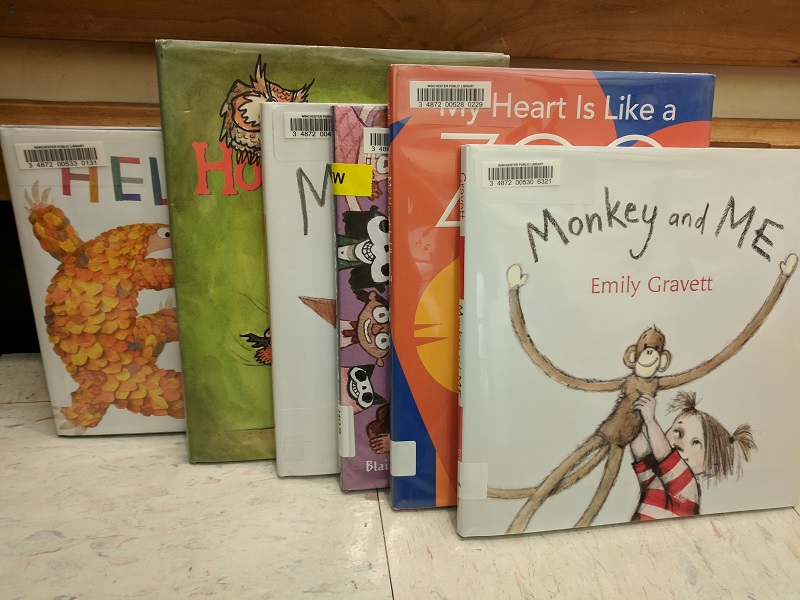
Hello, Hoodwinked, Matilda's Cat, Skulls, My Heart is Like A Zoo, Monkey and Me

It seems really obvious, but encouraging grown-ups both at the beginning and end of storytime to come to me with any book- or library-related questions totally works! I’ve had one or two people approach me after each storytime so far this fall. Today’s question was about the Kevin Henkes Penny books (Penny and Her Song, Penny and Her Doll, Penny and Her Marble). I showed them where they should be on the shelf, showed them where Kevin Henkes picture books are, and recommended Frog & Toad and Charlie & Mouse as well.

Step Into Storytime, September 30

Today’s group of about sixteen kids was unusually quiet and engaged! (Noisy and engaged is also fine, of course, but as someone whose voice is not naturally loud, quiet and engaged is delightful.) We read six books, did some stretching, sang some songs, and did a craft that I came up with about 20 minutes before storytime started.

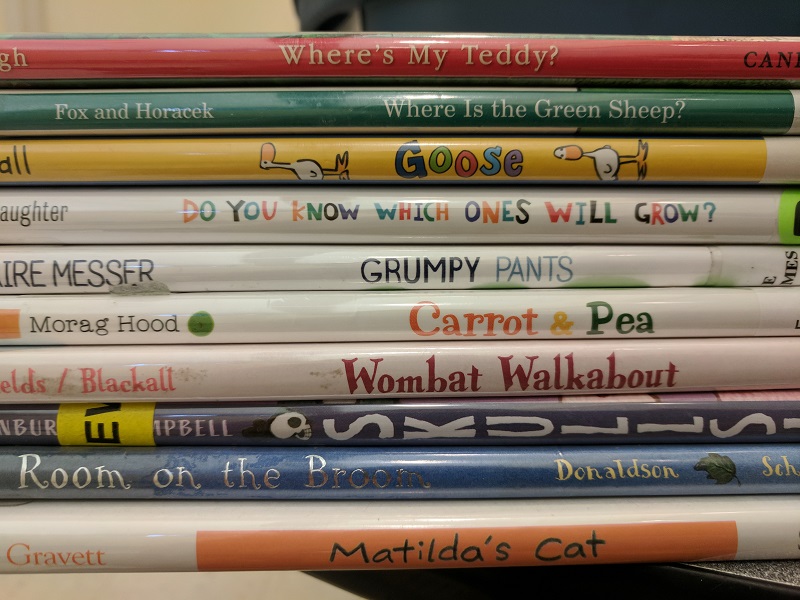
Stack of picture books, spines showing

  • Welcome and announcements
  • “Hello Friends” song with ASL (Jbrary)
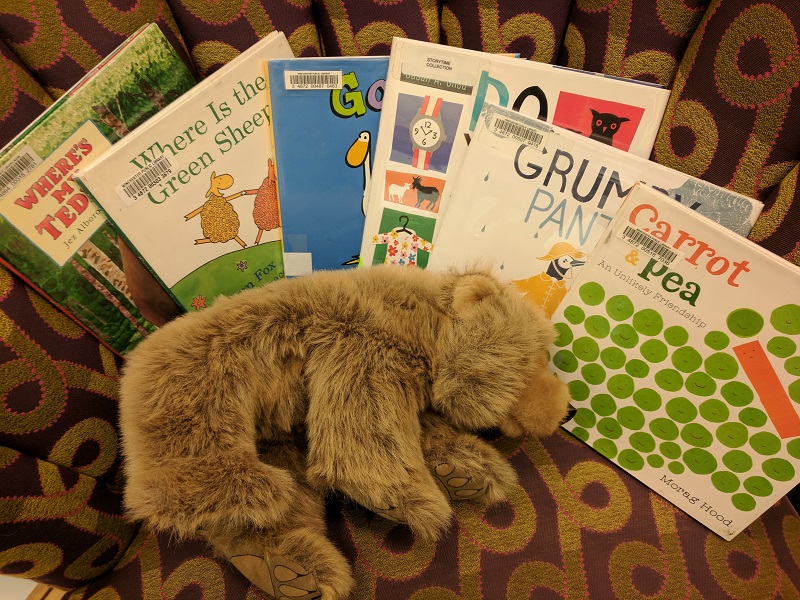
  • Where’s My Teddy? by Jez Alborough, with two bears (one big, one small) from the storytime puppet stash
  • Where Is The Green Sheep? by Mem Fox, with flannel board sheep: I put blue, pink, and yellow sheep on the board (kids identified the colors when I held them up) before the story, and pulled out that sleepy green sheep at the end. (Hat tip to Laura L. for showing me how to read this book aloud properly.)
  • Yoga: Stretching tall, touching toes
  • Goose by Laura Wall
  • Song cube: “I Had A Little Turtle” and “Zoom Zoom Zoom, We’re Going to the Moon”
  • Do You Know Which Ones Will Grow? by Susan Shea: This is the first time I’ve had success with this book! I encouraged everyone to shout out “yes” or “no,” and mostly it was the grown-ups, but they get participation points too.
  • Yoga and music: “Head, Shoulders, Knees, and Toes,” “Where Is Thumbkin?” and more stretching (mountain pose, forward fold, star, triangle pose)
  • Grumpy Pants by Claire Messer: This book is storytime gold. Someone always checks it out afterward.
  • Carrot and Pea by Morag Hood
  • “Goodbye Friends” song with ASL (Jbrary)
  • Clean up mats
  • Craft: Carrot and peas. Big orange paper triangles for carrots, medium-size green circles for peas, glue sticks, crayons for drawing on faces.

Picture books and bear on chair

Banned Books Week/Freedom to Read Week

It is Banned Books Week again (a.k.a. Freedom to Read Week). I’m going to quote from Rob’s BBW/FtRW post from the Robbins Library blog:

During Banned Books Week, we celebrate the freedom to read. As you can imagine, this is most librarians’ favorite theme week; after all, as our code of ethics states, “We uphold the principles of intellectual freedom and resist all efforts to censor library resources.” But you don’t have to be a librarian to enjoy Banned Books Week – all you have to do is read!

(The word “Banned” is in quotation marks in the title of this post because the name “Banned Books Week” is a bit of a misnomer.  First, we celebrate Banned Books Week not because we like or support books being banned – we celebrate to support intellectual freedom and the freedom to read whatever you want.  Second, it’s now much more common for books to be challenged than actually banned, thanks to the efforts of teachers, librarians, and other supporters of the freedom to read.  You can read a bit more about Banned Books Week here (or in our blog archives here) and check out a few lists of books that have been banned or challenged here & here.)

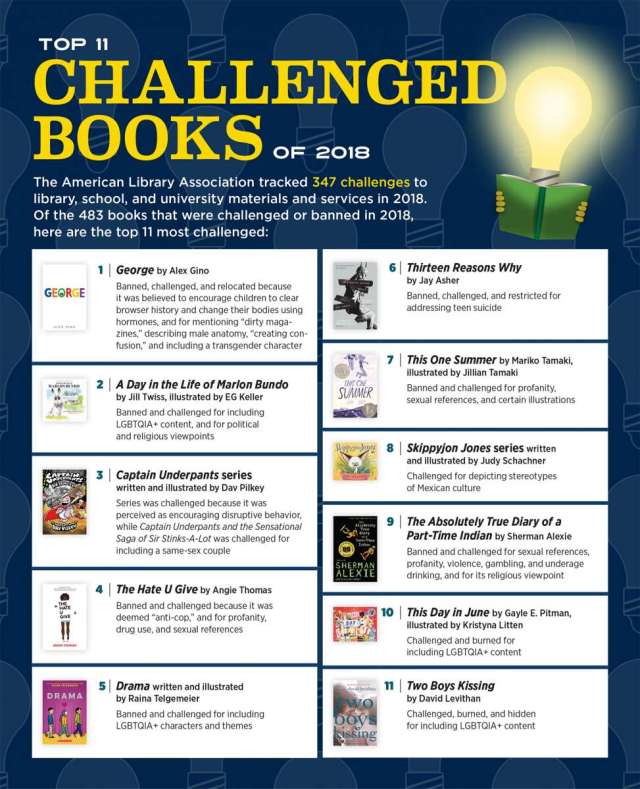
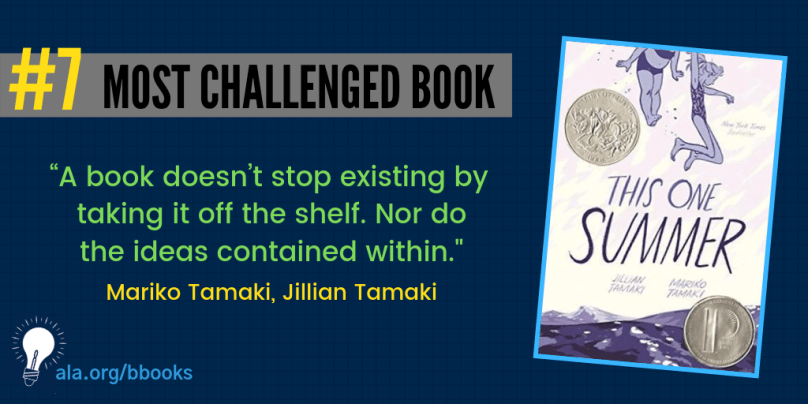
They link to a few of my Banned Books Week posts for the blog from past years, as well as the ALA site. Here are ALA’s infographics for this year:

ALA Censorship by the numbers infographic

2018-bbooks-graphic-2-rev_1-1

There is a difference between a challenge and a ban; there are many more challenges than bans. And just because a book is removed from one library, that doesn’t mean it’s removed from all of them, or unavailable at bookstores or online. But you’ll notice that almost all of these titles are children’s or teen books, and kids don’t always have options beyond their school library (if they’re lucky enough to have a school library and librarian) or their local public library. If a book is removed from those places, it’s effectively unavailable for that kid.

#4 Hate U Give_0

#7 This One Summer_0

It’s easy enough – for many of us pro-intellectual freedom types, at least – to see a story like the recent one from Nashville, Tennessee, where a Catholic school banned the Harry Potter series, and rail against it. Most librarians – and plenty of teachers and parents – believe that while parents do have the right to decide what their own children can and can’t read, they do NOT have the right to decide that a book should be unavailable for everyone.

However, there’s a subtler kind of censorship that I see a lot of, and I’m sure I’ll have moments where I wrestle with myself about this as well: the “is my kid ready for this yet?” question. Parents with eager, advanced readers, especially, see their kids racing through all the chapter books and middle grade novels and into the teen section. They’re concerned that their readers will encounter bad language, violence, sex, drugs (maybe even rock ‘n’ roll), etc.

So far, I’ve developed four responses to this: one, of course, is to talk with the parent (and the kid!) about the books they’ve liked, and suggest any others I can think of or find along those same lines, without going into more mature territory. Two is to suggest to the parent that they read the book too (either before the kid does, or at the same time, or after), so they’re prepared to talk about anything that concerns either of them. Three, if a kid is reading way above their age level (content-wise), they will likely either put the book down, or some things will just sail over their heads; they’ll take something away from the book, but they won’t understand it on every level, and that’s okay. Four, books are the safest places to encounter scary things. Plenty of fantasy and sci-fi scenarios won’t happen in real life (probably, hopefully), but realistic fiction that deals with death, divorce, poverty, bullying, mental health issues, violence, sexual assault, and any of the multitude of things that can and do go wrong in our world…those things happen. If they don’t happen to you, then knowing about them can build empathy for others; if they do happen to you, you know you’re not alone.

A final note: one other way that adults censor kids’ reading is by designating “girl books” and “boy books.” Here, I’m going to turn it over to author Shannon Hale:

Stories make us human. We form bonds by swapping personal stories with others, and reading fiction is a deeply immersive exercise in empathy.

So, what happens to a culture that encourages girls to read books about boys but shoos boys away from reading books about girls?

Read the rest of Hale’s article here: “What are we teaching boys when we discourage them from reading books about girls?” The Washington Post, October 10, 2018

Happy Freedom to Read Week, everyone!

Step Into Storytime, September 23

It’s officially the first day of fall, and yet today is particularly summery, and the storytime room gets HOT when it is full of people. But, I’m always happy to have lots of kiddos to read to and sing with! Today we started out with about 15, grew to 20, and ended with about 12.

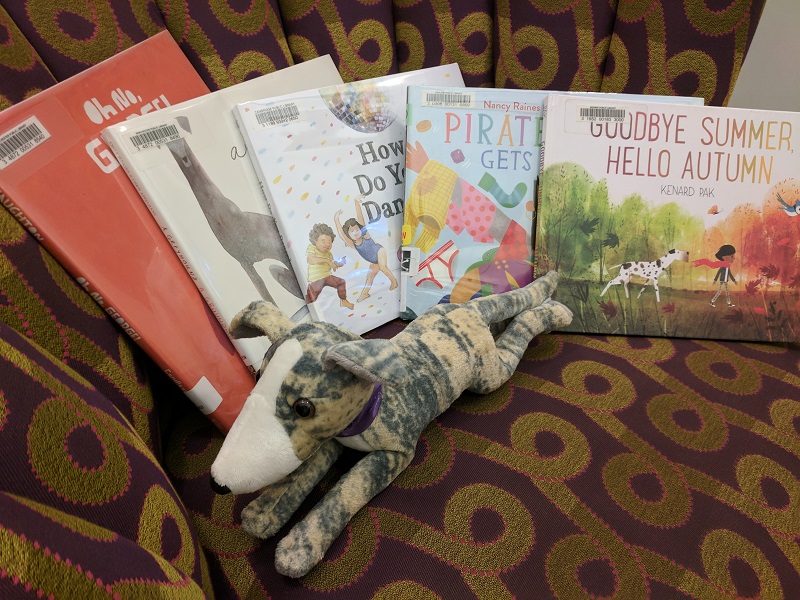
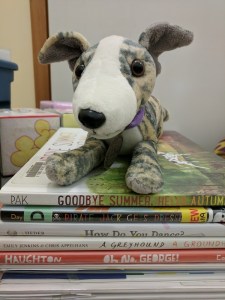
Picture books cover out on chair with greyhound stuffed animal

  • Welcome, announcements
  • “Hello Friends” with ASL (Jbrary)
  • Still Stuck by Shinsuke Yoshitake: I love this book, though it doesn’t usually get much reaction at storytime (at least, not from the kids; the parents like it). I used it as a lead-off book to take advantage of the relatively fresh attention span, and I made it more interactive by encouraging kids to mime taking off a shirt, as well as the scrub-a-dub-dub part. It’s not pictured in today’s photos because a parent took it home – yay!Greyhound stuffed animal on stack of picture books
  • “Head, Shoulders, Knees, and Toes”
  • Oh No, George! by Chris Haughton
  • Song cube: “Wheels on the Bus”
  • A Greyhound, A Groundhog by Emily Jenkins, illustrated by Chris Appelhans: I brought my stuffed greyhound as a prop.
  • “Kookaburra” – at least one parent was singing along this time! The second verse is better than the first, because (a) they’ve all heard the tune once already, and (b) there are motions (picking gumdrops, “stop” hands)
  • Handed out scarves
  • How Do You Dance? by Thyra Heder: This is a new book so today was the first time I used it at storytime, and it’s phenomenal. Lots of opportunities to move bodies and wave scarves!
  • Pirate Jack Gets Dressed by Nancy Raines Day and Allison Black: We paid a lot of attention to color in the book and in the room – the color of our clothes, of our mats, of our scarves.
  • Give the scarves one more wave, then collect them.
  • Song cube: “I’m A Little Teapot,” “ABCs,” “Zoom Zoom Zoom, We’re Going to the Moon”
  • Goodbye Summer, Hello Autumn by Kenard Pak: This is a quieter book and I was on the fence about it, especially as the last book of the day with a squirrelly group, but one grown-up with twins said they’d read it just last night, so I went ahead. It is the first day of fall, after all.
  • “Goodbye Friends” with ASL (Jbrary)
  • Clean up mats
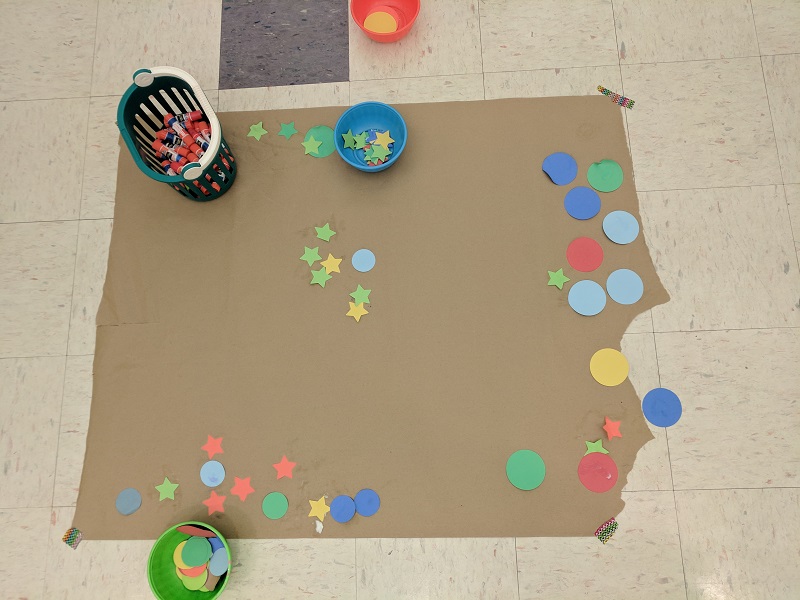
  • Craft: Gluing colored shapes

Craft: gluing colored paper shapes to butcher paper

Step Into Storytime, September 16

It was another large group for Step Into Storytime this morning! Again, the group skewed toward the younger end of the age range (2-3 years, with siblings welcome), and we had a mix of new families and regulars, including a couple older regulars who were very helpful during Not A Box.

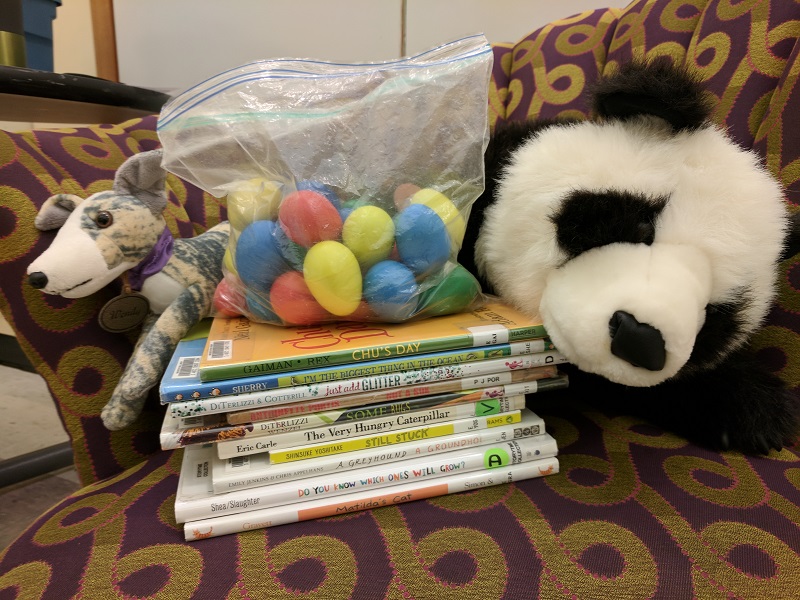
Books, shaker eggs, greyhound and panda stuffed animals

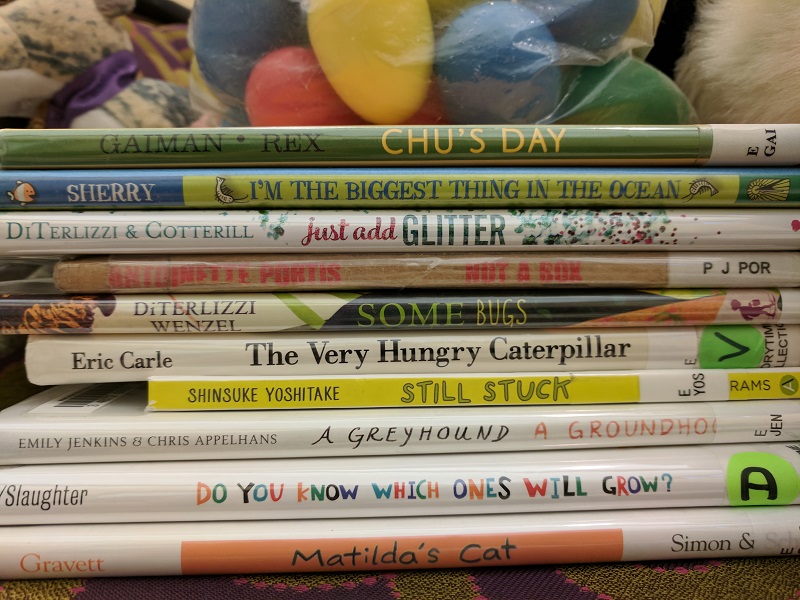
Books for storytime

  • Welcome and announcements: Keep the doorways clear, feel free to come and go (wiggliness, noise, bathroom, snack breaks), calendar of events available at desk and on website, etc.)
  • “Hello Friends” song with ASL (Jbrary)
  • Stretch: a seated stretch toward the ceiling, to toes, to ceiling, to toes
  • Chu’s Day by Neil Gaiman and Adam Rex, with enormous panda bear and fake sneezes.
  • Song cube: “I Had A Little Turtle” (seemed unfamiliar to most) and “If You’re Happy and You Know It” (familiar to everyone!)
  • I’m the Biggest Thing in the Ocean by Kevin Sherry: this giant squid knows how to make the best of things.
  • Passed out shaker eggs, tested them to make sure they worked (they did), instructed them to shake them every time they heard the word “glitter” in Just Add Glitter by Angela DiTerlizzi and Samantha Cotterill. (One of my favorite storytime tips is to recognize that little kids are going to make noise – so get them making the same noise at the same time.). Collected eggs.
  • Yoga cube: Downward dog is a little crowded when the storytime room is that full, but some kids made it work!
  • Some Bugs by Angela DiTerlizzi and Brendan Wenzel
  • “The Kookaburra Song”
  • Not A Box by Antoinette Portis (we read Not A Stick last week): This is where my older kids came in handy, especially because one of them was already familiar with the book. If it’s not a box, what is it?
  • Songs/rhymes: “Head, Shoulders, Knees, and Toes” and “Where is Thumbkin?” (twice, replacing “sir” with “friend”)
  • The Very Hungry Caterpillar by Eric Carle, with flannel board: I always have volunteers to help put the different fruits on the board.
  • “Goodbye Friends” song with ASL (Jbrary)
  • Clean up mats, invite questions (and someone did ask about chapter books with pictures for her 3-year-old!), tape down paper and put out crayons for coloring.

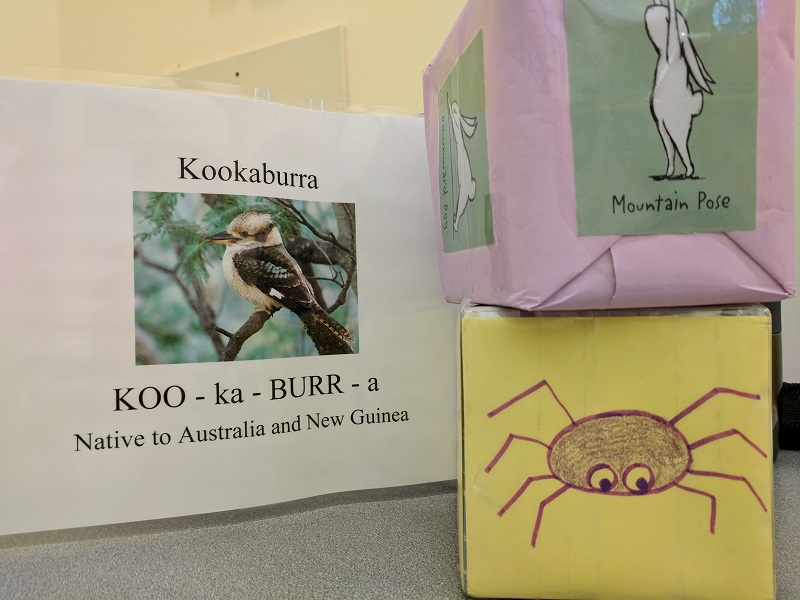
Kookaburra picture, yoga cube, song cube

Step Into Storytime, September 9

It’s a new season of Step Into Storytime, our library’s twice-weekly storytime for two- and three-year-olds (and siblings of various ages). I run our Monday storytime, and I’m excited to get back into a weekly rhythm!

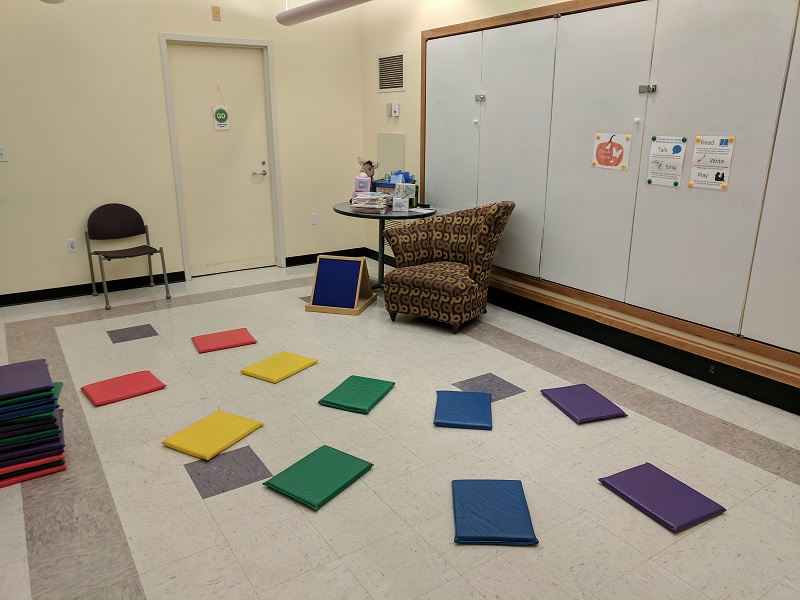
Storytime room

Room setup:

  • Step Into Storytime laminated poster and early literacy tips (Talk, Sing, Read, Write, Play) on the board with magnets
  • Colored mats in a stack
  • Storytime box (contains magnets, posters, bubbles, scissors, tape, scarves, shaker eggs, stickers, ipod with music, etc.)
  • Additional props (flannel board and shapes, puppets or stuffed animals)
  • Song cube(s) and yoga cube(s)
  • Books! (Usually 4-6 I plan to read, plus several alternates in case the crowd skews younger, older, wiggly, etc.)

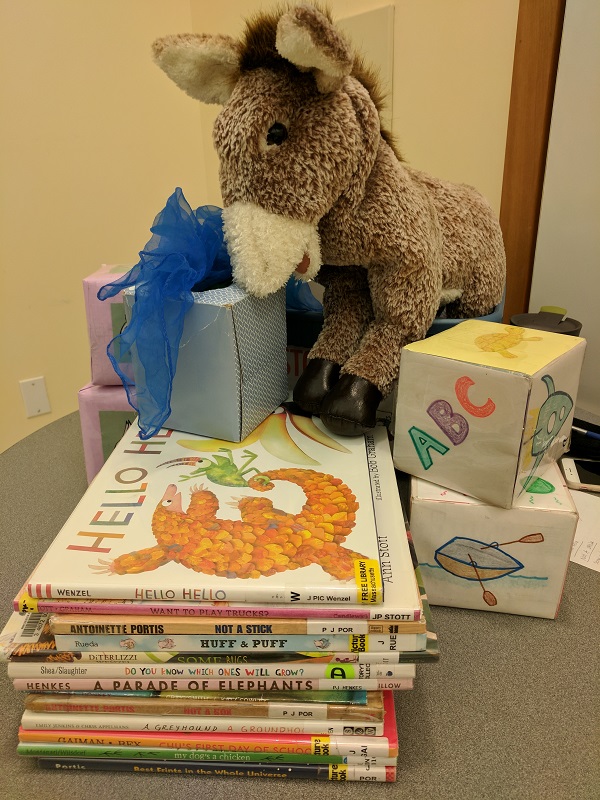
Books, donkey, song cubes, scarves, yoga cubes

Storytime:

  • Welcome everyone and announcements (keep the doorways clear, location of bathrooms and where to have snacks, upcoming program info)
  • “Hello Friends” song with ASL (Jbrary)
  • Name song (“____ is here today”) and early literacy tip: we do a lot of singing in storytime, in addition to reading, because the rhythm of songs helps with language development and lays the groundwork for reading and writing later on.
  • Hello Hello by Brendan Wenzel: This is one of my all-time favorite openers. There’s not a lot of text, but there are so many opportunities for interaction (who’s wearing dots/stripes? Can you move like an octopus? Show/touch your tongue, ears, hands, and nose, etc.). In today’s group, we had a few returning families but plenty of new kids and they were a little younger than last spring’s group. Storytime for younger groups is always going to be noisy and wiggly, so if you can get them making the same sounds/movements as each other, that’s a win.
  • Want to Play Trucks? by Ann Stott and Bob Graham: Even with a younger crowd, I like to have at least a couple books with some kind of narrative arc or story, and this one is perfectly simple, in a familiar scenario for most kids – a playground, toys, ice cream.
  • Song cube: “I’m A Little Teapot” and “ABCs”
  • Not A Stick by Antoinette Portis: An off-page voice asks the little piglet about its stick – but it’s not not not a stick! This is a brilliant representation of the way grown-ups misunderstand kids’ imaginative play, or simply don’t see the same things. (I’m planning to read Not A Box next week.)
  • Handed out scarves for Huff and Puff by Claudia Rueda. “Does anyone know the story of the three little pigs? Okay, this is different!” The scarves are fun in themselves, give the kids something to do with their hands, and help illustrate the wind created by the wolf’s huffing and puffing.
  • Yoga cube (“Yoga is a way of moving our bodies”): Warrior poses and chair pose (“Everyone pull up an invisible chair…and sit in it!”)
  • Fall Is Not Easy by Marty Kelley: Change is hard. Even young kids are familiar with the changing of seasons, and they can tell that there’s something funny about this tree’s fall leaves.A Parade of Elephants book and flannel board
  • The Wonky Donkey by Craig Smith and Katz Cowley, with donkey puppet. This one is funny, repetitive, and not as much of a tongue twister as it seems.
  • Flannel board: elephants
  • A Parade of Elephants by Kevin Henkes: Like Hello Hello, this one has so many opportunities for interaction and engagement: We identified the colors of the elephants, counted them, marched, stretched, yawned, and trumpeted.
  • “Goodbye Friends” song with ASL (Jbrary)
  • Clean up mats
  • Music (“Watch Petunia Dance” by Caspar Babypants) and bubbles (and no one got trampled or threw up!)

Bonus: Lots of high fives and hugs at the end, plus a huge hug from a kiddo who’s been coming for at least a year with her older brother! The storytime love was strong today.


Summer Storytime: Inclusion and Acceptance

Storytime books on chair

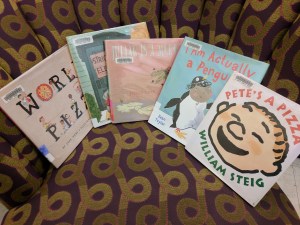
Again, I didn’t plan around a theme, but as I looked at the books I’d chosen, a theme emerged: inclusion and acceptance. Whether it’s solving world hunger through pizza, allowing every kind of pet into the pet club, or trying on new identities (penguin, mermaid), the kind thing to do is always to accept those who look or act differently.

  • “Hello Friends” with ASL (Jbrary)
  • World Pizza by Cece Meng
  • Stretching, “Head Shoulders Knees and Toes”
  • Strictly No Elephants by Lisa Mantchev
  • Julian Is A Mermaid by Jessica Love
  • “Shake Your Sillies Out” (Raffi music, scarves to shake)
  • I Am Actually A Penguin by Sean Taylor
  • Song cube: “If You’re Happy and You Know It,” “I Had A Tiny Turtle”
  • Pete’s A Pizza by William Steig
  • “Goodbye Friends” w/ ASL (Jbrary)
  • Decorate a pizza slice

Most of the kids seemed engaged throughout, and the pizza slice decoration was a hit. I told them they could take their slice home or add it to our pizza on the wall, and almost everyone chose to add theirs, so we made a whole pizza (with lots of interesting toppings).

I’ve gotten out of the habit of checking the blogs I follow via Feedly (and I can’t blame it all on the demise of Google Reader, either), but I dipped in recently to see what I’d missed and found these great posts:

  • From Tiny Tips for Library Fun, an examination of the Diversity in Children’s Books infographic, comparing 2015 to 2018. We have made a little progress but still have a ways to go – especially since the percentage of books featuring white characters dropped, but the percentage of books featuring non-human characters went up.
  • From Story Time Secrets, a new storytime complete with books, songs, and activities. The Giant Jumperee is one of my favorites to read aloud for toddlers, and I might use her “Story time is starting, clap your hands”/”Story time is over, clap your hands” sometime, although I really like “Hello Friends” and “Goodbye Friends.” I also think the “elevator” movement could work as a variation on “Head, Shoulders, Knees, and Toes” while standing up.
  • Betsy Bird’s Newbery/Cadecott 2020: Summer Prediction Edition. My reading list just got so much longer, but fortunately, lots of the titles are picture books. I’m looking forward to new Brendan Wenzel and a Bob Shea/Zachariah Ohora collaboration, and I’ve already enjoyed Antoinette Portis’ Hey, Water! I love middle grade too: New Kid and Other Words For Home were amazing, and I can’t wait for Corey Haydu’s newest, Eventown. Queen of the Sea looks interesting too.