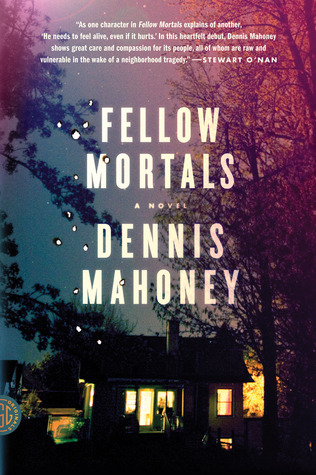
Fellow Mortals by Dennis Mahoney

fellowmortalsFellow Mortals by Dennis Mahoney (Farrar, Straus & Giroux, published February 5, 2013)

By throwing a match and a cigar into some dry bushes while on his route, mailman Henry Cooper causes a fire that kills a woman, burns down two houses, and damages two more. Henry is desperate to do everything he can to help the people whose lives he affected: Sam, now a widow; the Finn sisters, whose house was destroyed; the Carmichaels, a family of four; and couple Billy and Sherri Kane. Some of them want nothing to do with Henry; others accept his help immediately.

Of all of the people whose lives the fire affected, Sam Bailey is the one Henry must try hardest to reach. Sam’s wife Laura died in the fire, and Sam has retreated into the woods behind their old house, where he builds a cabin and carves trees into sculptures. Henry insists on helping him, and the two develop a relationship that is at first uneasy, but eventually becomes something resembling a friendship. Eventually, Henry draws his wife Ava out to the woods to spend time with Sam as well, though Henry asks Sam not to tell her how much he’s helping build the cabin; due to a heart condition, Henry isn’t supposed to do hard physical labor (yes, that’s foreshadowing).

This is a quiet, observant, transformative novel in which the characters wrestle with innocence and guilt, loss and forgiveness. Henry’s culpability for the fire, his guilt and desire to help both deepen and complicate his relationships with the people on Arcadia Street, and with Ava. In the wake of the tragic fire, some people are cleaved apart, while others cleave together. Henry’s essential goodness and innocence allow him to persevere, if clumsily, in forming bonds between people.

Mahoney’s characters are believable, and the sense of place is keenly developed. Comparisons to Stewart O’Nan (Songs for the Missing, Last Night at the Lobster) and Leah Hager Cohen (The Grief of Others) are apt.

Thanks to Emily Bell at FSG for a pre-publication copy of the book.


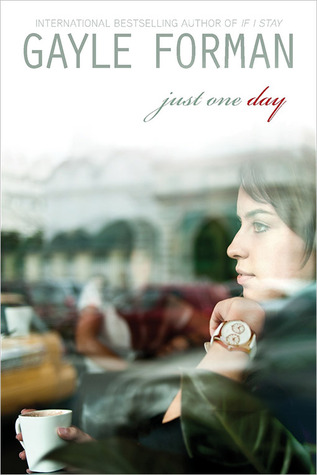
Just One Day by Gayle Forman

justonedayJust One Day by Gayle Forman (published January 2013)

Those who read a lot of YA fiction have doubtless encountered many trilogies recently. Often, the second book is the least satisfying, merely providing a bridge from the first book (in which most of the world-building takes place and the characters are introduced and established) to the final book (which, one hopes, provides the exciting and dramatic conclusion).

Gayle Forman wisely avoids this trap, opting to write books in pairs rather than in sets of three. I adored If I Stay and Where She Went, which together tell the story of Mia and Adam; she narrates the first book, he narrates the second. I was looking forward to Just One Day (the next book in this pair, Just One Year, comes out in the fall), and it did not disappoint.

Just One Day is Allyson’s story. Like Mia and Adam, Allyson is leaving high school and entering the world beyond: in her case, college, preceded by a summer tour through Europe. Allyson, always a good girl who lets her mother run her life to a degree unfathomable by me, impulsively takes a day trip to Paris with a young actor she meets in London, Willem. Their day and night is eventful and wonderfully romantic, until she wakes up the next morning and discovers him gone; heartbroken, she returns to London and then home, vowing to forget him, but when that strategy proves a failure, she decides she has to find him, and find out what happened.

There are so many great things about this book: it covers that transitional period between high school and college; the writing is lovely; Allyson’s friendships are realistic (she grows apart from a high school friend, miscommunicates with her roommates, finally makes a friend in her Shakespeare class), as are her relationships with her parents. For those who are partial to Shakespeare and European travel, those are bonus elements. Most of all, this is a story of personal growth, but it’s not a formulaic coming-of-age story; the author lets Allyson flounder for a while before getting back on her feet.

This story ended in a perfect place, and I can’t wait to read Just One Year.

Anna Karenina

Cross-posted on the Robbins Library blog.

To be perfectly honest, I wasn’t thrilled when my book club chose Tolstoy’s famous (and famously long) Anna Karenina. However, part of what I like about being in a book club is that it often provides that little nudge necessary to tackle a book that I might not otherwise have the motivation to begin on my own.

AnnaK-DukeSo, I downloaded the e-book version from the library’s digital media catalog and put it on my e-reader…then waited until about three days before our book club meeting to begin it. Needless to say, I didn’t finish in time for the discussion, but I did finish eventually – two and a half weeks later. And I’m so glad that I took the time to read Anna at a leisurely pace, in little sections, absorbing and savoring, because it is marvelous.

There are at least five main characters: Anna herself, of course; her husband, Alexander Alexandrovitch (Karenin); her lover, Alexey Vronsky; her niece Kitty; and Kitty’s husband Konstantin Levin. Anna’s brother, Stepan Oblonsky, and his wife, Darya Alexandrovna (Dolly), also play significant roles. Tolstoy’s mastery is such that the reader enjoys insight into each character, and is able to understand and sympathize with each.

annakareninaOver and over again, the characters’ emotions struck me as familiar, and I was surprised at how little human nature has changed. We “modern humans” tend to think of ourselves as more advanced, more enlightened, more complicated, and more progressive: but here is the character Natalia saying, “Parents now are not expected to live at all, but to exist altogether for their children,” and there is Kitty reveling because Levin’s jealousy proves his love for her. Here is Karenin exclaiming, “I cannot be unhappy, but neither she nor he ought to be happy,” and there is Anna lamenting, “And no one understands it except me, and no one ever will; and I can’t explain it.” Here is Anna making the Vronsky of her imagination fit with the Vronsky in reality, and there is Vronsky made cold and vindictive by Anna’s need for him.

AnnaK-PenguinEven one character’s light suggestion that “they ought to find out how to vaccinate for love, like smallpox” could have been the seed of the idea for Lauren Oliver’s recent popular young adult series, beginning with Delirium.

All of these emotions and reactions are so recognizably human that the book truly is timeless, retaining its power throughout the years. One line that had a particular impact was one of Anna’s last to Vronsky: “Respect was invented to cover the empty place where love should be. And if you don’t love me any more, it would be better and more honest to say so.”

AnnaK-modernlibraryI don’t think I’ll ruin it for anyone if I admit it has a tragic ending, but Anna Karenina is not relentlessly sad or hopeless. There are social engagements, horse races, hunting and farming scenes, meditations on business and bureaucracy, government and religion. There are also little touches of humor, intentionally or unintentionally. For example, very early on, when Anna goes to visit Dolly, she tells her hostess, “I assure you that I sleep everywhere, and always like a marmot.” (Are marmots particularly sleepy creatures, like sloths? I don’t know.) Later, Anna’s friend Betsy says to her, “Possibly you are inclined to look at things too tragically,” which is a rather dark piece of irony, considering Anna’s fate.

AnnaK-BnNAs someone who put off reading this long, classic work that I feared would be dense, impenetrable, and boring, I can now assure you that it is none of these things; it is in fact the opposite. Anna Karenina is an engrossing read, a comprehensive portrait of unchanging human nature.

With a new movie version recently released, one may be tempted to skip the book in favor of the movie. However, if you have the time and patience to read it, you’ll be rewarded with a lasting and memorable experience.

Handmade journal

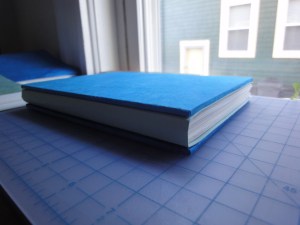
Over a year after attending a bookmaking workshop, I finally finished making a journal.

journal

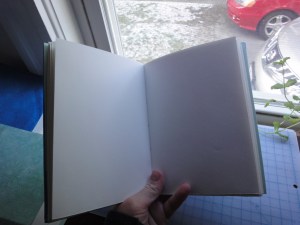
I had to cut and fold the pages to size (this was the most time-consuming part), and sew them together with a chain-stitch. The board covers I bought pre-cut, and covered them with blue paper. I didn’t have a board spine, so I used a piece of cardstock between the covers and the pages.

journal-open

Voila! I haven’t begun using it yet, but I’m nearly done with my current journal, so I will soon.


Bookish Resolutions

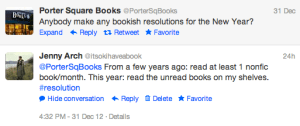
My first successful New Year’s resolution that I made, kept, and remembered, was: read at least one nonfiction book a month. Then, as now, I was reading about 10-15 books a month, and they were nearly all fiction. I decided I needed to push myself to branch out and read in some other areas, like (auto)biography, history, and science. Thus did I discover such excellent books as The Ghost Map, The World Without Us, The Man Who Loved Books Too Much, and The Wordy Shipmates, not to mention Tina Fey’s Bossypants and Keith Richards’ Life.

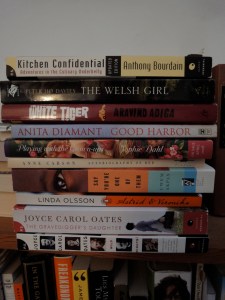
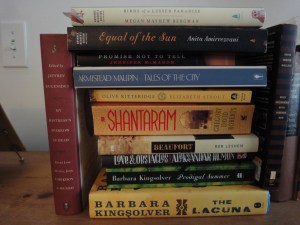
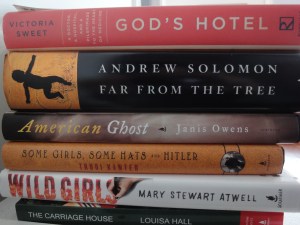
In the years between that resolution and this new year, I have accumulated a number of books that I haven’t yet gotten around to reading. Most are fiction, but some are nonfiction. Most I’ve bought used, some have been sent to me by thoughtful and generous friends. It used to be that if a book was in the house, I had read it or was in the process of reading it; now that’s not the case. (Partly because I work in a library; I’m surrounded all the time by free books that I can just borrow and give back, and which always seem to take precedence over the books that I own, which don’t have due dates.)

bookishresolutionI want to get through my shelves of unread books, either by reading them or by deciding that I don’t want to read them. After I’ve read them, I may keep them, may donate them, or may pass them on to friends, but there are too many unread books in the house.

So help me out: have you read any of the below? Loved them? Thought they were a waste of time? A few came with personal recommendations and are at the top of the list: Far From the Tree, God’s Hotel, Shantaram. If you’ve got opinions on those or any of the others, please share!


unread1unread2unread3


To finish or not to finish?

Among the countless “best of 2012” lists out there, Laura Miller’s recent piece for Salon, “Five Books I Bailed On in 2012” caught my attention. Every serious reader I know, myself included, has given up on a book before. Some of us feel unreasonable guilt about this; some will only give up right away, or not at all; some force themselves to read at least halfway before jumping ship. But, we try to convince ourselves, we are reading for pleasure. No one is forcing us to finish every book we start, and in fact, isn’t our time better spent finding and reading books we truly enjoy?

These unfinished books linger in limbo, on our “partially-read” or “on the back burner” shelves on Goodreads. Maybe we’ll return to them someday; some of them we’ll never open again. I consulted my own shelf of unfinished books to make a “books I bailed on” list like Laura Miller’s. I should note that (a) these were books I started in 2012, not necessarily books that were published in 2012, and (b) the experience of reading is, of course, entirely subjective; feel free to disagree with my opinions.
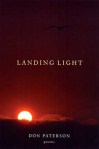
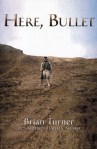
landinglightherebulletLanding Light by Don Paterson and Here, Bullet by Brian Turner.

These volumes have nothing in common except that they are both books of poetry that I ordered from the library.  However, I find it necessary to read poems in small doses; I’ve never read a book of poems straight through, because I need time to absorb and reflect. But then I put the book down and pick up something else…and then it’s time to return it to the library. (This is why I prefer owning books of poetry rather than borrowing them.) A more disciplined approach – one poem a night before bed, or one every morning before getting up – is a great idea in theory, but not one I’ve been able to pull off. However, the fact that I didn’t finish these books doesn’t mean I didn’t like them; I’d recommend both.

Paterson is a Scottish poet; Turner is an American soldier who fought in Iraq and who holds an MFA from the University of Oregon. I first read about Landing Light in the New York Times and the poem included in the article, “Luing,” is one of my favorites, especially the last three lines. I discovered Here, Bullet via the Times as well; I collected fragments from various poems in the collection in my Goodreads review.
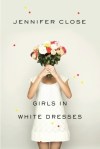
whitedressesGirls in White Dresses by Jennifer Close

I was tricked into picking this up by the flap copy (which made it sound like literary fiction instead of chick lit) and inexplicably good reviews (“genuinely empathetic…richly satisfying” –Booklist, “modern and funny…original” –Library Journal, “artfully spare prose” –Publishers Weekly). I found it to be frustratingly superficial, and put it down after 47 pages.
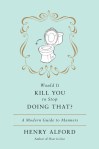
woulditkillyouWould It Kill You to Stop Doing That: A Modern Guide to Manners by Henry Alford

I enjoyed this, but was eager to move on to other books. Alford is intelligent and pleasant to read, but if you have to choose between this rant on manners and Lynn Truss’ excellent Talk to the Hand, I’d recommend the latter.
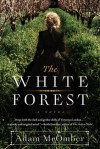
whiteforestThe White Forest by Adam McOmber

This book’s flap copy, cover, and reviews all drew me in; it looked like exactly the kind of book I would like, if not love. Yet after 15 pages, I wasn’t drawn into the story or compelled by the characters. I may pick it up again in the future – maybe it was just one of those “right book at the wrong time” cases – but probably not.
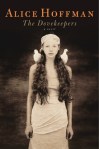
dovekeepersThe Dovekeepers by Alice Hoffman

This is one I may come back to at some point. I’ve liked Alice Hoffman’s books in the past (Practical MagicThe Story Sisters), and I didn’t dislike this one; it just didn’t grab me, and I had a few other books I was more excited about reading at the time.
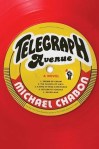
telegraphaveTelegraph Avenue by Michael Chabon

This is the big one. With the exception of Wonder Boys, I have loved every Michael Chabon book I’ve read, and so I had high hopes for Telegraph Avenue, and yet, on page 199, I threw in the towel. The bones of a good story are there, and the foundations of good characters; I especially liked Aviva and Gwen, the wives of the two main adult male characters, and main characters in their own right. I’m also sympathetic to the plight of independent stores to big corporate stores (as are many of Chabon’s readers, I suspect). So why did I put it down? It seemed as though the writing, instead of revealing the story, was obscuring it. I’m all for writing that is both intellectual, colorful, and poetic, but this was just too over the top for me. It was with regret but also relief that I put it down unfinished.

Agree? Disagree? What books linger on your back burner?

Cross-posted on the Robbins Library blog.

Edited to add: Tim Parks wrote an article (“Why Finish Books?”) for the New York Review of Books blog on March 13, 2012 that touches on a different aspect of the “to finish or not to finish” question. Parks clearly agrees that if you are not enjoying a book, it is perfectly okay to stop reading and pick up a book you will enjoy instead; however, he also posits that some readers might stop reading books that they are enjoying, and that does not necessarily mean that the book was bad or that the reader didn’t like it, just that the reader had had enough. It is an interesting article, whether or not you agree. -4/18/13
More 2012 favorites

Cross-posted as “Favorites of 2012” on the Robbins Library blog.

My colleague Linda posted her favorite reads of the year a few days ago, and we’ve definitely enjoyed some of the same ones: I too would highly recommend the fresh and funny Where’d You Go, Bernadette?the wise, wonderful and heartbreaking The Fault in Our Stars, the paranoia-inducing Gone Girl, and the erudite essays in More Baths, Less Talking.

To these, I’ll add a few of my own, with links to reviews (below). These are books I’ve read in 2012, not necessarily books published in 2012, though many of them were.

Fiction

gold2 Gold by Chris Cleave

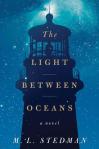
The Light Between Oceans by M.L. Stedman

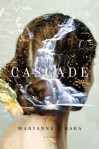
Cascade by Maryanne O’Hara (this is our Staff Picks book for February, and Maryanne herself will be joining us for the discussion!)

The Language of Flowers by Vanessa Diffenbaugh

rulesofcivility Rules of Civility by Amor Towles

Billy Lynn’s Long Halftime Walk by Ben Fountain

Bring Up the Bodies by Hilary Mantel (sequel to Wolf Hall; both books won the Booker Prize)

Arcadia by Lauren Groff


The Thousand Autumns of Jacob De Zoet
by David Mitchell (author of Cloud Atlas)

Vaclav and Lena by Haley Tanner

Maine by J. Courtney Sullivan

Fault in our Stars The Fault in Our Stars by John Green

My Sister Lives on the Mantelpiece by Annabel Pitcher

Nonfiction

Let’s Pretend This Never Happened: A Mostly True Memoir by Jenny Lawson (a.k.a. The Bloggess)

The Wordy Shipmates by Sarah Vowell (I listened to the audiobook)

Agree? Disagree? What are some of your recent favorites? Leave a comment!

Favorite Books of 2012

Today at work, I got an e-mail requesting staff send in their picks for favorite books of 2012. (Have I mentioned how much I like working in a library?) We were to submit no more than three each, which as every avid reader knows is a difficult-to-impossible task. However, it’s easier to think of it as “three of your favorite books” rather than “your three favorite books.”

With that caveat in mind, I headed over to my Goodreads page (I ❤ Goodreads) and sorted my shelf of books I had read by date read. Mentally, I filtered out books that were published before 2012; this meant I couldn’t include obvious shoo-in Rules of Civility by Amor Towles or The Language of Flowers by Vanessa Diffenbaugh, both published in 2011.

And yet: so many good books came out this year! The marvelous John Green’s The Fault in Our Stars, Maria Semple’s fresh and original Where’d You Go, Bernadette?, Hilary Mantel’s Bring Up the Bodies, the much-feted sequel to Wolf Hall…and then there are the nonfiction books, such as Jenny Lawson’s laughter-and-tears-inducing memoir, Let’s Pretend This Never Happened, and Ken Jennings’ clever Because I Said So: The Truth Behind the Myths, Tales, and Warnings Every Generation Passes Down to Its Kids.

Yet in the end, here are the three I chose:

gold2GOLD by Chris Cleave
Set before and during the London Olympics, Gold is timely; yet it is timeless in the way that it represents people’s best and worst natures, particularly the struggle between career ambitions and family life. Kate and Zoe are close friends and rival cyclists, competing for one spot on the London Olympic team. Zoe is focused solely on training, while Kate has a family: her husband Jack, another Olympian, and their eight-year-old daughter Sophie, who is battling leukemia. Flashbacks to earlier periods in the characters’ lives reveal crucial backstory in this wrenching novel.

lightbetweenoceansTHE LIGHT BETWEEN OCEANS by M.L. Stedman
This is a beautiful book with strong characters and a thought-provoking central dilemma. Tom Sherbourne returns from fighting in the Great War and takes a job as a lighthouse keeper on a remote island of the coast of Australia; he and his wife, Isabel, are deeply in love, but Isabel is inconsolable over her inability to have a child. When a lifeboat washes up on their beach containing a dead man and a live baby, Isabel begs Tom to keep it. The Light Between Oceans is the extraordinary story of that decision, and of how to act in the present when the past cannot be changed.

cascadeCASCADE by Maryanne O’Hara
“Life is full of tough choices between less-than-perfect alternatives,” says one character in this Depression-era novel, and that about sums it up for twenty-six-year-old Desdemona Hart. Dez married Asa Spaulding to provide stability for her ailing father, who died a few months later. Asa doesn’t understand Dez’s reluctance to start a family, but traveling artist Jacob does: Dez wants to go to New York City to pursue her career in art. On top of this dilemma, the town of Cascade is itself at risk: men from Boston visit the town as a potential site for a new reservoir. Will Dez fight to save the town and her father’s famous playhouse, or will she flee to follow her dream? The historical setting is vivid, and Dez is a compelling character; the decision she must make is one that many people still face today.

Build it, and they will come.

In sixth or seventh grade, I was asked to write an essay in response to the question, “Who is your hero?” I didn’t have a good answer, though I know I wrote something. If you asked me that question now, however, I’d have a pretty good answer ready: author and independent bookseller Ann Patchett.

For those who haven’t followed the birth of Parnassus Books, the store Patchett co-founded in her hometown of Nashville, TN, when its last remaining bookstore closed, you can catch up with this article from The Atlantic, “The Bookstore Strikes Back.”

Here are a few excerpts:

On entering the book retail business: “[I]f I wanted to re-create the bookish happiness of my childhood, then maybe was the person for the job. Or maybe not. I wanted to go into retail about as much as I wanted to go into the Army.”

On other booksellers: “Booksellers do not guard their best secrets: they are a generous tribe, and were quick to welcome me into their fold and give me advice.”

On what local brick-and-mortar stores do that Amazon can’t: “All things happen in a cycle…the little bookstore had succeeded and grown into a bigger bookstore. Seeing the potential for profit, the superstore chains rose up and crushed the independents, then Amazon rose up and crushed the superstore chains. Now that we could order any book at any hour without having to leave the screen in front of us, we realized what we had lost: the community center, the human interaction, the recommendation of a smart reader rather than a computer algorithm telling us what other shoppers had purchased.”

On what you, the reader, can do: “Amazon doesn’t get to make all the decisions; the people can make them, by choosing how and where they spend their money. If what a bookstore offers matters to you, then shop at a bookstore. If you feel that the experience of reading a book is valuable, then read a book. This is how we change the world: We grab hold of it. We change ourselves.”

If I ever visit Nashville, it will be to go to Parnassus. However, I’ve been lucky enough to hear Ann Patchett give a reading (of State of Wonder) at a great independent bookstore between Cambridge and Somerville, Porter Square Books. It has beautiful displays, friendly staff, and great author events, so I visit regularly, though I don’t buy books that often (hey, I work in a library). However, if you received books as a gift from me this holiday season, they came from Porter Square Books. Is it more expensive than Amazon? Most of the time. Is it worth it? Yes.

Researching and Writing Historical Fiction

Cross-posted as “Truth in Fiction” on the Robbins Library blog.

As November, otherwise known as National Novel Writing Month (NaNoWriMo), was drawing to a close, I had the opportunity to attend a program that I had set up at the Robbins Library: authors Margot Livesey and Adam Braver came to have a conversation about researching and writing historical fiction. Margot is the author of, most recently, The Flight of Gemma Hardy, a retelling of Jane Eyre; Adam’s newest novel is Misfit, about Marilyn Monroe.

Do you research first and write after, write and research at the same time, or write first and research after? “Research feeds imagination,” said Livesey. She does some preliminary research before writing, just enough for a chapter or a draft, then researches retrospectively as needed. Both authors agreed that they could get bogged down or sidetracked, and that research could be an excellent procrastination tool.

Braver said he will look up facts he needs as he writes, and “sometimes it leads to something [else],” but he also does a large amount of preliminary research, using newspapers and interviews. Both authors said they have worked and researched in public libraries, using newspapers, microfilm and microfiche, and of course books. At home, Livesey has two computers: one that “doesn’t know the Internet exists,” and another that is online. She writes on the offline computer, and only goes to the online one if she really needs to look something up.

How do you manage to spend so much time with your novels and not get sick of them; how do you manage to persevere? “Not getting sick of it is the challenge,” Braver responded. He said he usually goes through 15 – 20 revisions per book, and would often like to quit when it’s “good enough,” but “I’m restless until I feel like it’s right.”

How do you deal with conflicting versions of history? Braver answered that conflicting versions often become the story. Like historians, novelists are looking for the truth behind the facts; the facts may be irrefutable, but the order in which they are told is what makes a story.

How much is fact and how much is fiction? What liberties do you take when you write fiction set in the past? As a reader of fiction, Livesey said, “I count on fiction to tell me the truth…be faithful in certain ways.” One might, for example, add a burn unit to a hospital that didn’t have one, but not drop bombs on a city that wasn’t bombed. (Of course, authors can address what’s true and what’s invented in an Afterword.)

“I think readers mind very much about precision,” said Livesey, estimating that about 30% of the mail she receives from readers contains corrections to her work. However, “people are forgiving…unless it’s sloppy.”

What’s the difference between writing about a period some people remember, as opposed to writing about a time no one alive remembers? Braver said that certain periods in the past are viewed “in sepia tone,” and his goal is to “strip away the nostalgia,” and make the reader feel as though, by opening the novel, they are opening a door into the past.

Braver writes about well-known historical figures – President Lincoln, Jackie Kennedy, Marilyn Monroe – but focuses on the periphery, on moments that occurred out of the public spotlight. Livesey’s characters, by contrast, are “modest,” and invented. “Small details of ordinary life,” she said, can be more important than big events.