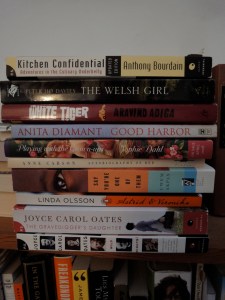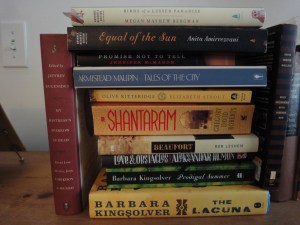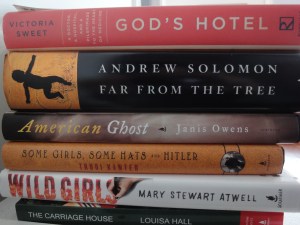
More 2012 favorites

Cross-posted as “Favorites of 2012” on the Robbins Library blog.

My colleague Linda posted her favorite reads of the year a few days ago, and we’ve definitely enjoyed some of the same ones: I too would highly recommend the fresh and funny Where’d You Go, Bernadette?the wise, wonderful and heartbreaking The Fault in Our Stars, the paranoia-inducing Gone Girl, and the erudite essays in More Baths, Less Talking.

To these, I’ll add a few of my own, with links to reviews (below). These are books I’ve read in 2012, not necessarily books published in 2012, though many of them were.

Fiction

gold2 Gold by Chris Cleave

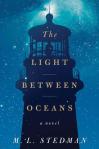
The Light Between Oceans by M.L. Stedman

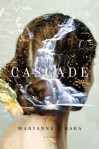
Cascade by Maryanne O’Hara (this is our Staff Picks book for February, and Maryanne herself will be joining us for the discussion!)

The Language of Flowers by Vanessa Diffenbaugh

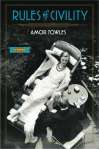
rulesofcivility Rules of Civility by Amor Towles

Billy Lynn’s Long Halftime Walk by Ben Fountain

Bring Up the Bodies by Hilary Mantel (sequel to Wolf Hall; both books won the Booker Prize)

Arcadia by Lauren Groff


The Thousand Autumns of Jacob De Zoet
by David Mitchell (author of Cloud Atlas)

Vaclav and Lena by Haley Tanner

Maine by J. Courtney Sullivan

Fault in our Stars The Fault in Our Stars by John Green

My Sister Lives on the Mantelpiece by Annabel Pitcher

Nonfiction

Let’s Pretend This Never Happened: A Mostly True Memoir by Jenny Lawson (a.k.a. The Bloggess)

The Wordy Shipmates by Sarah Vowell (I listened to the audiobook)

Agree? Disagree? What are some of your recent favorites? Leave a comment!

Favorite Books of 2012

Today at work, I got an e-mail requesting staff send in their picks for favorite books of 2012. (Have I mentioned how much I like working in a library?) We were to submit no more than three each, which as every avid reader knows is a difficult-to-impossible task. However, it’s easier to think of it as “three of your favorite books” rather than “your three favorite books.”

With that caveat in mind, I headed over to my Goodreads page (I ❤ Goodreads) and sorted my shelf of books I had read by date read. Mentally, I filtered out books that were published before 2012; this meant I couldn’t include obvious shoo-in Rules of Civility by Amor Towles or The Language of Flowers by Vanessa Diffenbaugh, both published in 2011.

And yet: so many good books came out this year! The marvelous John Green’s The Fault in Our Stars, Maria Semple’s fresh and original Where’d You Go, Bernadette?, Hilary Mantel’s Bring Up the Bodies, the much-feted sequel to Wolf Hall…and then there are the nonfiction books, such as Jenny Lawson’s laughter-and-tears-inducing memoir, Let’s Pretend This Never Happened, and Ken Jennings’ clever Because I Said So: The Truth Behind the Myths, Tales, and Warnings Every Generation Passes Down to Its Kids.

Yet in the end, here are the three I chose:

gold2GOLD by Chris Cleave
Set before and during the London Olympics, Gold is timely; yet it is timeless in the way that it represents people’s best and worst natures, particularly the struggle between career ambitions and family life. Kate and Zoe are close friends and rival cyclists, competing for one spot on the London Olympic team. Zoe is focused solely on training, while Kate has a family: her husband Jack, another Olympian, and their eight-year-old daughter Sophie, who is battling leukemia. Flashbacks to earlier periods in the characters’ lives reveal crucial backstory in this wrenching novel.

lightbetweenoceansTHE LIGHT BETWEEN OCEANS by M.L. Stedman
This is a beautiful book with strong characters and a thought-provoking central dilemma. Tom Sherbourne returns from fighting in the Great War and takes a job as a lighthouse keeper on a remote island of the coast of Australia; he and his wife, Isabel, are deeply in love, but Isabel is inconsolable over her inability to have a child. When a lifeboat washes up on their beach containing a dead man and a live baby, Isabel begs Tom to keep it. The Light Between Oceans is the extraordinary story of that decision, and of how to act in the present when the past cannot be changed.

cascadeCASCADE by Maryanne O’Hara
“Life is full of tough choices between less-than-perfect alternatives,” says one character in this Depression-era novel, and that about sums it up for twenty-six-year-old Desdemona Hart. Dez married Asa Spaulding to provide stability for her ailing father, who died a few months later. Asa doesn’t understand Dez’s reluctance to start a family, but traveling artist Jacob does: Dez wants to go to New York City to pursue her career in art. On top of this dilemma, the town of Cascade is itself at risk: men from Boston visit the town as a potential site for a new reservoir. Will Dez fight to save the town and her father’s famous playhouse, or will she flee to follow her dream? The historical setting is vivid, and Dez is a compelling character; the decision she must make is one that many people still face today.

Build it, and they will come.

In sixth or seventh grade, I was asked to write an essay in response to the question, “Who is your hero?” I didn’t have a good answer, though I know I wrote something. If you asked me that question now, however, I’d have a pretty good answer ready: author and independent bookseller Ann Patchett.

For those who haven’t followed the birth of Parnassus Books, the store Patchett co-founded in her hometown of Nashville, TN, when its last remaining bookstore closed, you can catch up with this article from The Atlantic, “The Bookstore Strikes Back.”

Here are a few excerpts:

On entering the book retail business: “[I]f I wanted to re-create the bookish happiness of my childhood, then maybe was the person for the job. Or maybe not. I wanted to go into retail about as much as I wanted to go into the Army.”

On other booksellers: “Booksellers do not guard their best secrets: they are a generous tribe, and were quick to welcome me into their fold and give me advice.”

On what local brick-and-mortar stores do that Amazon can’t: “All things happen in a cycle…the little bookstore had succeeded and grown into a bigger bookstore. Seeing the potential for profit, the superstore chains rose up and crushed the independents, then Amazon rose up and crushed the superstore chains. Now that we could order any book at any hour without having to leave the screen in front of us, we realized what we had lost: the community center, the human interaction, the recommendation of a smart reader rather than a computer algorithm telling us what other shoppers had purchased.”

On what you, the reader, can do: “Amazon doesn’t get to make all the decisions; the people can make them, by choosing how and where they spend their money. If what a bookstore offers matters to you, then shop at a bookstore. If you feel that the experience of reading a book is valuable, then read a book. This is how we change the world: We grab hold of it. We change ourselves.”

If I ever visit Nashville, it will be to go to Parnassus. However, I’ve been lucky enough to hear Ann Patchett give a reading (of State of Wonder) at a great independent bookstore between Cambridge and Somerville, Porter Square Books. It has beautiful displays, friendly staff, and great author events, so I visit regularly, though I don’t buy books that often (hey, I work in a library). However, if you received books as a gift from me this holiday season, they came from Porter Square Books. Is it more expensive than Amazon? Most of the time. Is it worth it? Yes.

Researching and Writing Historical Fiction

Cross-posted as “Truth in Fiction” on the Robbins Library blog.

As November, otherwise known as National Novel Writing Month (NaNoWriMo), was drawing to a close, I had the opportunity to attend a program that I had set up at the Robbins Library: authors Margot Livesey and Adam Braver came to have a conversation about researching and writing historical fiction. Margot is the author of, most recently, The Flight of Gemma Hardy, a retelling of Jane Eyre; Adam’s newest novel is Misfit, about Marilyn Monroe.

Do you research first and write after, write and research at the same time, or write first and research after? “Research feeds imagination,” said Livesey. She does some preliminary research before writing, just enough for a chapter or a draft, then researches retrospectively as needed. Both authors agreed that they could get bogged down or sidetracked, and that research could be an excellent procrastination tool.

Braver said he will look up facts he needs as he writes, and “sometimes it leads to something [else],” but he also does a large amount of preliminary research, using newspapers and interviews. Both authors said they have worked and researched in public libraries, using newspapers, microfilm and microfiche, and of course books. At home, Livesey has two computers: one that “doesn’t know the Internet exists,” and another that is online. She writes on the offline computer, and only goes to the online one if she really needs to look something up.

How do you manage to spend so much time with your novels and not get sick of them; how do you manage to persevere? “Not getting sick of it is the challenge,” Braver responded. He said he usually goes through 15 – 20 revisions per book, and would often like to quit when it’s “good enough,” but “I’m restless until I feel like it’s right.”

How do you deal with conflicting versions of history? Braver answered that conflicting versions often become the story. Like historians, novelists are looking for the truth behind the facts; the facts may be irrefutable, but the order in which they are told is what makes a story.

How much is fact and how much is fiction? What liberties do you take when you write fiction set in the past? As a reader of fiction, Livesey said, “I count on fiction to tell me the truth…be faithful in certain ways.” One might, for example, add a burn unit to a hospital that didn’t have one, but not drop bombs on a city that wasn’t bombed. (Of course, authors can address what’s true and what’s invented in an Afterword.)

“I think readers mind very much about precision,” said Livesey, estimating that about 30% of the mail she receives from readers contains corrections to her work. However, “people are forgiving…unless it’s sloppy.”

What’s the difference between writing about a period some people remember, as opposed to writing about a time no one alive remembers? Braver said that certain periods in the past are viewed “in sepia tone,” and his goal is to “strip away the nostalgia,” and make the reader feel as though, by opening the novel, they are opening a door into the past.

Braver writes about well-known historical figures – President Lincoln, Jackie Kennedy, Marilyn Monroe – but focuses on the periphery, on moments that occurred out of the public spotlight. Livesey’s characters, by contrast, are “modest,” and invented. “Small details of ordinary life,” she said, can be more important than big events.

Recent Reads: Fiction

I will never get through my “to-read” list, because writers keep writing books and publishers keep publishing them. Alas! Here are a few new-ish novels that I’ve read recently and really enjoyed. Somewhat incidentally, all but one feature teen narrators, and that one (Accelerated) has an eight-year-old character.

 Son by Lois Lowry

Son is the final book in The Giver quartet: The Giver, Gathering Blue, and Messenger. After The Giver, it is my favorite; it ties every strand of story and character together. It begins with Claire, a Birthmother in the community where Jonas lived in The Giver. In fact, Claire is only a few years older than Jonas, and it is her son, Gabe, who Jonas takes with him when he leaves for Elsewhere. Due to an oversight, Claire does not receive the emotion-suppressing pills that all other community members take, and she grieves over Gabe’s disappearance; the rest of the book is her journey to find him again. Dark and heart-wrenching, this is a satisfying end to the quartet, though I believe it can also stand alone.

 Where’d You Go, Bernadette? by Maria Semple

I read this on the strength of Ken Jennings’ recommendation, and loved it. Precocious, teenage Bee narrates: her father is a high-ranking Microsoft employee and her mother, the titular Bernadette, is an award-winning – but reclusive and eccentric – architect. Bee narrates, but the narrative is interspersed with letters, e-mails, and official documents to and from the adults in her life. The settings come alive as well: tech-savvy, hippie-filled Seattle; competitive, nutty Southern California; a peek into an east coast boarding school; and of course, Antarctica. Where’d You Go, Bernadette? is Bee’s unraveling of that very question: she is in search of her mother, figuratively and literally. A smart, funny book that also delves into deeper issues, such as mental illness and mother-daughter relationships.

 Tell the Wolves I’m Home by Carol Rifka Brunt

In Westchester, NY, in 1987, thirteen-year-old June Elbus is grieving over her uncle (and godfather) Finn, who died from AIDS. Her family, especially her mother and sister, don’t think June’s grief is appropriate, but Finn’s “special friend” Toby reaches out to June, and after a few awkward hitches, they form a friendship. From Toby, June begins to learn things her family has kept her in the dark about, and some things that even her family doesn’t know. The author evokes the power and complication of sibling relationships, both between June and her sister Greta, and their mother and her brother Finn. The treatment of AIDS, especially the fear, stigma, and ignorance surrounding it, is a compelling reminder of they way things were twenty-five years ago.

 Accelerated by Bronwen Hruska

Sean’s wife Ellie has left him and their eight-year-old son, Toby. Sean struggles along in single-dad mode, but Toby’s private prep school – paid for by Ellie’s parents – is pressuring Sean to have Toby evaluated for ADD/ADHD and put on drugs that Sean doesn’t think Toby needs. Eventually he knuckles under, with disastrous consequences, which spur him to investigate why so many of the kids at the Bradley School are on these meds. He enlists the help of Toby’s new teacher, Jess, and the two of them become romantically entangled as well. This is a literary novel with some thriller elements. Certain aspects require a willing suspension of disbelief, but the larger issue of medication in education remains.

What makes a good book club book?

First off: this question assumes that at least one of the main purposes of a book club is to discuss a book with friends and acquaintances whose opinions and ideas you respect. Other purposes can certainly include wine, cheese, chocolate, gossip, etc., but in the context of this post, “book club” refers to a group whose members read (at least partially) and discuss (at least for a while) books on a semi-regular schedule.

 So you are in, or want to start, a book club: how do you choose a book? There are all kinds of processes, from democratic to dictatorial, but I’m not going into that here. Whatever your process, the real question is: how do you make sure your selected book can fuel a discussion?

There are books I have enjoyed, but about which I have had very little to say; there are books I have loved, but have not been able to talk about well. It is often easier to identify what you dislike about a book, and harder to say what makes you love one; however, you don’t want to choose a book you think you’ll hate, just for the purpose of discussion.

In the best book club discussions I’ve been part of, there have been lots of mixed opinions. A character might inspire sympathy in some readers, indifference in others; an author’s writing style might be praised as poetic by some, while others will dismiss it as too flowery. Differences in opinion drive discussion, but these differences have more to do with the book’s readers than the book itself.

What about the book itself? I look for the thought-provoking book: the book with a central moral dilemma, where the characters must make difficult decisions or deal with unfamiliar situations. Ann Patchett is one author who excels at putting wonderfully real characters into settings that are strange or uncomfortable for them: a Jewish woman from Los Angeles in Nebraska with her in-laws, a shy scientist searching for her lost coworker in the Amazon, opera lovers held hostage in a South American country. Chris Cleave, on the other hand, is a master of the moral dilemma: family or ambition, sacrifice or cowardice?

Other books explore the future, or alternative versions of the present, and these books are thought-provoking in their own ways. Examples of these are A Visit from the Goon Squad by Jennifer Egan, Never Let Me Go by Kazuo Ishiguro, The Age of Miracles by Karen Thompson Walker, and The World Without Us by Alan Weisman (nonfiction). The beauty of these books is that they subtly encourage you to put yourself in the character’s shoes, to compare the character’s actions and thoughts with what you imagine your actions and thoughts might be in his or her place.

 Other books are simply unique in some way. Cloud Atlas by David Mitchell has an inventive structure: it consists of six related narratives told in halves (in the first half of the book, each narrative is interrupted by its successor; in the second half of the book, “each interruption is recontinued, in order”).

Other stories are unique because of their premise: Room by Emma Donoghue not only features a five-year-old narrator, but one who has lived with his mother in one room for his whole life. Arcadia by Lauren Groff is the story of Bit, a child born on a commune, who at age fourteen is plunged into the real world when the utopian community dissolves.

 Depending on the preferences of your group’s members, you might decide to focus on a subset of literature. You might choose a nonfiction area like science or history, or decide to revisit the classics, or read just one author’s work. “Not so young adult” groups read books aimed at teens or children (e.g. The Perks of Being a Wallflower by Stephen Chbosky). The book clubs I’ve been part of have focused on contemporary fiction, with occasional classics and nonfiction. Some of the criteria we consider are:

-Page count: most people don’t have the time for thousand-page tomes.

-Availability: Are your book club members willing to buy the book, or is everyone going to get it from the library? Something to consider before choosing that brand-new hardcover bestseller.

-Description/interest: the description of the book should appeal to a majority of the group; reviews need not be stellar but should be at least promising.

-Awards: If you have no idea where to start, there are plenty of awards lists, including the Pulitzer, the Booker, and the National Book Award, as well as genre awards like the Hugo, Edgar, and Nebula. Remember that awards are a good guideline, but they are also subjective.

-New vs. re-reading: book clubs can be great for re-hashing old favorites, but they’re also a great place to try new things and tackle challenging works that wouldn’t appeal to you solo. I might never have read Cloud Atlas on my own, but I loved it. Also, with a well-read bunch, it can be hard to find a book that everyone is interested in reading but that no one has read yet, so a willingness to re-read is a plus.

What are your book club success stories? Flops? What books do you think inspire discussion? Add suggestions and discuss in the comments.

Because I Said So! by Ken Jennings

 Because I Said So!: The truth behind the myths, tales, and warnings every generation passes down to its kids by Ken Jennings is perhaps the only book I can think of that I can wholeheartedly, unreservedly, recommend to EVERYONE, even those who usually don’t read nonfiction. Young or old, male or female, left brain or right brain, parent or child, skeptical or gullible, superstitious or scientific, this book is for you. Really.

The subtitle sums it up: this is the Mythbusters of books (with, alas, fewer explosions). Jennings takes dozens of myths, tales, and warnings, from “don’t swim after eating” to “put on a sweater, I’m cold,” and does the legwork to discover where they came from, and whether they’re true or false; sometimes, it turns out to be a little of both. Debunking or affirming each claim in just a few pages, his writing is clear, concise, and often amusing. For example, here’s a snippet of how he debunks the “no swimming after eating” warning:

“It is true that when we eat, our body diverts blood to the stomach to aid in digestion, but, as you may have noticed after every meal you ever ate in your life, that doesn’t immediately immobilize your arms and legs….Not one water death has ever been attributed to post-meal cramping.”

Truly, I recommend this to everyone. And, the scheduled publication date is December 4, just in time for the holidays. Usually, I try to avoid giving books as gifts (partly because I’m a librarian and people expect it), but I’ll probably be buying this for at least one person. So there: it has the librarian stamp of approval!

Goodreads shelves

[Note: if you don’t use Goodreads, and never plan to, there is zero need to read this post. Scroll down to read about Banned Books Week, The Perks of Being A Wallflower, and other things instead.]

I’ve been using Goodreads, a social networking site for readers, since 2007. I started using it as a way to keep track of books I’d read, as well as to keep an actual (as opposed to mental) “to-read” list. I’m still using it that way, and now I have a personal database with five years of data that I can consult anytime someone needs a recommendation.

Not only can I sort books by self-created categories (“shelves”), such as young adult, mystery, history, or science, I can also look back on my own ratings and reviews, and see friends’ reviews as well. Friends’ reviews count for a lot: research has shown that a recommendation from a friend is likely to be more influential than a professional review, a bookstore or library display, or an auto-generated Amazon suggestion.

Overall, Goodreads’ usability and user experience (how easy and how pleasant it is to use the site) are pretty top-notch. The only problems I’ve ever had are (1) when the site is getting too much traffic and I’m not able to access it for a few minutes; this message is accompanied by an elegant line drawing of a woman sitting in a chair reading a book, and (2) creating a fourth permanent shelf for “partially-read” books, in addition to the three automatic shelves: read, currently-reading, and to-read.

This is such a small thing, but I’ve had conversations with other Goodreads users, and it’s come up for most of us. Though a book can be on as many of your self-created shelves as you want, it must also be on one – and only one – of the three original shelves. But what if a book is neither read, currently-reading, or to-read? What if you read the first few chapters and put it down, never to return? (There’s no guilt in that.) Many people have created shelves for these books, such as “partially-read,” “abandoned,” or “unfinished,” but the book still had to be on one of the original three.

This is no longer the case, I’m glad to report. I wrote to Goodreads about it, and a Customer Care Representative got back to me overnight to inform me that I could make my partially-read shelf “exclusive” by going to the Edit Shelves page and checking a box. Which I did. And it worked. I’m not sure how long that’s been an option – it wasn’t in 2007, I don’t think, but I could be wrong – but it is now.

So, big points to Goodreads for creating a great site and being responsive to its users. This is how it’s done.

The Perks of Being a Wallflower

 The Perks of Being A Wallflower, the 1999 young adult cult classic by Stephen Chbosky, is that rare thing: a timeless high school book, and now also an excellent book-to-movie adaptation. Chbosky wrote and directed, which surely has something to do with the adaptation’s success, and the casting was superb. Logan Lerman is an utterly believable Charlie, Ezra Miller is a fabulous Patrick, and Emma Watson is an enchanting Sam (and she maintains a pretty good American accent throughout, with only one real slip-up that I noticed).

Some material (e.g. the Thanksgiving holiday; Charlie’s favor for his sister) was cut from the book, and there were a few other changes here and there, but the spirit of the movie was the same as in the book; even the new dialogue was true to the original, and of course many of the most emblematic and resonant lines from the book made it into the movie (“I feel infinite,” “We accept the love we think we deserve”). Needless to say, the soundtrack is also stellar; the Smiths’ “Asleep” appears early on.

 What was most captivating and touching about Perks the book was Charlie’s voice. The book is structured as a series of letters to an anonymous recipient: “Dear friend, I am writing to you because she said you listen and understand and didn’t try to sleep with that person at that party even though you could have…” (In this Chbosky interview on NPR, he almost reveals who Dear Friend is, but doesn’t.) The movie manages to capture Charlie’s voice; it reminded me how much I loved the book, while also being satisfying and enjoyable on its own.

Read my review of The Perks of Being A Wallflower (the book) on Goodreads. If you haven’t already read the book, I encourage you to do so. Then go see the movie.