Recent Reads: Fiction

I will never get through my “to-read” list, because writers keep writing books and publishers keep publishing them. Alas! Here are a few new-ish novels that I’ve read recently and really enjoyed. Somewhat incidentally, all but one feature teen narrators, and that one (Accelerated) has an eight-year-old character.
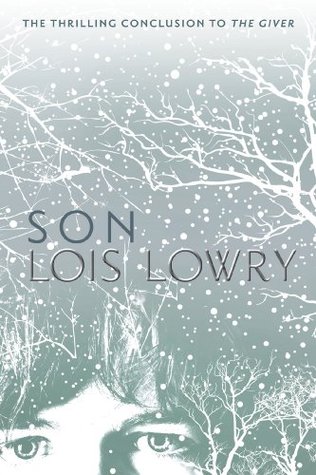
 Son by Lois Lowry

Son is the final book in The Giver quartet: The Giver, Gathering Blue, and Messenger. After The Giver, it is my favorite; it ties every strand of story and character together. It begins with Claire, a Birthmother in the community where Jonas lived in The Giver. In fact, Claire is only a few years older than Jonas, and it is her son, Gabe, who Jonas takes with him when he leaves for Elsewhere. Due to an oversight, Claire does not receive the emotion-suppressing pills that all other community members take, and she grieves over Gabe’s disappearance; the rest of the book is her journey to find him again. Dark and heart-wrenching, this is a satisfying end to the quartet, though I believe it can also stand alone.
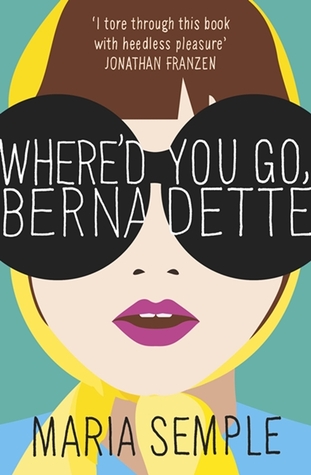
 Where’d You Go, Bernadette? by Maria Semple

I read this on the strength of Ken Jennings’ recommendation, and loved it. Precocious, teenage Bee narrates: her father is a high-ranking Microsoft employee and her mother, the titular Bernadette, is an award-winning – but reclusive and eccentric – architect. Bee narrates, but the narrative is interspersed with letters, e-mails, and official documents to and from the adults in her life. The settings come alive as well: tech-savvy, hippie-filled Seattle; competitive, nutty Southern California; a peek into an east coast boarding school; and of course, Antarctica. Where’d You Go, Bernadette? is Bee’s unraveling of that very question: she is in search of her mother, figuratively and literally. A smart, funny book that also delves into deeper issues, such as mental illness and mother-daughter relationships.
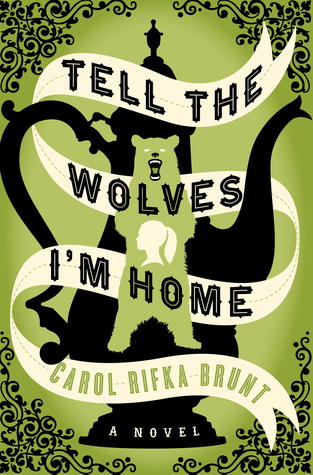
 Tell the Wolves I’m Home by Carol Rifka Brunt

In Westchester, NY, in 1987, thirteen-year-old June Elbus is grieving over her uncle (and godfather) Finn, who died from AIDS. Her family, especially her mother and sister, don’t think June’s grief is appropriate, but Finn’s “special friend” Toby reaches out to June, and after a few awkward hitches, they form a friendship. From Toby, June begins to learn things her family has kept her in the dark about, and some things that even her family doesn’t know. The author evokes the power and complication of sibling relationships, both between June and her sister Greta, and their mother and her brother Finn. The treatment of AIDS, especially the fear, stigma, and ignorance surrounding it, is a compelling reminder of they way things were twenty-five years ago.
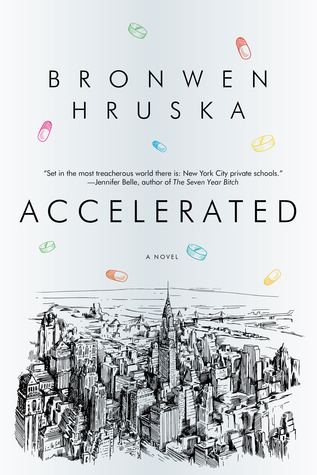
 Accelerated by Bronwen Hruska

Sean’s wife Ellie has left him and their eight-year-old son, Toby. Sean struggles along in single-dad mode, but Toby’s private prep school – paid for by Ellie’s parents – is pressuring Sean to have Toby evaluated for ADD/ADHD and put on drugs that Sean doesn’t think Toby needs. Eventually he knuckles under, with disastrous consequences, which spur him to investigate why so many of the kids at the Bradley School are on these meds. He enlists the help of Toby’s new teacher, Jess, and the two of them become romantically entangled as well. This is a literary novel with some thriller elements. Certain aspects require a willing suspension of disbelief, but the larger issue of medication in education remains.
What makes a good book club book?

First off: this question assumes that at least one of the main purposes of a book club is to discuss a book with friends and acquaintances whose opinions and ideas you respect. Other purposes can certainly include wine, cheese, chocolate, gossip, etc., but in the context of this post, “book club” refers to a group whose members read (at least partially) and discuss (at least for a while) books on a semi-regular schedule.

 So you are in, or want to start, a book club: how do you choose a book? There are all kinds of processes, from democratic to dictatorial, but I’m not going into that here. Whatever your process, the real question is: how do you make sure your selected book can fuel a discussion?

There are books I have enjoyed, but about which I have had very little to say; there are books I have loved, but have not been able to talk about well. It is often easier to identify what you dislike about a book, and harder to say what makes you love one; however, you don’t want to choose a book you think you’ll hate, just for the purpose of discussion.

In the best book club discussions I’ve been part of, there have been lots of mixed opinions. A character might inspire sympathy in some readers, indifference in others; an author’s writing style might be praised as poetic by some, while others will dismiss it as too flowery. Differences in opinion drive discussion, but these differences have more to do with the book’s readers than the book itself.

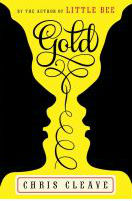
What about the book itself? I look for the thought-provoking book: the book with a central moral dilemma, where the characters must make difficult decisions or deal with unfamiliar situations. Ann Patchett is one author who excels at putting wonderfully real characters into settings that are strange or uncomfortable for them: a Jewish woman from Los Angeles in Nebraska with her in-laws, a shy scientist searching for her lost coworker in the Amazon, opera lovers held hostage in a South American country. Chris Cleave, on the other hand, is a master of the moral dilemma: family or ambition, sacrifice or cowardice?

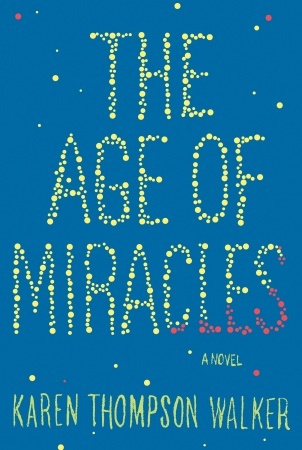
Other books explore the future, or alternative versions of the present, and these books are thought-provoking in their own ways. Examples of these are A Visit from the Goon Squad by Jennifer Egan, Never Let Me Go by Kazuo Ishiguro, The Age of Miracles by Karen Thompson Walker, and The World Without Us by Alan Weisman (nonfiction). The beauty of these books is that they subtly encourage you to put yourself in the character’s shoes, to compare the character’s actions and thoughts with what you imagine your actions and thoughts might be in his or her place.

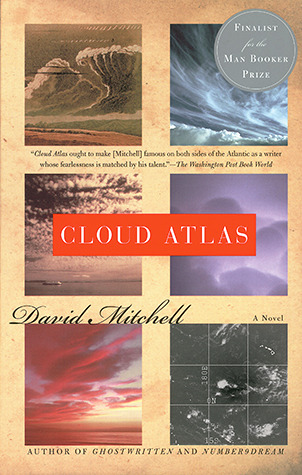
 Other books are simply unique in some way. Cloud Atlas by David Mitchell has an inventive structure: it consists of six related narratives told in halves (in the first half of the book, each narrative is interrupted by its successor; in the second half of the book, “each interruption is recontinued, in order”).

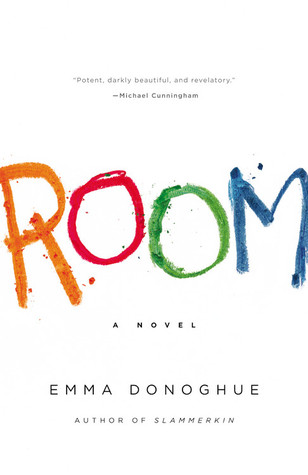
Other stories are unique because of their premise: Room by Emma Donoghue not only features a five-year-old narrator, but one who has lived with his mother in one room for his whole life. Arcadia by Lauren Groff is the story of Bit, a child born on a commune, who at age fourteen is plunged into the real world when the utopian community dissolves.

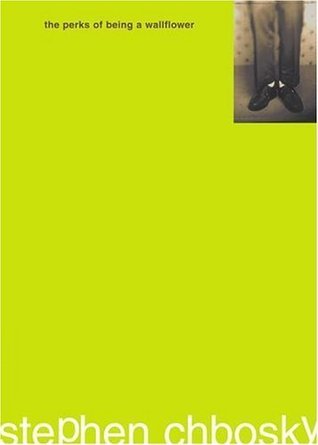
 Depending on the preferences of your group’s members, you might decide to focus on a subset of literature. You might choose a nonfiction area like science or history, or decide to revisit the classics, or read just one author’s work. “Not so young adult” groups read books aimed at teens or children (e.g. The Perks of Being a Wallflower by Stephen Chbosky). The book clubs I’ve been part of have focused on contemporary fiction, with occasional classics and nonfiction. Some of the criteria we consider are:

-Page count: most people don’t have the time for thousand-page tomes.

-Availability: Are your book club members willing to buy the book, or is everyone going to get it from the library? Something to consider before choosing that brand-new hardcover bestseller.

-Description/interest: the description of the book should appeal to a majority of the group; reviews need not be stellar but should be at least promising.

-Awards: If you have no idea where to start, there are plenty of awards lists, including the Pulitzer, the Booker, and the National Book Award, as well as genre awards like the Hugo, Edgar, and Nebula. Remember that awards are a good guideline, but they are also subjective.

-New vs. re-reading: book clubs can be great for re-hashing old favorites, but they’re also a great place to try new things and tackle challenging works that wouldn’t appeal to you solo. I might never have read Cloud Atlas on my own, but I loved it. Also, with a well-read bunch, it can be hard to find a book that everyone is interested in reading but that no one has read yet, so a willingness to re-read is a plus.

What are your book club success stories? Flops? What books do you think inspire discussion? Add suggestions and discuss in the comments.

Because I Said So! by Ken Jennings

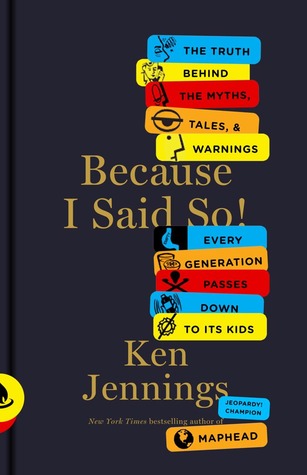
 Because I Said So!: The truth behind the myths, tales, and warnings every generation passes down to its kids by Ken Jennings is perhaps the only book I can think of that I can wholeheartedly, unreservedly, recommend to EVERYONE, even those who usually don’t read nonfiction. Young or old, male or female, left brain or right brain, parent or child, skeptical or gullible, superstitious or scientific, this book is for you. Really.

The subtitle sums it up: this is the Mythbusters of books (with, alas, fewer explosions). Jennings takes dozens of myths, tales, and warnings, from “don’t swim after eating” to “put on a sweater, I’m cold,” and does the legwork to discover where they came from, and whether they’re true or false; sometimes, it turns out to be a little of both. Debunking or affirming each claim in just a few pages, his writing is clear, concise, and often amusing. For example, here’s a snippet of how he debunks the “no swimming after eating” warning:

“It is true that when we eat, our body diverts blood to the stomach to aid in digestion, but, as you may have noticed after every meal you ever ate in your life, that doesn’t immediately immobilize your arms and legs….Not one water death has ever been attributed to post-meal cramping.”

Truly, I recommend this to everyone. And, the scheduled publication date is December 4, just in time for the holidays. Usually, I try to avoid giving books as gifts (partly because I’m a librarian and people expect it), but I’ll probably be buying this for at least one person. So there: it has the librarian stamp of approval!

Goodreads shelves

[Note: if you don’t use Goodreads, and never plan to, there is zero need to read this post. Scroll down to read about Banned Books Week, The Perks of Being A Wallflower, and other things instead.]

I’ve been using Goodreads, a social networking site for readers, since 2007. I started using it as a way to keep track of books I’d read, as well as to keep an actual (as opposed to mental) “to-read” list. I’m still using it that way, and now I have a personal database with five years of data that I can consult anytime someone needs a recommendation.

Not only can I sort books by self-created categories (“shelves”), such as young adult, mystery, history, or science, I can also look back on my own ratings and reviews, and see friends’ reviews as well. Friends’ reviews count for a lot: research has shown that a recommendation from a friend is likely to be more influential than a professional review, a bookstore or library display, or an auto-generated Amazon suggestion.

Overall, Goodreads’ usability and user experience (how easy and how pleasant it is to use the site) are pretty top-notch. The only problems I’ve ever had are (1) when the site is getting too much traffic and I’m not able to access it for a few minutes; this message is accompanied by an elegant line drawing of a woman sitting in a chair reading a book, and (2) creating a fourth permanent shelf for “partially-read” books, in addition to the three automatic shelves: read, currently-reading, and to-read.

This is such a small thing, but I’ve had conversations with other Goodreads users, and it’s come up for most of us. Though a book can be on as many of your self-created shelves as you want, it must also be on one – and only one – of the three original shelves. But what if a book is neither read, currently-reading, or to-read? What if you read the first few chapters and put it down, never to return? (There’s no guilt in that.) Many people have created shelves for these books, such as “partially-read,” “abandoned,” or “unfinished,” but the book still had to be on one of the original three.

This is no longer the case, I’m glad to report. I wrote to Goodreads about it, and a Customer Care Representative got back to me overnight to inform me that I could make my partially-read shelf “exclusive” by going to the Edit Shelves page and checking a box. Which I did. And it worked. I’m not sure how long that’s been an option – it wasn’t in 2007, I don’t think, but I could be wrong – but it is now.

So, big points to Goodreads for creating a great site and being responsive to its users. This is how it’s done.

The Perks of Being a Wallflower

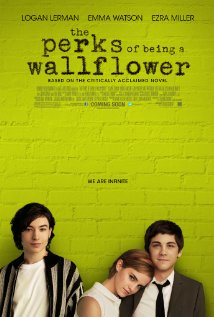
 The Perks of Being A Wallflower, the 1999 young adult cult classic by Stephen Chbosky, is that rare thing: a timeless high school book, and now also an excellent book-to-movie adaptation. Chbosky wrote and directed, which surely has something to do with the adaptation’s success, and the casting was superb. Logan Lerman is an utterly believable Charlie, Ezra Miller is a fabulous Patrick, and Emma Watson is an enchanting Sam (and she maintains a pretty good American accent throughout, with only one real slip-up that I noticed).

Some material (e.g. the Thanksgiving holiday; Charlie’s favor for his sister) was cut from the book, and there were a few other changes here and there, but the spirit of the movie was the same as in the book; even the new dialogue was true to the original, and of course many of the most emblematic and resonant lines from the book made it into the movie (“I feel infinite,” “We accept the love we think we deserve”). Needless to say, the soundtrack is also stellar; the Smiths’ “Asleep” appears early on.

 What was most captivating and touching about Perks the book was Charlie’s voice. The book is structured as a series of letters to an anonymous recipient: “Dear friend, I am writing to you because she said you listen and understand and didn’t try to sleep with that person at that party even though you could have…” (In this Chbosky interview on NPR, he almost reveals who Dear Friend is, but doesn’t.) The movie manages to capture Charlie’s voice; it reminded me how much I loved the book, while also being satisfying and enjoyable on its own.

Read my review of The Perks of Being A Wallflower (the book) on Goodreads. If you haven’t already read the book, I encourage you to do so. Then go see the movie.

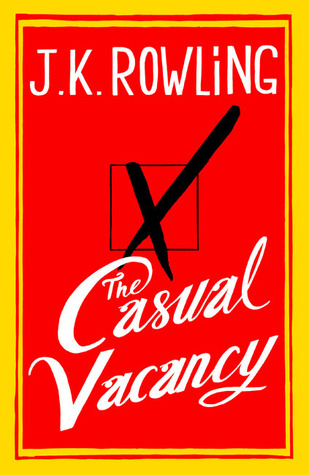
The Casual Vacancy by J.K. Rowling

 There are a lot of “big books” this fall, much-anticipated books by well-known authors, such as NW by Zadie Smith and Telegraph Avenue by Michael Chabon. Perhaps the biggest of all is The Casual Vacancy by J.K. Rowling (author of the Harry Potter books. In case you’ve been living under a rock since 1997).

Very little information about The Casual Vacancy was given out before its official publication date, other than that (1) it would feature neither witchcraft nor wizardry, and (2) it was for adults, not children. Having just finished the book, I can confirm that both of these things are true. I can also tell you a bit more:

The Casual Vacancy begins with the death of Barry Fairbrother. Barry leaves behind a widow, four children, and an empty seat on the Pagford town council. There is an important vote coming up, concerning the Fields, a low-income housing area that has long been a thorn in the side of many Pagfordians. Depending on the result of the vote, the Fields will either remain part of Pagford, or will become instead part of the larger neighboring town of Yarvil, which will most likely close down the Bellchapel Addiction Clinic. (Pagford’s small, but not sleepy.)

Enter an ensemble cast of townspeople who are, largely, self-important and petty. There are gossipy old women, self-conscious and selfish teenagers, resentful wives, fearful wives, affluent families and poor ones, insiders and outsiders. This isn’t a comedy or a farce; Rowling’s skill is such that each character is multidimensional. Though they don’t understand each other, and tend to assume the worst, the reader sees the true motivations behind their behavior. Every character wants something, which makes each character believable.

On top of that, Rowling is, as we all know, a master of pacing, and The Casual Vacancy is compulsively readable. For more detail (but no serious spoilers), read my review on Goodreads.

NW by Zadie Smith

Last Wednesday, I rushed home after work to feed and walk the dog, then rushed to the Cambridge Public Library to see Zadie Smith read from her new book, NW, and answer questions. Despite minimal advertising for the program, there was a long line; in addition to the auditorium where she was speaking, the CPL staff opened up an auxiliary room and set up a simulcast; I was one of the last four people allowed into the overflow room, and I was glad just to get in.

Smith read two sections from NW, one from the middle where Felix Cooper visits Annie, and one where Natalie Blake is part of a confrontation in a playground. (The book’s title, which refers to northwest London, reflects the author’s belief that “a novel is a local thing.”) Hearing an author read from her own work is nearly always enjoyable, and in this case it also helped give us Americans an idea of what the various NW characters were supposed to sound like (as we follow Smith’s advice, “Read what isn’t you,” e.g. the unfamiliar).

NW is divided into three parts, each focusing on a different character and each with a different narrative style. Felix’s story, in the middle, was the most straightforward, but only tangentially connected to Leah Hanwell and Natalie (formerly Keisha) Blake’s stories. The book opens with Leah, and ends with Natalie, whose section is broken into numbered segments; part of this ran in The New Yorker before the book was published.

As those who have read Zadie Smith’s work before know, she is fiercely intelligent and it can take some effort to keep up with her writing; additionally, in NW, the shifts in writing style will keep you on your toes. All three of the main characters grapple with their past, present, and future: in short, their identities. Though the writing is nontraditional and the characters are confused about who they are, NW has, in a way many other novels don’t, “thematic coherence” that resonates.

Read my full review, with quotes, on Goodreads.

Banned Books Week: Celebrating the Freedom to Read

Preparing for Banned Books Week at the library (September 30-October 6), I’m getting excited ahead of time. The American Library Association (ALA) has several cool badges and banners available to download for free (remember to give credit for the images if you use them).

Reprinted by permission of the American Library Association.

On the ALA site, you can also see lists of the most frequently banned/challenged books, by author, year, or decade. You can also see that almost half of the Radcliffe (now Columbia) Publishing Course Top 100 Novels of the 20th Century have been challenged or banned; if you did any of your assigned reading in school, I can pretty much guarantee that at least one of those books is on that list.

The most frequently challenged/banned books list is overwhelmingly comprised of classics (think To Kill A Mockingbird and Brave New World) and young adult literature (The Giver, A Wrinkle in Time, Harry Potter). The most common reasons for challenges are “sexually explicit,” “offensive language,” and “unsuited to age group,” and the most likely challenger, by a tremendous margin, is a parent.

I was fortunate that during my childhood and adolescence, my parents, teachers, and librarians never told me I couldn’t read a book. Reading has always been a positive part of my life, not something that ever harmed me – even when I was reading material “unsuited to my age group.”

Let’s all celebrate our freedom to read, not just September 30-October 6, but all year, every year – because reading is magic.


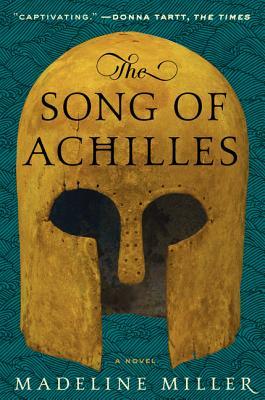
The Song of Achilles by Madeline Miller

An alternative title for this post, taken from author Madeline Miller’s event last night at Porter Square Books, could be: Mythological Fiction: “Am I really having a centaur in my novel?”

 “Mythological fiction” is how Miller categorizes her novel, The Song of Achilles, rather than historical fiction or simply literary fiction, and it’s apt: The Song of Achilles is a retelling of part of Homer’s Iliad, complete with heroes, gods, and mortals. Authors who choose to adapt or retell myths have a choice, said Miller, to write the gods as characters or to explain away their presence (e.g., Was it Poseidon or an earthquake?). Miller chose to include the gods as characters, notably Achilles’ sea-nymph mother Thetis, and his and Patroclus’ teacher, the centaur Chiron.

 Miller’s impetus for writing The Song of Achilles was Achilles’ extreme grief over Patroclus’ death in the Iliad. To explain Achilles’ reaction to Patroclus’ fate, she writes about their adolescence and coming of age together from Patroclus’ point of view. The Song of Achilles tells an ancient story in an accessible way; the writing is both modern and lyric. Of adapting Homer’s original material, Miller said, “Great artists [such as Homer] understand human nature…the stories in the past illuminate the present…great art has great psychological insight.” The story seems modern because human nature has not changed: pride, love, grief, and revenge are as familiar to us now as they were three thousand years ago.