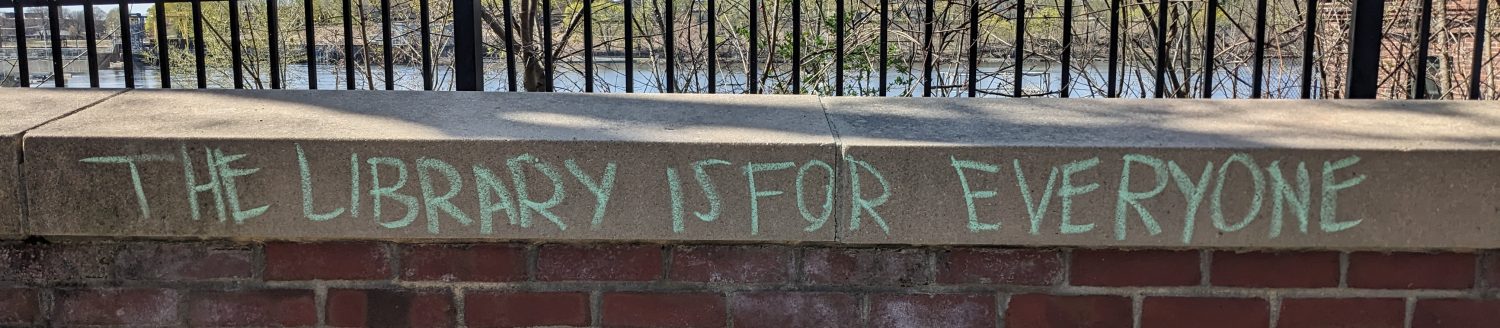
Many years ago at the Fox Branch Library in Arlington, MA, I noticed a bulletin board in the lobby. On the bulletin board were questions and comments that people had dropped into a suggestion box – and the library staff’s answers to those questions and comments. [Insert brain-exploding emoji here] What a brilliant, transparent way to communicate with patrons! Also, if one person has a question, others likely have the same question, so answering publicly helps more than just one person.
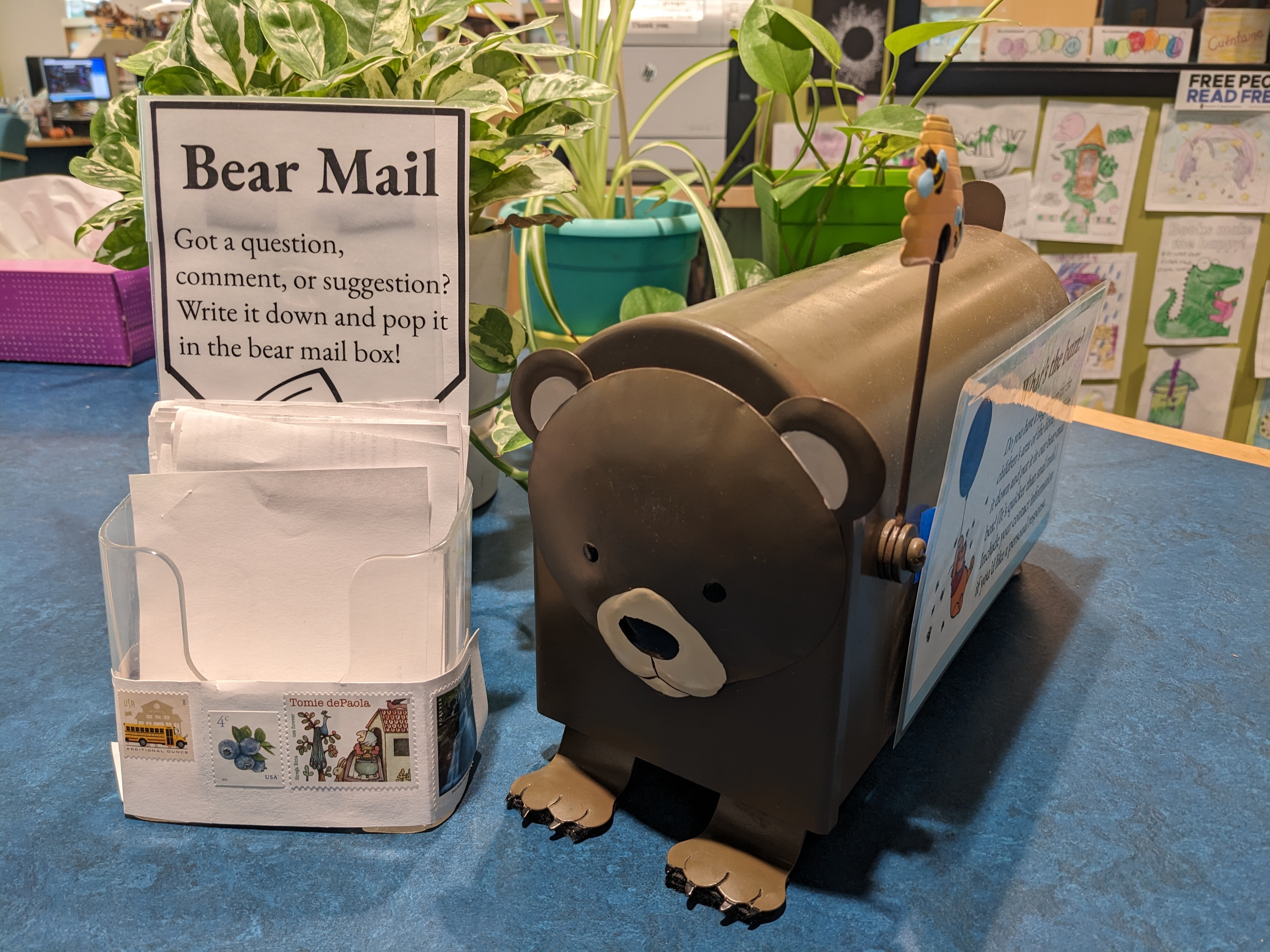 When I started my current job as the children’s librarian at a public library, I found an unused mailbox shaped like a bear, complete with little beehive flag. I set it up on my service desk, inviting people to leave notes – questions, comments, suggestions, anything! On a nearby column, I tape up the notes with my responses.
Over the last year, I’ve gotten dozens of notes. Sometimes people leave a note while I’m sitting right here, other times when I’m away from my desk. Sometimes it’s kid scribbles (great early literacy and fine motor practice!), occasionally a complaint or praise, most often a suggestion or question about the books in our collection or the programs that we offer.
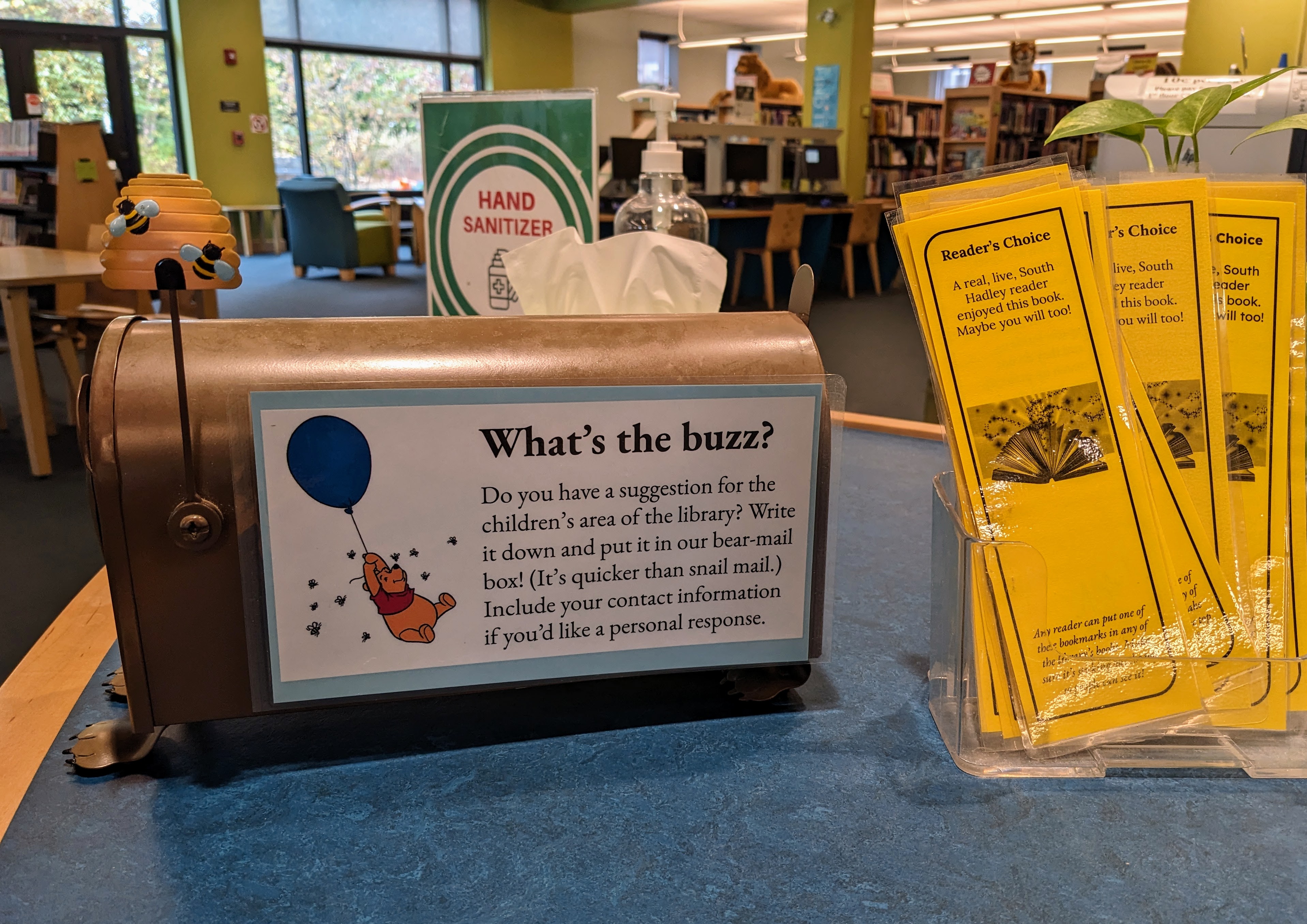 A few sample notes and responses (lightly edited for spelling, etc.):
- “Do you have any recommendations for Matilda-length chapter books about fantasy? With no pictures?” –> “Sure! Here are some to try: Greenwild by Pari Thomson, The Guardian Test by Christina Soontornvat, Earwig and the Witch by Diana Wynne Jones, Tuesdays at the Castle by Jessica Day George, Falling In by Frances O’Roark Dowell”
- “Recommendation for PJ Storytime: The Nuts: Bedtime at the Nuthouse. It’s one of our faves!” –> “Thanks for the suggestion! I requested it from another library.” [I read it at a subsequent Pajama Storytime program.]
- “Get more scary books!” –> “OK! Have you already tried Goosebumps, Eerie Elementary, and Scary Stories to Tell in the Dark?”
- “I think you guys should have bunnies and hamsters here.” –> “I would love to have a library pet! Maybe someday….In the meantime, have you seen Miss Bethany’s fish Moose?”
- “You should start a face drawing club.” –> “Comics Club meets every Tuesday afternoon! We also have lots of How to Draw books you can borrow and take home.”
- “The library should do book bingo again!” –> “We are! [Dates of summer book bingo program]”
- “Saturday morning activities would be great!” –> “We try to do at least one a month! Anything in particular you’d like to see?”
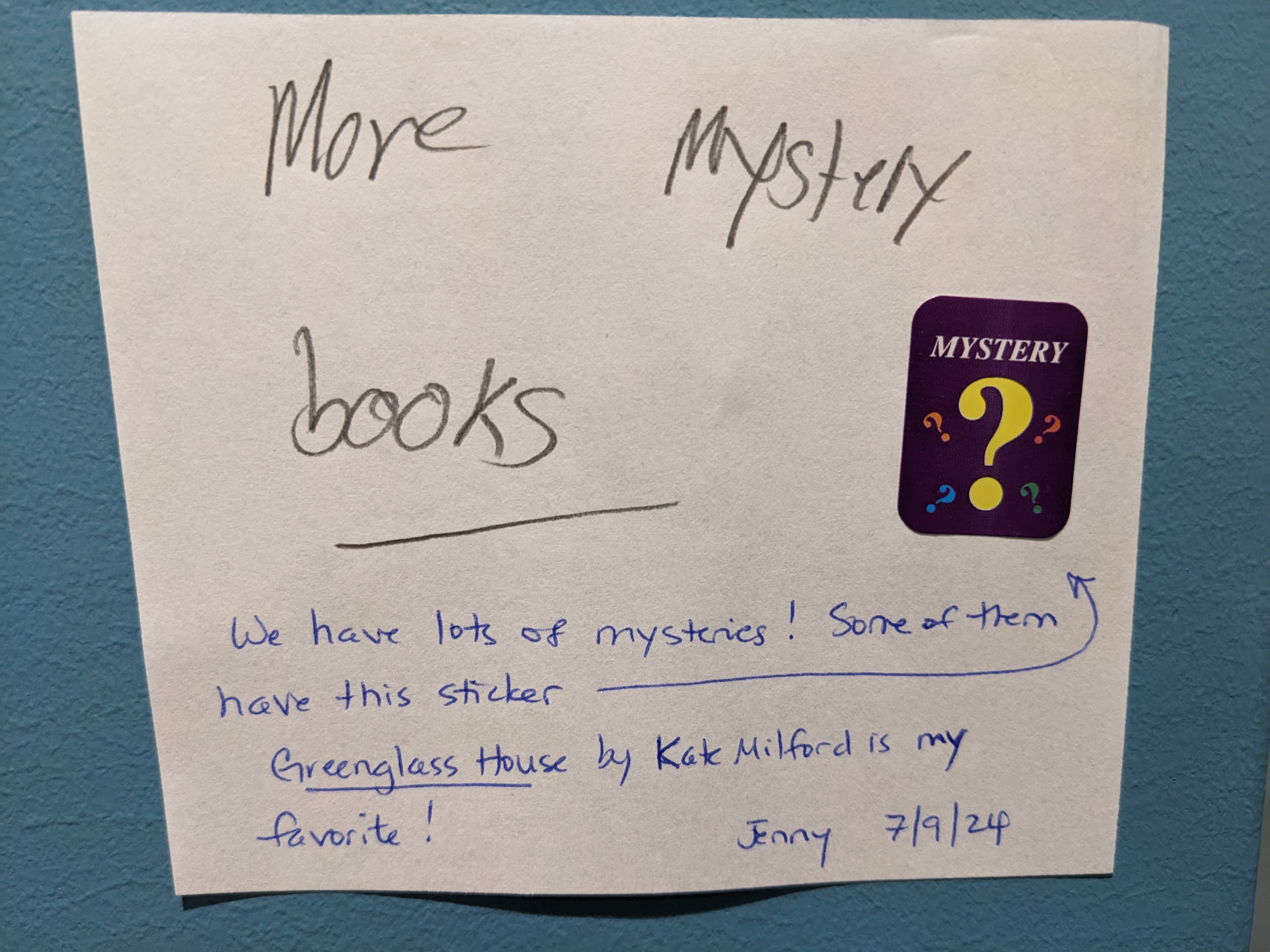
- “More mystery books” –> “We have lots of mysteries! Some of them have this sticker. One of my favorites is Greenglass House by Kate Milford.”
- “Can you get the book Out of My Dreams [by Sharon Draper] when it comes out?” –> “Absolutely! We have to have the sequel to Out of My Mind and Out of My Heart. It will be published September 3, 2024.”
- “Make more Roald Dahl books like The Twits” –> “Roald Dahl died in 1990 and can’t write any more books…Have you tried George’s Marvelous Medicine?”
One person asked, “Why aren’t the librarians here a lot of the time I’m here?” This one is kind of heartbreaking, but there is only one children’s librarian here (me). I work 40 hours a week (which is plenty! I miss my 35-hour week), but the library is open 52 hours, so the children’s desk is unstaffed at that time. People can get help at the main circulation desk, but it’s not the same level of service as having a children’s librarian present in the room to greet everyone and ask if they need help. I’m also not at my desk if I’m running a program, like Rhyme Time, Story Time, or one of the book clubs. What’s the answer to this one, then? An apology, and a request: Ask the Town to fund more staff for the library!
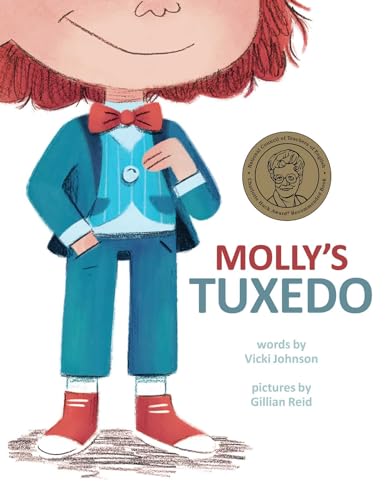 To end on a happy note (no pun intended): My favorite note so far was about how the book Molly’s Tuxedo by Vicki Johnson, illustrated by Gillian Reid, was affirming for a child deciding what to wear ahead of a family holiday, and helped foster a conversation with a grandparent too. The note-writer concluded, “Thank you for your commitment to diversity + inclusion!” It’s gratifying to see that books really do make a difference. I was able to share this note with the book’s author on social media, and I hope she was half as pleased as I was.
There are lots of reasons to encourage open communication and solicit feedback on a regular basis. You’ll hear about what you can do better, get ideas for positive changes, and you may be pleasantly surprised or get a laugh now and then! How do you communicate with patrons in your library?


 Whitney Scharer was up first, showing slides and then reading from her debut novel about Lee Miller, known as a model for Vogue and surrealist Man Ray’s muse, though she was a photographer in her own right, and co-inventor of the technique of solarization. (Aside: Every student should have a project like the one mentioned in Meg Wolitzer and Holly Goldberg Sloan’s new middle grade novel, To Night Owl From Dogfish, “Give the right person the credit.”) Scharer discovered Miller at an exhibit featuring Man Ray at the Peabody Essex Museum in 2011, and was interested in the two of them “being in love and making art together.” (Miller went on to be a war reporter; she reminded me of Robert Capa’s partner, Gerda Taro, who was killed while documenting the Spanish Civil War.) Scharer read a scene from her novel in which Miller describes what she calls “wild mind”: her ability to set any expression on her face while modeling, yet thinking of anything she wants, setting her mind free. The scene (possibly the whole novel?) was in present tense.
 Next, Jenna Blum (The Stormchasers, Those Who Save Us) talked about and read from her new novel, The Lost Family, set in New York and centered around a Holocaust survivor, Peter, who lost his wife and daughters. He now owns and runs a restaurant called Masha’s, after his late wife, and has sworn not to get involved with anyone again – but, of course, he does. The novel is about Peter and his second wife and their daughter, “a whole family trying to put its arms around a loved one’s PTSD.” Blum didn’t have slides, but she did share a cocktail of her own invention, and cream puffs called “Masha’s Little Clouds”; she said that she invented and kitchen-tested all the menu items in the book.
 Finally, Christopher Castellani (A Kiss From Maddalena, The Saint of Lost Things, All This Talk of Love) talked about his newest novel, Leading Men, which imagines a party thrown by Truman Capote in Portofino in 1975, the guests, and the aftermath. Castellani said that people always want to know “how much is true and how much is not true,” so he explained that the party did happen, and that Tennessee Williams and his lover Frank Merlot really were invited, but that Williams’ journal does not mention the party in the days or weeks following it. Using both “real and invented people,” Castellani imagined and invented “between the cracks of what was known about these people.” Merlot is his main character; Williams isn’t a “point of view character” largely because he is too well-known, has written and been written about too much; Merlot, though not obscure, is less of a known quantity. Castellani admitted that it was daunting to write dialogue for characters like Capote and Williams; he would often use an “anchor quote” from their writings in order to get the tone of the dialogue and scene, and would sometimes remove the “scaffolding” once the scene was finished.



 Jenny Arch