MLS

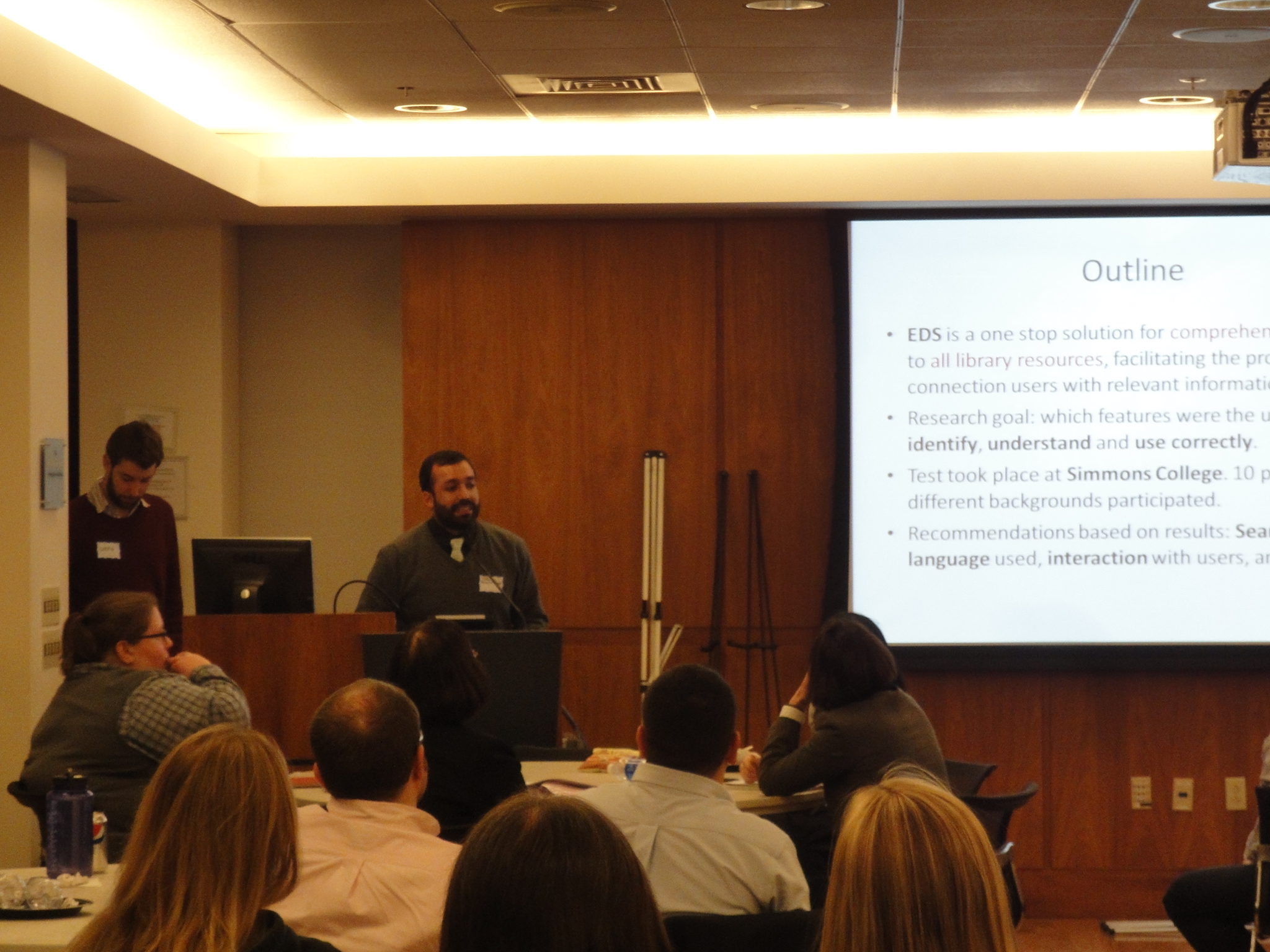
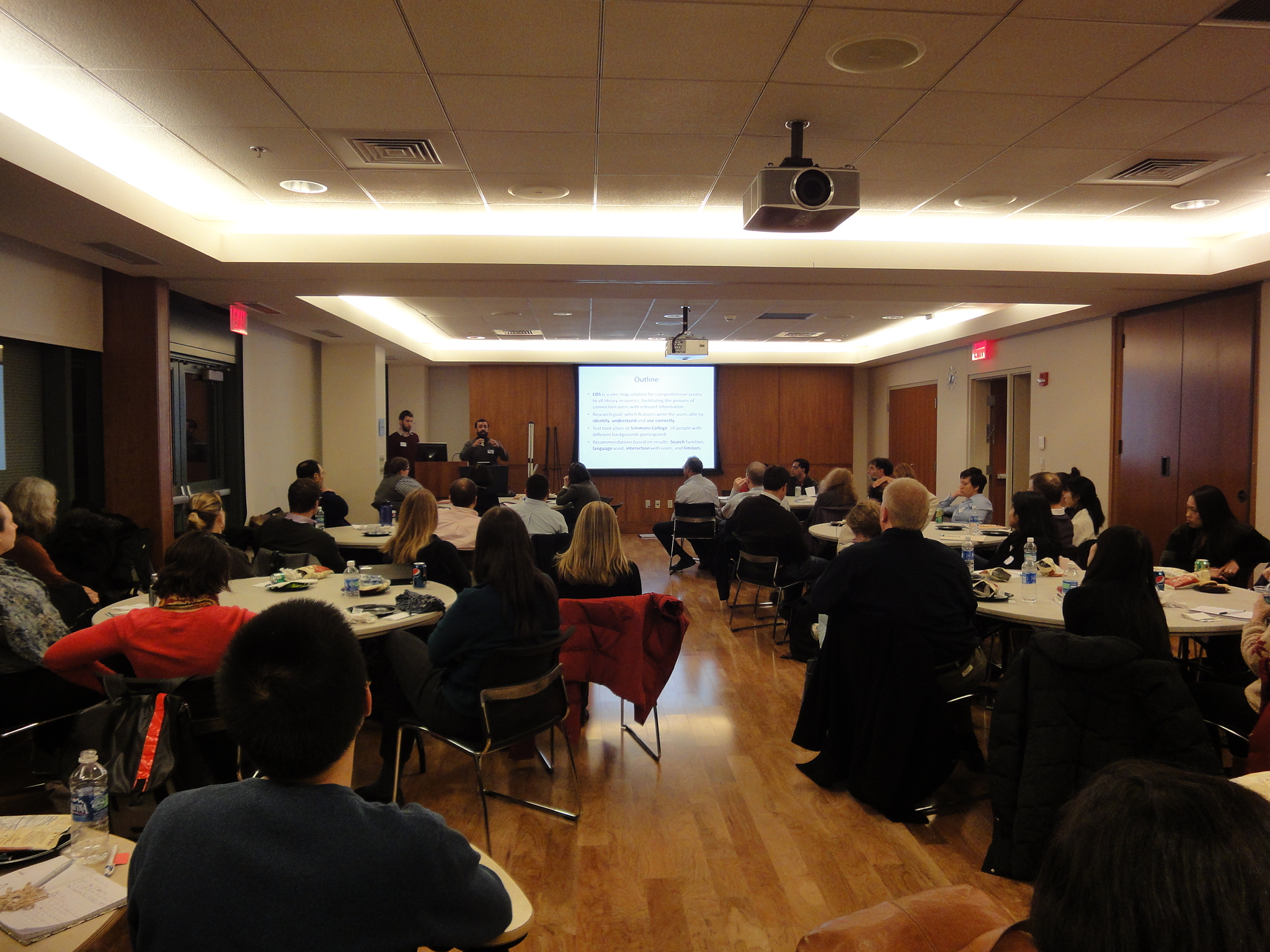
After yesterday afternoon’s half-hour group presentation in class (LIS 531Y, Usability and User Experience Research) on our team’s usability study on the EBSCO Discovery Service (EDS), and last night’s condensed presentation on the same to the Usability Professionals Association (UPA) Boston Chapter, I am completely done with papers and presentations (and all other work) for my MLS degree. HURRAY!

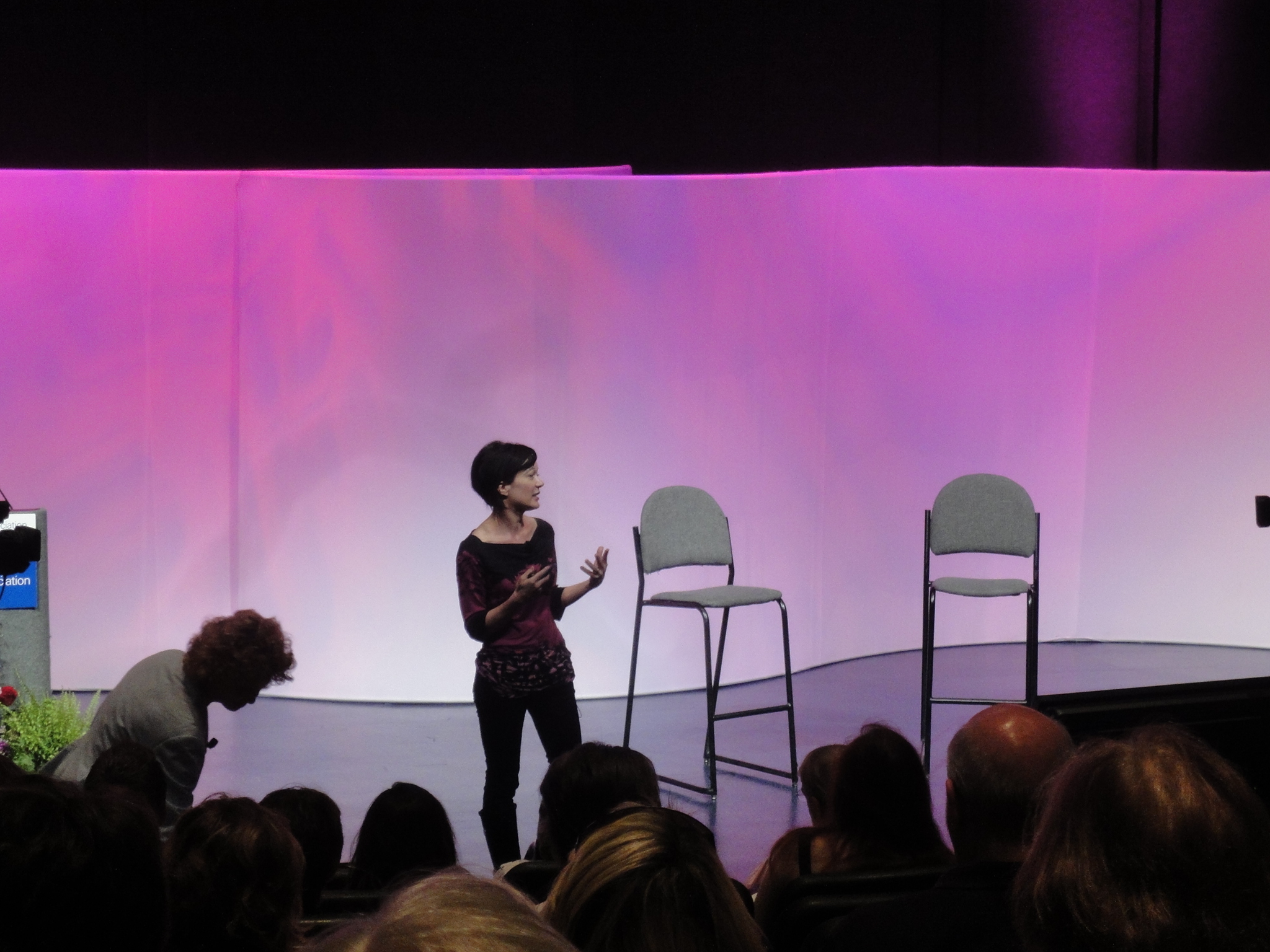
Photos: one group member from each EBSCO team presented the results of the usability tests to the UPA Boston meeting on at Simmons College on December 12.

As it happens, a recent (December 7) Library Journal article included comparisons of four discovery services, the first of which was EDS. Amanda Clay Powers of the Mississippi State University Libraries observed that EDS worked especially well for undergraduates (novice) and for doctoral students and faculty (advanced), but less well for upper-level undergraduates and master’s students, who were still best served by subject-specific databases.

The research we did in Usability and User Experience Research this semester was focused less on content and more on usability and specific system features (such as the cite tool, the “find similar books” option, and the ability to save or share search results). Still, the LJ article was an interesting overview, especially as it compared multiple discovery interfaces.

Losing “cite” of what’s important

I’ve been thinking about citation a lot lately. (Chances are, if you aren’t a student and you just read that sentence, you’re already weeping from boredom; but if you are a student, you might have made some sort of frustrated growling sound, or perhaps banged your head against the nearest wall.) I’m in my last semester of grad school in a program where most professors require APA citation (some are flexible – you can use another format as long as you’re consistent about it). As an undergrad I used Chicago style, and in high school I used MLA, so I’ve transitioned a few times, but I was pretty sure I had APA down; after all, attention to detail is what I do. However, two professors this semester have corrected my APA style citations, which makes me think that other professors just weren’t looking that closely – or that they simply didn’t care as much about the details, just that sources were acknowledged somehow and that the writing was good.

Then this morning, I read an opinion piece in the Chronicle of Higher Education: “Citation Obsession? Get Over It!”  The author, a teacher of writing at James Madison University, says that librarians aren’t able to help students with broader information literacy concerns (such as finding, choosing, and evaluating sources) because they are overwhelmed with anxious students needing help with citations. “What a colossal waste,” he writes. “Citation style remains the most arbitrary, formulaic, and prescriptive element of academic writing taught in American high schools and colleges.” He continues, “Now a sacred academic shibboleth, citation persists despite the incredibly high cost-benefit ratio of trying to teach students something they (and we should also) recognize as relatively useless to them as developing writers.”

The author, Kurt Schick, advocates focusing on the function rather than the form of citation. Most citation styles include the same basic information: author, title, publication date, publisher. It would seem that, with the help of a style guide, it wouldn’t be too hard to put that information in the right order – and it wouldn’t be, if all we were using was books and articles from academic journals. But information can come from a wide range of sources in a wide range of formats, and there are all kinds of exceptions. As long as the core information is there, allowing others to track down the item in question, does it really matter where the periods and parentheses are? Schick argues that no, it doesn’t – not until it’s time to publish. Until then, professors’ and librarians’ and writing center staffs’ time is better spend helping students with essential information literacy and writing skills: “We could…reinvest time wasted on formatting to teach more important skills like selecting credible sources, recognizing bias or faulty arguments, paraphrasing and summarizing effectively, and attributing sourced information persuasively and responsibly.” Students should absolutely understand the importance of acknowledging their own use of others’ words and ideas in their writing; no one is arguing that the concept of citation and attribution isn’t essential. The formatting, however, may not be that important.

Until this sea change takes place, however, the form of citation remains paramount for many professors at many institutions. For anyone required to use APA, I highly recommend the Purdue OWL (Online Writing Lab) APA Formatting and Style Guide. Individual college and university libraries and writing centers may have also prepared their own handouts, guides, and tips for citation. There are also citation tools like RefWorks and Zotero, and databases often have a “cite” tool built in; these can certainly be helpful, but they aren’t perfect, and students will still need to proofread for formatting errors.

Know of any other good citation style guides online? Please share in the comments.

A Balanced Information Diet

This evening I went to a screening of some TED talks at MIT, sponsored by the New England chapter of ASIS&T. We watched five TED talks, with a little bit of discussion between each one.

1. Raghava KK, “Shake up your story” – the artist/father talked about how looking at multiple perspectives could lead to the development of empathy and increase creativity.

2. Wael Ghonim, “Inside the Egyptian Revolution” – Ghonim described how the Internet allowed Egyptians to connect, to realize they were not alone and had shared dreams, to collaborate and speak out. He described how the “psychological barrier of fear” led to silence, but because of the Internet, “the fear is no longer fear, it’s strength. It’s power….The power of the people is much stronger than the people in power.” (After the talk, we discussed the flip side of technology: in the case of Egypt, technology allowed people to overcome their isolation, but what about when the government controls the technology?)

3. Eli Pariser, “Beware online filter bubbles” – This was the talk I found most interesting. Pariser, an online organizer and author, talked about the invisible shift in the flow of information online; search engines show us what they think we want – but what we want to see might not be what we need to see. Although the “personalization” due to algorithmic editing can sometimes be helpful, most people don’t realize that results are being filtered or tailored in this way – and we don’t decide what gets included or what gets left out.

Left to their own devices, people tend to read sources that re-confirm their existing points of view, and this was true long before the Internet (some people read the New York Times, some read the Wall Street Journal). Editors used to be our “human gatekeepers,” but now there are algorithmic gatekeepers, and they have no concept of journalistic integrity or ethics: they just want to show us what we want to see. Eventually, we may end up with a diet of “information dessert” and no “information vegetables. The information might be “relevant,” but we won’t be presented with information that is uncomfortable, challenging, important, or that presents other points of view – and we may become less and less aware that this information exists.

This addresses only a small piece of this issue, but check out the Google Transparency Report.

4. Sunni Brown, “Doodlers, Unite!” – According to Brown, doodling during a meeting isn’t a waste of time, and it doesn’t mean you aren’t paying attention – in fact, it may be helping you process information better. (After all, don’t many group brainstorming sessions end up using a whiteboard or pen and paper to sketch out ideas?)

5. Hans Rosling and the magic washing machine – This talk certainly had the best title, and was arguably the most entertaining. Swedish professor of global health Hans Rosling described the direct connection between the washing machine and reading: when his mother got a washing machine and no longer to do the washing by hand, she had time to take him to the library instead. “Thank you industrialization…that gave us time to read books!” The middle part of his talk concentrated on the developing world, climate change, and the use of resources (1/7 of the world population uses 1/2 of the resources – washing machines included).

One of the discussion questions (offered somewhat tongue-in-cheek, I believe) after this last talk was, “Do you think the invention of washing machines has increased library circulation?” In a roundabout way, it probably has: in the industrialized world, washing machines and other time-saving devices allow us to have more leisure time, which some of us do spend reading. 🙂

Many, many more TED talks are available “free to the world.” Explore, and enjoy!

Bookmaking for Beginners

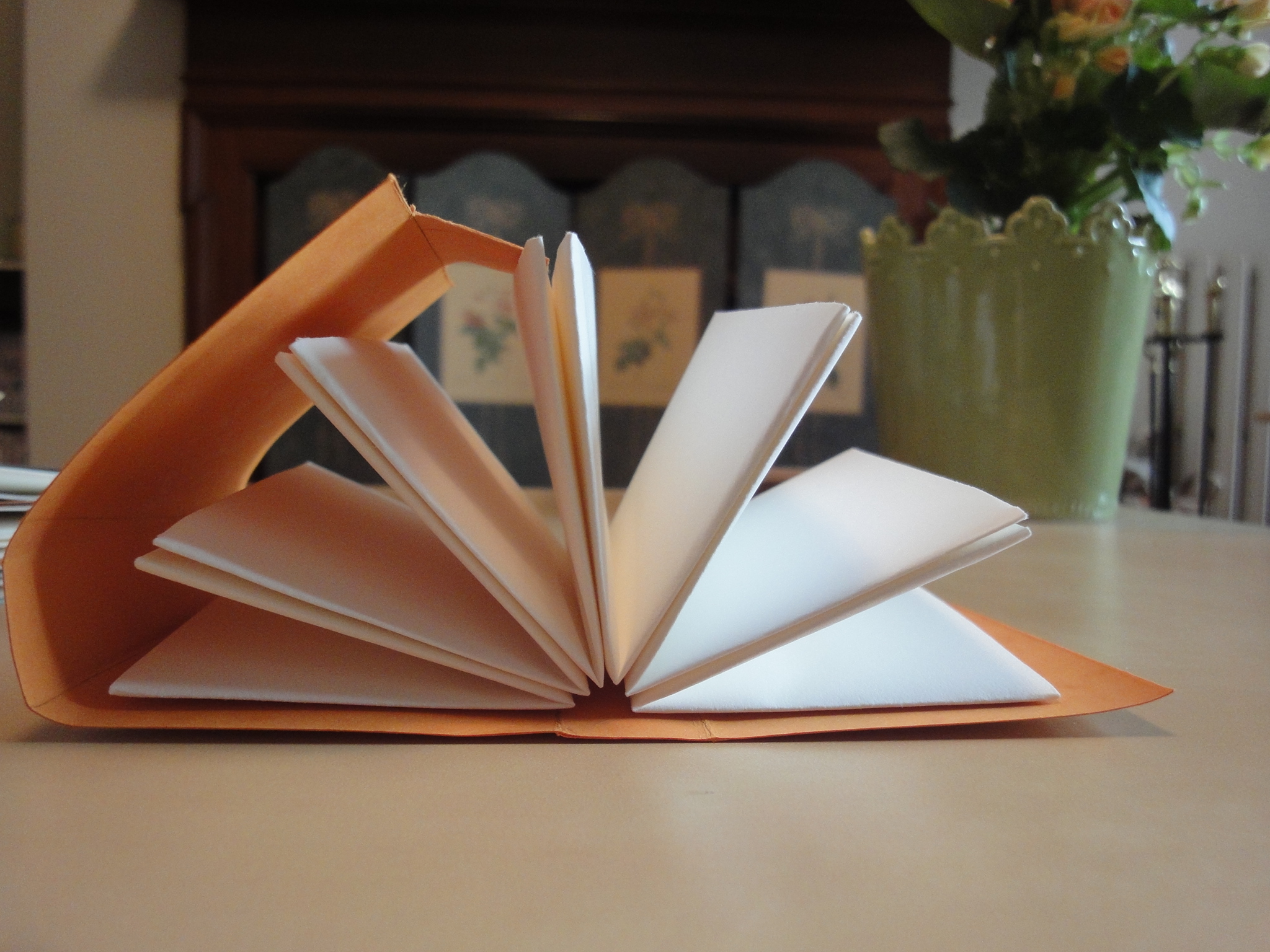
On Saturday, I took a Bookmaking for Beginners workshop taught by Sarah Smith through GSLIS Continuing Education. The workshop began with a short lecture about different kinds of bindings through history, and how contemporary artists are re-using and making books. The rest of the day was all hands-on: we started with the one-sheet fold-up and the accordion structure, then the blossom fold, Turkish map fold, and Korean map fold; then we learned how to make single-section and two-section pamphlets, and finally how to do chain-stitch.

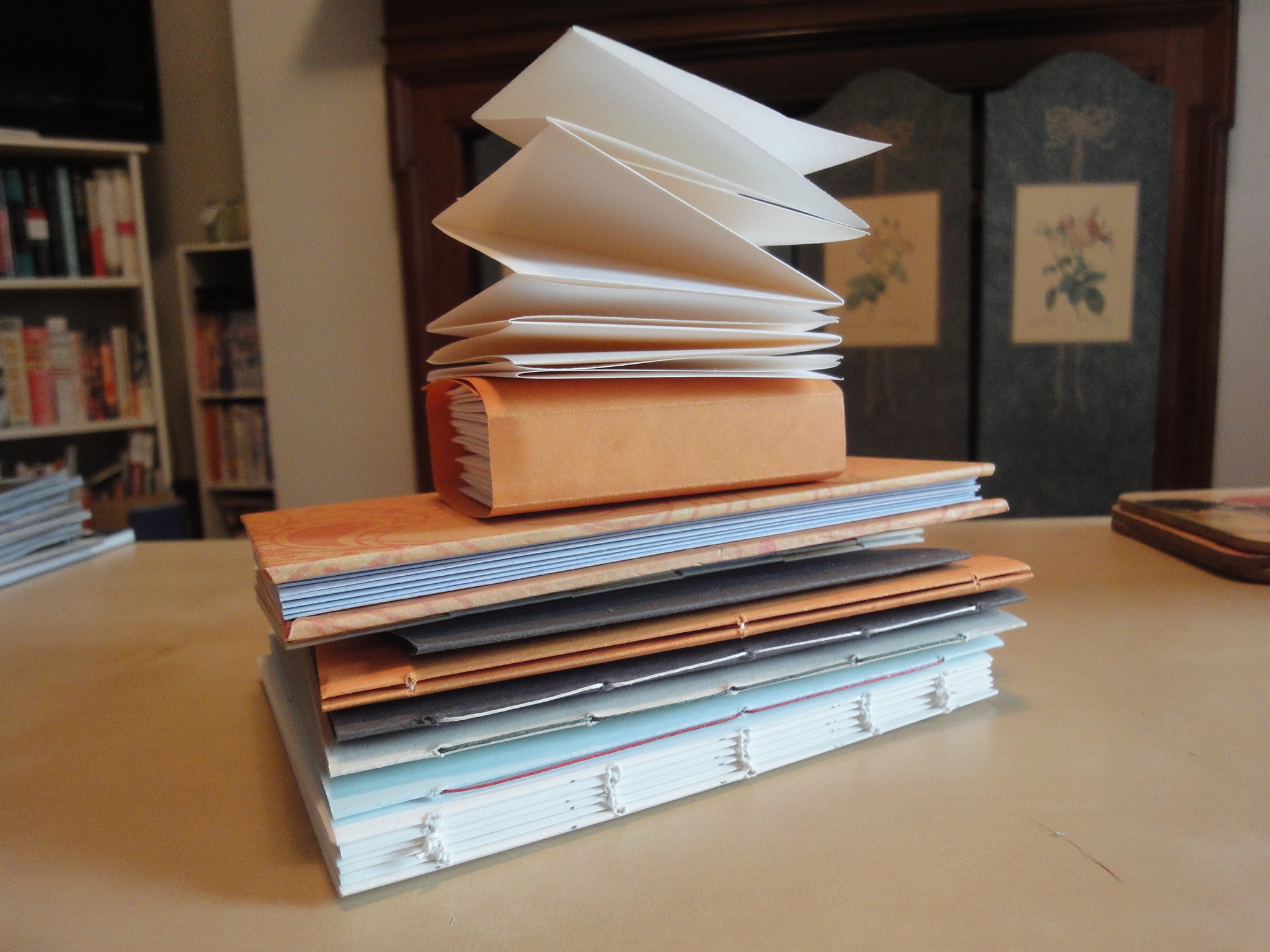
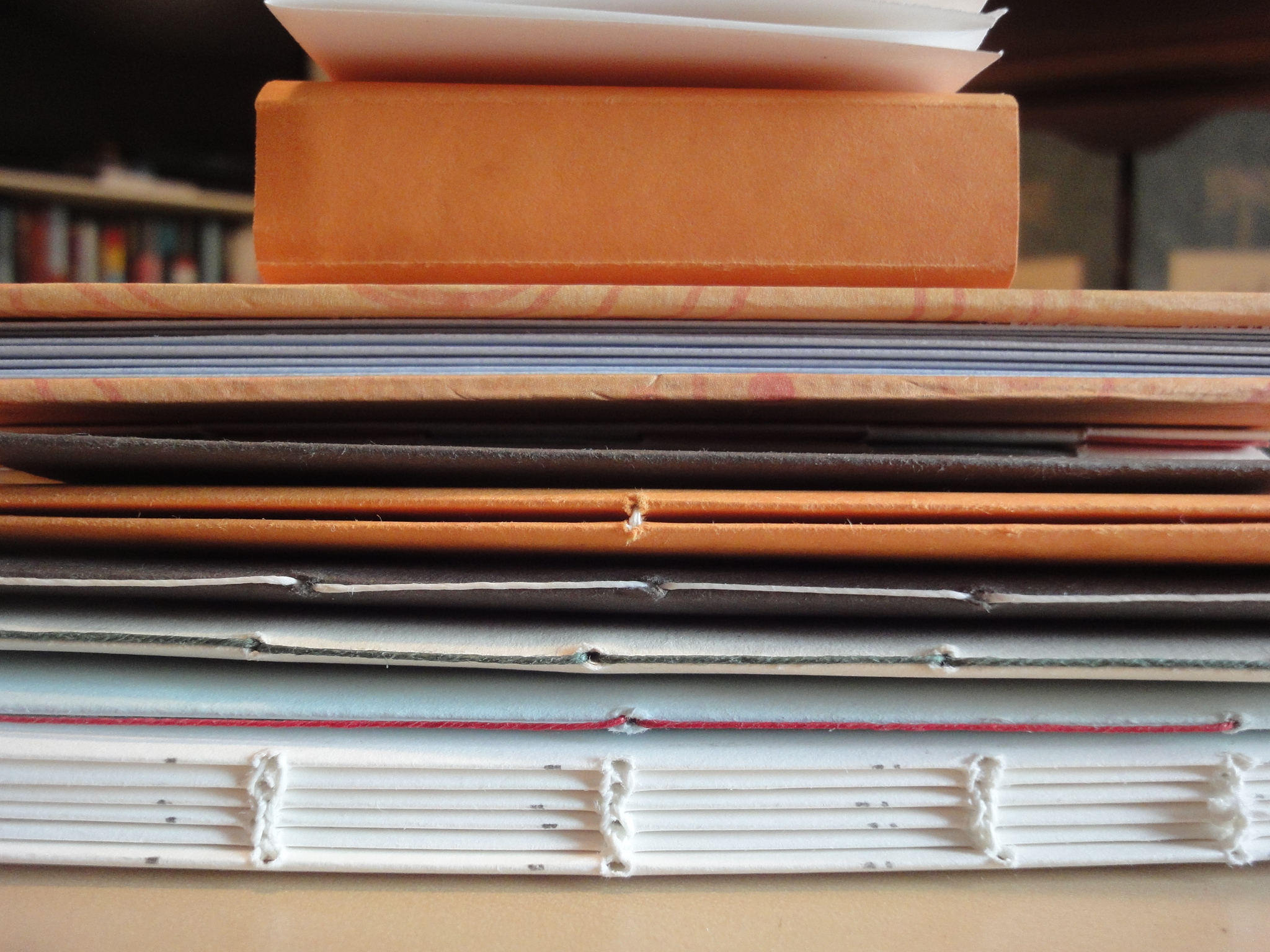
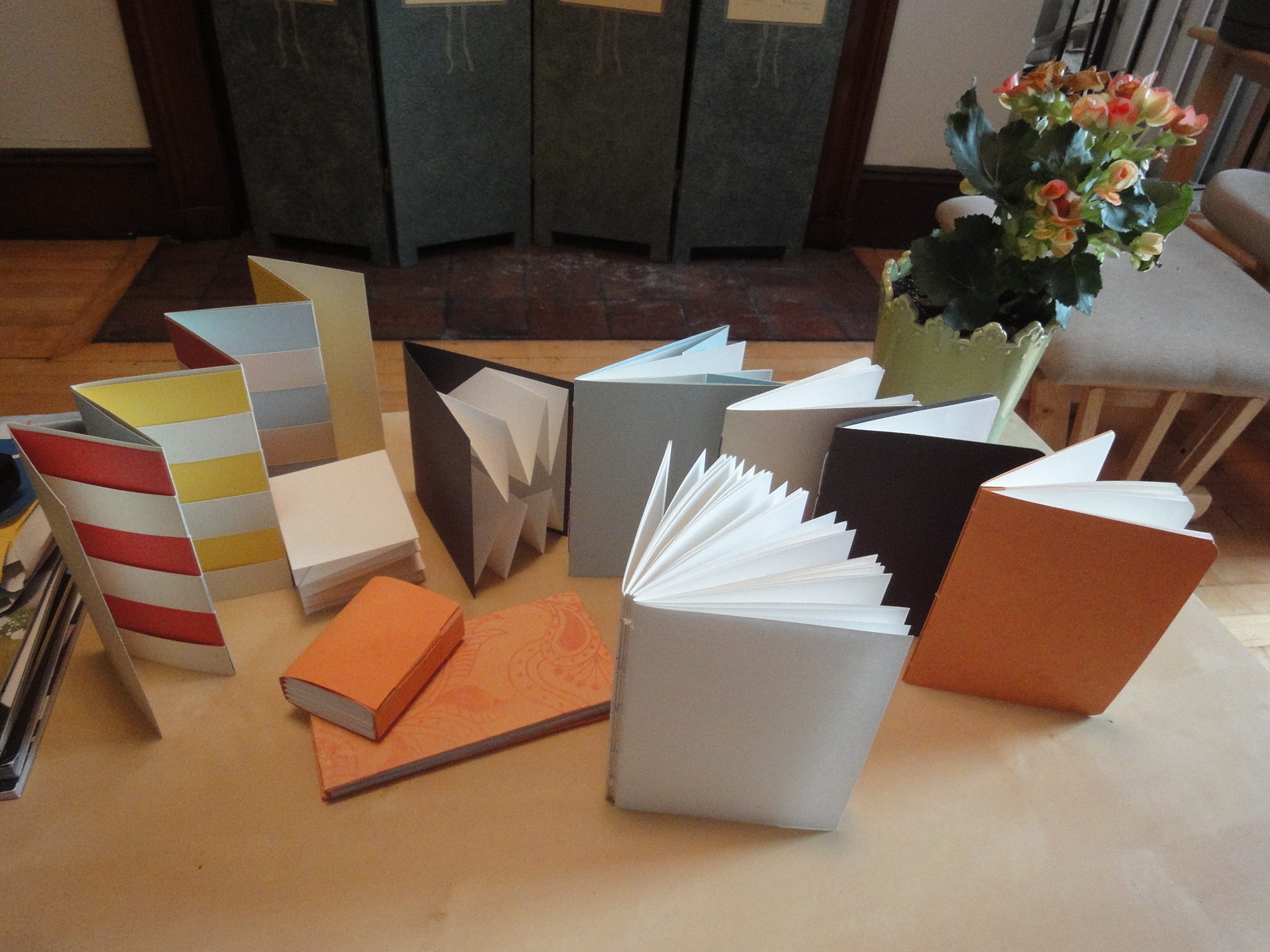
All the books! From top to bottom: Blossom fold, Korean map fold, accordion fold (with covers), woven flexagon, Turkish map fold, two-section pamphlet, one-section pamphlets, chain-stitched binding.

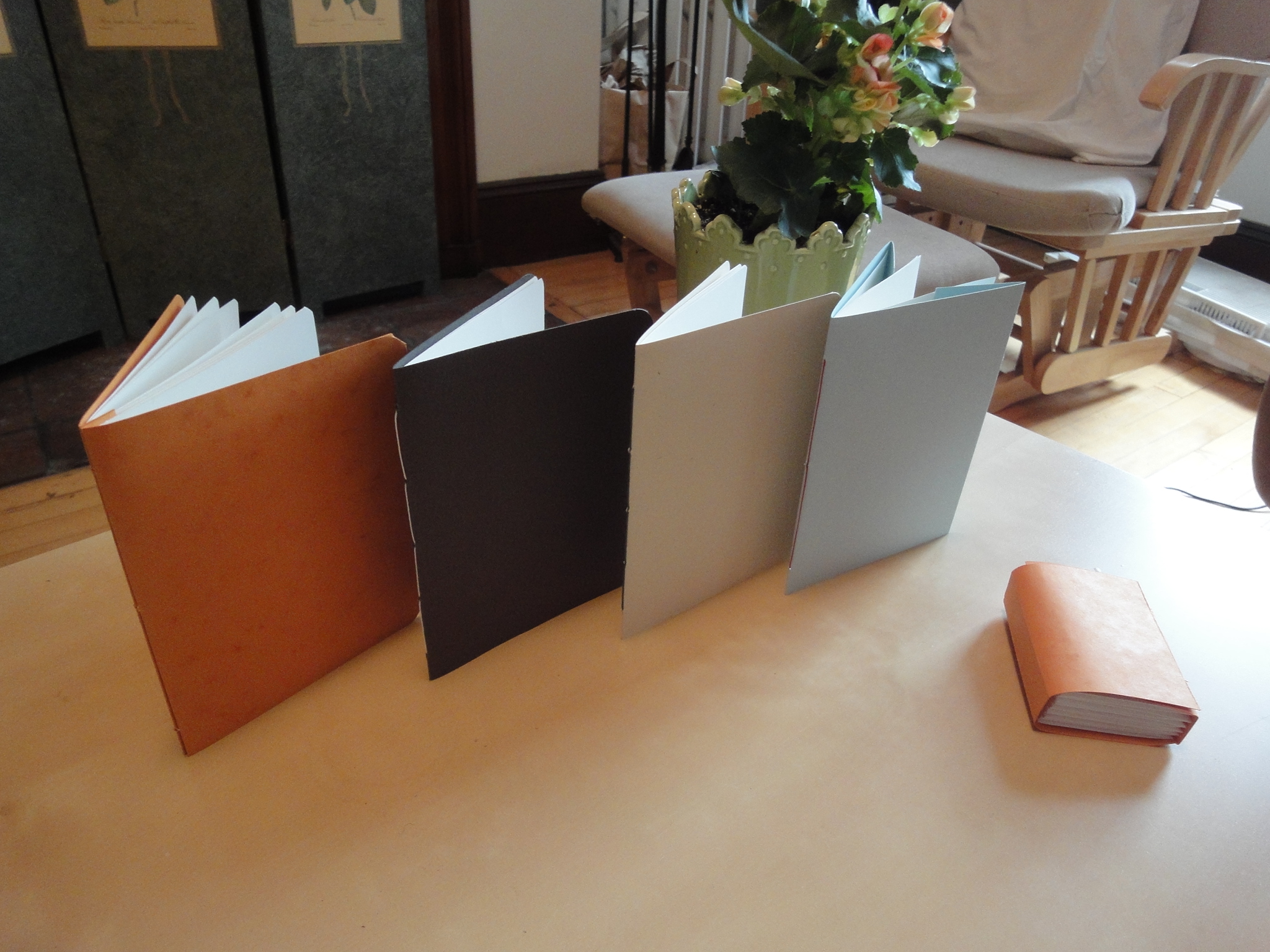
From left to right: two-section pamphlet, one-section pamphlets (3- and 5-station), and Korean map fold.

This is the Korean map fold book: it’s the same one that looks like a little cedar block in the previous picture. It’s bulky because it contains six pieces of 8.5″x11″ paper, folded into 8 sections each.

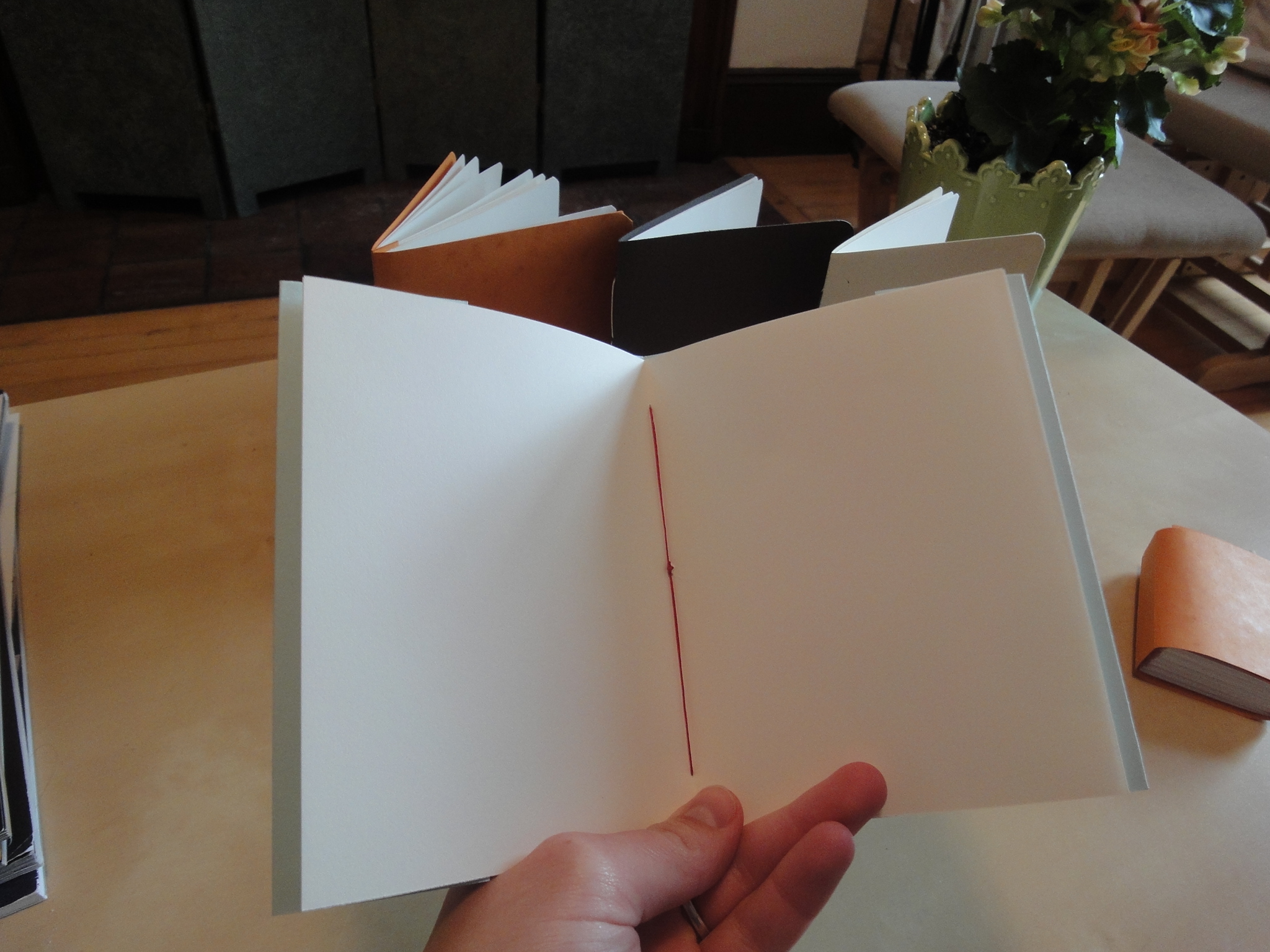
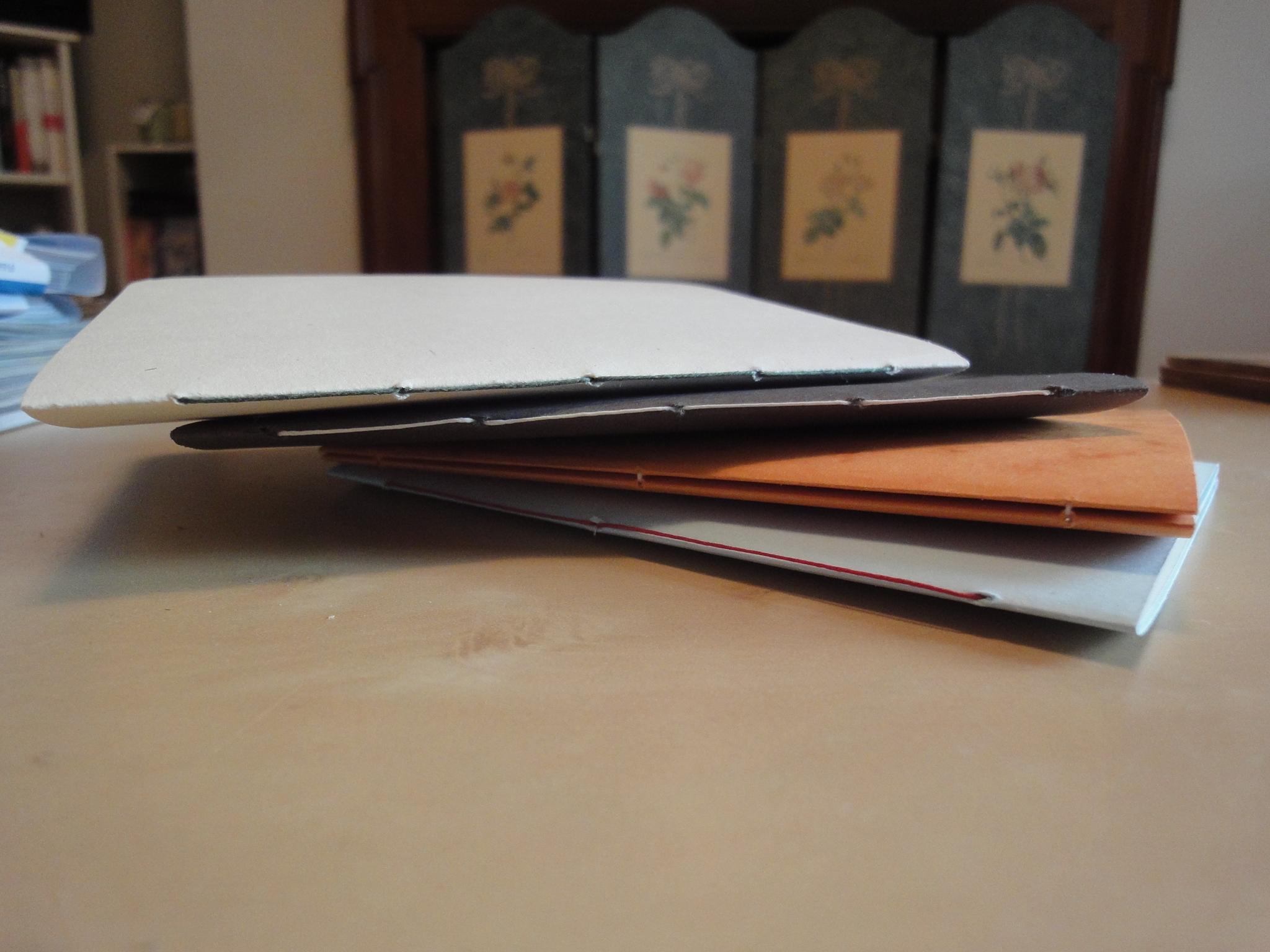
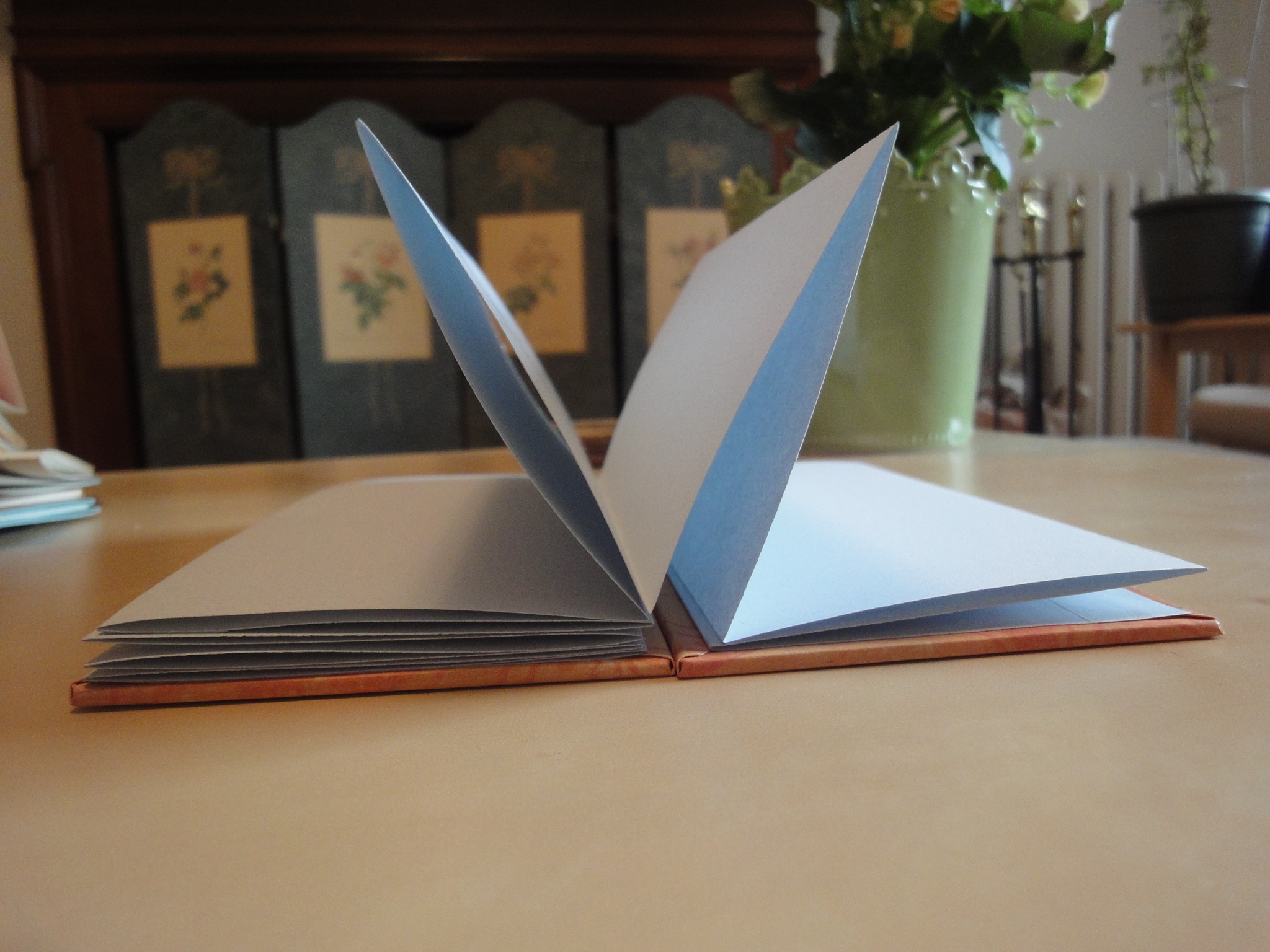
This is the two-section pamphlet; the sections are each made up of four sheets of paper, each folded in half once. The cover has a pleat in the middle, and there are three “stations” (holes) where the waxed thread goes through all the layers to hold it together.

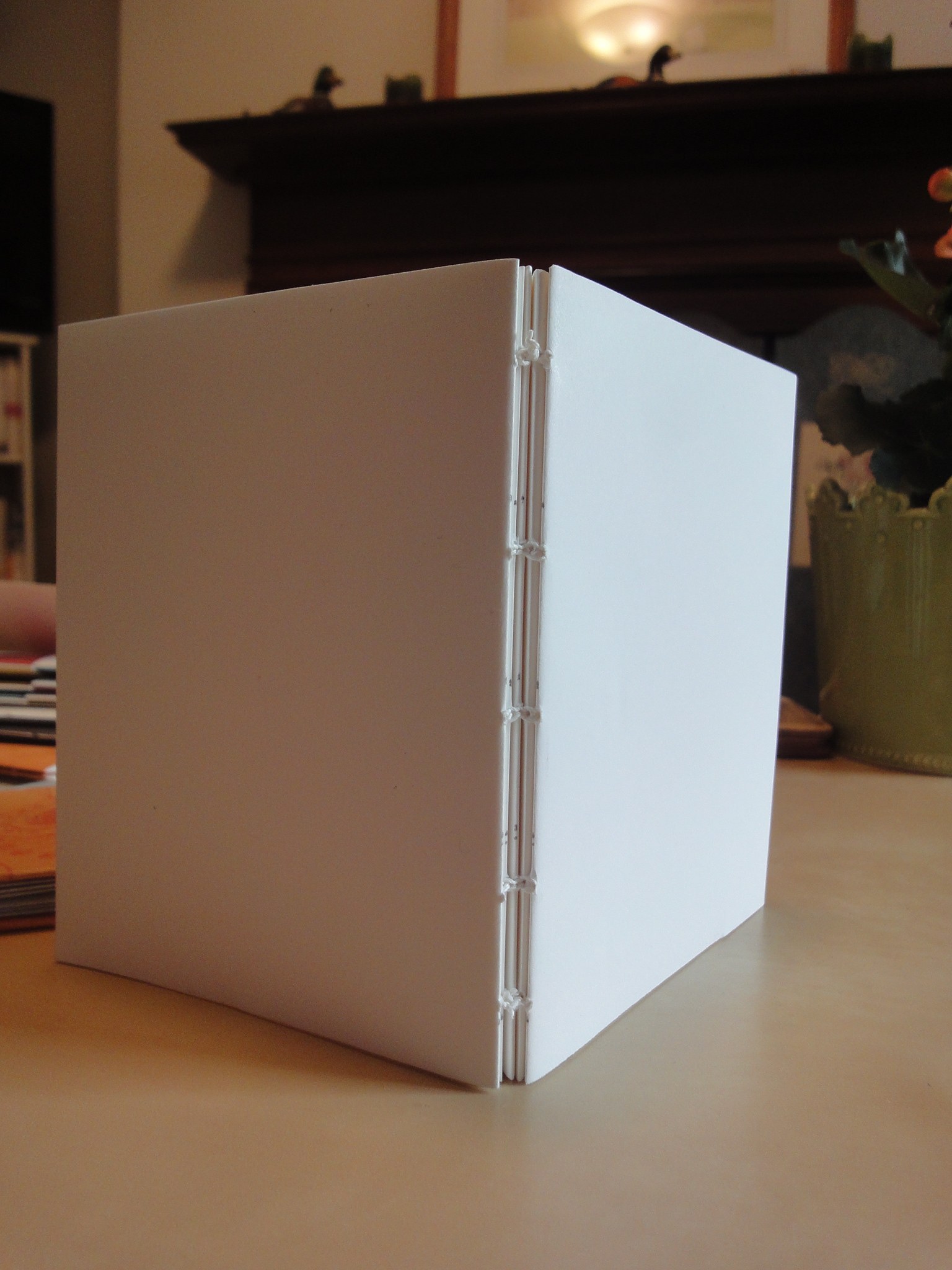
This is a one-section pamphlet, also with three stations. I gave the other pamphlets rounded corners, but I folded the edges of this cover in, so it has French flaps (like fancy trade paperback editions sometimes do).

All four pamplets: the top two have five stations, the bottom two have three.

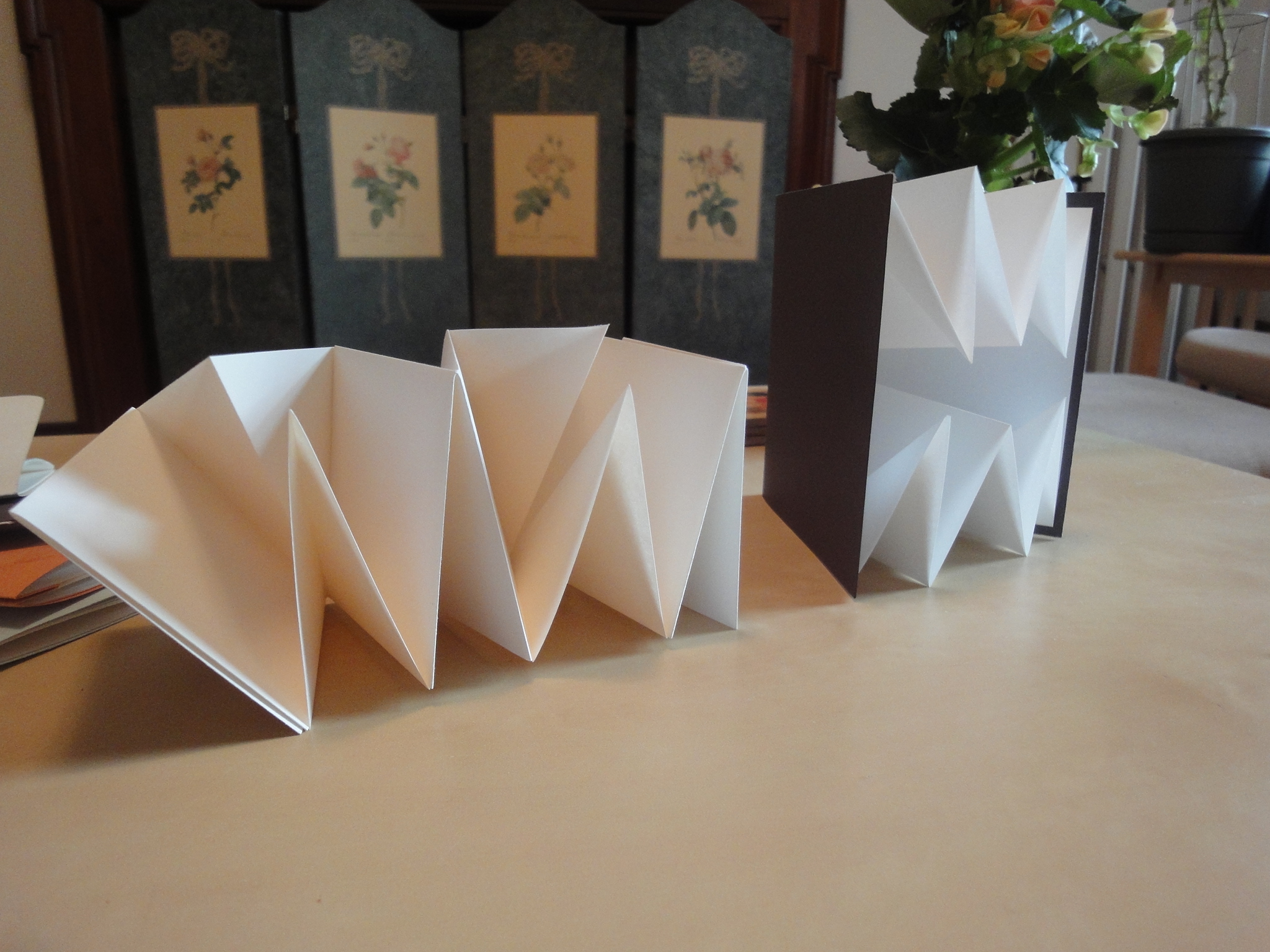
Standing up like this, these remind me of The Monster Book of Monsters from Harry Potter (when Hagrid teaches the Care of Magical Creatures). On the left is the blossom fold; on the right, the Turkish map fold.

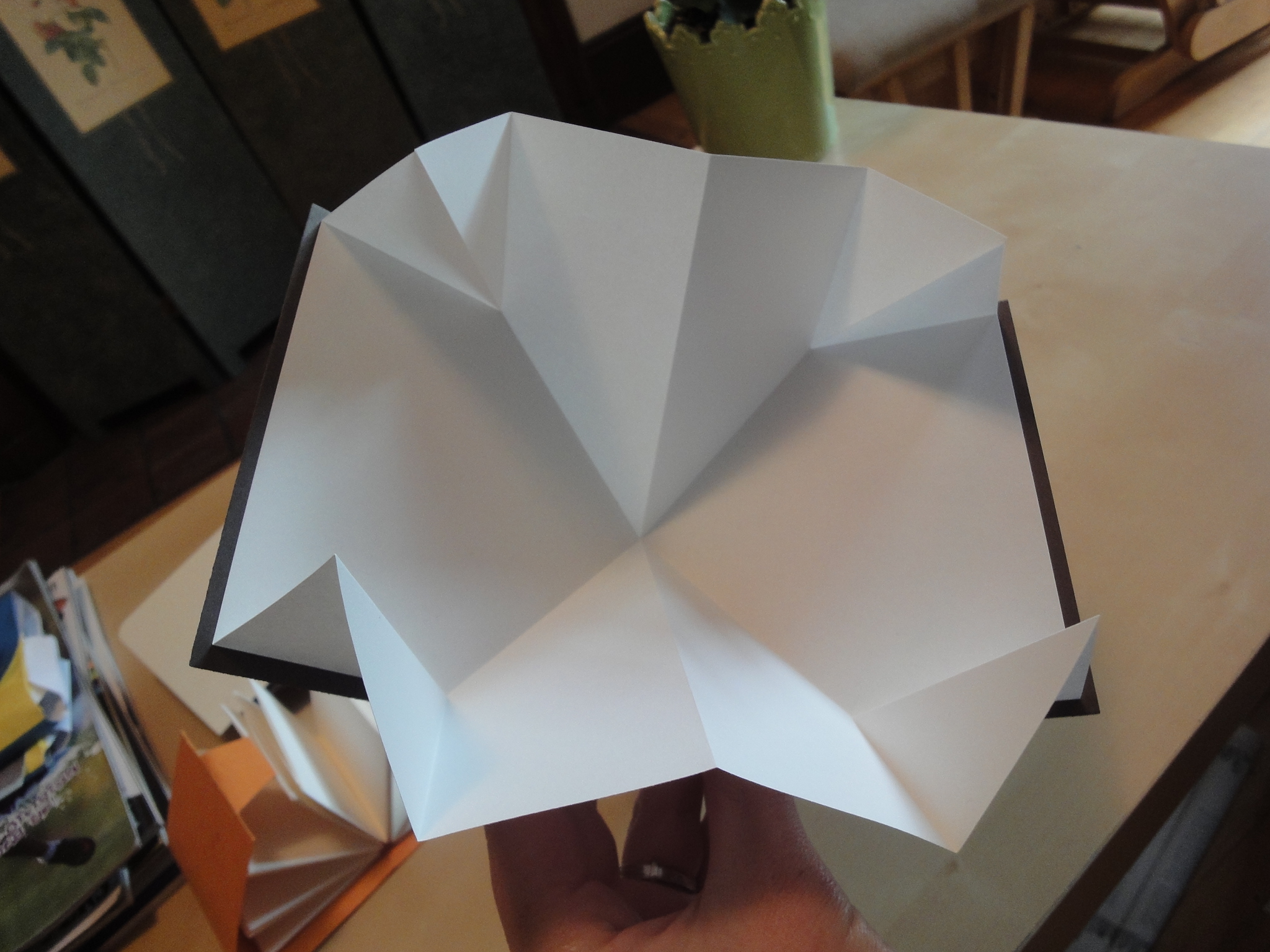
Here’s the Turkish map fold, open. It does fold down nice and flat – I think I have a city map of Paris folded in a similar way.

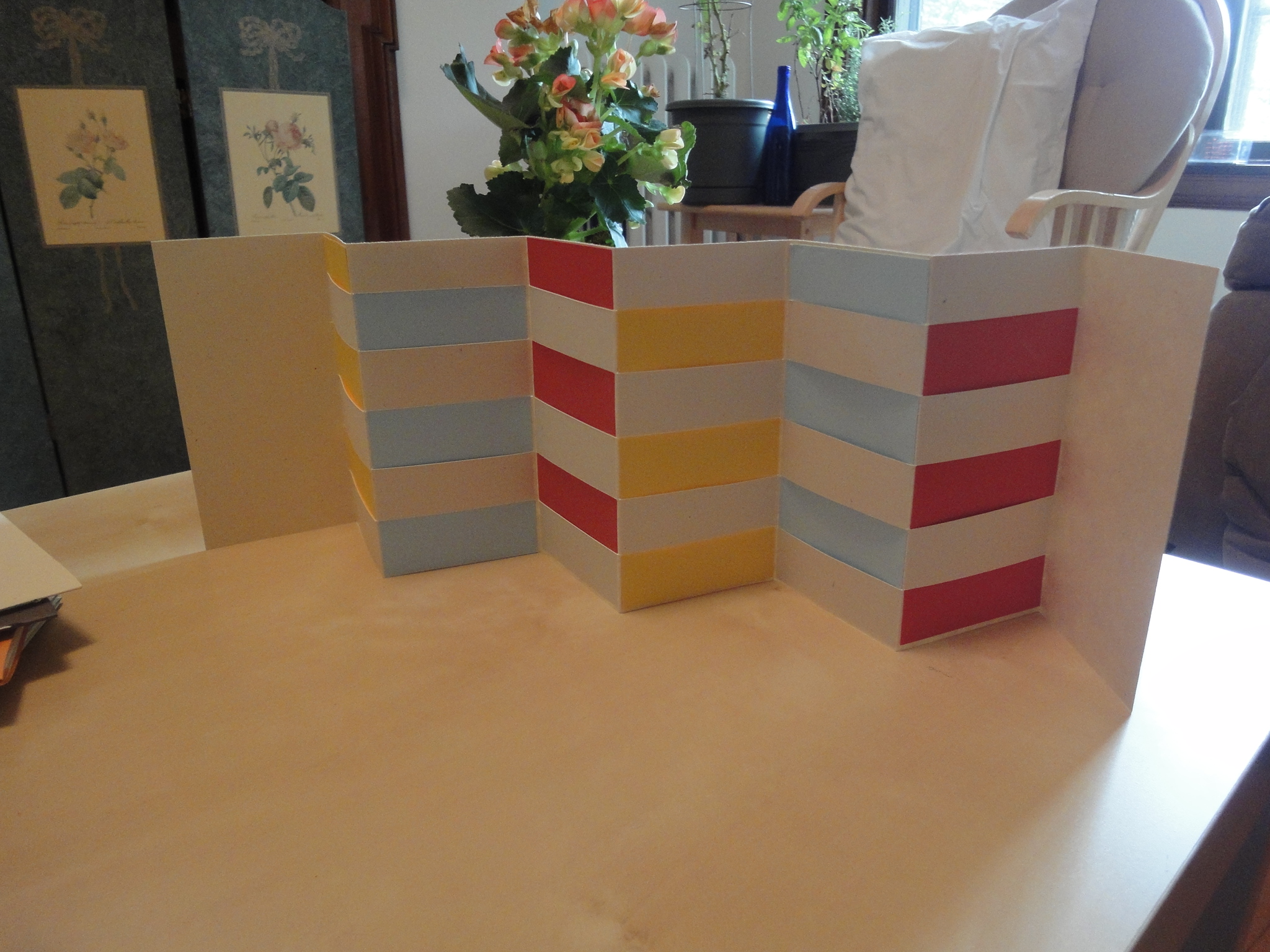
This has the best name of all: woven flexagon. We started with one long sheet (the cream-colored paper), and used a blade to make slices about 1″ apart; then, we took the colored papers and wove them between the slices. It’s quite cheerful-looking, but I have no idea what I’ll do with it.

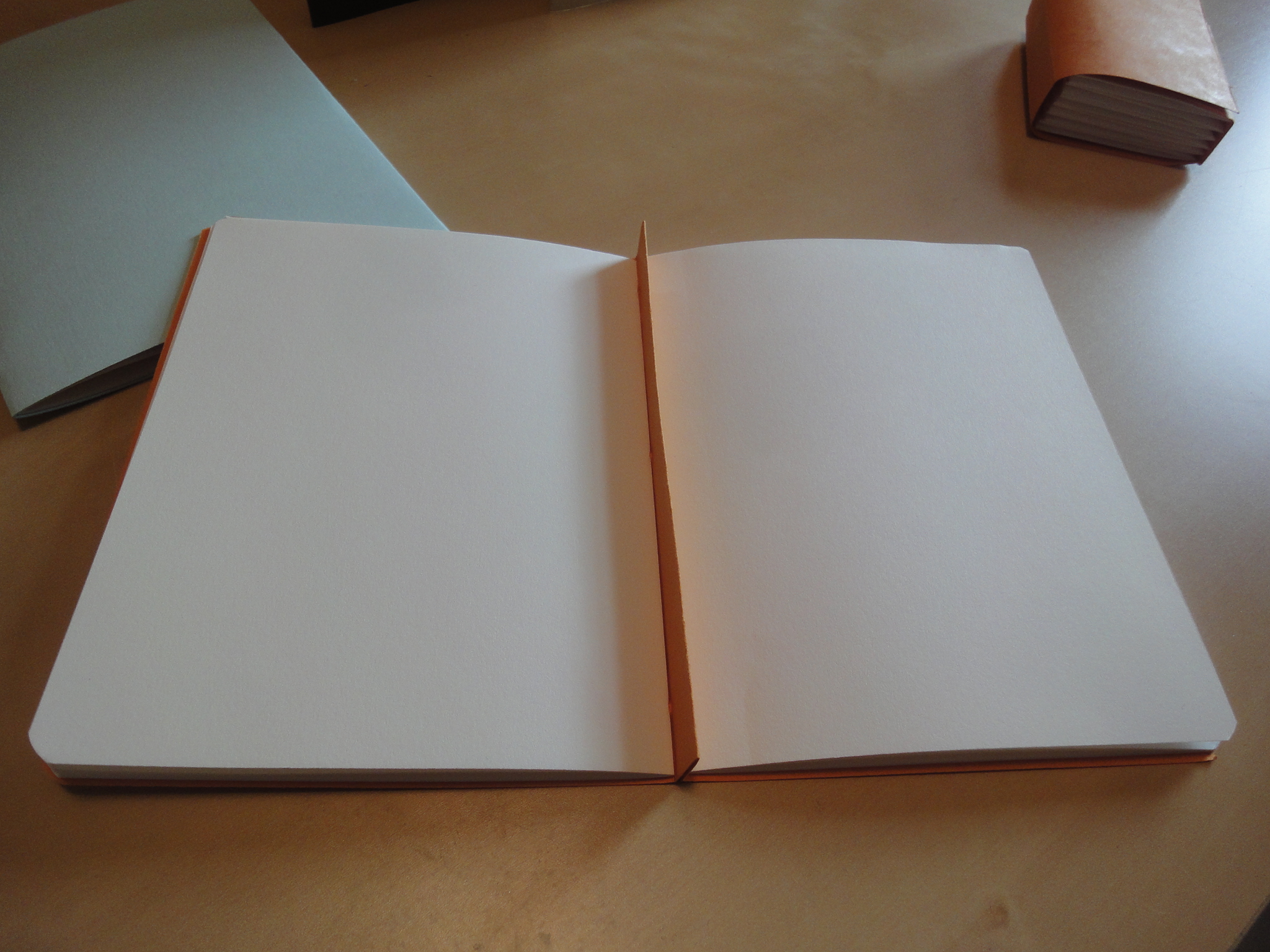
A simple accordion fold, with covers made of binder’s board covered with decorative paper. We got to use polyvinyl acetate (PVA), an archival-safe plastic adhesive, to glue the paper cover over the board. Sarah showed us how to tuck the corners in with a bone folder to make them smooth and sharp.

The same book, lying open. I preferred the sewing to the folding; I couldn’t make the folds 100% exact. Sarah also showed us how to make an accordion fold with pockets, which I would have liked to cover with the binder’s board, but mine didn’t quite stack straight.

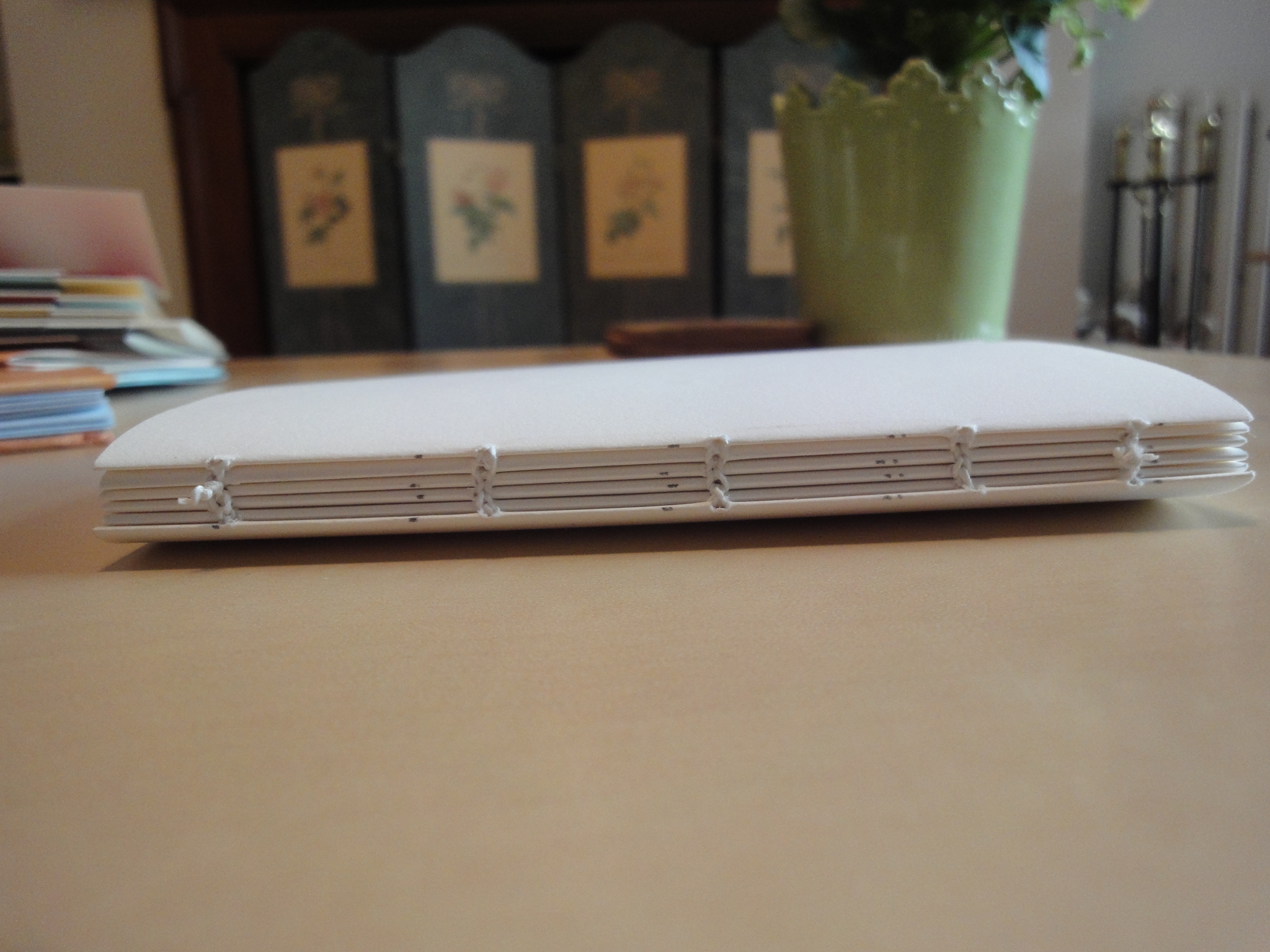
Finally, the chain stitch – this is the longest book, with five sections, or signatures, sewn together.

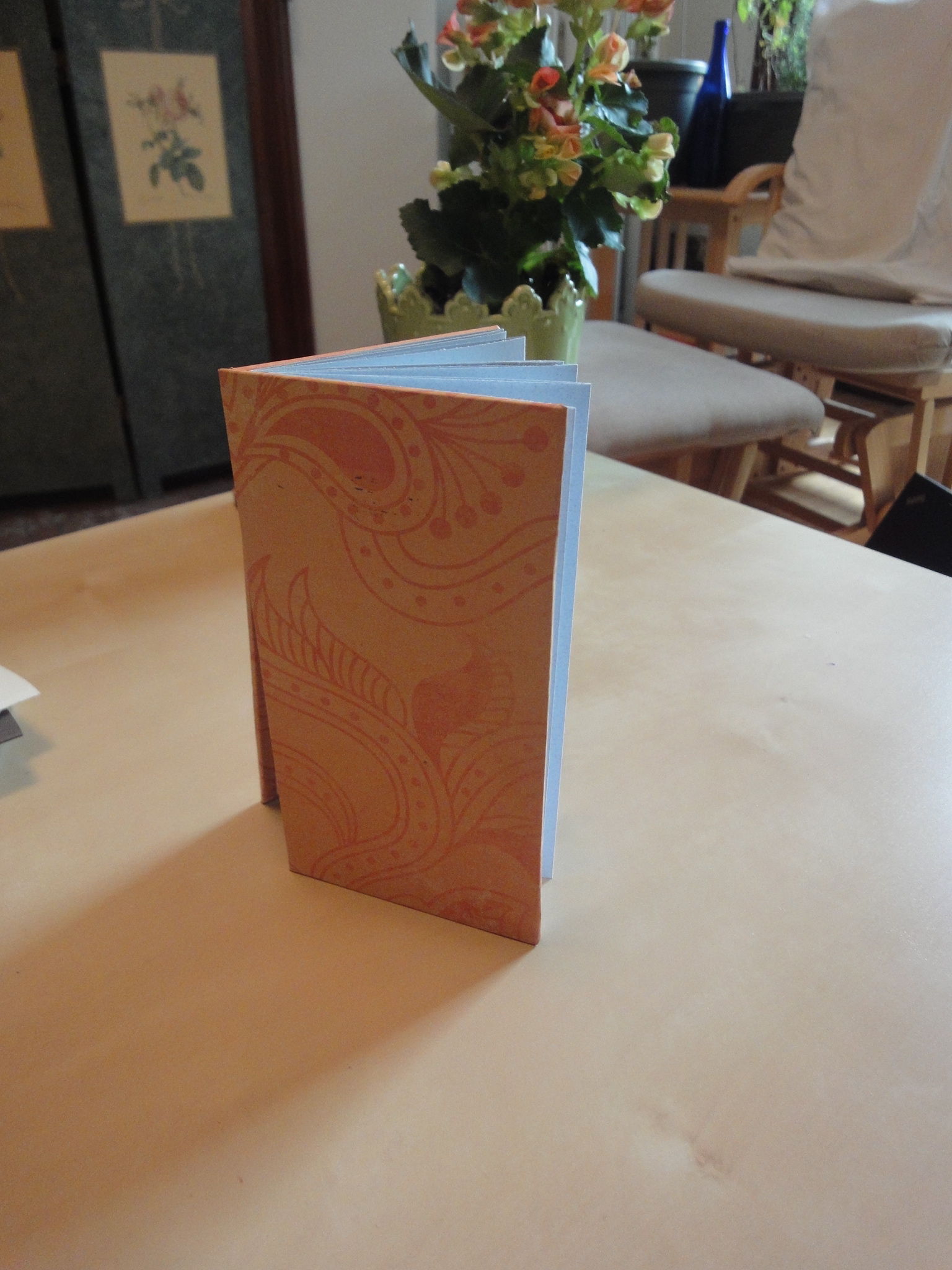
Here’s the chain-stitched booklet, closed. The stitching makes a nice pattern.

Other than being pretty, the chain stitch is also a nice binding because it allows the book to open flat, which is good for journals and sketchbooks, because you can write or draw deeper into the margins without worrying about the gutter.

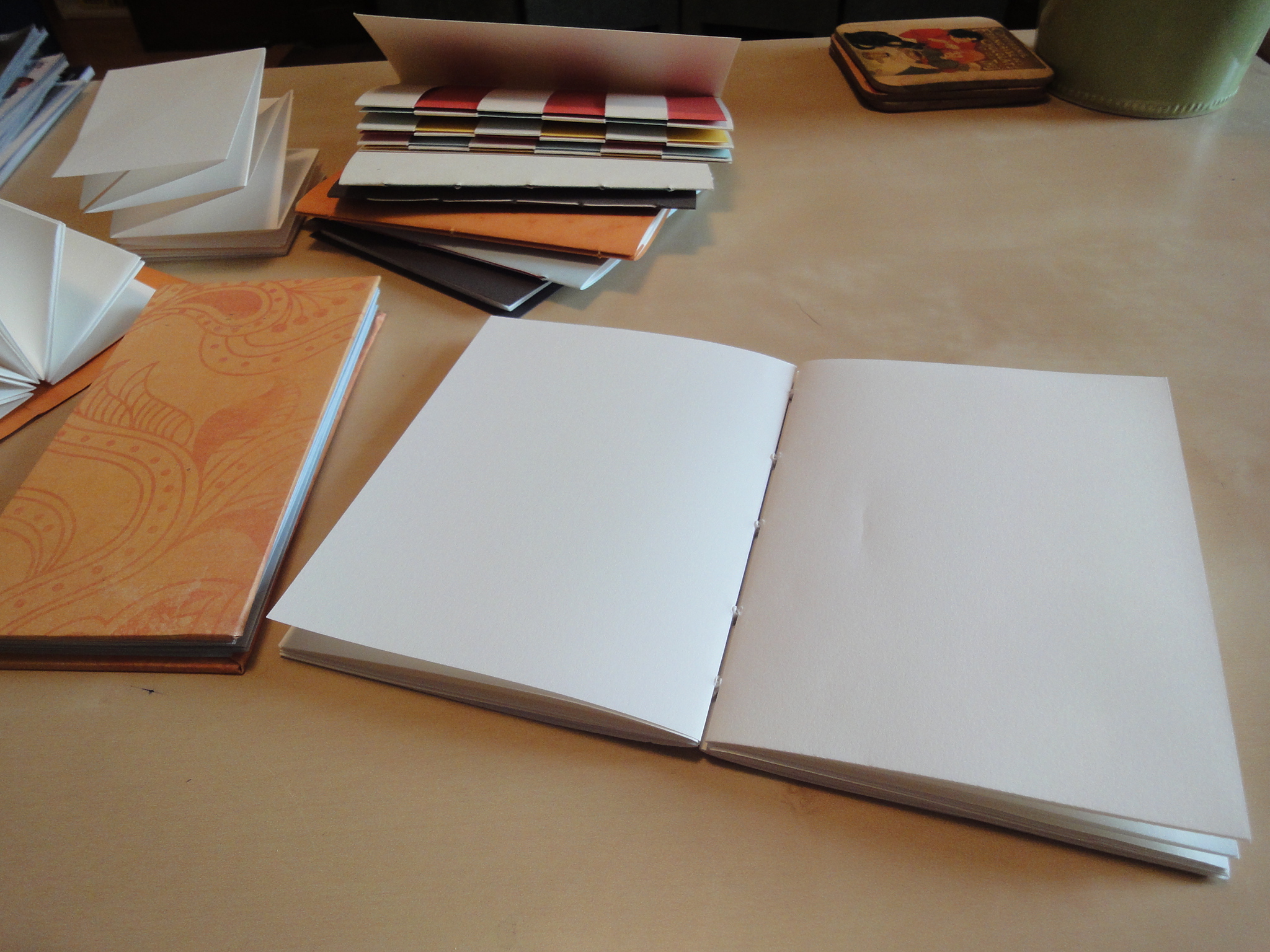
All the bindings!

A flock of books – all hand-made in less than seven hours. Even though I probably won’t be using these bookmaking skills in a practical setting anytime soon, the workshop was a good experience: I learned new things, stretched the part of my brain that relates to making tactile things, and created a physical product to use or give as gifts. All in all, a Saturday well spent.

Whose Common Sense?

This is another event that wasn’t on the initial schedule I drew up for myself, but a fellow student-to-staffer (and YALSA member) told me about it, and we went together. I’m so glad I did, especially as I’m taking a young adult literature class this fall; I got a jump on thinking about some of the issues that plague this particular group of readers.

Whose Common Sense?: How Labeling Systems Hurt Young Readers was sponsored by the ALA Intellectual Freedom Committee, and featured four amazing panelists:

Barbara Jones, Director of the ALA Office for Intellectual Freedom, began the session by making the distinction between book reviews and ratings: book reviews treat books as a whole; ratings target elements in books (e.g. sex, violence, etc.). This was perhaps the most objective statement of the whole session, because it was an impassioned session; while some panelists displayed understanding as to where “the other side” was coming from, others did not hold back, though for the most part they were preaching to the choir – librarians generally are for intellectual freedom and readers (of any age) making their own choices, and against censorship.

Michael Norris of Simba offered several statistics, reminding the audience that “not everyone loves books.” In fact, there are 5 print book buyers for every one e-book buyer, and 40% of iPad owners have never bought (or, presumably, read) an e-book. However, he added, censorship is one of the least effective ways to get boys to read books. (Girls are more likely than boys to read on their own.)

Jeffrey Nadel spoke as if he were the nation’s top five debate teams all rolled into one and someone had just hit the two-minute timer. Which is to say: well-spoken, well-rehearsed, articulate, impassioned, persuasive, and armed to the teeth with rhetoric. “What is protection?” he asked, then answered, “A group of people presuming to know better for another group.” In this case, protection is an “intellectual blockade” to exploration and curiosity; Nadel argued that restricting reading can actually harm young people, and that ratings take away freedom and creativity. Young people, he said, are the only protected/regulated “class” in the country, and yet “youth are unique.” He cited the problem with age-based ratings in other forms of media (e.g. movies), which is that “not all 13-year-olds are inherently the same.”

Parents, educators, and anyone with a shred of common sense knows this; one kid might be ready to dive into the Harry Potter series at age 7, while another might not be ready until 10. Christine Jenkins followed this nicely, describing the right and wrong approaches to helping a child find a book. If a kid comes up to the librarian and says, “I need a book,” “How old are you?” is the wrong response; instead, ask “What have you read that you’ve liked?” – just as you would for any other patron. Help with the discovery process, she advised, then let go.

As for ratings and age labels, Jenkins said, they only “give the illusion of control”; furthermore, attitudes shift in response to labels. Yet people are eager to label: the group Parents Against Bad Books in Schools, for example, pays lip service to the idea that “Bad is not for us to determine. Bad is what you determine is bad. Bad is what you think is bad for your child.” That, of course, is followed by a plethora of lists of books with “bad content.”

It’s this kind of mindset that sends David Levithan over the edge. These organizations, companies, and activists – the pro-ratings (and pro-censorship) groups – appear to be nonjudgmental, caring, and objective, but, Levithan said – and he has a point – “you cannot have an objective warning label.” Warning labels imply judgment; warning labels are “the enemy of the truth”; they are devoid of context. “The problem with warning labels,” Levithan said, “is that they’re fucking crazy. They are everything that the freedom to read is NOT about.”

Warning labels are reductive, he argued, and we cannot reduce literature to ratings. In terms of encouraging young people to read, he said, “You have to keep those gates open wide to everything…You can save time [using labels] and end up losing everything.”

All of this occurred before the Q&A session. During the Q&A, one audience member immediately brought up the Wall Street Journal article “Darkness Too Visible,” by Meghan Cox Gurdon, and this topic dominated most of the rest of the time. Gurdon’s article was a protest against the darkness, violence, and “depravity” of young adult literature. She lamented the fact that so many YA books contain “ugliness” and “damage, brutality, and loss.” The article provoked a tremendous reaction; author Sherman Alexie wrote an articulate and passionate defense, also in the WSJ, a few days later (“Why the Best Kids Books Are Written in Blood”).

Alexie was one of the many who spoke out. “When a body of [work/literature] is attacked, the people who it helped come to its defense,” said Levithan. “We are reflecting the problem, not creating it.” Sometimes, the consensus of the session seemed to be, it is better to the let child/young adult experience [fill in the blank] in a book rather than in real life – to have that experience vicariously through the safety of literature. Conversely, for those children and teenagers who have experienced the “dark” subject matter in books in their own lives, they are likely to be comforted, not damaged, by the books – they can empathize with the characters, and know they are not alone. And generally – like any other group of readers – if teens don’t like a book, they will stop reading and put it down.

Another question, after the WSJ article debate, was how to counter the idea that kids need to be protected from ideas. There is a proven link between leisure reading and educational achievement. It is important that kids have access to books that are interesting to them; our role as librarians is to make sure they have that access. Worse than books being challenged is books being censored preemptively – teachers not adding books to their syllabi or librarians not buying books for the library collection because they expect the book to be challenged.

Throughout this panel, I tried to think of a book – any one book, ever – that I had read that had damaged me in some way. I have read over a hundred books a year since grade school, and I know that I have read many of the most frequently banned/challenged books, including more than 30 from each of the most frequently challenged books of the decade lists (1990-1999 and 2000-2009; there’s a lot of overlap). Many of them have been assigned in school – see the list of challenged classics. (Ironically, people have wanted to ban Fahrenheit 451 and 1984 a lot. Bradbury and Orwell would be proud. Or horrified.)

The point is, I couldn’t think of one book I had ever read that I would have preferred to be “protected” from. I’m not a statistically significant sample size, just a case study, but my experience has led me to believe in the freedom to read, for people of all ages. Parents might have the right to determine what their own children are allowed to read, but they should not have the right to determine this for anyone else – not in school libraries, and not in public libraries. Ratings systems make it easier to target those books with “bad content,” and it’s a slippery slope from rating to banning.
Amy Pattee quoted in Salon.com article

This fall I’ll be taking Amy Pattee’s course on Young Adult (YA) Literature. I’ve been working my way through the reading list already: Forever by Judy Blume (I somehow missed this when I was younger, though I did read Are You There, God? It’s Me, Margaret), Boy Meets Boy by David Levithan, Stitches by David Small (actually I read this in galley form before it was published – they were giving it away at BEA a couple years ago), and many others.

One of Amy’s articles was quoted in a Salon.com piece back in July, “The case for raunchy teen lit.” Generally speaking, in the U.S., when parents or other adults get upset about or offended by a book and want to censor it, it is often because they (the books, not the adults) are “sexually explicit.” (Offensive language is next, followed by violence. See statistics on challenges on the ALA site.) In Europe, on the other hand, violent content is much more likely to raise opposition than is sexual content; one could extrapolate from this and say that Europeans are more comfortable with sex, and Americans are more accepting of violence.

Either way, the Salon article makes a good point; it’s much safer to explore these topics through literature than in person.

Wikipedia in Higher Education

July is just flying by. Earlier this month, I attended part of the Wikipedia in Higher Education Summit. I knew from the Reference class I took last fall that Wikipedia is about as reliable as other encyclopedias, but the idea of incorporating it into the classroom – professors assigning students to edit existing pages or create new ones – is somehow revelatory. Most reference sources are one-way – you consult them, they don’t consult you (unless you’re an acknowledged expert in your field). Wikipedia is a two-way information source, in that you can consult it and contribute to it. This is becoming legitimized and encouraged in academia, and it’s exciting.

I’ve collected a few articles around this topic here, in reverse-chronological order, with links and snippets. It’s worth noting that David Ferriero, the archivist of the United States (and a GSLIS alum!), spoke at the summit, supporting Wikipedia in higher ed. (Ferriero also had good things to say about the National Archives’ “Wikipedian-in-Residence” – a GSLIS student).

Read on – and please add any relevant links in the comments.

July 11, 2011, “Wikipedia Aims Higher,” Inside Higher Ed
Late last week, the Wikimedia Foundation, which runs the encyclopedia, took another step toward assuming the mantle of an accessory of higher education: it held an academic conference. The first-ever Wikipedia in Higher Education Summit convened professors who had incorporated Wikipedia into their teaching, as well as others who were considering doing so, to talk about pros and cons of assigning students to improve the publicly edited online encyclopedia.

May 1, 2011, “For More Students, Working on Wikis is Part of Making the Grade, New York Times
Although wikis, with their collaborative approach and vast reach online, have been around for at least 15 years, their use as a general teaching tool in higher education is still relatively recent. But an increasing number of universities are now adopting them as a teaching tool.

February 5, 2011, “Web-Dominated Web Site Seeking Female Experts,” New York Times
Today women earn 57 percent of the bachelor’s degrees, 61 percent of the master’s degrees and, as of 2009, a majority of doctorates in the United States. It is inconceivable that this well-educated majority should be largely absent from the world’s most popular interactive encyclopedia project.

January 30, 2011, “Define Gender Gap? Look Up Wikipedia’s Contributor List,” New York Times
In 10 short years, Wikipedia has accomplished some remarkable goals. More than 3.5 million articles in English? Done. More than 250 languages? Sure. But another number has proved to be an intractable obstacle for the online encyclopedia: surveys suggest that less than 15 percent of its hundreds of thousands of contributors are women.

September 7, 2010, “Wikipedia for Credit,” Inside Higher Ed
Some professors believe Wikipedia has no place in the footnotes of a college paper. But could it have a place on the syllabus?

Wikipedia and Sue Gardner

One of my favorite programs at ALA Annual was Sue Gardner‘s talk on Wikipedia. Gardner is the Executive Director of the Wikimedia Foundation, the nonprofit behind Wikipedia, and she is an incredible speaker: dynamic, enthusiastic, and prepared. She answered questions in a direct manner (and she’s quotable).

We are getting to the point in academia where Wikipedia is becoming accepted as a reliable reference tool. It is a great jumping-off point. You wouldn’t cite it in a paper – but then, you wouldn’t cite any other encyclopedia in a paper, either, after about third grade. Its value is in its currency, relevance, and most of all in its citations.

Gardner said that Wikipedia is an “inherently radical” nonprofit, supporting the idea that “people have a right to access to information.” She described the “virtuous circle, by which participation leads to quality, which leads to a broader reach, which leads to greater participation. There is “no such thing as perfect accuracy” – even recognized authoritative sources such as Britannica have errors, and those can’t be corrected as quickly as Wikipedia can, and they aren’t as widely or frequently monitored, either.

Wikipedia is a “credentials-neutral environment – some people need to be anonymous.” However, unlike communism, which looks good in theory but breaks down in practice, some problems for Wikipedia are theoretical rather than practical: “Wikipedians are fierce defenders of editorial integrity,” so while self-serving articles are a concern in theory, they are not so much of a problem in practice.

One of the main goals of Wikipedia, said Gardner during the Q&A, is “to get information to people so they can make informed decisions about their lives.” Gardner – former director of the Canadian Broadcasting Company’s website and online news – also encouraged questioning the nature of “authority” – “Is Fox News a ‘reliable source’?”

Journalism, Gardner said, “is not really a profession, it’s a job for curious people.” Also, it seems, a job for students and librarians: part of a recent public policy initiative encourages teachers and professors to assign students to write for Wikipedia. There are over 100,000 Wikipedia editors worldwide; these editors work for free, because they enjoy it and believe in it. The average Wikipedia contributor/editor is 25 years old, a STEM (Science/Technology/Engineering/Math) grad student – and male. Wikipedia contributors skew male; librarians skew female. Gardner’s message was clear: “We want you as Wikipedians.”

It was a galvanizing talk – read the American Libraries write-up here – and I’m excited to be attending the first Wikipedia in Higher Education Summit tomorrow.

Promising Pals Breakfast

The Promising Pals end-of-year breakfast was on June 3. I didn’t realize what a huge program it was until I got there; every single student, 6th grade through 8th, has a Pal, and the program strongly emphasizes how important it is to come to the breakfast; students are disappointed if their Pals don’t show up.

There were several speakers (including Mayor Menino!) and performers, and all of us “adults” got to meet our student pals. It’s a pretty incredible program – still going strong after 25 years, and impressively well organized. I’m glad I got involved.

Digital Library Launch

Tomorrow, the digital library we have been building in LIS-462 is officially launching! Over the course of the semester, the class has digitized the scrapbook of Caroline Stokes, a student at Simmons from 1929-1933. We’ve done everything from digitization to metadata, writing content to creating the database and website. It has been a huge effort but a great learning experience. View the Caroline Stokes Scrapbook here.

The Caroline Stokes Scrapbook home page.