Academic Uses of Social Media

The GSLIS Tech Lab streamed the Berkman Center for Internet & Society webinar “Academic Uses of Social Media: Exploring 21st Century Communications” this afternoon. John Palfrey, faculty co-director of the Berkman Center (and author of Born Digital ), gave an introduction and noted that, when looking at the growth of social technologies, it is important to keep in mind the digital divide (which so often corresponds to the socioeconomic divide).

The keynote speaker, Danah Boyd, sought to provide “a higher-order conceptual understanding” of the “cultural logic” behind social media and networking sites. She examined the components of social media sites like Facebook and Twitter; what do these services do? She spoke of the user profile as “writing the self into being” and the friend structure as “writing the audience into being.”

Boyd also talked about the creation of a new kind of public space; its persistence over time, its replicability, searchablity, and scalability. She also spoke of the invisible/imagined audience, the collapsing of contexts, and the blurring between public and private, and how “young people” are participating in a public environment but still want privacy.

One of the most interesting points she made was that face-to-face interactions are private by default and public by effort, whereas interactions through social media are public by default, private by effort. She, too, emphasized that not all young people are “digital natives,” and that even because they use certain technology doesn’t mean they understand it: for example, one can use a search engine every day without really knowing how to structure a query properly.

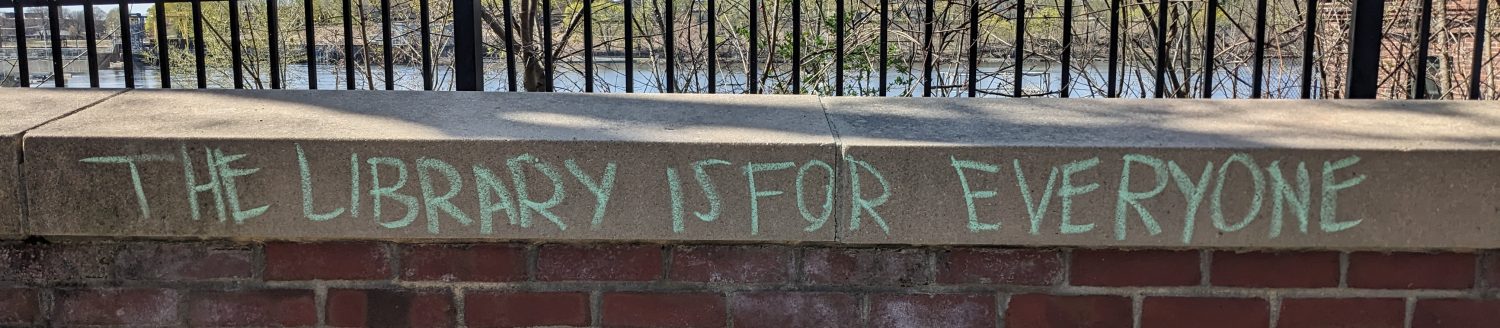
Near the end of her lecture, Boyd showed a slide with this image: “Replace fear of the unknown with curiosity.” The source appears to be a blog concerned with celebrity news and fashion, but it’s an excellent position to take, all the same.
GSLIS After Dark Poster Session

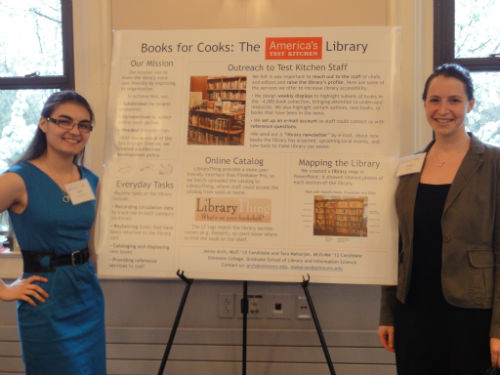
Tonight, I had the opportunity to present a poster about my experience working in the library of America’s Test Kitchen at the annual GSLIS alumni event, “GSLIS After Dark.” My fellow library intern and I had put the poster together over the past few weeks; we made it as a PowerPoint slide, converted it to PDF, and had it printed by PhD Posters. It turned out really well, and we enjoyed sharing our experience with other students and alumni.

We called our poster “Books for Cooks: The America’s Test Kitchen Library,” and it had information (too small to see here) about our mission, outreach to staff, and projects we’ve tackled, like creating a library map and moving the catalog online with LibraryThing. Most people who stopped by seemed interested…of course, we also had snacks: homemade blondies from a recipe in Baking Illustrated.

Simmons GSLIS in the News

Faculty and students from Simmons’ Graduate School of Library and Information Science (GSLIS) were featured in this Boston Globe article, “Checking out the future,” by Sam Allis. Here’s an excerpt:

“Tomorrow’s librarians face a two-year graduate school curriculum freighted with technology courses that didn’t exist 10 years ago, courses that will likely be replaced by others within a year or two. The future of libraries is a constantly evolving digital landscape, and technical literacy, as it is in so many other fields, is absolutely essential to find a job in a brutal job market…

…While the core mission of librarians hasn’t changed — they are still committed to provide information to patrons who need it, wherever they are — most everything else has.”

This is more or less what I say when confronted with the “libraries are dying” sentiment. They aren’t dying; the core mission, to provide equal access to information, still remains and is just as relevant as ever. Not all of that information is contained solely in books anymore, however; we have to keep pace with technology and use it to our advantage. Libraries are not dying – they are  evolving.

Welcome New Students!

Today is Advising Day at GSLIS, and about 25 of the 70 or so students who will be starting here in the summer semester (like I did last year) were on campus today for orientation activities and registration. I went to the lunch for the new students to talk to them about ALASC (American Library Association Student Chapter) and answer any other questions they had about classes, the Boston/Cambridge/Somerville area, and other library- (or not) related topics.

It has been almost a year since I started this program, and I have learned so much about the library world in general, as well as acquiring specific skill sets: cataloging, web development and design, best practices in public libraries and collection development. To paraphrase Julia Child’s sentiments about cooking, the more you learn, the more there is to know!

Version Control Saves Lives!

March has been a workshop-rich month: today I attended “Git for Fun & Profit, or How Git May Save Your Life,” presented by Mark Tomko in the GSLIS Tech Lab. He designed this workshop recently with the Digital Libraries class in mind, and it was a great overall as well as practical intro.

In plain English, version control systems (VCS) allow users to keep track of changes to a set of files and directories. For example, if you’re working on a website and you break something but can’t figure out what, you can always revert to a working version and start over from there. VCS also allows multiple users to read and modify the same files simultaneously. Git is available to download for free, and there are lots of web resources for users.

CMS and Random Library Fact

This morning I attended the CMS program at Simmons sponsored by NEASIS&T. First we heard about WordPress from Theresa Maturevich, who used WordPress to build the Beverly Public Library site, which won the Massachusetts Library Association’s Public Relations Award in 2009. Next we heard from Michael Witwicki, who spoke about ExpressionEngine; then Steve Sanzo, who spoke about Drupal, and finally Anna Burke (a Simmons GSLIS grad!) and Talia Resendes from Springshare, who presented LibGuides. All of the talks were interesting, especially considering that of the four CMS we heard about, only two – ExpressionEngine and Drupal – were designed to be CMS; WordPress was designed as a blogging tool, and LibGuides was a web platform for subject and research guides. These last two retain their original functions in addition to expanded ones, but it’s a case of the people behind the software adapting the product in response to the (unintended/unforeseen) way(s) people were using it.

Now for the random library fact: it’s not hugely surprising, but I read in G. Edward Evans’ Developing Library and Information Center Collections that library books shelved on the top and bottom shelves have lower circulation rates than those shelved on the middle shelves. This makes sense, because the books on the middle shelves are closer to most people’s eye level; no one has to crouch or stand on tip-toe to see them. It’s a compelling argument against using the lowest and highest shelves at all – if you have the space. (Bookstores, in comparison, tend to use their highest shelves for overstock.)

Bibliomaniac or Bibliophile?

I just came across this little aside in Developing Library and Information Center Collections by G. Edward Evans and Margaret Zarnosky Saponaro, which I am reading for my collection development class: “If there is a bibliographic equivalent of alcoholism, many librarians have it.” The following sentence cites the Random House Dictionary’s definition of bibliomania: an “excessive fondness for acquiring and possessing books.” Note it doesn’t mention an excessive (or obsessive) fondness for reading books. It must be a fine line, because Dictionary.com (also based on the Random House Dictionary) defines the more tranquil bibliophile as “a person who loves or collects books, especially as examples of fine or unusual printing, binding, or the like.” For more on the topic, I highly recommend Allison Hoover Bartlett’s excellent The Man Who Loved Books Too Much.

Promising Pals

I have a pen pal!

Last fall, I volunteered to be part of the Promising Pals program through the Scott/Ross Center for Community Service at Simmons. For months, I received bright yellow postcards indicating that the program was underway, that the students were very excited, that the first letter would be arriving soon, etc. The program was delayed a little because of all the snow days, but last week I finally received my first letter. My correspondent (pen pal!) is a sixth-grade student at the James P. Timilty School in Roxbury, and she has handwriting so exceedingly neat that it puts mine to shame.

I like writing (and receiving) letters – real, paper letters, not e-mail – but I underestimated how exciting this program would be. More precisely, I forgot how enthusiastic sixth-graders can be, and how that enthusiasm can be contagious. It’s not just letter-writing; it’s getting to know someone who would otherwise be a stranger, and getting to know that person through that antiquated medium of pen and paper (not the internet!). We’re different ages – different generations, eek! I actually wrote letters in grade school because e-mail didn’t yet exist on the scale it does now – we have different backgrounds and different interests, but we have been randomly connected. The main purpose of the program may be “to highlight literacy and mentoring,” but what a cool way to do that – by reading the same book and discussing it, in handwritten letters.

Classes Begin

Spring 2011 courses begin this week (though to call it “spring” seems unnaturally cruel, as it is currently all of two degrees Fahrenheit outside right now, and -18 with windchill). But it looks like it will be “warming up” to the 20s and 30s by by the time I have to go to classes, later this week: Collection Development with Michael Leach on Thursday evening, Digital Libraries with Candy Schwartz on Friday morning, and Web Development and Information Architecture with Linda Braun on Friday afternoon.