NELA 2018: The Library is Your Space (Part 2)

See Monday’s recap of NELA 2018 here.

Tuesday, 9am: ALA President Loida Garcia-Febo’s “Big Ideas” Talk: “Libraries = Strong Communities”

ALA President Loida Garcia-Febo’s speech put libraries at the center of their communities, and gave examples of the many different ways libraries serve their communities, from the usual (“When it comes to connecting people to information, librarians do it better than anyone…We promote reading, lifelong learning skills, equal access to information for ALL”) to the unusual (one library has partnered with a hospital so that every time a baby is born there, the mother can push a button and a gong rings in the library to announce the birth).

Garcia-Febo showed a slide of the text of Article 19 of the United Nations’ Universal Declaration of Human Rights: “Everyone has the right to freedom of opinion and expression; this right includes freedom to hold opinions without interference and to seek, receive and impart information and ideas through any media and regardless of frontiers.” She said, “Access to information is at the core of what librarians do” – and access to information leads to education, citizen engagement, and empowerment….Libraries play a critical role in leveling the playing field.”

She concluded, “We are all creating the library of the future every day. We need to continue working with community members and local organizations….Libraries are the cornerstones of democracy….Information is a human right.”

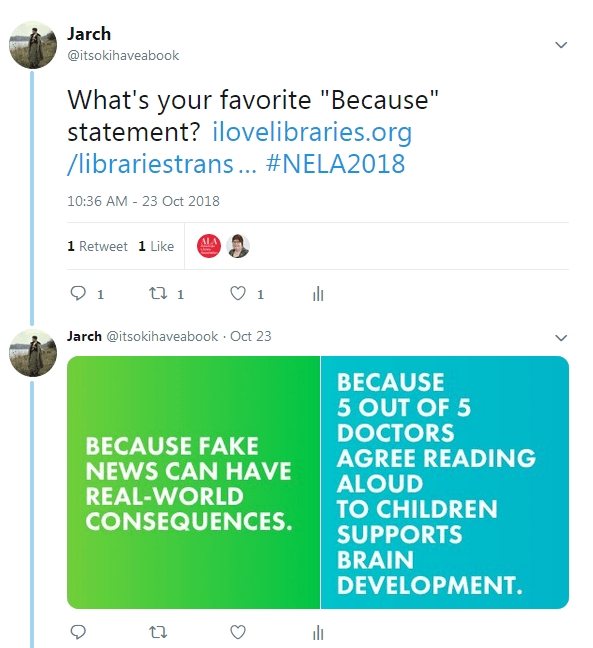
Additional resources with links, and tweets below:

ala1ala-because


Tuesday, 11am: Free Speech & Libraries, Edward Fitzpatrick

Much of the content of Ed Fitzpatrick’s talk can be found in his October 2017 Providence Journal article, “Nation needs First Amendment refresher course.” The roomful of librarians (unsurprisingly) did much better than the national average at identifying the five freedoms protected by the First Amendment, and after the talk there was some articulate pushback on the pithy idea that “The best answer to hate speech is great speech.”

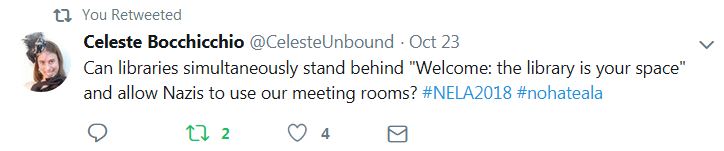
A particular dilemma faced in libraries centers around our public meeting rooms. If they are open to all, does that mean we must allow hate groups such as the KKK to use them? A July 2018 feature in School Library Journal, updated with comments by Jamie LaRue and a sidebar by Martin Gardnar, “Free Speech Debate Erupts with ALA’s Inclusion of Hate Groups in Revision of Bill of Rights Interpretation,” summarizes the issue neatly. In short, the ALA’s answer is yes. (So is Ed Fitzpatrick’s: ““When you’re a public library, you’re committed to that public experiment…It doesn’t mean the library is supporting or welcoming these groups or advocating for them.”) But there are other things libraries can do to show that we don’t agree with hate speech or hate groups. However, no matter how inclusive our collections, how welcoming our displays, or how diverse our events, patrons who are the target of such hate groups may well feel threatened and unsafe in the library.

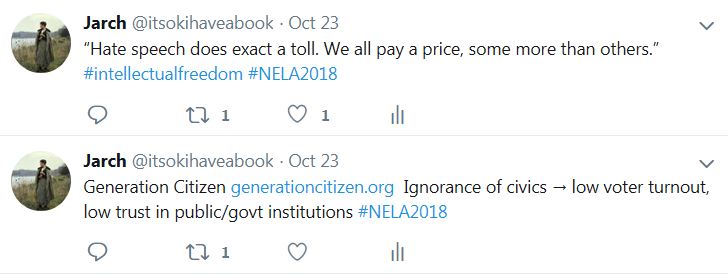
Fitzpatrick cited two books repeatedly, both by Anthony Lewis: Gideon’s Trumpet (1964) and Freedom for the Thought We Hate (2007). Even as he defended free speech, including hate speech, he admitted, “Hate speech does exact a toll. We all pay a price, some more than others….Such freedom carries a real cost.” Fitzpatrick, a white man, may not bear as much of that cost as others in our society.

freespeech1freespeech2freespeech3

Tuesday lunch: Gregory Maguire

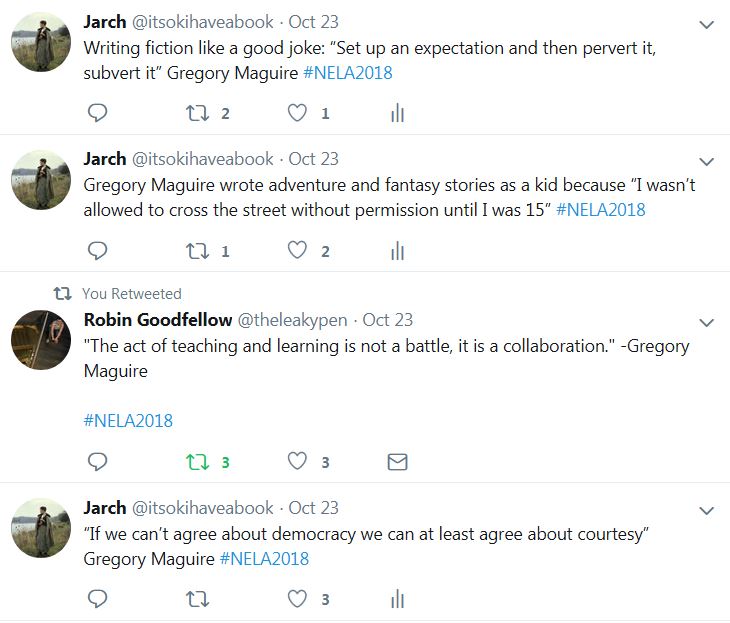
The author of Wicked (the book the Broadway show was based on) and many, many other books for children, teens, and adults spoke during Tuesday’s lunch, and he was an amusing and engaging speaker. I hadn’t known much about his childhood, or all the picture books he wrote, and I may dip into one of his more recent novels (After Alice) – it’s been a long time since I read Wicked or tried (but didn’t finish) Confessions of an Ugly Stepsister. Here are some tweets from the talk:

Screenshot of tweets from Gregory Maguire talk

Tuesday, 2:30pm: Ignite!

The “Ignite!” sessions are quick, five-minute presentations on various topics:

“Time Travel Toolkit: Historical Maker Activities for Modern Kids,” Elise Petrarca, Youth Services Librarian, Cranston PL: Attendance at kids’ technology programs (like 3D printing and coding) was dropping off, so Petrarca used her background in history to come up with a new series of programs, branded “Time Travel Toolkit,” featuring stories and crafts related to a particular time period. Open to kids in grades 3-8, the goals of the program were to provide a unique, hands-on experience around an era of history, and to engage kids so they have fun and learn a little bit. It was a success, with the older kids helping the younger ones. The most popular activities were bread baking and butter churning (nor surprising, if they got to eat their creations…).

Sue Sullivan talked about ArtWeek (#ArtWeekMA); many ArtWeek events take place in collaboration with Massachusetts libraries.

“Collapse & Rebirth: Librarians as Architects of a New Humanity,” Madeleine Charney, UMass Amherst: Charney talked about hosting discussions on climate change, using the World Cafe dialogue model. She also recommended the book Emergent Strategy: shaping change, shaping worlds by Adrienne Maree Brown.

screenshot of Johnson & Wales library chat options (Ask a Librarian and Ask a Student)
Johnson & Wales University library chat options

Four presenters from Johnson & Wales University presented “Who’s Got Your Back? Empowering Student Chat Ambassadors”: J&W librarians talked about training student employees to answer chat questions, and the results of their training.

“Touchscreen Digital Displays to Showcase Local History at the Watertown Free Public Library,” Brita Zitin: Zitin spoke about how they had made local history more accessible to library users in Watertown by placing touchscreens throughout the building. Using the software Intuiface, they made an interactive historical map, partnered with their local history society to make biographies of local historical figures, and – always popular – made features from high school yearbooks (such as guessing the decade from the hairstyle).

“From Reference Desk to Genius Bar, Public Libraries of Brookline” Callan Bignoli: Bignoli spoke about rethinking how library staff offers tech help at the (very busy) Brookline Public Library. In addition to one-on-one tech appointments, patrons can now come during drop-in tech help sessions, “Lunch and learn” sessions, and use LibChat reference. Bignoli’s advice if you’re rethinking how you offer tech help at your library:

  • Make sure staff are prepared – not for everything, but for many things.
  • Think about who’s coming in (and when). What are they asking you for help with?
  • Meet people where they are.
  • Try to get them what they came for. Does the format fit the person/topic? (Class, drop-in, 1-on-1)

See: Phil Agre, “How to help someone use a computer” (1996)

Finally, Anna Mickelson from the Springfield City Library and Alene Moroni from the Forbes Library in Northampton presented “Weed This, Not That.” (Aside: I just noticed that the Springfield City Library’s tag line is “All Yours, Just Ask,” which is brilliant.) Their rapid-fire presentation included two case studies with before-and-after pictures (Before: crammed shelves. After: shelves with plenty of space for face-out titles, and no books too high to reach or so low they’re on the ground). When there’s “too much stuff” on the shelf, “people can’t find what they need. Find a reason to keep something not a reason to get rid of it.” Weed in accordance with library mission, space, etc. Different methods include item-by-item, “dusty” lists (low/no circulation in last __ years), and at the shelf (e.g. pulling books that have obvious problems like torn covers, water damage, or appallingly out-of-date information). Use professional discretion; you can do things like keeping series while getting rid of years-old “incandescent debuts,” and keep the inclusive, diverse books (put them on display!) and “get rid of the old white guys.”

Are you excited to weed, but need some talking points to convince others in your library? Weeding makes room for new items, seating areas, welcoming spaces, display opportunities, and it increases circulation. After all, “Do you still have every pair of shoes you’ve ever bought?”

All in all, a fantastic conference experience. Thank you to all the presenters, NELA and RILA, and the staff of the Crown Plaza in Warwick – professional, courteous, and unflustered in the face of fire alarms.


NELA 2018: The Library Is Your Space

The New England Library Association (NELA) annual conference was in Warwick, Rhode Island this year, and it was a fantastic conference; all of the sessions I attended were worthwhile, and I saw lots of activity on Twitter (#NELA2018) to indicate that many other sessions were generating a lot of excitement as well. To top it off, the food was good, and the room temperature resembled neither saunas nor igloos. Well done, Rhode Island! Now, on to the sessions:

Monday, 9am: Finding Appeal Factors: Or What I’ve Learned from Being Twitter’s Resident Reader’s Advisory Specialist by Margaret Willison (@MrsFridayNext)

Willison had spoken the evening before about debunking the myth that “smart people like smart things and dumb people like dumb things.” Her presentation Monday morning was two-pronged: (1) how to learn to like what you don’t like (e.g. how to recommend horror if you don’t read/watch horror), and (2) cross-format recommendations (e.g. “I just watched ___, what should I read next?”). She talked about the need to step outside your natural tastes and build enthusiasm/information for other things; a great way to do this is to ask an articulate friend, and have them explain why they like what they like (not why you should like what they like). By discovering the appeal factors, you can build a common ground and work back. After all, “Just because something isn’t your cup of tea doesn’t mean you can’t understand why someone else likes it.”

Willison did a live example with an audience member who reads the Jack Reacher books by Lee Child, finding out the appeal factors, making a “wrong” recommendation (a series of books that matched in character and content, but differed in tone). This can be done for music and movies as well as for books, and that’s where cross-format recommendations come in. See, for example, NPR’s Read, Watch, Binge series (and while you’re at it, check out their incredible Book Concierge tool, which they make annually; here’s 2017). Other resources are Goodreads, Smart Bitches, Trashy Books and The Ripped Bodice (for romance), The Criminal Element and Stop, You’re Killing Me! (for mysteries and thrillers), and the publisher TOR (for sci-fi and fantasy).

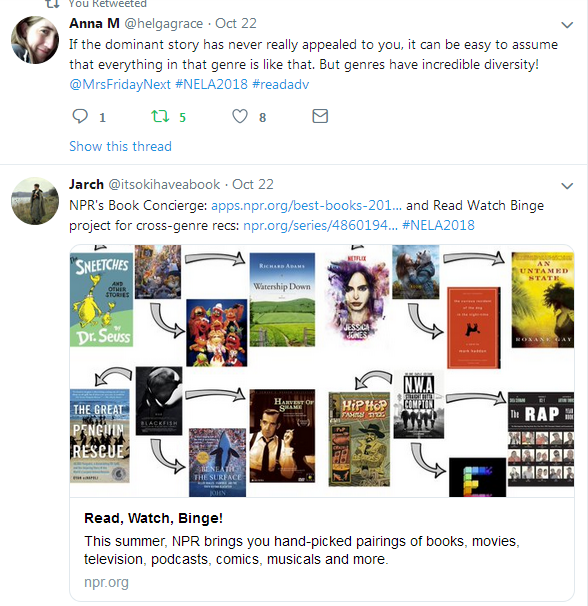
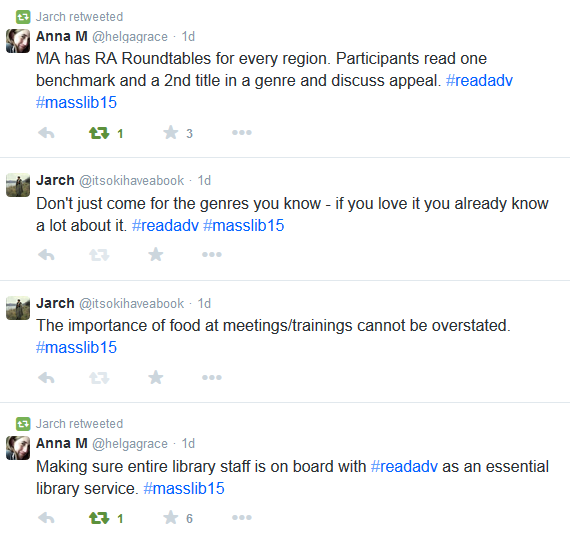
Screenshot of @itsokihaveabook and @helgagrace on Twitter

Monday, 11:30am: Sensory Storytime at the Public Library by Babs Wells, Maria Cotto

Shifting gears from adult readers’ advisory to children’s services, I attended two librarians’ joint presentation about sensory storytimes they offer at their libraries. Sensory storytime is geared for kids on the autism spectrum or with other developmental issues, though neurotypical children are welcome. Wells and Cotto strongly encouraged anyone thinking of offering a sensory storytime to use the book Programming for Children and Teens with Autism Spectrum Disorder by Barbara Klipper, and also pointed to an ALSC blog post that serves as a brief how-to guide. It’s important to be aware of community resources as well, to partner with and to spread the word. (If you’re in Rhode Island, Massachusetts, or nearby, check out The Autism Project.)

Wells and Cotto described their usual sensory storytime, starting with registration: not required, but helpful, especially if it gives the librarian a chance to talk with the parent/caregiver beforehand about any special needs their child might have. They might also want a “social story,” a one-page handout that can help prepare the child for a new environment or event; it can be read like a picture book. Once the storytime has begun, it’s helpful to have visuals for everything, to ease transitions from one activity to another (books, bubbles, songs, activities, etc.). Starting with a hello song is a good idea; the librarian learns everyone’s names (parents too!) and can roll a ball to each kid and have them roll it back. Cotto said she always has a felt board or a puppet, and stools or mats for kids to sit on, and things for them to hold in their hands and fidget with. “These kids need something that will capture their attention, they need something in their hands, they like to participate.” She only reads one book, something like Dog’s Colorful Day by Emma Dodd or The Deep Blue Sea by Audrey Wood. “Go with the flow,” she advised – much like toddler storytime. After the organized part of sensory storytime, it’s playtime: they bring out more activities – popsicle sticks with velcro on the ends so kids can make different shapes, sensory sand, water marbles (but not together!), dried beans with little treasures kids can find and scoop into a cup. This can be a time for parents and caregivers to socialize (they shouldn’t be socializing or on phones during storytime; they should be involved. “I get in everyone’s faces!” Cotto said). Be sure to give plenty of warning when the program is wrapping up: five minutes, three, one, goodbye!

Lastly, remember: “When you meet one child with autism, you meet one child with autism.”

sensorystorytime1sensorystorytime2

Monday, 12:45pm: NERTCL Lunch with author Tracey Baptiste

The New England Roundtable of Teen and Children’s Librarians (NERTCL) had their annual business meeting over lunch and then invited author Tracey Baptiste (The Jumbies, Rise of the Jumbies) to speak. She tried out a new talk on us, “Creativity Under Pressure.” Here are my tweets from the session, which was probably less polished than one she’d given many times, but definitely interesting (and mark your calendars for the third Jumbies book next year!).

Twitter screenshotstracey2

Monday, 2:15pm: Fake News or Real News? Helping Our Patrons Tell Fact from Fake, by Victoria Palmatier and Lisa Lipshires, Springfield City Library

This is a topic I follow closely (See: Fake News a.k.a. Information Disorder reading list | “What is fake news?” informational handout (Creative Commons licensed) | Libraries in a Post-Truth World | Libraries in a Post-Truth World: The Conversation Continues), and the Springfield librarians’ presentation was very good, from their handout (a double-sided folded brochure called “Fake News? Real News? How to Tell Fact From Fake”) to their explanation of how they designed their workshop and what they’d do differently next time. They consulted two librarians and a journalism professor from UMass-Amherst as well as a local journalist, collected lots of resources for checking facts and photos (one I hadn’t heard of before was mediabiasfactcheck.com), suggested browser plug-ins (AdBlockPlus and Privacy Badger), and explained that in addition to checking a source’s bias, it’s necessary to check your own, especially if you’re having a strong emotional reaction to a headline.

Palmatier and Lipshires’ initial workshop was a lecture format followed by discussion, and they said that next time, they would offer a more hands-on approach in their computer lab. Another great idea they had was to have a copy of the day’s local paper for each workshop attendee, and then look at the local news online as well. They said that an in-person workshop makes the library and librarians seem approachable and legitimate, and as resources that can provide human connection in a meaningful way and make the world less confusing. (We all know we’re not going to change anyone’s mind on Facebook…)

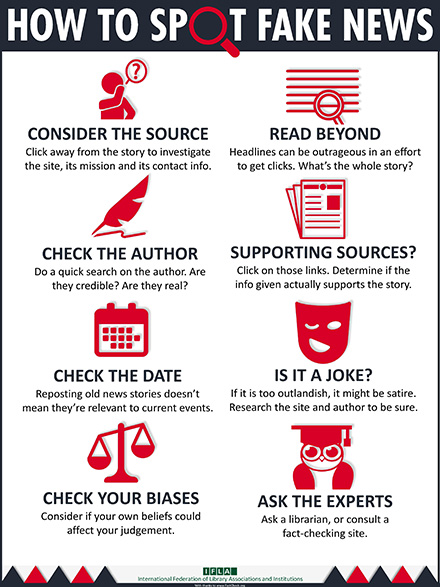
IFLA infographic: How to Spot Fake News

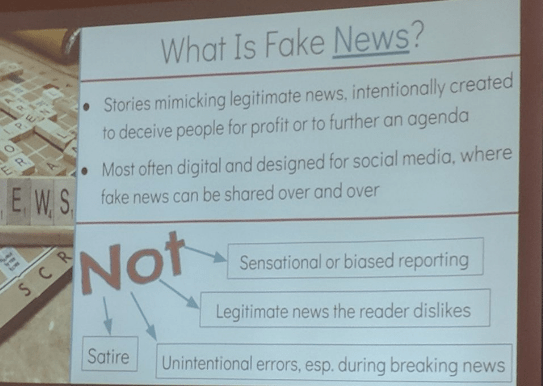
Photo of "What is fake news?" slide
Presenters’ slide: What is Fake News?

Monday, 4:30pm (slightly delayed due to fire alarm): Great Expectations: Leaping from High School to College, by Sarah Hunicke (Portsmouth High School), Mary C. MacDonald (University of Rhode Island), and Marianne Mirando (Westerly High School)

There is a gap between what college and university professors expect in terms of research skills and information literacy and the students’ abilities in these areas. Because this year’s high school senior is next year’s college freshman, these three presenters worked together to examine what high school librarians (and high school teachers) can do to bridge the gap. College faculty expect students to be able to: 1. determine information needed to answer questions, 2. recognize information bias, 2. distinguish scholarly vs. popular, 3. understand the publishing cycle.

“Where do our students struggle?” Practice, Process, Assessment. “Where do our instructors struggle?” Assignment design (format vs content), Process (time commitment), Additional burden (grading). The two high school librarians who were presenting wanted to help teachers integrate information literacy into their students’ assignments without greatly increasing their grading burden. They each brought an example assignment from their schools, and we split into groups to come up with ways to do just that. In one case, it was as simple as adding a section on research quality to the grading rubric, and having the students hand in an annotated bibliography early in the process. Of course, librarians can also model searching library databases and online, showing students how to broaden or narrow searches as needed, and how to use keywords instead of natural language; if students see librarians working through problems (like getting no results, or too many results), they feel more confident to work through the same problems themselves.

Some teachers may not seek librarians’ help or even accept it when it is offered; however, the idea of “coaching” is big in K-12 education right now, so one approach librarians can take is to ask teachers, “If you’re not happy with your students’ sources/bibliographies, what can we do about that?” and work together.

For more on this topic: Project Information Literacy | Stanford study, “Evaluating Information: The Cornerstone of Civic Online Reasoning”

And that was Monday! Stay tuned for Tuesday’s sessions: the ALA President’s “Big Ideas” speech, the First Amendment in libraries, Gregory Maguire, and the Ignite sessions (quick, 5-minute presentations on different topics).

MLA Confronting Inequality conference

The Intellectual Freedom/Social Responsibility committee of the Massachusetts Library Association just put on an excellent one-day conference at the Milton Public Library. Speakers included Dr. Roopika Risam, recipient of the first Civil Liberties Champion award; Virginia Eubanks, professor of political science and author of Automating Inequality; and Chuck Collins of the Institute for Policy Studies and author of Born on Third Base (also, a Hampshire College alum, which I didn’t realize until after the conference).

Welcome slide to Confronting Inequality conference

Roopika Risam, of Salem State, worked with researchers at Columbia University and the University of Houston to produce Torn Apart/Separados, a data visualization project using public data (including a previously FOIAd list of detention centers and children’s shelters in the U.S.) to show the locations of ICE detention centers and their funding.  Risam said that she and other researchers asked themselves, “Can we [librarians, students, faculty] mobilize the skills we have to respond in times of crisis? Who are the people on the ground (lawyers, families), how can we be helpful to them?” The result was “Torn Apart/Separados,” released June 2018. Volume 2 – “to follow the money,” i.e. government contracts – was released later, and Risam showed us the “murderboard,” which shows connections between products, contractors, and subsidiaries.

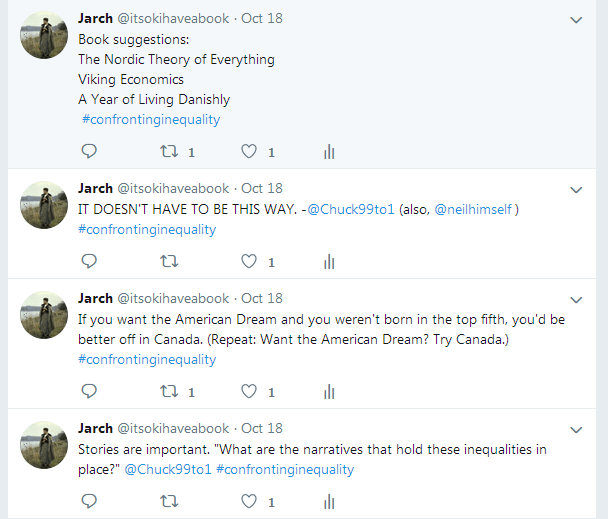
Next, we heard from Chuck Collins, author of Born on Third Base and Is Inequality in America Irreversible? Starting with personal stories, he also gave an overview of how the U.S. was on track to becoming a more equal society after WWII, when progressive taxation was invested in public goods like infrastructure, education, and mortgage loans. The American Dream of social mobility was much more possible then than it is now; now, the American Dream is more achievable in Canada.

Since the 1970s, assets at the top have multiplied with little to no effort, while wages have stagnated. Wealth at the top has now reached “absurdist levels,” with the combined wealth of the 400 richest individuals in the U.S. equaling the combined wealth of the bottom 60% of households in the country; the three richest individuals (Bezos, Buffet, and Gates) have as much as the bottom 50% of households. Almost one in five households have zero or negative net worth; the “precariat” is largest-growing group in this country. If we look at the story through the lens of race, a median white family has 35x wealth of a median Black family and 27x wealth of a median Latinx family.

chuckcollins1

Is this inequality good for anyone? No. (See: Capital in the Twenty-First Century, Thomas Piketty.) How do we make things more equal? There are plenty of answers, but the main one seems to be creating and maintaining a “social floor” or a “decency floor,” through which people cannot fall. Is this a “welfare state”? No, it’s a “pro-work state” that supports its people at a foundational level, adding security to everyone’s lives.

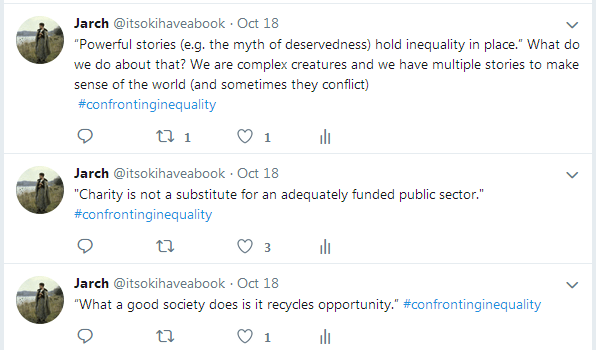
“What a good society does is it recycles opportunity,” says Collins. If you have millions or billions of dollars, you didn’t do it alone. But if you admit that you had help, you’re obligated to ensure a more level playing field for others. If you believe you did it alone (on hard work and merit), then you believe anyone else can do the same. “Powerful stories hold inequality in place,” such as “the myth of deservedness.” For some families – mostly white – public subsidies and assistance programs have led to stability, and wealth that can be passed down, but the recipients of this inheritance don’t always understand its origins. We can begin dismantling the myth of deservedness by identifying instances of advantage of privilege. “Tell true stories of how advantage works. Tell true stories about advantage.”

For more on the topic, check out Inequality.org.

chuckcollins2

Next up, we heard from Virginia Eubanks, author of Automating Inequality. Eubanks talked like most of my favorite teachers and professors: fast, energetic, full of memorable examples and cases, with plenty of evidence (some of it rendered in easily digestible, yet horrifying, cartoon form), wisdom and a sense of humor.

Eubanks described a number of terrible systems, from the Allegheny Family Screening Tool in Pennsylvania to the process for applying for public benefits in Indiana to the systems used in Los Angeles to match unhoused people with affordable housing.

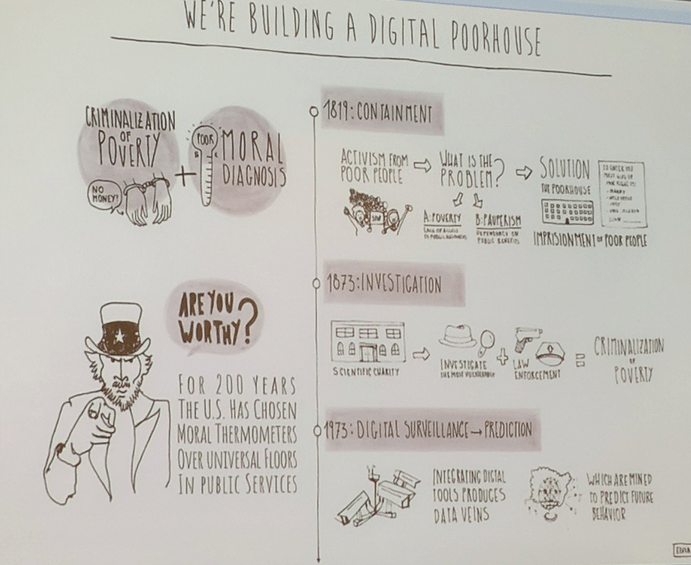
Like Collins, Eubanks brought up the idea of a social floor or a decency floor; she called it the universal floor. One of her slides said, “For 200 years the US has chosen moral thermometers over universal floors in public services.” She said, “Tools have not gotten better or fairer over time, they’ve gotten faster and scaled up. The narrative of austerity says there’s not enough for everyone and we have to make difficult decisions about who deserves basic human rights.” Tech tools promise to address bias, but really they just hide it, often leading to “a feedback loop of injustice.”

"We're building a digital poorhouse" slide

Do people really mean to create these systems? It doesn’t take bad intentions to create bad impacts. Speaking of the 58,000 unhoused people in L.A. and the shortage of affordable housing there (and she went into the history of that a little bit), Eubanks said, “Triage only makes sense if there are more resources coming. If there aren’t more resources coming, it’s not triage, it’s rationing….The fundamental danger of these systems is that they make us think small.”

So, what do we do? (1) Change the story about poverty; (2) Shift from diagnosis to universal floors; (3) Design less harmful technology. Eubanks said, “If you make these systems poorly, they’re only cheap at first. If you do them well, they’re time- and labor-intensive and expensive. It’s very expensive to punish poor people for being poor….I believe it would be much less expensive to create a universal basic floor.”

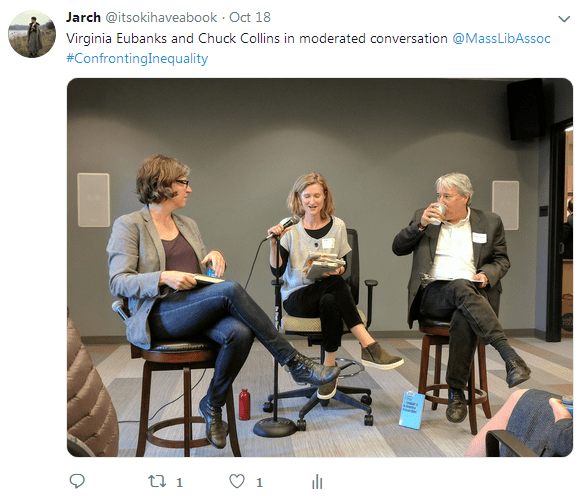
Photo of Eubanks, Fiorillo, Collins in conversation

The conference ended with a moderated discussion and Q&A with Collins and Eubanks. Andrea Fiorillo of the Reading Public Library started off with a question about the importance of storytelling. Eubanks answered, “The key to dismantling the digital poorhouse is changing the way how we think, talk, and feel about poverty.” She added, “We have to understand our own experience differently….It’s a system we’re supposed to use to share national wealth so we’re investing in each other.” Collins, in addition to the “myth of deservedness,” mentioned the “myth of disconnectedness” and the “myth of superiority.” His audience is often wealthy, and he challenges them to demystify their advantage and tell their true story. He said, “Do an inventory – what forms of help did you get? Understand that advantage is multigenerational. We are shaming people who need help and that rebounds on the whole culture.”

One question/comment from the audience raised the issue that the often-praised Nordic countries with strong social floors are more homogenous than the U.S.; is it more challenging to create a social floor in a more diverse country? “Racism has been used to divide people,” Collins said, and Eubanks stated, “We don’t have to be the same to take care of each other.”

They also discussed the ways in which people opt into their communities or opt out of them. For many, there are plenty of everyday choices that add up to supporting and being part of a community, or not: drive or take the bus? Send kids to public school or private? Order from Amazon or go to the local library or bookstore? In many cases, the affluent (not just the superrich) are opting out. “Be accountable to the other people who live in your community.”

Speaking of communities and libraries, “Public libraries and their partners can be places for face-to-face conversations. The more stakeholders the better,” said Collins. And Eubanks noted the ways in which librarians have filled in as de facto caseworkers for social services, as many applications are online and many people still don’t have internet access at home.

Overall, there are reasons to be optimistic; namely, the solutions to many of these problems are clear. The real issue is, is the political will there? And can we act fast enough?


Libraries: Our Common Wealth (MLA 2018)

The Massachusetts Library Association conference was in Framingham this year; I followed along on Twitter (#masslib18) for the first two days, and attended (and presented) on the third and final day.

It seems that the opening keynote by Debby Irving, author of Waking Up White, was extremely well received. For those who missed it, she has a TEDx Talk here.

The first session I attended on Wednesday morning was Co-Creating Library/Social Services Partnerships: A Statewide Collaboration, presented by Michelle Eberle of MLS, Joe Vallely from the MA Department of Mental Health, and Shelley Quezada from MBLC. Michelle showed data that a majority of libraries are interested in partnering with social workers, but only 30% already do, to manage issues like homelessness, mental health, substance abuse, and help for immigrants. Library workers are interested in partnering with social workers – perhaps even students of social work – and in receiving staff training such as mental health first aid. MLS has a LibGuide for “Responding to the Social Services Needs of Our Library Communities.

Next, Joe told the room about the outreach and engagement teams serving over 1600 individuals within Massachusetts. They have had a few trainings at different libraries to introduce themselves (“what we do”) and look for ways to collaborate. “We have a common mission,” which gives us the opportunity to collaborate to assist people in need. “You provide a safe, warm place where many individuals, who are very fragile, go.” Many are clients or potential clients – how can we begin to assist? The organization Eliot was also mentioned, a part of PATH (the federal Project for Assistance in Transition from Homelessness).

Shelley spoke next, telling the audience about available LSTA grants and how MBLC can help with the grant process. Before applying for a grant, she said, there are a number of questions to ask, including: Who are your best community partners? How do you identify them? What is the overarching goal for your library to achieve? What resources do you need (staff, materials, training, equipment, publicity, space, etc.)?

Shelley reeled off a list of additional resources, including: Massachusetts Behavioral Health Partnership, Mass Legal Help, the Opioid Overdose Prevention project of Mass.gov, and Mass 211. Audience participants added Pine Street and Rosie’s Place. Audience members also spoke up to say that “Even with a social worker on staff, there are overwhelming needs”; staff training is still necessary for trauma-informed care, mindfulness, etc., and a series of trainings is better than a one-time session (grant funding can help with this!). One person also spoke about enforcing library policies apologetically, but “It’s okay to have rules. Rules keep people safe.”

The need for social services for a variety of often related issues (mental health, homelessness, substance abuse, domestic violence) is receiving more attention recently due to the movie The Public (trailer), which writer/director/actor Emilio Estevez said was inspired partly by an article by Chip Ward (I’m guessing this one: “How the Public Library Became Heartbreak Hotel,” 2007).

For the next morning session, I chose Charlie Grosholz’s interactive session on “The Role of Fantasy in the Library.” This was a small, hands-on session in which Charlie led participants through three exercises: world building, character creation, and role play. But first, a definition: What is fantasy? It is the “improbable, impossible…held down by rules.” (As any reader of fantasy knows, even magic has rules; otherwise it would be surrealism.) Any of these three exercises would be a great prompt for a creative writing workshop, but they could be used in a variety of other programs too, or to re-envision the library itself. For example…

  • Around Halloween time, a library in a walkable area might host a program starting with a zombie attack scenario: Where in town are the safest places, the most valuable resources?
  • Character creation can be used to develop personas; staff can collaborate to build personas based on library “characters,” an exercise that can build empathy.
  • Role play allows people to build social skills, public speaking skills, empathy, and conflict resolution skills. Charlie ran a successful murder mystery party for teens, complete with costumes, music, artifacts, and Shirley Temples (there was a speakeasy theme).  Role play can also be used for emergency preparedness drills, or even in ELL conversation groups.

If your library has (or is thinking of starting) a Library of Things collection, acquire some board games; you can build programming around each new game as you introduce it, and bring fans of the games together.

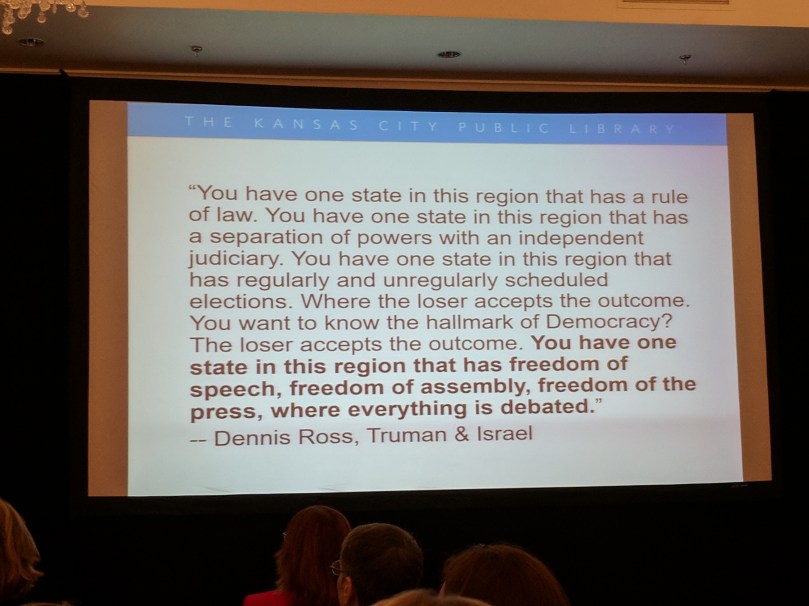
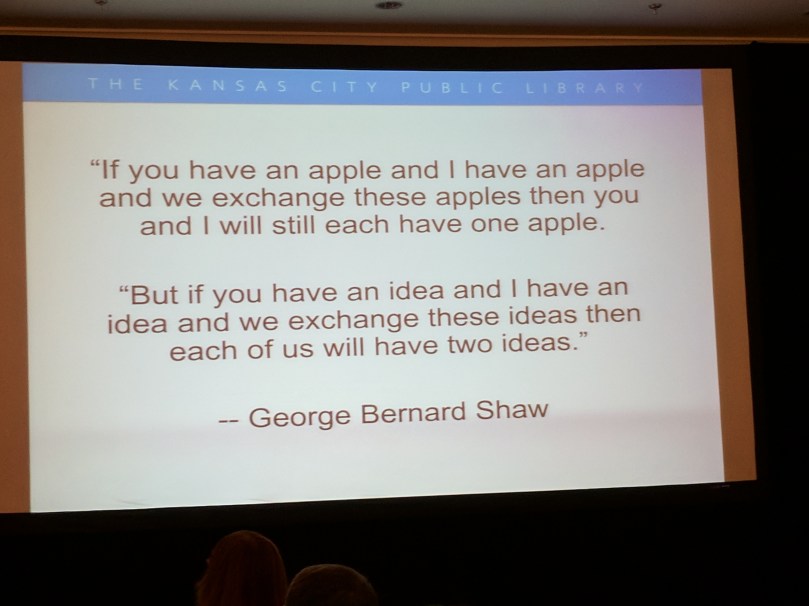
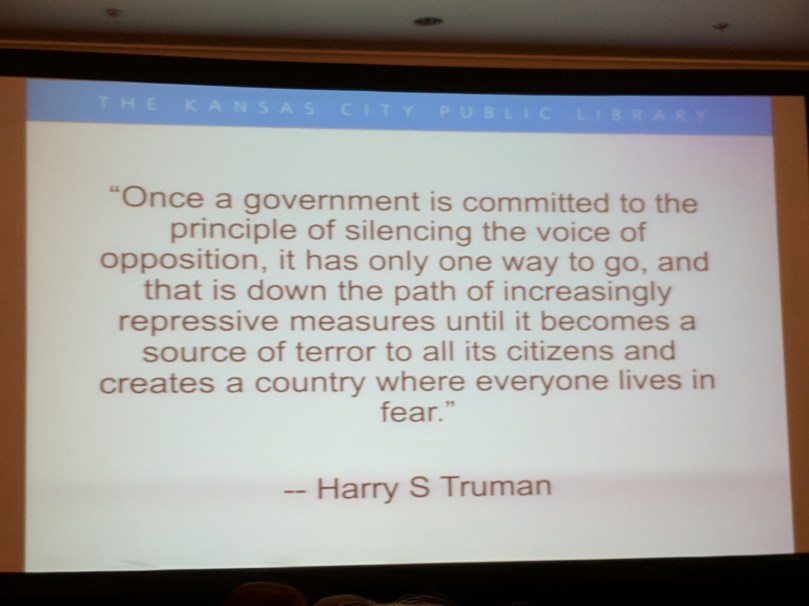
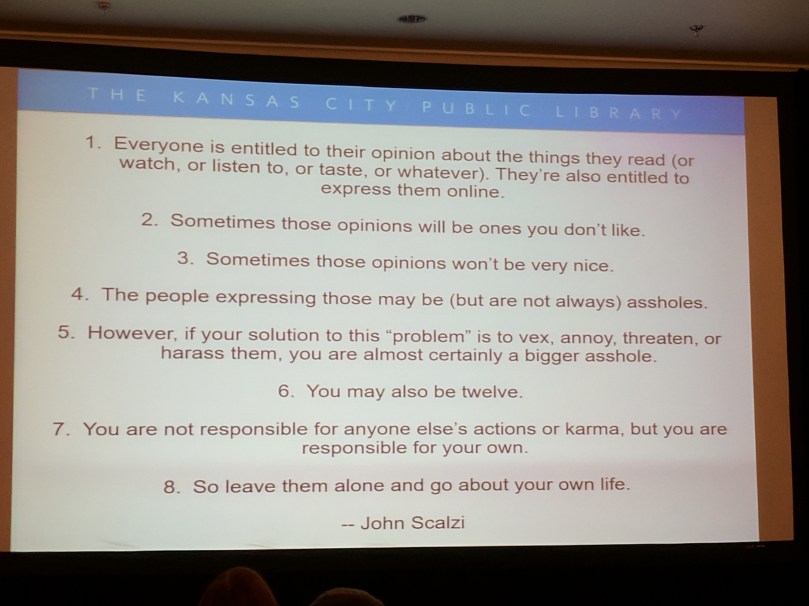
The last program of the morning was a general session, “Librarians on the Front Line: Protecting Free Speech,” presented by Steve Woolfolk of the Kansas City Public Library. Woolfolk’s name may be familiar to those in the library world; he was arrested during a program at his library for defending a patron’s right to speak. Though the case seemed incredibly clear-cut (for an overview, see the American Libraries article from October 2016), it dragged on until he was ultimately cleared. The incident certainly didn’t shake his dedication to free speech and the free exchange of ideas; when an audience member asked if it had had a chilling effect on programming at KCPL, Steve replied, “Nope! If anything, we’re getting more controversial.”

The First Amendment, he said, is about more than just being able to say what you want; “you have a right to express your ideas, and I have the right to be exposed to your ideas.” He pointed out that the government does not lead on issues, the public does – and librarians are already “committed to opening people’s minds.” He asked, why can’t we do with ideas what we do with books? Recommend something outside their comfort zone. “Nobody’s obligated to agree with the ideas they hear…but we have to make an effort to understand why people believe the things that they do.”

Steve’s talk was very well received, and I wasn’t the only one taking photos of his slides to post to Twitter.

Dennis Ross quote
Dennis Ross quote from the Truman & Israel author event
IMG_20180523_112815
George Bernard Shaw quote
IMG_20180523_113523
Harry S. Truman quote
IMG_20180523_114121
John Scalzi quote (from his blog)

After a break for lunch, it was time for “Readers’ Advisory in the Age of Uncertainty,” which I presented along with Kevin O’Kelly from Somerville Public Library and Louise Goldstein from Waltham Public Library. We each took a different angle on the topic: Louise talked about the “Initiating Inspiration” book group at the Waltham library, in partnership with the Agape Spiritual Community. The group met five times in its first year, discussing five different titles. Kevin talked about bibliotherapy, from the little-known Sadie Petersen Delaney (“Our Lady of Bibliotherapy”) to author Alain de Boton’s “School of Life” to the Changing Lives Through Literature program. And I talked about readers’ advisory at the reference desk, whether people are looking for escapism or a deeper understanding of current topics (or – through speculative literature – both!). My handout with book lists is here.

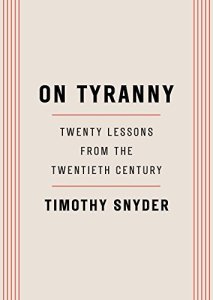
Cover image of On TyrannyThe closing keynote session featured Timothy Snyder, professor of history at Yale and author of (most recently) On Tyranny: Twenty Lessons from the Twentieth Century (2017) and The Road to Unfreedom: Russia, Europe, America (2018). The talk was entitled “The New Authoritarianism: Where It Comes From and What Readers and Citizens Can Do About It,” and was essentially a summary of On Tyranny. If you missed the talk, read the book – it’s only 126 pages.
All in all, it was a worthwhile conference day! And let’s not forget Book Cart Drill Team


On Display: Highlighting what the library has to offer

Arts and crafts didn’t end after elementary school like I expected they might. I put some basic arts and crafts (and graphic design) skills to work almost every month at the library (File under: “things they didn’t teach you in library school”). We have three main display tables, plus a set of shelves used seasonally (teen summer reading prizes in the summer, holiday CDs in November and December), and we change the displays every month. Rob’s awesome displays challenge the rest of us to up our game!

What’s the purpose of library displays? They convey information; they offer entertainment or humor; they ask passers-by to stop and engage (many of our displays have interactive elements); they highlight parts of the library collection; and they give people something to look at while they wait in line.

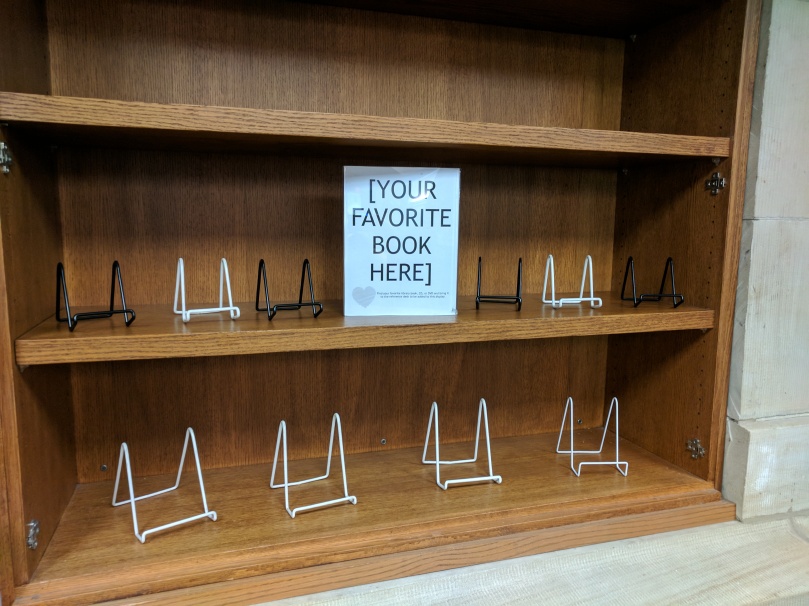
Your faveorite book here

This is the simplest possible display: empty book stands with a sign that reads “[YOUR FAVORITE BOOK HERE]” and directions for how to add a book to the display. This display encourages engagement and participation by asking library users to recommend books (or movies or music) to each other.

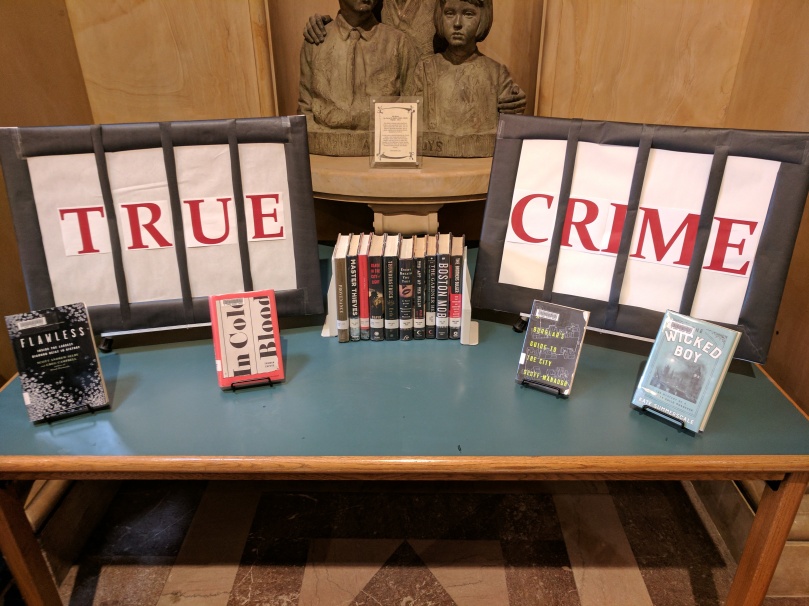
True Crime

Sometimes displays feature a specific area of the collection; in this case, I highlighted our true crime books. It was very easy to pull books for this display, as they’re helpfully grouped in 364 (for Dewey nerds). I was pleased that I was able to pull off my vision of getting the words “TRUE CRIME” to look as though they were behind bars while still being legible. (The stone statue behind the table is not part of the display.)

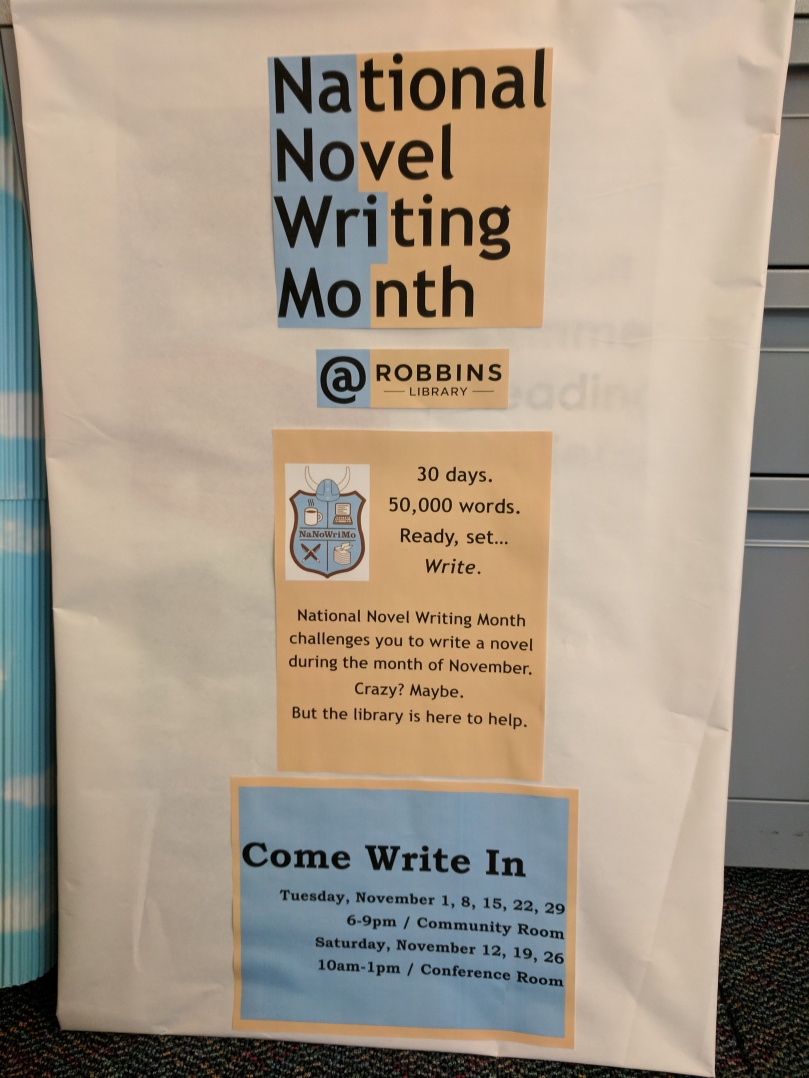
NaNoWriMo

Some displays are annual; this one is part of last year’s National Novel Writing Month display. We hosted “Write-Ins” throughout the month. The display table included the schedule of write-ins and a word count calendar, along with some library books about writing, and the official NaNoWriMo poster for that year.

Not everyone knows what NaNoWriMo is, so I wanted to find a way to include both the whole name and the nickname; I achieved the effect by changing the background color behind the text. (I made this in Publisher, which gives the user more control and precision than Canva, plus it has the eyedropper tool that allows you to pick colors from a graphic or image and use that exact color for text or background; I used colors from the one of the NaNoWriMo graphics. Canva has other strengths, though!)

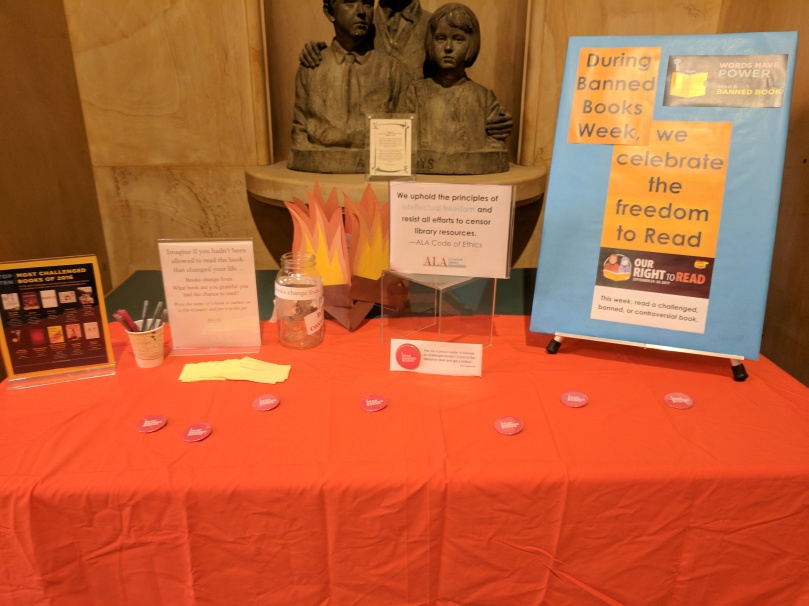
Banned Books Week

I always put up a display for Banned Books Week at the end of September; this one features a poster, a quote from the ALA Code of Ethics, an infographic from the ALA Office of Intellectual Freedom, some “I read banned books” buttons that I made, a small fake bonfire, and – my favorite interactive element – the “books change lives” jar, with comment cards and a cup of pens. The week after Banned Books Week, I pull the responses from the jar and write a blog post for the library.

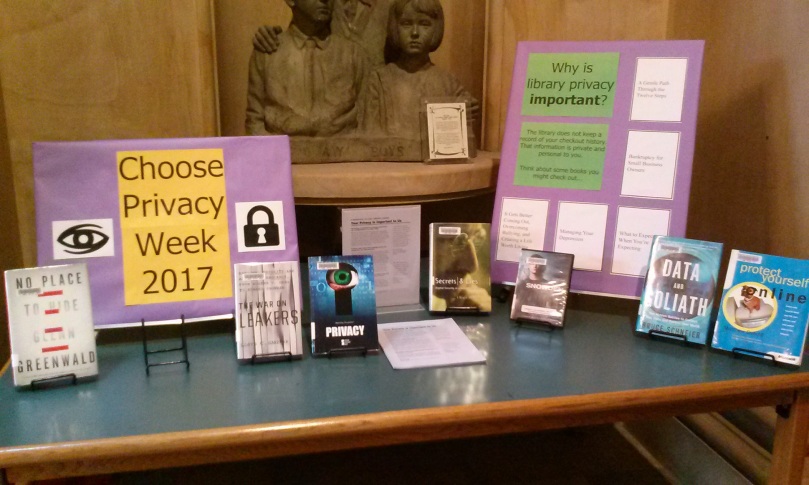
Choose Privacy Week 2017

Choose Privacy Week is another annual display, in the first week of May. For this display, I designed two poster boards using simple, bold graphics and bright colors. The poster on the right in the photo that asks “Why is privacy important?” answers its own question in part by including the titles of library books that people might not want others to know they had checked out, from Managing Your Depression to What to Expect When You’re Expecting to It Gets Better.

I also included a fact sheet from ALA and books and DVDs about privacy from the library collection. People are always welcome to take library materials from the display to check out.

For Choose Privacy Week in 2015, I used a series of “True or False?” questions about privacy with answers under a flap of paper, so patrons were encouraged to interact with the display to get the answers.

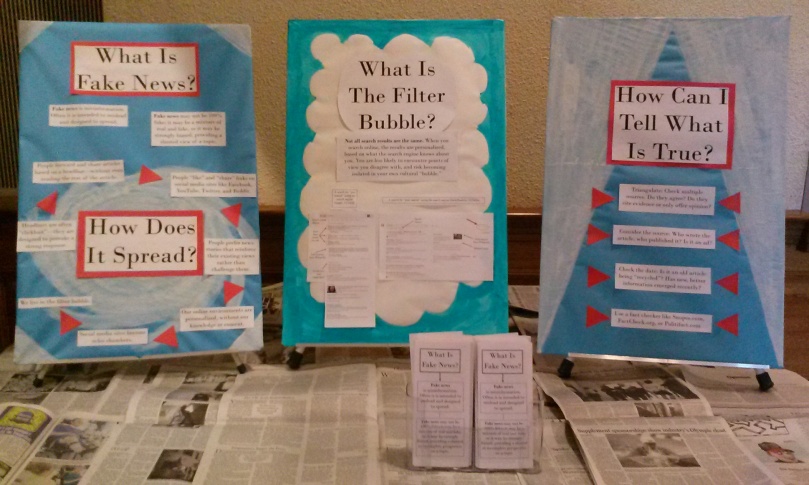
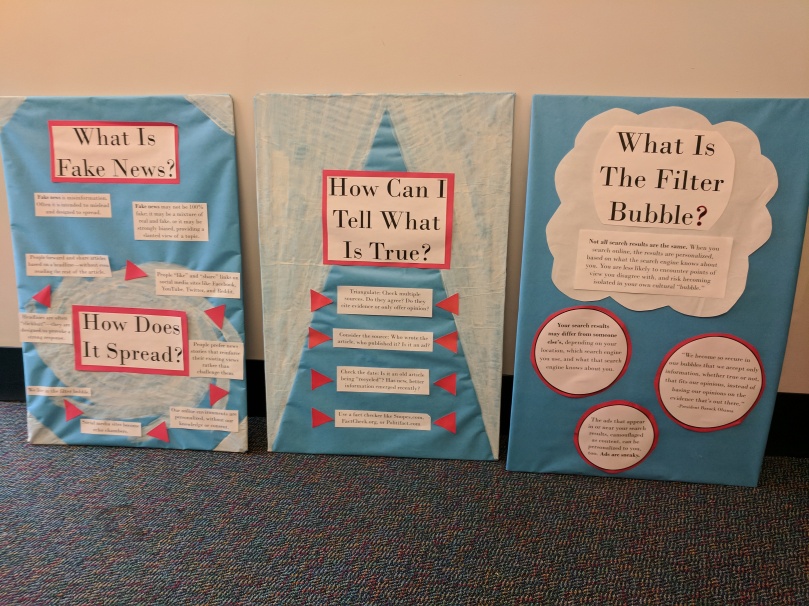
What Is Fake News

I started off the year with a “What is fake news?” display. Instead of using a tablecloth or butcher paper to cover the table, I used old newspaper. I put together three informational poster boards (a bit more text-heavy than usual), and included copies of a pamphlet with information about “fake news”: what is it, how it spreads, how to avoid spreading it yourself. (Basically, how to be a responsible information consumer. A PDF of the pamphlet is available here.)

I updated one of the boards (“What is the filter bubble?”), as I will be bringing them to a conference and a class later this month.

Fake News updated boards

None of these are particularly flashy – Rob might say I don’t use enough glitter, for one thing, and I could use more 3D objects and props – but I hope they get the point across. Do you make displays for your library? What are some of the ones you’re proud of? What materials and techniques do you like to use?


Libraries in a Post-Truth World, Part II: Morning Panel

See the first Libraries in a Post-Truth World conference post here.

The panelists:

John Palfrey, Head of School, Phillips Academy, and author
Mary Robb, Teacher, Media Literacy and Democracy, Andover High School
Adam Schrader, Former Facebook editor and news fact checker
Damaso Reyes, Program Coordinator, The News Literacy Project
Melissa Zimdars, PhD, Assistant Professor of Communication at Merrimack College
Catherine Tousignant, English Instructor, Phillips Academy
Alison Head, PhD, Project Information Literacy
John Wihbey, Assistant Professor of Journalism and New Media at Northeastern University
Claire Wardle, First Draft News
Ben Sobel, Fellow, Berkman Klein Center for Internet and Society, Harvard University

Right away, many of the panelists took issue with the term “post-truth”:

  • Not post-truth but post-accountability; the responsibility is on all of us to call out inaccuracies. It is important to teach students the skills to tell fact from fiction. (Mary Robb)
  • “Post-truth” is a useful way to think about how information and politics are converging. Immediacy sacrifices deep digging. When people only read headlines, what kind of information are they taking from that and what does that mean? Variety of the internet includes misinformation and disinformation (and “bullshit”). (Melissa Zimdars)
  • “There is a world of truth and a world of facts and it doesn’t go away. But there’s also a world of words that occupies its own space…the words have their own power.” Who has authority? Whose authorship is valuable and meaningful? Perspective does matter. Words have power even if they’re untrue. (Catherine Tousignant)
  • Students look for consensus, not answers/truth….Untruth works well when it confirms how you feel. (Alison Head)

They also discussed “fake news” and its synonyms:

  • There is a difference between untruth and bias. (Adam Schrader)
  • “Fake news” is a new term for an old thing – PROPAGANDA. It is important to call these things by their actual names. (Damaso Reyes)
  • A lot of the fake news propagated during the election were fueled by economic motives, not political ones (clicks = money). Antidotes/possible correctives are complicated. (John Wihbey)
  • “I don’t want to take us down the rabbit hole of darkness, but…we have to think about this” ability to create and disseminate. Trust shifts. Trust bubbles/filter bubbles increase peer-to-peer influence in the absence of gatekeepers. (Claire Wardle)
  • The best way to combat fake news is to understand how it is created and disseminated. (Adam Schrader)

Information literacy, media literacy, news literacy:

  • “Information is coming towards [students], they don’t have to seek it out….Reach has become a proxy for authority. There are more sources of information” being seen as valid. (Damaso Reyes)
  • There has been a slippage in authority – we’ve moved from scarcity to abundance [of information], moving target. (Alison Head)
  • Confirmation bias is a bipartisan challenge (Damaso Reyes)
  • “We’re surrounded by editorial speech” (e.g. Google search autocomplete). “[People think] the way we obtain our news…are neutral conduits for information, when in fact they are not.” What does it mean to hold Google and Facebook accountable? (Ben Sobel)

What can librarians do?

  • Librarians are the “intellectual beating heart of our institutions.” (John Palfrey)
  • Different types of libraries can take different actions. Read Pew reports, PIL reports, etc. Libraries are a trusted institution. (Whereas newspapers are less so now.) Librarians are good at ferreting out what exists and good at making partnerships. Librarians are in the right position to make an impact. (Alison Head)
  • Academic libraries trying to prepare students to be successful may be using the ACRL Framework for Information Literacy for Higher Education, though this framework mentions quality but not truth. Evaluation is the one skill students tend to take and build on. What kind of tools [for evaluation of information] already exist? What partnerships are formed around those tools?  Twitter Trails is one example of a tool to determine where information came from and how it spread.  (Alison Head)
  • Public libraries are going through a shift not unlike the shift newspapers and media have gone through….It’s not about directing a student to a book…it’s about teaching them how to find information. The best thing librarians can do is give students/patrons the tools to find, sort, prioritize information. “It’s about having the tools to interrogate the information that you find.” (Damaso Reyes)
  • Teach students to look for WAIL in news stories: Word choice, Adjectives/adverbs, facts Included, Left out. Sometimes you don’t know what’s left out until you consult another source. Students used to come to school for information, now they have information but don’t know its quality. Teach critical analysis. (Mary Robb)
  • Have programs with journalists. What libraries could do is bring in different journalists who covered the same event and have them “unpack” how they covered that story: what goes into news creation, how stories can be reported in two different ways. (Damaso Reyes)
  • Students love to talk to journalists. It’s a great way to get students to understand how news is created. (Melissa Zimdars)
  • Improve (or help explain) the presentation of information, e.g. from government websites. Improve library websites – they could be much more user-friendly. (John Wihbey)

Q&A

Question for the journalists on the panel: What process do you use for fact-checking?

Panel response: It depends on the type of fact. For a quote, try to find video or audio recording of the person saying it (video is better, so you can carefully examine whether the sound and the lips moving sync up – both audio and video can be faked). For a statistic, go to the organization that issued it. Obtain multiple, credible sources. Cross-verify independently. Use government sources (but be skeptical about these too). Sometimes it’s better to “wait for the debris to clear,” then accurately report the truth. For verification of unofficial sources (e.g. social media content), try to determine the providence, source, state, location.

Question/comment: How to evaluate validity and quality is a complicated problem. Librarians are best-trained to deal with this problem, even better than journalists (who are often trying to be first to break the news). Provide evidence of incorrect information/lies. As humans we just cannot process all of this information. Tech people can create plug-ins to create alerts for lies, satire. Companies must cut off advertising to fake news purveyors. Schools need to teach media literacy and critical thinking. People should understand the scientific method and apply it to your everyday thinking and decisions. Understand the difference between fact and opinion. Understand who you are – know your biases.

Panel response: Silicon Valley needs to hire a nation of librarians! There are some programs and browser plugins that can help (e.g. Hoaxy). Re: Citizen journalism and breaking news: encourage students to keep off of social media (either viewing or sharing) during breaking news situations.

Question: Those of us who teach information literacy classes traditionally direct our students to government websites….

Panel response: During the government shutdown, many pages were inaccessible. Approach with skepticism. Each president has a different agenda; what have they said on a topic? Look elsewhere for information. Figure out which information source is most appropriate for each task. There are more ways to get information, there are ways to evaluate it. Someone introduced an idea about different versions (algorithms) of Facebook, as alternate versions of their usual (secret) algorithm; users could choose the MIT version, LOC version, etc.

All that discussion and Q&A filled an hour and a half and gave participants plenty to think about. In my next post, I’ll write about the afternoon discussion session on “fact, truth, and trust,” where we came up with ideas to use in academic and public libraries.

Libraries in a Post-Truth World

On Thursday, January 26, I attended a one-day conference hosted by Phillips Academy in Andover called “Libraries in a Post-Truth World.” There was some helpful pre-conference reading about fake news and hoaxes, information overload, and media literacy:

Why America is Self-Segregating” and “Did Media Literacy Backfire?” by danah boyd, January 9 & 10, 2017

Many Americans Believe Fake News Is Sowing Confusion,” Pew Research Center, December 15, 2016

The Real History of Fake News,” Columbia Journalism Review, December 15, 2016

At Sea in a Deluge of Data,” Alison J. Head and John Wihbey, The Chronicle of Higher Education, July 7, 2014

Mike Barker, Director of Academy Research and Library Services at Phillips Academy, introduced the morning’s panelists:

John Palfrey, Head of School, Phillips Academy, and author
Mary Robb, Teacher, Media Literacy and Democracy, Andover High School
Adam Schrader, Former Facebook editor and news fact checker
Damaso Reyes, Program Coordinator, The News Literacy Project
Melissa Zimdars, PhD, Assistant Professor of Communication at Merrimack College
Catherine Tousignant, English Instructor, Phillips Academy
Alison Head, PhD, Project Information Literacy
John Wihbey, Assistant Professor of Journalism and New Media at Northeastern University
Claire Wardle, First Draft News
Ben Sobel, Fellow, Berkman Klein Center for Internet and Society, Harvard University

The panelists were all informed and articulate, experts in their fields; they could have spoken for much longer, but we used the rest of the day for two presentation sessions (Damaso Reyes on The News Literacy Project and Checkology, Alison J. Head on Project Information Literacy), identifying areas of focus for the afternoon discussion, reforming into discussion topic groups, and reporting our results to the other participants.

“Librarians are good at ferreting out what exists and good at making partnerships. Librarians are in the right position to make an impact.” -Alison Head

I attended Damaso Reyes’ presentation on Checkology (“how to know what to believe”), a news literacy program designed for 6th-12th grade students. Reyes showed us videos created for the program (Peter Sagal was in one!) and guided us briefly through the four modules: (1) Filtering news and information; (2) exercising civic freedoms; (3) navigating today’s information landscape; and (4) how to know what to believe. Some key takeaways:

  • “Information literacy is not what it should be in our society, and that’s a threat to our democracy.”
  • When reading/listening to/watching news, ask: What is the primary purpose of this information? (To inform, to entertain, to convince, to provoke, etc.)
  • Consider the role of algorithms and personalization. The information you’re getting is filtered – think about how and why.
  • Trying to teach students to be skeptical, not cynical.
  • Critical thinking & skepticism is an important skill, and should not be outsourced to technology even if it could be (e.g. plugins). “We shouldn’t depend too much on technology to save us.”
  • What you share online has your credibility attached to it.
  • We are all susceptible to confirmation bias.
  • Society stops functioning if we can’t agree on some things (i.e. facts). A fact is something we can all agree on but it is also something we can independently verify.

After the presentation, we talked in small groups to come up with discussion topics for the afternoon. Two of the Phillips Academy librarians sorted our ideas into loose categories:

Partnerships & Collaboration with Faculty
Partnerships & Collaboration with Community
Professional Development
Fact, Truth, & Trust (I was in this group)
Access to Information
Lesson Plans
Teaching Approach
“Other”

I will be writing another blog post (or two) soon about the morning panel and the afternoon discussion. In the meantime, I’d like to share a handout I made for my library to accompany our display on media literacy. Here is the PDF of the tri-fold pamphlet: updated 2/16/17, 3/1/2017 – I have made a new version without the Robbins Library logo, with a Creative Commons license. Please feel free to use and share: 2017-01-fakenewsbrochure-update-2017-03

Data collection on banned and challenged books

You know when you are talking with someone and suddenly you wonder, “Wait, how did we get on this subject?” I like to be able to trace back to the original subject, as a kind of memory exercise. When the “conversation” isn’t with a person but is just you clicking from link to link on the Internet, the trail is a little easier to follow, thanks to tabs and the browser’s back button. Here was my path this morning:

All of the above links are worth reading, so I’ll only offer a very brief summary, and a few thoughts. The author of the 538 article, David Goldenberg, expressed frustration that (a) the ALA Office of Intellectual Freedom (OIF) would not hand over the raw data they collect on book challenges, and that (b) the quality of the data presented on the ALA’s site was not particularly granular or detailed and may not be statistically valid. For instance, a “challenge” might be a request to move a book from the children’s collection to the teen or adult collection, or it may be a demand that all copies of a book be removed from an entire library system. There’s a big difference between those two challenges.

In his reply to the 538 piece, Andy Woodworth delves into some of the issues behind challenge reporting and data collection. He writes that students in library school don’t learn they have an obligation to report challenges, that there may be external pressures not to report challenges, and that librarians simply may not know to report challenges. If they do report a challenge, though, there are more problems with the ALA-OIF itself: the amount of information required in the online challenge form is minimal, and the OIF does not have the budget or staff to chase down details or outcomes from the challenges that are reported. (The challenge form is also available as a PDF that can be printed, filled out, and faxed to the OIF. It’s certainly possible to find an e-mail address for someone at the OIF, but shouldn’t this be included as an option on the form?)

While I was in library school, I learned about the ALA’s Sample Request for Reconsideration of Library Resources, a form that can be adapted by any library and kept on hand in case of challenges. At both of the public libraries where I’ve worked, we have had this form ready to hand (though in my experience, challenges are exceedingly rare, at least at the adult reference desk; this is borne out by the ALA data – and many media reports – that show more challenges happen in school libraries than in public ones).

Should someone come to the reference desk with a challenge, I would be prepared with the reconsideration form. But what the form lacks, I noticed after reading Andy’s piece, is anything about reporting the challenge to the OIF. (On Twitter, Andy said he wrote it into the reconsideration policy at his library that “we reserve discretion to report challenges to the OIF.”) I don’t think it would hurt for library patrons to be aware of that, and it would remind library staff to take the extra step to report challenges when they do occur.

The granularity of the reporting, as Andy, David, and Jessamyn all pointed out, still leaves something to be desired. Every September, I put together a Banned Books Week display in the library and write about banned/challenged books and the freedom to read on the library blog. Every year, I’m frustrated by the ALA website, which, despite a redesign within the past five years, does not adhere to many of the web conventions and usability guidelines outlined in Useful, Usable, Desirable by Aaron Schmidt and Amanda Etches (about which more soon). The information architecture is convoluted and fragmented – there’s information on the ALA main site and a separate Banned Books Week website – the presentation isn’t as clear and attractive as it could be, and despite the existence of both sites, neither usually has the quality of data I want to present to our library patrons.

Both of these problems – the information itself and the organization of information – are especially vexing because information and organization is what we do. Furthermore, intellectual freedom is a core value of the library profession; Article II of the ALA Code of Ethics is “We uphold the principles of intellectual freedom and resist all efforts to censor library resources.” We need to do better, and it shouldn’t be that hard. We need to:

  • Raise awareness among library staff that reporting challenges is important and that there are ways to do it confidentially.
  • Collect more detailed data when possible and present it in as granular a fashion as possible, noting if necessary that not all reported challenges include the same level of detail.

It’s not rocket science. What are we waiting for?

MLA 2015: Through the Library Lens, Part II

Here we go, Day Two of MLA! Read about Monday sessions here.

Flexibility in Library Design, or Agile Libraries that Evolve with You, presented by Lauren Stara and Rosemary Waltos of the MBLC and Sal Genovese of the Walpole Public Library (Tuesday, May 5, 8:30am)

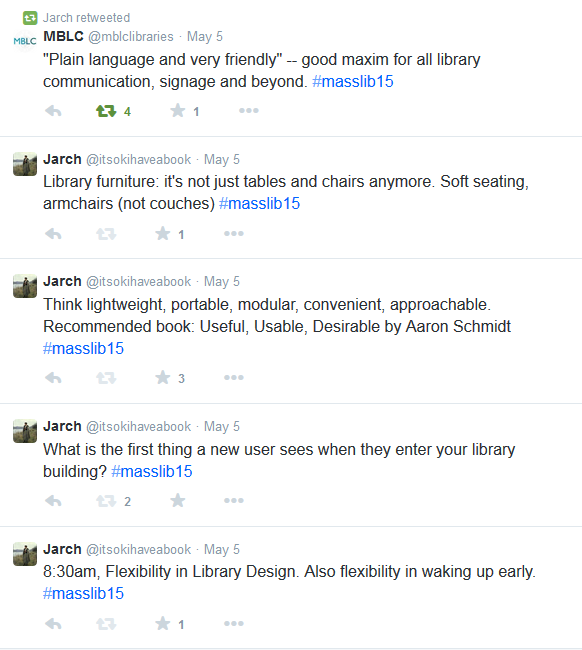
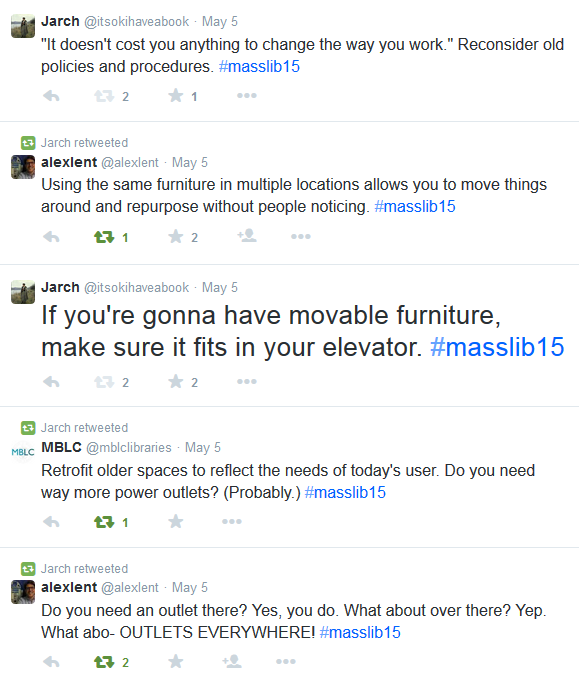
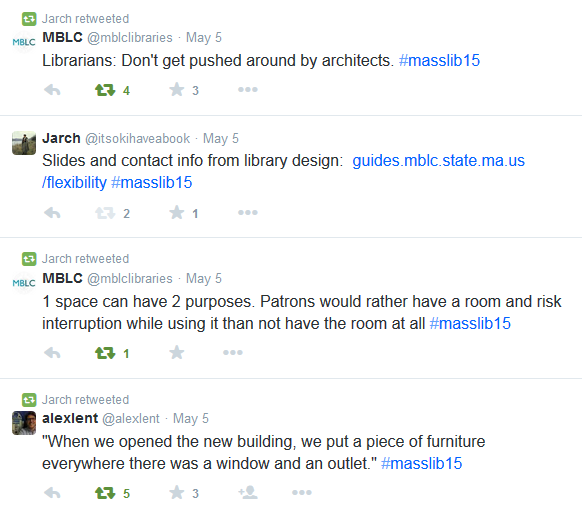
Three cheers for Lauren Stara, who posted her presentation slides online in advance of this session. Check out her slides for lots of great visuals of “lightweight, portable, modular, convenient, approachable” furniture, from service desks to comfy chairs; she included examples from many libraries in the U.S. and Canada. (The presenters’ contact info and a link to several useful Pinterest boards are available through that link as well.) There were tons of tweets during this session (see below), and between those and the slides, I don’t have much to add except that I’m in favor of flexible, adaptable design in libraries and I want to use at least 75% of these ideas right away. Also, I’ve added Aaron Schmidt’s Useful, Useable, Desirable to my ever-growing to-read list.

Screenshot of tweets including What is the first thing a new user sees when they enter your library building?Screenshot of tweets including If you're gonna have movable furniture, make sure it fits in your elevator.Screenshot of tweets, including "When we opened the new building, we put a piece of furniture everywhere there was a window and an outlet."

An Introduction to Fighting Surveillance and Promoting Privacy in Libraries, presented by Alison Macrina of the Library Freedom Project and Kade Crockford of the ACLU (Tuesday, May 5, 9:50am)

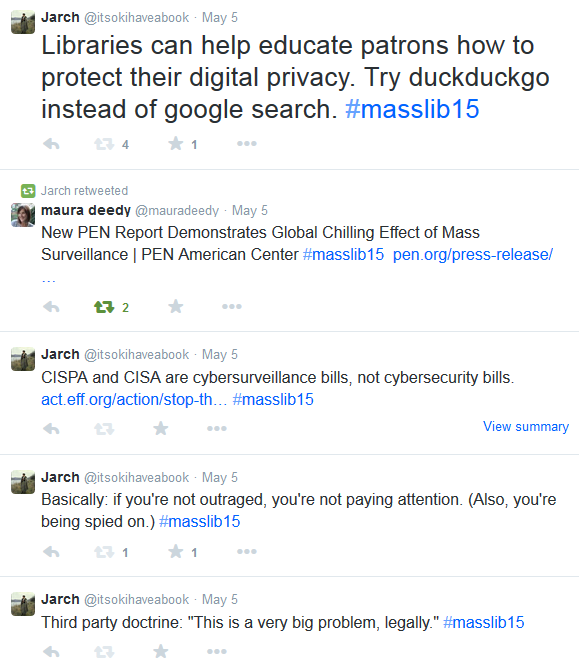
I’ve heard Kade and Alison before, but even though most of their presentation was familiar, it’s worth hearing and sharing again – plus I picked up a couple of new tips, as usual. Alison introduced a whole series of online privacy tools, which are also collected on the Library Freedom Project’s resources page.

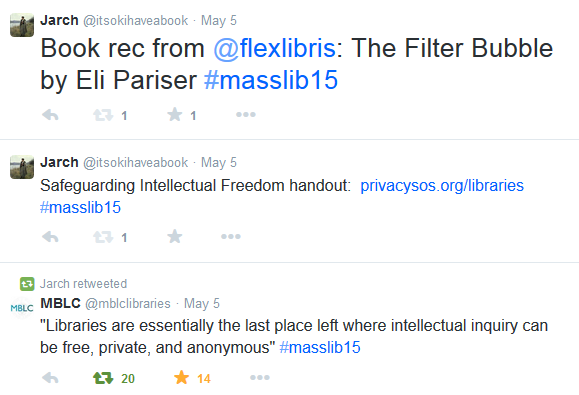
Libraries can introduce patrons to some of these tools by installing them on public computers, and posting signs to explain the changes and raise awareness about protecting online privacy. The TOR browser is one option (“it’s not just for criminals anymore!”), and the Firefox browser with the DuckDuckGo search engine and HTTPS Everywhere and Privacy Badger plugins is another great choice. (I’m planning to switch from the Ghostery plugin to Privacy Badger, after learning that Ghostery sells information to advertisers – though this is something you can control in your settings if you do have it installed.) Good privacy options (secure texting and phone calls) for mobile phones  can be downloaded from Open Whisper Systems.

Screenshot of tweets, including Libraries can help educate patrons how to protect their digital privacy. Try duckduckgo instead of google search.

Screenshot of tweets, including Book rec from @flexlibris: The Filter Bubble by Eli Pariser #masslib15

Advocacy and Your Library, with panelists Edward M. Augustus, Jr., City Manager of Worcester; Representative Kate Hogan, 3rd Middlesex, Chair, Public Library Caucus; John Arnold, Town Moderator, Westborough. Moderators: Susan McAlister, Dinah O’Brien, and Beverly Shank, MLA Legislative Committee Co-Chairs  (Tuesday, May 5, 11:15am)

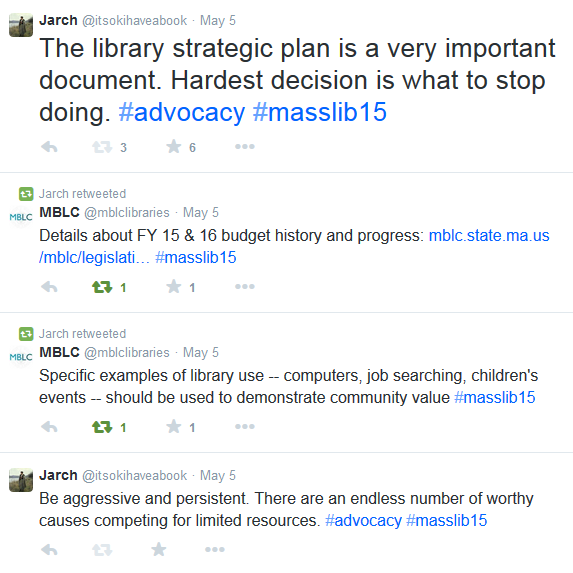
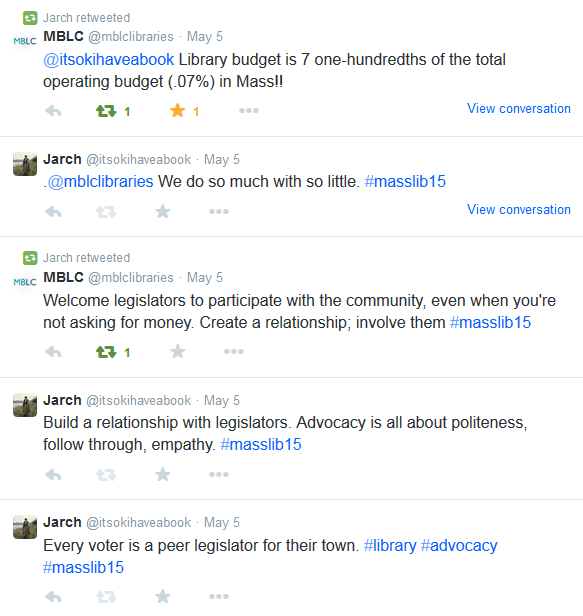
The takeaway point from this session: the importance of building a relationship with local legislators so that your only contact with them isn’t when you’re asking for money. (At the same time, “You are never going to get what you want if you don’t ask for it.”) It’s important for library staff to be involved, and also to encourage library trustees and patrons to advocate for the library; often, a patron’s voice is more persuasive to a legislator than a librarian’s. When librarians do speak on behalf of the library, the focus ought to be “We’re not here to preserve my job, we’re trying to make the community a better place.”

Demonstrating real outcomes for real people, through qualitative (anecdotes, stories) and quantitative (numbers and statistics) evidence, is most effective. Collaborating and building coalitions with other community groups is also helpful; there are many groups and limited resources. That said, libraries do a lot with a little – specifically, with 0.07% of the Massachusetts state budget.

Screenshot of tweets, including Be aggressive and persistent. There are an endless number of worthy causes competing for limited resources. #advocacyScreenshot of tweets, including Library budget is 7 one-hundredths of the total operating budget (.07%) in Mass!!

A Whale of a Good Time: Summer Library Programming for All Ages, presented by Jennifer Harris and Margaret McGrath of the Plymouth Public Library (Tuesday, May 5, 2:30pm)

Attendees had two choices during this session: get inspired, or take your ball and glove and go home, because this was a hell of a summer reading program/community read (“One Book, One Community”). First of all, they got people to read Moby-Dick, which is impressive on its own. Second, they did a massive PR push, with mailings to 25,000 households and visits to all the elementary schools, raising awareness for all ages; high school art students were recruited to help with PR design. Third, they used every last drop of a $3,000 programming budget, spreading programs for all ages throughout the summer. Programs included three book discussions (it’s 600+ pages, folks), concerts on the lawn in front of the library, knot-tying lessons, a mini-readathon, a craft program series for teens, a hard tack tasting (verdict: not tasty), a movie screening, a Melville impersonator, a field trip to the New Bedford Whaling Museum, and visits from two separate inflatable whales.

Key to the success of the Plymouth Public Library program was staff buy-in and great brainstorming sessions, as well as a healthy budget, good planning, and great PR (in addition to the mailings, they were active on Facebook, Twitter, Flickr, and Pinterest, and events appeared in the Boston Globe and on local TV as well).

Our library does a Community Read (Arlington Reads Together) in the spring, separate from our summer reading programs for children, teens, and adults. I’m curious how many other libraries combine their Community Read with summer reading.

Screenshot of tweet: PR: The message has to go out so that we can bring the people in. #summerreading #masslib15Screenshot of tweet: "If someone doesn't call you back, and you call a few days later and they still don't call you back, move on!" #lifeadvice #masslib15Screenshot of tweets: A Melville impersonator for Moby Dick summer reading program. I'm thinking of the Ben Franklin episode of The Office. #masslib15

RA Toolbox: Staying Alive – Readers’ Advisory Continuing Education, presented by Laurie Cavanaugh of the Holmes Public Library, Nanci Milone Hill of the Parker Memorial Library, Molly Moss, of the Forbes Library, and Leane M. Ellis of the Lucius Beebe Memorial Library (Tuesday, May 5, 4:15pm)

Each panelist in this session had been the recipient of a LSTA grant for readers’ advisory, administered through the MBLC, so each panelist talked about how they’d implemented the grant, as well as how they’d come to be interested (and expert) in readers’ advisory. Molly had a background in science and academic libraries; readers’ advisory was the most intimidating part of working at a public library reference desk for her. She tackled the task and became involved in the Adult Reading Round Table (ARRT) of Illinois. There is now a Readers’ Advisory Round Table (RART) for every region of Massachusetts (Northeast, West, Metrowest, Southeast), and each one has a blog.

Grant money can be put toward speaker fees, conference fees, materials (books), shelf talker materials (those plastic things that clip on to shelves), staff time, and mileage. Nanci invited Duncan Smith from NoveList to speak to her staff, as well as the Sisters in Crime; Molly invited Barry Trott of the Williamsburg (VA) Regional Library. The WRL was the first library to put a “reader profile form” online; many libraries, including the Forbes in Northampton and the Robbins in Arlington, have adapted the form (with permission) to use on their own websites. Librarians at the Forbes have also done blitz-style RA, asking patrons to post to the library’s Facebook wall with a book they liked, and recommending another book based on that one.

All the panelists talked about genre studies. A typical model includes monthly or bi-monthly meetings where participants read one “benchmark” book in a genre or subgenre, and one secondary selection. This allows for common ground (the book everyone read) and new recommendations. Genre studies can be done within a library, in partnership between two libraries, and through the round table groups across the state. Virtual participants are welcome in the Massachusetts Readers’ Advisory Goodreads group.

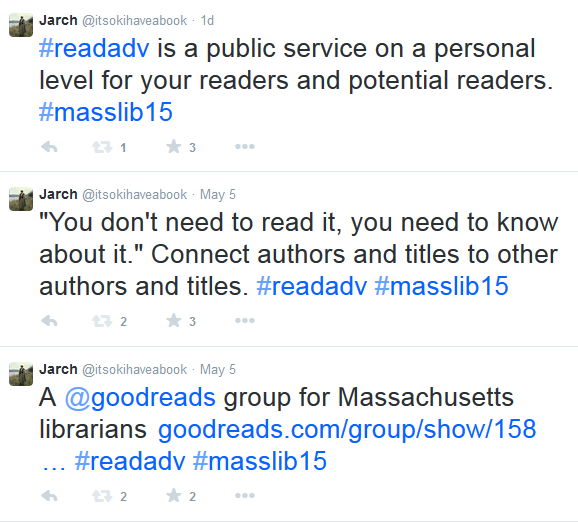
Laurie said that readers’ advisory was “customer service in the digital age,” providing a personal touch. Leane, too, said that RA was “public service on a personal level for your readers and potential readers.” Customized forms are just one way to provide great recommendations to patrons; other models include “five to try” booklists, “If you like [author/title, TV show, etc.], you might also like [___],” subgenre booklists, and staff picks lists.

This session concentrated on the LSTA RA grant and implementing genre studies, rather than specific RA tips such as including appeal factors as well as a summary when talking or writing about a book (and no spoilers!). The RA interview was covered in a previous session, RA Toolbox: Conversing with the Reader – the Readers’ Advisory Interview. Additional RA tips and resources are available from MLS. The MLA RA Toolbox handout should, hopefully, be available soon on the Presentations & Handouts page of the conference site.

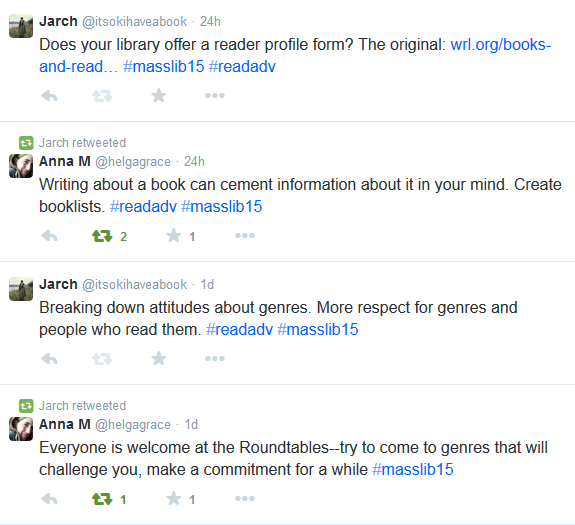
Screenshot of tweets including #readadv is a public service on a personal level for your readers and potential readers.Screenshot of tweets including Making sure entire library staff is on board with #readadv as an essential library service. #masslib15Screenshot of tweets including Writing about a book can cement information about it in your mind. Create booklists. #readadv #masslib15 2 retweets 1 favorite

Overall, a great conference experience that gave me plenty of ideas and resources to follow up on in the coming weeks, plus an opportunity to see friendly faces from grad school, past library work, fellow committee members, and even friends from Twitter.

If you have questions about any of these recaps, or have written your own recaps to share, please ask or link in the comments!


MLA 2015: Through the Library Lens, Part I

Thanks to my library’s wonderful support for professional development, once again I got to attend the Massachusetts Library Association (MLA) annual conference. This year’s theme was “through the library lens,” though none of the sessions I went to specifically addressed what that might mean. (Could it just be a joke about how most of us wear glasses?) (Probably not.) The conference hashtag was #masslib15 and several of us were active on Twitter during the conference.

Throughout my session recaps, I will include links to presentations and slides when possible; most aren’t available online yet, but they should be posted on the presentations & handouts page of the MLA site. (I spoke to a conference organizer about maybe having the materials posted online before the conference started; she said it was hard enough to get the details of everyone’s programs in advance of the conference, getting presentations ahead of time would be next to impossible.)

Bite-Size Learning: Staff Training a Little at a Time, presented by Michelle Filleul, Amy Lannon, and Patty O’Donnell of the Reading Public Library (Monday, May 4, 10:30am)

This session started off with a seven-minute video (“Did You Know 2014“); it’s worthwhile, but I recommend watching it without the sound. The main point is that the world is changing rapidly, especially technology. Libraries can encourage their staff to be “lifetime learners” and create a learner-centric culture by implementing a “bite-size learning” program: each participating staff member gets to spend an hour a week learning something new. This learning is self-directed, internally motivated, goal-oriented, and self-paced; it is relevant to the individual, and is experiential (learn by doing).

Individuals might choose to familiarize themselves with Overdrive or read storytime blogs; they might explore Ancestry.com or take a webinar on any number of subjects. Managers/leaders can start with competency checklists and tailor them to their departments. Staff set specific goals and check in with their supervisor each week to track progress; supervisors participate in the program too. Seeing department heads and directors learn new things sets a good example and breaks down the fear of failure that can accompany trying something out of one’s comfort zone.

A paralibrarian from Reading spoke movingly about how the bite-size learning helped her; she said, “Technology isn’t my thing, but learning is….I don’t want to become a senior citizen who didn’t keep up with technology. I want to communicate with the younger generation on their terms….We have to know how to do these things.” Learning new skills builds confidence in one’s ability to learn, and in one’s ability to help others – a pretty big payoff in exchange for an hour a week.

Screenshot of tweet: Self-directed learning: internally motivated, goal oriented, self-paced, relevant to learner, experiential #masslib15Screenshot of two tweets: Cross-training helps staff better understand and appreciate others' work in the library -and- Bite size learning: Overcome fear of failure, learn something new, increase confidence.

Stealth Reference: Reaching Non-Library Users, presented by Margot Malachowski from the Baystate Health Sciences Library, Anne Gancarz from the Chicopee Public Library, and John Walsh from the Newton Free Library (Monday, May 4, 1:15pm)

“Stealth reference” is a very cool name for what is usually referred to as “outreach.” Margot from Baystate talked about identifying your vulnerable populations, and aligning programs with community needs. She teaches the public directly, taking questions and answering them by mail (five stars for follow-up!), and she also teaches the people who teach the public, like The Literacy Project.

Screenshot of tweet: If a user population isn't using the library, the library may not be serving them effectively.

Anne from Chicopee asked herself, “Who am I seeking? What am I offering?” and asked what motivation potential users had to come to the library. Anne, I suspect, doesn’t sleep much: she has gone into schools, visited homebound patrons, worked with teens, connected to the visually impaired community, gone to the farmers’ market, worked with the sheriff and ex-offenders, and worked with the Council on Aging (COA); there is a bookmobile in her future. Anne suggested collaboration: with town departments like Parks & Rec, the COA, planning boards, and local events. She noticed that program popularity is cyclical; what works one year may not work the next year. “We’re always awesome and helpful,” she said, “but people don’t always know that.” If every library had a Community Services Librarian like Anne, more people would know about all the things libraries have to offer.

Screenshot of tweets and RTs, including "Any opportunity to discuss your library gives you the opportunity to engage your community of potential library users"

Last but not least, John also talked about leaving the library building, going where the people you want to be users are, and showing them what they’re missing. “They don’t know they want things” or they don’t think the library has them. He recommended contacting businesses in the area; even chains like Starbucks and Whole Foods sometimes have community relations people who may be eager to help. Bring some handouts with you, he advised, but those handouts should be immediately useful – a calendar of events, a link to the digital media catalog, etc.

One of the challenges libraries face with outreach efforts – assuming that library leadership supports it – is finding the time for staff to leave the building. Many public libraries are short-staffed, and most won’t consider leaving the reference desk unattended while librarians are at the farmers’ market, the high school, or the senior center. Off-desk hours are precious too – that’s when we order books and other materials, plan programs, create booklists and displays and flyers and a hundred other things – but starting small is better than nothing at all.

Connecting the Dots of Internet Freedom: The Future of Free Speech, presented by Evan Greer from Fight for the Future (Monday, May 4, 2:45pm)

Like many privacy advocates, Evan is an impassioned speaker. She concentrated on four modern threats to freedom of expression on the Internet: (1) attacks on Net Neutrality, (2) mass surveillance, (3) overzealous copyright enforcement, and (4) secretive trade deals, e.g. the Trans-Pacific Partnership (TPP). Her presentation was both entertaining and convincing, though I suspect the people in attendance were convinced before they showed up. I tweeted throughout this session; see below for tweets and additional links.

Screenshot of tweets, including Net Neutrality is the First Amendment of the Internet. Slowness equals censorship. Screenshot of tweets, including PEN America report on chilling effect of mass surveillance:  http://pen.org/global-chill  #masslib15Screenshot of tweets including TPP will export US copyright law to the rest of the world - minus Fair Use. Congress loves phone calls https://www.stopfasttrack.com/ Links:

Power of the Written Word: Librarian Influence Through Writing Reviews, presented by Kristi Chadwick of the Massachusetts Library System, Rebecca Vnuk of Booklist, and Nanci Milone Hill of the M.G. Parker Memorial Library in Dracut (Monday, May 4, 4:00pm)

Rebecca, Kristi, and Nanci all gave general advice about writing reviews as well as specific tips for which publications are looking for reviewers and whether or not they pay (mostly they don’t, but book reviewing shows engagement with the profession and looks good to potential future employers, etc.). They also talked about how they got started; they all “fell into it” (but only if “falling into it” means seeking out and creating opportunities for writing reviews and honing their blogging skills).

Rebecca (Shelf Renewal) talked about some of the standard review publications – Library Journal and SLJ, Booklist, Kirkus, VOYA – and their different style guides. Find your voice: is it conversational or formal? Figure out what you want to say and who your audience is. Incorporate readers’ advisory aspects (e.g. appeal factors) into your reviews, and a sense of humor. If you do get your reviews published in one of these sources, cut out your printed review and compare it to what you submitted, line by line; this will improve your reviews. Take cues from existing blogs and websites, and practice writing reviews on Amazon, Goodreads, or LibraryThing.

Kristi’s advice: find your review style, decide your limits, have a review policy, and don’t read other reviews of the book you’re reviewing (beware unintentional plagiarism). Identify the hook, the who/what/when/where/why, who the book will appeal to, and of course…no spoilers! Get e-galleys through NetGalley and/or Edelweiss and submit reviews to LibraryReads.

Screenshot of tweets, including Writing book reviews: What do you want to say? Who is your audience? #masslib15 -and- Find a style that works for you, decide your limits, have a review policy, don't plagiarize! -@booksNyarn Nanci suggested getting involved with your local Readers’ Advisory Round Table (every region of Massachusetts has one), and mentioned a few less obvious candidates for would-be reviewers and writers: NoveList, Public Libraries magazine, Bookmarks magazine, ALA Editions, the Massachusetts Center for the Book, and your local newspaper. Creating readers’ advisory materials for your own library is good practice too: shelf talkers (“If you like ___, try ___”), author and title readalikes, appeal readalikes, “five to try” (genre suggestions), etc.

As usual, presenters mentioned so many good resources and opportunities that follow-up will take me the next several weeks. And this was just day one – stay tuned for day two.