PLA, day one: You are only one energy stream

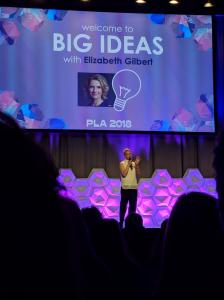
BigIdeasGilbert
Elizabeth Gilbert, photo credit Twitter user @brendageeker

The first event of the day on Thursday was the “Big Ideas” talk with author Elizabeth Gilbert. Gilbert is a polished speaker, and an inspiring one. Her theme for this talk was about focus. She told the audience about an encounter with a woman she admired when she was in her mid-20s; the woman, an artist, asked her, “What are you willing to give up to have the life you keep pretending you want?” Gilbert learned she needed to say no to things, even things she wanted to do, in order to shine “the spotlight of her attention” on what was most important.

“You are only one energy stream – what are you going to use it for? …The question is one of priorities – knowing what matters to you, and what does not matter to you.” Sometimes it takes a crisis: “A crisis forces a reckoning about who you are and what you care about.” You have to determine your priorities; set boundaries; and the third thing, Gilbert said, is mysticism – the idea that “there’s something going on her beyond what we can see…beyond the rational, empirical, logical.” At this stage in her life, Gilbert said, she is in search of teachers who are relaxed. Everyone is stressed, worried, anxious, so when she meets someone who is relaxed, she wonders how they got to be so at ease, and what she can learn from them. “You cannot be relaxed if you don’t know what matters to you.” Gilbert closed with words familiar to readers of Eat, Pray, Love: “Everything’s gonna be all right.”

Screen Shot 2018-03-27 at 8.11.18 PM

ECRR-logo-4CAfter Gilbert’s talk, it was into the exhibit hall to hear a quick presentation on Every Child Ready to Read: Play in the Library” from librarians from the Carroll County Public Library system in Maryland. Every Child Ready to Read consists of five simple practices that parents, caregivers, and educators can do with young children to increase early literacy skills: talking, singing, reading, writing, and playing. Skills developed in play include language, creativity, problem-solving, and social skills. The CCPL librarians described an interaction with two young children, a librarian, and a pop-up toy that illustrated all of these: the librarian helped the children take turns and introduced new vocabulary, while the children figured out how to make the animals pop up and go back down. Storytimes offer an opportunity for structured play as well, like using dry paintbrushes along with I Ain’t Gonna Paint No More, or scarves to blow in the wind with Mouse’s First Spring.

CCPL offers a 12-hour training course for educators on using play across the seven content areas of the curriculum; storytimes, playgroups, and “baby Rembrandt”; puppet theaters and Play and Learn centers in each of their libraries; and Make & Learn programming kits for use in the library and with library partners (e.g. daycares, preschools). Play and Learn centers can be set up in any space relatively inexpensively; remember to reserve one drawer for “Sanitize me!” (items that have gone into kids’ mouths). A final tip from CCPL: When you have the opportunity to renovate or redesign your space, go timeless: avoid typefaces, and try to bring the outside in (trees, trains, etc.).
Slide: Example of Creative
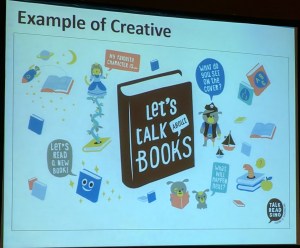
A slide from Too Small to Fail’s presentation: “Let’s Talk Books”

The morning session I chose also had to do with childhood development and early literacy efforts: Jane Park Woo of Too Small to Fail and Maricela Leon Barrera of the San Francisco Public Library presented “Talking is Teaching: Opportunities for Increasing Early Brain and Language Development.” Too Small To Fail’s goal is to “make small moments big,” and “to promote the importance of early brain and language development and to empower parents with tools to talk, read, and sing with their young children from birth” – work that librarians (“trusted messengers”) are already doing, making the library a perfect partner.

The SFPL already offers storytimes, Play to Learn areas at all locations, ECRR workshops, “Big SF Playdates,” an “Early Literacy Buffet” (for educators), and community partnerships. Their message to parents and caregivers is “Talk to/with your kids! Sing with them! If you’re doing that, you’re on the right track, they’re learning.” This message is generally well received.
IMG_20180322_145041
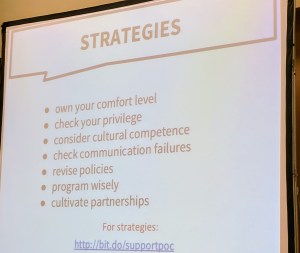
A slide from “Push Comes to Shove”

After lunch with some other folks from Massachusetts, I went to my first afternoon program, “Push Comes to Shove: Supporting Patrons of Color in Your Institution,” presented by Kristyn Caragher and Tracy Drake of the Chicago Public Library and Aisha Conner-Gaten of Loyola Marymount University.

“You have a lot of power and privilege as an information worker today,” said Conner-Gaten. Ask yourself, “How do I leverage my power to help this person?” Racism lurks in libraries: in policies, one-on-one interactions, and in programming.

  • White activists: Listen to understand, not respond. Make mistakes, be uncomfortable, apologize, educate yourself.
  • Ask: Are your policies a barrier? When were they written, why were they implemented, how often are they revisited? When you have to say no, does it make sense? Particular policies to revisit are those around sleeping, food and drink, and identification needed to get a library card.
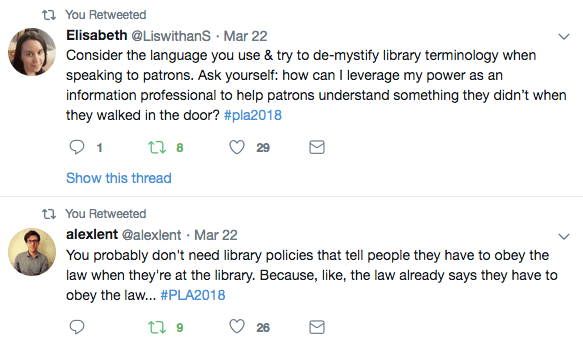
  • Librarians are fond of jargon, but many of our abbreviations (e.g. ILL) aren’t necessarily familiar to patrons. “De-mystify and de-class the library” by reducing your use of library jargon, or making sure you explain yourself in interactions where a patron seems confused.
  • If security or police officers work in your library building, they should be familiar with (and follow!) the library’s policies. Often it is better if a librarian handles the face-to-face interactions with patrons (but leave it to security if the patron is violent). Small changes make a big impact.
  • Harness community-driven energy and effort, especially with youth. Develop engaging collaborations with students. When looking for partners, check to see if they are coming from within the community or outside it.
  • For those in a position to hire, hire more diverse staff. Give serious consideration to out-of-state candidates, and advertise in other places than library job boards (like indeed.com) if the position doesn’t require an MLS.

The presenters supplied a handout with framework terminology (oppression, anti-racism, collective liberation, and social justice) and questions for reflection (Who are you? Who is your community? Who do you serve? Who is doing good work right now at your institution? In your community? What are you doing? What are you going to do? Who are your allies/partners? What resources do you need?).
Screen Shot 2018-03-27 at 8.11.52 PM

IMG_20180322_154946
Nametags as icebreakers

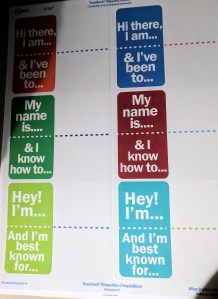
For the final program of the day, I chose to go to “Lost in the Library? Never Again with User-Centered Design,” presented by Bridget Quinn-Carey of Hartford Public Library, Margaret Sullivan of Margaret Sullivan Studio, and Maxine Bleiweis of Maxine Bleiweis and Associates, LLC. The audience was encouraged to use a nametag (see photo at right), though it wasn’t an interactive session.

Quinn-Carey started by defining “design thinking.” Design thinking is: service design, human-centered design, user-centered design, user experience. (See also: http://designthinkingforlibraries.com/.) She talked about eliminating barriers to use, like offering online payment for fines (or getting rid of fines!), having an open holds shelf, eliminating computer sign-ups. Consider physical barriers, service barriers, and language barriers too. Focus on customer-centered services, library trends, community values and needs; foster and cultivate staff and public engagement. Think about your space in a new way: “The library is a place for…” “The children’s room is a place for…”
Screen Shot 2018-03-27 at 8.11.06 PM

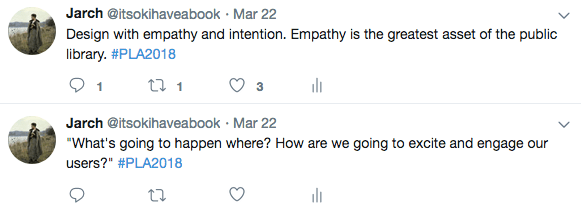
Sullivan asked, “What kind of community do you want to create? What kind of library do you want to create?” She said to foster learning outcomes, design with empathy and intention: “Empathy is the greatest asset of the public library.” Ask, “Who are we designing this for and why? How will the space support the activities and programs to foster the feelings and outcomes that we want for our community of users?” She advised going on “service safaris” to your favorite “third places” to examine how they achieve the effects you may want to reproduce in the library. Also, ask your patrons what they love about the library already!

For her part, Bleweis talked about the importance of staff buy-in. With current staff, identify the leaders and watch for opportunities. When hiring new staff, restructure the interview process to make it experiential: have them interact with patrons, have them show you or teach you something. Throughout the library, identify the “points of confusion” and put help there. Instead of documenting questions, document interactions. At programs, overstaff them if you can (ha!) and give people roles; talk to early arrivals and follow up if necessary. (It’s much easier to initiate conversations before a program if you aren’t worrying about if the presenter will show up, if the AV will work, the temperature in the room, etc.).

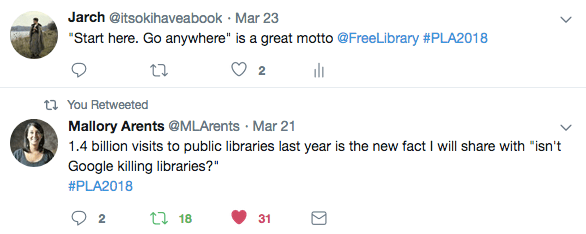
I wasn’t on Twitter as much as I usually am during conferences, and there wasn’t a huge Twitter presence (unless people were using a different hashtag?) but I sent out a few quotes from the sessions I attended, and enjoyed others’ quotes and comments from other sessions, so I’ve included some of those here.
Screen Shot 2018-03-27 at 8.12.21 PM

And that was my first full day of PLA! Stay tuned for more.



PLA Conference 2018: Imagine the Possibilities

IMG_20180321_160127Despite “winter storm Toby,” PLA went more or less as planned. Over the next week or so, I’ll be condensing and revising my sixteen (16) pages of notes into a more easily readable, digestible format to share here, but for now, here is an outline of my conference activities:
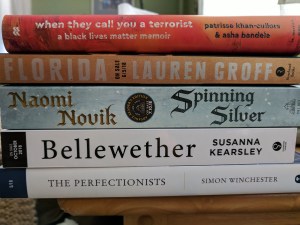
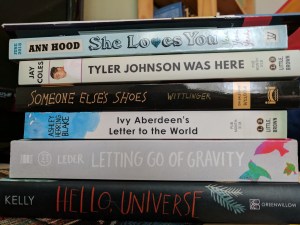
Wednesday: Drove from the Boston area to Philly. Definitely not the worst weather conditions I’ve ever driven in, but bad enough to keep lots of people off the road, so no traffic! Arrived safely and in good time, checked in at the hotel, and went to the convention center to sign in and walk through the exhibit hall. Met some friendly vendors (especially from Charlesbridge and Candlewick), and picked up several Advanced Reader Copies (ARCs).

IMG_20180325_141615
Adult fiction and nonfiction


IMG_20180325_141700
YA and children’s

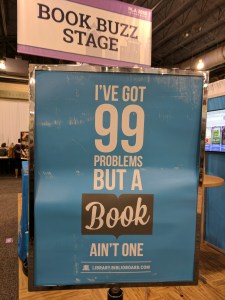
Thursday: Started bright and early with the morning’s “Big Ideas” talk, with author Elizabeth Gilbert. The exhibit hall opened up after her talk, and I was able to meet a few authors and pick up a few more galleys (Bob by Wendy Mass and Rebecca Stead!). Then I caught a quick (20-minute) talk at the PLA Pavilion about “Every Child Ready to Read (ECRR): Play in the Library,” and – on the other side of the exhibit hall – caught part of the AAP Children’s Publishers Book Buzz, where we heard about upcoming titles.

For the first program of the day, I chose “Talking is Teaching: Opportunities for Increasing Early Brain and Language Development,” where we heard about a partnership between the San Francisco Public Library and Too Small to Fail. Then I zipped back into the exhibit hall to meet Simon Winchester and pick up his upcoming book, The Perfectionists. Lunch, and then the first afternoon program, “Push Comes to Shove: Supporting Patrons of Color in Your Institution.” At the break between that session and the next, I caught some of the AAP Adult Publishers Book Buzz. Finally – and this was the hardest time slot to choose a program, because so many looked so good – I went to “Lost in the Library? Never Again with User-Centered Design.”

IMG_20180323_123916

Friday: Another visit to the PLA Pavilion for a quick session on “Early Literacy Enhanced Storytimes: Intentionality is the Key,” then over to sit in on part of the Children’s Book Buzz. (I ran into an old acquaintance from publishing, Juliet Grames, who is now working for SoHo Teen!) The morning program I had planned to go to, “Re-envisioning the Library: Engaging Staff and Building Capacity for Change” with Maureen Sullivan had been cancelled, so I went to “The Path to U.S. Citizenship Can Start at Public Libraries” and learned about U.S. Citizenship and Immigration Services.

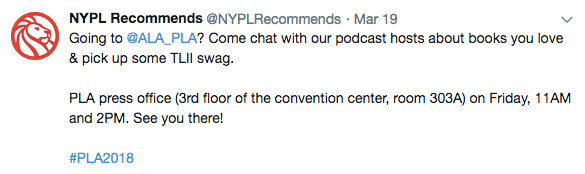
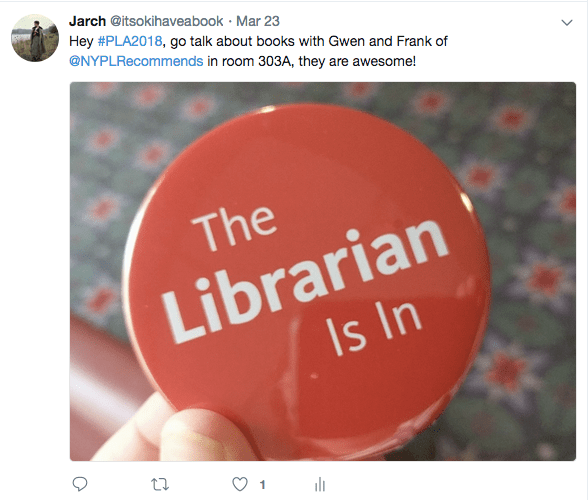
Following a tweet from NYPL Recommends, I went to visit Gwen and Frank to talk about books, and I might have been on a podcast. (Do you listen to NYPL Recommends? Let me know!) They were excellent to talk to (and they were handing out neat “The Librarian Is In” buttons). I grabbed a quick lunch from Reading Terminal, then sat on the floor to listen to some of the Adult Book Buzz before it was time for the afternoon programs: “Refuting the Idea of ‘Neutral’: Supporting Civic Engagement & Information in the Library” and “The Information Needs of Citizens: Where Libraries Fit In,” the latter with Lee Rainie of the Pew Research Center.

Screen Shot 2018-03-25 at 9.32.26 PMScreen Shot 2018-03-25 at 9.31.45 PM

Saturday: Started the day early with the final “Big Ideas” speaker, Tim Wu, at 8:15. Two more sessions after that – “How to Adult: Teaching Life Skills to Teens” and “AAP Crossover Appeal: Books That Work for Teens and Adults” – and we were packed up and on the road back home.

IMG_20180322_203438Throughout the conference, I met library people from all over. I tried to strike up conversations everywhere, and met people from Grand Forks, North Dakota; Peterborough, New Hampshire; The Portland (ME) Public Library; Arkansas; New York (the Brooklyn Public Library and the NYPL); and Calgary, Canada. The Convention Center itself was also great: easy to navigate, pretty temperate (many conference centers are either overheated or like refrigerators), and full of art. And the section of Philly where it’s located is on that lovely, lovely grid, which makes it so easy to get around. Overall, a great conference!

Still here

It’s been a little while, but I’m still here. The last week and a half has been difficult because of a tragedy that occurred at the library. In the aftermath, everyone has been incredibly supportive: town officials, library administration, the local community, and the broader library community have all shown care and concern in different ways. Patrons left kind notes in the book drop while the library was closed, many people sent flowers or brought food, and a counselor has led coping groups and met with people individually.

In more pleasant news, I just wrote a long post about my favorite picture books for toddlers. And I just attended a singalong at the Cambridge Public Library for the first time and was inspired to make a song cube as a future storytime tool. (The song cube idea is stolen directly from my friend and colleague LB, a genius children’s librarian if there ever was one.) I actually had more songs that I wanted to include, but a cube only has six sides…I may need to make another one the next time we use up a box of tissues.

Song cube decoded: Turtle for “I had a little turtle, I named him Tiny Tim,” Rocket ship for “Zoom zoom zoom, we’re going to the moon,” Spider for “Itsy-Bitsy Spider,” Hand for “If you’re happy and you know it,” Teapot for “I’m a little teapot,” and ABC for the alphabet song. All pictures drawn freehand with marker and crayon, except the hand (traced my two-year-old’s hand).

I’m also very excited to be attending PLA for the first time this year. I’ve started combing more closely through the schedule, and realized that there are at least seven sessions that I want to attend in the same time slot on the same day. Where is Hermione’s Time Turner when you need it?

Questions for you, readers: (1) What are your favorite storytime inventions, songs, and books? And, (2) Are you going to PLA? Which sessions are you excited about?


New year, new look (and ALA YMA!)

After several years (long enough that the theme I’d been using, Misty Lake, was retired), I’ve chosen a new WordPress theme to have an updated look. (In real life, I also got a haircut, new glasses frames, and a new job. So. Changes.) Please let me know if something isn’t working the way it should!

As part of my new job, I get to work in Children’s Services, and I am loving it! I am “upstairs” at the adult services desk most of the time, but I work “downstairs” in children’s once a week. Neither desk is as busy as the library where I worked before, which is nice for me as I learn on the job. So far, projects have included cataloguing the storytime collection and organizing and updating booklists by topic/theme/genre and age/grade/reading level. (I’m making booklists “upstairs” too – read-alikes for book group selections.)

There are definitely some different questions in children’s, and some of them are much more serious and emotional than any I encountered working at the adult desk; for example, twice in less than two months I’ve helped people find books to help explain death and grief to their young children. I’m also working hard to familiarize myself with books for younger readers, particularly the chapter books and early middle grade books. A self-assigned project I’m working on is to read all of the 2017/2018 Reading Rocks books, a program for fourth- and fifth-graders in the town. (I made a new tag for it in LibraryThing; I’ve read 5 out of 20 so far.)

Big news in the children’s/YA world today is, of course, the ALA Youth Media Awards (YMA), including the Newbery, the Caldecott, and the Printz. The live stream of the announcement was here, and the award and honor books are listed below the video. As usual after the announcements, I celebrate the titles I read and enjoyed (this year: A Different Pond, Piecing Me Together, The Hate U Give, Saints & Misfits, The Eyes of the World) and start requesting those I haven’t (Wolf in the Snow; Hello, Universe; Crown: An Ode to the Fresh Cut; Long Way Down; The First Rule of Punk; We Are Okay).

Did you watch the ALA Youth Media Awards? Which winners did you cheer? Are there any books you wish had gotten awards or honors that didn’t? Which books have you added to your to-read list?

Screenshot of old blog theme
Goodbye, Misty Lake theme. So long, and thanks for all the fish.

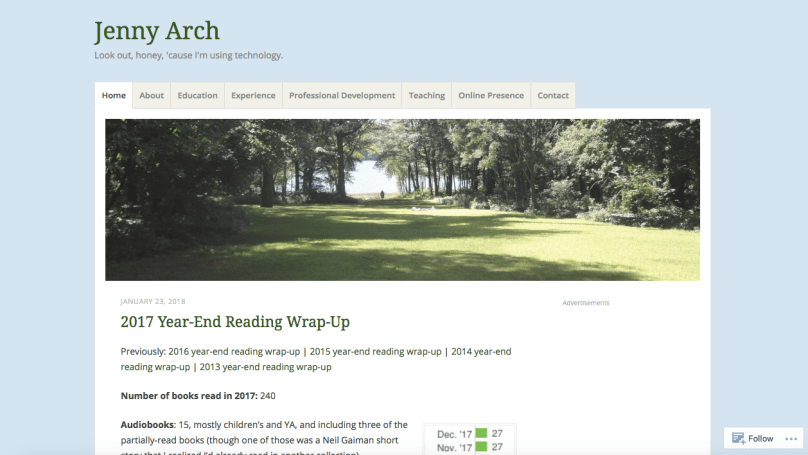
2017 Year-End Reading Wrap-Up

Previously: 2016 year-end reading wrap-up | 2015 year-end reading wrap-up | 2014 year-end reading wrap-up | 2013 year-end reading wrap-up

Number of books read in 2017: 240

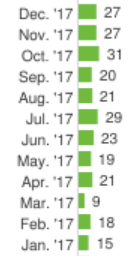
Number of reviews by month
Number of reviews by month (2017)

Audiobooks: 15, mostly children’s and YA, and including three of the partially-read books (though one of those was a Neil Gaiman short story that I realized I’d already read in another collection)

Nonfiction: 34, including a couple of nonfiction picture books and a few of the partially-read books. Also, one entire book about compost.

YA/children’s (middle grade) books read: 31

Picture books: 104, including an unspeakable amount of Maisy

Partially read books: 16, including a few cookbooks and gardening books (i.e. not necessarily designed to be read cover-to-cover)

Books read in 2017, excluding picture books and partially read books: 120

Average number of books read per month (excluding picture books and partially read books): 10

Five-star ratings: 13

Total page count: Too damn annoying to calculate from LibraryThing exports. A lot.

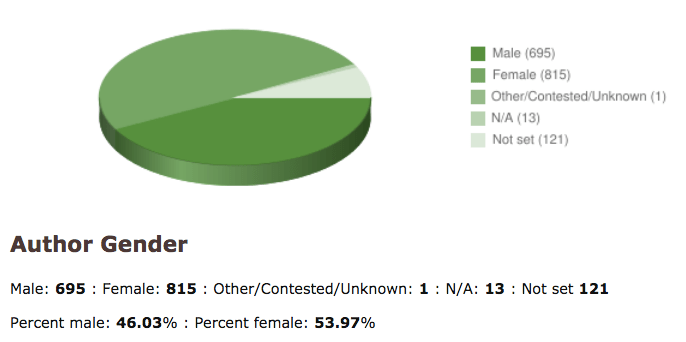
Author Gender pie chart
Author Gender pie chart from LibraryThing: now a definite majority of my authors (nearly 54%) is female, while 46% is male.

Looking ahead (well, further into) 2018, I haven’t set any specific goals and am not participating in any challenges.* Some of my favorite authors are publishing new books this year, and I’m looking forward to those, of course – Gayle Forman, Maggie O’Farrell, Jo Walton, Curtis Sittenfeld. Like last year, I’m aiming to read even more in the #WeNeedDiverseBooks area, for myself and for the little one. (Lately, she’s really liked Jabari Jumps, Thunder Boy Jr., and A Different Pond.)

Books that have been recommended to me by more than one person (triangulation: not just for fact-checking anymore!) usually move up on my to-read list. I’ve already made a dent in the to-read list I made in November: I’ve read Fun Home, The Hate U Give, Rebecca; I have Far From the Tree checked out from the library, and my book club just chose The Bear and the Nightingale for February. (I have the cape, I make the whoosh noises! Note: that’s a link to a Cyanide & Happiness cartoon panel.)

*Okay, not entirely true: I do plan to read all of the “Reading Rocks” books [PDF] for the 4th- and 5th-graders in Winchester, where I am now working. Proper blog post about this change to come! So far I’ve really liked Ghosts by Raina Telgemeier and am listening to the excellent audiobook of Stella By Starlight.

I do occasionally read things other than books, though I don’t get credit for it in LibraryThing: most days I read at least one article from The New York Times, and most weeks I read a few pieces from the LitHub (“the best of the literary internet”) email newsletter. I read most of the Library Link of the Day links, and occasionally will find a good piece in The Atlantic, The New Yorker, or somewhere else (Teen Vogue!) via Twitter or Publishers Lunch.

So that’s the 2017 wrap-up. How was your year in books?

Services for library patrons with low vision or hearing loss

This training was held on March 26, 2015; I typed up notes to share with my co-workers but didn’t write a blog post at the time.

Perkins Solutions hosted a “Library In-Service” at the Perkins School for the Blind in Watertown to help make libraries more accessible. I went to learn more about what kinds of difficulties and obstacles patrons with disabilities face in libraries and what libraries can do to help alleviate those and make the library more welcoming and easier to use. After all, the Library Code of Ethics states, “We provide the highest level of service to all library users through appropriate and usefully organized resources; equitable service policies; equitable access; and accurate, unbiased, and courteous responses to all requests” (emphasis added).

Here are some takeaways from the training:

Navigating the library for blind patrons (physical and online)

  • Offer to help if it looks like someone needs it, but do not touch them; the courteous thing to do is ask, e.g. “How can I help you best today?” They may want to take your arm (don’t take theirs) or they may not want physical contact.
  • If they have a guide dog, do not pet it; the dog is working. It’s nice to have a water dish for dogs, especially in the summer.
  • Websites are important; accessibility is key, but there is a difference between ADA compliance and true usefulness and efficiency.

Assistive Technology: Low-vision people are an “unseen, underserved” population. The technology has gotten very advanced; now it’s our job to catch up to technology, and do outreach to bring these potential patrons into the library.

  • CCTV (video) magnifiers: the reading material is placed flat on an X-Y tray (it moves on an X-Y axis, up and down and side to side), and the text is magnified on a screen. This is a “live” view of original material. Another version has a trackpad instead of the X-Y tray.
  • Handheld video magnifiers: These are good for scanning or skimming, not for long in-depth reading. They are portable and have more accessibility features than a simple magnifying glass.
  • OCR devices/magnifiers: This device presents a digital view by using OCR [optical character recognition] to capture the text and present it on the screen, but the original context and layout are lost.
  • Large print keyboards, keyboard guards: Large print keyboards (sometimes color-coded) can help low-vision people type. Keyboard guards can help those with fine motor control issues (e.g. Parkinson’s) choose one key at a time without accidentally pressing others.
  • iPads: iPads are very accessible!

Digital Accessibility: Section 508 of the Rehabilitation Act applies to all agencies that receive any federal funding. There are three easy-to-check pieces of HTML code that will make your website more accessible:

  • Check that every page has a title (e.g. <title>Using the Library – Robbins Library</title>)
  • Check that the language is set to English (lang=”en”)
  • Use alt-text to caption images. If an image is decorative, like a border or a line, hide it by using alt=””. Otherwise, describe the images, e.g. alt=”Children listening to a librarian during a storytime in the Community Room”

Screen reading software such as MAGic or JAWS can also help patrons with low vision or blindness.

Patrons with hearing loss

  • One out of six Baby Boomers have hearing loss. In Massachusetts there are an estimated 546,022 people living with hearing loss.
  • To communicate with a person who has hearing loss, get their attention before speaking. Make eye contact. Try to avoid background noise, backlighting, or darkness (anything that makes it hard to see your face).
  • Ask the person for their preferred method of communication. Writing back and forth on paper or a whiteboard, or typing back and forth, is one good method. If you’re speaking, keep your hands away from your mouth, speak at a moderate pace without exaggerating or shouting, don’t overemphasize lip movements. Use short sentences. Rephrase as necessary.
  • Walk people to the area they’re looking for, draw a map, or give directions by hand signal.
  • Relax and be patient. Don’t ignore the person and have a conversation with someone else.
  • Don’t comment on how people communicate, even “compliments.” Don’t assume deaf people know sign language.
  • Keep a large-print, step-by-step “how-to” guide for the catalog, library databases, etc.

Assistive devices

  • Assistive listening devices (ALD) amplify sound for people with impaired hearing. Can keep at reference desk (make sure it’s charged!) and/or use during programs: the speaker wears a mic, the receiver wears headphones and a pocket device.
  • Assistive Listening Systems and Induction Loop: this is a loop built in to the perimeter of a room so that people with hearing aids or an ALD can “tap in.”
  • Text Telephone (TTY) Services (e.g. Sorenson, Purple, Convo, ZVRS) may be used by some deaf people to make phone calls; an ASL interpreter will facilitate the call.
  • Online chat reference should be accessible (large print, subject to screen reader software)

Perkins Braille and Talking Book Library Services

Perkins Library also offers resources directly to patrons; anyone with a print disability can be a member. (Keep applications [PDF] at the reference desk!). They can also contact visually impaired people in the library’s community, and help set up volunteer programs in libraries to help patrons learn how to use assistive technology.

What assistive technology does your library offer? Are there specific outreach efforts to promote these services? What barriers to access remain?


A year of read-alikes

readalike logo/graphic, made in Canva
Logo designed in Canva

This year on the library blog, I started writing a new monthly post suggesting “readalikes” for one of our most popular books that month. It’s been a useful readers’ advisory tool, both for readers eager to read the most popular books, and for those who have already read them and are looking for similar titles.

Of the most popular books each month, I   featured books from different categories or genres, from literary fiction to nonfiction, young adult fiction to cookbooks.

January: The Woman in Cabin 10 by Ruth Ware – a psychological thriller

February: Hillbilly Elegy by J.D. Vance – a personal account of growing up as part of the declining white working class

March: A Gentleman in Moscow by Amor Towles – a popular work of literary historical fiction set in the Metropol hotel in Moscow in the 1920s, by the author of Rules of Civility

April: The Hate U Give by Angie Thomas – YA fiction inspired by the Black Lives Matter movement and racial inequality

May: Anything Is Possible by Elizabeth Strout – short stories by the author of My Name is Lucy Barton

June: Saints for All Occasions by J. Courtney Sullivan – literary fiction about a complicated family, set in Ireland and Boston

July: Al Franken, Giant of the Senate by Al Franken – a leftist political humor memoir (note: Franken has since resigned from the Senate after accusations of sexual harassment)

August: Dying by Cory Taylor and The Bright Hour by Nina Riggs – memoirs and other nonfiction on the topic of death and dying

September: What She Ate by Laura Shapiro – culinary historian Shapiro looks at three famous women through the lens of food and cooking

October: Glass Houses by Louise Penny – the newest Three Pines mystery featuring Armand Gamache

November: Smitten Kitchen Every Day by Deb Perelman – a second cookbook by the blogger with a dedicated following

December: Manhattan Beach by Jennifer Egan – a new work of historical fiction by the Pulitzer Prize-winning author of A Visit From the Goon Squad, set in WWII-era New York


Early literacy and 1000 Books Before Kindergarten

1000 Books Before Kindergarten logoThe 1000 Books Before Kindergarten initiative is one I first heard about via the Cambridge Public Library. Like all the best arts & crafts projects and recipes, it looks wildly impressive, but is actually quite simple and manageable. As their mission statement says, “Numerous studies estimate that as many as one in five children have difficulties learning to read. Reading has been associated as an early indicator of academic success. Public formal education does not typically start until ages 5-6. Before then, parents and caregivers are the first education providers during the 0-5 early critical years.” The goals of the organization are simply “to promote reading to newborns, infants, and toddlers” and “to encourage parent and child bonding through reading.”

A thousand books sounds like a lot, but remember that picture books are short, and board books are really short. If you read just one book a day, that’s 365 books in one year, 730 books in two years, 1,095 books in three years, and 1,460 books in four years. It doesn’t have to be a thousand unique books, either; young children love (and learn from) repetition, growing more familiar with words, rhymes, and patterns.

If your parents, caregivers, and teachers read to you when you were a young child, then you’ve already shared this experience and it will be easier for you to model it from the other side. If reading aloud to/with a child isn’t as natural for you, or if you aren’t sure why it is important, here are some resources to help:

  • Reading Tips for Parents from the Department of Education (in English and Spanish)
  • Early Learning tips from the Hennepin County Library: “Learn how all family members and your public library can help prepare young children to be readers with five early literacy activities [talk, sing, read, write, play] that are fun yet powerful ways to encourage early learning.”
  • The Six Early Literacy Skills [PDF] from Every Child Ready to Read (ECRR)

If you don’t know what books to read to (or with) your child, librarians can help! If you can get to a storytime, that’s great – a good storytime librarian will model great read-aloud strategies, and for younger ages will often include fingerplay, songs, and rhymes; reasonable people don’t expect two-year-olds to sit still and listen quietly for half an hour! A decent bookstore is also likely to have a weekly storytime, and staff who can recommend great books for little ones.

If you can’t get to a storytime, just ask a librarian or bookseller what they recommend, and they should be able to give suggestions based on your child’s age and interests. Here are some other resources for finding great books to share with your child:

Does your library, bookstore, school, or other organization support 1000 Books Before Kindergarten? Have you participated with your child? There are participation resources on the site, from reading logs to certificates to apps to hashtags, though my favorite idea is keeping a handwritten reading journal. In general I don’t like incentives (e.g. “if you read 100 books you get a sticker”) because reading is its own reward (intrinsic motivation), but I like the T-shirt – it reflects pride in an accomplishment, and helps spread the word about the program.

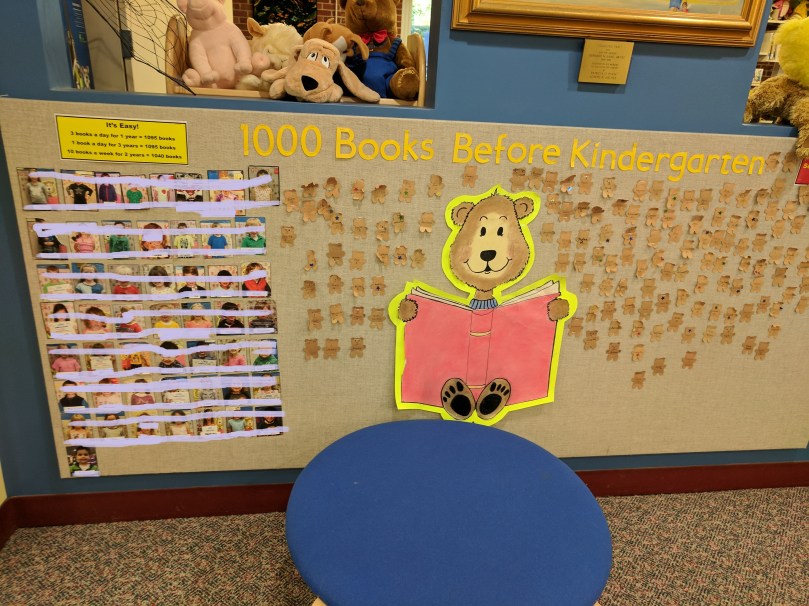
1000 Books Before Kindergarten display at the Guilford (CT) Public Library
1000 Books Before Kindergarten display at the Guilford (CT) Public Library (names and faces obscured for privacy purposes)

What do people do all day?

Cover image of What Do People Do All Day? by Richard Scarry
What Do People Do All Day?

What do librarians do all day?

The scope of library jobs has expanded over the years. In many places, “reference librarians” are now called “adult services” or “information services” librarians to reflect the additional tasks and responsibilities we’ve taken on. Reference services are still a core part of the job, as is collection management (someone has to buy new books…and get rid of old ones). We plan programs, too, and of course, there are always “other duties as assigned.”

At the reference desk: Now that we have the Internet, what kinds of questions do librarians answer?

We still answer the occasional “ready reference” or simple question about a fact (spelling, grammar, geography, phone number lookup). We answer questions about library services: our hours, where the restrooms are located, how to reserve a museum pass or study room, where to find books/music/movies. We answer LOTS of tech questions and do a lot of troubleshooting: we help people use library apps like OverDrive, we help them print and make copies, we help them scan, we help them check out laptops and use library software, we show them library databases.

We answer questions about books and recommend books based on reader’s preferences (those are my favorite questions!). We help people navigate the internet to find information they need, whether it’s looking for an apartment on Craigslist, looking for love on a dating website, or applying for a job online. We help people in languages other than English. We help people doing research for school projects and college classes, and help people make Inter-Library Loan (ILL) requests for books that are not in our library network. We answer local history questions and connect people with unique local history resources.

Collection development: Where do the books come from (and where do they go)?

“Collection management” or “collection development” is the library term for acquiring new materials and deaccessioning (a.k.a. weeding) others, to maintain a collection that is current and interesting to our users. There is more collection development work now than there used to be, because there are more formats – not just fiction and nonfiction books, and magazines and newspapers, but paperbacks, foreign language materials, large print books, graphic novels and manga, audiobooks on CD and Playaway, digital content (e-books and digital audiobooks), movies and documentaries on DVD, music on CD, electronic databases, streaming services, video games, and more.

Library users may not think about where library materials come from, but someone has to select every title in every format. It’s a bigger job than it used to be, and it takes a lot of time: time to read (or skim) reviews in at least one review source (though there are many – Kirkus, Booklist, Publishers Weekly, Library Journal, School Library Journal, to name a few, and VOYA and The Horn Book for teens and children’s books), time to make lists and order the materials, time to keep track of spending so you’re neither under- nor over-budget by the end of the fiscal year.


Making things happen: What’s involved in planning a program?

You may well ask! “Program” is a bland word. A library program can be almost anything: a book group (and we have five of these, three of which are run by librarians, one of which – mine! – is a cookbook club that does a potluck), a lecture or author talk, a crafting project, a music concert, a film screening, a theater performance, a dance lesson, a tech petting zoo. We have offered computer classes, drop-in tech help sessions, resume and cover letter workshops, holiday card writing stations, game nights, and singalongs (not just for kids! Les Miserables and Pitch Perfect were very popular with adults).

For every program, there is a whole checklist of tasks to complete, in many different places (physical and digital):

  • Reserve event space on the library’s internal calendar (Google calendar)
  • Create the event on the library website calendar (WordPress)
  • If there is an outside performer/presenter, set a date and time and agree on payment or travel costs (e-mail or phone)
  • Add the event to our monthly press release (Google docs)
  • Create a flyer to post in the library (Publisher or Canva)
  • Make another version of the flyer to fit our digital sign (Publisher and Paint or Canva) and upload (Dropbox)
  • Make additional promo materials (e.g. bookmarks or half- or quarter-sheet handouts)
  • Write a blog post (WordPress)
  • Promote on social media (Facebook and Twitter via Hootsuite)
  • Set up event registration, if using, and send a reminder to participants (Eventbrite)

And that’s all before the day of the program itself. On that day, there is the time of the program itself, plus setup and cleanup, remembering to take a head count of attendees, and perhaps asking them to fill out a feedback form to help improve future programming.

The work of program planning, collection development, and creating displays largely takes place during our off-desk hours (the time that we are not at the reference desk), because, as they say, reports of our death have been greatly exaggerated; the library is busier than ever.

Other duties as assigned

Reference service, collection development, and program planning are three big chunks of the adult services librarian job. What else do we do? This varies from library to library. Here, we create displays (we have three display tables, and we create new displays every month, which means that our team of five full-time librarians creates thirty-six displays each year), write for the library blog, offer a variety of “readers’ advisory” services (from our staff picks shelf to our Goodreads account to handouts on specific topics or genres), contribute to the library’s social media accounts (Facebook and Twitter), attend monthly department meetings and other meetings for various committees and groups, and attend the occasional conference or other professional development activity. And of course, there are little tasks that take up time, such as refilling office supplies, cleaning up messes, watering the office plants, and anything else that arises.

So that’s what librarians do all day. Do you work in a library? What parts of your job do you think would surprise people?


Extreme Customer Service: Hospitality in the Library

Earlier this month, I got to attend a presentation called “Re-energizing Your Customer Service Skills,” presented by Sally Ijams of Darien Library (CT), at the Newton Free Library (MA). Darien is well known in the library world for its customer service, technology, and programs, and Ijams’ (pronounced “imes,” rhymes with “limes”) presentation was the staff training that all new employees at Darien receive.

What does good customer service look like?

When developing their training, they had to look outside the library world for guidance: they looked to brands and companies like Disney, Zappos, Nordstrom, Shake Shack (Danny Meyer’s book Setting the Table is required reading for all new staff in Darien), and even Ritz-Carlton. One might think that public libraries don’t have much in common with the Ritz, but libraries are like these businesses in four ways:

  1. We have customers
  2. We have products we believe in
  3. We want repeat business
  4. We know our customers have other options

From these examples, Darien aimed to provide an extraordinary level of customer service by hiring for attitude (“You can train people to do just about anything but you can’t train them to be nice”) and focusing on consistent delivery of excellent service: greeting each library guest when they arrive and thanking them when they leave, saying yes whenever possible (only safety issues are a firm no), and anticipating and fulfilling library visitors’ needs.

WELCOME text made in Canva

The Welcome

What do people see when they first enter the library or first approach a service desk? Library staff should be approachable. Smile and make eye contact (this works in Darien, but may not work everywhere depending on people’s cultures and backgrounds). Stand up to greet people, then be on the same level (both sitting or both standing). Determine your “resting face” – is it welcoming? Don’t watch the clock – people will notice you looking. Be “relentlessly positive…fake it till you make it.”

Words and gestures are important. Instead of pointing, use the “Disney wave” (gesturing with the whole arm and hand); instead of saying “no problem” or “no worries,” say “you’re welcome” or “it was my pleasure.”

Nametags: they work! If nothing else, they show that you work at the library, so visitors can identify staff.

Smile when you answer the phone; people can hear it in your voice. But prioritize people who are physically in the building; reward them for coming. If you are on the phone with another patron, wrap up the call and call them back. Meanwhile, acknowledge the person in front of you (eye contact, “I will be right with you”).

Don’t talk about patrons in a public area. If there is information you need to convey to a colleague to bring them up to speed, do it in a private place.

The Handoff

Often, a person will need to go from one service desk to another desk or another area of the library. Rather than pointing or offering directions, escort them to where they need to go. If this “warm transfer” isn’t possible (you have a long line of people waiting), do a “lukewarm transfer” – call a colleague in the part of the building where the person is going to let them know who to expect and what they need.

As you’re walking through the library, use the “bartender’s trick”: clean as you go. Pick up trash, tidy books, push in chairs. “You are inviting people into your home. Make it look as nice as you can.”

Patron Behavior

Know your patron behavior policy! Every library should have one. (Darien’s is on their website.) Enforce this policy with compassion; staff should be empowered to make exceptions as they see fit. Remind patrons that “Our policies were written to benefit everyone in the library.” Other useful tips:

  • Remain calm
  • Defuse the situation (is there anything that will make them happy at this moment?)
  • Have difficult conversations out of the public eye
  • Bring in a backup staff person
  • Never touch or restrain a patron
  • If patron is “stuck in a loop,” change your body language or move to another location
  • Say you will follow up if necessary, then follow up!

Ijams cited a recent piece in American Libraries that has a useful sidebar called “What to say when things get inappropriate.” When staff is faced with verbal abuse or harassment, simple, firm scripts like these are helpful (“I’m sorry, we don’t tolerate language like that in the library”). If you have a bad interaction, try to take a break to reset afterward; likewise, if you see a co-worker have a bad interaction, give them a chance to take a break and recover.

“Extreme customer service” / hospitality: making everyone feel welcome at the library

How are we perceived by our patrons? Here are some of the things Darien does to earn its “extreme customer service” reputation:

  • Treat every person like a VIP. Make them feel special; greet them by name
  • When you have to say no, say it with yes options (some libraries call this “getting to yes”)
  • If you direct someone to another library or organization, make the initial contact for them (phone call, introduction, etc.)
  • Notary service: Darien has eleven notaries on staff, so a notary is always available. They do not charge patrons for this service. The library pays the cost for staff members to become notaries.
  • Library hours: Staff are paid to arrive early and leave together after closing time, so though the library opens at 9am, doors usually open at 8:50. At the end of the day, technology does not shut down before closing time. Five minutes before the library closes, they play music over the PA system.
  • No fines for senior residents. Fines are a barrier to access; Darien would like to get rid of all fines, but there is a budget crisis in Connecticut right now.
  • “We trust our patrons.” This is “the easiest thing and the hardest thing.” (Sometimes you know someone is lying to you and you just have to accept it.)

That was the bulk of Ijams’ presentation. During the Q&A, I asked what they did at Darien to make signage welcoming. Ijams said that in the old building, there was so much signage it was visual clutter; in the new building, they started with minimalist signage, but added more for wayfinding purposes. The only guideline is no negative signs – phrase it as a yes option. The only exception is inside a staff stairwell, where the public shouldn’t be in the first place. Instead of out-of-order signs, they use one that says “Taking a vacation day, be back at work tomorrow”! (Speaking of time off, Ijams also recommended, “If you’re sick, stay home! Colleagues will appreciate not being infected.” Of course, this presumes an adequate amount of paid sick leave.)

Ijams’ presentation was professional and gave the three of us from our library who attended much to consider. For customer service to be consistent, though, everyone must be on the same page, so our own staff training would be necessary, and while Darien’s philosophy is admirable, we wouldn’t likely adopt every detail. Still, there is always room for improvement, and some improvements can be made easily right away: escorting rather than pointing, performing more warm transfers, saying “you’re welcome” instead of “no worries,” employing the “bartender’s trick.” Other changes, such as prioritizing in-person visitors over people who contact the library via phone or chat, using nametags, or changing closing time procedures, would need to be made at a higher level.

Do you work at a public library? What do you do to make visiting the library a great experience for patrons?