This year on the library blog, I started writing a new monthly post suggesting “readalikes” for one of our most popular books that month. It’s been a useful readers’ advisory tool, both for readers eager to read the most popular books, and for those who have already read them and are looking for similar titles.
Of the most popular books each month, I featured books from different categories or genres, from literary fiction to nonfiction, young adult fiction to cookbooks.
March: A Gentleman in Moscow by Amor Towles – a popular work of literary historical fiction set in the Metropol hotel in Moscow in the 1920s, by the author of Rules of Civility
The 1000 Books Before Kindergarten initiative is one I first heard about via the Cambridge Public Library. Like all the best arts & crafts projects and recipes, it looks wildly impressive, but is actually quite simple and manageable. As their mission statement says, “Numerous studies estimate that as many as one in five children have difficulties learning to read. Reading has been associated as an early indicator of academic success. Public formal education does not typically start until ages 5-6. Before then, parents and caregivers are the first education providers during the 0-5 early critical years.” The goals of the organization are simply “to promote reading to newborns, infants, and toddlers” and “to encourage parent and child bonding through reading.”
A thousand books sounds like a lot, but remember that picture books are short, and board books are really short. If you read just one book a day, that’s 365 books in one year, 730 books in two years, 1,095 books in three years, and 1,460 books in four years. It doesn’t have to be a thousand unique books, either; young children love (and learn from) repetition, growing more familiar with words, rhymes, and patterns.
If your parents, caregivers, and teachers read to you when you were a young child, then you’ve already shared this experience and it will be easier for you to model it from the other side. If reading aloud to/with a child isn’t as natural for you, or if you aren’t sure why it is important, here are some resources to help:
Early Learning tips from the Hennepin County Library: “Learn how all family members and your public library can help prepare young children to be readers with five early literacy activities [talk, sing, read, write, play] that are fun yet powerful ways to encourage early learning.”
If you don’t know what books to read to (or with) your child, librarians can help! If you can get to a storytime, that’s great – a good storytime librarian will model great read-aloud strategies, and for younger ages will often include fingerplay, songs, and rhymes; reasonable people don’t expect two-year-olds to sit still and listen quietly for half an hour! A decent bookstore is also likely to have a weekly storytime, and staff who can recommend great books for little ones.
If you can’t get to a storytime, just ask a librarian or bookseller what they recommend, and they should be able to give suggestions based on your child’s age and interests. Here are some other resources for finding great books to share with your child:
Does your library, bookstore, school, or other organization support 1000 Books Before Kindergarten? Have you participated with your child? There are participation resources on the site, from reading logs to certificates to apps to hashtags, though my favorite idea is keeping a handwritten reading journal. In general I don’t like incentives (e.g. “if you read 100 books you get a sticker”) because reading is its own reward (intrinsic motivation), but I like the T-shirt – it reflects pride in an accomplishment, and helps spread the word about the program.
1000 Books Before Kindergarten display at the Guilford (CT) Public Library (names and faces obscured for privacy purposes)
The scope of library jobs has expanded over the years. In many places, “reference librarians” are now called “adult services” or “information services” librarians to reflect the additional tasks and responsibilities we’ve taken on. Reference services are still a core part of the job, as is collection management (someone has to buy new books…and get rid of old ones). We plan programs, too, and of course, there are always “other duties as assigned.”
At the reference desk: Now that we have the Internet, what kinds of questions do librarians answer?
We still answer the occasional “ready reference” or simple question about a fact (spelling, grammar, geography, phone number lookup). We answer questions about library services: our hours, where the restrooms are located, how to reserve a museum pass or study room, where to find books/music/movies. We answer LOTS of tech questions and do a lot of troubleshooting: we help people use library apps like OverDrive, we help them print and make copies, we help them scan, we help them check out laptops and use library software, we show them library databases.
We answer questions about books and recommend books based on reader’s preferences (those are my favorite questions!). We help people navigate the internet to find information they need, whether it’s looking for an apartment on Craigslist, looking for love on a dating website, or applying for a job online. We help people in languages other than English. We help people doing research for school projects and college classes, and help people make Inter-Library Loan (ILL) requests for books that are not in our library network. We answer local history questions and connect people with unique local history resources.
Collection development: Where do the books come from (and where do they go)?
“Collection management” or “collection development” is the library term for acquiring new materials and deaccessioning (a.k.a. weeding) others, to maintain a collection that is current and interesting to our users. There is more collection development work now than there used to be, because there are more formats – not just fiction and nonfiction books, and magazines and newspapers, but paperbacks, foreign language materials, large print books, graphic novels and manga, audiobooks on CD and Playaway, digital content (e-books and digital audiobooks), movies and documentaries on DVD, music on CD, electronic databases, streaming services, video games, and more.
Library users may not think about where library materials come from, but someone has to select every title in every format. It’s a bigger job than it used to be, and it takes a lot of time: time to read (or skim) reviews in at least one review source (though there are many – Kirkus, Booklist, Publishers Weekly, Library Journal, School Library Journal, to name a few, and VOYA and The Horn Book for teens and children’s books), time to make lists and order the materials, time to keep track of spending so you’re neither under- nor over-budget by the end of the fiscal year.
Making things happen: What’s involved in planning a program?
You may well ask! “Program” is a bland word. A library program can be almost anything: a book group (and we have five of these, three of which are run by librarians, one of which – mine! – is a cookbook club that does a potluck), a lecture or author talk, a crafting project, a music concert, a film screening, a theater performance, a dance lesson, a tech petting zoo. We have offered computer classes, drop-in tech help sessions, resume and cover letter workshops, holiday card writing stations, game nights, and singalongs (not just for kids! Les Miserables and Pitch Perfect were very popular with adults).
For every program, there is a whole checklist of tasks to complete, in many different places (physical and digital):
Reserve event space on the library’s internal calendar (Google calendar)
Create the event on the library website calendar (WordPress)
If there is an outside performer/presenter, set a date and time and agree on payment or travel costs (e-mail or phone)
Add the event to our monthly press release (Google docs)
Create a flyer to post in the library (Publisher or Canva)
Make another version of the flyer to fit our digital sign (Publisher and Paint or Canva) and upload (Dropbox)
Make additional promo materials (e.g. bookmarks or half- or quarter-sheet handouts)
Write a blog post (WordPress)
Promote on social media (Facebook and Twitter via Hootsuite)
Set up event registration, if using, and send a reminder to participants (Eventbrite)
And that’s all before the day of the program itself. On that day, there is the time of the program itself, plus setup and cleanup, remembering to take a head count of attendees, and perhaps asking them to fill out a feedback form to help improve future programming.
The work of program planning, collection development, and creating displays largely takes place during our off-desk hours (the time that we are not at the reference desk), because, as they say, reports of our death have been greatly exaggerated; the library is busier than ever.
Other duties as assigned
Reference service, collection development, and program planning are three big chunks of the adult services librarian job. What else do we do? This varies from library to library. Here, we create displays (we have three display tables, and we create new displays every month, which means that our team of five full-time librarians creates thirty-six displays each year), write for the library blog, offer a variety of “readers’ advisory” services (from our staff picks shelf to our Goodreads account to handouts on specific topics or genres), contribute to the library’s social media accounts (Facebook and Twitter), attend monthly department meetings and other meetings for various committees and groups, and attend the occasional conference or other professional development activity. And of course, there are little tasks that take up time, such as refilling office supplies, cleaning up messes, watering the office plants, and anything else that arises.
So that’s what librarians do all day. Do you work in a library? What parts of your job do you think would surprise people?
Earlier this month, I got to attend a presentation called “Re-energizing Your Customer Service Skills,” presented by Sally Ijams of Darien Library (CT), at the Newton Free Library (MA). Darien is well known in the library world for its customer service, technology, and programs, and Ijams’ (pronounced “imes,” rhymes with “limes”) presentation was the staff training that all new employees at Darien receive.
What does good customer service look like?
When developing their training, they had to look outside the library world for guidance: they looked to brands and companies like Disney, Zappos, Nordstrom, Shake Shack (Danny Meyer’s book Setting the Table is required reading for all new staff in Darien), and even Ritz-Carlton. One might think that public libraries don’t have much in common with the Ritz, but libraries are like these businesses in four ways:
We have customers
We have products we believe in
We want repeat business
We know our customers have other options
From these examples, Darien aimed to provide an extraordinary level of customer service by hiring for attitude (“You can train people to do just about anything but you can’t train them to be nice”) and focusing on consistent delivery of excellent service: greeting each library guest when they arrive and thanking them when they leave, saying yes whenever possible (only safety issues are a firm no), and anticipating and fulfilling library visitors’ needs.
The Welcome
What do people see when they first enter the library or first approach a service desk? Library staff should be approachable. Smile and make eye contact (this works in Darien, but may not work everywhere depending on people’s cultures and backgrounds). Stand up to greet people, then be on the same level (both sitting or both standing). Determine your “resting face” – is it welcoming? Don’t watch the clock – people will notice you looking. Be “relentlessly positive…fake it till you make it.”
Words and gestures are important. Instead of pointing, use the “Disney wave” (gesturing with the whole arm and hand); instead of saying “no problem” or “no worries,” say “you’re welcome” or “it was my pleasure.”
Nametags: they work! If nothing else, they show that you work at the library, so visitors can identify staff.
Smile when you answer the phone; people can hear it in your voice. But prioritize people who are physically in the building; reward them for coming. If you are on the phone with another patron, wrap up the call and call them back. Meanwhile, acknowledge the person in front of you (eye contact, “I will be right with you”).
Don’t talk about patrons in a public area. If there is information you need to convey to a colleague to bring them up to speed, do it in a private place.
The Handoff
Often, a person will need to go from one service desk to another desk or another area of the library. Rather than pointing or offering directions, escort them to where they need to go. If this “warm transfer” isn’t possible (you have a long line of people waiting), do a “lukewarm transfer” – call a colleague in the part of the building where the person is going to let them know who to expect and what they need.
As you’re walking through the library, use the “bartender’s trick”: clean as you go. Pick up trash, tidy books, push in chairs. “You are inviting people into your home. Make it look as nice as you can.”
Patron Behavior
Know your patron behavior policy! Every library should have one. (Darien’s is on their website.) Enforce this policy with compassion; staff should be empowered to make exceptions as they see fit. Remind patrons that “Our policies were written to benefit everyone in the library.” Other useful tips:
Remain calm
Defuse the situation (is there anything that will make them happy at this moment?)
Have difficult conversations out of the public eye
Bring in a backup staff person
Never touch or restrain a patron
If patron is “stuck in a loop,” change your body language or move to another location
Say you will follow up if necessary, then follow up!
Ijams cited a recent piece in American Libraries that has a useful sidebar called “What to say when things get inappropriate.” When staff is faced with verbal abuse or harassment, simple, firm scripts like these are helpful (“I’m sorry, we don’t tolerate language like that in the library”). If you have a bad interaction, try to take a break to reset afterward; likewise, if you see a co-worker have a bad interaction, give them a chance to take a break and recover.
“Extreme customer service” / hospitality: making everyone feel welcome at the library
How are we perceived by our patrons? Here are some of the things Darien does to earn its “extreme customer service” reputation:
Treat every person like a VIP. Make them feel special; greet them by name
When you have to say no, say it with yes options (some libraries call this “getting to yes”)
If you direct someone to another library or organization, make the initial contact for them (phone call, introduction, etc.)
Notary service: Darien has eleven notaries on staff, so a notary is always available. They do not charge patrons for this service. The library pays the cost for staff members to become notaries.
Library hours: Staff are paid to arrive early and leave together after closing time, so though the library opens at 9am, doors usually open at 8:50. At the end of the day, technology does not shut down before closing time. Five minutes before the library closes, they play music over the PA system.
No fines for senior residents. Fines are a barrier to access; Darien would like to get rid of all fines, but there is a budget crisis in Connecticut right now.
“We trust our patrons.” This is “the easiest thing and the hardest thing.” (Sometimes you know someone is lying to you and you just have to accept it.)
That was the bulk of Ijams’ presentation. During the Q&A, I asked what they did at Darien to make signage welcoming. Ijams said that in the old building, there was so much signage it was visual clutter; in the new building, they started with minimalist signage, but added more for wayfinding purposes. The only guideline is no negative signs – phrase it as a yes option. The only exception is inside a staff stairwell, where the public shouldn’t be in the first place. Instead of out-of-order signs, they use one that says “Taking a vacation day, be back at work tomorrow”! (Speaking of time off, Ijams also recommended, “If you’re sick, stay home! Colleagues will appreciate not being infected.” Of course, this presumes an adequate amount of paid sick leave.)
Ijams’ presentation was professional and gave the three of us from our library who attended much to consider. For customer service to be consistent, though, everyone must be on the same page, so our own staff training would be necessary, and while Darien’s philosophy is admirable, we wouldn’t likely adopt every detail. Still, there is always room for improvement, and some improvements can be made easily right away: escorting rather than pointing, performing more warm transfers, saying “you’re welcome” instead of “no worries,” employing the “bartender’s trick.” Other changes, such as prioritizing in-person visitors over people who contact the library via phone or chat, using nametags, or changing closing time procedures, would need to be made at a higher level.
Do you work at a public library? What do you do to make visiting the library a great experience for patrons?
Since before the first Libraries in a Post-Truth World conference at the beginning of this year, I’ve been keeping a list of relevant articles. This list has expanded to include books, studies and reports, and other materials, and I am sharing it here. If you have relevant materials to add, please leave a comment here. If you would like to use this list for library programming, teaching, or related work, please feel free – I’d love to know about it if you do.
Though “fake news” is a term most people recognize these days (unfortunately), it is not the best term to use, for reasons Claire Wardle and Hossein Derakhshan state in their Council of Europe report:
We refrain from using the term ‘fake news’, for two reasons. First, it is woefully inadequate to describe the complex phenomena of information pollution. The term has also begun to be appropriated by politicians around the world to describe news organisations whose coverage they find disagreeable. In this way, it’s becoming a mechanism by which the powerful can clamp down upon, restrict, undermine and circumvent the free press.
We therefore introduce a new conceptual framework for examining information disorder, identifying the three different types: mis-, dis- and mal-information.
Misinformation is when false information is shared with no harmful intent; disinformation is when false information is shared to cause harm; and mal-information is when genuine information is shared to cause harm (e.g. by moving it from the private to the public sphere). Unfortunately, again, we are dealing with all three today (plus satirical sources like The Onion, which are the only good kind of fake news).
Again, feedback is welcomed; please let me know if you use this list, or have anything to add. I am particularly interested in using the rise of interest in the topic of fake news to advocate for librarians in schools, as they are the ones who do the important work of teaching research skills, critical thinking, information literacy, and media literacy.
There is so much to love about this idea. Together, libraries and Repair Cafe/Fixit Clinic:
help build a more sustainable world
fight the “throwaway” culture of obsolescence
encourage an interest in how things work
teach useful skills
For the past several years, libraries have been talking about Makerspaces – and in some cases, carving out space and buying 3D printers. While I think that 3D printers are amazing for specific purposes (like making teeth), I’m afraid a lot of them are used for churning out cheap plastic junk. They may serve as an introduction to design and robotics, which is not to be discounted…but I think the repair cafe/fixit clinic idea is so much more useful. After all, learning a skill comes easier when you have a purpose: learning a coding language, for example, will probably be a wasted effort unless there’s something you want to make with it.
In this scenario, a broken item – lamp, toaster, necklace, scooter – provides motivation for learning, the library provides space and coordinates the event, and the Repair Cafe or Fixit Clinic provides the volunteers (who may bring the tools of their trade with them). In the AL article, Cottrell writes, “The goal of the U-Fix-It Clinic [is] allowing people to repair broken items instead of throwing them away, but also inspiring them to learn more about the products they consume and how they work. The event is part of a larger movement across the globe working to help keep broken items out of landfills and revive the lost art of repair.”
Knowing how things work – and how to go about fixing them – is empowering; it’s useful knowledge. In a piece for WGBH, “‘Fixit Clinics’ Help People Revive Their Broken Items,” Tina Martin interviewed the founder of Fixit Clinics, MIT grad Peter Mui, who said, “There’s a sense that [people] don’t have a choice when something breaks, there’s no repair people left anymore to fix this stuff.”
Mui wrote a guest blog post on ifixit.org, saying, “Once people start repairing, they start asking questions like ‘What went wrong?’, ‘Can it be fixed?’, and ‘How might it have been designed differently to avoid breaking in the first place?’ That last question is where we’re ultimately going with Fixit Clinic: to encourage products designed with maintenance, serviceability, and repairability in mind.”
As the things we use on a daily basis have become more complex (sometimes by necessity, sometimes not), design has become more opaque. I often think of Don Norman’s The Design of Everyday Thingswhile I’m working at the reference desk, explaining the “hamburger menu” to a patron, or helping them locate the miniscule, hidden power button on our new laptops. They often apologize, and I tell them it’s not their fault – it’s poor design. But as more and more of our things have microchips inside them, instead of parts we can see and tinker with, we’ve forgotten how to open things up and explore; we’ve given up on figuring out how things work – or why they stop working.
The mentality behind the Repair Cafe and the Fixit Clinic addresses these problems in a tremendously useful way. The Repair Cafe “About” page explains, “We throw away vast amounts of stuff….The trouble is, lots of people have forgotten that they can repair things themselves or they no longer know how. Knowing how to make repairs is a skill quickly lost. Society doesn’t always show much appreciation for the people who still have this practical knowledge, and against their will they are often left standing on the sidelines.”
The Fixit Clinic’s mission has similar themes: “Fixit Clinic conveys basic disassembly, troubleshooting, and repair skills using peoples’ own broken things as the vehicle. By sharing these skills while transferring them to others we teach critical thinking through the lens of our relationship to consumption and sustainability. We strive to demystify science and technology so that we can ultimately make better policy choices as a society.”
A community learning experience that brings people together to share skills and tools, and repair items that would otherwise end up in landfills and be replaced with new things: this is a perfect program for libraries to host. The Cambridge Public Library has partnered with the Repair Cafe in Cambridge already; I’d love for our library to do this as well, and I’m keeping the idea on the back burner. (The front burners are already occupied: I’ve just launched a cookbook club this fall, which is wonderful but a lot of work. If only we had more staff…)
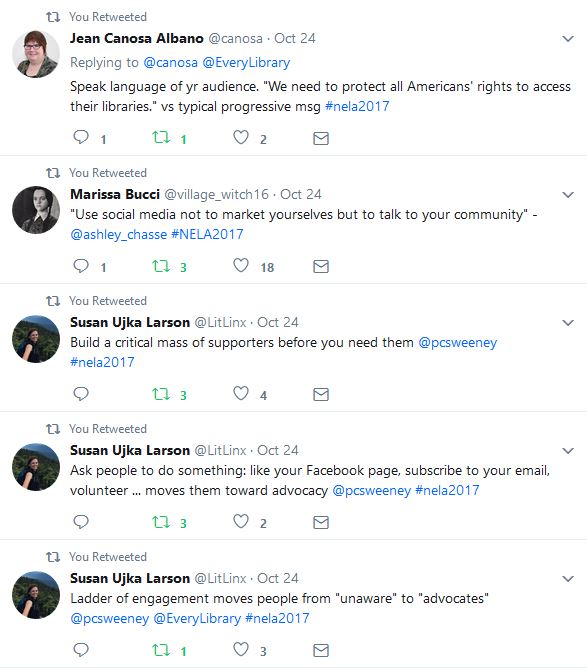
At every library conference, there are a few good souls who tweet key ideas, soundbites, stats, pictures of slides, and other tidbits from the sessions they attend. I didn’t go to the New England Library Association annual conference this year, but I did follow it on Twitter.
A few key themes emerged:
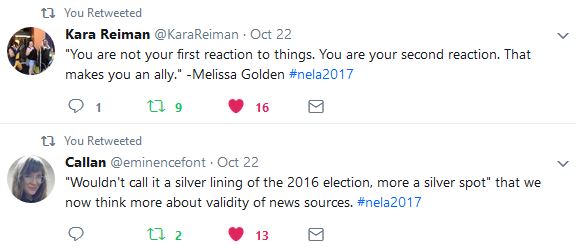
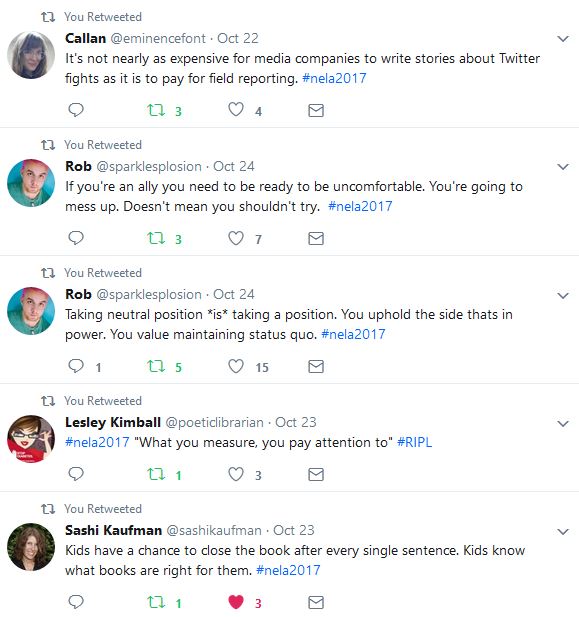
Media: A “silver spot” (not so much as to be a lining) of the 2016 election is the resulting heightened awareness of fake news and the importance of media literacy. A related point is that news organizations, pressured by the 24-hour news cycle and the lure of clickbait (clicks = revenue), may opt to cover “Twitter fights” instead of paying journalists for real field reporting.
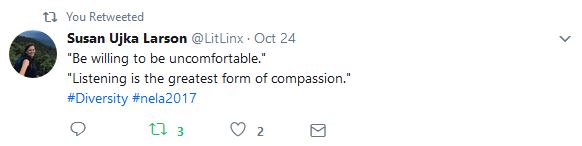
Allyship and “neutrality”: As my co-worker tweeted, “Taking a neutral position is taking a position”; it supports the status quo. Being an ally for historically marginalized populations may be uncomfortable – “You’re going to mess up. That doesn’t mean you shouldn’t try.” It is not your first reaction but your second that makes you an ally. Be willing to be uncomfortable, be willing to listen with openness and compassion.
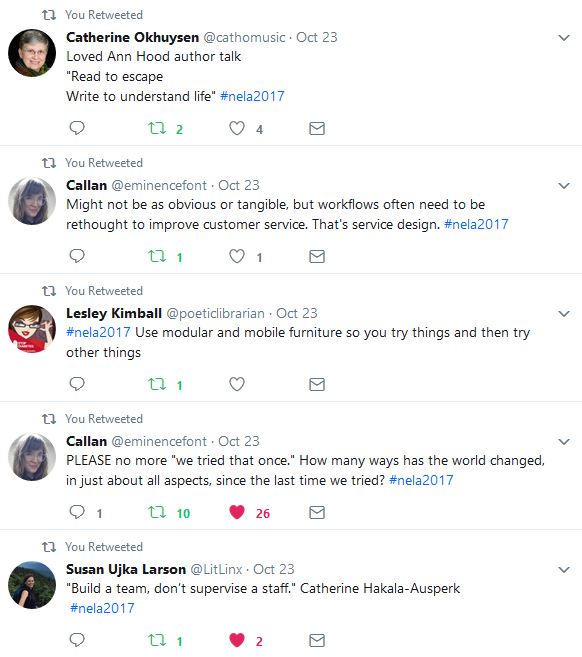
Ch-ch-ch-changes: Think outside the box, move things around (mobile furniture!), try new ideas – and don’t use the “we tried it once and it didn’t work” excuse. When was the last time you tried? Changes in staff, the community, or technology may make an idea that failed last time succeed this time. This applies to workflows as well. Why do we do the things we do the way we do them? Does the original reason still apply, or would doing things a different way make more sense now (and serve patrons better)?
Library, community, and social media: Social media is more of a conversation than a lecture; use the library social media accounts (Facebook, Twitter, etc.) as an engagement tool, not just a marketing device. PC Sweeney, political director of EveryLibrary, advised libraries to “build a critical mass of supporters before you need them,” raising awareness and encouraging advocacy. (EveryLibrary is “the first and only national organization dedicated exclusively to political action at a local level to create, renew, and protect public funding for libraries of all types.”) It’s also important to “speak the language of your audience,” for example, “We need to protect all Americans’ rights to access their libraries.”
Statistics: “What you measure, you pay attention to.” And you pay attention to what you measure.
Kids and reading: “Kids know what books are right for them.” They can close a book at any time if they are scared or confused.
It sounds like the author talks – Ann Hood, Adam Gidwitz, and Garth Stein – were all wonderful, as well.
Thanks to those NELA participants who tweeted from the sessions!
Back in January, there was a one-day conference called “Libraries in a Post-Truth World,” where panelists, presenters, and participants discussed the problem of “fake news,” the spread of misinformation/disinformation, the nature of truth, and what role librarians can play to help boost information literacy and media literacy. (And more. It was a pretty packed conference. See blog posts one | two | three.)
Another conference this month grew out of that one; the Massachusetts Library Association (MLA) Intellectual Freedom / Social Responsibilities Committee planned it, and it was held at Tower Hill Botanic Garden in Boylston, MA, which is by far the most beautiful place I’ve ever attended a conference.
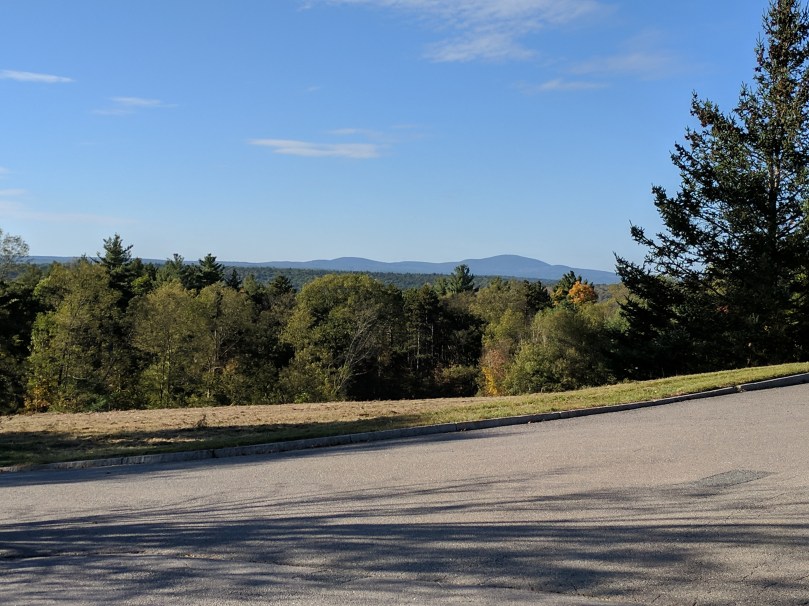
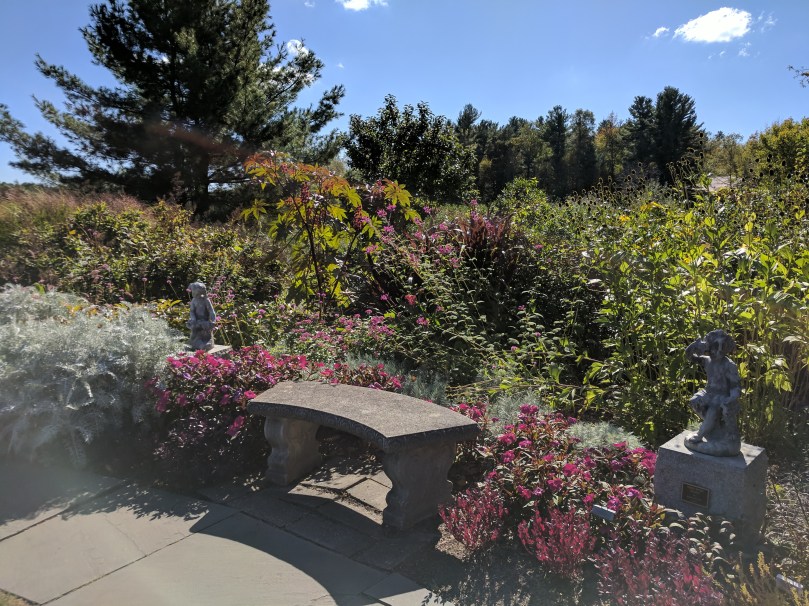
View from Tower Hill Botanic Garden
The first speaker was Gail Slater, General Counsel for the Internet Association, based in Washington, DC. She had also spoken at ALA’s Midwinter conference in Boston, where she said she realized that “Librarians are the first responders and guardians of the Constitution” (a nice way to win over your librarian audience right away).
Slater’s topic was “The Right to Be Forgotten: Rulings in the EU, Their Impact on Global Internet Companies and Pending Legislation in the United States.” She spoke about “a wave of public policy challenges” to do with the internet now; one of the key questions is about internet companies’ (“online intermediaries”) responsibilities in terms of content posted by users. At the moment, Section 230 of the Communications Decency Act protects them from liability, but this “safe harbor” law may change.
Slater then moved on to speak about the Right to Be Forgotten. In a key case from Spain in May 2014, the European Court of Justice ruled that search engines are responsible for the content they point to. People in the EU have the right to be forgotten; they can petition Google to de-index links to content about themselves, as Mario Costeja Gonzalez did in the Spanish case. The information itself still exists, but a search engine won’t bring it up.
A hanging plant, Tower Hill Botanic Garden
Google handles these requests, weighing the public’s right to know against the individual’s right to privacy. Slater explained that in the EU, they place a higher value on the right to privacy, while in the US, we place a higher value on the right to know and free speech. This is “one of the bigger issues” on the geopolitical scale.
During the Q&A, someone asked a very good question: If a person can claim the Right to Be Forgotten or right of erasure, can a corporation claim it? Slater thought there were two reasons this was unlikely, even in the EU: first, the definition of a “data subject” is an individual citizen, not a corporation; and second, the request itself would become a news event, reminding everyone of the original story that the corporation is trying to erase.
Someone else asked what librarians can do about some of these issues. Slater said librarians can speak out about the importance of speech and the right to know. In the EU, privacy is considered a human right, but free speech is important too. She spoke of these as “competing equities” that require a careful balance.
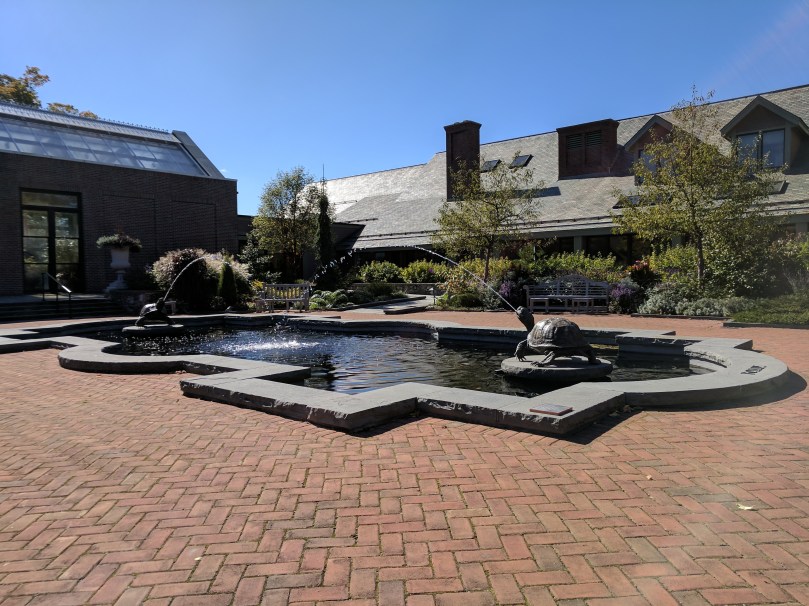
Turtle fountains in the Winter Garden, Tower Hill Botanic Garden
The second speaker was Shawn McIntosh, Assistant Professor of English and Digital Journalism & Communications at Massachusetts College of Liberal Arts. His topic was “Journalism Today: Learning to Trust the First Rough Draft of History.” Unlike Slater, he read a prepared speech, in the manner of a formal lecture. Rather ironically, he quoted Jay Rosen: “Journalism is a conversation, not a lecture.”
McIntosh spoke about what has and hasn’t changed in journalism. “Fake news” isn’t new, of course – there has always been propaganda, biased and partisan writing, and satire. However, “Willingness to accept the lies or spin them as ‘alternative facts’ or not caring is new.”
McIntosh said that his background in strategic communications (a.k.a. PR, a.k.a. “the dark side”) had been helpful: knowing how and why persuasion works, and how attitudes can be impervious to change even/especially when confronted with facts gives perspective to the news climate today. “Beliefs,” he said, “eat facts for lunch.” Research shows that presenting facts to counter someone’s beliefs does not work to change their minds (a disappointing thing for a roomful of librarians to hear).
Over the past few decades, McIntosh said, there has been a broad shift that is “dangerous to our civic and cultural life,” an erosion of public trust in experts and institutions. Journalists are seen as biased and untrustworthy sources. (Librarians, on the other hand, enjoy a high degree of social trust.)
A tree with fall foliage, Tower Hill Botanic Garden
What are the obstacles? Journalists are overworked and underpaid, and employees and coverage are being cut back, so there is more use of wire service content and less reporting on local issues. Less advertising leads to more cutbacks in a downward spiral. And the 24-hour news cycle certainly doesn’t help.
What can be done? “Journalism has to get back to its roots and break free from its modern traditions.” Rather than attempting or pretending to be objective, journalists must provide context for their stories. “Narrative and stories are how we make sense of the world….News is socially constructed. Acknowledge that.” Furthermore, because of mass communication and social media, the lecture style of journalism no longer works; it must be a conversation. Within this conversation, though, “people will seek trusted voices,” and curation (the librarian ears perk up) “will play more of a role than it has so far.”
In this environment, McIntosh said, “Developing higher-order critical thinking skills is crucial….News literacy and information literacy skills are vital.” Librarians, of course, are on board with information literacy and media literacy, but McIntosh also said, “It can’t be all consumption, it must be production too.” People need to look under the hood to get an idea of how things work. Here, he said, is a “natural place for libraries, educations, journalists to meet.” People meeting face to face in libraries and classrooms can lead to “exchanges and dialogues between people of different views, [which] can start to break down polarization.”
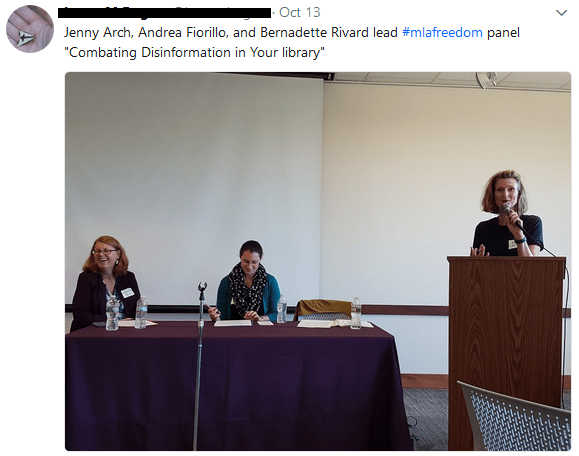
After a lunch break and a walk around the beautiful grounds, we reconvened in the conference room for a panel on “Combating Disinformation in Your Library.” I spoke, along with Andrea Fiorillo of the Reading Public Library and Bernadette Rivard of the Bellingham Public Library, about what we have done in our libraries to increase information literacy and media literacy.
Bernadette Rivard, Jenny Arch, Andrea Fiorillo
Last December, Bernadette wrote a blog post encouraging library users to “think before you share,” and giving tips on how to evaluate news sources. Andrea ran a “civil civics” series, bringing in speakers such as Melissa Zimdars (who was on the panel at the January conference; she also got online access to newspapers for the library’s patrons. (Most libraries still subscribe to newspapers in print, but because most people read the news online, digital subscriptions are another way the library can help connect people with quality information.) I spoke about my “What Is Fake News?” pamphlet, display, and library blog posts, and went over some tips that I’ll be sharing in a future library blog post.
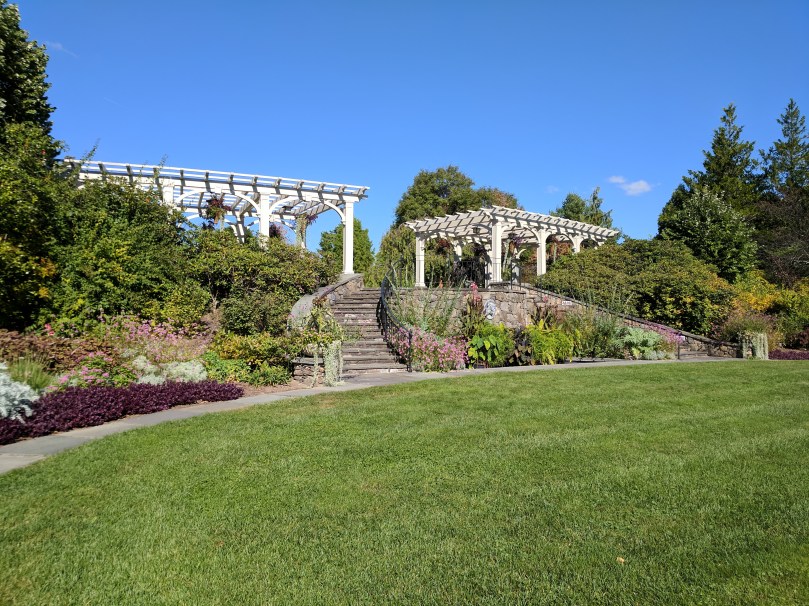
View of the pergolas from the Secret Garden
After the panel, we returned to our tables for small group discussion on the following four questions:
What does the term “fake news” mean for librarians and the communities we serve?
What are some creative and traditional approaches for librarians to support First Amendment awareness and education?
What are your library’s barriers and supports to promoting media literacy?
What has your library done and what would you like to do to support media literacy?
Conference organizers will be compiling the replies and sending them out to participants, so I may share those here later. At our table alone, we had a mix of public librarians (children’s and adult) and school librarians; I imagine academic librarians would have had a different set of answers. The hashtag for the conference, #mlafreedom, purposely didn’t include a date, so it may be used for related events in the future.
What does your library do to promote information literacy and media literacy? What role(s) do you think librarians can play in our current information environment? Do you have blog posts or handouts to share?
Arts and crafts didn’t end after elementary school like I expected they might. I put some basic arts and crafts (and graphic design) skills to work almost every month at the library (File under: “things they didn’t teach you in library school”). We have three main display tables, plus a set of shelves used seasonally (teen summer reading prizes in the summer, holiday CDs in November and December), and we change the displays every month. Rob’s awesome displays challenge the rest of us to up our game!
What’s the purpose of library displays? They convey information; they offer entertainment or humor; they ask passers-by to stop and engage (many of our displays have interactive elements); they highlight parts of the library collection; and they give people something to look at while they wait in line.
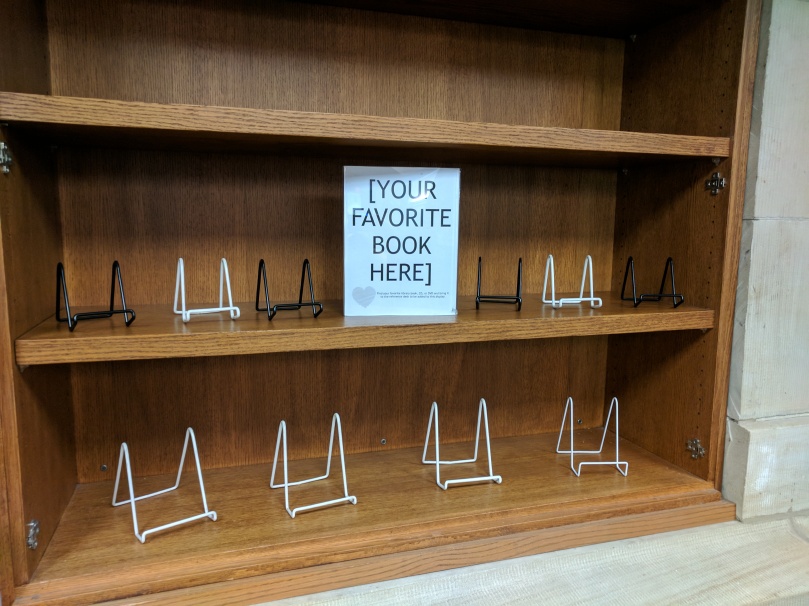
This is the simplest possible display: empty book stands with a sign that reads “[YOUR FAVORITE BOOK HERE]” and directions for how to add a book to the display. This display encourages engagement and participation by asking library users to recommend books (or movies or music) to each other.
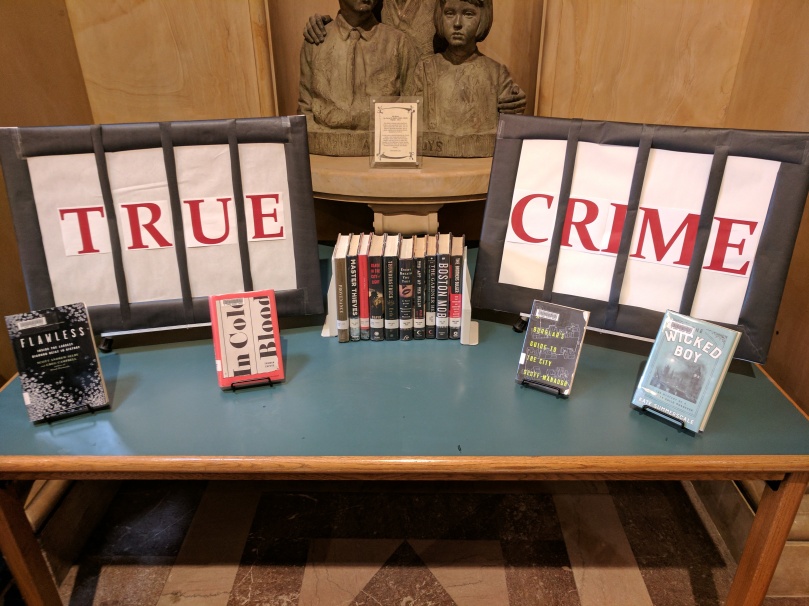
Sometimes displays feature a specific area of the collection; in this case, I highlighted our true crime books. It was very easy to pull books for this display, as they’re helpfully grouped in 364 (for Dewey nerds). I was pleased that I was able to pull off my vision of getting the words “TRUE CRIME” to look as though they were behind bars while still being legible. (The stone statue behind the table is not part of the display.)
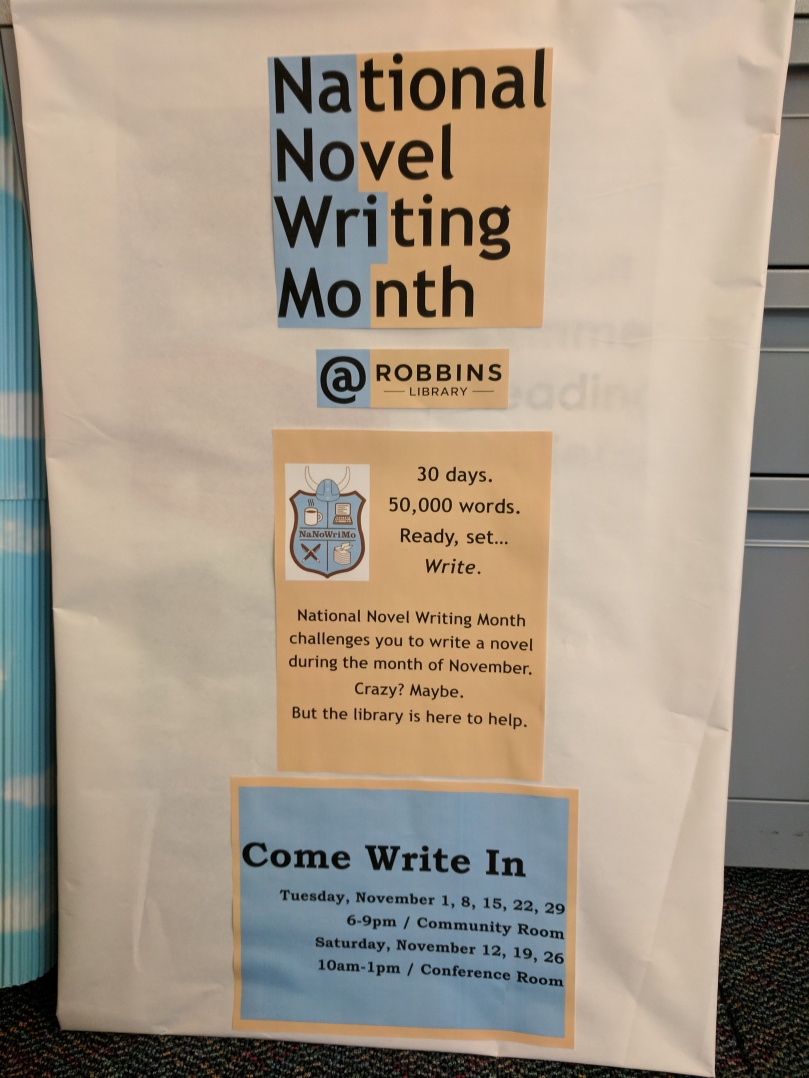
Some displays are annual; this one is part of last year’s National Novel Writing Month display. We hosted “Write-Ins” throughout the month. The display table included the schedule of write-ins and a word count calendar, along with some library books about writing, and the official NaNoWriMo poster for that year.
Not everyone knows what NaNoWriMo is, so I wanted to find a way to include both the whole name and the nickname; I achieved the effect by changing the background color behind the text. (I made this in Publisher, which gives the user more control and precision than Canva, plus it has the eyedropper tool that allows you to pick colors from a graphic or image and use that exact color for text or background; I used colors from the one of the NaNoWriMo graphics. Canva has other strengths, though!)
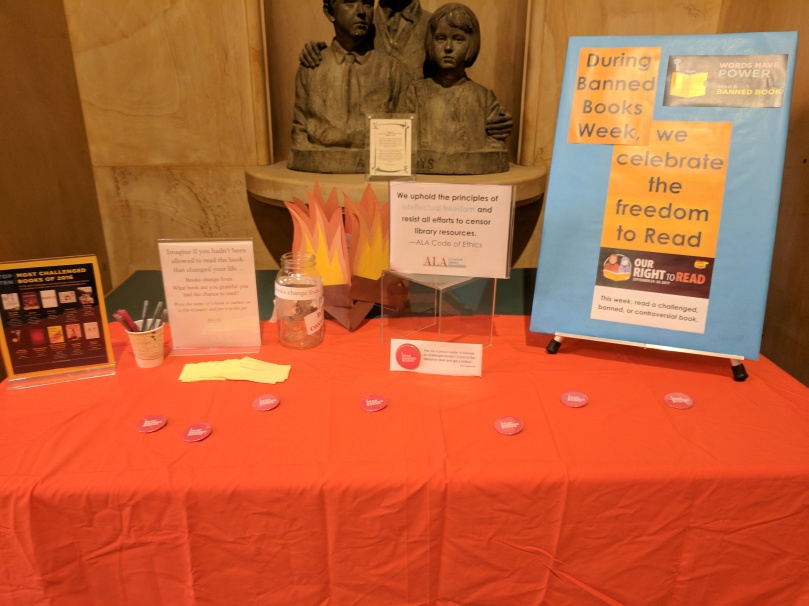
I always put up a display for Banned Books Week at the end of September; this one features a poster, a quote from the ALA Code of Ethics, an infographic from the ALA Office of Intellectual Freedom, some “I read banned books” buttons that I made, a small fake bonfire, and – my favorite interactive element – the “books change lives” jar, with comment cards and a cup of pens. The week after Banned Books Week, I pull the responses from the jar and write a blog post for the library.
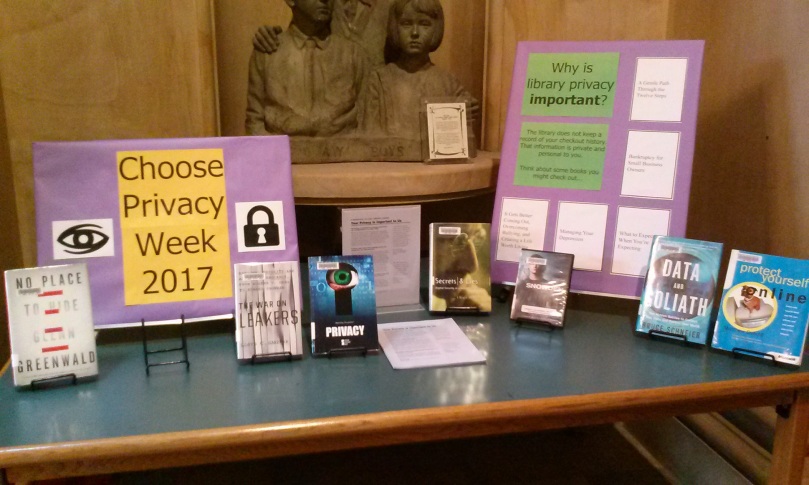
Choose Privacy Week is another annual display, in the first week of May. For this display, I designed two poster boards using simple, bold graphics and bright colors. The poster on the right in the photo that asks “Why is privacy important?” answers its own question in part by including the titles of library books that people might not want others to know they had checked out, from Managing Your Depression to What to Expect When You’re Expecting to It Gets Better.
I also included a fact sheet from ALA and books and DVDs about privacy from the library collection. People are always welcome to take library materials from the display to check out.
For Choose Privacy Week in 2015, I used a series of “True or False?” questions about privacy with answers under a flap of paper, so patrons were encouraged to interact with the display to get the answers.
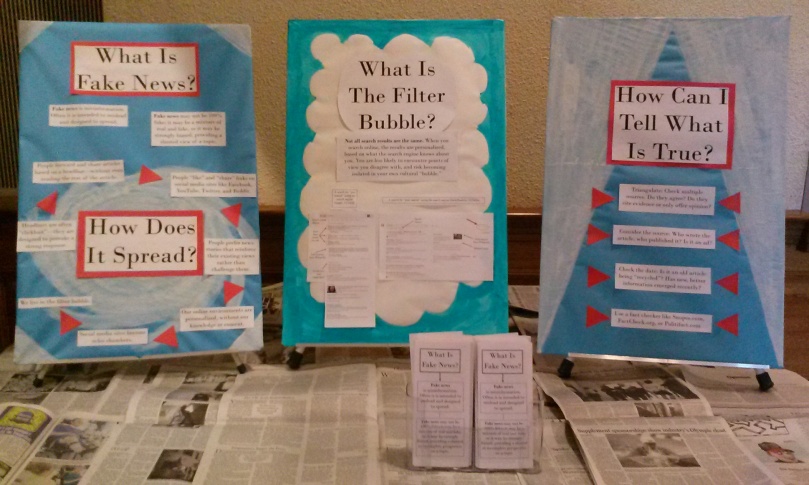
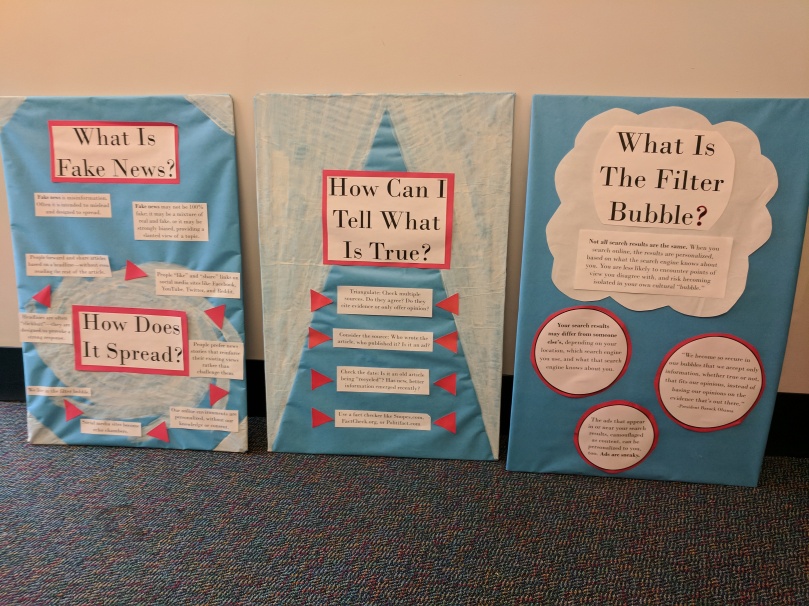
I started off the year with a “What is fake news?” display. Instead of using a tablecloth or butcher paper to cover the table, I used old newspaper. I put together three informational poster boards (a bit more text-heavy than usual), and included copies of a pamphlet with information about “fake news”: what is it, how it spreads, how to avoid spreading it yourself. (Basically, how to be a responsible information consumer. A PDF of the pamphlet is available here.)
I updated one of the boards (“What is the filter bubble?”), as I will be bringing them to a conference and a class later this month.
None of these are particularly flashy – Rob might say I don’t use enough glitter, for one thing, and I could use more 3D objects and props – but I hope they get the point across. Do you make displays for your library? What are some of the ones you’re proud of? What materials and techniques do you like to use?
The most recent issue of Kirkus is a “diversity issue,” with about 40 pages of articles and essays that give different perspectives on diversity in literature. I’m still making my way through it, but I loved this quote from author Padma Venkatraman:
“Books are more than mere mirrors or windows; they are keys to compassion. And novels don’t just expose readers to differences, they allow readers to experience diversity. They allow us to live within another’s skin, think another’s thoughts, feel the depths of another’s soul. Novels transport, transform, and, most importantly, allow us to transcend prejudice. When we immerse ourselves in characters whose religions are different than our own, our empathy is enhanced. We move closer to embracing people of all religions.”
It reminded me a bit of the way Neil Gaiman talks about fiction (“Fiction can show you a different world. It can take you somewhere you’ve never been”), and what Caitlin Moran wrote in her essay “Alma Mater” about growing up in the library:
“The shelves were supposed to be loaded with books – but they were, of course, really doors….A library in the middle of a community is a cross between an emergency exit, a life raft and a festival. They are cathedrals of the mind; hospitals of the soul; theme parks of the imagination….They are the only sheltered public spaces where you are not a consumer, but a citizen instead.”
When Venkatraman writes about mirrors and windows, she is referencing Rudine Sims Bishop’s 1990 article “Mirrors, Windows, and Sliding Glass Doors.” Books that are mirrors reflect the reader’s self and own world back at them; books that are windows show the reader another person or people and world; books that are sliding glass doors allow the reader to “enter” another world.
The San Antonio Public Library page “Diversity in the Classroom: Building Your (Early Childhood) Library with Mirrors and Windows” has a video clip of Bishop from January 2015. In it, Bishop says, “Children need to see themselves reflected, but books can also be windows, so you can look through and see other worlds, and see how they match up or don’t match up to [your] own. But the sliding glass door allows you to enter that world as well, so that’s the reason diversity needs to go both ways.” She says that just as children of color need to see themselves in books, white children – who see plenty of themselves in books – need to see characters of other cultures, races, and religions as well, to provide a more accurate picture of the world as it is (“colorful”).
The #WeNeedDiverseBooks movement FAQ page cites an infographic produced by multicultural publisher Lee & Low Books (“About everyone. For everyone”), which used statistics from the Cooperative Children’s Book Center and census data. Although 37% of the U.S. population are people of color, only 10% of published children’s books contain multicultural content. Note that that includes books where the main character might not be a person of color, and it also doesn’t mean that the author was a person of color.
Where do we go from here? We need more diversity at all levels of publishing, in libraries, in schools, in the bookselling business. We need to write, publish, read, and promote diverse books; “multicultural books don’t sell” is no longer a valid argument, if it ever was. We need more stories about more different people and places. We’re getting there, but too slowly.
8/17/17 Edited to add:
As I made my way through the rest of the issue, I found two more quotes I wanted to share. The first is from Megan Dowd Lambert, an author, senior lecturer in children’s literature at Simmons, and Kirkus reviewer; she in turn is quoting Mary Robinette Kowel:
“It’s not about adding diversity for the sake of diversity, it’s about subtracting homogeneity for the sake of realism.”
Though our society is far more segregated than it ought to be, and some kids may rarely see people outside of their own race, culture, or class, the world is “colorful” and literature ought to reflect that. In fact, books are where many people encounter new ideas and perspectives and learn about the world. “Armchair traveling” isn’t just for seeing the lives of ancient royalty, dangerous mountain-climbing expeditions, or sea voyages; it may be a way to see into the next neighborhood.
“…Disability comes from scarcity and environment and other people’s prejudices as much as the body. Silencing the word can silence real injustices, emotions, and experiences. Diverse books are tools for empathy, but we can’t address what we won’t say.”
This is from Amy Robinson, children’s librarian and Kirkus reviewer. She makes an important point about environment contributing to disability. Are our built environments inclusive, or do they present barriers? (Do elevators work? Are aisles wide enough? Are there ramps or only stairs? Is signage large and clear? Are there curb cuts on sidewalks? Are sidewalks even or broken, covered in snow or cleared?) In many cases, a disability may only present extra difficulty because of obstacles in the world – in the built environment or as part of prevailing cultural and societal ideas. Let’s figure out what those obstacles are (it’s often very hard to imagine, so ask people who confront them) and start removing them.
 The
The 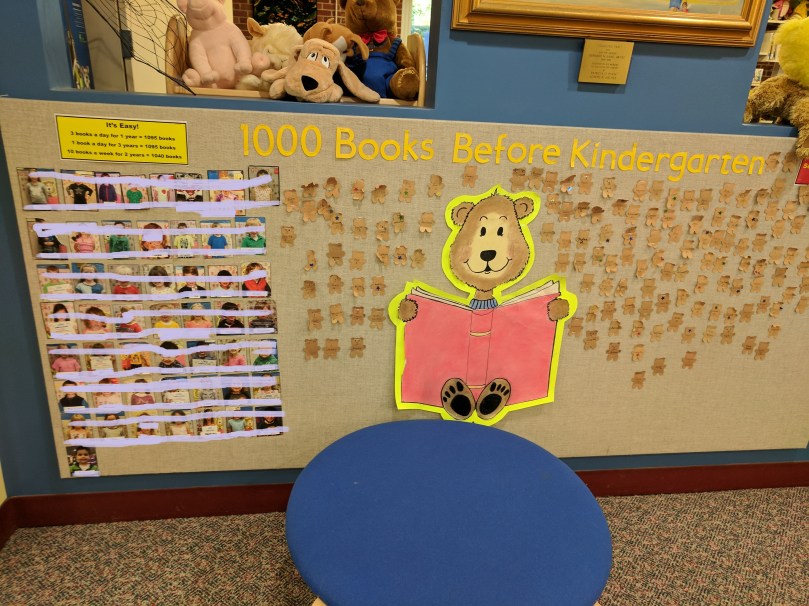




 Where do we go from here? We need more diversity at all levels of publishing, in libraries, in schools, in the bookselling business. We need to write, publish, read, and promote diverse books; “multicultural books don’t sell” is no longer a valid argument, if it ever was. We need more stories about more different people and places. We’re getting there, but too slowly.
 Jenny Arch