Libraries in a Post-Truth World

On Thursday, January 26, I attended a one-day conference hosted by Phillips Academy in Andover called “Libraries in a Post-Truth World.” There was some helpful pre-conference reading about fake news and hoaxes, information overload, and media literacy:

Why America is Self-Segregating” and “Did Media Literacy Backfire?” by danah boyd, January 9 & 10, 2017

Many Americans Believe Fake News Is Sowing Confusion,” Pew Research Center, December 15, 2016

The Real History of Fake News,” Columbia Journalism Review, December 15, 2016

At Sea in a Deluge of Data,” Alison J. Head and John Wihbey, The Chronicle of Higher Education, July 7, 2014

Mike Barker, Director of Academy Research and Library Services at Phillips Academy, introduced the morning’s panelists:

John Palfrey, Head of School, Phillips Academy, and author
Mary Robb, Teacher, Media Literacy and Democracy, Andover High School
Adam Schrader, Former Facebook editor and news fact checker
Damaso Reyes, Program Coordinator, The News Literacy Project
Melissa Zimdars, PhD, Assistant Professor of Communication at Merrimack College
Catherine Tousignant, English Instructor, Phillips Academy
Alison Head, PhD, Project Information Literacy
John Wihbey, Assistant Professor of Journalism and New Media at Northeastern University
Claire Wardle, First Draft News
Ben Sobel, Fellow, Berkman Klein Center for Internet and Society, Harvard University

The panelists were all informed and articulate, experts in their fields; they could have spoken for much longer, but we used the rest of the day for two presentation sessions (Damaso Reyes on The News Literacy Project and Checkology, Alison J. Head on Project Information Literacy), identifying areas of focus for the afternoon discussion, reforming into discussion topic groups, and reporting our results to the other participants.

“Librarians are good at ferreting out what exists and good at making partnerships. Librarians are in the right position to make an impact.” -Alison Head

I attended Damaso Reyes’ presentation on Checkology (“how to know what to believe”), a news literacy program designed for 6th-12th grade students. Reyes showed us videos created for the program (Peter Sagal was in one!) and guided us briefly through the four modules: (1) Filtering news and information; (2) exercising civic freedoms; (3) navigating today’s information landscape; and (4) how to know what to believe. Some key takeaways:

  • “Information literacy is not what it should be in our society, and that’s a threat to our democracy.”
  • When reading/listening to/watching news, ask: What is the primary purpose of this information? (To inform, to entertain, to convince, to provoke, etc.)
  • Consider the role of algorithms and personalization. The information you’re getting is filtered – think about how and why.
  • Trying to teach students to be skeptical, not cynical.
  • Critical thinking & skepticism is an important skill, and should not be outsourced to technology even if it could be (e.g. plugins). “We shouldn’t depend too much on technology to save us.”
  • What you share online has your credibility attached to it.
  • We are all susceptible to confirmation bias.
  • Society stops functioning if we can’t agree on some things (i.e. facts). A fact is something we can all agree on but it is also something we can independently verify.

After the presentation, we talked in small groups to come up with discussion topics for the afternoon. Two of the Phillips Academy librarians sorted our ideas into loose categories:

Partnerships & Collaboration with Faculty
Partnerships & Collaboration with Community
Professional Development
Fact, Truth, & Trust (I was in this group)
Access to Information
Lesson Plans
Teaching Approach
“Other”

I will be writing another blog post (or two) soon about the morning panel and the afternoon discussion. In the meantime, I’d like to share a handout I made for my library to accompany our display on media literacy. Here is the PDF of the tri-fold pamphlet: updated 2/16/17, 3/1/2017 – I have made a new version without the Robbins Library logo, with a Creative Commons license. Please feel free to use and share: 2017-01-fakenewsbrochure-update-2017-03
Advice for 21st Century Libraries

Recently, a trustee from another library in Massachusetts contacted me to ask for some thoughts on the future of libraries, and how best to design for that future. She said her library was “at a crossroads,” but may soon have the opportunity to renovate their current building or build in a new location. She was taking the wise step of seeking information and opinions from a variety of perspectives before launching any action. Here, then, is some of my advice for libraries looking to the future:

  • If you’re lucky enough to get a building grant (or another source of funding to make changes to a current building or build a new one):
    • Consider the way that patrons are using your library now, but also consider other ways people might use the space. Make it as flexible as possible, with modular furniture and movable stacks.
    • Get as much natural light as you can. This includes basement levels (children’s and teen departments are often downstairs, as are meeting rooms, and staff work space).
    • When choosing an architect, make sure they have designed libraries before. Talk to staff – not just directors, but all staff, from circ to reference to children’s – to see what they like and dislike, what works and what could be improved. Staff on the “front lines” have a lot of valuable knowledge that an architect should consider: the importance of sight lines between desks, the location of bathrooms, the varying temperature zones in different areas of the library.
  • Have places for people to meet: large meeting and program rooms, smaller study rooms, open areas with tables for group work. Study rooms are in demand at most public libraries, and larger rooms can be used (for free or for a fee, depending on library policy) by community groups, which may lead to partnerships between those groups and the library.
  • Make the space welcoming. Natural light, comfortable furniture, perhaps some bright colors or a particular visual element – like a mural in the children’s area – encourage people to come in and stay for a while.
    • And if you give a mouse a place to stay for a while…he’s probably going to ask for milk and cookies. Do you have (or can you add) a coffee shop or cafe? At the very least, consider scrapping policies against food and drink in the library, at least in some areas.
  • Who uses the library? Are you missing certain demographics (age, income, race)? How do you encourage those people to use the library?
  • Where are the teenagers? Talk to teen librarians. In my experience, they are some of the most enthusiastic and creative librarians in the profession, bubbling over with outside-the-box ideas, and they have incredible problem-solving skills. How can you support them to make the teen space inviting, either in terms of furniture, materials, technology, or programming? Teen space in the library should be distinct from children’s space and adult space.
    • Is there a good library in the middle school and high school? Support your teen librarian’s efforts to connect to teachers and school librarians. Consider offering programs that are more fun than educational – games, arts and crafts, movies.

The two most important things I hope that library directors and boards will take into account when planning for the future are the following:

Get buy-in from library staff, library users, and people in the community who don’t use the library. (Why don’t they come in? What could you offer that would attract them?) Not everyone will be excited about change, but if you can get a few “early adopters” on board, they will bring others with them. Bottom-up change is usually more successful than top-down change, so get input from every level.

Design for flexibility. We can’t see the future, but we can safely assume it will be different from the present. Make your space as flexible as possible so that you can make changes to meet unforeseen needs and wants: renovations and new furniture are expensive, so make them count. And remember to prioritize accessibility, not simply to fulfill ADA compliance, but because the library should be welcoming and easy to use for everyone.

Do you work in a library? Are you a library user? What do you think are the most important things to keep in mind when planning for the future of a library?

Caitlin Moran discusses her Moranifesto

Cover image of MoranifestoOn November 30, journalist and author Caitlin Moran (pronounced CAT-lin mo-RAN) spoke in conversation with Boston Globe columnist Meredith Goldstein at the Brattle Theater in Cambridge, hosted by the Harvard Bookstore. It was dark and rainy, but good to be in a room full of feminist librarian types. I haven’t yet read Moran’s newest book, Moranifesto, but I loved her book How to Be A Woman and her previous essay collection, Moranthology. I initially discovered her via her essay “Alma Mater” in The Library Book, and I still think of a passage from it often:

“The shelves were supposed to be loaded with books – but they were, of course, really doors….A library in the middle of a community is a cross between an emergency exit, a life raft and a festival. They are cathedrals of the mind; hospitals of the soul; theme parks of the imagination….They are the only sheltered public spaces where you are not a consumer, but a citizen instead.”

-“Alma Mater,” Caitlin Moran

Like most of the audience, I was prepared for Moran to be her unselfconscious, energetic, hilariously uncensored self, and she launched in right away about having just gotten her period and being on codeine (which I’m pretty sure you cannot get over the counter in this country) and coffee. The coffee was winning, I think, because she was talking faster than Lauren Graham.

In shifting from writing about pop culture and feminism, Moran said that at first she had felt “ill-qualified” to write about politics, but gained confidence when she realized that many political figures were former journalists. She stated, “Politics does not work anymore,” and said that we need to form new political parties in the U.K. and U.S. Moran believes in action: “If you started complaining three minutes ago, you should’ve started doing something two minutes ago.”

Of certain of our current political figures, Moran said, “These are not politicians, they are agents provocateurs.” She said that the tone of politics has been set by the Internet, which is  largely young, male, and lawless – “like California during the Gold Rush.”

“EVERYTHING is going to change in the next twenty years.”

Moran believes the left’s biggest enemy is itself. Whereas the goal of conservatism is to keep things as they are (the status quo), the left has two goals: to redistribute power and to invent a future. It is far harder to create something new than to preserve something, which leads to greater dissent, even among those who agree on a progressive agenda.

Moran read from one of the essays in Moranifesto, “Advice to Teenage Girls.” Some of her advice:

  • “‘Yet’ is a very useful word.”
  • “When in doubt, listen to David Bowie.”
  • “Go out there and change the world so it works for you.”

“I think everyone should write a manifesto,” Moran said. What will her next book be? How to Be Famous. “Celebrities are the Greek gods of our time.”

Q&A

The questions from the audience were mostly serious, but the answers ranged. In one case Moran’s answer skittered so far from the topic of the question so quickly that the only possible explanation is a tesseract. Suffice to say that Moran has clearly given the issue of Muppet sex some thought. Her answer offended an audience member; Moran listened to the complaint and responded that she was glad the person had spoken up: “I try to make everyone feel like they can say anything.”

Another audience member asked how we can encourage a cultural shift so that sexual violence and rape is taken seriously? Moran’s idea is to drop the word “sexual” in front of the word “assault”; “physical assault” sounds more serious.

Moran also talked about the online environment and social media. She said, “If you had a town planner, they’d never build the Internet the way it is. There are no safe public spaces….We need to find a new way [of designing and using social media]. This is a “problem of culture, not politics.” There is more money in argument and dissent than in agreement, thus “the world becomes angrier and more afraid.” The U.S., Moran pointed out, will never be invaded – our biggest danger is ourselves (internal dissent).

Ending on a serious note, Moran said that the Brexit vote and the Trump election are part of the same phenomenon, dating back to the 2008 crash. Neither approach of the current political systems – austerity or stimulus – brought anyone to justice for the events of 2008. Instead, the strategy of those in power to stop a revolution was to create a sub-class so people’s anger was directed down instead of up (to the elite).

And back out into the rainy night we went.

Flaunt It, Baby: Creating Inventive Library Displays

I’ve had this “creative library display ideas” post kicking around in my drafts folder here for the better part of a year, and I realized…someone else should write it. Specifically, my kickass colleague Rob Lorino (@lostboybrarian), because he makes some of the best displays I’ve ever seen. Take it away, Rob!

Confession: Making displays is probably my favorite part of being a librarian.  I think that’s due in part to my photography background.  I tend to put photographers in two categories:  there are the documenters, who try to capture the world as they see it, and there are the constructors, who create objects, situations, and worlds to photograph.  I’m firmly in the latter camp, and the skills I’ve developed creating props, outfits, and more for photo shoots have really lent themselves to the art of display making.

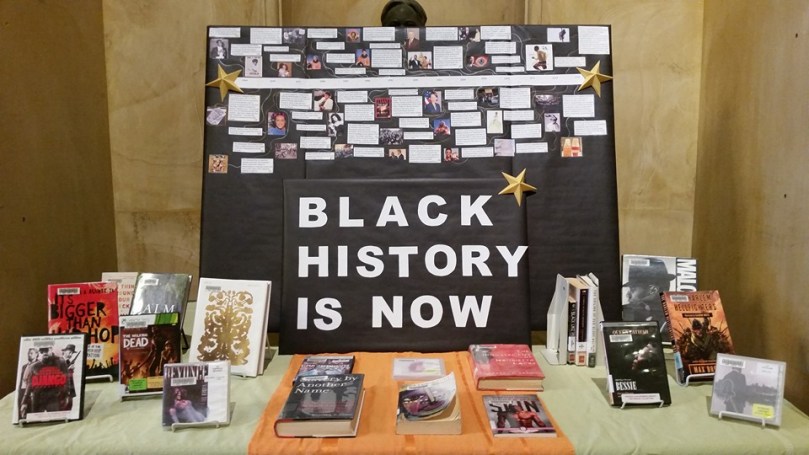
ral_bhm
The Black History Month display featuring a timeline of events from the 1960s-present, as well as a variety of materials to check out.

Photography background aside, why do I love making displays so much?  Making displays combines creativity, problem solving, and self-promotion.  (Or is that shelf-promotion?)   You get instant feedback and can see how patrons are responding.  Honestly, it’s still a small rush for me every time I see an empty spot on one of my displays.  It’s also value added for your patrons by collecting materials that don’t necessarily get shelved together.  Sure you can point patrons to the 970’s if they’re looking for books for Black History Month, but you’re missing so many other areas that are just as relevant to Black History month: biographies, parts of the 300’s, movies, music, etc.

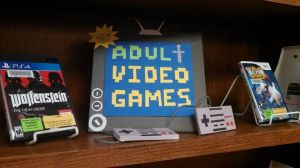
ral_videogames
A display highlighting the new collection of adult video games.

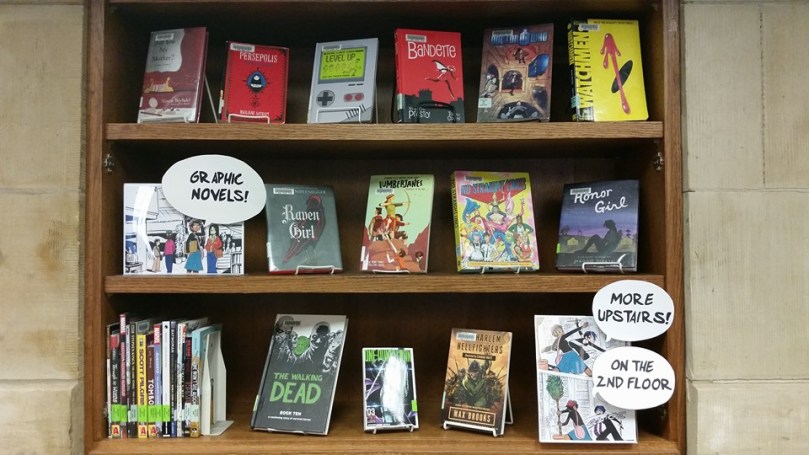
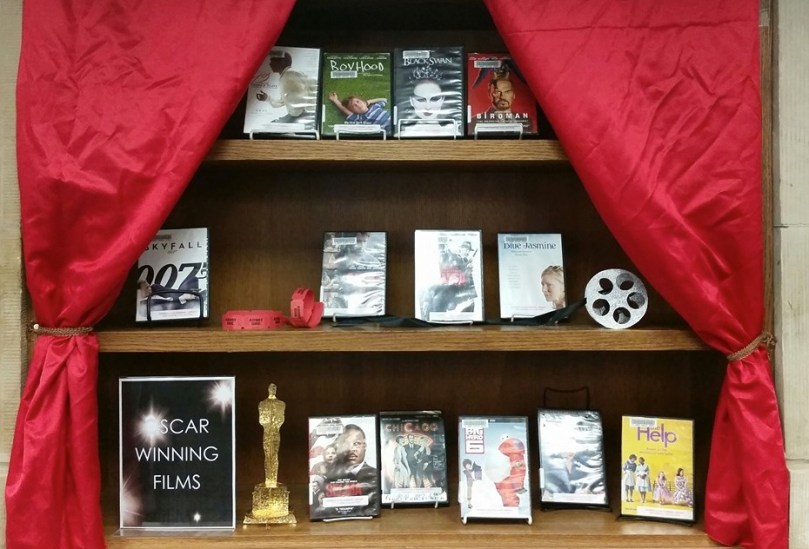
I’ve been lucky enough to work in libraries that have pretty much allowed me carte blanche in terms of selecting themes for my displays.  I largely pick a theme based on what’s been on my mind recently; but that’s not me being lackadaisical. If you’re paying attention to current events and pop culture, what’s on your mind will in all likelihood be what’s on your patrons’ minds.  I’ve done displays based on holidays, like Black History Month and Banned Books Week. I look to current events as well, like with my display of Oscar-winning films.  Sometimes I’m inspired to highlight a collection that I know some patrons don’t know we have, like Playaways or graphic novels.  Other times I’ll use the season or other feature of a month to get a little punny, like a “cold-hearted characters” display I did in December, or a “fall into adventure” display of autumn-colored covers I did in November.  Displays are a great way to show off new collections too:  I made a display celebrating the addition of adult video games to our collection.

ral_graphic
A display of graphic novels with speech bubble text.

After I’ve got a theme, I try to visualize what I want my display to look like.  Bold, graphic, and unexpected are adjectives I try to keep in my head throughout the process.  For me, displays are places to catch patron’s attention visually, not necessarily places to feed patrons lots of information.  If you can do both, that’s great!  But the visual impact is key to making patrons walk over and engage.  Don’t muddy the waters by putting too much on your display – negative space is just as important as your visuals.  It’s also important to remember that books or other materials will be occupying the same space as the rest of your display.  You’ll want to remember to make sure that the materials don’t get in the way of important parts of your display.  The materials will also be another layer of visual interest, which is why I try for more simple but graphic visuals on my displays.

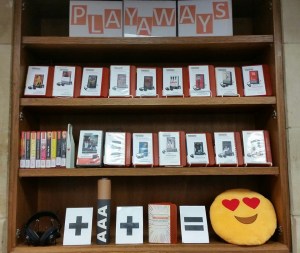
ral_playaway
A display of Playaways featuring a homemade jumbo AAA battery.

When it comes to the actual construction of displays, I try my best to make or borrow as many elements of my display as possible.  I will occasionally buy a piece here or there if I’m really married to a specific idea, but a lot of times you can make things using really basic materials like construction paper, poster board, card stock, glue, etc.  I recently made a (fake) jumbo size AAA battery using a roll of paper as a base and covering it with construction paper.  Websites like Pinterest and other crafty blogs have innumerable guides and tutorials on how to create pretty much anything you’d need.  Creating interesting lettering or graphics is easier than ever now with software like Publisher, InDesign, and Photoshop, and free online tools like Canva.  I feel like every display I make teaches me something new or a way to be more efficient next time, through trial and error.  Learning things like the fact that painting on card stock might make it warp or that different types of glue are more effective on different materials aren’t necessarily intuitive to folks (like me) that don’t craft all the time.

ral_oscars
A display of Oscar-winning films includes an Oscar statuette, a film reel, tickets, and the movies themselves, all framed by fancy red curtains.

I tend to judge the success of a display by three things: did materials get checked out, did people stop and browse the display, and did patrons comment to staff about the display.  Having materials move off the display is the most obvious, but the other two are just as important.  Even if a patron doesn’t physically take anything from your display, if you get them to notice it you’ve still given them something.  That something could be knowledge of something the library offers. It could be perspective on something in the world; several people relayed that they had an “aha” moment with the tagline “Black History Is Now” I used for my Black History Month display.  It could even just a positive experience, like a chuckle at your bad pun or appreciating the artistry of the display itself.  Sometimes it’s hard to capture the latter two, so if you notice patrons stopping to look at a coworker’s display or if patrons say something nice about a display, definitely let your coworkers know!

I know that thinking up new displays and executing them every month can feel like a slog to some people, but displays are an incredibly important service we provide to our patrons.  They can be a really fun and engaging way to interact with your patrons – don’t underestimate them!

Thanks, Rob! (Again, he’s at @lostboybrarian on Twitter.) Does anyone else have any display ideas they’re proud of? Stuff you’ve always wanted to try? Challenges? Handy crafting tips? Please share in the comments!


Stuff I’ve Been Reading, Online Edition

My online reading habits have shifted over the past few months, both in the amount of time I have to spend reading online (less) and the way I do it (more on the smartphone, less on the computer). It was a little surprising to me how much the device I use determines what content I consume.

I’m still using Feedly (their app is pretty good, though if you go in and out of it, it doesn’t save your place, which is annoying), and reading many of the same blogs as I’ve been reading for years (see this post from August 2013). Some old favorites have fallen by the wayside, particularly webcomics, which don’t display well on the smaller phone screen. I’ve also, happily, discovered some new ones (and am taking recommendations!).

Here are the blogs I’ve kept up with through these months of erratic sleep and limited free time:

Librarian blogs

Linda @ Three Good Rats

Brita @ Library &

Anna @ LCARSLibrarian

Brian @ Swiss Army Librarian

Jessamyn West @ librarian.net

Librarian Problems

I Work At A Public Library

Non-Librarian blogs

Wonderfully weird: Jenny Lawson (author of Let’s Pretend This Never Happened and Furiously Happy) @ The Bloggess

Delicious (if labor-intensive) recipes: Deb Perelman (author of The Smitten Kitchen Cookbook) @ Smitten Kitchen

How to live a “luxuriously frugal” lifestyle (which sometimes dovetails and sometimes clashes with The Life-Changing Magic of Tidying Up): Liz @ Frugalwoods (discovered via this Boston Globe article)

Parenting/humor: The Ugly Volvo (start with her deconstruction of Goodnight Moon)

Technology, privacy, general nerdiness: Cory Doctorow @ Boing Boing (I make a valiant attempt to keep up with this one, but am perpetually behind)

What makes you stick with a blog – content, humor, consistency, post length, post frequency? My ideal right now is a shorter post – several paragraphs, say – a few times a week; most of the blogs above follow that formula fairly closely. What blogs do you read? Whose writing do you enjoy?

Have you ever noticed a shift in your reading habits due to format (print, digital) or device (computer, smartphone, tablet)?

Designing Interactive Library Spaces and Collections

During the month of March, I took an online workshop called “Designing Interactive Library Spaces and Collections” through the Simmons School of Library and Information Science Continuing Education (SLIS CE) program. The brief course description was:

“Modern library practices and strategies are driving many libraries to rethink and redesign their spaces and their collections. This workshop will focus on how to design and deliver spaces and collections which facilitate and grow user interaction and engagement.”

I was torn between this one and “Graphic Design for Librarians,” but ultimately chose this one in case the other was too basic. (Did anyone take that one, or have any tips or great resources along those lines? Please share in the comments!)

The course requirements included some reading, posting to the discussion board each week, responding to other participants’ posts, and completing a final assignment. In the past, I’ve found that online discussion boards really enhanced a class experience, whether the class was blended or entirely online; in this case, however, only about four of us posted, and by chance our libraries were all different: academic, school, special, and public. Of course, some ideas work just as well in any of these settings, but with such specific cases, there were fewer transferable ideas than I had hoped. I was also disappointed that the workshop instructor did not participate or offer feedback.

She did, however, pull together some interesting reading (and video) and an overwhelming number of food-for-thought questions; the discussion board prompts (below) are only the tip of the iceberg. As usual with online learning, you get out of it what you put into it; anyone who answered every prompt and question would have produced a pretty thorough long-range plan for their library, at least in terms of designing the space and collection to promote interaction.

The first week’s discussion board, Designing for Engagement, asked participants:

Please discuss your current approach to user engagement. Include:

  • An overview of your current user engagement strategy and model, as well as your library’s definition of successful user engagement
  • The strengths and weaknesses of your spaces and physical layout
  • Your vision and goals for the future

The second week’s discussion board, Designing for Participation and Discovery, asked:

Discuss how you develop valuable and compelling opportunities for participation and discovery at your library:

  • What is the desired participatory experience?
  • What are your goals? What do you promote?
  • How would you like people to create, share, connect, etc. around your content?
  • Do you trust your users?
  • Are you comfortable with messy?

The third week’s discussion board, Evolving Services and Interactive Collections, asked:

Consider and discuss your collections and services:

  • Do your collections offer any avenues for fluid experimentation, open exploration, or immediate feedback on new ideas?
  • Do you offer people tools and supports to pursue their interests and passions? Could you expand your offerings?
  • Are you more engaging or more transactional?
  • What are your short and longer term goals for your collections?

Finally, the course project:

Develop a strategy to increase user engagement, participation, or discovery within/with your library. Focus on any aspect of your collections, services, partnerships, programming, and/or spaces at your library or institution which you wish to adapt. This can be a simple, or more complex, strategy according to your needs and time available. Establish a timeline and a schedule for implementation, and determine and state specific and measurable objectives. What are you focusing on? User engagement, participation, discovery? Who are you trying to reach? What outcomes are you trying to achieve? What actions will you be taking?

The “strategy” I developed for this assignment was simple: I would like to install a Welcome Board that all visitors to the library see upon entering the building. We have just one main entrance/exit, so the Welcome Board would be visible to all foot traffic, no matter the visitor’s ultimate destination within the library. The Welcome Board would (a) communicate a welcoming message (ideally in concert with an overhaul of library signage), and (b) promote events and programs happening in the library that day (as well as upcoming programs that week, space permitting). [Note: I’m borrowing this idea from the Carnegie Library of Pittsburgh, PA.]

Most events and programs at our library take place in one of two rooms: one is up on the fourth floor, and the other is on the basement level, accessible by elevator or by walking through the Children’s Department. Thus, it’s likely that most library visitors may be entirely unaware of what’s happening at the library, even as it’s happening! Of course, there are many other ways to learn about library events – flyers, our e-newsletter, the website calendar – but a Welcome Board is a simple, high-visibility way to promote things that are already happening at the library. Even if visitors don’t have time to attend or aren’t interested in that day’s offerings, the Welcome Board sends the message that the library is more than just a place to get books and movies – it’s a place where things happen and people come together.

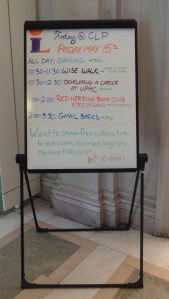
An easel whiteboard with CLP events written on it in different colors
Like this! “Today @ the library…”

As for a timeline, this one should be easy to implement. We already have the information about library events on the calendar and the monthly press release, so it’s just a matter of presentation. The fancy, high-tech option would be a screen, either freestanding or wall-mounted, but the simpler, less expensive, and more personal option would be a whiteboard or a chalkboard (again, freestanding, wall-mounted, or easel-style). We could get two, so Tuesday’s events could be prepared on Monday without taking the board down early Monday night or requiring any staff to come in early Tuesday morning. And we could even do a program on chalkboard art and lettering, for staff and patrons alike.

What do you say, boss?

What are your favorite interactive/engaging elements you’ve seen at a library? Please share!


Early literacy: Baby sign language

Recently we attended a baby sign language class at the library, taught by Sheryl White of Baby Kneads. According to Sheryl, the benefits of baby sign language include:

  • reducing frustration for everyone
  • giving babies the ability to express themselves before they can speak
  • accelerating babies’ development of speech
  • enhancing early literacy skills
  • deepening bonding and increasing contentedness

Sheryl taught us several signs and when to use them: when you have the baby’s attention (when s/he is looking at you), before, during, and after the activity or item in question. For example, you might sign “book” before reading, during reading, and after reading. (The exception is “milk”: if the baby is already hungry and fussy, give her milk first, and make the sign for milk during and after she eats.) Always say the word along with the sign, and make your tone of voice interesting and relevant (exciting for “dinosaur,” soothing for “sleep”).

The signs to start with are milk, more, and finished/all done, and the usual recommended time to start is around six months, though Sheryl said starting as early as two months could help some babies start signing earlier. Babies will catch on and may start trying to sign well before their adults realize it, so watch closely if you’re trying this with your baby.

In addition to the four signs mentioned above, we’ve chosen a few others to introduce once she gets the idea: play, music, jump, ball, water, bath, diaper, yes and no, please and thank you (it’s never too early for good manners!), hello and goodbye, and mom and dad. You can tell by our selection what we’re up to these days…

We’re hoping these signs let us communicate with each other sooner than we would be able to otherwise, since she’ll be able to sign before she can speak. Have you used baby sign language? What was your experience with it?

Bye for now!


Pleasure reading should be pleasurable

Makes sense when you think about it, right? Yet so many of us feel obligated to finish a book once we’ve started it, and feel guilty if we set it aside. We really should read it, because a friend recommended it, or it got a good review, or it’s on a topic we really ought to know more about, or everyone else is reading it, or we put it on our to-read list four years ago (but we can’t remember why), or it’s a classic…fill in the blank however you like.

But unless a book is assigned reading for school or work, then presumably you’re reading for pleasure, and pleasure reading should be pleasurable. Not that you shouldn’t ever explore a new genre or try a book that you find a bit difficult, but if you’re 25 or 50 or 100 pages in and you’re just not that into it, then by all means, put it down and pick up something else instead! You have this librarian’s permission.

This is something I have worked on for years myself. I was inspired partly by Knopf editor Marty Asher, who said something along the lines of “I don’t have time to read anything but great books” (and that was almost a decade ago). Of course, you might well think a book is going to be great and it turns out not to be: you can only judge so much by the cover, title, author, first sentence, first page, flap copy, reviews, etc. Most of us don’t choose books we think we’re going to dislike on purpose.

And yet it can be so hard to put down a book we’ve invested some time in already. It feels like giving up; it feels like failure. And who knows? We’re optimistic; maybe it will get better in another 25, 50, 100 pages. But no: at some point you begin to feel certain that this book is not the one for you, at least not right now. (“Every reader his/her book, every book its reader“).

One side effect of my free time having been somewhat curtailed of late is that I have become much better at putting down a book that doesn’t hook me quickly. This is usually not a reflection on the book’s quality; it’s just not for me, not right now. For example, I have decided to return M.T. Anderson’s Symphony for the City of the Dead to the library – despite the fact that it was personally recommended to me by a reader I trust, and that it was a finalist for the YALSA Award for Excellence in Nonfiction for Young Adults – because I just can’t get excited about the siege of Leningrad right now.

What can I get excited about? Young adult fiction, apparently: I’ve read nine YA novels so far this year, including some truly stellar books (all right, let’s name names: Simon vs. the Homo Sapiens Agenda, Like No Other, Dumplin’, Roller Girl, Echo, A Step Toward Falling, Bone Gap, Rain Reign). I’ve also read (and re-read) some excellent picture books. And, I got to read Gayle Forman’s upcoming adult novel Leave Me, which is just as good as her YA; I read it in just two days, and I have a three-month-old baby, so that should tell you something. (The thing it should tell you is “read Leave Me“!)

So there you have it, from a librarian: if you don’t like what you’re reading, and you don’t have to read it, put it down and read something you love instead. That’s the beauty of the public library: millions of books just there for the borrowing. Don’t do what I did and spend an entire month trying to slog through a book you aren’t that excited about: you’re not being graded, and ticking a box on a checklist you made yourself isn’t nearly as satisfying as spending time reading a book you love. In fact, I think there’s a song about this. Let it go…

[All that said…my library is hosting a 2016 Reading Challenge with some interesting categories, and one book can count toward more than one category. Click through to read more if you’re interested in participating.]

Do you debut? Focus on first books

I only realized how few new debuts* I read when I was offered the chance to contribute to another Reader’s Shelf column in Library Journal,New Year, Nearly New Books: Favorite 2015 Debuts.” Looking back through nearly a year’s worth of reading, there weren’t very many for me to choose from, but I did really enjoy The Magician’s Lie by Greer Macallister. If you like magic and illusion, turn-of-the-century America, and (possibly) unreliable narrators, it would be a great book to curl up with this winter.

*”New debuts” isn’t redundant, I don’t think: an author’s first book is a debut whether it was published ten years ago or ten days ago. And if it was ten years ago, then hopefully there have been a few since, and you’ve got some catching up to do!

Do you seek out debuts? I don’t make a point of it, though I certainly don’t have anything against them – if it’s recommended to me or gets glowing reviews or has a great hook, I’m just as interested in a first novel as a tenth, and discovering a new writer is a pleasure. Really, the only downside to reading a new debut is that you’ll be waiting for the next one instead of diving into an author’s backlist.

Do you like to read everything an author has written, or do you read more selectively, even if you really like the author? Do you like to read an author’s work chronologically, reverse-chronologically, or does the order not matter to you?