BEA 2014, Part One: When we love a book, we can’t stop talking about it

Thanks to Gene Ambaum and Bill Barnes (perhaps better known as “the Unshelved guys“), I got to go to BookExpo America (BEA) for free this year. I built a schedule in advance with the BEA show planner, and ended up following the schedule pretty closely.
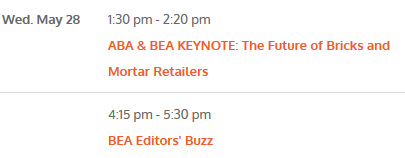
BEA14WedThe keynote on Wednesday afternoon, “The Future of Bricks and Mortar Retailers,” was focused on booksellers, but much of it could apply to libraries as well. Oren Teicher, CEO of the American Booksellers Association, noted that there was a “real resurgence in indie bookselling,” and that “localism” was becoming a powerful movement (“Small Business Saturday” being one example). However, it’s still a challenge to convince customers to think of bookstores as places to buy e-books.

Michael Tamblyn, president of Kobo, acknowledged that the virtual browsing experience doesn’t (yet) match the physical, but that booksellers could be strategic about what books they stock in print. Romance novels, for example, sell better in e-book format, so it’s less important to have them on the shelves – just point customers toward the e-bookstore. Cookbooks, gift books, and picture books, however, are much more popular in print.

John Ingram, CEO of Ingram, said of digital and print, “it’s not either/or, it’s either/and.” Many readers buy both print books and e-books; this is supported by research from Library Journal. On the limited (thus far) success of bundling a digital book with the purchase of a print book, Ingram said, “Somewhere in there, there are economics that work for everybody.” Ingram also proposed that “each [bookstore] could be a publisher.”

Joyce Meskis, owner of the Tattered Cover bookstore, had great advice about connecting to the community and attracting customers. Tattered Cover has 500-600 events annually, including storytime, author events, and “Book Happy Hour.” She recommended using media, including public radio and podcasts, to “be part of the story.”
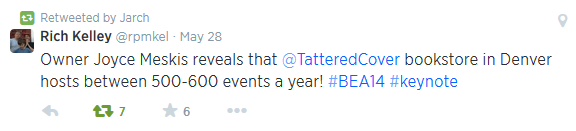
BEA14_tatteredcoverOf course, the keynote wouldn’t have been complete without a dig at the ongoing Amazon/Hachette issue; indie booksellers “make ALL publishers’ books available all the time.”
BEA14buzz

Next was the BEA Editors’ Buzz. Robert Sindelar from Third Place Books in Seattle moderated a panel of seven editors, each of whom raved about one book from their list. Sindelar said he initially had a negative reaction to the word “buzz,” but said it connotes activity; “When we really love a book we can’t stop talking about it.” The best editors and salespeople, he said, are “cool, have good taste, and know how to talk about books.” All editors on the panel fit this description, and after the event there was a mob around the tables of galleys that resembled hyenas feasting on a carcass. (Note to the organizers: Spread the galleys out. Use more than two tables for a room of a few hundred people. Have an exit plan. Have signs. Encourage people to form lines. Etc.) Though the print galleys disappeared in a flash, e-galleys should be available through Edelweiss. Here are the titles and authors:

  • Jenny Jackson from Knopf called Station Eleven by Emily St. John Mandel “a requiem for the world as we know it.” This “plausible and terrifying” book, which she compared to Peter Heller’s The Dog Stars, is about art and fame, and has already garnered positive word-of-mouth buzz.
  • Marysue Rucci from S&S described Matthew Thomas‘ ten-years-in-the-making We Are Not Ourselves as an “epic” of three generations of an Irish family in New York, a novel that describes “the great unwinding of the middle class” and “resilience in the face of disappointment.”
  • Lee Boudreaux from Ecco mentioned a slew of comp titles for The Miniaturist by Jessie Burton, including Billy Lynn’s Long Halftime Walk, The Story of Edgar Sawtelle, The Song of Achilles, Slammerkin, and The Signature of All Things. Suspense builds in this “dollhouse mystery” set in 1700s Amsterdam.
  • Jeff Shotts from Graywolf Press was aware of the irony of his last name when introducing On Immunity: An Inoculation by Eula Biss. This slim work of nonfiction addresses parents’ impulse to protect themselves and their children, as well as issues of race, class, and government, and the “far-reaching ramifications” of the “implications of vaccination.”
  • Amy Einhorn touted My Sunshine Away by M.O. Wilson from her eponymous imprint. Like The Help, My Sunshine Away is set in the South, and the story is inseparable from the setting. A debut novel and a literary mystery, My Sunshine Away is about adolescence, family, memory, and forgiveness.
  • Josh Kendall from Little, Brown admitted that author Laird Hunt was “not the new guy,” but that Neverhome was going to be his breakout novel. Hunt discovered a trove of letters in a family barn in Indiana, and those letters inspired this tale of a woman who goes to war in place of her husband.
  • Colin Harrison from Scribner closed the session with The Short and Tragic Life of Robert Peace: A Brilliant Young Man Who Left Newark for the Ivy League But Did Not Survive by Jeff Hobbs, Peace’s roommate for two years at Yale. This is a true tale of poverty, race, education, drugs, murder, discrimination, and fate.

And that was just the first day. Stay tuned for more.

MLA Conference 2014, Day Two (Thursday)

Screen shot 2014-05-08 at 8.53.24 PMHarvard Library Innovation Lab: Pop-Ups, Prototypes, and Awesome Boxes

Annie Cain, Matt Phillips, and Jeff Goldenson from the Harvard Library Innovation Lab  presented some of their recent projects. Cain started off by introducing Awesome Box: the Awesome Box gives library users the opportunity to declare a library item (book, audiobook, movie, TV show, magazine, etc.) “awesome” by returning it to an Awesome Box instead of putting it into the book drop. Library staff can then scan the “awesome” items and send them to a custom website (e.g. arlington.awesomebox.io), where anyone can see the “recently awesome” and “most awesome” items. Instead of librarian-to-patron readers’ advisory, it’s patron-to-patron/librarian. Cool, fun, and easy to use! “Awesome” books can also be put on display in the library.

Phillips talked about the idea of “hovermarks,” bringing favicon-style images to the stacks by placing special bookmarks in books. Patrons or librarians could place a hovermark in a book to draw attention to local authors, Dewey Decimal areas, beach reads, favorites, Awesome Box picks, or anything else. It’s a “no-tech” way to “annotate the stacks.”

Goldenson floated the idea of a Library Community Catalog, inspired by the Whole Earth Catalog. The Library Community Catalog could contain real things, ideas, speculations, interviews, or other articles. It could be “hyper-local,” in print and/or online.

Of the three ideas presented, Awesome Box is definitely the most developed, and Harvard, which “isn’t necessarily known for sharing,” is eager to get it into public libraries. Contact them if you’re interested in setting it up at your library!

Libraries are Keeping Readers First: An Update on the National Initiative and How You Can Participate

Readers First is “a movement to improve e-book access and services for public library users.” Kelvin Watson from Queens Library and Michael Santangelo from BookOps presented an update on this initiative, explaining the work that’s been done thus far and how far we have to go. The more people (and libraries) sign on, the stronger the team, the better ability to effect change. Already, said Santangelo, Readers First represents over 20 million readers.

Screen shot 2014-05-09 at 3.57.31 PM

It’s worth going to the Readers First site (link in the previous paragraph) to read their principles. The two main challenges regarding e-books in libraries are availability and discoverability/access. Availability is an issue with the publishers; the issues of discoverability and access can be taken up with the vendors. Because libraries are only indirectly connected to publishers, but directly connected to vendors, Readers First decided to focus its efforts on the discoverability/access challenge.

Santangelo said that Ranganathan’s Five Laws of Library Science applied to e-books also (save the time of the reader, (e)books are for use, etc.) and that libraries have a responsibility to ensure open, easy, and free access to e-books the same as we do for print books. However, the e-book experience now is fragmented, disjointed, and cumbersome, creating a poor user experience. This is where the four Readers First principles come in: readers should be able to discover content in one comprehensive catalog; access a variety of content from multiple sources; interact with the library in the library’s own context; and read e-books compatible with all e-reading devices.

A Readers First Working Group sent a survey to vendors in order to create a guide to library e-book vendors. This guide will help librarians who are choosing an e-book vendor for the first time, or moving from one to another; it will also help vendors design their systems and decide what to prioritize.

Watson said that libraries should see vendors as partners, and challenge them to “do the right thing.” Librarians should hold all vendors accountable to the Readers First principles, with the end goal of a seamless experience for the user. The long-term objective, said Michael Colford of the Boston Public Library, is to “have the discovery layer be the platform.” Until then, we’re relying on APIs. “We can make things less complicated, but we can’t make it easier,” said Santangelo.

Readers First is working with the National Information Standards Organization (NISO) to develop standards for e-books, but according to Watson, the perfect format hasn’t been invented yet. (Other than PDFs, most e-book files are proprietary formats, wrapped in DRM and not usable across devices.)

MA E-Book Project

Deb Hoadley presented an update on the Massachusetts E-Book Project on behalf of the Massachusetts Library System. I was already familiar with the project because Robbins is one of the pilot libraries, but it was good to review the history, see where the project had hit snags, and hear from other librarians at pilot libraries (Jason Homer from Wellesley and Jackie Mushinsky from WPI) about how they had introduced the project to patrons.

150x71-MA-EbooksYou can read about the project’s history, the RFP, and see updates on the website, so I want to use this space to draw a parallel between the MA E-Book Project and Readers First. Although the pilot consists of three different vendors (BiblioBoard, Baker & Taylor (Axis 360), and EBL) with three different models, the end goal is a single e-book platform that offers integrated and seamless discovery. Any Massachusetts resident would have access through this user-friendly platform to e-content that is owned – not licensed – by Massachusetts libraries; local content would also be hosted and discoverable.

Although we are far from this goal right now, “Our vendors are listening to us,” said Homer. He said that participating in the pilot project has enabled him to start conversations with patrons about how much we spend on e-books now and why we need a new model. Mushinsky, who added local content through BiblioBoard, said that we need to ask, “Will this resource be of value to us? Can we add value to it?”

I came away from these two sessions (Readers First and the MA E-Book Project) convinced that we have the right goals, and dedicated people working toward them, but a little depressed at how far we have to go. Slowly but surely…


Teaching the Tools: Technology Education in Public Libraries

Clayton Cheever live-blogged this session; his notes are posted on the Teaching the Tools site.

Anna Litten from Wellesley did an excellent job moderating this informative panel. Litten and the other panelists (Michael Wick, Theresa Maturevitch, Jason Homer, and Sharani Robins) built a website called Teaching the Tools: Libraries and Technology Education, which they hope will serve as a resource going forward. To borrow from the site: “All reference librarians are technology trainers, educators and instructors these days.  But what does it really mean to teach technology topics in public libraries?  What can and should we teach?  How does technology instruction fit into our broader mission and core responsibilities?  What resources are available to use and to our clients?  How do we become better presenters and instructors?”

The panelists addressed these questions during the session. They all teach in their libraries, but the teaching takes different forms. “I teach to whatever question comes to the door, in whatever way the learner can understand it,” said Wick. Maturevich talked about printed brochures, online resources, and videos; Robins talked about beginner classes, one-on-one sessions, and “Wired Wednesday,” when patrons can drop in for tech help. Robins has also had reps from Barnes & Noble and Best Buy come in to help people with e-reading devices, and she often uses the resources at GCF LearnFree.org. Homer teaches intermediate classes in the Wellesley computer lab, and other Wellesley staff teach beginner classes. Clearly, there are many approaches, and flexibility is key.

Litten suggested taking the time to read instructional design blogs; most librarians don’t have a background in instructional design, but the field does exist and there’s a lot we can learn. “We have to focus on what’s going to work,” she said. “If it’s not working, abandon! Abandon!”

What to do when you offer a class and no one shows up? Wick and Litten talked about forming partnerships in the community. “We can be really useful to you in ways you didn’t even realize,” said Litten. “Listen,” Wick encouraged. Ask people, “What do you want? We’ll give it to you.” As for whether teaching technology is part of the library’s mission, Wick said, why wouldn’t it be? “We help everybody with everything else. Why aren’t we helping them as much as we can, more than they’re asking?” Find your audience first, said Wick, then design your classes.

Some library staff are reluctant to teach classes, but that isn’t the only kind of teaching. Nor do tech teachers have to be experts; in fact, said Wick, good teachers can be just one step ahead of their students. Knowing the librarian/teacher is not an expert but a fellow learner can put patrons/students at ease. Confronted with a question she doesn’t know the answer to, Maturevich often uses the line, “I don’t know either, but this is how we find out.”

“Good instruction depends on having good goals,” said Litten. “We’re already doing these things, we just need to do them a little bit better.”

carlitos_Simple_Pencil_ho

That’s all, folks! If you missed it, you can read about Wednesday’s sessions here (part 1) and here (part 2).

See the whole MLA conference program here [PDF]


MLA Conference 2014, Day One (Wednesday), Part Two

Read a recap of the first three sessions of the day in Part One.

Working with and Managing Multigenerational Staff/People

In a day full of really good sessions, this might have been my favorite. Presenter Cally Ritter was fantastic: organized, energetic, a skilled moderator who blended small group talk with lecture and discussion. The lack of diversity in libraries is a common topic, and it’s true that in terms of race, ethnicity, gender, and socioeconomic status, library staff skews toward middle-class Caucasian women, but in terms of age, library staff spans the whole range:

“Traditionals” (b. 1945 or earlier; 69+) 4% of the workforce
“Baby Boomers” (b. 1946-1964, 50-68) 44% of the workforce
“Generation X” (b. 1965-1980, 34-49) 44% of the workforce
“Generation Y” (b. 1981-1999, 14-33) 8% of the workforce

Screen shot 2014-05-08 at 8.29.46 PM

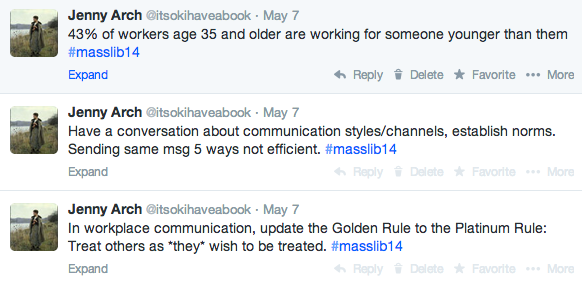
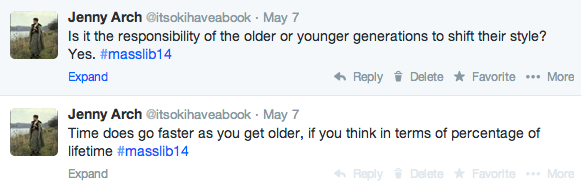
In small groups, we talked about what characterized each generation, from pop culture (TV/movies, music, hairstyles) to historical influences to preferred working styles. Because of the generational differences, Ritter said, we all need to “upgrade” from the Golden Rule to the Platinum Rule: Treat others as they wish to be treated. In order to do that, we need to listen to what people want. Ritter suggested having a conversation about preferred communication styles (face to face, phone, e-mail, paper memo, text, etc.) and then establishing norms (because it’s not efficient to send the same message through five different channels). In a situation where coworkers’ communication styles are different, Ritter asked, whose responsibility is it to shift their style? Who needs to change? (Answer: Yes!)

Screen shot 2014-05-08 at 8.29.31 PM

The age diversity among library staff as compared to other professions is remarkable. What could be the cause? One idea is that the age diversity of staff reflects the age diversity of the “customer base” – library users are all ages. One audience member/participant said, “We need all these generations to do what we do.” To which Ritter responded that every workplace needs age diversity. We should remember that what we have in common unites us more than our differences separate us; we are more similar than we are different. We should avoid stereotypes, communicate strategically, encourage collaboration, and capitalize on the diversity of thought. And get ready for “Generation Z” (b. 1999-), the Millennials…

Screen shot 2014-05-08 at 8.30.02 PM

Building Intergenerational Collaboration & Programs: Serving People of Different Ages

Andrea Weaver developed the Bridges Together program, which brings different generations together. It has been used in school systems, and recently at the Goodnow Library in Sudbury, MA. Weaver started the session at MLA by asking the audience to think of their first memory of interacting with an “older adult” (OA). Many people mentioned grandparents, great-aunts and great-uncles, neighbors, or teachers. Then, Weaver asked what activity this interaction included, and people mentioned reading (of course – it was a room full of librarians), music, games, food, holidays, and gardening.

The term “multi-generational” means that multiple generations are included; the term “intergenerational” indicates a skipped generation, e.g. grandparents and grandchildren.

Demographically, there are more and more OAs, but there are fewer opportunities for interaction. Many kids now have little or no experience interacting with OAs, and that’s what the Bridges Together program aims to correct. OA volunteers are paired with children and they build a relationship over the course of several weeks. According to Weaver, these intergenerational programs help reduce or prevent ageism, increase compassion and respect, give kids a chance to learn about possible careers, give OAs a chance to reflect on their experiences and share their stories, and give kids (and OAs) attention.

Where do libraries come in? Libraries build community by giving people permission to engage with each other. This can take the form of the Bridges Together program, or any other form; potential programming partners include the Council on Aging (every city/town in MA has one), the senior centers, garden clubs, theater troupes or dance companies, the Cultural Council, the historical society, the Parks & Rec department, and after-school programs. Other ideas mentioned: an oral history project; watching and discussing silent films, then looking them up in IMDB; hosting an intergenerational book club. (Weaver suggested books by Jennifer Chiaverini, Adriana Trigiani, and Dorothea Benton Frank; these authors generally write about multiple generations of families. She also read from a book used in the Bridges Together project, How Old Is Old? It’s out of print now, but there are still a couple copies in Minuteman.)

That’s it for the Wednesday sessions! Thanks to those who live-tweeted other sessions on Wednesday, especially Kristi (@booksNyarn), Anna (@helgagrace), Clayton (@cfcheever), Erin (@ErinCerulean), and Beth (@infogdss29).

Thursday session post(s) coming soon.

We interrupt this broadcast…

Another post or three about MLA still to come, but first: May 6 was International Day Against DRM. Please go read what Sarah (a.k.a. the Librarian In Black) has to say about this, and follow all her links (especially check out Defective By Design).

librariansagainstDRM“Consumers, and libraries by extension, should have the right to access eBooks on any technological platform, including the hardware and software we choose.” -Sarah Houghton

And now, back to our regularly scheduled programming…

MLA Conference 2014, Day One (Wednesday), Part One

It’s that time again! This year, the Massachusetts Library Association conference is in Worcester, and once again the lovely and gracious Friends of the Library enabled some of our library staff (myself included) to attend. Here’s my round-up of the first three sessions I went to today, with more to come. Several conference-goers are also on Twitter (#masslib14).

Brand New You: How Libraries Use Branding to Establish Relevance and Engage Users

Anna Popp from the Massachusetts Library System presented on MLS’ experience developing their brand with Walter Briggs of Briggs Advertising. Popp convened a task force and established a clear decision-making protocol (essential, according to Briggs). Popp and Briggs explained that an organization’s brand is evolutionary, not visionary; it’s not the same as its vision or mission statement (‘it’s not what you aim to be, it’s what you are’).

MLS logoThe process involved brainstorming everything about the organization, then crossing out everything that wasn’t unique, with the goal of distilling it down to 3-5 words or phrases – the “brand mantra.” The brand mantra is an internal tool, and is not the same thing as a tagline (e.g., Nike’s brand mantra is “Authentic Athletic Performance,” not “Just Do It.”) MLS came up with “Uniting, Empowering, Library Enhancement.” The brand mantra is “the most important deliverable” from the branding process, more important even than the logo (at left). The logo’s job is not to show or tell what an organization does.

The tagline should be “evocative, inspiring, brief, lyrical” and have “integrity.” The (awesome) MLS tagline is “Stronger together,” which perfectly suits an organization dedicated to building a statewide community of libraries, empowering those libraries, and championing resource sharing.

Briggs finished the presentation by sharing some of his past work. I especially loved the Patten Free Library tagline, “More than you’ll ever know,” and the tangram-like logos (below) for the Curtis Memorial Library (both libraries are in Maine).

CurtisMemorialLibrary logoCurtisMemorialTeenCurtisMemorialKids


The takeaways from this session included: (1) Recognize what people bring to the table, (2) Establish role clarity – who will have an advisory role, who will have a decision-making role?, (3) Let people do their jobs, help when necessary, (4) Prepare to learn something about yourself, (5) Plan ahead, but be prepared for eventualities and opportunities. It may be hard to prove the ROI on a logo, but Popp mentioned the idea of “mindshare”: “in marketing, repetition wins.” Establish your relevance and constantly reaffirm it.

An Agenda for Information Activism: Internet Freedom and Press Freedom Today

Kevin Gallagher stepped up here in place of the original presenter, Josh Stearns, formerly of Free Press. Gallagher clearly knew his stuff, particularly the threat that government mass surveillance poses to journalists and society at large, and he did a good job on short notice. He wasn’t the most comfortable speaker, and his presentation jumped around a little bit; the audience wasn’t all familiar with some of the terms he used or the services he referenced. The presentation had no handouts or visual component (other than the trailer for the upcoming Aaron Schwartz documentary, The Internet’s Own Boy). However, privacy is something librarians care deeply about, and this program took a step toward convincing us all to do more research for ourselves, and think about what we can offer patrons, both in terms of tools and education. Here are a few points and links from the session (thanks also to Alison Macrina of Watertown Free Public Library):

  • When the government undermines and weakens Internet security standards for the purposes of surveillance and data-gathering, it makes us all less safe, not more.
  • There are library privacy laws in 48 states and the District of Columbia. Patron privacy and confidentiality is essential for the free pursuit of knowledge.
  • If the government can collect metadata on journalists’ communications, that exposes journalists’ sources, whose confidentiality should be protected.
  • Read the full text of the Guerilla Open Access Manifesto by Aaron Schwartz on the Internet Archive.
  • “There is already a war” against whistleblowers, journalists, and activists (examples: Julian Assange, Jeremy Hammond, Edward Snowden, Barrett Brown, Jim Risen).
  • “We need a new Church Committee.”
  • Government agencies and private companies are collecting personal data and metadata. Be aware of what personal data private companies are collecting, and what permissions you are giving when you use services like facebook. See Terms of Service; Didn’t Read.
  • Use search engines that value privacy, like DuckDuckGo, or use plugins like Ghostery or services like Disconnect.me. Install Tails, an operating system that lets you use the Internet anonymously via TOR.
  • What can we (in libraries) do? Use more privacy and security tools (like https everywhere from the EFF). Use free and open software instead of proprietary software (“There’s a free and open alternative to everything”). Make sure patron privacy policies are up to date, and make sure we aren’t collecting any more patron information than necessary. If libraries are receiving federal funds that force compliance with CIPA, make sure you aren’t filtering any more than you have to – or, if possible, don’t accept the strings-attached funds. Host a “crypto party.” Support the USA Freedom Act, make FOIA requests. Remember the Library Bill of Rights.

How We Doin’?: Public Libraries Using LibSat to Gather Patron Feedback

The Los Angeles Public Library uses LibStat.

The Massachusetts Board of Library Commissioners (MBLC) is providing LibSat from Counting Opinions to all Massachusetts libraries for a three-year term. All library directors have the login information, and can pass it on to any of their staff. From what we saw in this session, LibSat is a pretty incredible tool to gather continuous patron feedback about their library experience; data nerds in the room were audibly delighted.

This session began with the proverb “A guest sees more in an hour than the host sees in a year.” Patron feedback is valuable to libraries, offering reminders of how much people appreciate library services and staff as well as presenting opportunities for improvement; patrons who rate the library’s importance as high but their satisfaction with the library as low direct attention to areas for improvement.

LibSat offers patrons a choice of a short survey (3-5 minutes), a regular survey (5-7 minutes), and an in-depth survey (~15 minutes). Other than possible survey fatigue, there’s really no reason MA libraries shouldn’t be using this tool. The results could really come in handy when it’s time to prepare those annual reports…

Next up:

Working with and Managing Multigenerational Staff/People

Building Intergenerational Collaboration & Programs: Serving People of Different Ages

Last year’s (rather long) MLA posts:

4/24/13: Teaching Technology to Patrons and Staff & Afraid to Advocate? Get Over It! & Library Services and the Future of the Catalog: Lessons from Recent ILS Upgrades & Loaning E-Readers to the Public: Legal and Strategic Challenges

4/25/13: On Life Support, But Not Dead Yet!: Revitalizing Reference for the 21st Century & Authors, Authors, Authors!: Three Local Authors Strut Their Stuff & Analyze Your Collection & Print and Digital Publishing: How Are Publishers, Editors, and Authors Adapting.

404 Day: Action Against Censorship

Join EFF!

Today is 4/04, “a nation-wide day of action to call attention to the long-standing problem of Internet censorship in public libraries and public schools.” Read the Electronic Frontier Foundation (EFF) piece about Internet filtering in libraries and the Children’s Internet Protection Act (CIPA). Though CIPA requires some Internet filtering in libraries that accept federal funding, libraries often go further than is required. (Also, no filter is perfect: some “bad” content will always get through, and plenty of legitimate content will be blocked.)

Barbara Fister at Inside Higher Ed is also eloquent, as always, in her piece “404 Day: Protecting Kids From…What?” She mentions Gretchen Casserotti, a public library director in Meridian, Idaho, who live-tweeted a school board meeting in which Sherman Alexie’s The Absolutely True Diary of a Part-Time Indian was, ultimately, removed from the school curriculum. (Book Riot collected these tweets in order.)

Kids don’t need to be protected from literature. They need to engage with it, think about it, and discuss it; if adults can help with that, all the better. But as Fister points out, it would be better to protect kids from, say, hunger, than from “dangerous” books.

Characters, Gender, and Likability

Yesterday I followed a couple of links from Twitter and read these two pieces: “Why Talking About Girl Reading Matters” from Kelly Jensen at Stacked and “On Liking Characters” by Liz Burns at School Library Journal (SLJ). The Stacked post linked to Laurel Snyder’s post “Boys Will Be Boys, And Girls Will Be Accommodating.” Together, these pieces make the point that in focusing on “books for boys” (boys are generally more reluctant readers than girls) we do everyone an injustice.

If boys only ever read “books for boys,” they may never discover that they like other kinds of books as well. Those of us putting books into the hands of growing readers can’t underestimate them; we ought to encourage them to stretch and try something new. At the same time, “girl books” tend to be pushed to the sides, sending the message that they are less important. “The best solution,” writes Snyder, “would require us to push against the gender bias in the world, and in ourselves.”

If there’s one thing The Hunger GamesDivergent, and The Fault in Our Stars have proved, it’s that boys will read books that have girls as the main character. (As for the author’s gender, it’s not something I remember ever paying attention to much as I was growing up, and I don’t pay much attention now, either; this is borne out in my reading stats. But in the above examples, those incredibly successful trilogies are written by women.)

A character’s gender also affects their likability, as Burns points out in her piece. Some readers are quick to label girl characters unlikable if the character acts in a nontraditional way. But a likable character isn’t the same as a good one (i.e., a well-written, realistic one). Here’s my response to Burns’ piece:

The most important thing about character is believability. Are the character’s actions believable? Is there an internal consistency? Does the reader understand the character’s motivation? If the answer to these questions is yes, then the author has probably created a good character: recognizably human, with some flaws and some talents.

Likability is a different issue entirely. Personally, I would be bored reading about likable characters all the time, or if all characters were binary, either likable or unlikable – protagonist/antagonist, hero/villain. Real people are more complicated than that.

As Claire Messud has pointed out, the likability issue does affect female characters (and female authors) disproportionately; it’s more common for readers to criticize female characters for being unlikable than male characters.

My friend Anna has also written about the “books for boys/books for girls” issue, both at YALSA’s The Hub and on her own blog. On The Hub, she wrote, “…it doesn’t matter if a book is ‘for’ a guy or a girl; the gender of the intended audience tends to get all mixed up when you factor in the power of a good story. Boys like stories; girls like stories. Readers in general like stories” (emphasis added). Anna added to this thought a few days later on her blog, asking, “What About Books for Girls?” She wrote,

“Readers are readers. If we could just take off the gendered lenses entirely, I think we could serve our readers better. Let’s focus on writing, reading, and recommending stories that are true (in the manner of Truth, not necessarily a nonfiction story), that matter, that touch the soul, that are real, that show the varieties of human emotion and experience, that are maybe even an inspiration. Let’s do that instead of focusing on the gender we think might like the book the best. Books for girls are books for boys, and books for boys are books for girls. It’s all just stories.”

A skilled author, male or female, can write excellent, believable, well-rounded characters of any gender. Let’s try to focus on getting great stories into the hands of all readers.

The Pleasure of Picture Books (and Reading Magic by Mem Fox)

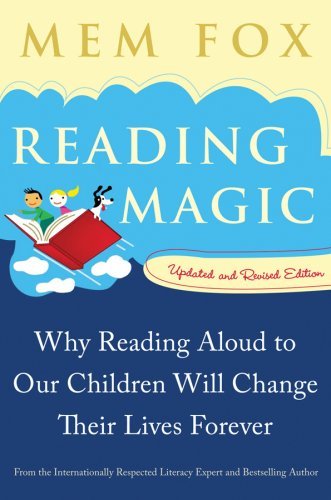
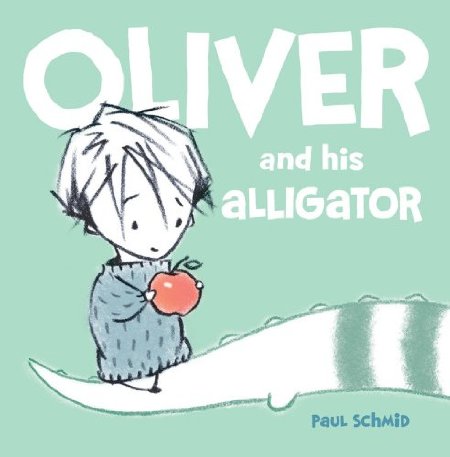
readingmagicI’ve been on a picture book kick recently, starting with the indescribably adorable Oliver and His Alligator by Paul Schmid, which I read about in a review from Kirkus. The children’s librarians at my library were happy to provide me with more contemporary picture books, and then I started revisiting old favorites.

Along the way, I read Australian author Mem Fox’s book Reading Magic: Why Reading Aloud to Children Will Change Their Lives Forever. As a librarian, and as someone whose parents read her stories every night, I’m already sold on the reading-to-kids idea, but Fox emphasizes how important it truly is.

Among all the anecdotes and tips for reading aloud, I came across this quote on page 142, which struck me as perfect for Banned Books week. But Banned Books Week is in September, and I didn’t want to wait to share:

“The whole point of books is to allow us to experience troubled realities that are different from our own, to feel the appropriate emotions, to empathize, to make judgments, and to have our interest held. If we sanitize everything children read, how much more shocking and confusing will the real world be when they finally have to face it?”

Books are a safe place to encounter new ideas and situations, and think (or talk) through them. Experiencing something vicariously or hypothetically is often safer than having that experience oneself. Though “difficult topics” may be uncomfortable for some, books are an excellent “vehicle for true learning and understanding.” (For more on this topic, see “Censorship and Invisibility,” one of my Banned Book Week blog posts from last fall.)

Picture books naturally lend themselves to discussion. For those of us who tend to focus on the text, they are also a good reminder that reading an image requires another type of literacy. In a good picture book, the text and the image complement each other; the pictures aren’t just a representation of the text, they can contain more information – and often jokes. It’s worth taking a bit of extra time to look at the pictures on each page closely, not just because they are colorful or cute, but because there is more going on. (Officer Buckle and Gloria by Peggy Rathmann is an excellent example of this.)

oliveralligatorcoverHere are a few of my favorite picture books, old and new. I keep a current list, tagged “children’s” in LibraryThing.

Sometimes I Forget You’re A Robot by Sam Brown, 2013

Mr. Wuffles by David Wiesner, 2013

Oliver and His Alligator by Paul Schmid (also, A Pet for Petunia), 2011, 2013

A Kiss Like This by Mary Murphy, 2012

I Want My Hat Back by Jon Klassen (also, This Is Not My Hat), 2011, 2012

13 Words by Lemony Snicket, illustrated by Maira Kalman, 2010

Orange Pear Apple Bear by Emily Gravett, 2007

Martha Speaks by Susan Meddaugh, 1992

Julius, the Baby of the World by Kevin Henkes, 1990

Alexander and the Terrible, Horrible, No Good, Very Bad Day by Judith Viorst, illustrated by Ray Cruz, 1972

Harry the Dirty Dog by Gene Zion, illustrations by Margaret Bloy Graham (also, Harry by the Sea and No Roses for Harry), 1956-1965

What are your favorite picture books from childhood? When was the last time you read a picture book, quietly to yourself or out loud?

First Sale doctrine in the age of licenses

One of the ways I keep up to date with news pertaining to the library world is through Library Link of the Day, which is exactly what it sounds like. The link is usually to an article or blog post, sometimes a video or a longer document. On February 5, the link was to an article from the February 2014 edition of College & Research Libraries News, “Last sale? Libraries’ rights in the digital age,” by Jennifer Jenkins.

For those who aren’t clear on what “first sale” means, or those who are familiar with it but haven’t kept up with some of the more recent cases (Capitol Records v. ReDigi, for example), this article gives an excellent explanation of the history of first sale, the problems with applying it to the digital realm (where much content is licensed rather than sold/owned), and the possibilities for the future.

Jenkins covers all the points I’ve seen in other articles and blog posts thus far (Copyfight is one good source to follow, if this is an issue that interests you, and it should). The only piece I have to add is a response to the Copyright Office’s statement that “[p]hysical copies degrade with time and use; digital information does not…” While this is true in some sense, it’s false in another: digital formats change so quickly that it takes a significant investment to keep digital information accessible. (Word Perfect, anyone? Floppy disks?)

Technology changes quickly; content creators (e.g. publishers, the music industry, etc.) will adopt new formats and abandon* old ones, and those who “own” (or license) information in those formats will be up a creek unless they have the ability (and time, and money) to upgrade or migrate old formats to new ones.

Digital Rights Management (DRM) throws an additional monkey wrench into the mix. DRM, Jenkins writes, “adds a layer of technological controls that further restrain libraries’ freedoms.” Currently, the first sale doctrine applies only to physical items; digital items aren’t covered by first sale (yet). Libraries, like consumers, pay to license these items (e-books, digital audiobooks) instead of buying and owning them. Jenkins explains, “These licenses restrict libraries’ uses of e-books. If a library has a physical book, it can loan it out as many times as it is requested. It can send the book to another institution via interlibrary loan. Licenses often limit these activities.”

Digital first sale is important to libraries. Demand for e-books is growing, yet restrictive licenses mean that libraries are not always allowed to purchase e-books and lend them out in the same way as physical books. Publishers are experimenting with different models: higher prices for libraries, or prices comparable to consumer prices but with some kind of catch (a 26-loan limit, or a one-year expiration date), or simultaneous use (in rare cases). Right now, the publishers have more power than the libraries (or the consumers, who click “I Agree” to any Terms of Service to get content). Jenkins writes, “Many librarians are concerned that digital technology has upset the balance between users’ and owners’ rights.”

In writing about the ReDigi case, Jenkins stated, “Studies have shown that the effective way to drive down rates of illicit copying is to provide cheap and legal alternatives. Digital first sale could lead would-be downloaders to turn to a legal second-hand market.” Libraries, too, should be able to offer a legal alternative. Jenkins suggests that Congress could grant libraries specific rights “allowing them to lend, preserve, and archive electronic materials.” Makes sense to me.

*As Adobe is about to do by introducing new EPUB DRM this summer.

Yearly wrap-up, 2013 edition

In the spirit of those sites that do a weekly wrap-up (like Dooce’s “Stuff I found while looking around” and The Bloggess’ “Sh*t I did when I wasn’t here”), here are a few odds and ends I found while going through my work e-mail inbox and my drafts folder.

How to Search: “How to Use Google Search More Effectively” is a fantastic infographic that will teach you at least one new trick, if not several. It was developed for college students, but most of the content applies to everyday Google-users. Google has its own Tips & Tricks section as well, which is probably updated to reflect changes and new features.

How to Take Care of Your Books: “Dos and Don’ts for Taking Care of Your Personal Books at Home” is a great article by Shelly Smith, the New York Public Library’s Head of Conservation Treatment. Smith recommends shelving your books upright, keeping them out of direct sunlight and extreme temperatures, and dusting. (Sigh. Yes, dusting.)

The ARPANET Dialogues: “In the period between 1975 and 1979, the Agency convened a rare series of conversations between an eccentric cast of characters representing a wide range of perspectives within the contemporary social, political and cultural milieu. The ARPANET Dialogues is a serial document which archives these conversations.” The “eccentric cast of characters” includes Ronald Reagan, Edward Said, Jane Fonda, Jim Henson, Ayn Rand, and Yoko Ono, among others. A gem of Internet history.

All About ARCs: Some librarians over at Stacked developed a survey about how librarians, bloggers, teachers, and booksellers use Advance Reader Copies (ARCs). There were 474 responses to the survey, and the authors summarized and analyzed the results beautifully. I read a lot of ARCs, both in print and through NetGalley or Edelweiss, and I was surprised to learn the extent of the changes between the ARC stage and the finished book; I had assumed changes were copy-level ones, not substantial content-level ones, but sometimes they are. (I also miss the dedication and acknowledgements.)

E-books vs. Print books: There were, at a conservative estimate, approximately a zillion articles and blog posts this year about e-books, but I especially liked this one from The Guardian, “Why ebooks are a different genre from print.” Stuart Kelly wrote, “There are two aspects to the ebook that seem to me profoundly to alter the relationship between the reader and the text. With the book, the reader’s relationship to the text is private, and the book is continuous over space, time and reader. Neither of these propositions is necessarily the case with the ebook.” He continued, “The printed book…is astonishingly stable over time, place and reader….The book, seen this way, is a radically egalitarian proposition compared to the ebook. The book treats every reader the same way.”

On (used) bookselling: This has been languishing in my drafts folder for nearly two years now. A somewhat tongue-in-cheek but not overly snarky list, “25 Things I Learned From Opening a Bookstore” includes such amusing lessons as “If someone comes in and asks for a recommendation and you ask for the name of a book that they liked and they can’t think of one, the person is not really a reader.  Recommend Nicholas Sparks.” Good for librarians as well as booksellers (though I’d hesitate to recommend Sparks).

The-Library-Book-154x250_largeOn Libraries: Along the same lines, I really enjoyed Lucy Mangan’s essay “The Rules” in The Library Book. Mangan’s “rules” are those she would enforce in her own personal library, and they include: (2) Silence is to be maintained at all times. For younger patrons, “silence” is an ancient tradition, dating from pre-digital times. It means “the absence of sound.” Sound includes talking. (3) I will provide tea and coffee at cost price, the descriptive terms for which will be limited to “black,” “white,” “no/one/two/three sugars” and “cup.” Anyone who asks for a latte, cappuccino or anything herbal anything will be taken outside and killed. Silently.

On Weeding: It’s a truth often unacknowledged that libraries possessed of many books must be in want of space to put them – or must decide to get rid of some. Julie Goldberg wrote an excellent essay on this topic, “I Can’t Believe You’re Throwing Out Books!” I also wrote a piece for the local paper, in which I explain the “culling” of our collection (not my choice of headline).

“What We Talk About When We Talk About Public Libraries”: In an essay for In the Library with the Lead Pipe, Australian Hugh Rundle wrote about the lack of incentives for public librarians to do research to test whether public libraries are achieving their desired outcomes.

Public Journalism, Private Platforms: Dan Gillmor questions how much journalists know about security, and how much control they have over their content once it’s published online. (Article by Caroline O’Donovan at Nieman Journalism Lab)