What is SOPA? Bring in the nerds!

I was reading Jessamyn West’s insightful wrap-up of the SOPA strike, which contained several excellent links, a few of which I’ll re-share here.

Jon Stewart, on SOPA’s likely effect, and on Congress’ lack of understanding of the internet: “‘Bring in the nerds’…Really? Nerds? You know I think actually the word you’re looking for is experts” at 4:21-4:45. (Also funny: at 6:50-7:00, when “Imagine” starts to play, “Wait, no no no no no no, even as a joke we don’t have John Lennon copyright money!”)

West also linked to ProPublica, which offers a tool to look up your current members of Congress’ stance on SOPA/PIPA. Here also is a graphic showing the difference between Jan. 18 and Jan. 19 (it went from 80 supporters and 31 opponents to 65 supporters and 101 opponents).

Lastly, here’s a slightly older (Jan. 6) article from Publishers Weekly, arguing that libraries are in fact the best counter to piracy. Author Peter Brantley cites Tim O’Reilly’s 2002 essay, “Piracy is Progressive Taxation,” wherein O’Reilly says that the incentive for piracy (of e-books, in this case) is “dramatically reduced” when demand is satisfied in as many places and as many ways as possible.

I don’t have a statistic for what percentage of people pirate books, movies, music, or other content as opposed to obtaining it legally, whether by purchasing it, borrowing it from the library, or licensing it through various services, but I think that many people would prefer to obtain their content legally, and are even willing to pay for it, as comedian Louis CK proved recently with his “Live at the Beacon Theater” production, which he sold for $5 online. The takeaway: when buying or borrowing is easier than pirating, people are likely to borrow or buy.

Searching for Context

Yesterday I attended Alison Head’s lecture “Searching for Context: Modeling the Information-Seeking Process of College Students” at the Berkman Center at Harvard. Head is affiliated with Project Information Literacy, and what she said about her research findings largely agreed with what I’d found through my User Instruction course last semester (though consulting the PIL reports would have been helpful at the time!).

Project Information Literacy (PIL) is an ongoing national study, including (so far) 11,000 students across 41 college campuses – community colleges as well as private and public four-year undergraduate institutions. Findings are not generalizable as the samples are voluntary, not random, but the methodology is sound (focus groups, surveys, content analysis, interviews) and the findings are certainly interesting.

Head’s presentation yesterday included four “takeaway points” from the PIL studies:

1. Students say research is more difficult for them now than ever before. Research – course-related and “everyday” – is a stressful process. Students must grasp the big picture, gather information, use appropriate language (search terms), and measure the information they find against their expectations. Unexpectedly, the PIL studies found that students were most likely to consult a librarian for help with search terms, rather than gathering information; also, the studies found that everyday, open-ended research questions were harder than research assignments.

2. Students turn to the same “tried and true” sources over and over again. Students use the same sources no matter what their contextual need is – whether it’s for an assignment or an everyday question, whether it’s for a science class or a literature class. Students reply on course readings first, then search engines, library databases, instructors, and Wikipedia; farther down the list is librarians. However, contrary to expectations, students use a hybrid model – they don’t search exclusively online, but also consult printed matter, teachers, and family and friends.

3. Students use a strategy of predictability and efficiency…as opposed to the librarian model of scholarly thoroughness. Students are risk-averse, preferring familiar resources, and placing a high value on currency (above other measures of quality, such as the publication, the author, etc.). Students say the most difficult step is getting started, then defining a topic, narrowing the topic, and sorting through irrelevant results. Seven out of ten students consulted Wikipedia, often as a “presearch” tool – to help with the big picture before really starting to research.

4. “Research and finding and using information is different than when you were in college.” Perhaps this was aimed at audience members who are no longer in their 20s; most everything Head described about PIL’s findings was relatively familiar to me. However, there has no doubt been rapid change: the amount of information available today is “staggering,” the level of connectivity is higher, there is a Web 2.0 culture of sharing, and expectations about information have changed. Group projects, for example, used to be objectionable to students because they did not want to share their work with others; today, group projects are still objectionable, but for different reasons – scheduling issues, personality conflicts, unequal contributions (not that these weren’t problems before as well).

To revisit takeaway #3 – this was much discussed in my User Instruction class last fall – librarians and faculty both can help alleviate student anxiety about research and improve their research strategies by providing clearer and more detailed guidelines in syllabi, assignment descriptions, and handouts. Head admitted that when she taught, she designed her syllabus largely based on that of her favorite professor at UC Berkeley; there is no class in a Ph.D. program where future professors learn how to craft syllabi and assignments.

On top of this, faculty tend to assume that students possess research skills already, when this is often not the case. High school research is different than college research, and students cannot learn all they need to know in one class session with a librarian during freshman year (some don’t even have the benefit of this). Ideally, professors’ assignment guidelines would include a description of what research means, how to do it, and what resources are available; they should point not just to library resources, but also to librarians. They should also discuss plagiarism – not just the standard warning that plagiarism is a punishable offense, but a description of what it is (it might seem obvious, but there are different levels – word-for-word copying, paraphrasing too closely, lack of attribution for others’ ideas).

Research does not have to be as stressful for students as it is. (Head gave an example of a professor who likened the research process to solving a mystery, complete with Sherlock Holmes analogy.) Librarians can reach out to both faculty and students; faculty can reevaluate their expectations of students’ research skills and craft their assignments accordingly; and of course, students can be more proactive in seeking help. But they’ll have to have a good reason to trade in their strategy of predictability and efficiency for a model of scholarly thoroughness.

Edited to add: There was an article on this topic in Inside Higher Ed in July 2010: “Assignments: Being Clear About What Matters,” by Barbara Fister.

People just don’t make sense anymore

A brief round-up of mostly unrelated pieces of news/commentary:

In a blog post for the Harvard Business Review, Dan Pallotta discusses the problems of “abstractionitis,” “acronymitis,” “Valley Girl 2.0,” and “meaningless expressions” – in other words, people don’t use real words with real meanings anymore.

It would be great if there was Netflix for books…oh wait, there is! It’s called the library.

Borders employees take one last jab at Amazon, reminding customers of one advantage physical stores have over online ones.

MLS

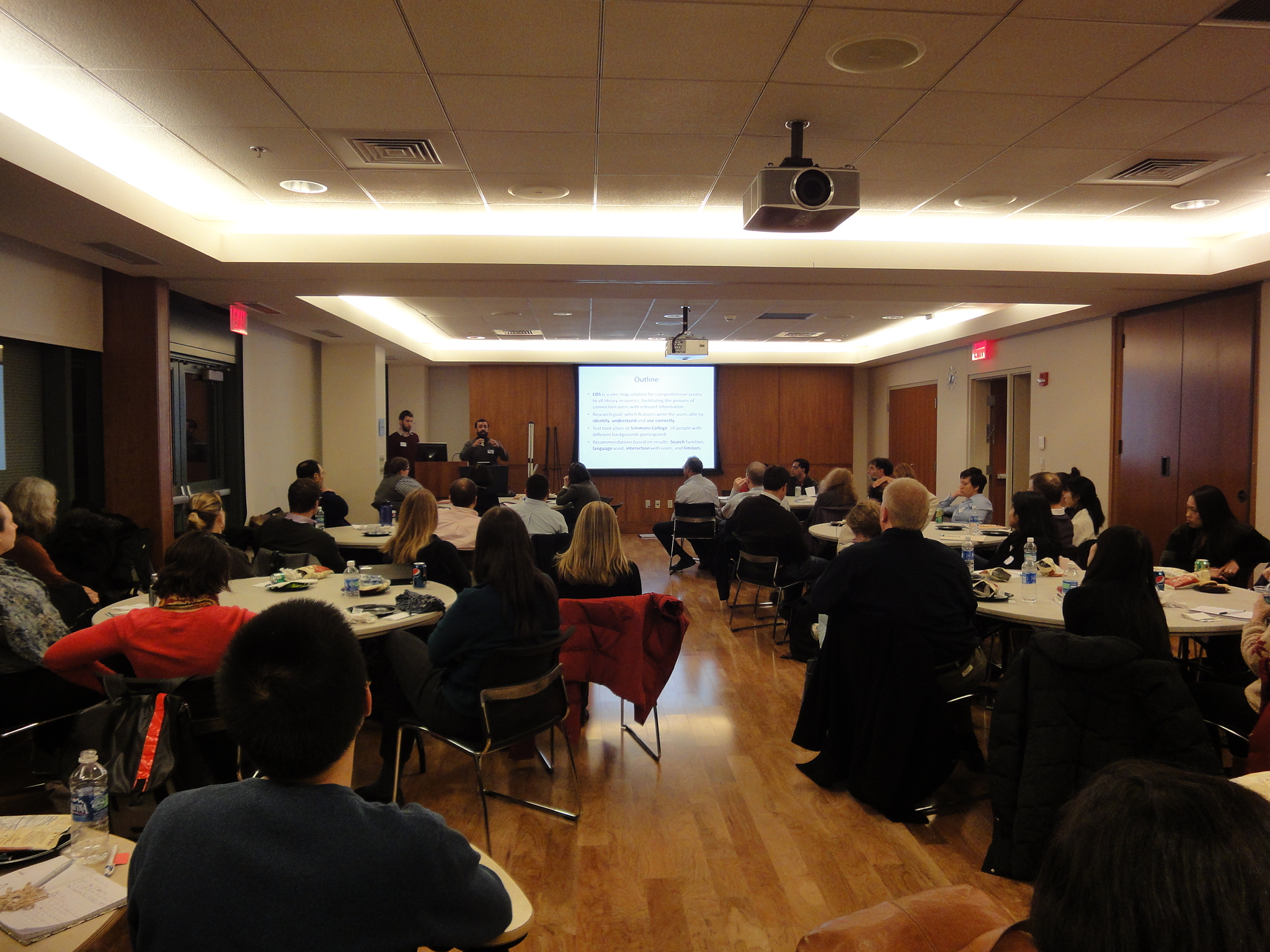
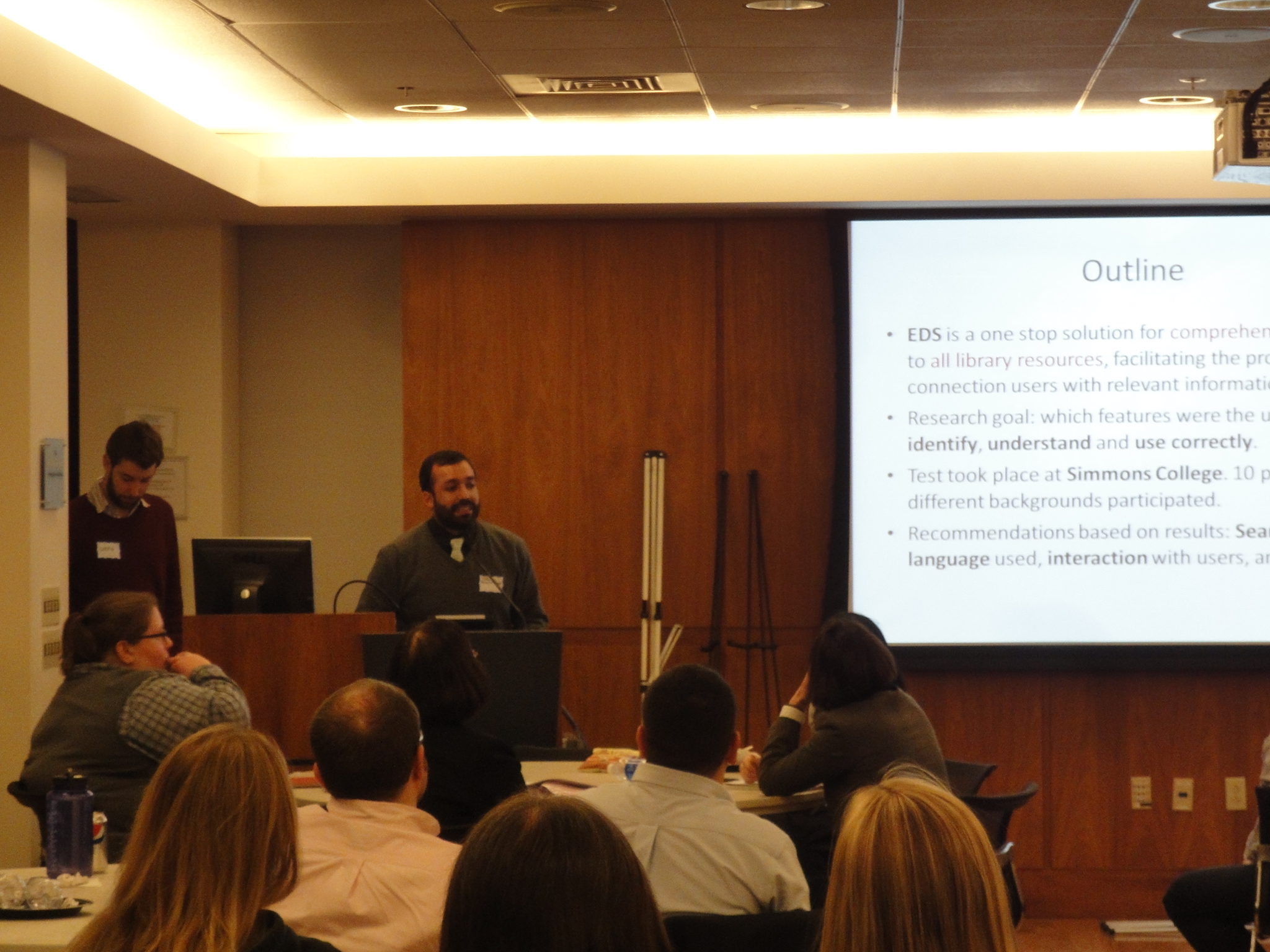
After yesterday afternoon’s half-hour group presentation in class (LIS 531Y, Usability and User Experience Research) on our team’s usability study on the EBSCO Discovery Service (EDS), and last night’s condensed presentation on the same to the Usability Professionals Association (UPA) Boston Chapter, I am completely done with papers and presentations (and all other work) for my MLS degree. HURRAY!

Photos: one group member from each EBSCO team presented the results of the usability tests to the UPA Boston meeting on at Simmons College on December 12.

As it happens, a recent (December 7) Library Journal article included comparisons of four discovery services, the first of which was EDS. Amanda Clay Powers of the Mississippi State University Libraries observed that EDS worked especially well for undergraduates (novice) and for doctoral students and faculty (advanced), but less well for upper-level undergraduates and master’s students, who were still best served by subject-specific databases.

The research we did in Usability and User Experience Research this semester was focused less on content and more on usability and specific system features (such as the cite tool, the “find similar books” option, and the ability to save or share search results). Still, the LJ article was an interesting overview, especially as it compared multiple discovery interfaces.

Open Library

If you aren’t already familiar with Open Library, a project of the non-profit Internet Archive, you now have one more reason to head over and check it out: all 50 state librarians have voted to build an alliance with IA. What does this mean? The Chief Officers of State Library Agencies (COSLA) and Open Library will be working together to ensure free access to e-books through all public libraries in the U.S.

Already, anyone can borrow e-books from Open Library‘s collection of 10,000 e-books, provided by the Internet Archive and its partner libraries. You can borrow up to 5 books for 2 weeks each, in a variety of formats (in-browser, e-Pub, or PDF). If your public library is a member, you may have access to even more.

Happy reading!

Amazon, Library?

In case you haven’t already heard, Amazon recently announced the Kindle Owners’ Lending Library. Unlike borrowing books from a public library (free! Well, your taxes pay for it), in order to borrow books from Amazon’s library, you must (a) own a Kindle, and (b) have Amazon Prime membership, which unless you get the student deal is $79/month. Is this bad for libraries? Actually, probably not.

While I don’t want to generalize, I will say that people who belong to categories (a) and (b) above may still visit public libraries, but they probably don’t rely on them as their only source of information/entertainment. Even for those who do have a Kindle and Prime membership, public libraries still offer a much wider selection of e-books for the Kindle and other e-readers than Amazon’s “library,” which offers just over 5,000 titles.  And, none of the Big Six – the six largest U.S. publishers – have jumped on the bandwagon yet, so although some bestsellers are available, many are not.

This isn’t a ploy to compete with libraries; it’s a ploy to sell more Kindle devices. The one advantage Amazon has is that it can lend any title instantly; there’s no wait time, unlike libraries, where – even with e-books – the library has a limited number of copies and only one patron can borrow any given copy at a time (i.e., library owns 10 copies of The Hunger Games, 10 patrons can borrow The Hunger Games at a time – just like print). However, Amazon pays publishers for this privilege – mostly a flat fee, but sometimes per item, as it’s borrowed. So Amazon isn’t making money on lending content – they’re just trying to make Kindle ownership and Prime membership as appealing as possible.

Further reading:

Wall Street Journal
Huffington Post
New York Times
Amazon (press release)

Amazon, Overdrive, Privacy?

Sarah Houghton, a.k.a. the Librarian in Black, has posted a 10-minute video offering her point of view on “why the Kindle format lending from Overdrive is anti-user, anti-intellectual freedom, anti-library, and something that all librarians should be aware of and disturbed by.” One of her core issues is that, when Kindle users borrow e-books from the library, Amazon keeps track of those records. Customers may be used to Amazon tracking their purchases, but libraries are much more careful about patron data.

The American Library Association (ALA) website has a section devoted to intellectual freedom, and to privacy and confidentiality. This section states, “Lack of privacy and confidentiality chills users’ choices, thereby suppressing access to ideas. The possibility of surveillance, whether direct or through access to records of speech, research and exploration, undermines a democratic society.” Therefore, “confidentiality of library records is a core value of librarianship.” Amazon does not care about keeping your reading or borrowing history private and confidential, and this is what Houghton – and many other librarians – are upset about. Patrons may be willing to sacrifice privacy and confidentiality for convenience, but many libraries have privacy policies in place – supported by state law – specifically in order to protect patron privacy. That isn’t something that ought to be given up lightly.

Digital Public Library of America

For those interested in the Digital Public Library of America (DPLA) project, Simmons GSLIS will be streaming the plenary meeting, which is taking place this Friday, October 21, in Washington, D.C. Here’s the agenda: there are a number of amazing speakers, including David Ferriero (Archivist of the United States) and John Palfrey, chair of the DPLA steering committee and author of Born Digital. Maureen Sullivan (ALA President 2012-13) and Robert Darnton of Harvard University Libraries (and author of The Case for Books) will serve as moderators at different times of day. The Beta Sprint projects will be presented at 1:30pm.

This is a project I’m interested in and have been following for some time. I’m sorry I can’t be in D.C. on Friday, but looking forward to seeing what they have come up with. A “national digital library” is such a huge project, it’s hard to wrap your mind around – but if Europe can do it, maybe the U.S. can pull it off as well.

Borrowing e-books from the library

This is by no means a universal set of instructions, but the New York Public Library (NYPL) blog has posted step-by-step instructions for how to check e-books out of the library with a Kindle. It’s a great visual walk-through, which is good because there are a lot of steps. I prefer the step-by-step screenshots, though – it’s the next best thing to having someone walk you through it one-on-one. (There’s a link to a video from OverDrive, as well.)

We aren’t “there” yet, but it’s exciting to see the progress being made with libraries and e-books.

Archiving Digital Content at Schlesinger Library, or “Terror Nova” – Amy Benson

Amy Benson lecture at Simmons co-hosted by ALASC and SCoSAA

Amy Benson is the Librarian/Archivist for Digital Initiatives at the Schlesinger Library, one of 73 Harvard libraries. The Schlesinger focuses on the history of women in America, and Amy talked to us about digital collections: the process of creating, managing, and preserving them, and the challenges.

The first collection they worked on digitizing was women’s travel writing, for an interested vendor. Next was the Charlotte Perkins Gilman Collection, which is now fully digitized, and currently they are working on digitizing the Radcliffe College Publications. All of these collections, for the most part, are analog – papers, letters, books, photos, etc. (The analog-to-digital process is, relatively, the easiest, according to Amy.)

Other types of digital collections involve capturing and preserving web content, and born-digital content. Born-digital content is especially tricky:  material comes in various physical formats (diskettes, flash drives, CDs, DVDs, cartridge tapes(!), hard drives, etc.) and multiple file formats – and then there’s e-mail (“Thinking about processing e-mail at the individual message level is a little bit crazy”). Sixty-five collections at the Schlesinger include born-digital material: it’s on more than 1900 individual media storage devices, each containing any number of files. “You begin to see we’re in a big mess,” Amy explained. Then she rephrased, “Well, not a big mess – an interesting time….There’s no shortage of things that need to be figured out in the world.”

Amy spoke about trying to expand scope of collection, but acknowledged that selection was a challenge. Radical feminists on the web, for example – Which ones do you pick? How do you know which ones people will want to use for research? Donor agreements must be worked out, both for materials already in the collection and for new acquisitions, and all incoming born-digital material must be tracked.

Another challenge in managing digital archives is deciding what to keep. And, once that’s decided, how do you preserve it? (In the Schlesinger’s case, items can be deposited into Harvard’s Digital Repository Service.) Once items are selected and preserved, how can patrons access them? “The thing that’s cool about my job is figuring out how to do all of this,” said Amy. She also mentioned the importance of documenting the process to guarantee authenticity of the final product – assuming that the end user doesn’t just give the institution the benefit of the doubt that the item is an exact copy of the original.

Essentially, digital archives are the same as any other archives: selection, accession, preservation/storage, and access are the key elements of the process. “In some ways it’s the exact same thing – you just have to do it through a computer,” said Amy. However, because the technology is new and constantly changing, and because each archives has specific needs and goals, there doesn’t seem to be a go-to set of best practices. So, what do you need to be a digital archivist? “A willingness to experiment and a love for computers.”

On mistakes and loss: “Some stuff is already lost forever. There’s actually going to be a big black hole in the ’80s…”

Interesting links:

MIT’s FACADE project

Harvard’s Web Archive Collection Service (WAX)